towing DODGE RAM 2001 Service User Guide
[x] Cancel search | Manufacturer: DODGE, Model Year: 2001, Model line: RAM, Model: DODGE RAM 2001Pages: 2889, PDF Size: 68.07 MB
Page 339 of 2889
OPERATIONÐCOOLING SYSTEM
The cooling system regulates engine operating tem-
perature. It allows the engine to reach normal oper-
ating temperature as quickly as possible. It also
maintains normal operating temperature and pre-
vents overheating.
The cooling system also provides a means of heat-
ing the passenger compartment and cooling the auto-
matic transmission fluid (if equipped). The cooling
system is pressurized and uses a centrifugal water
pump to circulate coolant throughout the system.
An optional factory installed maximum duty cool-
ing package is available on most models. This pack-
age will provide additional cooling capacity for
vehicles used under extreme conditions such as
trailer towing in high ambient temperatures.
DIAGNOSIS AND TESTING - PRELIMINARY
CHECKS
ENGINE COOLING SYSTEM OVERHEATING
Establish what driving conditions caused the com-
plaint. Abnormal loads on the cooling system such as
the following may be the cause:
²PROLONGED IDLE
²VERY HIGH AMBIENT TEMPERATURE
²SLIGHT TAIL WIND AT IDLE
²SLOW TRAFFIC
²TRAFFIC JAMS
²HIGH SPEED OR STEEP GRADES
Driving techniques that avoid overheating are:
²Idle with A/C off when temperature gauge is at
end of normal range.²Increasing engine speed for more air flow is rec-
ommended.
TRAILER TOWING:
Consult Trailer Towing section of owners manual.
Do not exceed limits.
AIR CONDITIONING; ADD-ON OR AFTER MARKET:
A maximum cooling package should have been
ordered with vehicle if add-on or after market A/C is
installed. If not, maximum cooling system compo-
nents should be installed for model involved per
manufacturer's specifications.
RECENT SERVICE OR ACCIDENT REPAIR:
Determine if any recent service has been per-
formed on vehicle that may effect cooling system.
This may be:
²Engine adjustments (incorrect timing)
²Slipping engine accessory drive belt(s)
²Brakes (possibly dragging)
²Changed parts. Incorrect water pump or pump
rotating in wrong direction due to belt not correctly
routed
²Reconditioned radiator or cooling system refill-
ing (possibly under filled or air trapped in system).
NOTE: If investigation reveals none of the previous
items as a cause for an engine overheating com-
plaint, (Refer to 7 - COOLING - DIAGNOSIS AND
TESTING)
DIAGNOSIS AND TESTINGÐON-BOARD
DIAGNOSTICS (OBD)
COOLING SYSTEM RELATED DIAGNOSTICS
The powertrain control module (PCM) has been
programmed to monitor certain cooling system com-
ponents:
²If the engine has remained cool for too long a
period, such as with a stuck open thermostat, a Diag-
nostic Trouble Code (DTC) can be set.
²If an open or shorted condition has developed in
the relay circuit controlling the electric radiator fan,
a Diagnostic Trouble Code (DTC) can be set.
If the problem is sensed in a monitored circuit
often enough to indicated an actual problem, a DTC
is stored. The DTC will be stored in the PCM mem-
ory for eventual display to the service technician.
(Refer to 25 - EMISSIONS CONTROL - DESCRIP-
TION).
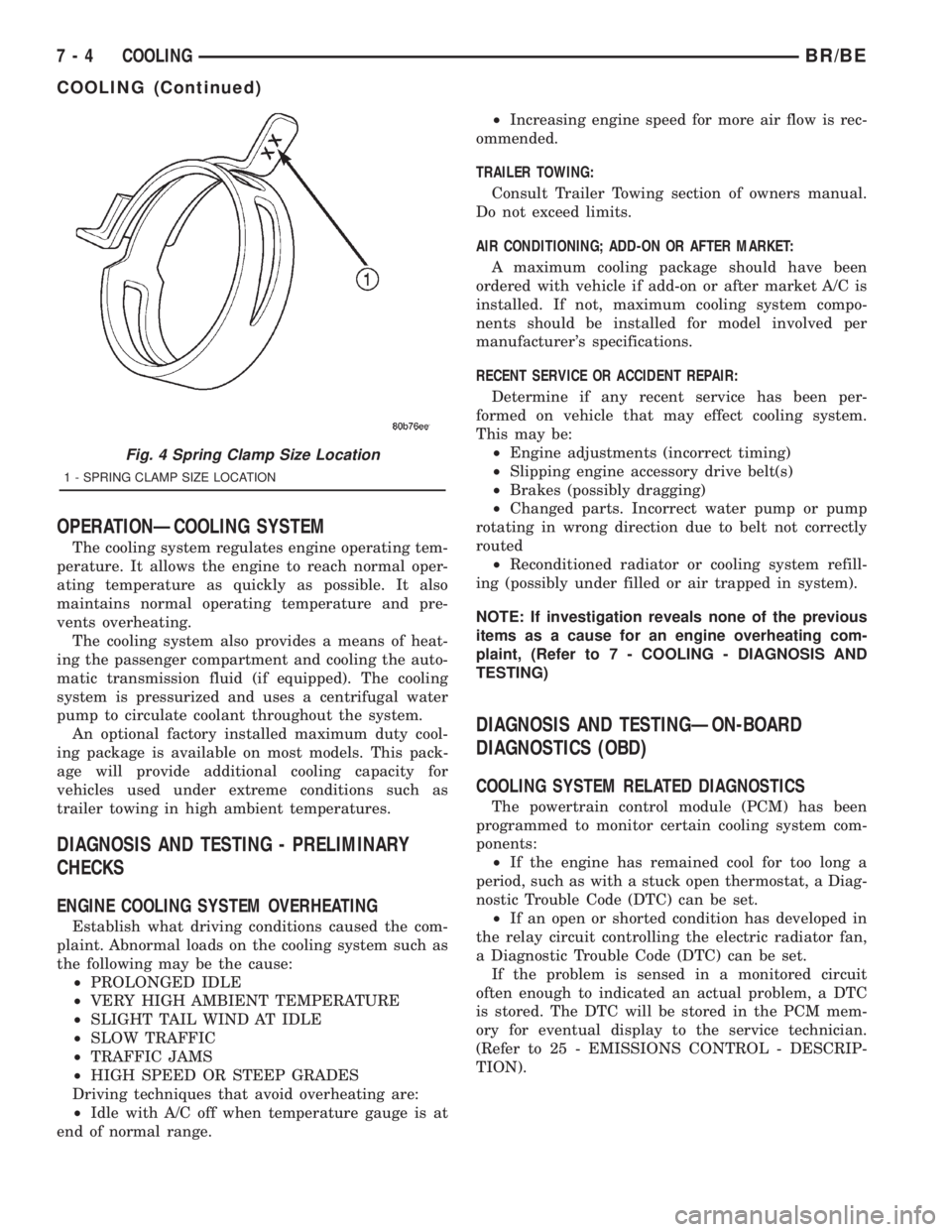
Fig. 4 Spring Clamp Size Location
1 - SPRING CLAMP SIZE LOCATION
7 - 4 COOLINGBR/BE
COOLING (Continued)
Page 391 of 2889
FAN DRIVE VISCOUS CLUTCH
- 3.9L/5.2L/5.9L/8.0L
DESCRIPTION
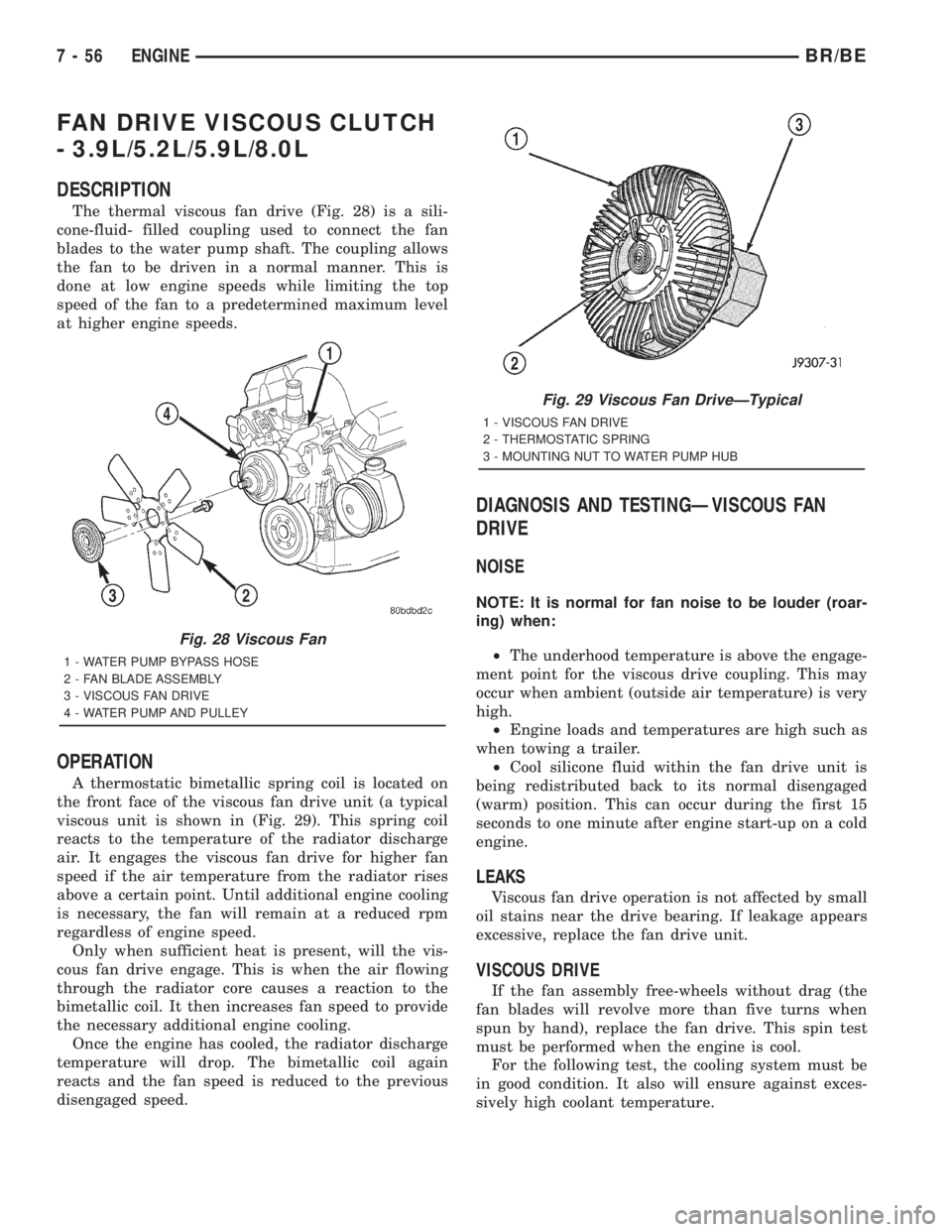
The thermal viscous fan drive (Fig. 28) is a sili-
cone-fluid- filled coupling used to connect the fan
blades to the water pump shaft. The coupling allows
the fan to be driven in a normal manner. This is
done at low engine speeds while limiting the top
speed of the fan to a predetermined maximum level
at higher engine speeds.
OPERATION
A thermostatic bimetallic spring coil is located on
the front face of the viscous fan drive unit (a typical
viscous unit is shown in (Fig. 29). This spring coil
reacts to the temperature of the radiator discharge
air. It engages the viscous fan drive for higher fan
speed if the air temperature from the radiator rises
above a certain point. Until additional engine cooling
is necessary, the fan will remain at a reduced rpm
regardless of engine speed.
Only when sufficient heat is present, will the vis-
cous fan drive engage. This is when the air flowing
through the radiator core causes a reaction to the
bimetallic coil. It then increases fan speed to provide
the necessary additional engine cooling.
Once the engine has cooled, the radiator discharge
temperature will drop. The bimetallic coil again
reacts and the fan speed is reduced to the previous
disengaged speed.
DIAGNOSIS AND TESTINGÐVISCOUS FAN
DRIVE
NOISE
NOTE: It is normal for fan noise to be louder (roar-
ing) when:
²The underhood temperature is above the engage-
ment point for the viscous drive coupling. This may
occur when ambient (outside air temperature) is very
high.
²Engine loads and temperatures are high such as
when towing a trailer.
²Cool silicone fluid within the fan drive unit is
being redistributed back to its normal disengaged
(warm) position. This can occur during the first 15
seconds to one minute after engine start-up on a cold
engine.
LEAKS
Viscous fan drive operation is not affected by small
oil stains near the drive bearing. If leakage appears
excessive, replace the fan drive unit.
VISCOUS DRIVE
If the fan assembly free-wheels without drag (the
fan blades will revolve more than five turns when
spun by hand), replace the fan drive. This spin test
must be performed when the engine is cool.
For the following test, the cooling system must be
in good condition. It also will ensure against exces-
sively high coolant temperature.
Fig. 28 Viscous Fan
1 - WATER PUMP BYPASS HOSE
2 - FAN BLADE ASSEMBLY
3 - VISCOUS FAN DRIVE
4 - WATER PUMP AND PULLEY
Fig. 29 Viscous Fan DriveÐTypical
1 - VISCOUS FAN DRIVE
2 - THERMOSTATIC SPRING
3 - MOUNTING NUT TO WATER PUMP HUB
7 - 56 ENGINEBR/BE
Page 393 of 2889
Only when sufficient heat is present, will the vis-
cous fan drive engage. This is when the air flowing
through the radiator core causes a reaction to the
bimetallic coil. It then increases fan speed to provide
the necessary additional engine cooling.
Once the engine has cooled, the radiator discharge
temperature will drop. The bimetallic coil again
reacts and the fan speed is reduced to the previous
disengaged speed.
DIAGNOSIS AND TESTINGÐVISCOUS FAN
DRIVE
NOISE
NOTE: It is normal for fan noise to be louder (roar-
ing) when:
²The underhood temperature is above the engage-
ment point for the viscous drive coupling. This may
occur when ambient (outside air temperature) is very
high.
²Engine loads and temperatures are high such as
when towing a trailer.
²Cool silicone fluid within the fan drive unit is
being redistributed back to its normal disengaged
(warm) position. This can occur during the first 15
seconds to one minute after engine start-up on a cold
engine.
LEAKS
Viscous fan drive operation is not affected by small
oil stains near the drive bearing. If leakage appears
excessive, replace the fan drive unit.
VISCOUS DRIVE
If the fan assembly free-wheels without drag (the
fan blades will revolve more than five turns when
spun by hand), replace the fan drive. This spin test
must be performed when the engine is cool.
For the following test, the cooling system must be
in good condition. It also will ensure against exces-
sively high coolant temperature.
WARNING: BE SURE THAT THERE IS ADEQUATE
FAN BLADE CLEARANCE BEFORE DRILLING.
(1) Drill a 3.18-mm (1/8-in) diameter hole in the
top center of the fan shroud.
(2) Obtain a dial thermometer with an 8 inch stem
(or equivalent). It should have a range of -18É-to-
105ÉC (0É-to-220É F). Insert thermometer through the
hole in the shroud. Be sure that there is adequate
clearance from the fan blades.
(3) Connect a tachometer and an engine ignition
timing light. The timing light is to be used as a
strobe light. This step cannot be used on the diesel
engine.
(4) Block the air flow through the radiator. Secure
a sheet of plastic in front of the radiator (or air con-
ditioner condenser). Use tape at the top to secure the
plastic and be sure that the air flow is blocked.
(5) Be sure that the air conditioner (if equipped) is
turned off.
WARNING: USE EXTREME CAUTION WHEN THE
ENGINE IS OPERATING. DO NOT STAND IN A
DIRECT LINE WITH THE FAN. DO NOT PUT YOUR
HANDS NEAR THE PULLEYS, BELTS OR FAN. DO
NOT WEAR LOOSE CLOTHING.
(6) Start the engine and operate at 2400 rpm.
Within ten minutes the air temperature (indicated on
the dial thermometer) should be up to 88É C (190É F).
Fan driveengagementshould start to occur at/be-
tween:
²3.9L/5.2L/5.9L gas engines Ð 79É C (175É F)
²8.0L engine Ð 88É to 96É C (190É to 205É F)
²5.9L diesel engine Ð 71É to 82É C (160É to 179É
F)Engagement is distinguishable by a definite
increasein fan flow noise (roaring). The timing light
also will indicate an increase in the speed of the fan
(non-diesel only).
(7) When viscous drive engagement is verified,
remove the plastic sheet. Fan drivedisengagement
should start to occur at between 57É to 79É C (135É to
175É F). A definitedecreaseof fan flow noise (roar-
ing) should be noticed. If not, replace the defective
viscous fan drive unit.
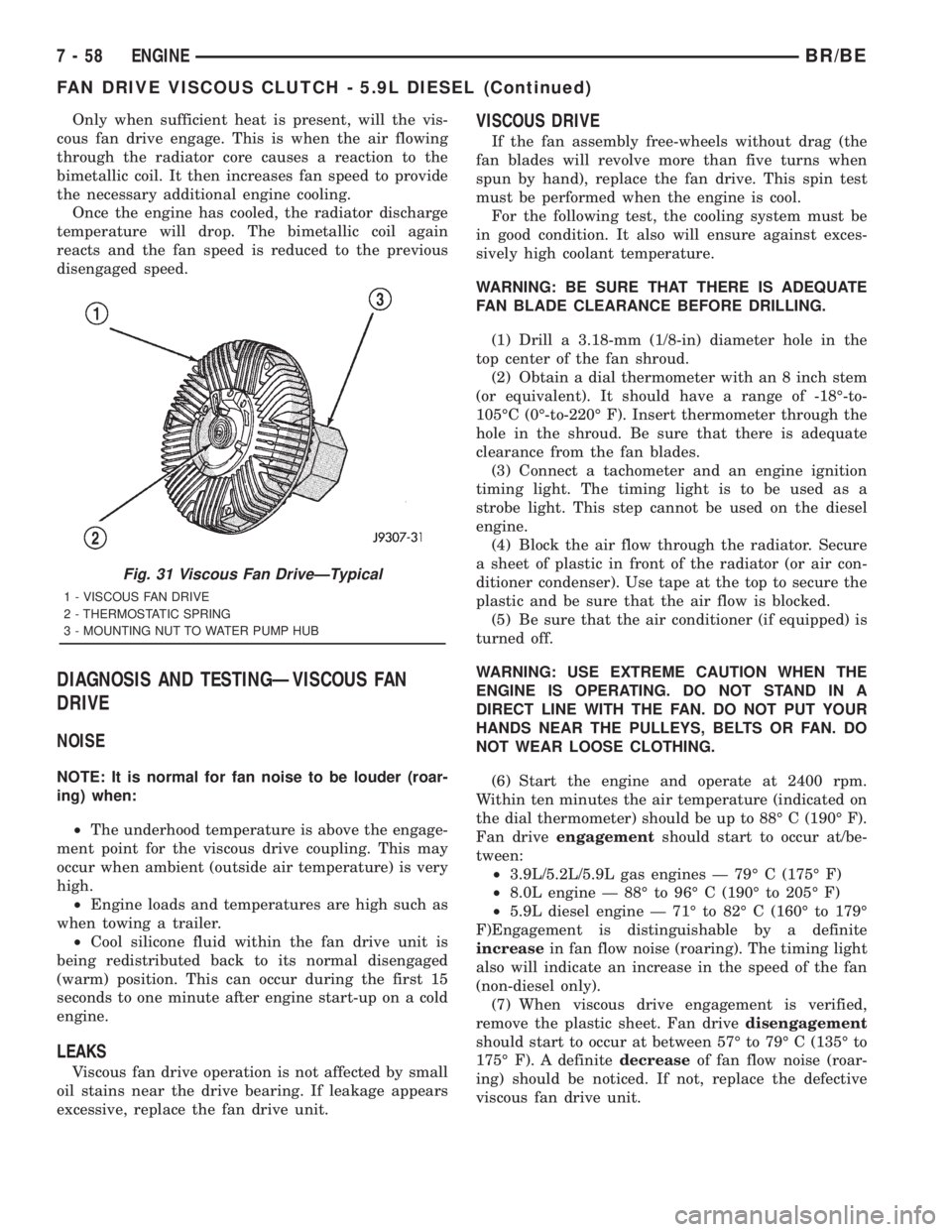
Fig. 31 Viscous Fan DriveÐTypical
1 - VISCOUS FAN DRIVE
2 - THERMOSTATIC SPRING
3 - MOUNTING NUT TO WATER PUMP HUB
7 - 58 ENGINEBR/BE
FAN DRIVE VISCOUS CLUTCH - 5.9L DIESEL (Continued)
Page 604 of 2889
COMBINATION FLASHER
DESCRIPTION
The combination flasher is located in the Junction
Block (JB) behind the fuse access panel on the left
outboard end of the instrument panel. The combina-
tion flasher is a smart relay that functions as both
the turn signal system and the hazard warning sys-
tem flasher. The combination flasher contains active
electronic Integrated Circuitry (IC) elements. This
flasher is designed to handle the current flow
requirements of the factory-installed lighting. If sup-
plemental lighting is added to the turn signal lamp
circuits, such as when towing a trailer with lights,
the combination flasher will automatically try to
compensate to keep the flash rate the same.
The combination flasher has five blade-type termi-
nals that connect it to the vehicle electrical system
through five matching cavities in the receptacle of
the JB. While the combination flasher has a Interna-
tional Standards Organization (ISO)-type relay ter-
minal configuration or footprint, the internal
circuitry is much different. The combination flasher
does not use standard ISO-relay inputs or provide
ISO-relay type outputs or functions. The combination
flasher should never be substituted for an ISO-relay
or replaced with an ISO-relay, or else component and
vehicle damage may occur.
The combination flasher cannot be repaired or
adjusted and, if faulty or damaged, it must be
replaced.
OPERATION
The combination flasher has five blade-type termi-
nals intended for the following inputs and outputs:
fused B(+), fused ignition switch output, ground, turn
signal circuit, and hazard warning circuit. Constant
battery voltage and ground are supplied to the
flasher so that it can perform the hazard warning
function, and ignition switched battery voltage is
supplied for the turn signal function.
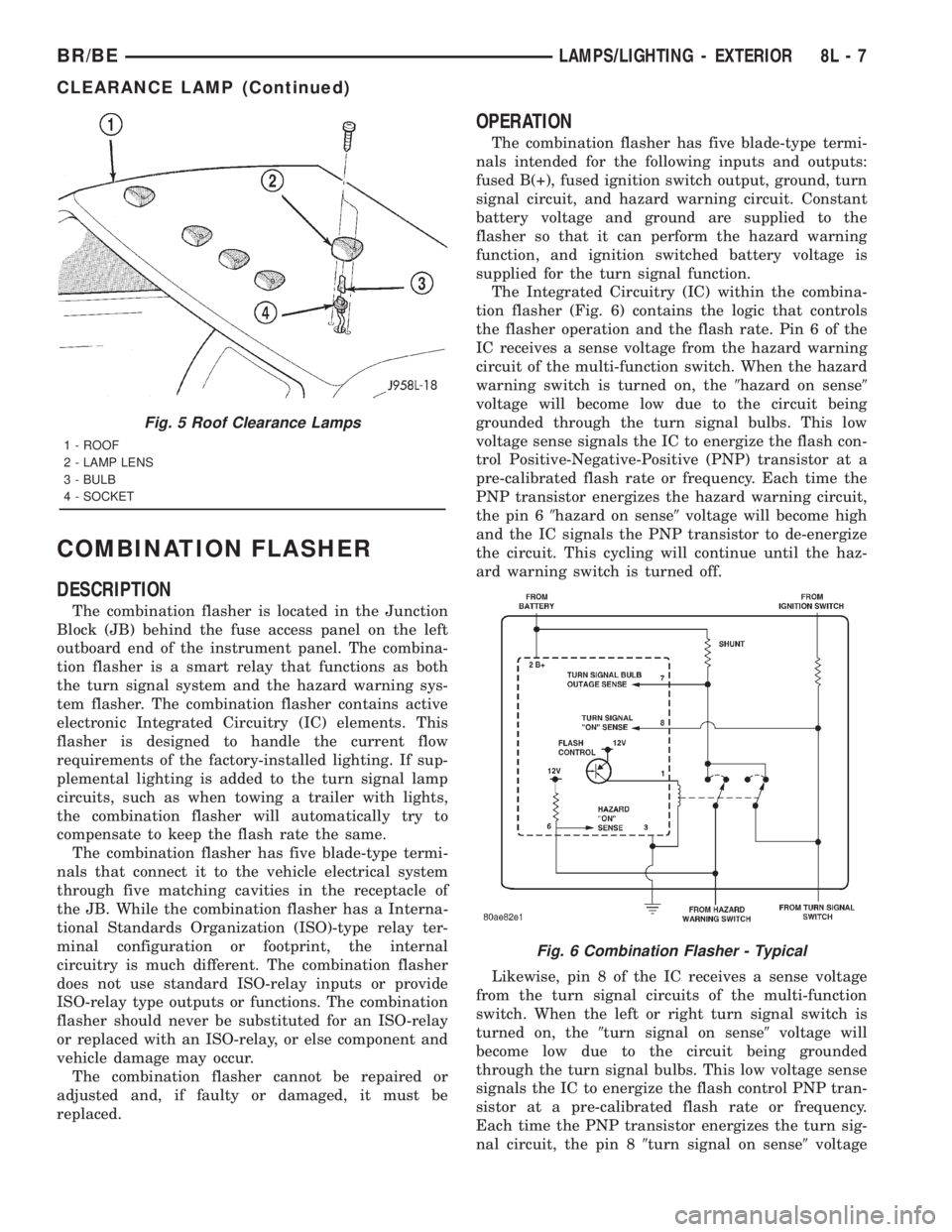
The Integrated Circuitry (IC) within the combina-
tion flasher (Fig. 6) contains the logic that controls
the flasher operation and the flash rate. Pin 6 of the
IC receives a sense voltage from the hazard warning
circuit of the multi-function switch. When the hazard
warning switch is turned on, the9hazard on sense9
voltage will become low due to the circuit being
grounded through the turn signal bulbs. This low
voltage sense signals the IC to energize the flash con-
trol Positive-Negative-Positive (PNP) transistor at a
pre-calibrated flash rate or frequency. Each time the
PNP transistor energizes the hazard warning circuit,
the pin 69hazard on sense9voltage will become high
and the IC signals the PNP transistor to de-energize
the circuit. This cycling will continue until the haz-
ard warning switch is turned off.
Likewise, pin 8 of the IC receives a sense voltage
from the turn signal circuits of the multi-function
switch. When the left or right turn signal switch is
turned on, the9turn signal on sense9voltage will
become low due to the circuit being grounded
through the turn signal bulbs. This low voltage sense
signals the IC to energize the flash control PNP tran-
sistor at a pre-calibrated flash rate or frequency.
Each time the PNP transistor energizes the turn sig-
nal circuit, the pin 89turn signal on sense9voltage
Fig. 5 Roof Clearance Lamps
1 - ROOF
2 - LAMP LENS
3 - BULB
4 - SOCKET
Fig. 6 Combination Flasher - Typical
BR/BELAMPS/LIGHTING - EXTERIOR 8L - 7
CLEARANCE LAMP (Continued)
Page 2883 of 2889
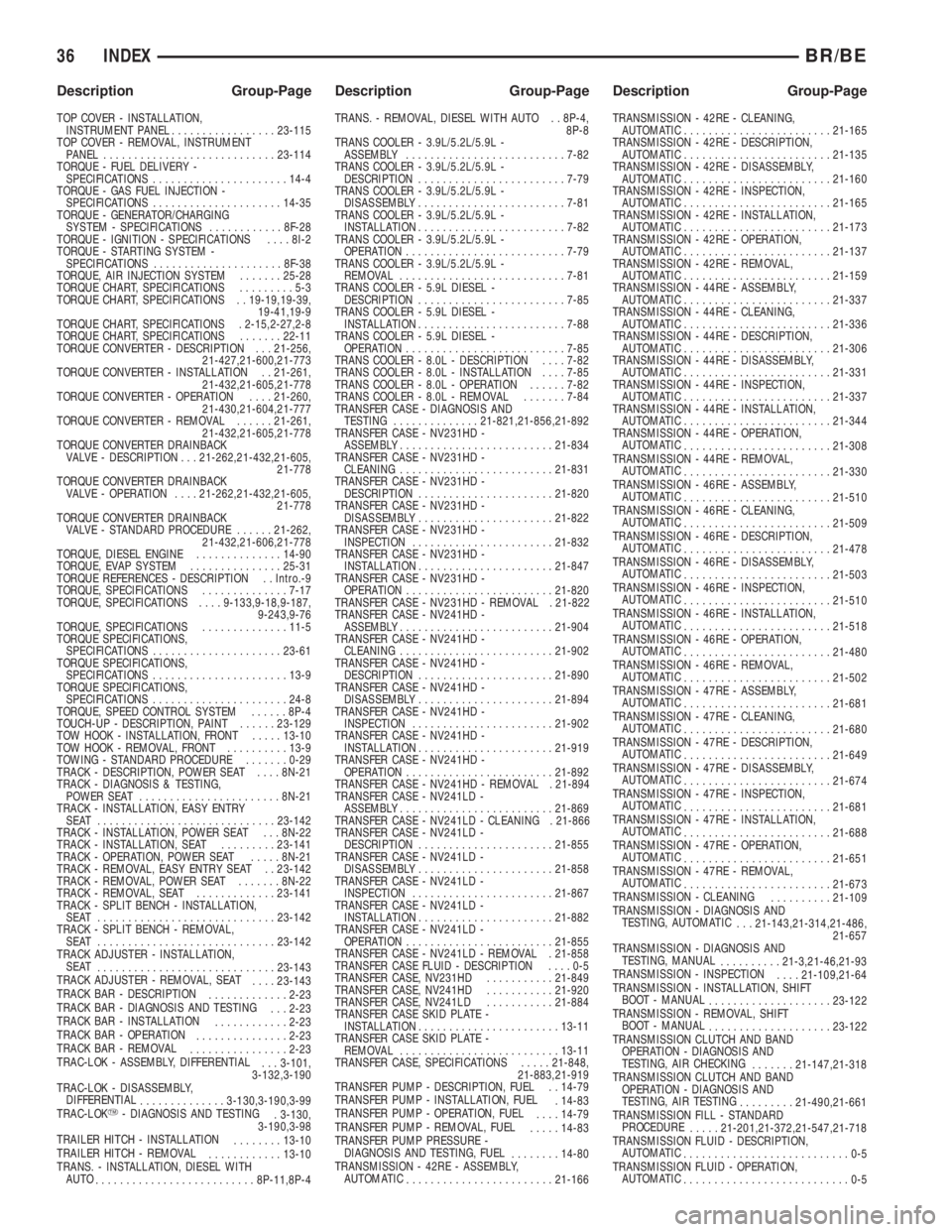
TOP COVER - INSTALLATION,
INSTRUMENT PANEL.................23-115
TOP COVER - REMOVAL, INSTRUMENT
PANEL............................23-114
TORQUE - FUEL DELIVERY -
SPECIFICATIONS......................14-4
TORQUE - GAS FUEL INJECTION -
SPECIFICATIONS.....................14-35
TORQUE - GENERATOR/CHARGING
SYSTEM - SPECIFICATIONS............8F-28
TORQUE - IGNITION - SPECIFICATIONS....8I-2
TORQUE - STARTING SYSTEM -
SPECIFICATIONS.....................8F-38
TORQUE, AIR INJECTION SYSTEM.......25-28
TORQUE CHART, SPECIFICATIONS.........5-3
TORQUE CHART, SPECIFICATIONS . . 19-19,19-39,
19-41,19-9
TORQUE CHART, SPECIFICATIONS . 2-15,2-27,2-8
TORQUE CHART, SPECIFICATIONS.......22-11
TORQUE CONVERTER - DESCRIPTION . . . 21-256,
21-427,21-600,21-773
TORQUE CONVERTER - INSTALLATION . . 21-261,
21-432,21-605,21-778
TORQUE CONVERTER - OPERATION....21-260,
21-430,21-604,21-777
TORQUE CONVERTER - REMOVAL......21-261,
21-432,21-605,21-778
TORQUE CONVERTER DRAINBACK
VALVE - DESCRIPTION . . . 21-262,21-432,21-605,
21-778
TORQUE CONVERTER DRAINBACK
VALVE - OPERATION....21-262,21-432,21-605,
21-778
TORQUE CONVERTER DRAINBACK
VALVE - STANDARD PROCEDURE......21-262,
21-432,21-606,21-778
TORQUE, DIESEL ENGINE..............14-90
TORQUE, EVAP SYSTEM...............25-31
TORQUE REFERENCES - DESCRIPTION . . Intro.-9
TORQUE, SPECIFICATIONS..............7-17
TORQUE, SPECIFICATIONS....9-133,9-18,9-187,
9-243,9-76
TORQUE, SPECIFICATIONS..............11-5
TORQUE SPECIFICATIONS,
SPECIFICATIONS.....................23-61
TORQUE SPECIFICATIONS,
SPECIFICATIONS......................13-9
TORQUE SPECIFICATIONS,
SPECIFICATIONS......................24-8
TORQUE, SPEED CONTROL SYSTEM......8P-4
TOUCH-UP - DESCRIPTION, PAINT......23-129
TOW HOOK - INSTALLATION, FRONT.....13-10
TOW HOOK - REMOVAL, FRONT..........13-9
TOWING - STANDARD PROCEDURE.......0-29
TRACK - DESCRIPTION, POWER SEAT....8N-21
TRACK - DIAGNOSIS & TESTING,
POWER SEAT.......................8N-21
TRACK - INSTALLATION, EASY ENTRY
SEAT .............................23-142
TRACK - INSTALLATION, POWER SEAT . . . 8N-22
TRACK - INSTALLATION, SEAT.........23-141
TRACK - OPERATION, POWER SEAT.....8N-21
TRACK - REMOVAL, EASY ENTRY SEAT . . 23-142
TRACK - REMOVAL, POWER SEAT.......8N-22
TRACK - REMOVAL, SEAT.............23-141
TRACK - SPLIT BENCH - INSTALLATION,
SEAT .............................23-142
TRACK - SPLIT BENCH - REMOVAL,
SEAT .............................23-142
TRACK ADJUSTER - INSTALLATION,
SEAT
.............................23-143
TRACK ADJUSTER - REMOVAL, SEAT
....23-143
TRACK BAR - DESCRIPTION
.............2-23
TRACK BAR - DIAGNOSIS AND TESTING
. . . 2-23
TRACK BAR - INSTALLATION
............2-23
TRACK BAR - OPERATION
...............2-23
TRACK BAR - REMOVAL
................2-23
TRAC-LOK - ASSEMBLY, DIFFERENTIAL
. . . 3-101,
3-132,3-190
TRAC-LOK - DISASSEMBLY,
DIFFERENTIAL
..............3-130,3-190,3-99
TRAC-LOKY- DIAGNOSIS AND TESTING
. 3-130,
3-190,3-98
TRAILER HITCH - INSTALLATION
........13-10
TRAILER HITCH - REMOVAL
............13-10
TRANS. - INSTALLATION, DIESEL WITH
AUTO
..........................8P-11,8P-4TRANS. - REMOVAL, DIESEL WITH AUTO . . 8P-4,
8P-8
TRANS COOLER - 3.9L/5.2L/5.9L -
ASSEMBLY..........................7-82
TRANS COOLER - 3.9L/5.2L/5.9L -
DESCRIPTION........................7-79
TRANS COOLER - 3.9L/5.2L/5.9L -
DISASSEMBLY........................7-81
TRANS COOLER - 3.9L/5.2L/5.9L -
INSTALLATION........................7-82
TRANS COOLER - 3.9L/5.2L/5.9L -
OPERATION..........................7-79
TRANS COOLER - 3.9L/5.2L/5.9L -
REMOVAL...........................7-81
TRANS COOLER - 5.9L DIESEL -
DESCRIPTION........................7-85
TRANS COOLER - 5.9L DIESEL -
INSTALLATION........................7-88
TRANS COOLER - 5.9L DIESEL -
OPERATION..........................7-85
TRANS COOLER - 8.0L - DESCRIPTION....7-82
TRANS COOLER - 8.0L - INSTALLATION....7-85
TRANS COOLER - 8.0L - OPERATION......7-82
TRANS COOLER - 8.0L - REMOVAL.......7-84
TRANSFER CASE - DIAGNOSIS AND
TESTING..............21-821,21-856,21-892
TRANSFER CASE - NV231HD -
ASSEMBLY.........................21-834
TRANSFER CASE - NV231HD -
CLEANING.........................21-831
TRANSFER CASE - NV231HD -
DESCRIPTION......................21-820
TRANSFER CASE - NV231HD -
DISASSEMBLY......................21-822
TRANSFER CASE - NV231HD -
INSPECTION.......................21-832
TRANSFER CASE - NV231HD -
INSTALLATION......................21-847
TRANSFER CASE - NV231HD -
OPERATION........................21-820
TRANSFER CASE - NV231HD - REMOVAL . 21-822
TRANSFER CASE - NV241HD -
ASSEMBLY.........................21-904
TRANSFER CASE - NV241HD -
CLEANING.........................21-902
TRANSFER CASE - NV241HD -
DESCRIPTION......................21-890
TRANSFER CASE - NV241HD -
DISASSEMBLY......................21-894
TRANSFER CASE - NV241HD -
INSPECTION.......................21-902
TRANSFER CASE - NV241HD -
INSTALLATION......................21-919
TRANSFER CASE - NV241HD -
OPERATION........................21-892
TRANSFER CASE - NV241HD - REMOVAL . 21-894
TRANSFER CASE - NV241LD -
ASSEMBLY.........................21-869
TRANSFER CASE - NV241LD - CLEANING . 21-866
TRANSFER CASE - NV241LD -
DESCRIPTION......................21-855
TRANSFER CASE - NV241LD -
DISASSEMBLY......................21-858
TRANSFER CASE - NV241LD -
INSPECTION.......................21-867
TRANSFER CASE - NV241LD -
INSTALLATION......................21-882
TRANSFER CASE - NV241LD -
OPERATION........................21-855
TRANSFER CASE - NV241LD - REMOVAL . 21-858
TRANSFER CASE FLUID - DESCRIPTION....0-5
TRANSFER CASE, NV231HD...........21-849
TRANSFER CASE, NV241HD...........21-920
TRANSFER CASE, NV241LD...........21-884
TRANSFER CASE SKID PLATE -
INSTALLATION.......................13-11
TRANSFER CASE SKID PLATE -
REMOVAL..........................13-11
TRANSFER CASE, SPECIFICATIONS.....21-848,
21-883,21-919
TRANSFER PUMP - DESCRIPTION, FUEL . . 14-79
TRANSFER PUMP - INSTALLATION, FUEL
. 14-83
TRANSFER PUMP - OPERATION, FUEL
....14-79
TRANSFER PUMP - REMOVAL, FUEL
.....14-83
TRANSFER PUMP PRESSURE -
DIAGNOSIS AND TESTING, FUEL
........14-80
TRANSMISSION - 42RE - ASSEMBLY,
AUTOMATIC
........................21-166TRANSMISSION - 42RE - CLEANING,
AUTOMATIC........................21-165
TRANSMISSION - 42RE - DESCRIPTION,
AUTOMATIC........................21-135
TRANSMISSION - 42RE - DISASSEMBLY,
AUTOMATIC........................21-160
TRANSMISSION - 42RE - INSPECTION,
AUTOMATIC........................21-165
TRANSMISSION - 42RE - INSTALLATION,
AUTOMATIC........................21-173
TRANSMISSION - 42RE - OPERATION,
AUTOMATIC........................21-137
TRANSMISSION - 42RE - REMOVAL,
AUTOMATIC........................21-159
TRANSMISSION - 44RE - ASSEMBLY,
AUTOMATIC........................21-337
TRANSMISSION - 44RE - CLEANING,
AUTOMATIC........................21-336
TRANSMISSION - 44RE - DESCRIPTION,
AUTOMATIC........................21-306
TRANSMISSION - 44RE - DISASSEMBLY,
AUTOMATIC........................21-331
TRANSMISSION - 44RE - INSPECTION,
AUTOMATIC........................21-337
TRANSMISSION - 44RE - INSTALLATION,
AUTOMATIC........................21-344
TRANSMISSION - 44RE - OPERATION,
AUTOMATIC
........................21-308
TRANSMISSION - 44RE - REMOVAL,
AUTOMATIC
........................21-330
TRANSMISSION - 46RE - ASSEMBLY,
AUTOMATIC
........................21-510
TRANSMISSION - 46RE - CLEANING,
AUTOMATIC
.........................21-509
TRANSMISSION - 46RE - DESCRIPTION,
AUTOMATIC
........................21-478
TRANSMISSION - 46RE - DISASSEMBLY,
AUTOMATIC
........................21-503
TRANSMISSION - 46RE - INSPECTION,
AUTOMATIC
........................21-510
TRANSMISSION - 46RE - INSTALLATION,
AUTOMATIC
........................21-518
TRANSMISSION - 46RE - OPERATION,
AUTOMATIC
........................21-480
TRANSMISSION - 46RE - REMOVAL,
AUTOMATIC
........................21-502
TRANSMISSION - 47RE - ASSEMBLY,
AUTOMATIC
........................21-681
TRANSMISSION - 47RE - CLEANING,
AUTOMATIC
........................21-680
TRANSMISSION - 47RE - DESCRIPTION,
AUTOMATIC
........................21-649
TRANSMISSION - 47RE - DISASSEMBLY,
AUTOMATIC
........................21-674
TRANSMISSION - 47RE - INSPECTION,
AUTOMATIC
........................21-681
TRANSMISSION - 47RE - INSTALLATION,
AUTOMATIC
........................21-688
TRANSMISSION - 47RE - OPERATION,
AUTOMATIC
........................21-651
TRANSMISSION - 47RE - REMOVAL,
AUTOMATIC
........................21-673
TRANSMISSION - CLEANING
..........21-109
TRANSMISSION - DIAGNOSIS AND
TESTING, AUTOMATIC
. . . 21-143,21-314,21-486,
21-657
TRANSMISSION - DIAGNOSIS AND
TESTING, MANUAL
..........21-3,21-46,21-93
TRANSMISSION - INSPECTION
....21-109,21-64
TRANSMISSION - INSTALLATION, SHIFT
BOOT - MANUAL
....................23-122
TRANSMISSION - REMOVAL, SHIFT
BOOT - MANUAL
....................23-122
TRANSMISSION CLUTCH AND BAND
OPERATION - DIAGNOSIS AND
TESTING, AIR CHECKING
.......21-147,21-318
TRANSMISSION CLUTCH AND BAND
OPERATION - DIAGNOSIS AND
TESTING, AIR TESTING
.........21-490,21-661
TRANSMISSION FILL - STANDARD
PROCEDURE
.....21-201,21-372,21-547,21-718
TRANSMISSION FLUID - DESCRIPTION,
AUTOMATIC
...........................0-5
TRANSMISSION FLUID - OPERATION,
AUTOMATIC
...........................0-5
36 INDEXBR/BE
Description Group-Page Description Group-Page Description Group-Page