belt DODGE RAM 2001 Service Repair Manual
[x] Cancel search | Manufacturer: DODGE, Model Year: 2001, Model line: RAM, Model: DODGE RAM 2001Pages: 2889, PDF Size: 68.07 MB
Page 2776 of 2889
the compressor with an engine stethoscope or a long
screwdriver with the handle held to your ear to bet-
ter localize the source of the noise.
(2) Loosen all of the compressor mounting hard-
ware and retighten. Tighten the compressor clutch
mounting nut. Be certain that the clutch coil is
mounted securely to the compressor, and that the
clutch plate and pulley are properly aligned and have
the correct air gap. (Refer to 24 - HEATING & AIR
CONDITIONING/CONTROLS/A/C COMPRESSOR
CLUTCH - INSTALLATION)
(3) To duplicate a high-ambient temperature condi-
tion (high head pressure), restrict the air flow
through the condenser. Install a manifold gauge set
to be certain that the discharge pressure does not
exceed 2760 kPa (400 psi).
(4) Check the refrigerant system plumbing for
incorrect routing, rubbing or interference, which can
cause unusual noises. Also check the refrigerant lines
for kinks or sharp bends that will restrict refrigerant
flow, which can cause noises. (Refer to 24 - HEAT-
ING & AIR CONDITIONING/PLUMBING - CAU-
TION)
(5) If the noise is from opening and closing of the
high pressure relief valve, recover, evacuate, and
recharge the refrigerant system. (Refer to 24 - HEAT-
ING & AIR CONDITIONING/PLUMBING - STAN-
DARD PROCEDURE - REFRIGERANT RECOVERY)
(Refer to 24 - HEATING & AIR CONDITIONING/
PLUMBING - STANDARD PROCEDURE - REFRIG-
ERANT SYSTEM EVACUATE) (Refer to 24 -
HEATING & AIR CONDITIONING/PLUMBING -
STANDARD PROCEDURE - REFRIGERANT SYS-
TEM CHARGE) If the high pressure relief valve still
does not seat properly, replace the compressor.
(6) If the noise is from liquid slugging on the suc-
tion line, replace the accumulator. (Refer to 24 -
HEATING & AIR CONDITIONING/PLUMBING/AC-
CUMULATOR - REMOVAL) Check the refrigerant oil
level and the refrigerant system charge. (Refer to 24
- HEATING & AIR CONDITIONING/PLUMBING/
REFRIGERANT OIL - STANDARD PROCEDURE -
REFRIGERANT OIL LEVEL) (Refer to 24 - HEAT-
ING & AIR CONDITIONING/PLUMBING - SPECI-
FICATIONS - CHARGE CAPACITY) If the liquid
slugging condition continues following accumulator
replacement, replace the compressor.
(7) If the noise continues, replace the compressor
and repeat Step 1.
REMOVAL
WARNING: REVIEW THE WARNINGS AND CAU-
TIONS IN THE FRONT OF THIS SECTION BEFORE
PERFORMING THE FOLLOWING OPERATION.
(Refer to 24 - HEATING & AIR CONDITIONING/PLUMBING - WARNING) (Refer to 24 - HEATING &
AIR CONDITIONING/PLUMBING - CAUTION)
The compressor may be removed and repositioned
without disconnecting the refrigerant lines or dis-
charging the refrigerant system. Discharging is not
necessary if servicing the compressor clutch or clutch
coil, the engine, the cylinder head, or the generator.
(1) Recover the refrigerant from the refrigerant
system. (Refer to 24 - HEATING & AIR CONDI-
TIONING/PLUMBING - STANDARD PROCEDURE -
REFRIGERANT RECOVERY)
(2) Disconnect and isolate the battery negative
cable.
(3) Remove the serpentine drive belt. Refer to
Cooling for the procedures.
(4) Unplug the compressor clutch coil wire harness
connector.
(5) Remove the bolt that secures the refrigerant
line manifold to the compressor. Install plugs in, or
tape over all of the opened refrigerant line fittings.
(6) Remove the four bolts that secure the compres-
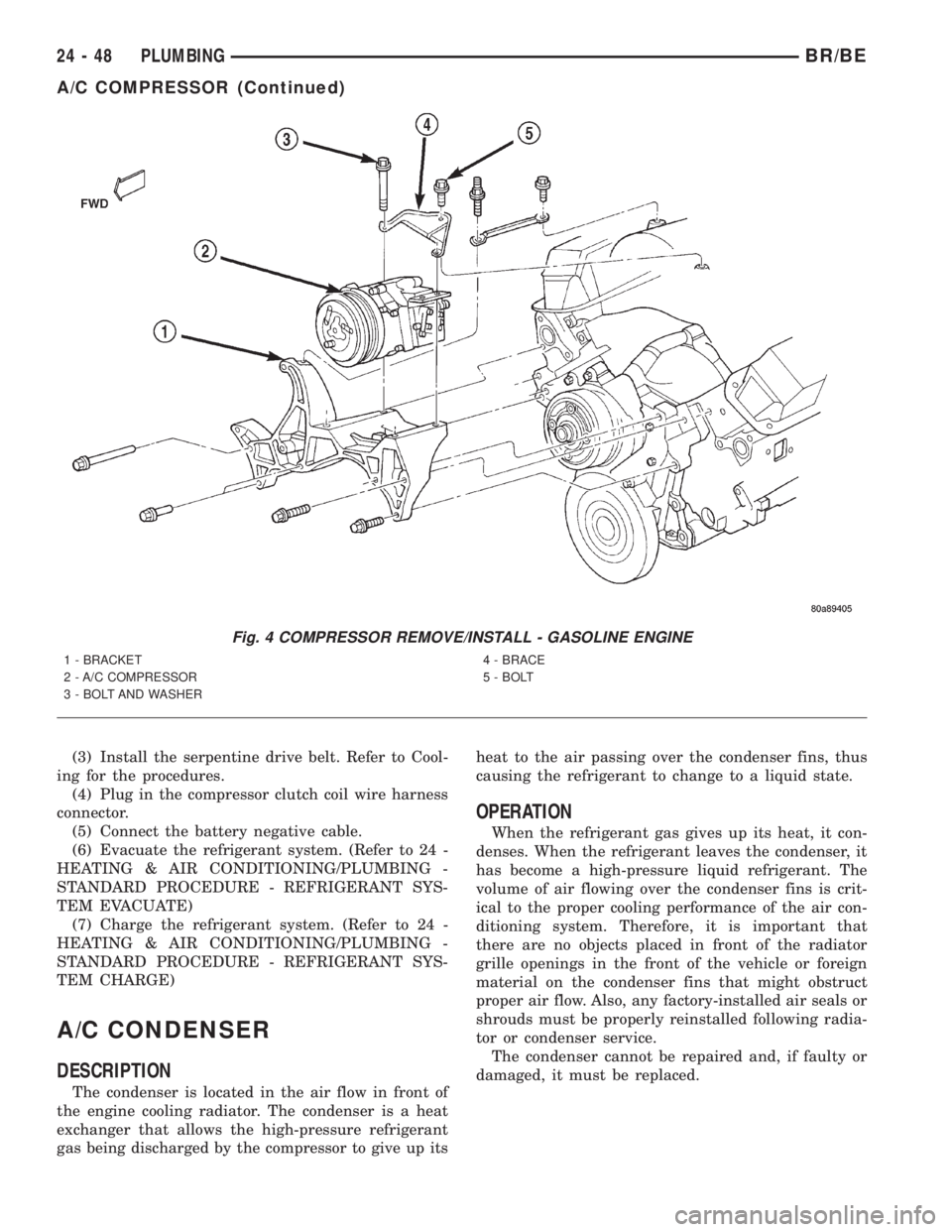
sor to the mounting bracket (Fig. 4) or (Fig. 5).
(7) Remove the a/c compressor from the mounting
bracket.
INSTALLATION
WARNING: REVIEW THE WARNINGS AND CAU-
TIONS IN THE FRONT OF THIS SECTION BEFORE
PERFORMING THE FOLLOWING OPERATION.
(Refer to 24 - HEATING & AIR CONDITIONING/
PLUMBING - WARNING) (Refer to 24 - HEATING &
AIR CONDITIONING/PLUMBING - CAUTION)(Refer to
24 - HEATING & AIR CONDITIONING/PLUMBING -
CAUTION - REFRIGERANT HOSES/LINES/TUBES
PRECAUTIONS)
NOTE: If a replacement compressor is being
installed, be certain to check the refrigerant oil
level. (Refer to 24 - HEATING & AIR CONDITIONING/
PLUMBING/REFRIGERANT OIL - STANDARD PRO-
CEDURE) Use only refrigerant oil of the type
recommended for the compressor in the vehicle.
(Refer to 24 - HEATING & AIR CONDITIONING/
PLUMBING/REFRIGERANT OIL - DESCRIPTION)
(1) Install the compressor to the mounting bracket.
Tighten the four mounting bolts to 24 N´m (210 in.
lbs.).
(2) Remove the tape or plugs from all of the
opened refrigerant line fittings. Install the suction
and discharge line manifold to the compressor. (Refer
to 24 - HEATING & AIR CONDITIONING/PLUMB-
ING/A/C SUCTION AND DISCHARGE LINE -
INSTALLATION)
BR/BEPLUMBING 24 - 47
A/C COMPRESSOR (Continued)
Page 2777 of 2889
(3) Install the serpentine drive belt. Refer to Cool-
ing for the procedures.
(4) Plug in the compressor clutch coil wire harness
connector.
(5) Connect the battery negative cable.
(6) Evacuate the refrigerant system. (Refer to 24 -
HEATING & AIR CONDITIONING/PLUMBING -
STANDARD PROCEDURE - REFRIGERANT SYS-
TEM EVACUATE)
(7) Charge the refrigerant system. (Refer to 24 -
HEATING & AIR CONDITIONING/PLUMBING -
STANDARD PROCEDURE - REFRIGERANT SYS-
TEM CHARGE)
A/C CONDENSER
DESCRIPTION
The condenser is located in the air flow in front of
the engine cooling radiator. The condenser is a heat
exchanger that allows the high-pressure refrigerant
gas being discharged by the compressor to give up itsheat to the air passing over the condenser fins, thus
causing the refrigerant to change to a liquid state.
OPERATION
When the refrigerant gas gives up its heat, it con-
denses. When the refrigerant leaves the condenser, it
has become a high-pressure liquid refrigerant. The
volume of air flowing over the condenser fins is crit-
ical to the proper cooling performance of the air con-
ditioning system. Therefore, it is important that
there are no objects placed in front of the radiator
grille openings in the front of the vehicle or foreign
material on the condenser fins that might obstruct
proper air flow. Also, any factory-installed air seals or
shrouds must be properly reinstalled following radia-
tor or condenser service.
The condenser cannot be repaired and, if faulty or
damaged, it must be replaced.
Fig. 4 COMPRESSOR REMOVE/INSTALL - GASOLINE ENGINE
1 - BRACKET
2 - A/C COMPRESSOR
3 - BOLT AND WASHER4 - BRACE
5 - BOLT
24 - 48 PLUMBINGBR/BE
A/C COMPRESSOR (Continued)
Page 2798 of 2889
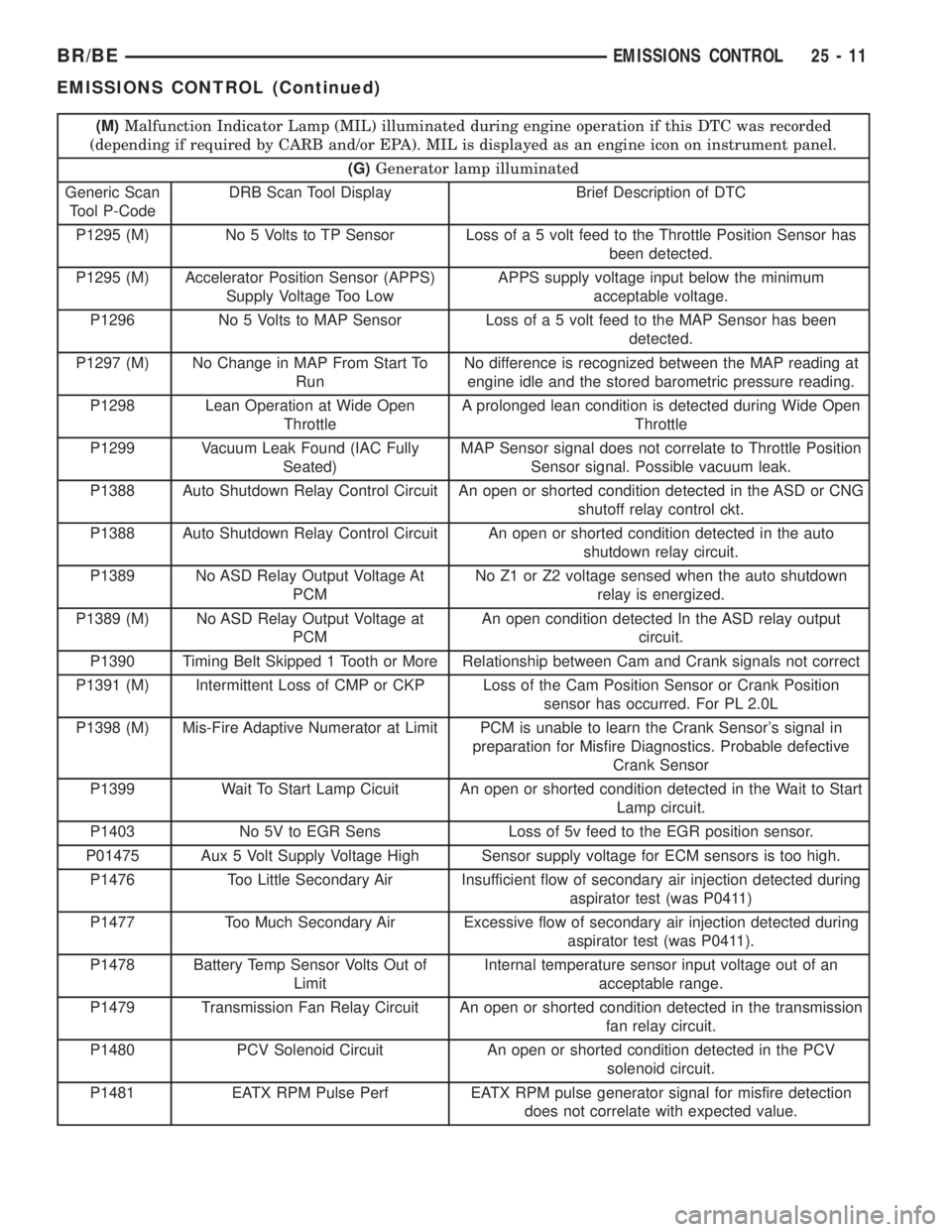
(M)Malfunction Indicator Lamp (MIL) illuminated during engine operation if this DTC was recorded
(depending if required by CARB and/or EPA). MIL is displayed as an engine icon on instrument panel.
(G)Generator lamp illuminated
Generic Scan
Tool P-CodeDRB Scan Tool Display Brief Description of DTC
P1295 (M) No 5 Volts to TP Sensor Loss of a 5 volt feed to the Throttle Position Sensor has
been detected.
P1295 (M) Accelerator Position Sensor (APPS)
Supply Voltage Too LowAPPS supply voltage input below the minimum
acceptable voltage.
P1296 No 5 Volts to MAP Sensor Loss of a 5 volt feed to the MAP Sensor has been
detected.
P1297 (M) No Change in MAP From Start To
RunNo difference is recognized between the MAP reading at
engine idle and the stored barometric pressure reading.
P1298 Lean Operation at Wide Open
ThrottleA prolonged lean condition is detected during Wide Open
Throttle
P1299 Vacuum Leak Found (IAC Fully
Seated)MAP Sensor signal does not correlate to Throttle Position
Sensor signal. Possible vacuum leak.
P1388 Auto Shutdown Relay Control Circuit An open or shorted condition detected in the ASD or CNG
shutoff relay control ckt.
P1388 Auto Shutdown Relay Control Circuit An open or shorted condition detected in the auto
shutdown relay circuit.
P1389 No ASD Relay Output Voltage At
PCMNo Z1 or Z2 voltage sensed when the auto shutdown
relay is energized.
P1389 (M) No ASD Relay Output Voltage at
PCMAn open condition detected In the ASD relay output
circuit.
P1390 Timing Belt Skipped 1 Tooth or More Relationship between Cam and Crank signals not correct
P1391 (M) Intermittent Loss of CMP or CKP Loss of the Cam Position Sensor or Crank Position
sensor has occurred. For PL 2.0L
P1398 (M) Mis-Fire Adaptive Numerator at Limit PCM is unable to learn the Crank Sensor's signal in
preparation for Misfire Diagnostics. Probable defective
Crank Sensor
P1399 Wait To Start Lamp Cicuit An open or shorted condition detected in the Wait to Start
Lamp circuit.
P1403 No 5V to EGR Sens Loss of 5v feed to the EGR position sensor.
P01475 Aux 5 Volt Supply Voltage High Sensor supply voltage for ECM sensors is too high.
P1476 Too Little Secondary Air Insufficient flow of secondary air injection detected during
aspirator test (was P0411)
P1477 Too Much Secondary Air Excessive flow of secondary air injection detected during
aspirator test (was P0411).
P1478 Battery Temp Sensor Volts Out of
LimitInternal temperature sensor input voltage out of an
acceptable range.
P1479 Transmission Fan Relay Circuit An open or shorted condition detected in the transmission
fan relay circuit.
P1480 PCV Solenoid Circuit An open or shorted condition detected in the PCV
solenoid circuit.
P1481 EATX RPM Pulse Perf EATX RPM pulse generator signal for misfire detection
does not correlate with expected value.
BR/BEEMISSIONS CONTROL 25 - 11
EMISSIONS CONTROL (Continued)
Page 2812 of 2889
AIR INJECTION
TABLE OF CONTENTS
page page
AIR INJECTION
DESCRIPTION...........................25
OPERATION.............................27
SPECIFICATIONS........................28
AIR INJECTION PUMP
DESCRIPTION...........................28
OPERATION.............................28
DIAGNOSIS AND TESTING.................28
AIR INJECTION PUMP...................28
REMOVAL..............................29
INSTALLATION...........................29AIR PUMP FILTER
REMOVAL..............................29
INSTALLATION...........................29
ONE WAY CHECK VALVE
DESCRIPTION...........................30
OPERATION.............................30
DIAGNOSIS AND TESTING.................30
TESTING ONE-WAY CHECK VALVE.........30
REMOVAL..............................30
INSTALLATION...........................30
AIR INJECTION
DESCRIPTION - AIR INJECTION SYSTEM
The air injection system (Fig. 1), (Fig. 2) or (Fig. 3)
is used on 5.9L V-8 and 8.0L V-10 heavy duty cycle
(HDC) gas powered engines only. The air injection
system consists of:²A belt-driven air injection (AIR) pump
²Two air pressure relief valves
²Rubber connecting air injection hoses with
clamps
²Metal connecting air tubes
²Two one-way check valves
²A replaceable injection pump air filter (8.0L V-10
engine only)
BR/BEAIR INJECTION 25 - 25
Page 2815 of 2889
SPECIFICATIONS
TORQUE - AIR INJECTION SYSTEM
DESCRIPTION N´m Ft. Lbs. In. Lbs.
Air Pump Filter Housing
Nut18
Air Pump Mounting Bolts 40 30
Air Pump Pulley Mounting
Bolts11 105
One-Way Check Valve to
Catalyst Tube33 25
AIR INJECTION PUMP
DESCRIPTION
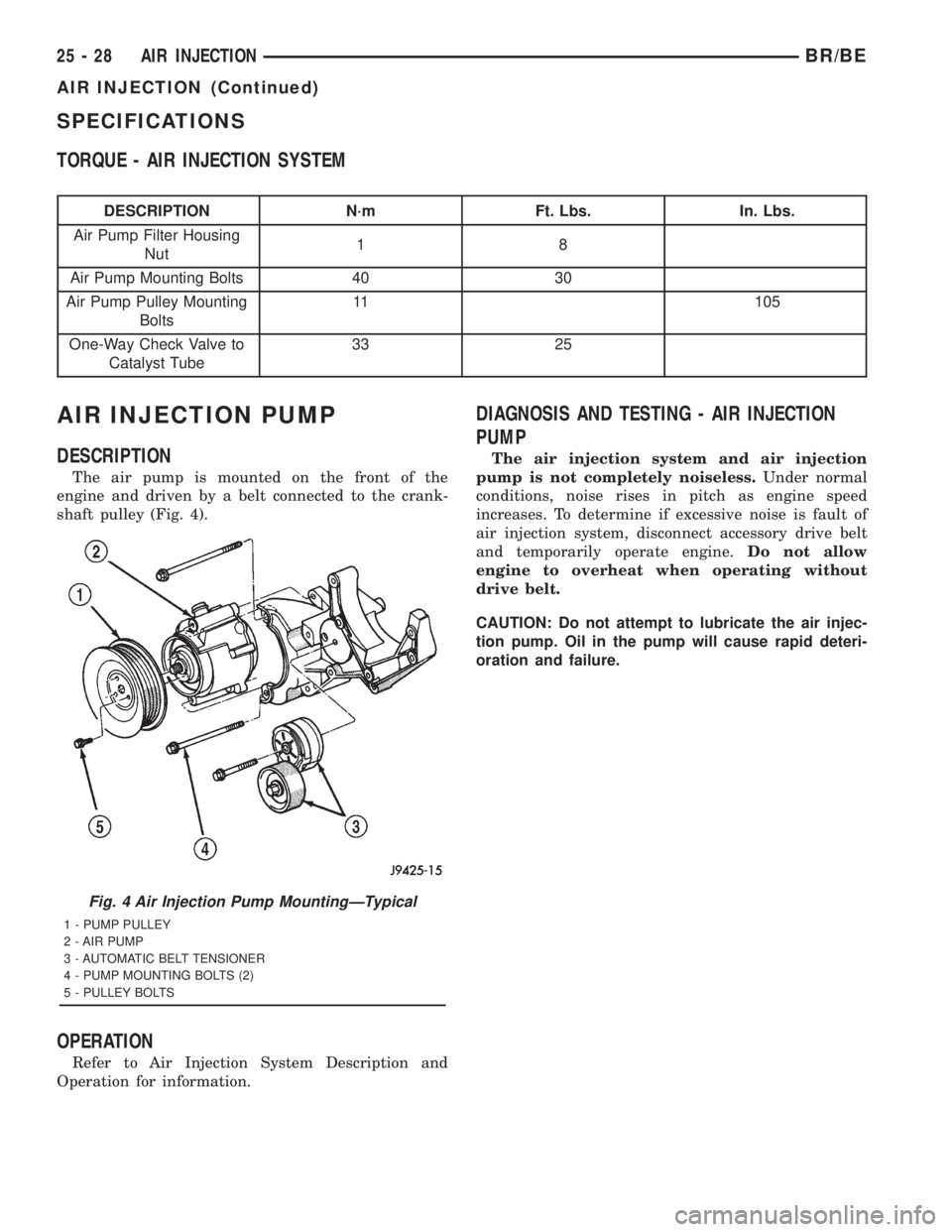
The air pump is mounted on the front of the
engine and driven by a belt connected to the crank-
shaft pulley (Fig. 4).
OPERATION
Refer to Air Injection System Description and
Operation for information.
DIAGNOSIS AND TESTING - AIR INJECTION
PUMP
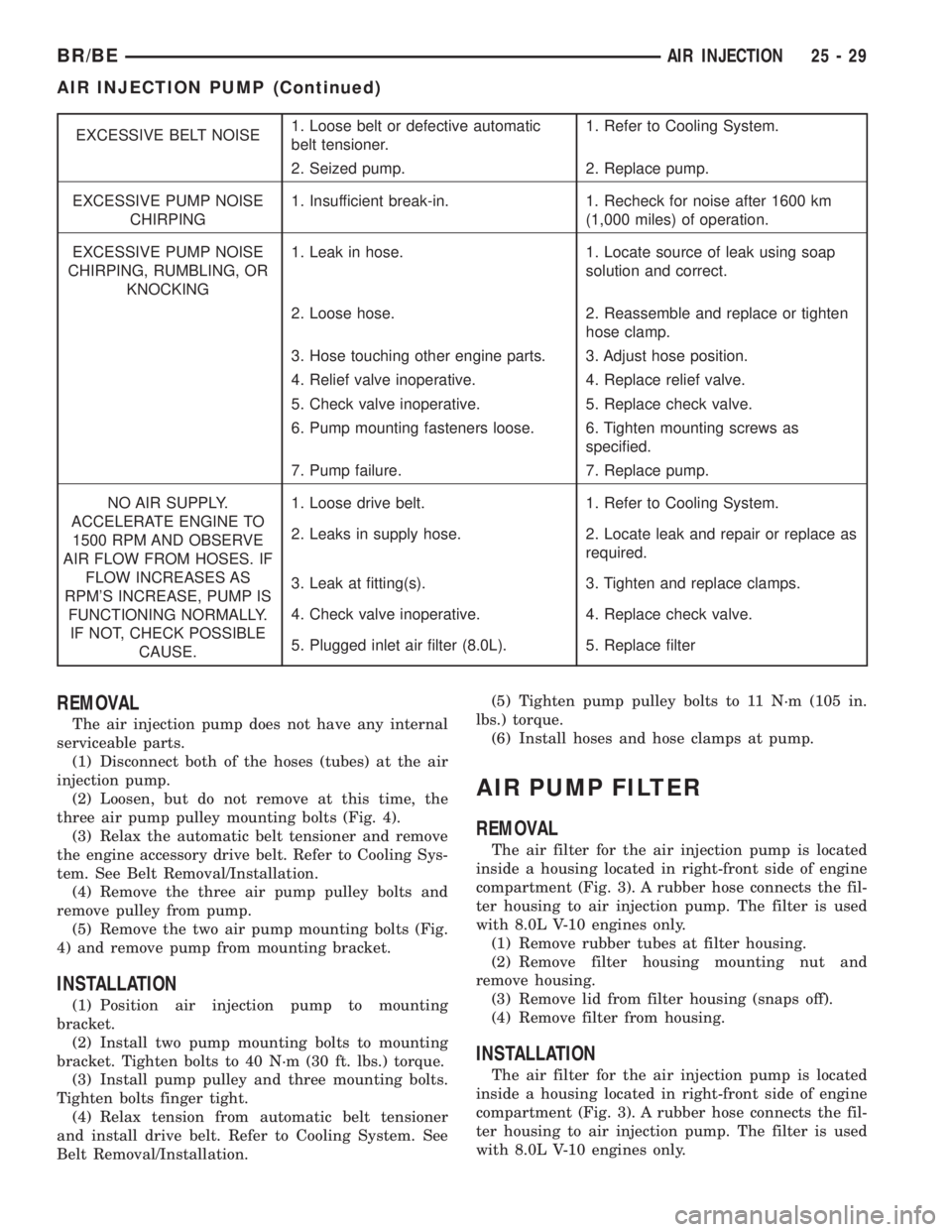
The air injection system and air injection
pump is not completely noiseless.Under normal
conditions, noise rises in pitch as engine speed
increases. To determine if excessive noise is fault of
air injection system, disconnect accessory drive belt
and temporarily operate engine.Do not allow
engine to overheat when operating without
drive belt.
CAUTION: Do not attempt to lubricate the air injec-
tion pump. Oil in the pump will cause rapid deteri-
oration and failure.
Fig. 4 Air Injection Pump MountingÐTypical
1 - PUMP PULLEY
2 - AIR PUMP
3 - AUTOMATIC BELT TENSIONER
4 - PUMP MOUNTING BOLTS (2)
5 - PULLEY BOLTS
25 - 28 AIR INJECTIONBR/BE
AIR INJECTION (Continued)
Page 2816 of 2889
EXCESSIVE BELT NOISE1. Loose belt or defective automatic
belt tensioner.1. Refer to Cooling System.
2. Seized pump. 2. Replace pump.
EXCESSIVE PUMP NOISE
CHIRPING1. Insufficient break-in. 1. Recheck for noise after 1600 km
(1,000 miles) of operation.
EXCESSIVE PUMP NOISE
CHIRPING, RUMBLING, OR
KNOCKING1. Leak in hose. 1. Locate source of leak using soap
solution and correct.
2. Loose hose. 2. Reassemble and replace or tighten
hose clamp.
3. Hose touching other engine parts. 3. Adjust hose position.
4. Relief valve inoperative. 4. Replace relief valve.
5. Check valve inoperative. 5. Replace check valve.
6. Pump mounting fasteners loose. 6. Tighten mounting screws as
specified.
7. Pump failure. 7. Replace pump.
NO AIR SUPPLY.
ACCELERATE ENGINE TO
1500 RPM AND OBSERVE
AIR FLOW FROM HOSES. IF
FLOW INCREASES AS
RPM'S INCREASE, PUMP IS
FUNCTIONING NORMALLY.
IF NOT, CHECK POSSIBLE
CAUSE.1. Loose drive belt. 1. Refer to Cooling System.
2. Leaks in supply hose. 2. Locate leak and repair or replace as
required.
3. Leak at fitting(s). 3. Tighten and replace clamps.
4. Check valve inoperative. 4. Replace check valve.
5. Plugged inlet air filter (8.0L). 5. Replace filter
REMOVAL
The air injection pump does not have any internal
serviceable parts.
(1) Disconnect both of the hoses (tubes) at the air
injection pump.
(2) Loosen, but do not remove at this time, the
three air pump pulley mounting bolts (Fig. 4).
(3) Relax the automatic belt tensioner and remove
the engine accessory drive belt. Refer to Cooling Sys-
tem. See Belt Removal/Installation.
(4) Remove the three air pump pulley bolts and
remove pulley from pump.
(5) Remove the two air pump mounting bolts (Fig.
4) and remove pump from mounting bracket.
INSTALLATION
(1) Position air injection pump to mounting
bracket.
(2) Install two pump mounting bolts to mounting
bracket. Tighten bolts to 40 N´m (30 ft. lbs.) torque.
(3) Install pump pulley and three mounting bolts.
Tighten bolts finger tight.
(4) Relax tension from automatic belt tensioner
and install drive belt. Refer to Cooling System. See
Belt Removal/Installation.(5) Tighten pump pulley bolts to 11 N´m (105 in.
lbs.) torque.
(6) Install hoses and hose clamps at pump.
AIR PUMP FILTER
REMOVAL
The air filter for the air injection pump is located
inside a housing located in right-front side of engine
compartment (Fig. 3). A rubber hose connects the fil-
ter housing to air injection pump. The filter is used
with 8.0L V-10 engines only.
(1) Remove rubber tubes at filter housing.
(2) Remove filter housing mounting nut and
remove housing.
(3) Remove lid from filter housing (snaps off).
(4) Remove filter from housing.
INSTALLATION
The air filter for the air injection pump is located
inside a housing located in right-front side of engine
compartment (Fig. 3). A rubber hose connects the fil-
ter housing to air injection pump. The filter is used
with 8.0L V-10 engines only.
BR/BEAIR INJECTION 25 - 29
AIR INJECTION PUMP (Continued)
Page 2817 of 2889
(1) Clean inside of housing and lid before install-
ing new filter.
(2) Install filter into housing.
(3) Install lid to filter housing (snaps on).
(4) Position filter housing to fender.
(5) Install mounting nut and tighten to 11 N´m (8
ft. lbs.) torque.
(6) Install rubber tubes and cap at filter housing.
ONE WAY CHECK VALVE
DESCRIPTION
For air injection systems:A pair of one-way
check valves is used with the air injection system.
The check valves (Fig. 1) are located on each of the
air injection downstream tubes.
OPERATION
Each one-way check valve has a one-way dia-
phragm which prevents hot exhaust gases from back-
ing up into the air injection hose and air injection
pump. The check valve will protect the system if the
air injection pump belt fails, an air hose ruptures or
exhaust system pressure becomes abnormally high.
DIAGNOSIS AND TESTING - ONE-WAY CHECK
VALVE
The one-way check valves are not repairable. To
determine condition of valve, remove the rubber air
tube from the inlet side of each check valve. Start the
engine. If exhaust gas is escaping through the inlet
side of check valve, it must be replaced.
REMOVAL
(1) Remove the hose clamp at inlet side of valve.
(2) Remove hose from valve.
(3) Remove valve from catalyst tube (unscrew).To
prevent damage to catalyst tube, a backup
wrench must be used on the tube.
INSTALLATION
(1) Install valve to catalyst tube. Tighten to 33
N´m (25 ft. lbs.) torque.
(2) Install hose and hose clamp to valve.
25 - 30 AIR INJECTIONBR/BE
AIR PUMP FILTER (Continued)
Page 2837 of 2889
BODY INTERIOR
INSPECTION - COMPASS
NOTE: Set variance after calibration.
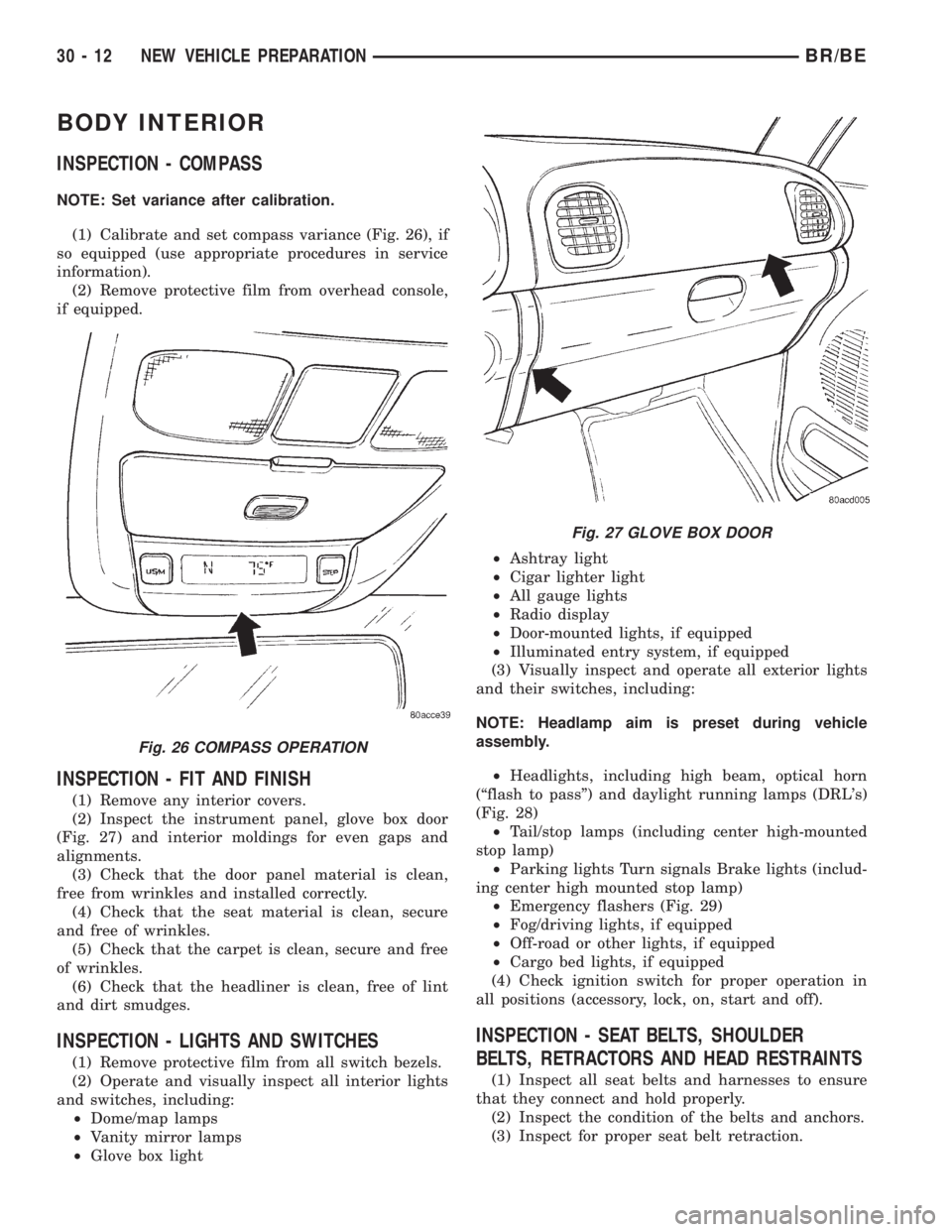
(1) Calibrate and set compass variance (Fig. 26), if
so equipped (use appropriate procedures in service
information).
(2) Remove protective film from overhead console,
if equipped.
INSPECTION - FIT AND FINISH
(1) Remove any interior covers.
(2) Inspect the instrument panel, glove box door
(Fig. 27) and interior moldings for even gaps and
alignments.
(3) Check that the door panel material is clean,
free from wrinkles and installed correctly.
(4) Check that the seat material is clean, secure
and free of wrinkles.
(5) Check that the carpet is clean, secure and free
of wrinkles.
(6) Check that the headliner is clean, free of lint
and dirt smudges.
INSPECTION - LIGHTS AND SWITCHES
(1) Remove protective film from all switch bezels.
(2) Operate and visually inspect all interior lights
and switches, including:
²Dome/map lamps
²Vanity mirror lamps
²Glove box light²Ashtray light
²Cigar lighter light
²All gauge lights
²Radio display
²Door-mounted lights, if equipped
²Illuminated entry system, if equipped
(3) Visually inspect and operate all exterior lights
and their switches, including:
NOTE: Headlamp aim is preset during vehicle
assembly.
²Headlights, including high beam, optical horn
(ªflash to passº) and daylight running lamps (DRL's)
(Fig. 28)
²Tail/stop lamps (including center high-mounted
stop lamp)
²Parking lights Turn signals Brake lights (includ-
ing center high mounted stop lamp)
²Emergency flashers (Fig. 29)
²Fog/driving lights, if equipped
²Off-road or other lights, if equipped
²Cargo bed lights, if equipped
(4) Check ignition switch for proper operation in
all positions (accessory, lock, on, start and off).
INSPECTION - SEAT BELTS, SHOULDER
BELTS, RETRACTORS AND HEAD RESTRAINTS
(1) Inspect all seat belts and harnesses to ensure
that they connect and hold properly.
(2) Inspect the condition of the belts and anchors.
(3) Inspect for proper seat belt retraction.
Fig. 26 COMPASS OPERATION
Fig. 27 GLOVE BOX DOOR
30 - 12 NEW VEHICLE PREPARATIONBR/BE
Page 2838 of 2889
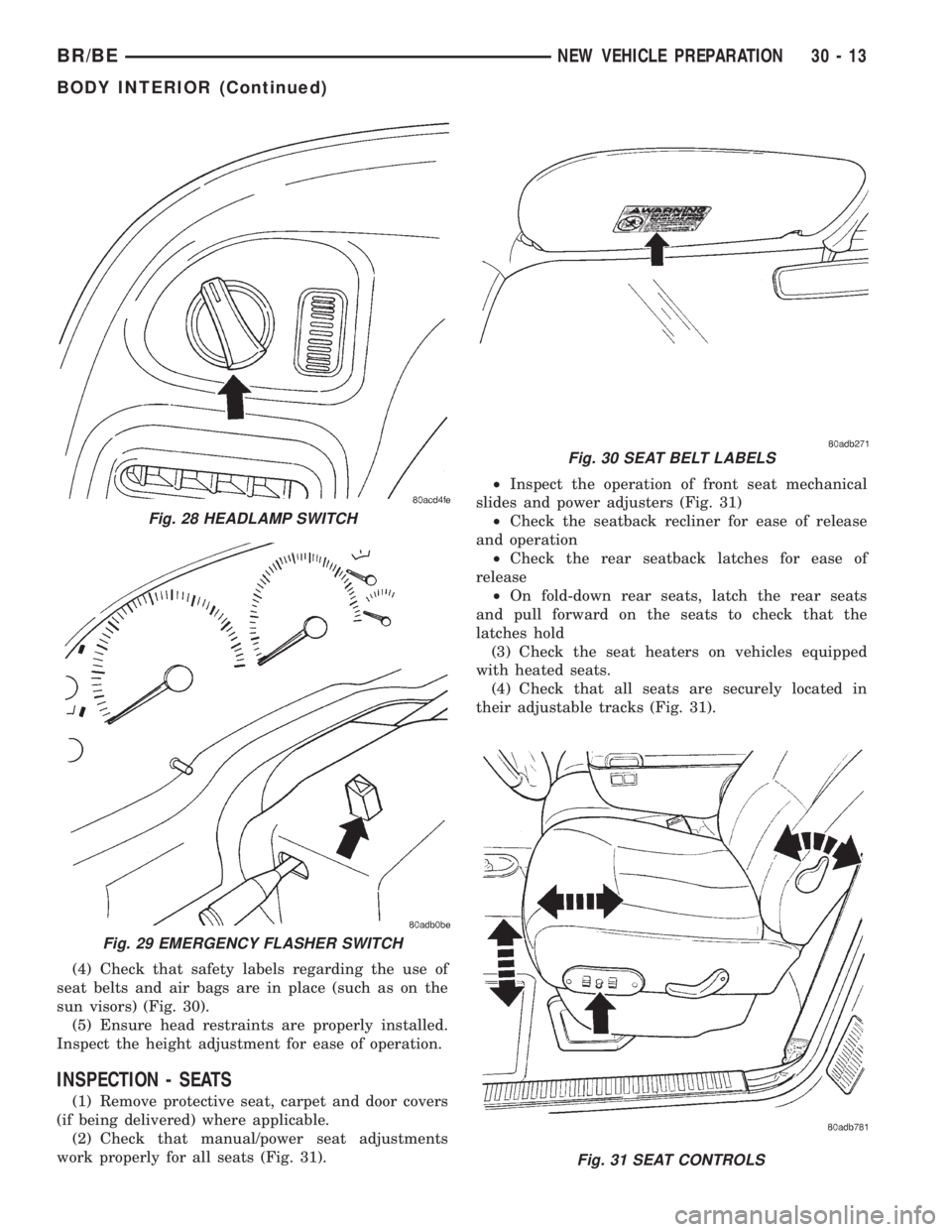
(4) Check that safety labels regarding the use of
seat belts and air bags are in place (such as on the
sun visors) (Fig. 30).
(5) Ensure head restraints are properly installed.
Inspect the height adjustment for ease of operation.
INSPECTION - SEATS
(1) Remove protective seat, carpet and door covers
(if being delivered) where applicable.
(2) Check that manual/power seat adjustments
work properly for all seats (Fig. 31).²Inspect the operation of front seat mechanical
slides and power adjusters (Fig. 31)
²Check the seatback recliner for ease of release
and operation
²Check the rear seatback latches for ease of
release
²On fold-down rear seats, latch the rear seats
and pull forward on the seats to check that the
latches hold
(3) Check the seat heaters on vehicles equipped
with heated seats.
(4) Check that all seats are securely located in
their adjustable tracks (Fig. 31).
Fig. 31 SEAT CONTROLS
Fig. 28 HEADLAMP SWITCH
Fig. 29 EMERGENCY FLASHER SWITCH
Fig. 30 SEAT BELT LABELS
BR/BENEW VEHICLE PREPARATION 30 - 13
BODY INTERIOR (Continued)
Page 2848 of 2889
ABS INDICATOR - DESCRIPTION.........8J-14
ABS INDICATOR - OPERATION..........8J-14
A/C APPLICATION TABLE,
SPECIFICATIONS......................24-8
A/C COMPRESSOR - DESCRIPTION......24-46
A/C COMPRESSOR - DIAGNOSIS AND
TESTING...........................24-46
A/C COMPRESSOR - INSTALLATION......24-47
A/C COMPRESSOR - OPERATION........24-46
A/C COMPRESSOR - REMOVAL.........24-47
A/C COMPRESSOR CLUTCH -
DESCRIPTION.......................24-13
A/C COMPRESSOR CLUTCH -
INSPECTION........................24-16
A/C COMPRESSOR CLUTCH -
INSTALLATION.......................24-16
A/C COMPRESSOR CLUTCH -
OPERATION.........................24-13
A/C COMPRESSOR CLUTCH - REMOVAL . . 24-14
A/C COMPRESSOR CLUTCH BREAK-IN -
STANDARD PROCEDURE...............24-13
A/C COMPRESSOR CLUTCH COIL -
DIAGNOSIS AND TESTING.............24-13
A/C COMPRESSOR CLUTCH RELAY -
DESCRIPTION.......................24-17
A/C COMPRESSOR CLUTCH RELAY -
DIAGNOSIS AND TESTING.............24-17
A/C COMPRESSOR CLUTCH RELAY -
INSTALLATION.......................24-18
A/C COMPRESSOR CLUTCH RELAY -
OPERATION.........................24-17
A/C COMPRESSOR CLUTCH RELAY -
REMOVAL..........................24-18
A/C CONDENSER - DESCRIPTION........24-48
A/C CONDENSER - INSTALLATION.......24-49
A/C CONDENSER - OPERATION..........24-48
A/C CONDENSER - REMOVAL...........24-49
A/C EVAPORATOR - DESCRIPTION.......24-52
A/C EVAPORATOR - INSTALLATION......24-53
A/C EVAPORATOR - OPERATION.........24-53
A/C EVAPORATOR - REMOVAL..........24-53
A/C HEATER CONTROL - DESCRIPTION . . . 24-18
A/C HEATER CONTROL - DIAGNOSIS
AND TESTING.......................24-19
A/C HEATER CONTROL - INSTALLATION . . . 24-20
A/C HEATER CONTROL - OPERATION.....24-18
A/C HEATER CONTROL - REMOVAL......24-19
A/C HIGH PRESSURE SWITCH -
DESCRIPTION.......................24-20
A/C HIGH PRESSURE SWITCH -
DIAGNOSIS AND TESTING.............24-20
A/C HIGH PRESSURE SWITCH -
INSTALLATION.......................24-21
A/C HIGH PRESSURE SWITCH -
OPERATION.........................24-20
A/C HIGH PRESSURE SWITCH -
REMOVAL..........................24-21
A/C LINE COUPLERS - DESCRIPTION.....24-40
A/C LINE COUPLERS - OPERATION......24-41
A/C LINE COUPLERS - STANDARD
PROCEDURE........................24-43
A/C LOW PRESSURE SWITCH -
DESCRIPTION.......................24-21
A/C LOW PRESSURE SWITCH -
DIAGNOSIS AND TESTING.............24-21
A/C LOW PRESSURE SWITCH -
INSTALLATION.......................24-22
A/C LOW PRESSURE SWITCH -
OPERATION.........................24-21
A/C LOW PRESSURE SWITCH -
REMOVAL..........................24-21
A/C ORIFICE TUBE - DESCRIPTION.......24-53
A/C ORIFICE TUBE - OPERATION........24-53
A/C ORIFICE TUBE - REMOVAL..........24-54
A/C PERFORMANCE - DIAGNOSIS AND
TESTING............................24-2
ACCELERATOR PEDAL - INSTALLATION . . . 14-37
ACCELERATOR PEDAL - REMOVAL.......14-37
ACCELERATOR PEDAL POSITION
SENSOR - DESCRIPTION
...............14-91
ACCELERATOR PEDAL POSITION
SENSOR - INSTALLATION
..............14-93
ACCELERATOR PEDAL POSITION
SENSOR - OPERATION
................14-91
ACCELERATOR PEDAL POSITION
SENSOR - REMOVAL
..................14-91
ACCESSORY DRIVE BELT - DIAGNOSIS
AND TESTING
................7-24,7-27,7-31ACCUMULATOR - DESCRIPTION.........24-54
ACCUMULATOR - DESCRIPTION . 21-191,21-362,
21-537,21-707
ACCUMULATOR - INSPECTION . . 21-192,21-363,
21-538,21-708
ACCUMULATOR - INSTALLATION........24-55
ACCUMULATOR - OPERATION..........24-54
ACCUMULATOR - OPERATION . . . 21-191,21-362,
21-537,21-708
ACCUMULATOR - REMOVAL............24-54
ACTUATION TEST MODE - DESCRIPTION,
CIRCUIT.............................25-1
ACTUATOR - INSTALLATION, BLEND
DOOR.............................24-26
ACTUATOR - INSTALLATION, HEAT/
DEFROST DOOR.....................24-27
ACTUATOR - INSTALLATION, INSIDE
HANDLE.......................23-71,23-80
ACTUATOR - INSTALLATION, PANEL/
DEFROST DOOR.....................24-27
ACTUATOR - INSTALLATION,
RECIRCULATION DOOR................24-28
ACTUATOR - REMOVAL, BLEND DOOR....24-25
ACTUATOR - REMOVAL, HEAT/DEFROST
DOOR.............................24-26
ACTUATOR - REMOVAL, INSIDE HANDLE . 23-71,
23-80
ACTUATOR - REMOVAL, PANEL/DEFROST
DOOR.............................24-27
ACTUATOR - REMOVAL, RECIRCULATION
DOOR.............................24-27
ADAPTER - INSTALLATION, DEFROSTER
AND DEMISTER DUCT.................24-35
ADAPTER - REMOVAL, DEFROSTER AND
DEMISTER DUCT.....................24-35
ADAPTER BRACKET - INSTALLATION,
CAB CHASSIS........................13-9
ADAPTER BRACKET - REMOVAL, CAB
CHASSIS............................13-9
ADAPTER HOUSING SEAL -
INSTALLATION.................21-132,21-87
ADAPTER HOUSING SEAL - REMOVAL . . 21-132,
21-87
ADDING ADDITIONAL COOLANT -
STANDARD PROCEDURE................7-16
ADDITIONAL COOLANT - STANDARD
PROCEDURE, ADDING..................7-16
ADHESIVE LOCATIONS, SPECIFICATIONS
- STRUCTURAL......................23-44
ADJUSTER - DIAGNOSIS & TESTING,
POWER LUMBAR....................8N-18
ADJUSTER - INSTALLATION, SEAT BELT
TURNING LOOP.....................8O-29
ADJUSTER - INSTALLATION, SEAT
TRACK............................23-143
ADJUSTER - REMOVAL, SEAT BELT
TURNING LOOP.....................8O-29
ADJUSTER - REMOVAL, SEAT TRACK....23-143
ADJUSTER ASSEMBLY - INSTALLATION,
ROCKER ARM........................9-85
ADJUSTER ASSEMBLY - REMOVAL,
ROCKER ARM........................9-85
ADJUSTER ASSY - CLEANING, ROCKER
ARM ..............................9-262
ADJUSTER ASSY - DESCRIPTION,
ROCKER ARM.......................9-261
ADJUSTER ASSY - INSPECTION,
ROCKER ARM.......................9-262
ADJUSTER ASSY - INSTALLATION,
ROCKER ARM.............9-142,9-200,9-263
ADJUSTER ASSY - REMOVAL, ROCKER
ARM ....................9-142,9-200,9-261
ADJUSTER KNOB - INSTALLATION,
TURNING LOOP HEIGHT...............8O-30
ADJUSTER KNOB - REMOVAL, TURNING
LOOP HEIGHT.......................8O-30
ADJUSTMENT - STANDARD
PROCEDURE, COMPASS VARIATION......8M-4
ADJUSTMENT AND VERIFICATION -
STANDARD PROCEDURE, VALVE LASH....9-256
ADJUSTMENT, BANDS . . . 21-193,21-364,21-539,
21-709
ADJUSTMENT, CABLE TENSIONER
........5-40
ADJUSTMENT, CARGO DOOR
...........23-78
ADJUSTMENT, CENTER BEARING -
CENTER BEARING
.....................3-10
ADJUSTMENT, FRONT DOOR FORE/AFT
. . . 23-68
ADJUSTMENT, FRONT DOOR IN/OUT
.....23-69ADJUSTMENT, FRONT DOOR LATCH......23-72
ADJUSTMENT, FRONT DOOR UP/DOWN . . . 23-69
ADJUSTMENT, FRONT FASCIA...........13-2
ADJUSTMENT, HOOD................23-100
ADJUSTMENT, LATCH................23-100
ADJUSTMENT, LATCH STRIKER........23-102
ADJUSTMENT, REAR BRAKE DRUM.......5-34
ADJUSTMENT, SHIFT LEVER....21-853,21-888,
21-925
ADJUSTMENT, SHIFT MECHANISM.....21-252,
21-423,21-596,21-769
ADJUSTMENTS, FOG LAMP UNIT........8L-12
ADJUSTMENTS, FRONT AXLE - 216FBI....3-17
ADJUSTMENTS, FRONT AXLE - 248FBI....3-50
ADJUSTMENTS, GEAR.................19-16
ADJUSTMENTS, HEADLAMP UNIT.......8L-21
ADJUSTMENTS, REAR AXLE - 248RBI....3-114
ADJUSTMENTS, REAR AXLE - 267RBI....3-145
ADJUSTMENTS, REAR AXLE - 286RBI....3-174
ADJUSTMENTS, REAR AXLE - 9 1/4 .......3-84
ADJUSTMENTS, TRANSMISSION
THROTTLE VALVE CABLE . 21-254,21-425,21-598,
21-771
ADJUSTMENTS, VALVE BODY . . . 21-304,21-476,
21-646,21-818
AFTER AN AIRBAG DEPLOYMENT -
STANDARD PROCEDURE, SERVICE.......8O-4
AIR BLEED - STANDARD PROCEDURE....14-57
AIR CHECKING TRANSMISSION CLUTCH
AND BAND OPERATION - DIAGNOSIS
AND TESTING................21-147,21-318
AIR CLEANER ELEMENT - INSTALLATION . . 9-245
AIR CLEANER ELEMENT - REMOVAL.....9-244
AIR CONDITIONER - DESCRIPTION,
HEATER .............................24-1
AIR CONDITIONER - OPERATION,
HEATER .............................24-1
AIR CONDITIONING - INSTALLATION,
WATER PUMP BYPASS HOSE WITH.......7-77
AIR CONDITIONING - INSTALLATION,
WATER PUMP BYPASS HOSE
WITHOUT............................7-78
AIR CONDITIONING - REMOVAL, WATER
PUMP BYPASS HOSE WITH.............7-74
AIR CONDITIONING - REMOVAL, WATER
PUMP BYPASS HOSE WITHOUT..........7-77
AIR CONTROL MOTOR - DESCRIPTION,
IDLE...............................14-41
AIR CONTROL MOTOR - OPERATION,
IDLE...............................14-41
AIR COOLER AND PLUMBING -
CLEANING, CHARGE..................11-18
AIR COOLER AND PLUMBING -
DESCRIPTION, CHARGE...............11-17
AIR COOLER AND PLUMBING -
INSPECTION, CHARGE.................11-18
AIR COOLER AND PLUMBING -
INSTALLATION, CHARGE...............11-18
AIR COOLER AND PLUMBING -
OPERATION, CHARGE.................11-17
AIR COOLER AND PLUMBING -
REMOVAL, CHARGE..................11-17
AIR DAM - INSTALLATION, FRONT........13-2
AIR DAM - REMOVAL, FRONT...........13-1
AIR EXHAUSTER - INSTALLATION.......23-77
AIR EXHAUSTER - REMOVAL...........23-77
AIR HEATER - DESCRIPTION, INTAKE....14-100
AIR HEATER - INSTALLATION, INTAKE . . . 14-101
AIR HEATER - OPERATION, INTAKE.....14-100
AIR HEATER - REMOVAL, INTAKE.......14-100
AIR HEATER RELAY - DESCRIPTION,
INTAKE............................14-101
AIR HEATER RELAY - INSTALLATION,
INTAKE............................14-102
AIR HEATER RELAY - OPERATION,
INTAKE............................14-102
AIR HEATER RELAY - REMOVAL, INTAKE . 14-102
AIR IN FUEL SYSTEM - DIAGNOSIS AND
TESTING...........................14-56
AIR INJECTION PUMP - DESCRIPTION....25-28
AIR INJECTION PUMP - DIAGNOSIS AND
TESTING...........................25-28
AIR INJECTION PUMP - INSTALLATION . . . 25-29
AIR INJECTION PUMP - OPERATION
.....25-28
AIR INJECTION PUMP - REMOVAL
.......25-29
AIR INJECTION SYSTEM - DESCRIPTION
. . 25-25
AIR INJECTION SYSTEM - OPERATION
....25-27
AIR INJECTION SYSTEM - TORQUE
......25-28
BR/BEINDEX 1
Description Group-Page Description Group-Page Description Group-Page