belt DODGE RAM 2001 Service Repair Manual
[x] Cancel search | Manufacturer: DODGE, Model Year: 2001, Model line: RAM, Model: DODGE RAM 2001Pages: 2889, PDF Size: 68.07 MB
Page 1597 of 2889
CONDITION POSSIBLE CAUSE CORRECTION
VEHICLE PULLS OR LEADS TO
ONE SIDE.1. Tire Pressure. 1. Adjust tire pressure.
2. Radial tire lead. 2. Rotate tires.
3. Brakes dragging. 3. Repair as necessary.
4. Wheel alignment. 4. Align front end.
DIAGNOSIS AND TESTING - POWER STEERING
FLOW AND PRESSURE
The following procedure is used to test the opera-
tion of the power steering system on the vehicle. This
test will provide the flow rate of the power steering
pump along with the maximum relief pressure. Per-
form test any time a power steering system problem
is present. This test will determine if the power
steering pump or power steering gear is not function-
ing properly. The following pressure and flow test is
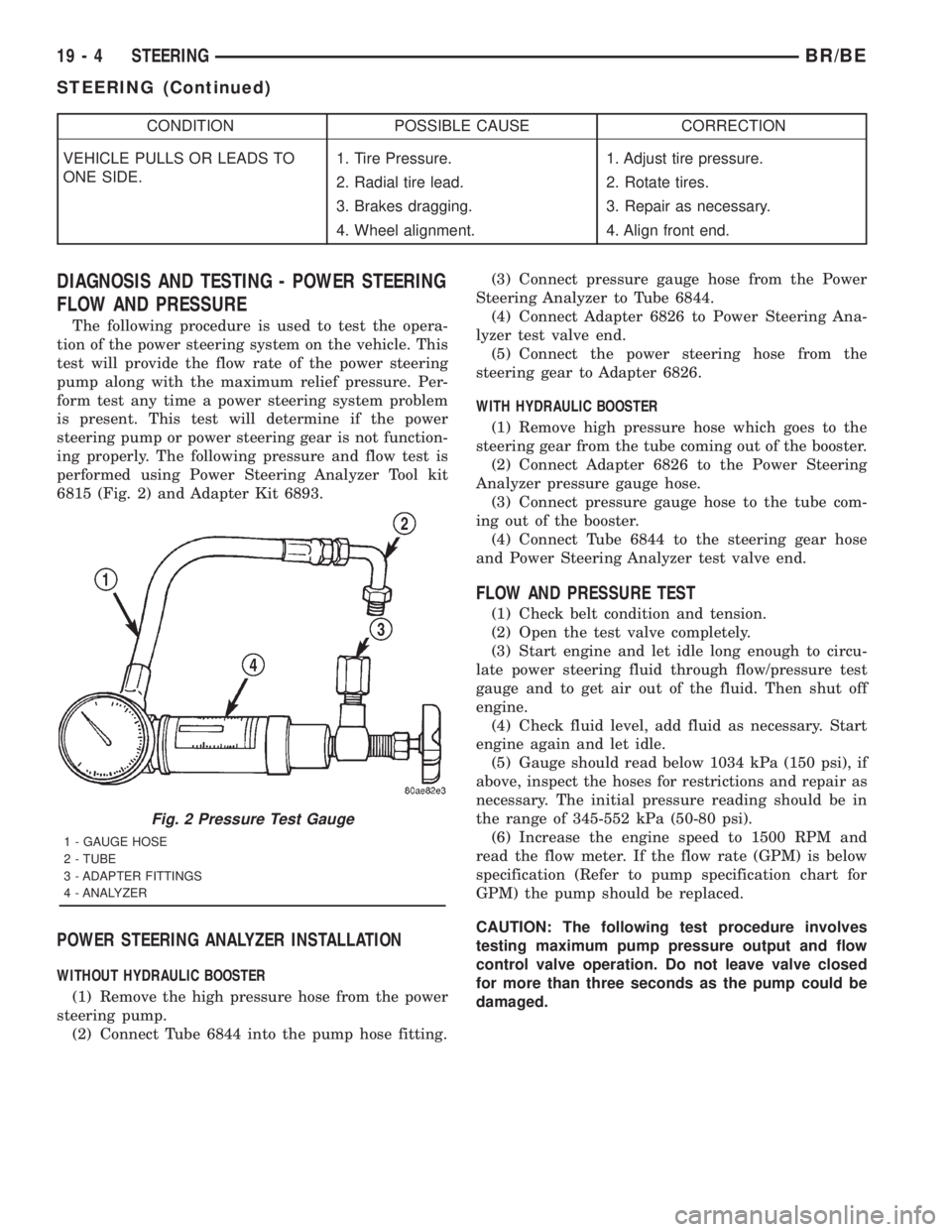
performed using Power Steering Analyzer Tool kit
6815 (Fig. 2) and Adapter Kit 6893.
POWER STEERING ANALYZER INSTALLATION
WITHOUT HYDRAULIC BOOSTER
(1) Remove the high pressure hose from the power
steering pump.
(2) Connect Tube 6844 into the pump hose fitting.(3) Connect pressure gauge hose from the Power
Steering Analyzer to Tube 6844.
(4) Connect Adapter 6826 to Power Steering Ana-
lyzer test valve end.
(5) Connect the power steering hose from the
steering gear to Adapter 6826.
WITH HYDRAULIC BOOSTER
(1) Remove high pressure hose which goes to the
steering gear from the tube coming out of the booster.
(2) Connect Adapter 6826 to the Power Steering
Analyzer pressure gauge hose.
(3) Connect pressure gauge hose to the tube com-
ing out of the booster.
(4) Connect Tube 6844 to the steering gear hose
and Power Steering Analyzer test valve end.
FLOW AND PRESSURE TEST
(1) Check belt condition and tension.
(2) Open the test valve completely.
(3) Start engine and let idle long enough to circu-
late power steering fluid through flow/pressure test
gauge and to get air out of the fluid. Then shut off
engine.
(4) Check fluid level, add fluid as necessary. Start
engine again and let idle.
(5) Gauge should read below 1034 kPa (150 psi), if
above, inspect the hoses for restrictions and repair as
necessary. The initial pressure reading should be in
the range of 345-552 kPa (50-80 psi).
(6) Increase the engine speed to 1500 RPM and
read the flow meter. If the flow rate (GPM) is below
specification (Refer to pump specification chart for
GPM) the pump should be replaced.
CAUTION: The following test procedure involves
testing maximum pump pressure output and flow
control valve operation. Do not leave valve closed
for more than three seconds as the pump could be
damaged.
Fig. 2 Pressure Test Gauge
1 - GAUGE HOSE
2 - TUBE
3 - ADAPTER FITTINGS
4 - ANALYZER
19 - 4 STEERINGBR/BE
STEERING (Continued)
Page 1624 of 2889
PUMP
TABLE OF CONTENTS
page page
PUMP
DESCRIPTION...........................31
OPERATION.............................31
DIAGNOSIS AND TESTING.................31
PUMP LEAKAGE.......................31
STANDARD PROCEDURE..................31
POWER STEERING PUMP - INITIAL
OPERATION...........................31
FLUSHING POWER STEERING SYSTEM.....32
REMOVAL..............................33
INSTALLATION...........................35SPECIAL TOOLS.........................36
PULLEY
REMOVAL..............................36
INSTALLATION...........................36
HOSES - PRESSURE
DESCRIPTION...........................37
OPERATION.............................37
HOSES - RETURN
DESCRIPTION...........................37
OPERATION.............................37
PUMP
DESCRIPTION
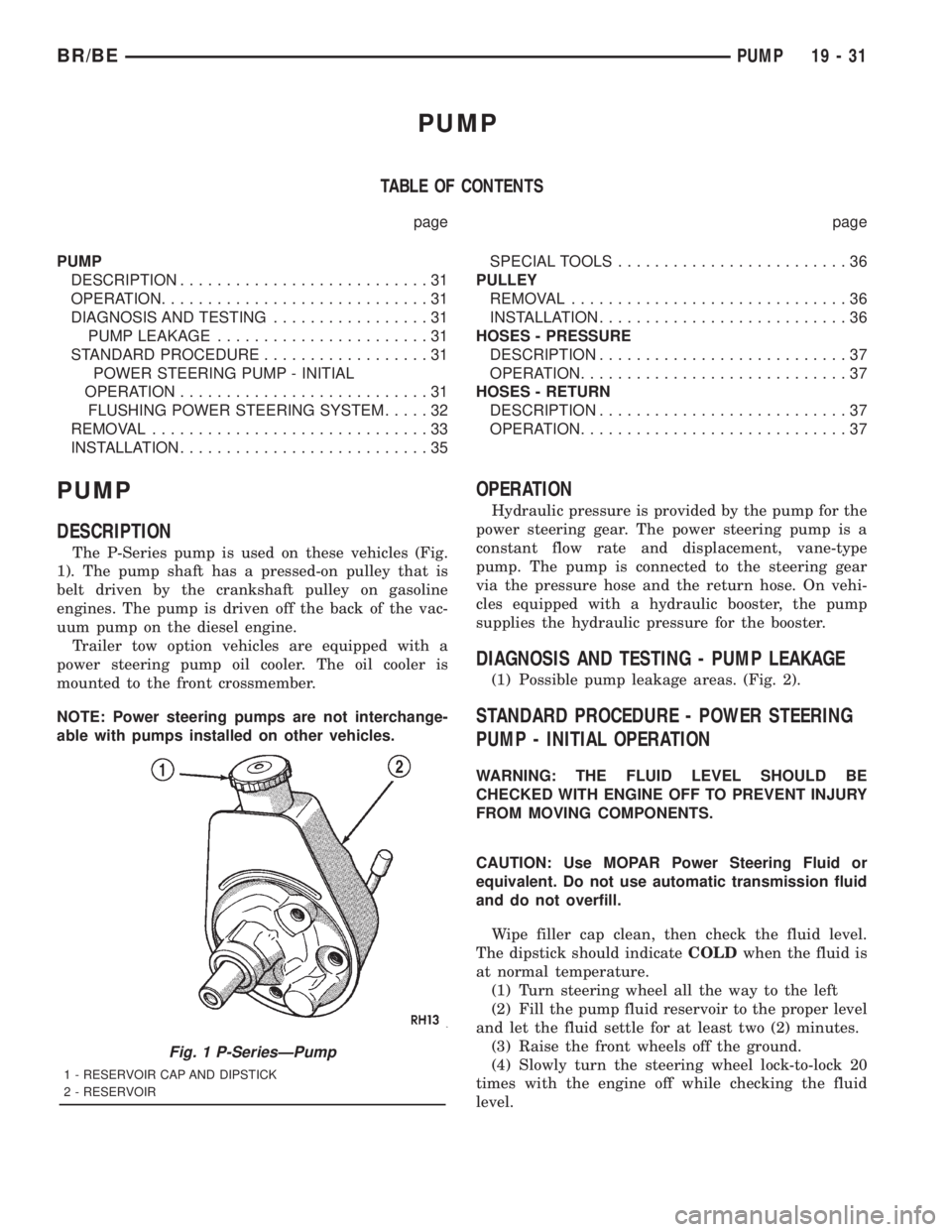
The P-Series pump is used on these vehicles (Fig.
1). The pump shaft has a pressed-on pulley that is
belt driven by the crankshaft pulley on gasoline
engines. The pump is driven off the back of the vac-
uum pump on the diesel engine.
Trailer tow option vehicles are equipped with a
power steering pump oil cooler. The oil cooler is
mounted to the front crossmember.
NOTE: Power steering pumps are not interchange-
able with pumps installed on other vehicles.
OPERATION
Hydraulic pressure is provided by the pump for the
power steering gear. The power steering pump is a
constant flow rate and displacement, vane-type
pump. The pump is connected to the steering gear
via the pressure hose and the return hose. On vehi-
cles equipped with a hydraulic booster, the pump
supplies the hydraulic pressure for the booster.
DIAGNOSIS AND TESTING - PUMP LEAKAGE
(1) Possible pump leakage areas. (Fig. 2).
STANDARD PROCEDURE - POWER STEERING
PUMP - INITIAL OPERATION
WARNING: THE FLUID LEVEL SHOULD BE
CHECKED WITH ENGINE OFF TO PREVENT INJURY
FROM MOVING COMPONENTS.
CAUTION: Use MOPAR Power Steering Fluid or
equivalent. Do not use automatic transmission fluid
and do not overfill.
Wipe filler cap clean, then check the fluid level.
The dipstick should indicateCOLDwhen the fluid is
at normal temperature.
(1) Turn steering wheel all the way to the left
(2) Fill the pump fluid reservoir to the proper level
and let the fluid settle for at least two (2) minutes.
(3) Raise the front wheels off the ground.
(4) Slowly turn the steering wheel lock-to-lock 20
times with the engine off while checking the fluid
level.
Fig. 1 P-SeriesÐPump
1 - RESERVOIR CAP AND DIPSTICK
2 - RESERVOIR
BR/BEPUMP 19 - 31
Page 1626 of 2889
(8) Fill the system with fluid and perform Steering
Pump Initial Operation, (Refer to 19 - STEERING/
PUMP - STANDARD PROCEDURE).
(9) Start the engine and run it for fifteen minutes
then stop the engine.
(10) Remove the return line/lines from the pump
and plug the pump port/ports.
(11) Pour fresh fluid into the reservoir and check
the draining fluid for contamination. If the fluid is
still contaminated, disassemble and clean the steer-
ing gear and flush the system again.
(12) Install the return line/lines and perform
Steering Pump Initial Operation, (Refer to 19 -
STEERING/PUMP - STANDARD PROCEDURE).
REMOVAL - GASOLINE ENGINE
(1) Remove the serpentine drive belt, (Refer to 7 -
COOLING/ACCESSORY DRIVE/DRIVE BELTS -
REMOVAL) OR (Refer to 7 - COOLING/ACCESSORY
DRIVE/DRIVE BELTS - REMOVAL).
(2) Remove the hoses from the power steering
pump and cap the fittings.
(3) Remove battery ground cable and unthread
stud from cylinder head, do not remove from bracket.
(4) Loosen upper bracket bolt and remove the
lower bracket to engine block bolts.
(5) Pivot the pump assembly past the coolant tube.
(6) Remove the upper stud and remove upper bolt
from cylinder head.
(7) Remove steering pump and mounting bracket
from engine as an assembly.
(8) Remove the pump pulley with Puller C-4333, to
access pump attaching bolts, (Refer to 19 - STEER-
ING/PUMP/PULLEY - REMOVAL).
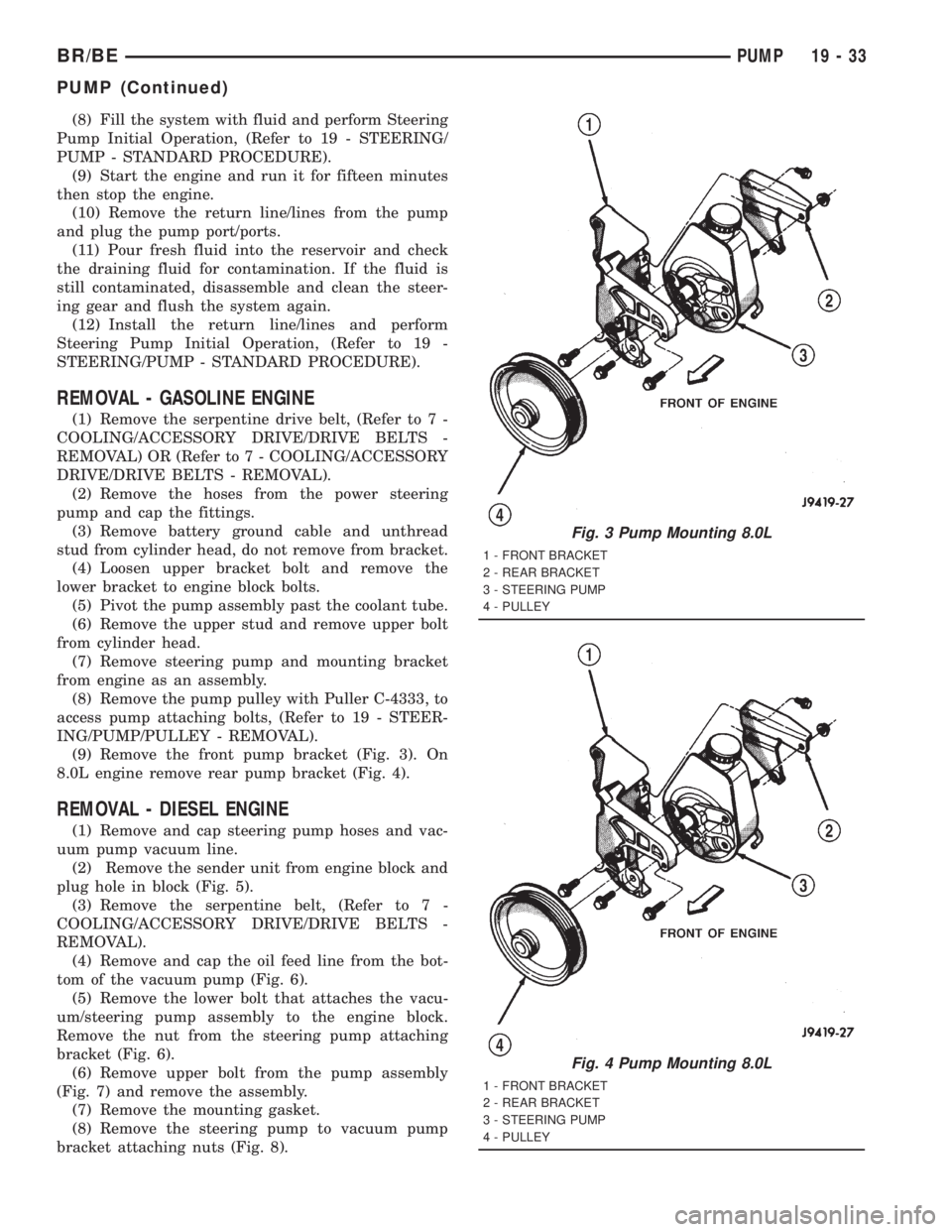
(9) Remove the front pump bracket (Fig. 3). On
8.0L engine remove rear pump bracket (Fig. 4).
REMOVAL - DIESEL ENGINE
(1) Remove and cap steering pump hoses and vac-
uum pump vacuum line.
(2) Remove the sender unit from engine block and
plug hole in block (Fig. 5).
(3) Remove the serpentine belt, (Refer to 7 -
COOLING/ACCESSORY DRIVE/DRIVE BELTS -
REMOVAL).
(4) Remove and cap the oil feed line from the bot-
tom of the vacuum pump (Fig. 6).
(5) Remove the lower bolt that attaches the vacu-
um/steering pump assembly to the engine block.
Remove the nut from the steering pump attaching
bracket (Fig. 6).
(6) Remove upper bolt from the pump assembly
(Fig. 7) and remove the assembly.
(7) Remove the mounting gasket.
(8) Remove the steering pump to vacuum pump
bracket attaching nuts (Fig. 8).
Fig. 3 Pump Mounting 8.0L
1 - FRONT BRACKET
2 - REAR BRACKET
3 - STEERING PUMP
4 - PULLEY
Fig. 4 Pump Mounting 8.0L
1 - FRONT BRACKET
2 - REAR BRACKET
3 - STEERING PUMP
4 - PULLEY
BR/BEPUMP 19 - 33
PUMP (Continued)
Page 1628 of 2889
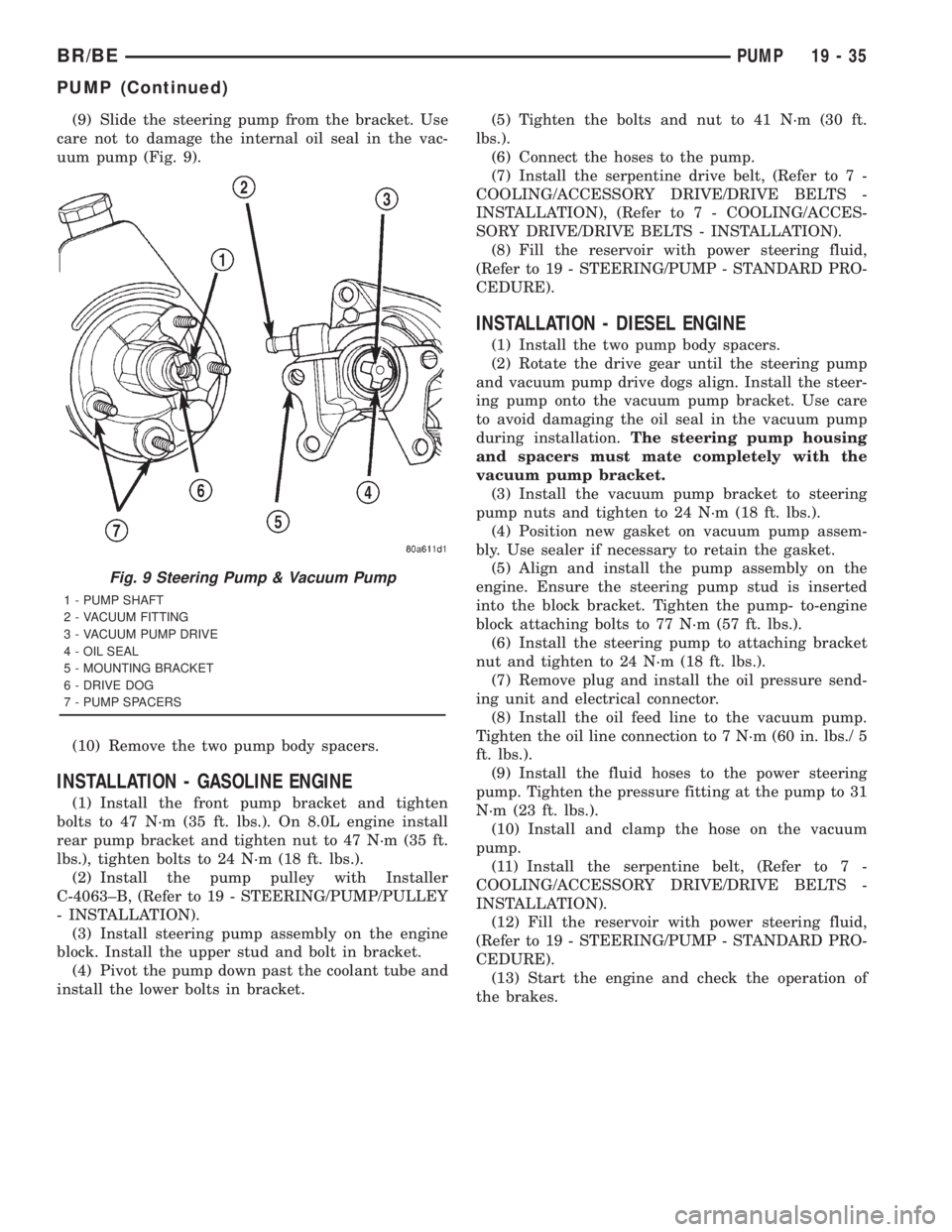
(9) Slide the steering pump from the bracket. Use
care not to damage the internal oil seal in the vac-
uum pump (Fig. 9).
(10) Remove the two pump body spacers.
INSTALLATION - GASOLINE ENGINE
(1) Install the front pump bracket and tighten
bolts to 47 N´m (35 ft. lbs.). On 8.0L engine install
rear pump bracket and tighten nut to 47 N´m (35 ft.
lbs.), tighten bolts to 24 N´m (18 ft. lbs.).
(2) Install the pump pulley with Installer
C-4063±B, (Refer to 19 - STEERING/PUMP/PULLEY
- INSTALLATION).
(3) Install steering pump assembly on the engine
block. Install the upper stud and bolt in bracket.
(4) Pivot the pump down past the coolant tube and
install the lower bolts in bracket.(5) Tighten the bolts and nut to 41 N´m (30 ft.
lbs.).
(6) Connect the hoses to the pump.
(7) Install the serpentine drive belt, (Refer to 7 -
COOLING/ACCESSORY DRIVE/DRIVE BELTS -
INSTALLATION), (Refer to 7 - COOLING/ACCES-
SORY DRIVE/DRIVE BELTS - INSTALLATION).
(8) Fill the reservoir with power steering fluid,
(Refer to 19 - STEERING/PUMP - STANDARD PRO-
CEDURE).
INSTALLATION - DIESEL ENGINE
(1) Install the two pump body spacers.
(2) Rotate the drive gear until the steering pump
and vacuum pump drive dogs align. Install the steer-
ing pump onto the vacuum pump bracket. Use care
to avoid damaging the oil seal in the vacuum pump
during installation.The steering pump housing
and spacers must mate completely with the
vacuum pump bracket.
(3) Install the vacuum pump bracket to steering
pump nuts and tighten to 24 N´m (18 ft. lbs.).
(4) Position new gasket on vacuum pump assem-
bly. Use sealer if necessary to retain the gasket.
(5) Align and install the pump assembly on the
engine. Ensure the steering pump stud is inserted
into the block bracket. Tighten the pump- to-engine
block attaching bolts to 77 N´m (57 ft. lbs.).
(6) Install the steering pump to attaching bracket
nut and tighten to 24 N´m (18 ft. lbs.).
(7) Remove plug and install the oil pressure send-
ing unit and electrical connector.
(8) Install the oil feed line to the vacuum pump.
Tighten the oil line connection to 7 N´m (60 in. lbs./ 5
ft. lbs.).
(9) Install the fluid hoses to the power steering
pump. Tighten the pressure fitting at the pump to 31
N´m (23 ft. lbs.).
(10) Install and clamp the hose on the vacuum
pump.
(11) Install the serpentine belt, (Refer to 7 -
COOLING/ACCESSORY DRIVE/DRIVE BELTS -
INSTALLATION).
(12) Fill the reservoir with power steering fluid,
(Refer to 19 - STEERING/PUMP - STANDARD PRO-
CEDURE).
(13) Start the engine and check the operation of
the brakes.
Fig. 9 Steering Pump & Vacuum Pump
1 - PUMP SHAFT
2 - VACUUM FITTING
3 - VACUUM PUMP DRIVE
4 - OIL SEAL
5 - MOUNTING BRACKET
6 - DRIVE DOG
7 - PUMP SPACERS
BR/BEPUMP 19 - 35
PUMP (Continued)
Page 1629 of 2889
SPECIAL TOOLS
POWER STEERING PUMP
PULLEY
REMOVAL
(1) Remove pump assembly.
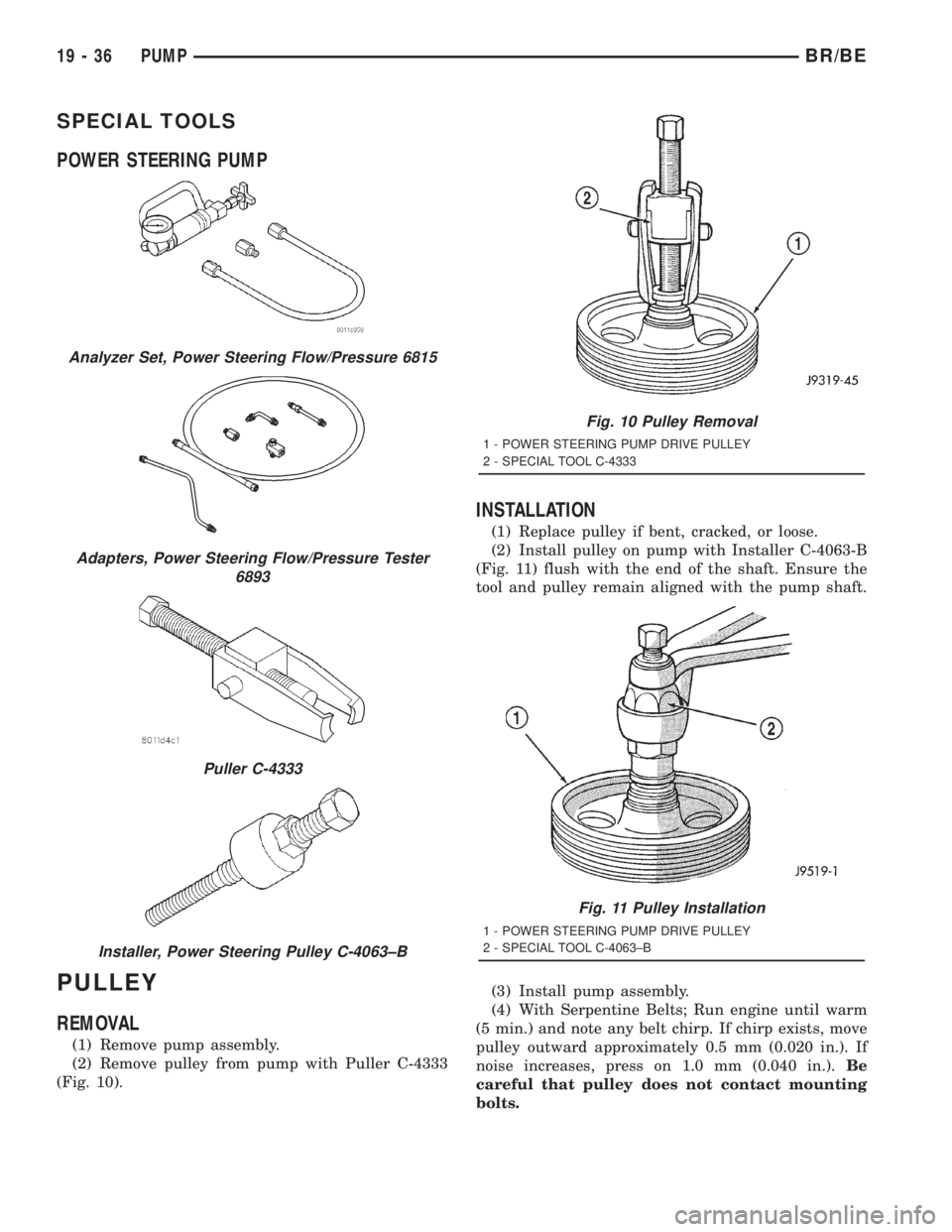
(2) Remove pulley from pump with Puller C-4333
(Fig. 10).
INSTALLATION
(1) Replace pulley if bent, cracked, or loose.
(2) Install pulley on pump with Installer C-4063-B
(Fig. 11) flush with the end of the shaft. Ensure the
tool and pulley remain aligned with the pump shaft.
(3) Install pump assembly.
(4) With Serpentine Belts; Run engine until warm
(5 min.) and note any belt chirp. If chirp exists, move
pulley outward approximately 0.5 mm (0.020 in.). If
noise increases, press on 1.0 mm (0.040 in.).Be
careful that pulley does not contact mounting
bolts.
Analyzer Set, Power Steering Flow/Pressure 6815
Adapters, Power Steering Flow/Pressure Tester
6893
Puller C-4333
Installer, Power Steering Pulley C-4063±B
Fig. 10 Pulley Removal
1 - POWER STEERING PUMP DRIVE PULLEY
2 - SPECIAL TOOL C-4333
Fig. 11 Pulley Installation
1 - POWER STEERING PUMP DRIVE PULLEY
2 - SPECIAL TOOL C-4063±B
19 - 36 PUMPBR/BE
Page 2634 of 2889
TORQUE SPECIFICATIONS
BODY COMPONENTS
Description N´m Ft.
lbs.In. lbs.
Bench seat front anchor
bolt54 40 Ð
Bench seat rear inboard
anchor nut40 30 Ð
Bench seat rear outboard
anchor nut54 40 Ð
Bench seat, rear seat
track to frame bolt25 18 Ð
Bench seat, front seat
track to frame bolt25 18 Ð
Bench seat, inboard
belt/buckle anchor bolt40 30 Ð
Bench seat back to
cushion pivot bolt25 18 Ð
Bench seat slider bolts 10 7 Ð
Cab mounting bolt 81 60 Ð
Front shoulder belt upper
anchor bolt39 28 Ð
Front belt buckle inboard
anchor nut45 33 Ð
Front belt retractor
anchor bolt39 28 Ð
Front shoulder belt lower
anchor bolt39 28 Ð
Front shoulder belt lower
anchor bolt45 33 Ð
Door hinge to A-pillar bolt 28 21 Ð
Door latch screw 11 8 Ð
Door latch striker screw 28 21 Ð
Door glass to lift plate
screw97Ð
Sliding backlite
latch/keeper screws1.5 Ð 15
Split bench seat front
anchor bolt54 40 Ð
Split bench seat rear
inboard anchor nut40 30 Ð
Split bench seat rear
outboard anchor nut54 40 Ð
Split bench seat track to
frame bolt25 18 Ð
Split bench seat back to
cushion pivot bolt25 18 Ð
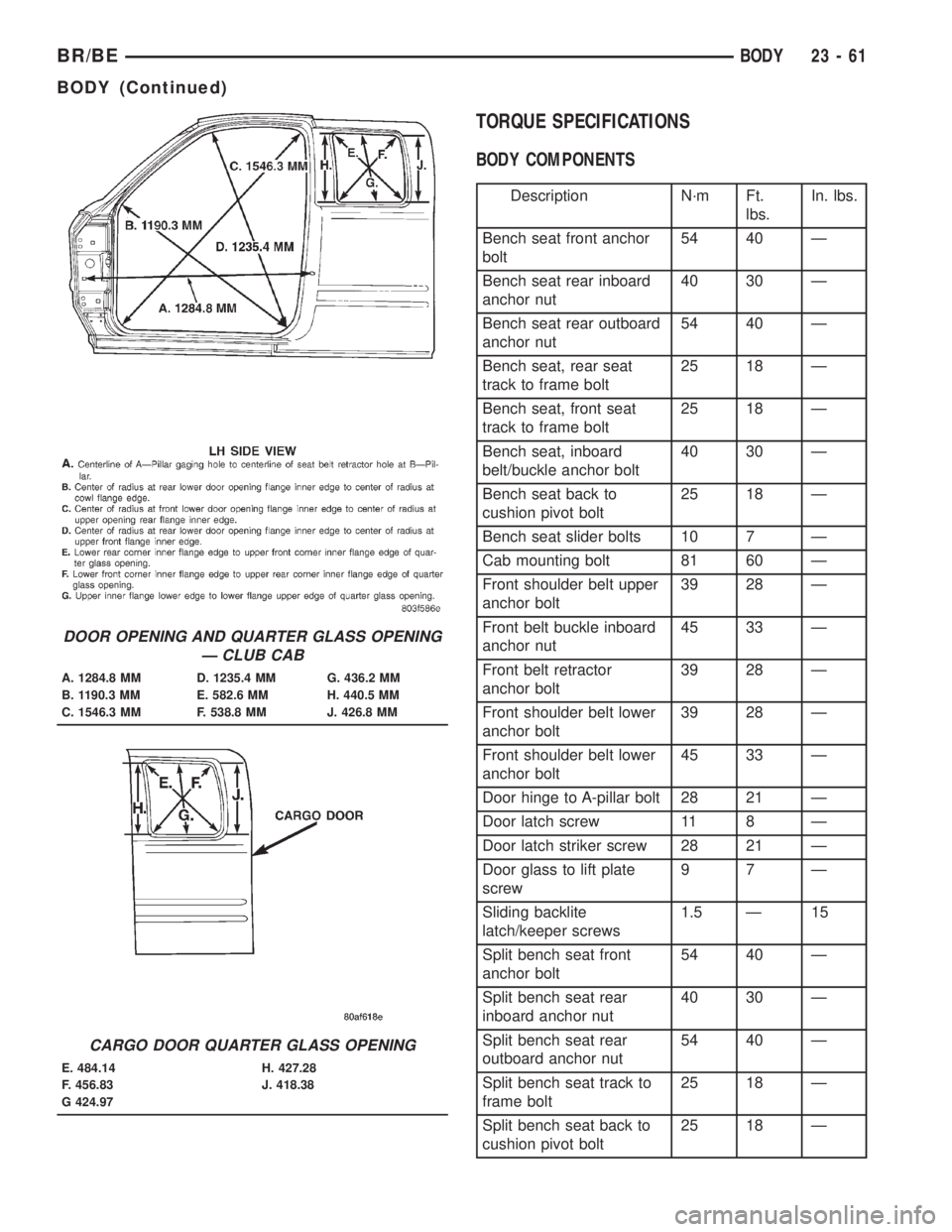
DOOR OPENING AND QUARTER GLASS OPENING
Ð CLUB CAB
A. 1284.8 MM D. 1235.4 MM G. 436.2 MM
B. 1190.3 MM E. 582.6 MM H. 440.5 MM
C. 1546.3 MM F. 538.8 MM J. 426.8 MM
CARGO DOOR QUARTER GLASS OPENING
E. 484.14 H. 427.28
F. 456.83 J. 418.38
G 424.97
BR/BEBODY 23 - 61
BODY (Continued)
Page 2640 of 2889
DOOR - FRONT
TABLE OF CONTENTS
page page
APPLIQUE
REMOVAL..............................67
INSTALLATION...........................67
DOOR
REMOVAL..............................68
INSTALLATION...........................68
ADJUSTMENTS..........................68
DOOR GLASS
REMOVAL..............................69
INSTALLATION...........................69
EXTERIOR HANDLE
REMOVAL..............................70
INSTALLATION...........................70
GLASS RUN CHANNEL
REMOVAL..............................70
INSTALLATION...........................70
HINGE
REMOVAL..............................70
INSTALLATION...........................71
INSIDE HANDLE ACTUATOR
REMOVAL..............................71
INSTALLATION...........................71LATCH
REMOVAL..............................72
INSTALLATION...........................72
ADJUSTMENTS..........................72
LATCH STRIKER
REMOVAL..............................73
INSTALLATION...........................73
LOCK CYLINDER
REMOVAL..............................73
INSTALLATION...........................73
SIDE VIEW MIRROR FLAG
REMOVAL..............................74
INSTALLATION...........................74
TRIM PANEL
REMOVAL..............................74
INSTALLATION...........................74
WATERDAM
REMOVAL..............................75
INSTALLATION...........................75
WINDOW REGULATOR
REMOVAL..............................75
INSTALLATION...........................76
APPLIQUE
REMOVAL
(1) Using a heat lamp, warm B-pillar to 38É C
(100É F).
(2) Remove glass run weatherstrip (Refer to 23 -
BODY/WEATHERSTRIP/SEALS/FDR GLASS RUN
WEATHERSTRIP - REMOVAL).
(3) Remove outer belt weatherstrip (Refer to 23 -
BODY/WEATHERSTRIP/SEALS/FDR OUTER BELT
WEATHERSTRIP - REMOVAL).
(4) Using an even pressure pull, peel B-pillar
applique away from the B-pillar.
INSTALLATION
Installation equipment needed:
²Lint free applicator cloth
²six inch applicator squeegee
²Piercing pin
(1) Clean B-pillar using Mopar Super Kleen or
equivalent.
(2) Wipe surface with a lint free cloth.
(3) Using a heat gun, warm surface to 22É C (70É
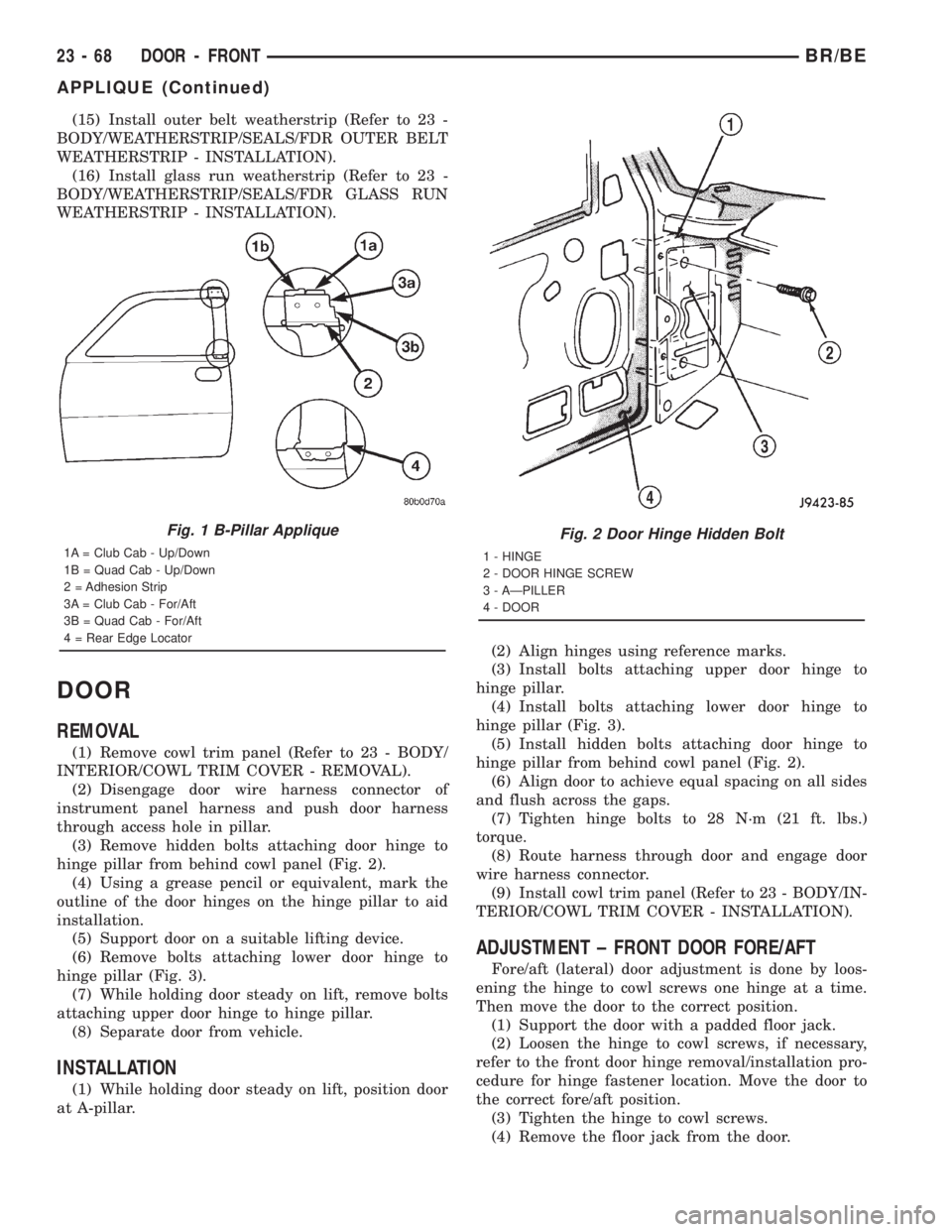
F).(4) Fold down, up/down locator tab (1a or 1b) (Fig.
1)along crease.
(5) Remove carrier from adhesion strip (2).
(6) Using up/down locator tab (1a or 1b) and fore/
aft locator tab (3a or 3b), position the applique on the
upper portion of the B-pillar.
(7) Using the lower edge locator (4), position the
applique on the lower portion of the B-pillar.
(8) Verify the applique is positioned correctly and
press the adhesion strip (2) to the door to tempo-
rarily secure it in place.
(9) Remove the carrier for the applique.
(10) Holding the applique from the surface, apply
firm downward pressure with a six inch applicator
squeegee. Ensure the lower rear edge (4) is aligned
correctly.
(11) Wrap edges around door to at least a 90É
angle.
(12) Remove premask by pulling in a firm contin-
uous manner from top down at 180É.
(13) Complete wrapping applique around the door
edges.
(14) Inspect for air bubbles. Small bubbles can be
pierced with a sharp pin and smoothed out.
BR/BEDOOR - FRONT 23 - 67
Page 2641 of 2889
(15) Install outer belt weatherstrip (Refer to 23 -
BODY/WEATHERSTRIP/SEALS/FDR OUTER BELT
WEATHERSTRIP - INSTALLATION).
(16) Install glass run weatherstrip (Refer to 23 -
BODY/WEATHERSTRIP/SEALS/FDR GLASS RUN
WEATHERSTRIP - INSTALLATION).
DOOR
REMOVAL
(1) Remove cowl trim panel (Refer to 23 - BODY/
INTERIOR/COWL TRIM COVER - REMOVAL).
(2) Disengage door wire harness connector of
instrument panel harness and push door harness
through access hole in pillar.
(3) Remove hidden bolts attaching door hinge to
hinge pillar from behind cowl panel (Fig. 2).
(4) Using a grease pencil or equivalent, mark the
outline of the door hinges on the hinge pillar to aid
installation.
(5) Support door on a suitable lifting device.
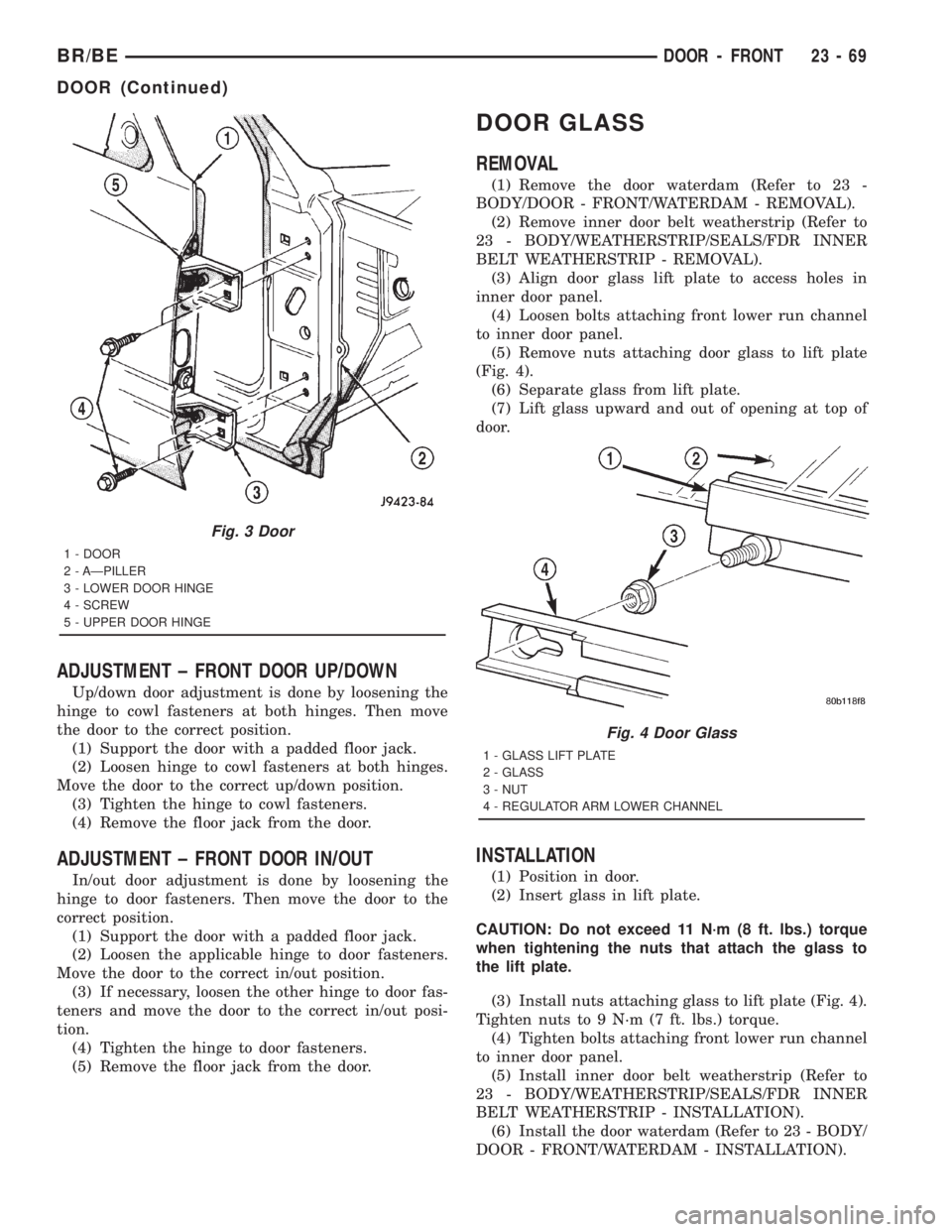
(6) Remove bolts attaching lower door hinge to
hinge pillar (Fig. 3).
(7) While holding door steady on lift, remove bolts
attaching upper door hinge to hinge pillar.
(8) Separate door from vehicle.
INSTALLATION
(1) While holding door steady on lift, position door
at A-pillar.(2) Align hinges using reference marks.
(3) Install bolts attaching upper door hinge to
hinge pillar.
(4) Install bolts attaching lower door hinge to
hinge pillar (Fig. 3).
(5) Install hidden bolts attaching door hinge to
hinge pillar from behind cowl panel (Fig. 2).
(6) Align door to achieve equal spacing on all sides
and flush across the gaps.
(7) Tighten hinge bolts to 28 N´m (21 ft. lbs.)
torque.
(8) Route harness through door and engage door
wire harness connector.
(9) Install cowl trim panel (Refer to 23 - BODY/IN-
TERIOR/COWL TRIM COVER - INSTALLATION).
ADJUSTMENT ± FRONT DOOR FORE/AFT
Fore/aft (lateral) door adjustment is done by loos-
ening the hinge to cowl screws one hinge at a time.
Then move the door to the correct position.
(1) Support the door with a padded floor jack.
(2) Loosen the hinge to cowl screws, if necessary,
refer to the front door hinge removal/installation pro-
cedure for hinge fastener location. Move the door to
the correct fore/aft position.
(3) Tighten the hinge to cowl screws.
(4) Remove the floor jack from the door.
Fig. 1 B-Pillar Applique
1A = Club Cab - Up/Down
1B = Quad Cab - Up/Down
2 = Adhesion Strip
3A = Club Cab - For/Aft
3B = Quad Cab - For/Aft
4 = Rear Edge Locator
Fig. 2 Door Hinge Hidden Bolt
1 - HINGE
2 - DOOR HINGE SCREW
3 - AÐPILLER
4 - DOOR
23 - 68 DOOR - FRONTBR/BE
APPLIQUE (Continued)
Page 2642 of 2889
ADJUSTMENT ± FRONT DOOR UP/DOWN
Up/down door adjustment is done by loosening the
hinge to cowl fasteners at both hinges. Then move
the door to the correct position.
(1) Support the door with a padded floor jack.
(2) Loosen hinge to cowl fasteners at both hinges.
Move the door to the correct up/down position.
(3) Tighten the hinge to cowl fasteners.
(4) Remove the floor jack from the door.
ADJUSTMENT ± FRONT DOOR IN/OUT
In/out door adjustment is done by loosening the
hinge to door fasteners. Then move the door to the
correct position.
(1) Support the door with a padded floor jack.
(2) Loosen the applicable hinge to door fasteners.
Move the door to the correct in/out position.
(3) If necessary, loosen the other hinge to door fas-
teners and move the door to the correct in/out posi-
tion.
(4) Tighten the hinge to door fasteners.
(5) Remove the floor jack from the door.
DOOR GLASS
REMOVAL
(1) Remove the door waterdam (Refer to 23 -
BODY/DOOR - FRONT/WATERDAM - REMOVAL).
(2) Remove inner door belt weatherstrip (Refer to
23 - BODY/WEATHERSTRIP/SEALS/FDR INNER
BELT WEATHERSTRIP - REMOVAL).
(3) Align door glass lift plate to access holes in
inner door panel.
(4) Loosen bolts attaching front lower run channel
to inner door panel.
(5) Remove nuts attaching door glass to lift plate
(Fig. 4).
(6) Separate glass from lift plate.
(7) Lift glass upward and out of opening at top of
door.
INSTALLATION
(1) Position in door.
(2) Insert glass in lift plate.
CAUTION: Do not exceed 11 N´m (8 ft. lbs.) torque
when tightening the nuts that attach the glass to
the lift plate.
(3) Install nuts attaching glass to lift plate (Fig. 4).
Tighten nuts to 9 N´m (7 ft. lbs.) torque.
(4) Tighten bolts attaching front lower run channel
to inner door panel.
(5) Install inner door belt weatherstrip (Refer to
23 - BODY/WEATHERSTRIP/SEALS/FDR INNER
BELT WEATHERSTRIP - INSTALLATION).
(6) Install the door waterdam (Refer to 23 - BODY/
DOOR - FRONT/WATERDAM - INSTALLATION).
Fig. 3 Door
1 - DOOR
2 - AÐPILLER
3 - LOWER DOOR HINGE
4 - SCREW
5 - UPPER DOOR HINGE
Fig. 4 Door Glass
1 - GLASS LIFT PLATE
2 - GLASS
3 - NUT
4 - REGULATOR ARM LOWER CHANNEL
BR/BEDOOR - FRONT 23 - 69
DOOR (Continued)
Page 2677 of 2889
INSTRUMENT PANEL SYSTEM
TABLE OF CONTENTS
page page
INSTRUMENT PANEL SYSTEM
DESCRIPTION..........................104
OPERATION............................105
REMOVAL.............................106
INSTALLATION..........................107
ASH RECEIVER
REMOVAL.............................108
INSTALLATION..........................109
CLUSTER BEZEL
REMOVAL.............................109
INSTALLATION..........................110
CUBBY BIN
REMOVAL.............................110
INSTALLATION..........................110
CUP HOLDER
REMOVAL.............................110
INSTALLATION..........................111
GLOVE BOX
REMOVAL.............................112DISASSEMBLY..........................112
ASSEMBLY.............................112
INSTALLATION..........................113
GLOVE BOX LATCH STRIKER
REMOVAL.............................113
INSTALLATION..........................113
GLOVE BOX OPENING UPPER TRIM
REMOVAL.............................114
INSTALLATION..........................114
INSTRUMENT PANEL TOP COVER
REMOVAL.............................114
INSTALLATION..........................115
STEERING COLUMN OPENING COVER
REMOVAL.............................115
INSTALLATION..........................116
STORAGE BIN
REMOVAL.............................116
INSTALLATION..........................116
INSTRUMENT PANEL SYSTEM
DESCRIPTION
The instrument panel is located at the front of the
passenger compartment. This instrument panel is
molded from a blend of various plastics that are
mechanically attached to the vehicle. Colors are
molded into the plastic components to minimize
appearance degradation from scratches or abrasions.
The panel components are internally ribbed and riv-
eted to steel reinforcements for additional structural
integrity and dimensional stability. The instrument
panel surface components are designed to deform
upon impact without breaking. This type of construc-
tion provides improved energy absorption which, in
conjunction with the dual airbags and seat belts,
helps to improve occupant protection.
The top of the instrument panel is secured to the
top of the dash panel near the base of the windshield
using screws. An end bracket integral to each end of
the instrument panel structure is secured to each
cowl side inner panel with a screw. A stamped metal
bracket supports the center of the instrument panel
by securing it to the top of the floor panel transmis-
sion tunnel below the instrument panel with screws.
The instrument cluster, radio, heater-air conditioner
control, passenger airbag, glove box, electrical junc-
tion block, Central Timer Module (CTM), accessoryswitches, ash receiver, cigar lighter, accessory power
outlet, park brake release handle, inside hood release
handle, as well as numerous other components are
secured to and supported by this unit.
The instrument panel for this vehicle includes the
following major features:
²Cluster Bezel- This molded plastic bezel is
secured with snap clips to the instrument panel sup-
porting structure. It trims out the edges of the head-
lamp switch, instrument cluster, radio, heater-air
conditioner controls, passenger airbag on-off switch,
and the heated seat switches on vehicles so equipped.
On vehicles without the heated seat option, a small
storage cubby bin is provided in the cluster bezel.
This bezel also incorporates three completely adjust-
able panel outlets for the climate control system, and
fills the opening between the instrument cluster and
the top of the steering column where it passes
through the instrument panel.
²Cup Holder/Storage Bin- Vehicles equipped
with an automatic transmission feature a latching
fold-down, adjustable cup holder located on the lower
instrument panel between the glove box and the ash
receiver. Vehicles equipped with a manual transmis-
sion have a lighted storage bin on the instrument
panel in place of the cup holder.
²Glove Box- The hinged bin-type glove box in
the passenger side of the instrument panel features a
recessed paddle-operated latch handle. Three molded
23 - 104 INSTRUMENT PANEL SYSTEMBR/BE