flat tire DODGE RAM 2001 Service Owner's Manual
[x] Cancel search | Manufacturer: DODGE, Model Year: 2001, Model line: RAM, Model: DODGE RAM 2001Pages: 2889, PDF Size: 68.07 MB
Page 2569 of 2889
DIAGNOSIS AND TESTING - TIRE NOISE OR
VIBRATION
Radial-ply tires are sensitive to force impulses
caused by improper mounting, vibration, wheel
defects, or possibly tire imbalance.
To find out if tires are causing the noise or vibra-
tion, drive the vehicle over a smooth road at varying
speeds. Note the noise level during acceleration and
deceleration. The engine, differential and exhaust
noises will change as speed varies, while the tire
noise will usually remain constant.
STANDARD PROCEDURES - REPAIRING LEAKS
For proper repairing, a radial tire must be removed
from the wheel. Repairs should only be made if the
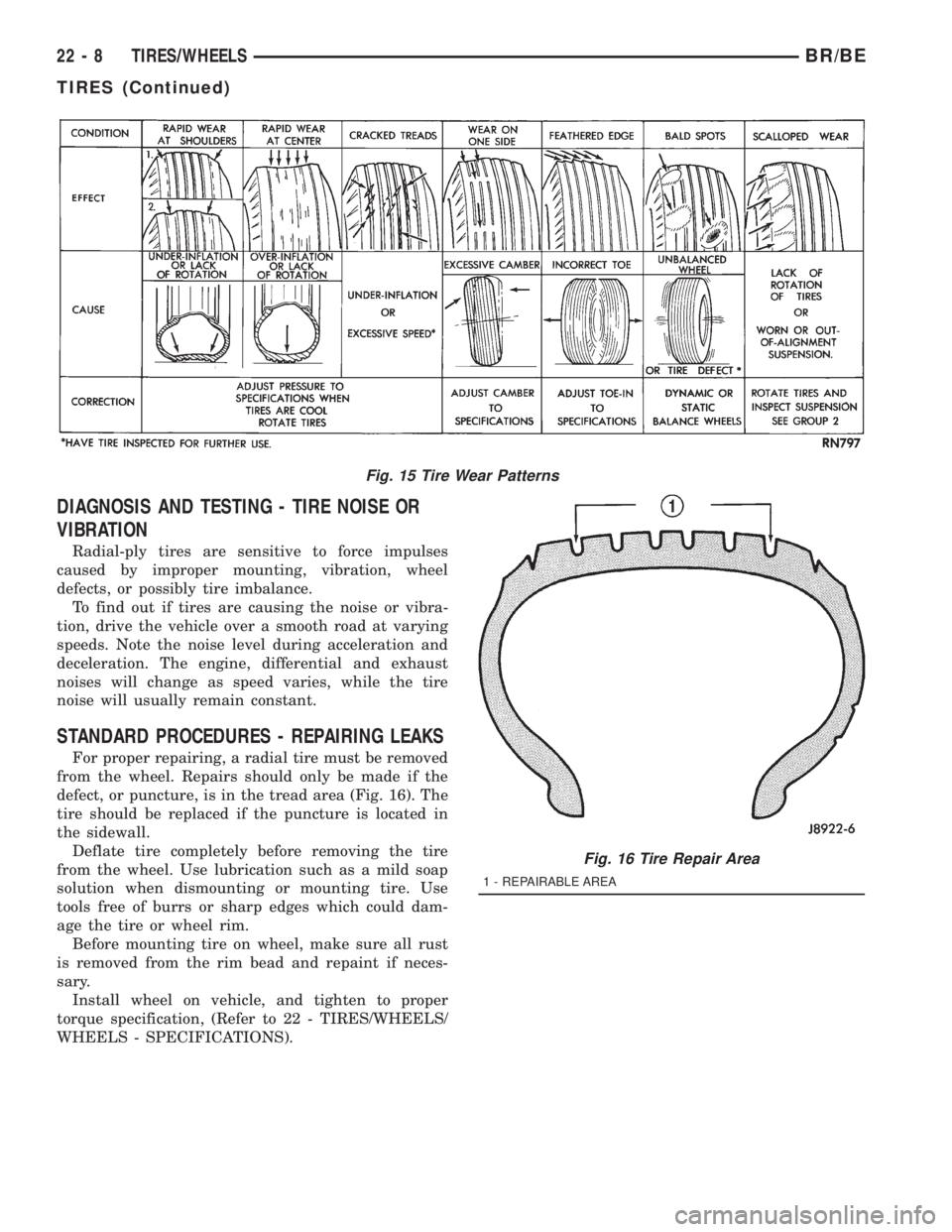
defect, or puncture, is in the tread area (Fig. 16). The
tire should be replaced if the puncture is located in
the sidewall.
Deflate tire completely before removing the tire
from the wheel. Use lubrication such as a mild soap
solution when dismounting or mounting tire. Use
tools free of burrs or sharp edges which could dam-
age the tire or wheel rim.
Before mounting tire on wheel, make sure all rust
is removed from the rim bead and repaint if neces-
sary.
Install wheel on vehicle, and tighten to proper
torque specification, (Refer to 22 - TIRES/WHEELS/
WHEELS - SPECIFICATIONS).
Fig. 15 Tire Wear Patterns
Fig. 16 Tire Repair Area
1 - REPAIRABLE AREA
22 - 8 TIRES/WHEELSBR/BE
TIRES (Continued)
Page 2570 of 2889
SPECIFICATIONS
TIRE REVOLUTIONS PER MILE
TIRE SIZE SUPPLIER REVOLUTIONS PER MILE
P225/75/R16 XL GOODYEAR 716
P245/75R16
WRT/SGOODYEAR 692
P245/75R16
LTX A/SMICHELIN 691
P265/75R16
WRT/SGOODYEAR 668
LT245/75R16 LTX A/S MICHELIN 679
LT245/75R16 LTX M/S MICHELIN 678
LT265/75R16 LTX A/S MICHELIN 648
LT265/75R16 LTX M/S MICHELIN 652
LT275/70R17
WGSAGOODYEAR 650
LT235/85R16
WAPGOODYEAR 650
LT235/85R16
LTX M/SMICHELIN 650
SPARE TIRE
DESCRIPTION
The temporary spare tire is designed for emer-
gency use only. The original tire should be repaired
or replaced at the first opportunity, then reinstalled.
Do not exceed speeds of 50 M.P.H. when using the
temporary spare tire. Refer to Owner's Manual for
complete details.
WHEELS
DESCRIPTION
Original equipment wheels are designed for the
specified Maximum Vehicle Capacity.
All models use steel or cast aluminum drop center
wheels.
Cast aluminum wheels require special balance
weights and alignment equipment.
Ram Truck Models equipped with dual rear wheels
have eight-stud hole rear wheels. The wheels have a
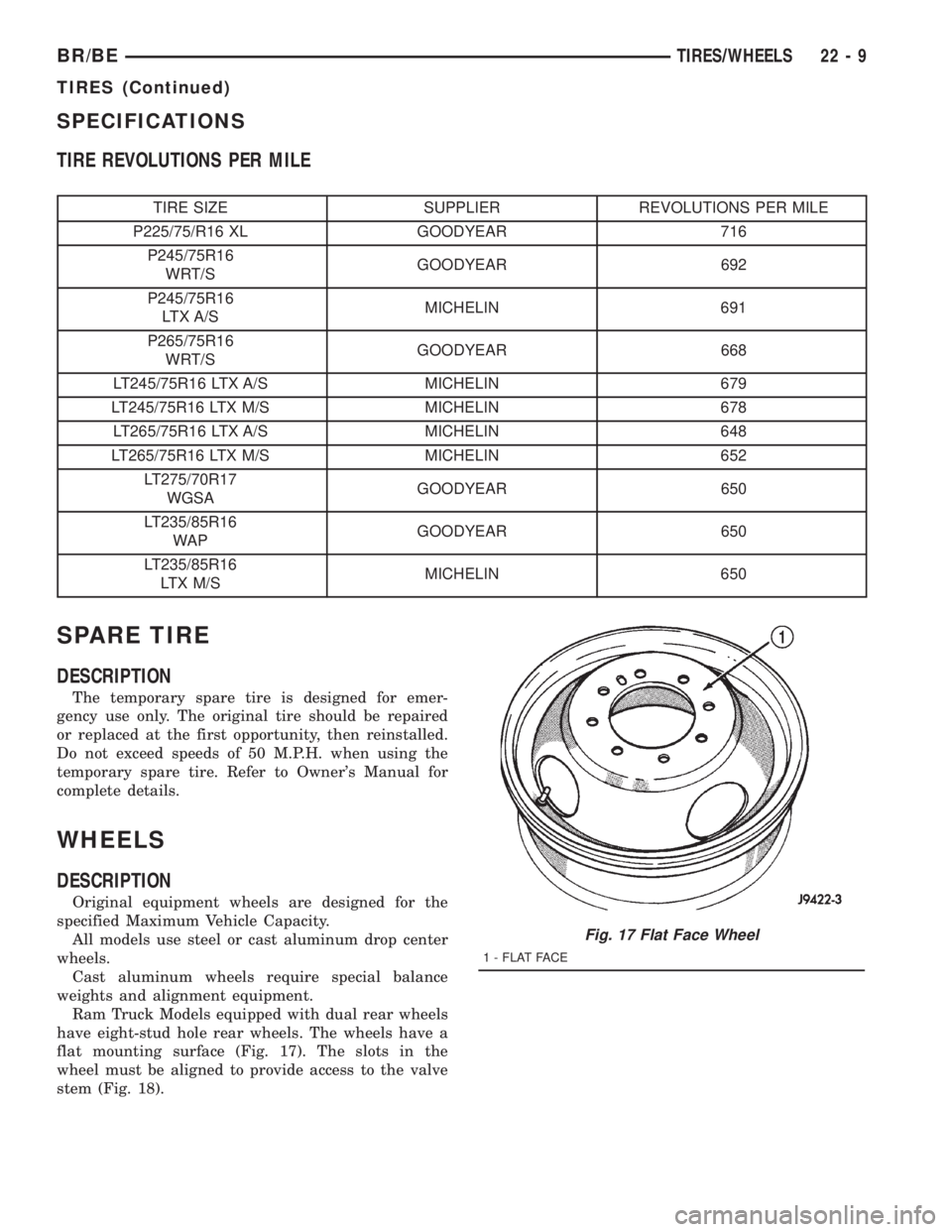
flat mounting surface (Fig. 17). The slots in the
wheel must be aligned to provide access to the valve
stem (Fig. 18).
Fig. 17 Flat Face Wheel
1 - FLAT FACE
BR/BETIRES/WHEELS 22 - 9
TIRES (Continued)
Page 2571 of 2889
OPERATION
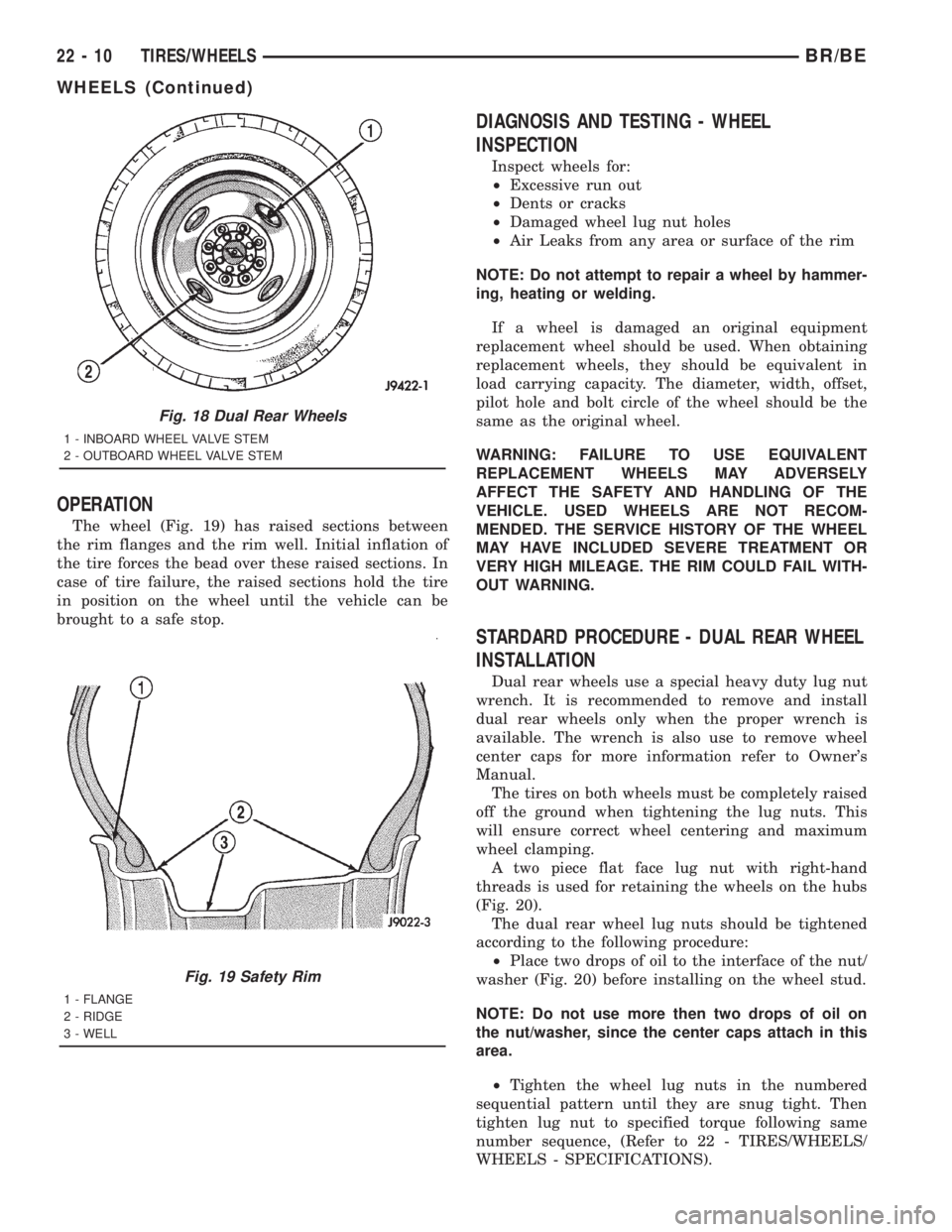
The wheel (Fig. 19) has raised sections between
the rim flanges and the rim well. Initial inflation of
the tire forces the bead over these raised sections. In
case of tire failure, the raised sections hold the tire
in position on the wheel until the vehicle can be
brought to a safe stop.
DIAGNOSIS AND TESTING - WHEEL
INSPECTION
Inspect wheels for:
²Excessive run out
²Dents or cracks
²Damaged wheel lug nut holes
²Air Leaks from any area or surface of the rim
NOTE: Do not attempt to repair a wheel by hammer-
ing, heating or welding.
If a wheel is damaged an original equipment
replacement wheel should be used. When obtaining
replacement wheels, they should be equivalent in
load carrying capacity. The diameter, width, offset,
pilot hole and bolt circle of the wheel should be the
same as the original wheel.
WARNING: FAILURE TO USE EQUIVALENT
REPLACEMENT WHEELS MAY ADVERSELY
AFFECT THE SAFETY AND HANDLING OF THE
VEHICLE. USED WHEELS ARE NOT RECOM-
MENDED. THE SERVICE HISTORY OF THE WHEEL
MAY HAVE INCLUDED SEVERE TREATMENT OR
VERY HIGH MILEAGE. THE RIM COULD FAIL WITH-
OUT WARNING.
STARDARD PROCEDURE - DUAL REAR WHEEL
INSTALLATION
Dual rear wheels use a special heavy duty lug nut
wrench. It is recommended to remove and install
dual rear wheels only when the proper wrench is
available. The wrench is also use to remove wheel
center caps for more information refer to Owner's
Manual.
The tires on both wheels must be completely raised
off the ground when tightening the lug nuts. This
will ensure correct wheel centering and maximum
wheel clamping.
A two piece flat face lug nut with right-hand
threads is used for retaining the wheels on the hubs
(Fig. 20).
The dual rear wheel lug nuts should be tightened
according to the following procedure:
²Place two drops of oil to the interface of the nut/
washer (Fig. 20) before installing on the wheel stud.
NOTE: Do not use more then two drops of oil on
the nut/washer, since the center caps attach in this
area.
²Tighten the wheel lug nuts in the numbered
sequential pattern until they are snug tight. Then
tighten lug nut to specified torque following same
number sequence, (Refer to 22 - TIRES/WHEELS/
WHEELS - SPECIFICATIONS).
Fig. 18 Dual Rear Wheels
1 - INBOARD WHEEL VALVE STEM
2 - OUTBOARD WHEEL VALVE STEM
Fig. 19 Safety Rim
1 - FLANGE
2 - RIDGE
3 - WELL
22 - 10 TIRES/WHEELSBR/BE
WHEELS (Continued)
Page 2573 of 2889
STUDS
REMOVAL
(1) Raise and support the vehicle.
(2) Remove the wheel and tire assembly.
(3) Remove the brake caliper, caliper adapter and
rotor, (Refer to 5 - BRAKES/HYDRAULIC/MECHAN-
ICAL/ROTORS - REMOVAL).
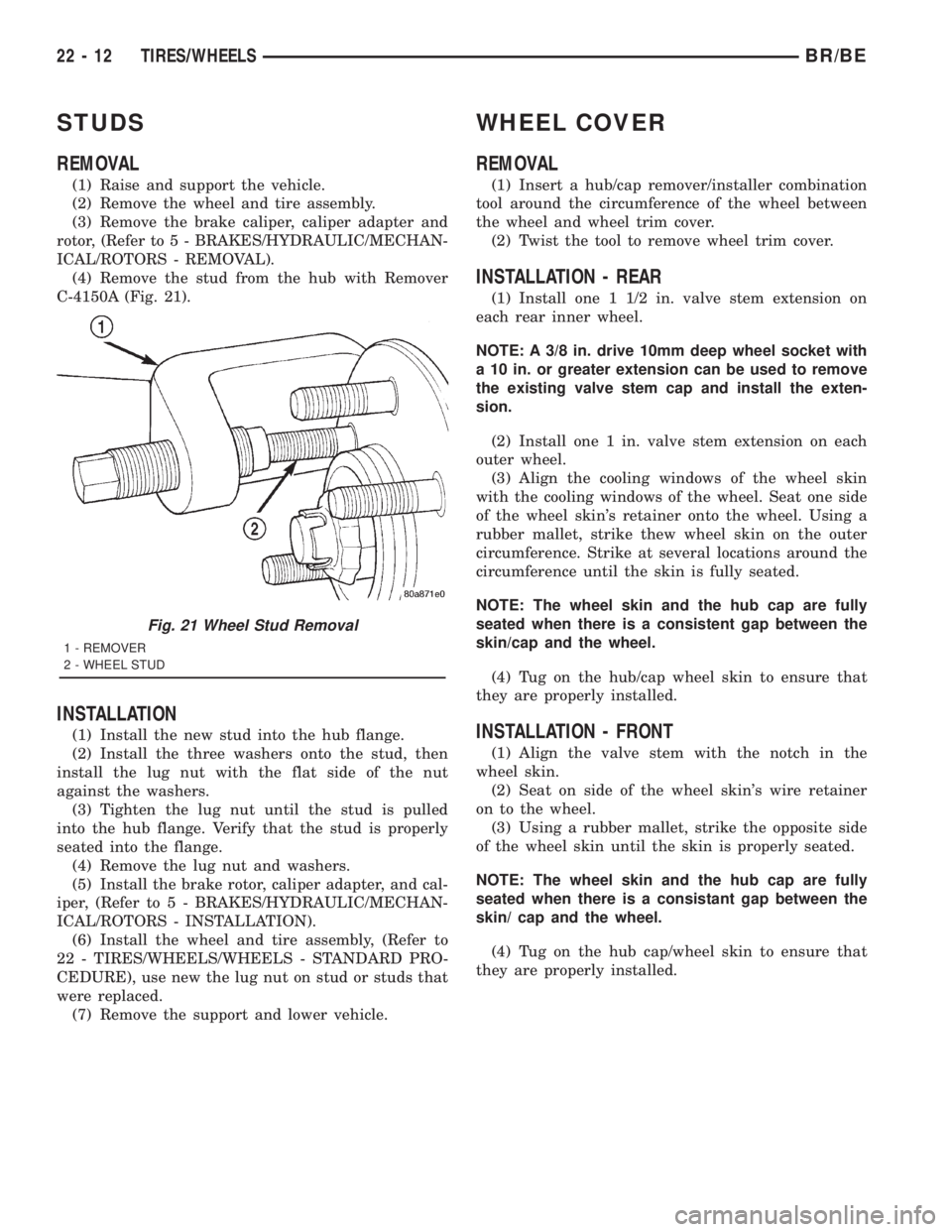
(4) Remove the stud from the hub with Remover
C-4150A (Fig. 21).
INSTALLATION
(1) Install the new stud into the hub flange.
(2) Install the three washers onto the stud, then
install the lug nut with the flat side of the nut
against the washers.
(3) Tighten the lug nut until the stud is pulled
into the hub flange. Verify that the stud is properly
seated into the flange.
(4) Remove the lug nut and washers.
(5) Install the brake rotor, caliper adapter, and cal-
iper, (Refer to 5 - BRAKES/HYDRAULIC/MECHAN-
ICAL/ROTORS - INSTALLATION).
(6) Install the wheel and tire assembly, (Refer to
22 - TIRES/WHEELS/WHEELS - STANDARD PRO-
CEDURE), use new the lug nut on stud or studs that
were replaced.
(7) Remove the support and lower vehicle.
WHEEL COVER
REMOVAL
(1) Insert a hub/cap remover/installer combination
tool around the circumference of the wheel between
the wheel and wheel trim cover.
(2) Twist the tool to remove wheel trim cover.
INSTALLATION - REAR
(1) Install one 1 1/2 in. valve stem extension on
each rear inner wheel.
NOTE: A 3/8 in. drive 10mm deep wheel socket with
a 10 in. or greater extension can be used to remove
the existing valve stem cap and install the exten-
sion.
(2) Install one 1 in. valve stem extension on each
outer wheel.
(3) Align the cooling windows of the wheel skin
with the cooling windows of the wheel. Seat one side
of the wheel skin's retainer onto the wheel. Using a
rubber mallet, strike thew wheel skin on the outer
circumference. Strike at several locations around the
circumference until the skin is fully seated.
NOTE: The wheel skin and the hub cap are fully
seated when there is a consistent gap between the
skin/cap and the wheel.
(4) Tug on the hub/cap wheel skin to ensure that
they are properly installed.
INSTALLATION - FRONT
(1) Align the valve stem with the notch in the
wheel skin.
(2) Seat on side of the wheel skin's wire retainer
on to the wheel.
(3) Using a rubber mallet, strike the opposite side
of the wheel skin until the skin is properly seated.
NOTE: The wheel skin and the hub cap are fully
seated when there is a consistant gap between the
skin/ cap and the wheel.
(4) Tug on the hub cap/wheel skin to ensure that
they are properly installed.
Fig. 21 Wheel Stud Removal
1 - REMOVER
2 - WHEEL STUD
22 - 12 TIRES/WHEELSBR/BE
Page 2845 of 2889
STANDARD PROCEDURE - PRE DELIVERY
STORAGE
(1) If possible, store vehicles indoors, in clean, dry
places. If vehicles must be stored outdoors:
²Try to avoid storage locations that are near any
obvious sources of industrial or environmental con-
tamination (e.g., trees, factories, steam or vapor
vents, railroad tracks, etc.)
²Maintain tight security to help prevent pilferage
and vandalism, and inspect each vehicle regularly to
check for such damage
²If the vehicle must be parked on an incline, park
it with the front end higher than the rear; this will
prevent ªhydrostatic lockº caused by fuel draining
into the engine
²Rinse the vehicle at least once a week. Snow
should be washed away more often, since it can trap
harmful contaminants. Dry all horizontal surfaces
(2) The IOD fuse should be removed in order to
prevent battery drain and possible damage.
(3) Check the vehicle's coolant and anti-freeze pro-
tection.
(4) Check the vehicle's battery at least once a
month for a proper charge (at least 12.4 volts).
Charge the battery if necessary. This will help pre-
vent freezing and deterioration.
(5) Check the vehicle's tires and inflate them to
their maximum recommended levels. Move the vehi-
cles periodically to avoid ªflatspottingº the tires.
(6) Do not engage the parking brake; keep it in the
OFF position.
(7) Keep all windows closed, all doors locked, and
all trim covers intact and in place.
(8) Do not use chalks, crayons or any marker con-
taining abrasives on painted, plated or glass sur-
faces.
(9) Always use seat covers when moving a vehicle.
PROGRAMMABLE
ELECTRONIC FEATURES
DESCRIPTION
The programming of electronic features applies to
specific DaimlerChrysler Corporation vehicles. Not
all vehicles are equipped with these electronic fea-
tures, and not all vehicles equipped with electronic
features have all the available features. Programma-
ble electronic features are subject to change and may
be added or deleted from specific vehicle models.
(1) The programmable electronic features that may
be provided on the vehicle are:
²Rolling Power Door Locks
²Horn Chirp (When Doors Locked With Remote
Keyless Entry)²Headlamp Flash (When Doors Locked or
Unlocked With Remote Keyless Entry)
²Low Fuel Chime
²Remote Keyless Entry Door Unlock Sequence
²Headlights On Automatically With Wipers
²Turn Signal Chime
²12V Power Outlet
²Remote Unlock
²Remote Linked To Memory
²Headlamp Delay
²Service Interval
²Easy Exit Seat
(2) Programming any of the above features is to be
performed prior to vehicle delivery to the customer,
depending on customer preference.
NOTE: For all vehicles except Caravan/Town and
Country, the programming must be performed using
the DRB IIITscan tool. On Caravan/Town and Coun-
try vehicles the features can be programmed using
the DRB IIITscan tool or by button pushing
sequences. The customer can perform program-
ming, if desired, by following the instructions out-
lined in the owner manual.
OPERATION
NOTE: The programmable features provided on
vehicles need to be explained to the customer at
the time of sale. The customer's preferences con-
cerning the features should be noted and pro-
grammed accordingly during predelivery.
NOTE: When using the DRB IIITscan tool to enable/
disable any programmable electronic features, go to
the main menu item #9 on the DRB IIITscan tool.
This is ªCustomer Preferencesº. You must choose
ªCustomer Preferencesº on the main menu to pro-
gram the desired features.
ROLLING POWER DOOR LOCKS
With this feature enabled, the vehicle's door lock-
ing mechanisms automatically lock when the vehicle
reaches approximately 24 Km/h (15 mph).
HORN CHIRP
NOTE: This feature can be enabled with or without
the headlamp flash feature.
The horn chirp function is a feature that can be
enabled or disabled on vehicles equipped with
30 - 20 NEW VEHICLE PREPARATIONBR/BE
PRE DELIVERY STORAGE (Continued)