battery capacity DODGE RAM 2002 Service User Guide
[x] Cancel search | Manufacturer: DODGE, Model Year: 2002, Model line: RAM, Model: DODGE RAM 2002Pages: 2255, PDF Size: 62.07 MB
Page 407 of 2255
(5) Remove the battery hold down strap from the
top of the battery case.
INSTALLATION
(1) Clean and inspect the battery hold down hard-
ware (Refer to 8 - ELECTRICAL/BATTERY SYSTEM
- CLEANING).
(2) Position the battery hold down strap across the
top of the battery case.
(3) Install and tighten the two battery hold down
bolts through the holes on each end of the hold down
strap and into the U-nuts on each side of the battery
tray. Tighten the bolts to 4 N´m (35 in. lbs.).
(4) Reconnect the battery negative cable terminal
clamp to the battery negative terminal post. Tighten
the terminal clamp pinch-bolt hex nut to 4 N´m (35
in. lbs.).
BATTERY CABLE
DESCRIPTION
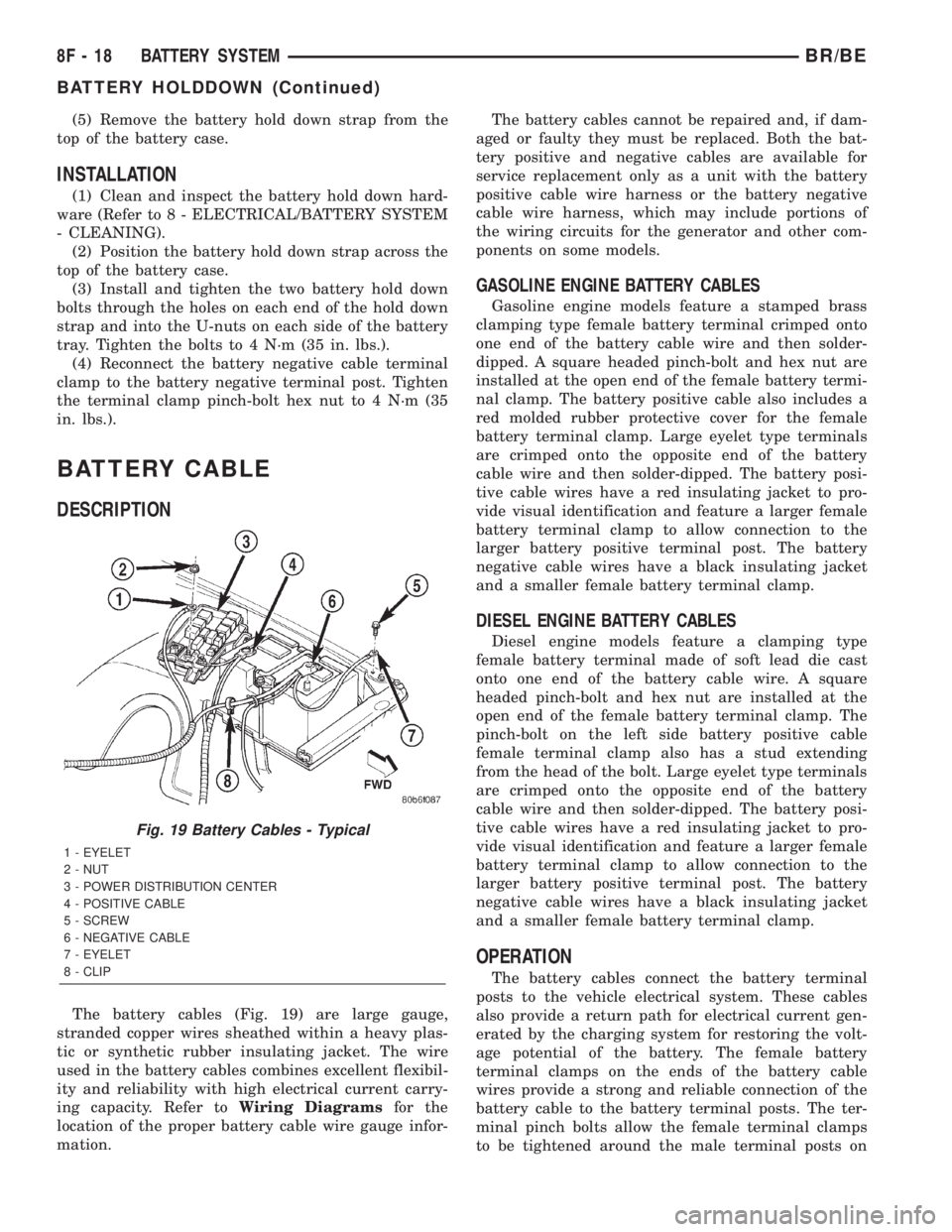
The battery cables (Fig. 19) are large gauge,
stranded copper wires sheathed within a heavy plas-
tic or synthetic rubber insulating jacket. The wire
used in the battery cables combines excellent flexibil-
ity and reliability with high electrical current carry-
ing capacity. Refer toWiring Diagramsfor the
location of the proper battery cable wire gauge infor-
mation.The battery cables cannot be repaired and, if dam-
aged or faulty they must be replaced. Both the bat-
tery positive and negative cables are available for
service replacement only as a unit with the battery
positive cable wire harness or the battery negative
cable wire harness, which may include portions of
the wiring circuits for the generator and other com-
ponents on some models.
GASOLINE ENGINE BATTERY CABLES
Gasoline engine models feature a stamped brass
clamping type female battery terminal crimped onto
one end of the battery cable wire and then solder-
dipped. A square headed pinch-bolt and hex nut are
installed at the open end of the female battery termi-
nal clamp. The battery positive cable also includes a
red molded rubber protective cover for the female
battery terminal clamp. Large eyelet type terminals
are crimped onto the opposite end of the battery
cable wire and then solder-dipped. The battery posi-
tive cable wires have a red insulating jacket to pro-
vide visual identification and feature a larger female
battery terminal clamp to allow connection to the
larger battery positive terminal post. The battery
negative cable wires have a black insulating jacket
and a smaller female battery terminal clamp.
DIESEL ENGINE BATTERY CABLES
Diesel engine models feature a clamping type
female battery terminal made of soft lead die cast
onto one end of the battery cable wire. A square
headed pinch-bolt and hex nut are installed at the
open end of the female battery terminal clamp. The
pinch-bolt on the left side battery positive cable
female terminal clamp also has a stud extending
from the head of the bolt. Large eyelet type terminals
are crimped onto the opposite end of the battery
cable wire and then solder-dipped. The battery posi-
tive cable wires have a red insulating jacket to pro-
vide visual identification and feature a larger female
battery terminal clamp to allow connection to the
larger battery positive terminal post. The battery
negative cable wires have a black insulating jacket
and a smaller female battery terminal clamp.
OPERATION
The battery cables connect the battery terminal
posts to the vehicle electrical system. These cables
also provide a return path for electrical current gen-
erated by the charging system for restoring the volt-
age potential of the battery. The female battery
terminal clamps on the ends of the battery cable
wires provide a strong and reliable connection of the
battery cable to the battery terminal posts. The ter-
minal pinch bolts allow the female terminal clamps
to be tightened around the male terminal posts on
Fig. 19 Battery Cables - Typical
1 - EYELET
2 - NUT
3 - POWER DISTRIBUTION CENTER
4 - POSITIVE CABLE
5 - SCREW
6 - NEGATIVE CABLE
7 - EYELET
8 - CLIP
8F - 18 BATTERY SYSTEMBR/BE
BATTERY HOLDDOWN (Continued)
Page 422 of 2255
Starting System Diagnosis
CONDITION POSSIBLE CAUSE CORRECTION
STARTER ENGAGES,
SPINS OUT BEFORE
ENGINE STARTS.1. Starter ring gear faulty. 1. Refer to Starter Motor Removal and Installation.
Remove starter motor to inspect starter ring gear.
Replace starter ring gear if required.
2. Starter motor faulty. 2. If all other starting system components and circuits test
OK, replace starter motor assembly.
STARTER DOES NOT
DISENGAGE.1. Starter motor
improperly installed.1. Refer to Starter Motor Removal and Installation.
Tighten starter mounting hardware to correct torque
specifications.
2. Starter relay faulty. 2. Refer to Starter Relay Diagnosis and Testing. Replace
starter relay if required.
3. Ignition switch faulty. 3. Refer to Ignition Switch and Key Lock Cylinder.
Replace ignition switch if required.
4. Starter motor faulty. 4. If all other starting system components and circuits test
OK, replace starter motor.
INSPECTION
For complete starter wiring circuit diagrams, refer
to 8, Wiring Diagrams. Before removing any unit
from starting system for repair or diagnosis, perform
the following inspections:
WARNING: ON VEHICLES EQUIPPED WITH AIR-
BAGS, REFER TO 8, PASSIVE RESTRAINT SYS-
TEMS, BEFORE ATTEMPTING ANY STEERING
WHEEL, STEERING COLUMN, OR INSTRUMENT
PANEL COMPONENT DIAGNOSIS OR SERVICE.
FAILURE TO TAKE THE PROPER PRECAUTIONS
COULD RESULT IN ACCIDENTAL AIRBAG DEPLOY-
MENT AND POSSIBLE PERSONAL INJURY.
²Battery- Visually inspect battery for indica-
tions of physical damage and loose or corroded cable
connections. Determine state-of-charge and cranking
capacity of battery. Charge or replace battery if
required. Refer toBatteryin 8, Battery.Note: If
equipped with diesel engine, a dual battery sys-
tem may be used, and both batteries must be
inspected.
²Ignition Switch- Visually inspect ignition
switch for indications of physical damage and loose
or corroded wire harness connections. Refer toIgni-
tion Switch and Key Lock Cylinder.
²Clutch Pedal Position Switch- If equipped
with manual transmission, visually inspect clutch
pedal position switch for indications of physical dam-
age and loose or corroded wire harness connections.
Refer toClutch Pedal Position Switchin 6,
Clutch.
²Park/Neutral Position Switch- If equipped
with automatic transmission, visually inspect park/
neutral position switch for indications of physical
damage and loose or corroded wire harness connec-tions. Refer toPark/Neutral Position Switchin
21, Transmission.
²Starter Relay- Visually inspect starter relay
for indications of physical damage and loose or cor-
roded wire harness connections.
²Starter Motor- Visually inspect starter motor
for indications of physical damage and loose or cor-
roded wire harness connections.
²Starter Solenoid- Visually inspect starter sole-
noid for indications of physical damage and loose or
corroded wire harness connections.
²Wiring- Visually inspect wire harnesses for
damage. Repair or replace any faulty wiring, as
required. Refer to 8, Wiring Diagrams.
TESTING
COLD CRANKING TEST
For complete starter wiring circuit diagrams, refer
to 8, Wiring Diagrams. The battery must be fully-
charged and load-tested before proceeding. Refer to
Batteryin 8, Battery.
(1) Connect volt-ampere tester to battery terminals
(Fig. 1). See instructions provided by manufacturer of
volt-ampere tester being used.Note: Certain diesel
equipped models use dual batteries. If equipped
with dual battery system, tester should be con-
nected to battery on left side of vehicle only.
Also, tester current reading must be taken from
positive battery cable lead that connects to
starter motor.
(2) Fully engage parking brake.
(3) If equipped with manual transmission, place
gearshift selector lever in Neutral position and block
clutch pedal in fully depressed position. If equipped
with automatic transmission, place gearshift selector
lever in Park position.
BR/BESTARTING 8F - 33
STARTING (Continued)
Page 445 of 2255
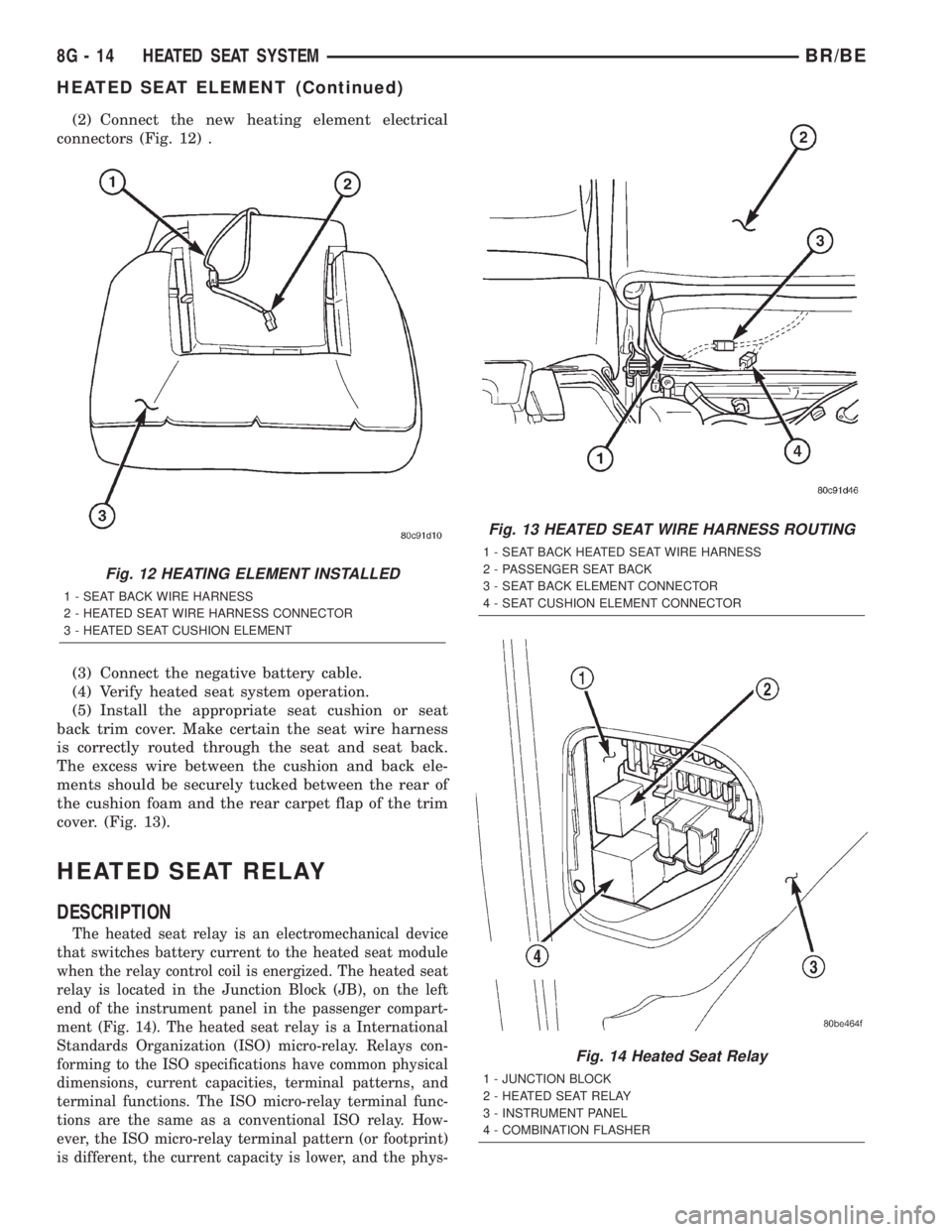
(2) Connect the new heating element electrical
connectors (Fig. 12) .
(3) Connect the negative battery cable.
(4) Verify heated seat system operation.
(5) Install the appropriate seat cushion or seat
back trim cover. Make certain the seat wire harness
is correctly routed through the seat and seat back.
The excess wire between the cushion and back ele-
ments should be securely tucked between the rear of
the cushion foam and the rear carpet flap of the trim
cover. (Fig. 13).
HEATED SEAT RELAY
DESCRIPTION
The heated seat relay is an electromechanical device
that switches battery current to the heated seat module
when the relay control coil is energized. The heated seat
relay is located in the Junction Block (JB), on the left
end of the instrument panel in the passenger compart-
ment (Fig. 14). The heated seat relay is a International
Standards Organization (ISO) micro-relay. Relays con-
forming to the ISO specifications have common physical
dimensions, current capacities, terminal patterns, and
terminal functions. The ISO micro-relay terminal func-
tions are the same as a conventional ISO relay. How-
ever, the ISO micro-relay terminal pattern (or footprint)
is different, the current capacity is lower, and the phys-
Fig. 12 HEATING ELEMENT INSTALLED
1 - SEAT BACK WIRE HARNESS
2 - HEATED SEAT WIRE HARNESS CONNECTOR
3 - HEATED SEAT CUSHION ELEMENT
Fig. 13 HEATED SEAT WIRE HARNESS ROUTING
1 - SEAT BACK HEATED SEAT WIRE HARNESS
2 - PASSENGER SEAT BACK
3 - SEAT BACK ELEMENT CONNECTOR
4 - SEAT CUSHION ELEMENT CONNECTOR
Fig. 14 Heated Seat Relay
1 - JUNCTION BLOCK
2 - HEATED SEAT RELAY
3 - INSTRUMENT PANEL
4 - COMBINATION FLASHER
8G - 14 HEATED SEAT SYSTEMBR/BE
HEATED SEAT ELEMENT (Continued)
Page 454 of 2255
INSTALLATION
(1) Position the horn and mounting bracket unit(s)
onto the right fender wheel house front extension.
(2) Install and tighten the screw that secures the
horn and mounting bracket unit(s) to the right
fender wheel house front extension. Tighten the
screw to 11 N´m (95 in. lbs.).
(3) Reconnect the wire harness connector(s) to the
horn connector receptacle(s).
(4) Reconnect the battery negative cable.
HORN RELAY
DESCRIPTION
The horn relay is a electromechanical device that
switches battery current to the horn when the horn
switch grounds the relay coil. The horn relay is
located in the Power Distribution Center (PDC) in
the engine compartment. If a problem is encountered
with a continuously sounding horn, it can usually be
quickly resolved by removing the horn relay from the
PDC until further diagnosis is completed. See the
fuse and relay layout label affixed to the inside sur-
face of the PDC cover for horn relay identification
and location.
The horn relay is a International Standards Orga-
nization (ISO) micro-relay. Relays conforming to the
ISO specifications have common physical dimensions,
current capacities, terminal patterns, and terminal
functions. The ISO micro-relay terminal functions
are the same as a conventional ISO relay. However,
the ISO micro-relay terminal pattern (or footprint) is
different, the current capacity is lower, and the phys-
ical dimensions are smaller than those of the conven-
tional ISO relay.
The horn relay cannot be repaired or adjusted and,
if faulty or damaged, it must be replaced.
OPERATION
The ISO relay consists of an electromagnetic coil, a
resistor or diode, and three (two fixed and one mov-
able) electrical contacts. The movable (common feed)
relay contact is held against one of the fixed contacts
(normally closed) by spring pressure. When the elec-
tromagnetic coil is energized, it draws the movable
contact away from the normally closed fixed contact,
and holds it against the other (normally open) fixed
contact.
When the electromagnetic coil is de-energized,
spring pressure returns the movable contact to the
normally closed position. The resistor or diode is con-
nected in parallel with the electromagnetic coil in the
relay, and helps to dissipate voltage spikes that are
produced when the coil is de-energized.
DIAGNOSIS AND TESTING - HORN RELAY
The horn relay (Fig. 2) is located in the Power Dis-
tribution Center (PDC) behind the battery on the
driver side of the engine compartment. If a problem
is encountered with a continuously sounding horn, it
can usually be quickly resolved by removing the horn
relay from the PDC until further diagnosis is com-
pleted. See the fuse and relay layout label affixed to
the inside surface of the PDC cover for horn relay
identification and location. For complete circuit dia-
grams, refer to the appropriate wiring information.
The wiring information includes wiring diagrams,
proper wire and connector repair procedures, details
of wire harness routing and retention, connector pin-
out information and location views for the various
wire harness connectors, splices and grounds.
WARNING: ON VEHICLES EQUIPPED WITH AIR-
BAGS, REFER TO ELECTRICAL, RESTRAINTS
BEFORE ATTEMPTING ANY STEERING WHEEL,
STEERING COLUMN, OR INSTRUMENT PANEL
COMPONENT DIAGNOSIS OR SERVICE. FAILURE
TO TAKE THE PROPER PRECAUTIONS COULD
RESULT IN ACCIDENTAL AIRBAG DEPLOYMENT
AND POSSIBLE PERSONAL INJURY.
(1) Remove the horn relay from the PDC. (Refer to
8 - ELECTRICAL/HORN/HORN RELAY -
REMOVAL) for the procedures.
(2) A relay in the de-energized position should
have continuity between terminals 87A and 30, and
no continuity between terminals 87 and 30. If OK, go
to Step 3. If not OK, replace the faulty relay.
(3) Resistance between terminals 85 and 86 (elec-
tromagnet) should be 75 5 ohms. If OK, go to Step
4. If not OK, replace the faulty relay.
(4) Connect a battery to terminals 85 and 86.
There should now be continuity between terminals
30 and 87, and no continuity between terminals 87A
and 30. If OK, perform the Relay Circuit Test that
follows. If not OK, replace the faulty relay.
RELAY CIRCUIT TEST
(1) The relay common feed terminal cavity (30) is
connected to battery voltage and should be hot at all
times. If OK, go to Step 2. If not OK, repair the open
circuit to the fuse in the PDC as required.
(2) The relay normally closed terminal (87A) is
connected to terminal 30 in the de-energized position,
but is not used for this application. Go to Step 3.
(3) The relay normally open terminal (87) is con-
nected to the common feed terminal (30) in the ener-
gized position. This terminal supplies battery voltage
to the horn(s). There should be continuity between
the cavity for relay terminal 87 and the horn relay
output circuit cavity of each horn wire harness con-
BR/BEHORN 8H - 3
HORN (Continued)
Page 1071 of 2255
(4) Press firmly on the cigar lighter or power out-
let receptacle base until the retaining bosses of the
mount are fully engaged in their receptacles.
(5) Install the cigar lighter knob and element into
the cigar lighter receptacle base, or the protective cap
into the power outlet receptacle base.
(6) Reconnect the battery negative cable.
HORN RELAY
DESCRIPTION
The horn relay is a International Standards Orga-
nization (ISO) micro-relay. The terminal designations
and functions are the same as a conventional ISO
relay. However, the micro-relay terminal orientation
(or footprint) is different, current capacity is lower,
and the relay case dimensions are smaller than those
of the conventional ISO relay.
The horn relay is a electromechanical device that
switches battery current to the horn when the horn
switch or when the high-line or premium Central
Timer Module (CTM) grounds the relay coil. See
Horn Relay in the Diagnosis and Testing section of
this group for more information.
The horn relay is located in the Power Distribution
Center (PDC), in the engine compartment. Refer to
the PDC label for relay identification and location.
If a problem is encountered with a continuously
sounding horn, it can usually be quickly resolved by
removing the horn relay from the PDC until further
diagnosis is completed.
The horn relay cannot be repaired and, if faulty or
damaged, it must be replaced.
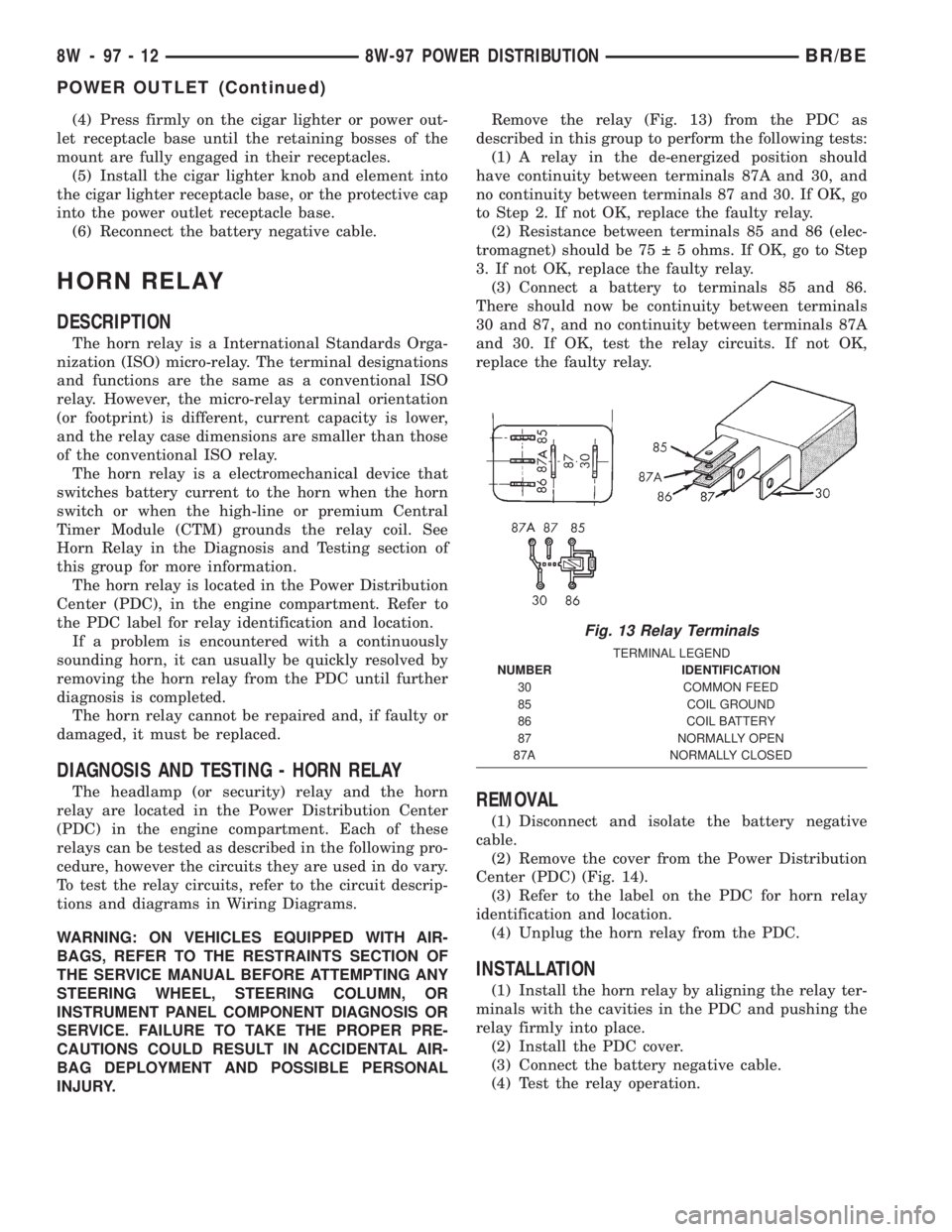
DIAGNOSIS AND TESTING - HORN RELAY
The headlamp (or security) relay and the horn
relay are located in the Power Distribution Center
(PDC) in the engine compartment. Each of these
relays can be tested as described in the following pro-
cedure, however the circuits they are used in do vary.
To test the relay circuits, refer to the circuit descrip-
tions and diagrams in Wiring Diagrams.
WARNING: ON VEHICLES EQUIPPED WITH AIR-
BAGS, REFER TO THE RESTRAINTS SECTION OF
THE SERVICE MANUAL BEFORE ATTEMPTING ANY
STEERING WHEEL, STEERING COLUMN, OR
INSTRUMENT PANEL COMPONENT DIAGNOSIS OR
SERVICE. FAILURE TO TAKE THE PROPER PRE-
CAUTIONS COULD RESULT IN ACCIDENTAL AIR-
BAG DEPLOYMENT AND POSSIBLE PERSONAL
INJURY.Remove the relay (Fig. 13) from the PDC as
described in this group to perform the following tests:
(1) A relay in the de-energized position should
have continuity between terminals 87A and 30, and
no continuity between terminals 87 and 30. If OK, go
to Step 2. If not OK, replace the faulty relay.
(2) Resistance between terminals 85 and 86 (elec-
tromagnet) should be 75 5 ohms. If OK, go to Step
3. If not OK, replace the faulty relay.
(3) Connect a battery to terminals 85 and 86.
There should now be continuity between terminals
30 and 87, and no continuity between terminals 87A
and 30. If OK, test the relay circuits. If not OK,
replace the faulty relay.REMOVAL
(1) Disconnect and isolate the battery negative
cable.
(2) Remove the cover from the Power Distribution
Center (PDC) (Fig. 14).
(3) Refer to the label on the PDC for horn relay
identification and location.
(4) Unplug the horn relay from the PDC.
INSTALLATION
(1) Install the horn relay by aligning the relay ter-
minals with the cavities in the PDC and pushing the
relay firmly into place.
(2) Install the PDC cover.
(3) Connect the battery negative cable.
(4) Test the relay operation.
Fig. 13 Relay Terminals
TERMINAL LEGEND
NUMBER IDENTIFICATION
30 COMMON FEED
85 COIL GROUND
86 COIL BATTERY
87 NORMALLY OPEN
87A NORMALLY CLOSED
8W - 97 - 12 8W-97 POWER DISTRIBUTIONBR/BE
POWER OUTLET (Continued)
Page 1072 of 2255
HEADLAMP RELAY
DESCRIPTION
The headlamp (or security) relay is a International
Standards Organization (ISO) micro-relay. The termi-
nal designations and functions are the same as a con-
ventional ISO relay. However, the micro-relay
terminal orientation (or footprint) is different, cur-
rent capacity is lower, and the relay case dimensions
are smaller than those of the conventional ISO relay.
The headlamp relay is a electromechanical device
that switches battery current to the headlamps when
the high-line or premium Central Timer Module
(CTM) grounds the relay coil. See Headlamp Relay in
the Diagnosis and Testing section of this group for
more information.
The headlamp (or security) relay is located in the
Power Distribution Center (PDC), in the engine com-
partment. Refer to the PDC label for relay identifica-
tion and location.
The headlamp relay cannot be repaired and, if
faulty or damaged, it must be replaced.
REMOVAL
(1) Disconnect and isolate the battery negative
cable.
(2) Remove the cover from the Power Distribution
Center (PDC) (Fig. 15).
(3) Refer to the label on the PDC for headlamp (or
security) relay identification and location.
(4) Unplug the headlamp relay from the PDC.
INSTALLATION
(1) Install the headlamp relay by aligning the
relay terminals with the cavities in the PDC and
pushing the relay firmly into place.(2) Install the PDC cover.
(3) Connect the battery negative cable.
(4) Test the relay operation.
MICRO-RELAY
DESCRIPTION
A micro-relay is a conventional International Stan-
dards Organization (ISO) micro relay (Fig. 16).
Relays conforming to the ISO specifications have
common physical dimensions, current capacities, ter-
minal patterns, and terminal functions. The relay is
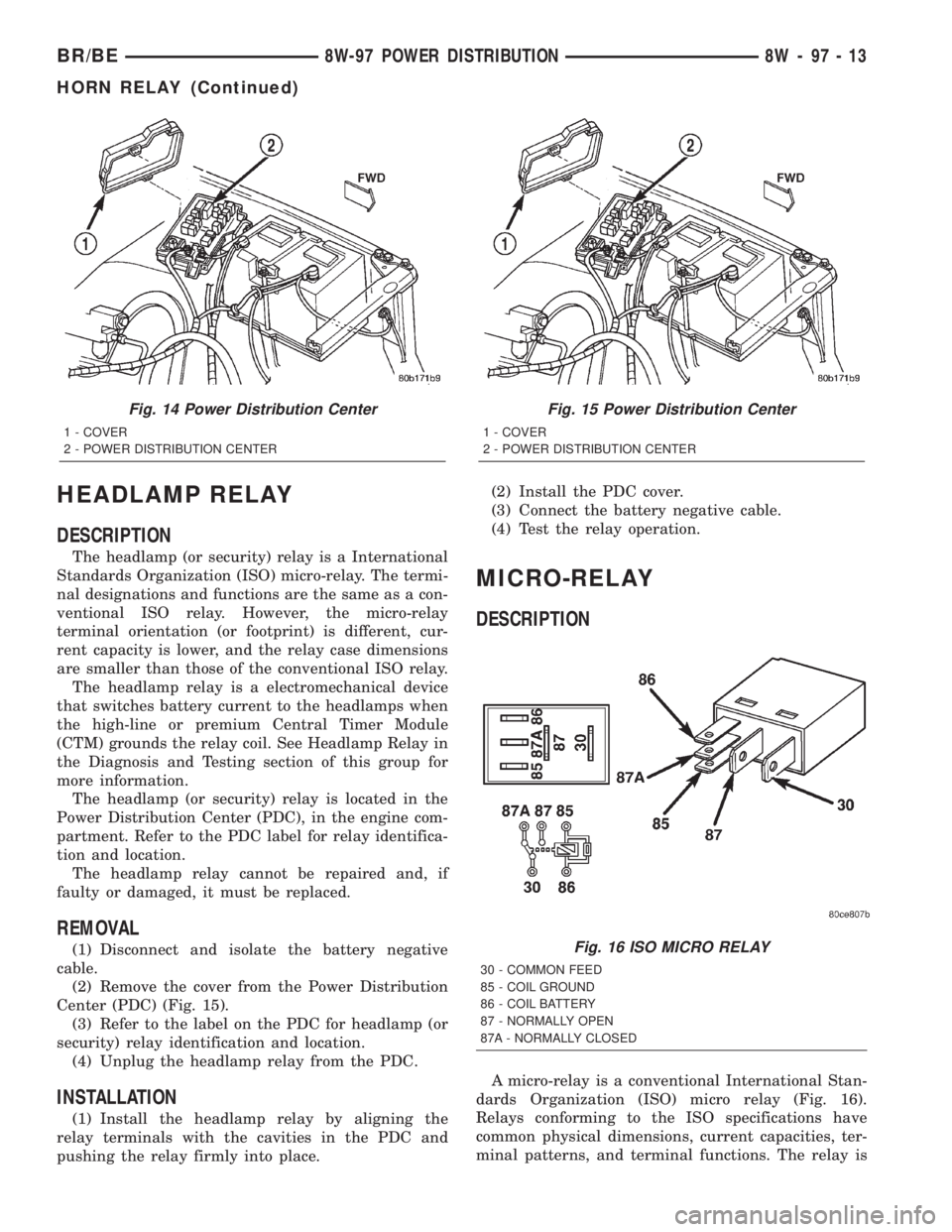
Fig. 14 Power Distribution Center
1 - COVER
2 - POWER DISTRIBUTION CENTER
Fig. 15 Power Distribution Center
1 - COVER
2 - POWER DISTRIBUTION CENTER
Fig. 16 ISO MICRO RELAY
30 - COMMON FEED
85 - COIL GROUND
86 - COIL BATTERY
87 - NORMALLY OPEN
87A - NORMALLY CLOSED
BR/BE8W-97 POWER DISTRIBUTION 8W - 97 - 13
HORN RELAY (Continued)
Page 1310 of 2255
WARNING: BEFORE PROCEEDING TO NEXT STEP,
NOTE THE FUEL PUMP WILL BE ACTIVATED AND
SYSTEM PRESSURE WILL BE PRESENT. THIS WILL
OCCUR AFTER CONNECTING TEST LEADS FROM
LCS ADAPTER INTO FUEL PUMP RELAY CAVITIES.
THE FUEL PUMP WILL OPERATE EVEN WITH IGNI-
TION KEY IN OFF POSITION. BEFORE ATTACHING
TEST LEADS, BE SURE ALL FUEL LINES AND
FUEL SYSTEM COMPONENTS ARE CONNECTED.
CAUTION: To prevent possible damage to the vehi-
cle electrical system and LCS adapter, the test
leads must be connected into relay cavities exactly
as shown in following steps.
Depending upon vehicle model, year or engine con-
figuration, three different types of relays may be
used: Type-1, type-2 and type±3.
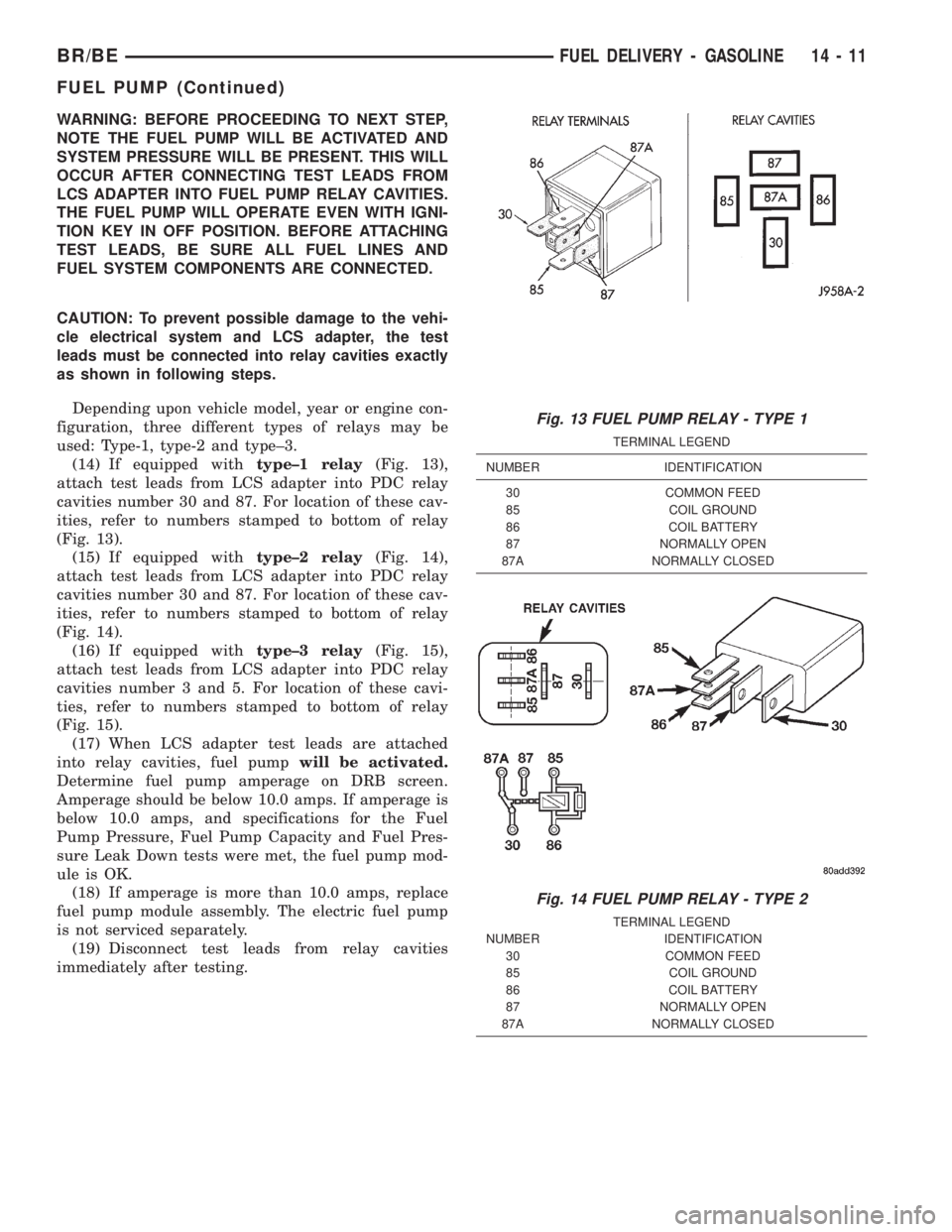
(14) If equipped withtype±1 relay(Fig. 13),
attach test leads from LCS adapter into PDC relay
cavities number 30 and 87. For location of these cav-
ities, refer to numbers stamped to bottom of relay
(Fig. 13).
(15) If equipped withtype±2 relay(Fig. 14),
attach test leads from LCS adapter into PDC relay
cavities number 30 and 87. For location of these cav-
ities, refer to numbers stamped to bottom of relay
(Fig. 14).
(16) If equipped withtype±3 relay(Fig. 15),
attach test leads from LCS adapter into PDC relay
cavities number 3 and 5. For location of these cavi-
ties, refer to numbers stamped to bottom of relay
(Fig. 15).
(17) When LCS adapter test leads are attached
into relay cavities, fuel pumpwill be activated.
Determine fuel pump amperage on DRB screen.
Amperage should be below 10.0 amps. If amperage is
below 10.0 amps, and specifications for the Fuel
Pump Pressure, Fuel Pump Capacity and Fuel Pres-
sure Leak Down tests were met, the fuel pump mod-
ule is OK.
(18) If amperage is more than 10.0 amps, replace
fuel pump module assembly. The electric fuel pump
is not serviced separately.
(19) Disconnect test leads from relay cavities
immediately after testing.
Fig. 13 FUEL PUMP RELAY - TYPE 1
TERMINAL LEGEND
NUMBER IDENTIFICATION
30 COMMON FEED
85 COIL GROUND
86 COIL BATTERY
87 NORMALLY OPEN
87A NORMALLY CLOSED
Fig. 14 FUEL PUMP RELAY - TYPE 2
TERMINAL LEGEND
NUMBER IDENTIFICATION
30 COMMON FEED
85 COIL GROUND
86 COIL BATTERY
87 NORMALLY OPEN
87A NORMALLY CLOSED
BR/BEFUEL DELIVERY - GASOLINE 14 - 11
FUEL PUMP (Continued)
Page 2138 of 2255
NOTE: The air gap is determined by the spacer
shims. When installing an original, or a new clutch
assembly, try the original shims first. When install-
ing a new clutch onto a compressor that previously
did not have a clutch, use 1.0, 0.50, and 0.13 milli-
meter (0.040, 0.020, and 0.005 inch) shims from the
clutch hardware package that is provided with the
new clutch.
(12) On models with the diesel engine option,
install the compressor on the engine. (Refer to 24 -
HEATING & AIR CONDITIONING/PLUMBING/A/C
COMPRESSOR - INSTALLATION)
(13) Connect the battery negative cable.
A/C COMPRESSOR CLUTCH
RELAY
DESCRIPTION
The a/c compressor clutch relay is a International
Standards Organization (ISO) micro-relay. The termi-
nal designations and functions are the same as a con-
ventional ISO relay. However, the micro-relay
terminal orientation (footprint) is different, the cur-
rent capacity is lower, and the relay case dimensions
are smaller than those of the conventional ISO relay.
OPERATION
The compressor clutch relay is a electromechanical
device that switches battery current to the compres-
sor clutch coil when the Powertrain Control Module
(PCM) grounds the coil side of the relay. The PCM
responds to inputs from the a/c heater control, the a/closs of charge switch, the a/c pressure transducer and
the evaporator fin probe.
The compressor clutch relay is located in the Power
Distribution Center (PDC) in the engine compart-
ment. Refer to the PDC label for relay identification
and location.
The compressor clutch relay cannot be repaired
and, if faulty or damaged, it must be replaced.
DIAGNOSIS AND TESTING - A/C COMPRESSOR
CLUTCH RELAY
RELAY TEST
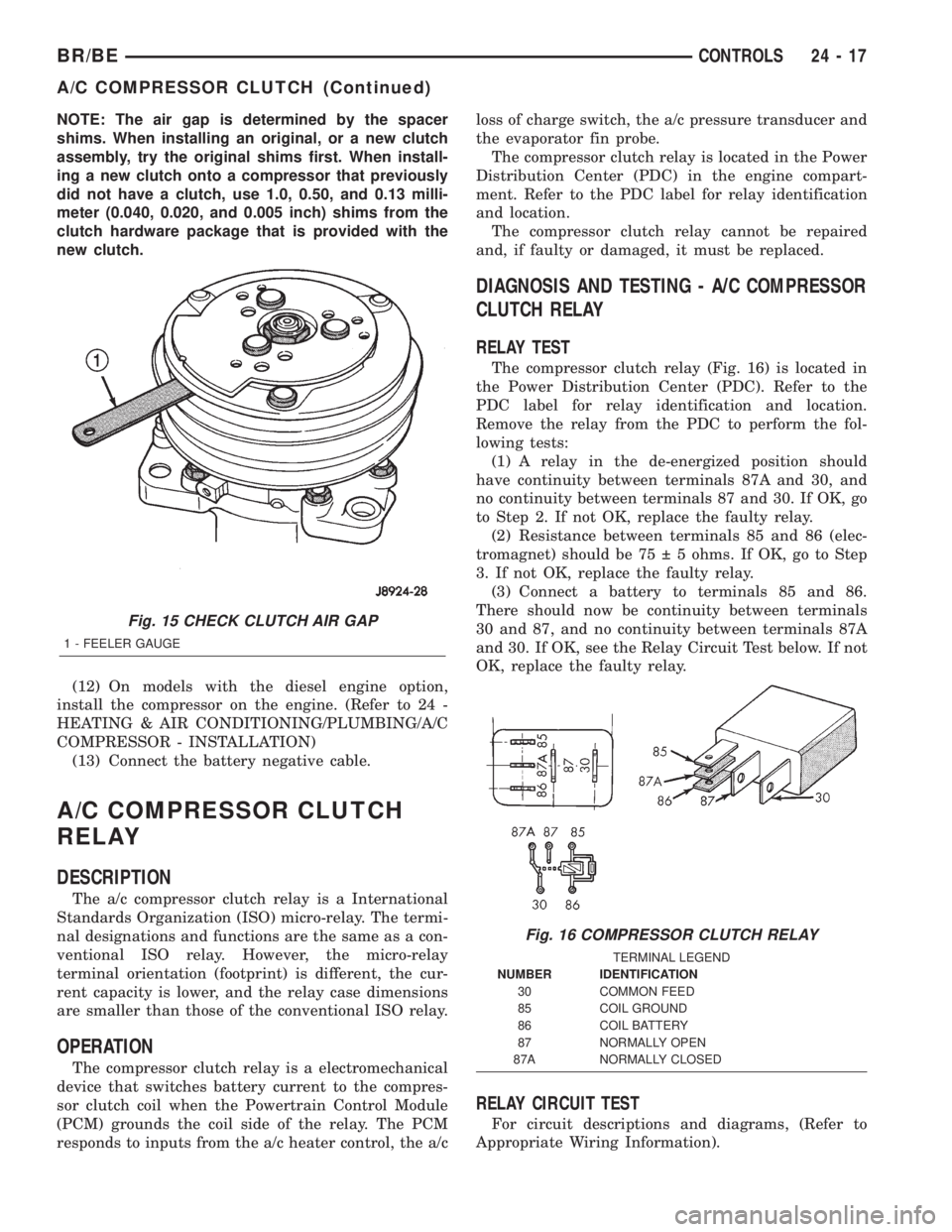
The compressor clutch relay (Fig. 16) is located in
the Power Distribution Center (PDC). Refer to the
PDC label for relay identification and location.
Remove the relay from the PDC to perform the fol-
lowing tests:
(1) A relay in the de-energized position should
have continuity between terminals 87A and 30, and
no continuity between terminals 87 and 30. If OK, go
to Step 2. If not OK, replace the faulty relay.
(2) Resistance between terminals 85 and 86 (elec-
tromagnet) should be 75 5 ohms. If OK, go to Step
3. If not OK, replace the faulty relay.
(3) Connect a battery to terminals 85 and 86.
There should now be continuity between terminals
30 and 87, and no continuity between terminals 87A
and 30. If OK, see the Relay Circuit Test below. If not
OK, replace the faulty relay.
RELAY CIRCUIT TEST
For circuit descriptions and diagrams, (Refer to
Appropriate Wiring Information).
Fig. 15 CHECK CLUTCH AIR GAP
1 - FEELER GAUGE
Fig. 16 COMPRESSOR CLUTCH RELAY
TERMINAL LEGEND
NUMBER IDENTIFICATION
30 COMMON FEED
85 COIL GROUND
86 COIL BATTERY
87 NORMALLY OPEN
87A NORMALLY CLOSED
BR/BECONTROLS 24 - 17
A/C COMPRESSOR CLUTCH (Continued)
Page 2222 of 2255
CAB SIDE PANEL SPEAKER - REMOVAL,
REAR..............................8A-20
CABLE - ADJUSTMENTS,
TRANSMISSION THROTTLE
VALVE ......................21-210,21-382
CABLE - DESCRIPTION.................8P-4
CABLE - DESCRIPTION, ANTENNA BODY . . . 8A-4
CABLE - DESCRIPTION, BATTERY........8F-18
CABLE - DESCRIPTION, SPARK PLUG.....8I-20
CABLE - DESCRIPTION, THROTTLE
VALVE ......................21-209,21-381
CABLE - INSTALLATION, ANTENNA BODY . . 8A-6
CABLE - INSTALLATION, CHECK.........23-67
CABLE - INSTALLATION, FRONT
PARKING BRAKE......................5-30
CABLE - INSTALLATION, INSTRUMENT
PANEL ANTENNA......................8A-9
CABLE - INSTALLATION, LATCH RELEASE . 23-103
CABLE - INSTALLATION, REAR PARK
BRAKE..............................5-30
CABLE - INSTALLATION, RELEASE.......23-82
CABLE - INSTALLATION, SPARK PLUG....8I-21
CABLE - INSTALLATION, THROTTLE
CONTROL....................14-110,14-50
CABLE - OPERATION...................8P-4
CABLE - OPERATION, ANTENNA BODY.....8A-4
CABLE - OPERATION, BATTERY..........8F-18
CABLE - OPERATION, SPARK PLUG.......8I-20
CABLE - REMOVAL, ANTENNA BODY......8A-6
CABLE - REMOVAL, CHECK.............23-67
CABLE - REMOVAL, FRONT PARKING
BRAKE..............................5-29
CABLE - REMOVAL, INSTRUMENT PANEL
ANTENNA...........................8A-9
CABLE - REMOVAL, LATCH RELEASE....23-103
CABLE - REMOVAL, REAR PARK BRAKE . . . 5-29
CABLE - REMOVAL, RELEASE...........23-82
CABLE - REMOVAL, SPARK PLUG........8I-21
CABLE - REMOVAL, THROTTLE
CONTROL....................14-109,14-49
CABLE INSTALLATION, GASOLINE
ENGINE - NEGATIVE..................8F-22
CABLE INSTALLATION, GASOLINE
ENGINE - POSITIVE...................8F-22
CABLE ORDER, 8.0L V-10 ENGINE -
SPARK PLUG.........................8I-3
CABLE REMOVAL, GASOLINE ENGINE -
NEGATIVE..........................8F-22
CABLE REMOVAL, GASOLINE ENGINE -
POSITIVE...........................8F-21
CABLE RESISTANCE, SPECIFICATIONS -
SPARK PLUG.........................8I-3
CABLES - DIAGNOSIS AND TESTING,
BATTERY...........................8F-19
CABLES - DIAGNOSIS AND TESTING,
SPARK PLUG........................8I-20
CAB-TO-BED GROUND STRAP -
INSTALLATION.......................8A-14
CAB-TO-BED GROUND STRAP -
REMOVAL..........................8A-13
CALIBRATION - STANDARD PROCEDURE,
COMPASS...........................8M-4
CALIPERS - DESCRIPTION, DISC BRAKE . . . 5-10
CALIPERS - OPERATION, DISC BRAKE.....5-10
CAM - DESCRIPTION, TURN SIGNAL
CANCEL............................8L-31
CAM - OPERATION, TURN SIGNAL
CANCEL............................8L-31
CAM BORE REPAIR - STANDARD
PROCEDURE........................9-151
CAM/OVERDRIVE PISTON RETAINER -
ASSEMBLY, OVERRUNNING
CLUTCH.....................21-193,21-364
CAM/OVERDRIVE PISTON RETAINER -
CLEANING, OVERRUNNING
CLUTCH
.....................21-192,21-364
CAM/OVERDRIVE PISTON RETAINER -
DESCRIPTION, OVERRUNNING
CLUTCH
.....................21-192,21-363
CAM/OVERDRIVE PISTON RETAINER -
DISASSEMBLY, OVERRUNNING
CLUTCH
.....................21-192,21-364
CAM/OVERDRIVE PISTON RETAINER -
INSPECTION, OVERRUNNING
CLUTCH
.....................21-193,21-364
CAM/OVERDRIVE PISTON RETAINER -
OPERATION, OVERRUNNING
CLUTCH
.....................21-192,21-363CAMSHAFT - INSTALLATION....9-157,9-29,9-86
CAMSHAFT - REMOVAL.......9-152,9-28,9-85
CAMSHAFT BEARINGS - I
NSTALLATION...............9-157,9-28,9-86
CAMSHAFT BEARINGS -
REMOVAL..................9-152,9-27,9-85
CANCEL CAM - DESCRIPTION, TURN
SIGNAL............................8L-31
CANCEL CAM - OPERATION, TURN
SIGNAL............................8L-31
CANISTER - DESCRIPTION, VAPOR......25-37
CANISTER - INSTALLATION, CRANKCASE
BREATHER VAPOR...................9-126
CANISTER - INSTALLATION, VAPOR......25-38
CANISTER - OPERATION, VAPOR........25-37
CANISTER - REMOVAL, CRANKCASE
BREATHER VAPOR...................9-125
CANISTER - REMOVAL, VAPOR..........25-38
CAP - DESCRIPTION, FUEL FILLER.......25-34
CAP - DESCRIPTION, RADIATOR
PRESSURE..........................7-64
CAP - DIAGNOSIS AND TESTING,
DISTRIBUTOR.......................8I-14
CAP - DIAGNOSIS AND TESTING,
RADIATOR...........................7-65
CAP - OPERATION, FUEL FILLER........25-34
CAP - OPERATION, RADIATOR
PRESSURE..........................7-64
CAP - REMOVAL/INSTALLATION, FUEL
FILLER.............................25-34
CAPACITIES, SPECIFICATIONS - FLUID.......0-6
CAPACITY TEST - DIAGNOSIS AND
TESTING, FUEL PUMP..................14-9
CARDAN UNIVERSAL JOINTS -
ASSEMBLY, DOUBLE...................3-11
CARDAN UNIVERSAL JOINTS -
ASSEMBLY, SINGLE.....................3-9
CARDAN UNIVERSAL JOINTS -
DISASSEMBLY, DOUBLE................3-10
CARDAN UNIVERSAL JOINTS -
DISASSEMBLY, SINGLE..................3-8
CARDAN UNIVERSAL JOINTS -
INSTALLATION, SINGLE.................3-35
CARDAN UNIVERSAL JOINTS -
REMOVAL, SINGLE....................3-34
CARGO BOX - INSTALLATION...........23-97
CARGO BOX - REMOVAL...............23-97
CARGO DOOR - ADJUSTMENT..........23-78
CARPETS AND FLOOR MATS -
INSTALLATION......................23-123
CARPETS AND FLOOR MATS - REMOVAL . 23-123
CARTRIDGE FUSE - DESCRIPTION,
GENERATOR......................8W-97-4
CARTRIDGE FUSE - INSTALLATION,
GENERATOR......................8W-97-4
CARTRIDGE FUSE - OPERATION,
GENERATOR......................8W-97-4
CARTRIDGE FUSE - REMOVAL,
GENERATOR......................8W-97-4
CASE - DIAGNOSIS AND TESTING,
TRANSFER...................21-431,21-467
CASE - NV241 - DESCRIPTION,
TRANSFER
............................0-5
CASE - NV241HD - ASSEMBLY,
TRANSFER
.........................21-480
CASE - NV241HD - CLEANING,
TRANSFER
.........................21-476
CASE - NV241HD - DESCRIPTION,
TRANSFER
.........................21-465
CASE - NV241HD - DISASSEMBLY,
TRANSFER
.........................21-469
CASE - NV241HD - INSPECTION,
TRANSFER
.........................21-476
CASE - NV241HD - INSTALLATION,
TRANSFER
.........................21-494
CASE - NV241HD - OPERATION,
TRANSFER
.........................21-467
CASE - NV241HD - REMOVAL,
TRANSFER
.........................21-469
CASE - NV241LD - ASSEMBLY,
TRANSFER
.........................21-445
CASE - NV241LD - CLEANING,
TRANSFER
.........................21-441
CASE - NV241LD - DESCRIPTION,
TRANSFER
.........................21-430
CASE - NV241LD - DISASSEMBLY,
TRANSFER
.........................21-432CASE - NV241LD - INSPECTION,
TRANSFER.........................21-442
CASE - NV241LD - INSTALLATION,
TRANSFER.........................21-458
CASE - NV241LD - OPERATION,
TRANSFER.........................21-430
CASE - NV241LD - REMOVAL,
TRANSFER.........................21-432
CASE BEARINGS - INSTALLATION,
DIFFERENTIAL..........3-102,3-129,3-41,3-72
CASE BEARINGS - REMOVAL,
DIFFERENTIAL..........3-102,3-129,3-40,3-72
CASE, NV241HD - TRANSFER..........21-495
CASE, NV241LD - TRANSFER..........21-459
CASE SKID PLATE - INSTALLATION,
TRANSFER..........................13-11
CASE SKID PLATE - REMOVAL,
TRANSFER..........................13-11
CASE, SPECIFICATIONS -
TRANSFER...................21-458,21-495
CASTER CORRECTION MEASUREMENT -
STANDARD PROCEDURE.................2-3
CATALYTIC CONVERTER - 3.9L/5.2L/5.9L
- DESCRIPTION.......................11-5
CATALYTIC CONVERTER - 3.9L/5.2L/5.9L
- INSPECTION........................11-6
CATALYTIC CONVERTER - 3.9L/5.2L/5.9L
- INSTALLATION......................11-6
CATALYTIC CONVERTER - 3.9L/5.2L/5.9L
- OPERATION.........................11-5
CATALYTIC CONVERTER - 3.9L/5.2L/5.9L
- REMOVAL..........................11-5
CATALYTIC CONVERTER - 5.9L HD/8.0L -
DESCRIPTION........................11-6
CATALYTIC CONVERTER - 5.9L HD/8.0L -
INSPECTION.........................11-6
CATALYTIC CONVERTER - 5.9L HD/8.0L -
INSTALLATION........................11-7
CATALYTIC CONVERTER - 5.9L HD/8.0L -
OPERATION..........................11-6
CATALYTIC CONVERTER - 5.9L HD/8.0L -
REMOVAL...........................11-6
CAUSES OF BURNT FLUID - DIAGNOSIS
AND TESTING................21-157,21-327
CCD DATA BUS - DESCRIPTION..........8E-6
CCD DATA BUS - DIAGNOSIS AND
TESTING...........................8E-11
CCD DATA BUS - OPERATION............8E-7
CENTER - DESCRIPTION, POWER
DISTRIBUTION....................8W-97-8
CENTER - INSTALLATION, POWER
DISTRIBUTION...................8W-97-10
CENTER - OPERATION, POWER
DISTRIBUTION....................8W-97-8
CENTER - REMOVAL, POWER
DISTRIBUTION....................8W-97-8
CENTER BEARING - ADJUSTMENT.........3-8
CENTER BEARING - INSTALLATION........3-8
CENTER BEARING - REMOVAL............3-8
CENTER CONSOLE - INSTALLATION.....23-122
CENTER CONSOLE - REMOVAL.........23-122
CENTER CONSOLE LID - INSTALLATION . . 23-132
CENTER CONSOLE LID - REMOVAL.....23-131
CENTER HIGH MOUNTED STOP LAMP -
INSTALLATION........................8L-6
CENTER HIGH MOUNTED STOP LAMP -
REMOVAL...........................8L-6
CENTER HIGH MOUNTED STOP LAMP
UNIT - INSTALLATION..................8L-6
CENTER HIGH MOUNTED STOP LAMP
UNIT - REMOVAL.....................8L-6
CENTER SEAT ARMREST/CONSOLE -
INSTALLATION......................23-132
CENTER SEAT ARMREST/CONSOLE -
REMOVAL.........................23-132
CENTER SEAT ARMREST/LATCH COVER -
INSTALLATION......................23-132
CENTER SEAT ARMREST/LATCH COVER -
REMOVAL.........................23-132
CENTERING - STANDARD PROCEDURE,
CLOCKSPRING
......................8O-11
CENTRAL TIMER MODULE -
DESCRIPTION
........................8E-1
CENTRAL TIMER MODULE - DIAGNOSIS
AND TESTING
........................8E-4
CENTRAL TIMER MODULE -
INSTALLATION
........................8E-6
CENTRAL TIMER MODULE - OPERATION
. . . 8E-3
BR/BEINDEX 5
Description Group-Page Description Group-Page Description Group-Page
Page 2248 of 2255
SYSTEM - DIAGNOSIS AND TESTING,
POWER LOCK & REMOTE KEYLESS
ENTRY..............................8N-5
SYSTEM - DIAGNOSIS AND TESTING,
POWER SEAT.......................8N-16
SYSTEM - DIAGNOSIS AND TESTING,
POWER STEERING....................19-2
SYSTEM - DIAGNOSIS AND TESTING,
STARTING..........................8F-32
SYSTEM - DIAGNOSIS AND TESTING,
TURN SIGNAL & HAZARD WARNING......8L-3
SYSTEM - DIAGNOSIS AND TESTING,
VACUUM...........................24-10
SYSTEM - DIAGNOSIS AND TESTING,
VEHICLE THEFT SECURITY..............8Q-3
SYSTEM - DIAGNOSIS AND TESTING,
WIPER & WASHER....................8R-3
SYSTEM - INSPECTION, BATTERY........8F-6
SYSTEM - INSPECTION, WIPER &
WASHER............................8R-6
SYSTEM - LEAKS - DIAGNOSIS AND
TESTING, CHARGE AIR COOLER.........11-18
SYSTEM - OPERATION, AIR INJECTION . . . 25-28
SYSTEM - OPERATION, BATTERY.........8F-2
SYSTEM - OPERATION, CHIME
WARNING...........................8B-1
SYSTEM - OPERATION, COOLING..........7-4
SYSTEM - OPERATION, FUEL DELIVERY . . . 14-2
SYSTEM - OPERATION, HEATED MIRROR . . 8G-2
SYSTEM - OPERATION, HEATED SEAT.....8G-6
SYSTEM - OPERATION, INSTRUMENT
PANEL..............................23-106
SYSTEM - OPERATION, POWER SEAT....8N-16
SYSTEM - OPERATION, REMOTE
KEYLESS ENTRY......................8N-4
SYSTEM - OPERATION, SPEED CONTROL . . 8P-2
SYSTEM - OPERATION, TURN SIGNAL &
HAZARD WARNING....................8L-2
SYSTEM - SPECIAL TOOLS, AIRBAG......8O-6
SYSTEM - SPECIFICATIONS, TORQUE -
GENERATOR/CHARGING...............8F-27
SYSTEM - SPECIFICATIONS, TORQUE -
STARTING..........................8F-37
SYSTEM - STANDARD PROCEDURE,
BLEEDING ABS BRAKE.................5-36
SYSTEM - STANDARD PROCEDURE,
FLUSHING POWER STEERING...........19-34
SYSTEM - TORQUE, AIR INJECTION......25-29
SYSTEM - TORQUE, EVAP..............25-32
SYSTEM - TORQUE, SPEED CONTROL.....8P-4
SYSTEM 5.9L DIESEL ENGINE -
STANDARD PROCEDURE, DRAINING
COOLING............................7-15
SYSTEM 5.9L DIESEL ENGINE -
STANDARD PROCEDURE, REFILLING
COOLING............................7-16
SYSTEM 5.9L/8.0L ENGINES -
STANDARD PROCEDURE, DRAINING
COOLING............................7-15
SYSTEM 5.9L/8.0L ENGINES -
STANDARD PROCEDURE, REFILLING
COOLING............................7-16
SYSTEM AIR LEAK VACUUM TEST -
DIAGNOSIS AND TESTING, FUEL........14-57
SYSTEM AIRFLOW - DESCRIPTION,
HVAC..............................24-30
SYSTEM CHARGE - STANDARD
PROCEDURE, REFRIGERANT............24-46
SYSTEM CLEANING/REVERSE FLUSHING
- STANDARD PROCEDURE, COOLING......7-17
SYSTEM DIESEL ENGINE - DIAGNOSIS
AND TESTING, COOLING................7-13
SYSTEM EVACUATE - STANDARD
PROCEDURE, REFRIGERANT............24-46
SYSTEM FLOW - 5.9L DIESEL -
DESCRIPTION, COOLING.................7-2
SYSTEM FLOW - 5.9L ENGINE -
DESCRIPTION, COOLING.................7-1
SYSTEM GAS ENGINE - DIAGNOSIS AND
TESTING, COOLING
.....................7-7
SYSTEM LEAKS - DIAGNOSIS AND
TESTING, COOLING
.....................7-5
SYSTEM LEAKS - DIAGNOSIS AND
TESTING, REFRIGERANT
...............24-43
SYSTEM PARTS - STANDARD
PROCEDURES, CLEANING FUEL
.........14-61
SYSTEM PRESSURE - GAS ENGINES -
SPECIFICATIONS, FUEL
.................14-3SYSTEM PRESSURE RELEASE -
STANDARD PROCEDURE, FUEL..........14-3
SYSTEM PRESSURES, DIESEL ENGINES
- FUEL.............................14-62
SYSTEM REQUIREMENTS -
DESCRIPTION, COOLING................24-1
SYSTEM SERVICE EQUIPMENT -
STANDARD PROCEDURE,
REFRIGERANT.......................24-45
SYSTEM SERVICE PORT - DESCRIPTION,
REFRIGERANT........................24-1
SYSTEM SERVICE PORT - OPERATION,
REFRIGERANT........................24-2
SYSTEM, SPECIAL TOOLS - DIESEL
FUEL..............................14-63
SYSTEM, SPECIAL TOOLS - FUEL . . . 14-35,14-4
SYSTEM, SPECIFICATIONS - STARTING . . . 8F-36
SYSTEMS - DESCRIPTION, MONITORED . . 25-17
SYSTEMS, SPECIAL TOOLS - AUDIO......8A-4
SYSTEMS, SPECIAL TOOLS - POWER
DISTRIBUTION....................8W-97-2
TABLE, SPECIFICATIONS - A/C
APPLICATION........................24-7
TACHOMETER - DESCRIPTION..........8J-30
TACHOMETER - OPERATION............8J-30
TAIL LAMP - DESCRIPTION............8L-29
TAIL LAMP - INSTALLATION............8L-30
TAIL LAMP - OPERATION..............8L-29
TAIL LAMP - REMOVAL................8L-29
TAIL LAMP UNIT - INSTALLATION.......8L-30
TAIL LAMP UNIT - REMOVAL...........8L-30
TAILGATE - INSTALLATION.............23-67
TAILGATE - REMOVAL.................23-67
TAILPIPE - 3.9L/5.2L/5.9L - INSPECTION . . 11-11
TAILPIPE - 3.9L/5.2L/5.9L -
INSTALLATION.......................11-11
TAILPIPE - 3.9L/5.2L/5.9L - REMOVAL....11-11
TAILPIPE - 5.9L DIESEL - INSPECTION....11-12
TAILPIPE - 5.9L DIESEL - INSTALLATION . . 11-13
TAILPIPE - 5.9L DIESEL - REMOVAL.....11-12
TAILPIPE - 5.9L HD/8.0L - INSPECTION . . . 11-12
TAILPIPE - 5.9L HD/8.0L -
INSTALLATION.......................11-12
TAILPIPE - 5.9L HD/8.0L - REMOVAL.....11-12
TANK - DESCRIPTION, DIESEL FUEL.....14-82
TANK - DESCRIPTION, FUEL............14-18
TANK - INSTALLATION, FUEL...........14-20
TANK - OPERATION, FUEL..............14-18
TANK - REMOVAL, FUEL...............14-18
TANK CHECK VALVE - DESCRIPTION,
FUEL..............................14-21
TANK CHECK VALVE - INSTALLATION,
FUEL..............................14-23
TANK CHECK VALVE - REMOVAL, FUEL . . . 14-22
TANK MODULE - DESCRIPTION, FUEL....14-82
TANK MODULE - INSTALLATION, FUEL....14-83
TANK MODULE - OPERATION, FUEL......14-82
TANK MODULE - REMOVAL, FUEL.......14-83
TAPE STRIPE - INSTALLATION..........23-89
TAPE STRIPE - REMOVAL..............23-88
TAPPETS - DIAGNOSIS AND TESTING,
HYDRAULIC......................9-36,9-91
TASK MANAGER - DESCRIPTION........25-17
TASK MANAGER - OPERATION..........25-21
TEMP SENSOR - 5.9L - DESCRIPTION,
ENGINE COOLANT.....................7-47
TEMP SENSOR - 5.9L - INSTALLATION,
ENGINE COOLANT.....................7-47
TEMP SENSOR - 5.9L - OPERATION,
ENGINE COOLANT.....................7-47
TEMP SENSOR - 5.9L - REMOVAL,
ENGINE COOLANT.....................7-47
TEMP SENSOR - DESCRIPTION,
AMBIENT..........................8M-12
TEMP SENSOR - INSTALLATION,
AMBIENT..........................8M-13
TEMP SENSOR - OPERATION, AMBIENT . . 8M-12
TEMP SENSOR - REMOVAL, AMBIENT . . . 8M-12
TEMPERATURE GAUGE - DESCRIPTION,
ENGINE
............................8J-18
TEMPERATURE GAUGE - OPERATION,
ENGINE
............................8J-19
TEMPERATURE SENSOR - DESCRIPTION,
BATTERY
...........................8F-27
TEMPERATURE SENSOR - DESCRIPTION,
FUEL
.............................14-104
TEMPERATURE SENSOR - DESCRIPTION,
TRANSMISSION
...............21-218,21-390TEMPERATURE SENSOR - DIAGNOSIS
AND TESTING, AMBIENT..............8M-12
TEMPERATURE SENSOR -
INSTALLATION, BATTERY..............8F-28
TEMPERATURE SENSOR - OPERATION,
BATTERY...........................8F-27
TEMPERATURE SENSOR - OPERATION,
FUEL.............................14-104
TEMPERATURE SENSOR - OPERATION,
TRANSMISSION...............21-218,21-390
TEMPERATURE SENSOR - REMOVAL,
BATTERY...........................8F-27
TEMPORARY - DESCRIPTION, SPARE
TIRE................................22-6
TENSIONERS - 5.9L - DESCRIPTION,
BELT ...............................7-19
TENSIONERS - 5.9L - INSTALLATION,
BELT ...............................7-20
TENSIONERS - 5.9L - OPERATION, BELT . . . 7-19
TENSIONERS - 5.9L - REMOVAL, BELT.....7-19
TENSIONERS - 5.9L DIESEL -
DESCRIPTION, BELT...................7-23
TENSIONERS - 5.9L DIESEL -
INSTALLATION, BELT...................7-23
TENSIONERS - 5.9L DIESEL -
OPERATION, BELT.....................7-23
TENSIONERS - 5.9L DIESEL - REMOVAL,
BELT ...............................7-23
TENSIONERS - 8.0L - DESCRIPTION,
BELT ...............................7-20
TENSIONERS - 8.0L - INSTALLATION,
BELT ...............................7-22
TENSIONERS - 8.0L - OPERATION, BELT.....7-21
TENSIONERS - 8.0L - REMOVAL, BELT.....7-21
TERMINAL - INSTALLATION.........8W-01-13
TERMINAL - REMOVAL.............8W-01-13
TEST - DIAGNOSIS AND TESTING, FUEL
INJECTOR..........................14-99
TEST - DIAGNOSIS AND TESTING, FUEL
PRESSURE LEAK DOWN................14-2
TEST - DIAGNOSIS AND TESTING, FUEL
PUMP AMPERAGE....................14-10
TEST - DIAGNOSIS AND TESTING, FUEL
PUMP CAPACITY......................14-9
TEST - DIAGNOSIS AND TESTING, FUEL
PUMP PRESSURE.....................14-9
TEST - DIAGNOSIS AND TESTING, FUEL
SYSTEM AIR LEAK VACUUM............14-57
TEST - DIAGNOSIS AND TESTING,
HYDRAULIC PRESSURE.........21-270,21-98
TEST - DIAGNOSIS AND TESTING, ROAD . . . 8P-4
TEST - DIAGNOSIS AND TESTING,
VACUUM SUPPLY.....................8P-3
TEST - STANDARD PROCEDURE,
BUILT-IN INDICATOR..................8F-10
TEST - STANDARD PROCEDURE,
HYDROMETER.......................8F-11
TEST - STANDARD PROCEDURE,
IGNITION-OFF DRAW..................8F-13
TEST - STANDARD PROCEDURE, LOAD . . . 8F-12
TEST - STANDARD PROCEDURE,
OPEN-CIRCUIT VOLTAGE...............8F-12
TEST - STANDARD PROCEDURE,
VERIFICATION........................8O-5
TEST MODE - DESCRIPTION, CIRCUIT
ACTUATION
..........................25-2
TEST MODE - DESCRIPTION, STATE
DISPLAY
............................25-1
TETHER - INSTALLATION, CHILD
.........8O-9
TETHER - REMOVAL, CHILD
.............8O-9
THEFT SECURITY - DESCRIPTION,
VEHICLE
............................8Q-1
THEFT SECURITY - OPERATION, VEHICLE
. . 8Q-2
THEFT SECURITY SYSTEM - DIAGNOSIS
AND TESTING, VEHICLE
................8Q-3
THERMOSTAT - 5.9L - DESCRIPTION,
ENGINE COOLANT
.....................7-48
THERMOSTAT - 5.9L - INSTALLATION,
ENGINE COOLANT
.....................7-49
THERMOSTAT - 5.9L - OPERATION,
ENGINE COOLANT
.....................7-48
THERMOSTAT - 5.9L - REMOVAL,
ENGINE COOLANT
.....................7-48
THERMOSTAT - 5.9L DIESEL -
DESCRIPTION, ENGINE COOLANT
.........7-53
THERMOSTAT - 5.9L DIESEL -
INSTALLATION, ENGINE COOLANT
........7-54
BR/BEINDEX 31
Description Group-Page Description Group-Page Description Group-Page