tow DODGE RAM 2002 Service Repair Manual
[x] Cancel search | Manufacturer: DODGE, Model Year: 2002, Model line: RAM, Model: DODGE RAM 2002Pages: 2255, PDF Size: 62.07 MB
Page 2087 of 2255
INSTALLATION
(1) Position cowl trim cover on lower cowl.
(2) Press into place.
(3) Install front door sill trim cover (Refer to 23 -
BODY/INTERIOR/DOOR SILL TRIM - INSTALLA-
TION).
B-PILLAR TRIM
REMOVAL
(1) Remove rear floor stowage tray, If equipped.
(Refer to 23 - BODY/INTERIOR/REAR FLOOR
STOWAGE TRAY - REMOVAL).
(2) Remove door sill cover (Refer to 23 - BODY/IN-
TERIOR/DOOR SILL TRIM - REMOVAL).
(3) Remove bolt attaching seat belt anchor to floor.
(4) Snap turning loop cover up and remove bolt
attaching turning loop to B-pillar.
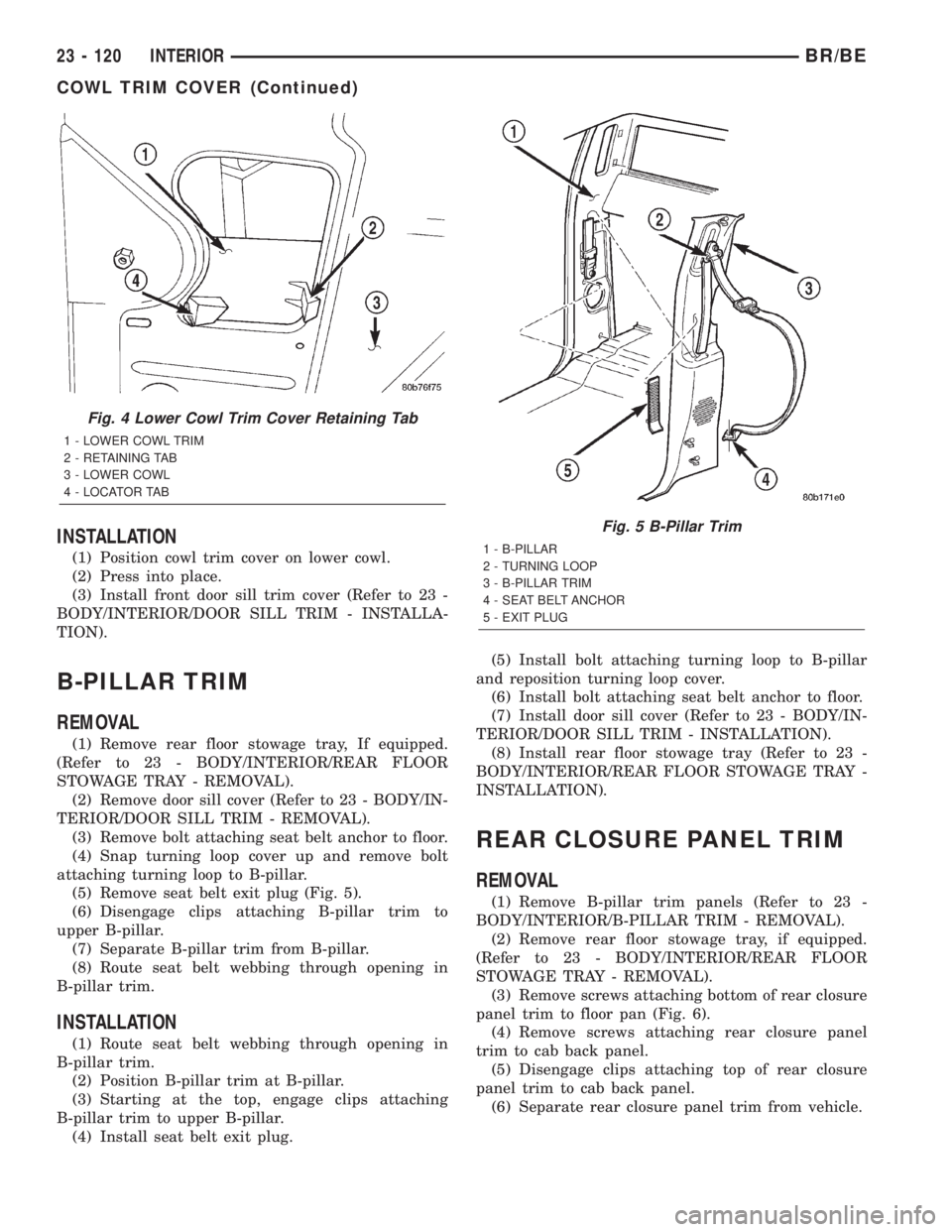
(5) Remove seat belt exit plug (Fig. 5).
(6) Disengage clips attaching B-pillar trim to
upper B-pillar.
(7) Separate B-pillar trim from B-pillar.
(8) Route seat belt webbing through opening in
B-pillar trim.
INSTALLATION
(1) Route seat belt webbing through opening in
B-pillar trim.
(2) Position B-pillar trim at B-pillar.
(3) Starting at the top, engage clips attaching
B-pillar trim to upper B-pillar.
(4) Install seat belt exit plug.(5) Install bolt attaching turning loop to B-pillar
and reposition turning loop cover.
(6) Install bolt attaching seat belt anchor to floor.
(7) Install door sill cover (Refer to 23 - BODY/IN-
TERIOR/DOOR SILL TRIM - INSTALLATION).
(8) Install rear floor stowage tray (Refer to 23 -
BODY/INTERIOR/REAR FLOOR STOWAGE TRAY -
INSTALLATION).
REAR CLOSURE PANEL TRIM
REMOVAL
(1) Remove B-pillar trim panels (Refer to 23 -
BODY/INTERIOR/B-PILLAR TRIM - REMOVAL).
(2) Remove rear floor stowage tray, if equipped.
(Refer to 23 - BODY/INTERIOR/REAR FLOOR
STOWAGE TRAY - REMOVAL).
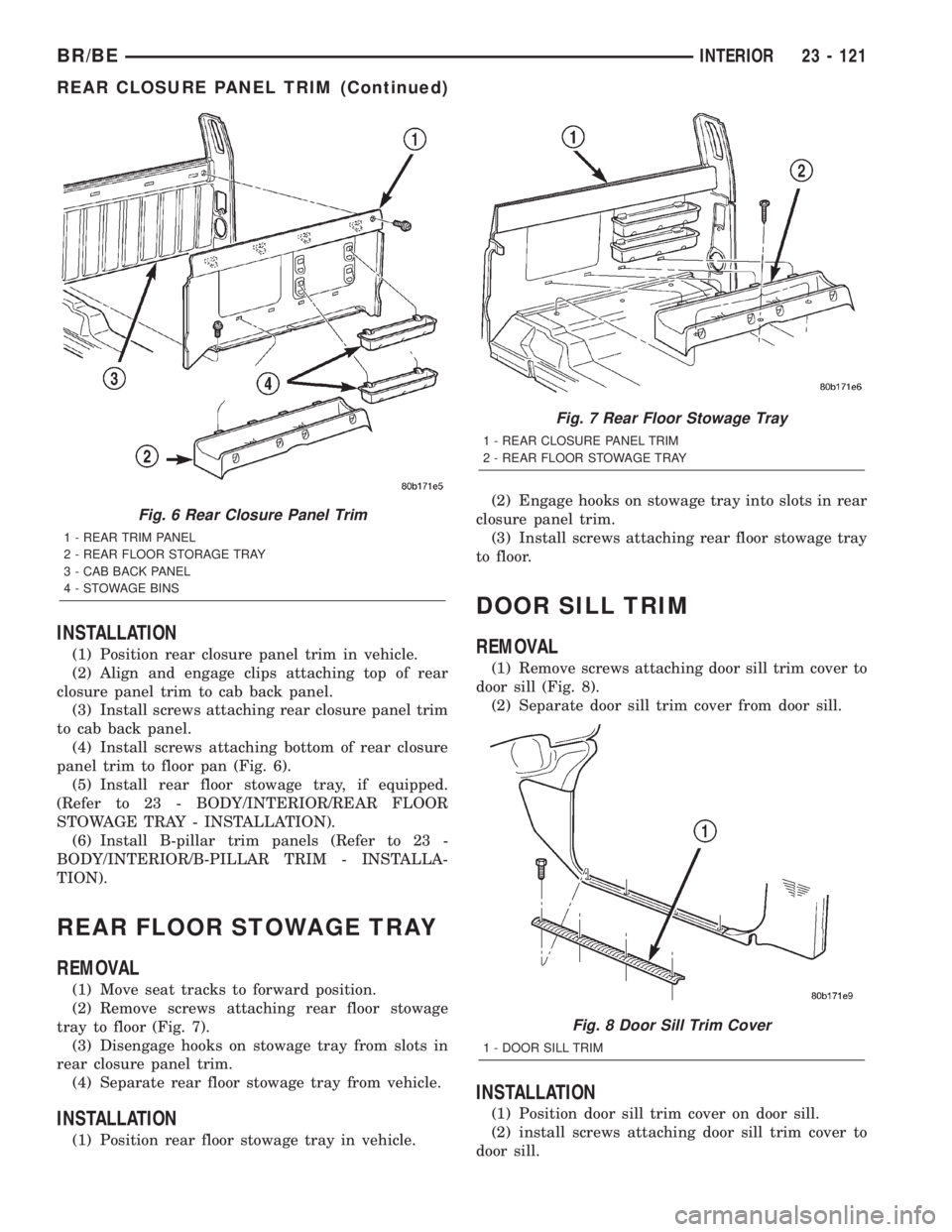
(3) Remove screws attaching bottom of rear closure
panel trim to floor pan (Fig. 6).
(4) Remove screws attaching rear closure panel
trim to cab back panel.
(5) Disengage clips attaching top of rear closure
panel trim to cab back panel.
(6) Separate rear closure panel trim from vehicle.
Fig. 4 Lower Cowl Trim Cover Retaining Tab
1 - LOWER COWL TRIM
2 - RETAINING TAB
3 - LOWER COWL
4 - LOCATOR TAB
Fig. 5 B-Pillar Trim
1 - B-PILLAR
2 - TURNING LOOP
3 - B-PILLAR TRIM
4 - SEAT BELT ANCHOR
5 - EXIT PLUG
23 - 120 INTERIORBR/BE
COWL TRIM COVER (Continued)
Page 2088 of 2255
INSTALLATION
(1) Position rear closure panel trim in vehicle.
(2) Align and engage clips attaching top of rear
closure panel trim to cab back panel.
(3) Install screws attaching rear closure panel trim
to cab back panel.
(4) Install screws attaching bottom of rear closure
panel trim to floor pan (Fig. 6).
(5) Install rear floor stowage tray, if equipped.
(Refer to 23 - BODY/INTERIOR/REAR FLOOR
STOWAGE TRAY - INSTALLATION).
(6) Install B-pillar trim panels (Refer to 23 -
BODY/INTERIOR/B-PILLAR TRIM - INSTALLA-
TION).
REAR FLOOR STOWAGE TRAY
REMOVAL
(1) Move seat tracks to forward position.
(2) Remove screws attaching rear floor stowage
tray to floor (Fig. 7).
(3) Disengage hooks on stowage tray from slots in
rear closure panel trim.
(4) Separate rear floor stowage tray from vehicle.
INSTALLATION
(1) Position rear floor stowage tray in vehicle.(2) Engage hooks on stowage tray into slots in rear
closure panel trim.
(3) Install screws attaching rear floor stowage tray
to floor.
DOOR SILL TRIM
REMOVAL
(1) Remove screws attaching door sill trim cover to
door sill (Fig. 8).
(2) Separate door sill trim cover from door sill.
INSTALLATION
(1) Position door sill trim cover on door sill.
(2) install screws attaching door sill trim cover to
door sill.
Fig. 6 Rear Closure Panel Trim
1 - REAR TRIM PANEL
2 - REAR FLOOR STORAGE TRAY
3 - CAB BACK PANEL
4 - STOWAGE BINS
Fig. 7 Rear Floor Stowage Tray
1 - REAR CLOSURE PANEL TRIM
2 - REAR FLOOR STOWAGE TRAY
Fig. 8 Door Sill Trim Cover
1 - DOOR SILL TRIM
BR/BEINTERIOR 23 - 121
REAR CLOSURE PANEL TRIM (Continued)
Page 2090 of 2255
(4) Install the screws attaching the console to
mounting brackets.
(5) Install the transmission shifter boot, (Refer to
23 - BODY/INTERIOR/SHIFT BOOT - INSTALLA-
TION).
(6) Install the transfer case shifter boot, if
equipped. (Refer to 23 - BODY/INTERIOR/SHIFT
BOOT - INSTALLATION).
(7) Install cup holder in console, if equipped.
CARPETS AND FLOOR MATS
REMOVAL
STANDARD CAB
(1) Remove seat (Refer to 23 - BODY/SEATS/SEAT
- BENCH SEAT - REMOVAL) or(Refer to 23 - BODY/
SEATS/SEAT - SPLIT BENCH - REMOVAL).
(2) Remove door sill covers (Refer to 23 - BODY/
INTERIOR/DOOR SILL TRIM - REMOVAL).
(3) Remove cowl trim covers (Refer to 23 - BODY/
INTERIOR/COWL TRIM COVER - REMOVAL).
(4) Remove center console, if equipped.(Refer to 23
- BODY/INTERIOR/CENTER CONSOLE -
REMOVAL)
(5) If not equipped with a center console remove
the transfer case shifter boot (Refer to 23 - BODY/IN-
TERIOR/SHIFT BOOT/TRANSFER CASE - REMOV-
AL).
(6) Remove rear stowage tray (Refer to 23 - BODY/
INTERIOR/REAR FLOOR STOWAGE TRAY -
REMOVAL).
(7) Remove rear closure panel trim (Refer to 23 -
BODY/INTERIOR/REAR CLOSURE PANEL TRIM -
REMOVAL).
(8) Fold carpet or mat toward center of cab.
(9) Remove carpet or mat through door opening
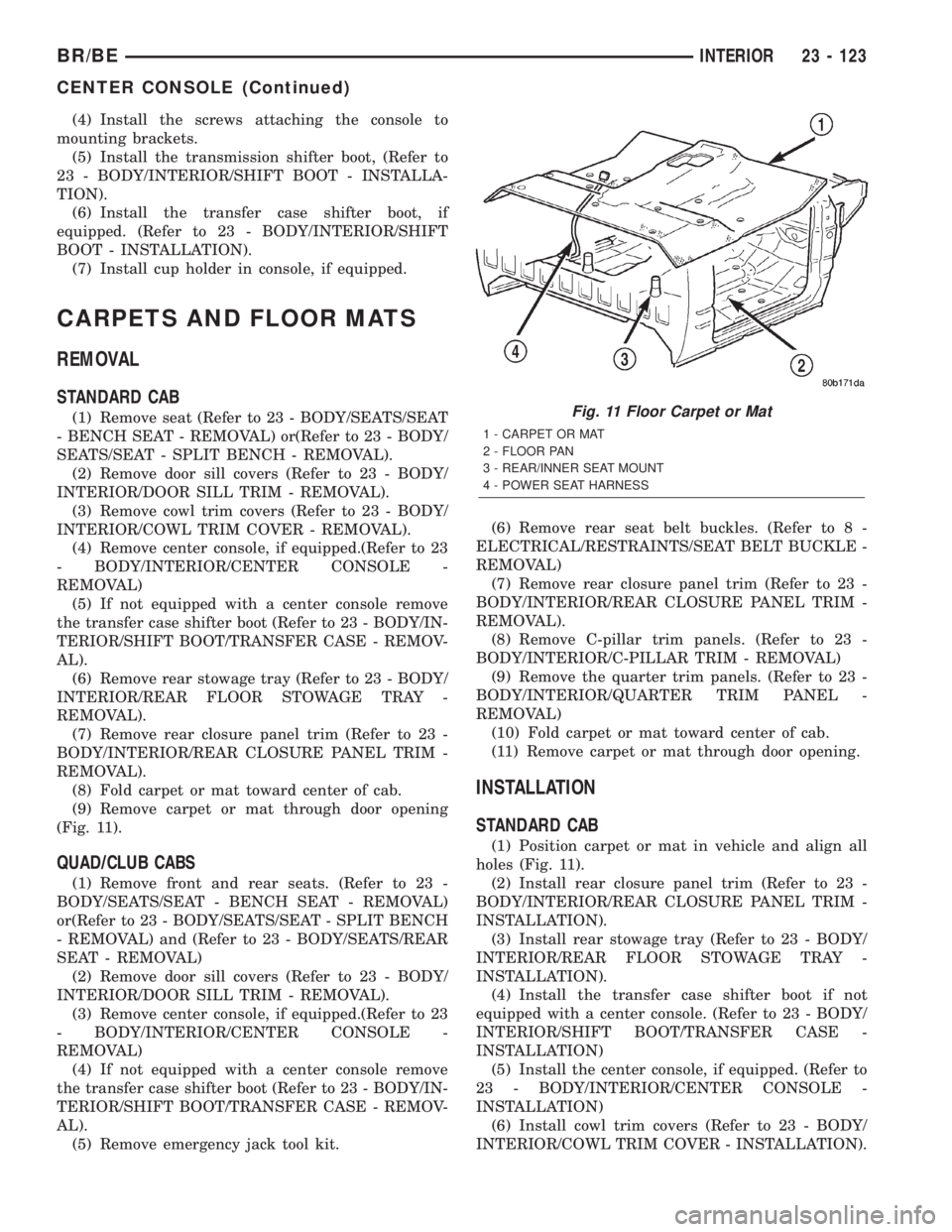
(Fig. 11).
QUAD/CLUB CABS
(1) Remove front and rear seats. (Refer to 23 -
BODY/SEATS/SEAT - BENCH SEAT - REMOVAL)
or(Refer to 23 - BODY/SEATS/SEAT - SPLIT BENCH
- REMOVAL) and (Refer to 23 - BODY/SEATS/REAR
SEAT - REMOVAL)
(2) Remove door sill covers (Refer to 23 - BODY/
INTERIOR/DOOR SILL TRIM - REMOVAL).
(3) Remove center console, if equipped.(Refer to 23
- BODY/INTERIOR/CENTER CONSOLE -
REMOVAL)
(4) If not equipped with a center console remove
the transfer case shifter boot (Refer to 23 - BODY/IN-
TERIOR/SHIFT BOOT/TRANSFER CASE - REMOV-
AL).
(5) Remove emergency jack tool kit.(6) Remove rear seat belt buckles. (Refer to 8 -
ELECTRICAL/RESTRAINTS/SEAT BELT BUCKLE -
REMOVAL)
(7) Remove rear closure panel trim (Refer to 23 -
BODY/INTERIOR/REAR CLOSURE PANEL TRIM -
REMOVAL).
(8) Remove C-pillar trim panels. (Refer to 23 -
BODY/INTERIOR/C-PILLAR TRIM - REMOVAL)
(9) Remove the quarter trim panels. (Refer to 23 -
BODY/INTERIOR/QUARTER TRIM PANEL -
REMOVAL)
(10) Fold carpet or mat toward center of cab.
(11) Remove carpet or mat through door opening.
INSTALLATION
STANDARD CAB
(1) Position carpet or mat in vehicle and align all
holes (Fig. 11).
(2) Install rear closure panel trim (Refer to 23 -
BODY/INTERIOR/REAR CLOSURE PANEL TRIM -
INSTALLATION).
(3) Install rear stowage tray (Refer to 23 - BODY/
INTERIOR/REAR FLOOR STOWAGE TRAY -
INSTALLATION).
(4) Install the transfer case shifter boot if not
equipped with a center console. (Refer to 23 - BODY/
INTERIOR/SHIFT BOOT/TRANSFER CASE -
INSTALLATION)
(5) Install the center console, if equipped. (Refer to
23 - BODY/INTERIOR/CENTER CONSOLE -
INSTALLATION)
(6) Install cowl trim covers (Refer to 23 - BODY/
INTERIOR/COWL TRIM COVER - INSTALLATION).
Fig. 11 Floor Carpet or Mat
1 - CARPET OR MAT
2 - FLOOR PAN
3 - REAR/INNER SEAT MOUNT
4 - POWER SEAT HARNESS
BR/BEINTERIOR 23 - 123
CENTER CONSOLE (Continued)
Page 2093 of 2255
BODY VENT
REMOVAL
(1) Open door.
(2) Pull outward at top of vent to disengage clips
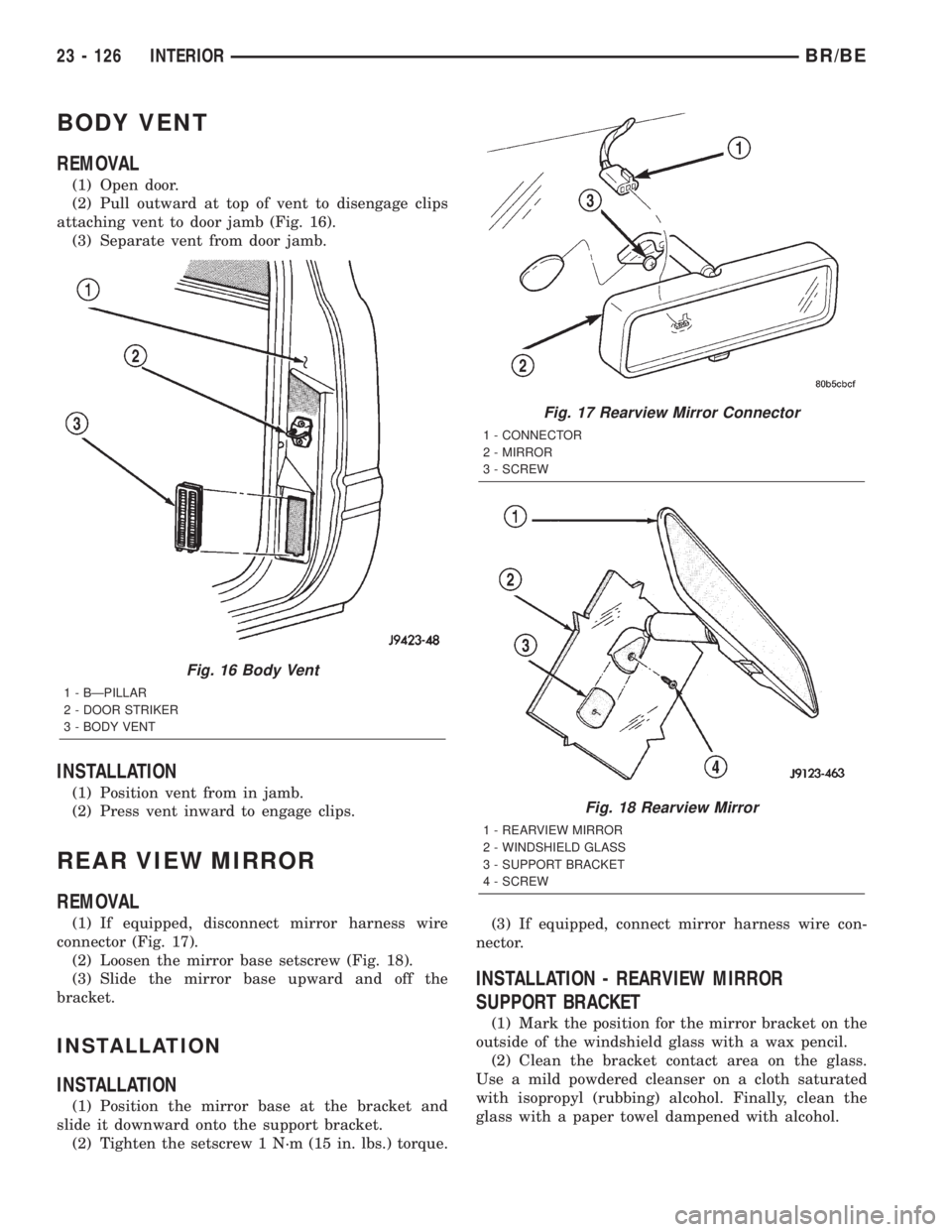
attaching vent to door jamb (Fig. 16).
(3) Separate vent from door jamb.
INSTALLATION
(1) Position vent from in jamb.
(2) Press vent inward to engage clips.
REAR VIEW MIRROR
REMOVAL
(1) If equipped, disconnect mirror harness wire
connector (Fig. 17).
(2) Loosen the mirror base setscrew (Fig. 18).
(3) Slide the mirror base upward and off the
bracket.
INSTALLATION
INSTALLATION
(1) Position the mirror base at the bracket and
slide it downward onto the support bracket.
(2) Tighten the setscrew 1 N´m (15 in. lbs.) torque.(3) If equipped, connect mirror harness wire con-
nector.
INSTALLATION - REARVIEW MIRROR
SUPPORT BRACKET
(1) Mark the position for the mirror bracket on the
outside of the windshield glass with a wax pencil.
(2) Clean the bracket contact area on the glass.
Use a mild powdered cleanser on a cloth saturated
with isopropyl (rubbing) alcohol. Finally, clean the
glass with a paper towel dampened with alcohol.
Fig. 16 Body Vent
1 - BÐPILLAR
2 - DOOR STRIKER
3 - BODY VENT
Fig. 17 Rearview Mirror Connector
1 - CONNECTOR
2 - MIRROR
3 - SCREW
Fig. 18 Rearview Mirror
1 - REARVIEW MIRROR
2 - WINDSHIELD GLASS
3 - SUPPORT BRACKET
4 - SCREW
23 - 126 INTERIORBR/BE
Page 2094 of 2255
(3) Sand the surface on the support bracket with
fine grit-sandpaper. Wipe the bracket surface clean
with a paper towel.
(4) Apply accelerator to the surface on the bracket
according to the following instructions:
(a) Crush the vial to saturate the felt applicator.
(b) Remove the paper sleeve.
(c) Apply accelerator to the contact surface on
the bracket.
(d) Allow the accelerator to dry for five minutes.
(e) Do not touch the bracket contact surface
after the accelerator has been applied.
(5) Apply adhesive accelerator to the bracket con-
tact surface on the windshield glass. Allow the accel-
erator to dry for one minute. Do not touch the glass
contact surface after the accelerator has been
applied.
(6) Install the bracket according to the following
instructions:
(a) Apply one drop of adhesive at the center of
the bracket contact-surface on the windshield
glass.
(b) Apply an even coat of adhesive to the contact
surface on the bracket.
(c) Align the bracket with the marked position
on the windshield glass.
(d) Press and hold the bracket in place for at
least one minute.
NOTE: Verify that the mirror support bracket is cor-
rectly aligned, because the adhesive will cure rap-
idly.
(7) Allow the adhesive to cure for 8-10 minutes.
Remove any excess adhesive with an alcohol-damp-
ened cloth.
(8) Allow the adhesive to cure for an additional
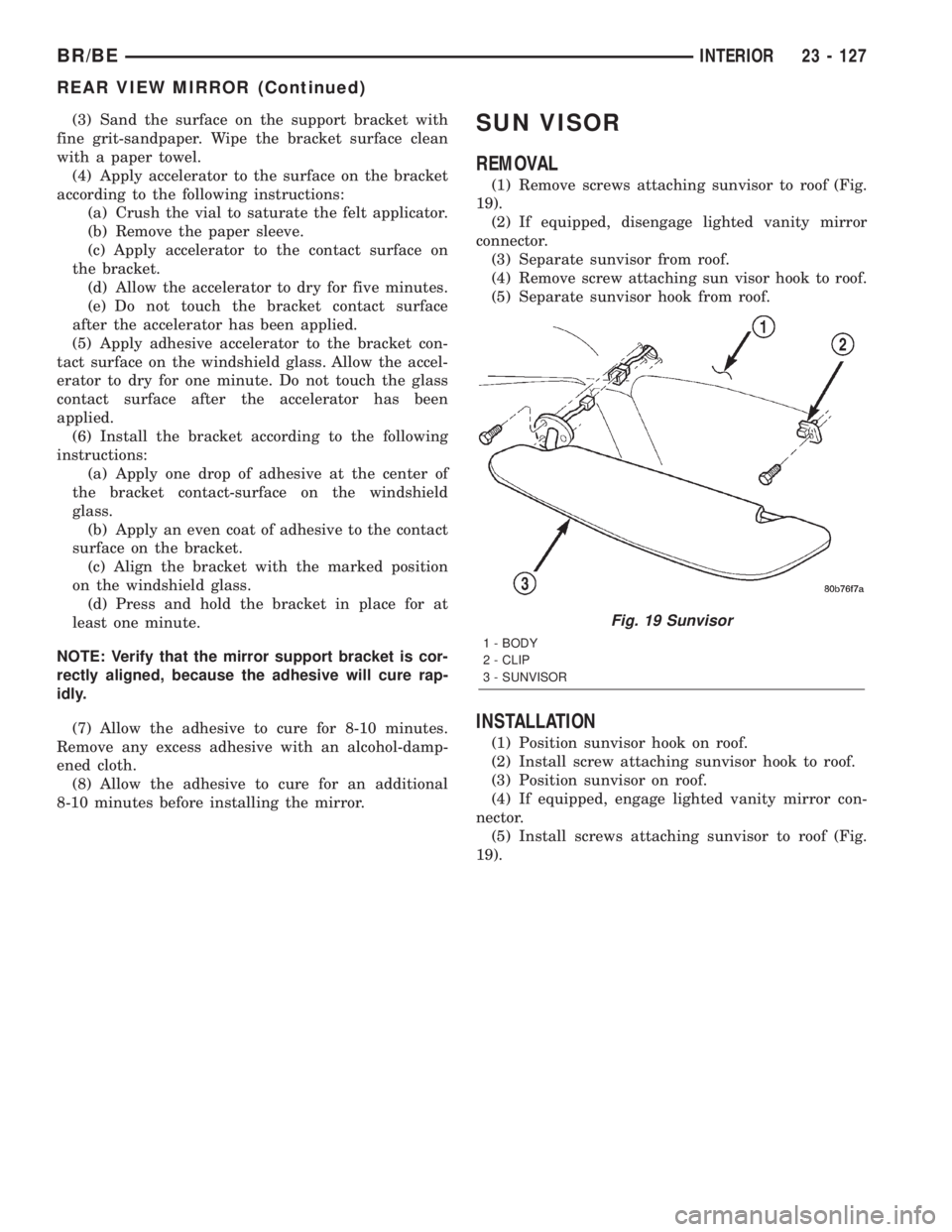
8-10 minutes before installing the mirror.SUN VISOR
REMOVAL
(1) Remove screws attaching sunvisor to roof (Fig.
19).
(2) If equipped, disengage lighted vanity mirror
connector.
(3) Separate sunvisor from roof.
(4) Remove screw attaching sun visor hook to roof.
(5) Separate sunvisor hook from roof.
INSTALLATION
(1) Position sunvisor hook on roof.
(2) Install screw attaching sunvisor hook to roof.
(3) Position sunvisor on roof.
(4) If equipped, engage lighted vanity mirror con-
nector.
(5) Install screws attaching sunvisor to roof (Fig.
19).
Fig. 19 Sunvisor
1 - BODY
2 - CLIP
3 - SUNVISOR
BR/BEINTERIOR 23 - 127
REAR VIEW MIRROR (Continued)
Page 2095 of 2255
QUARTER TRIM PANEL
REMOVAL
(1) Remove rear seat. (Refer to 23 - BODY/SEATS/
REAR SEAT - REMOVAL)
(2) Remove door sill cover as necessary to clear
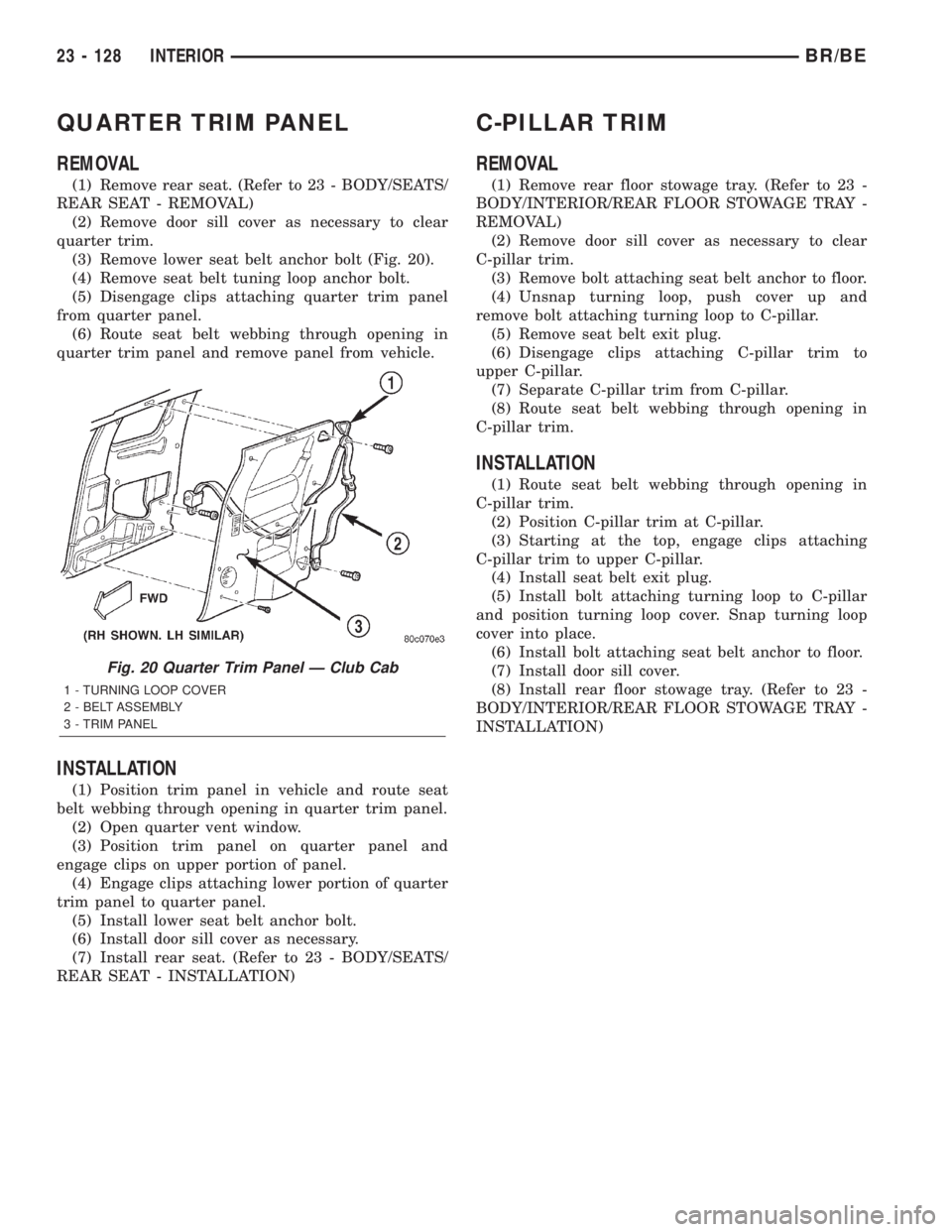
quarter trim.
(3) Remove lower seat belt anchor bolt (Fig. 20).
(4) Remove seat belt tuning loop anchor bolt.
(5) Disengage clips attaching quarter trim panel
from quarter panel.
(6) Route seat belt webbing through opening in
quarter trim panel and remove panel from vehicle.
INSTALLATION
(1) Position trim panel in vehicle and route seat
belt webbing through opening in quarter trim panel.
(2) Open quarter vent window.
(3) Position trim panel on quarter panel and
engage clips on upper portion of panel.
(4) Engage clips attaching lower portion of quarter
trim panel to quarter panel.
(5) Install lower seat belt anchor bolt.
(6) Install door sill cover as necessary.
(7) Install rear seat. (Refer to 23 - BODY/SEATS/
REAR SEAT - INSTALLATION)
C-PILLAR TRIM
REMOVAL
(1) Remove rear floor stowage tray. (Refer to 23 -
BODY/INTERIOR/REAR FLOOR STOWAGE TRAY -
REMOVAL)
(2) Remove door sill cover as necessary to clear
C-pillar trim.
(3) Remove bolt attaching seat belt anchor to floor.
(4) Unsnap turning loop, push cover up and
remove bolt attaching turning loop to C-pillar.
(5) Remove seat belt exit plug.
(6) Disengage clips attaching C-pillar trim to
upper C-pillar.
(7) Separate C-pillar trim from C-pillar.
(8) Route seat belt webbing through opening in
C-pillar trim.
INSTALLATION
(1) Route seat belt webbing through opening in
C-pillar trim.
(2) Position C-pillar trim at C-pillar.
(3) Starting at the top, engage clips attaching
C-pillar trim to upper C-pillar.
(4) Install seat belt exit plug.
(5) Install bolt attaching turning loop to C-pillar
and position turning loop cover. Snap turning loop
cover into place.
(6) Install bolt attaching seat belt anchor to floor.
(7) Install door sill cover.
(8) Install rear floor stowage tray. (Refer to 23 -
BODY/INTERIOR/REAR FLOOR STOWAGE TRAY -
INSTALLATION)
Fig. 20 Quarter Trim Panel Ð Club Cab
1 - TURNING LOOP COVER
2 - BELT ASSEMBLY
3 - TRIM PANEL
23 - 128 INTERIORBR/BE
Page 2110 of 2255
EASY ENTRY SEAT TRACK
REMOVAL
(1) Remove front passenger seat. (Refer to 23 -
BODY/SEATS/SEAT - SPLIT BENCH - REMOVAL)
(2) Remove recliner handle.
(3) Remove side shield.
(4) Disengage seat track latch release cables.
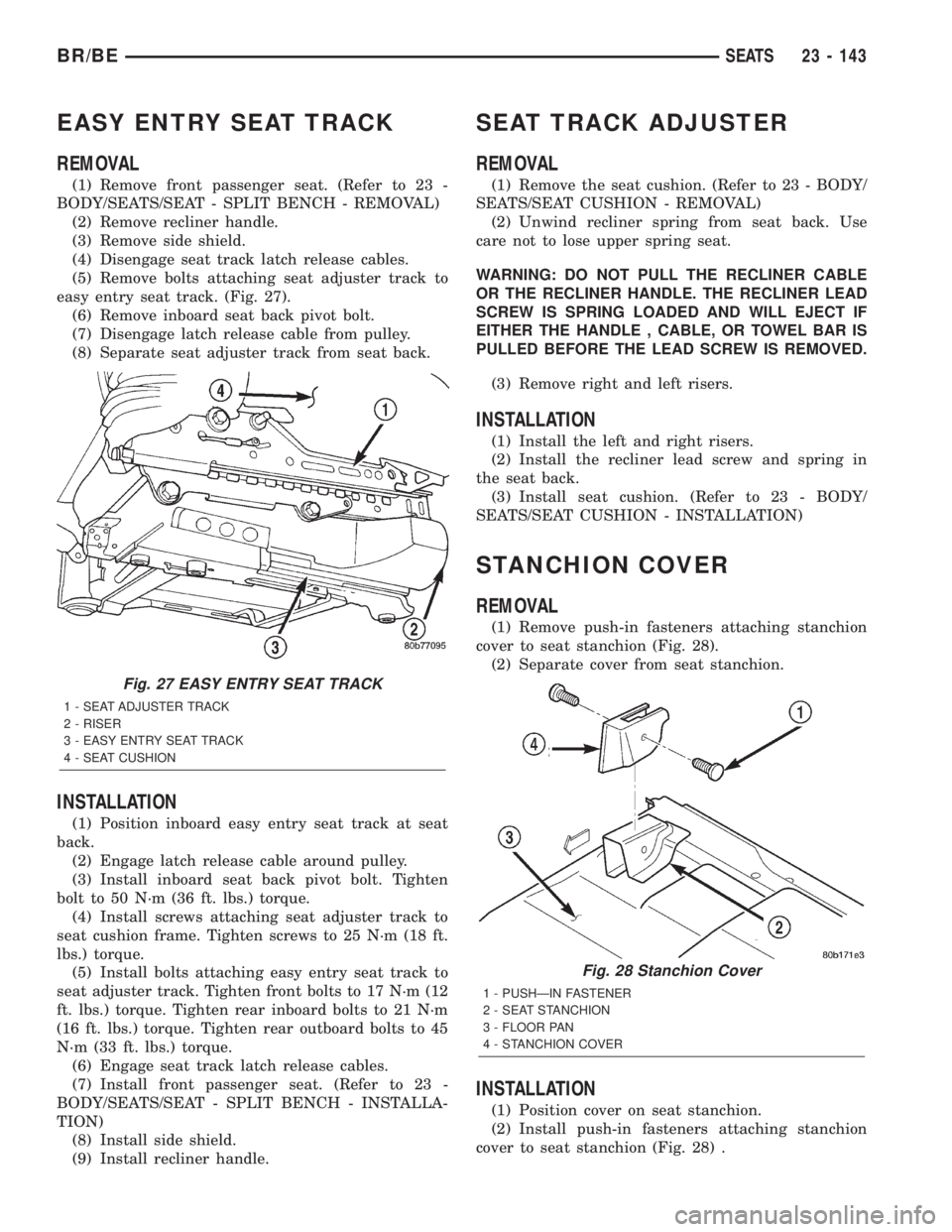
(5) Remove bolts attaching seat adjuster track to
easy entry seat track. (Fig. 27).
(6) Remove inboard seat back pivot bolt.
(7) Disengage latch release cable from pulley.
(8) Separate seat adjuster track from seat back.
INSTALLATION
(1) Position inboard easy entry seat track at seat
back.
(2) Engage latch release cable around pulley.
(3) Install inboard seat back pivot bolt. Tighten
bolt to 50 N´m (36 ft. lbs.) torque.
(4) Install screws attaching seat adjuster track to
seat cushion frame. Tighten screws to 25 N´m (18 ft.
lbs.) torque.
(5) Install bolts attaching easy entry seat track to
seat adjuster track. Tighten front bolts to 17 N´m (12
ft. lbs.) torque. Tighten rear inboard bolts to 21 N´m
(16 ft. lbs.) torque. Tighten rear outboard bolts to 45
N´m (33 ft. lbs.) torque.
(6) Engage seat track latch release cables.
(7) Install front passenger seat. (Refer to 23 -
BODY/SEATS/SEAT - SPLIT BENCH - INSTALLA-
TION)
(8) Install side shield.
(9) Install recliner handle.
SEAT TRACK ADJUSTER
REMOVAL
(1) Remove the seat cushion. (Refer to 23 - BODY/
SEATS/SEAT CUSHION - REMOVAL)
(2) Unwind recliner spring from seat back. Use
care not to lose upper spring seat.
WARNING: DO NOT PULL THE RECLINER CABLE
OR THE RECLINER HANDLE. THE RECLINER LEAD
SCREW IS SPRING LOADED AND WILL EJECT IF
EITHER THE HANDLE , CABLE, OR TOWEL BAR IS
PULLED BEFORE THE LEAD SCREW IS REMOVED.
(3) Remove right and left risers.
INSTALLATION
(1) Install the left and right risers.
(2) Install the recliner lead screw and spring in
the seat back.
(3) Install seat cushion. (Refer to 23 - BODY/
SEATS/SEAT CUSHION - INSTALLATION)
STANCHION COVER
REMOVAL
(1) Remove push-in fasteners attaching stanchion
cover to seat stanchion (Fig. 28).
(2) Separate cover from seat stanchion.
INSTALLATION
(1) Position cover on seat stanchion.
(2) Install push-in fasteners attaching stanchion
cover to seat stanchion (Fig. 28) .
Fig. 27 EASY ENTRY SEAT TRACK
1 - SEAT ADJUSTER TRACK
2 - RISER
3 - EASY ENTRY SEAT TRACK
4 - SEAT CUSHION
Fig. 28 Stanchion Cover
1 - PUSHÐIN FASTENER
2 - SEAT STANCHION
3 - FLOOR PAN
4 - STANCHION COVER
BR/BESEATS 23 - 143
Page 2111 of 2255
REAR SEAT
REMOVAL
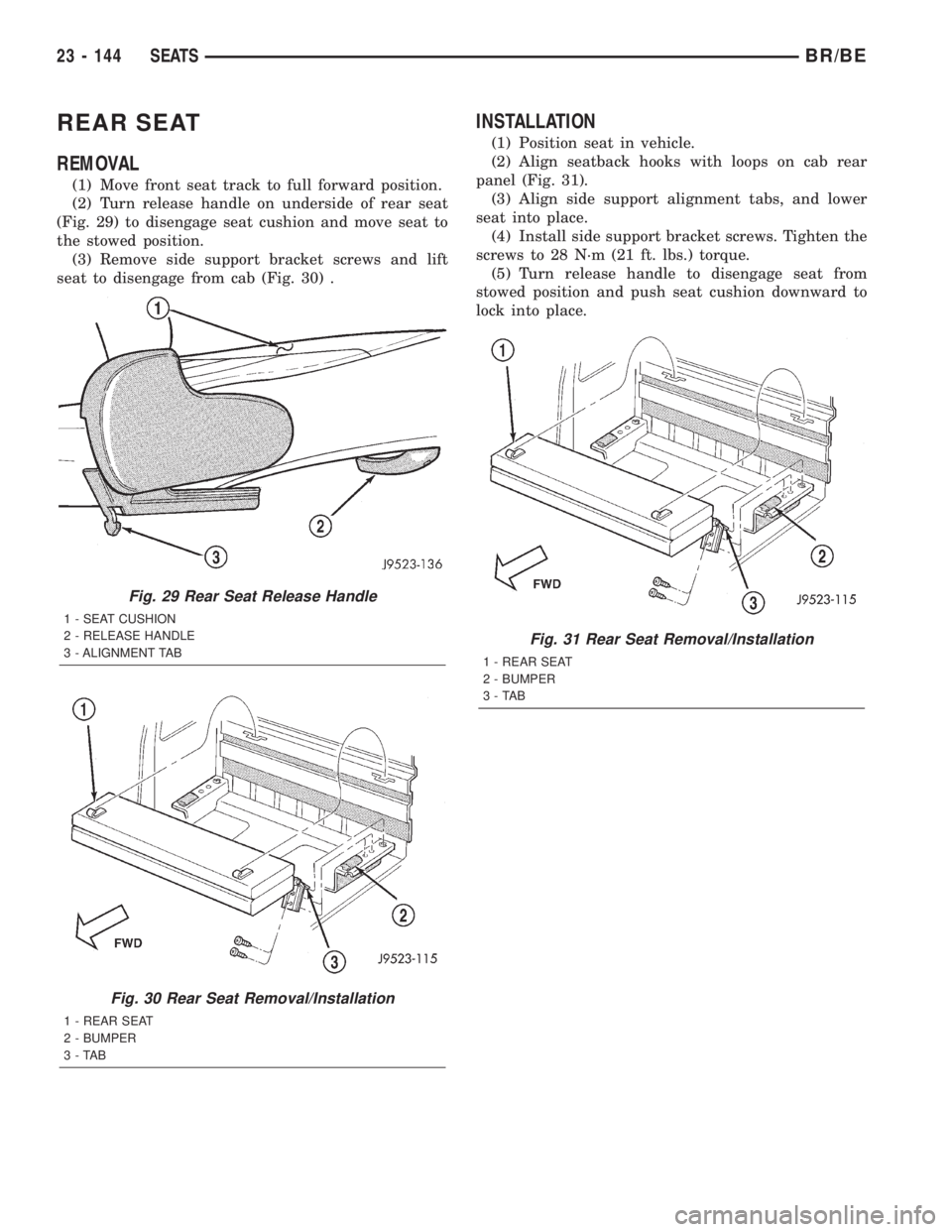
(1) Move front seat track to full forward position.
(2) Turn release handle on underside of rear seat
(Fig. 29) to disengage seat cushion and move seat to
the stowed position.
(3) Remove side support bracket screws and lift
seat to disengage from cab (Fig. 30) .
INSTALLATION
(1) Position seat in vehicle.
(2) Align seatback hooks with loops on cab rear
panel (Fig. 31).
(3) Align side support alignment tabs, and lower
seat into place.
(4) Install side support bracket screws. Tighten the
screws to 28 N´m (21 ft. lbs.) torque.
(5) Turn release handle to disengage seat from
stowed position and push seat cushion downward to
lock into place.
Fig. 29 Rear Seat Release Handle
1 - SEAT CUSHION
2 - RELEASE HANDLE
3 - ALIGNMENT TAB
Fig. 30 Rear Seat Removal/Installation
1 - REAR SEAT
2 - BUMPER
3-TAB
Fig. 31 Rear Seat Removal/Installation
1 - REAR SEAT
2 - BUMPER
3-TAB
23 - 144 SEATSBR/BE
Page 2171 of 2255
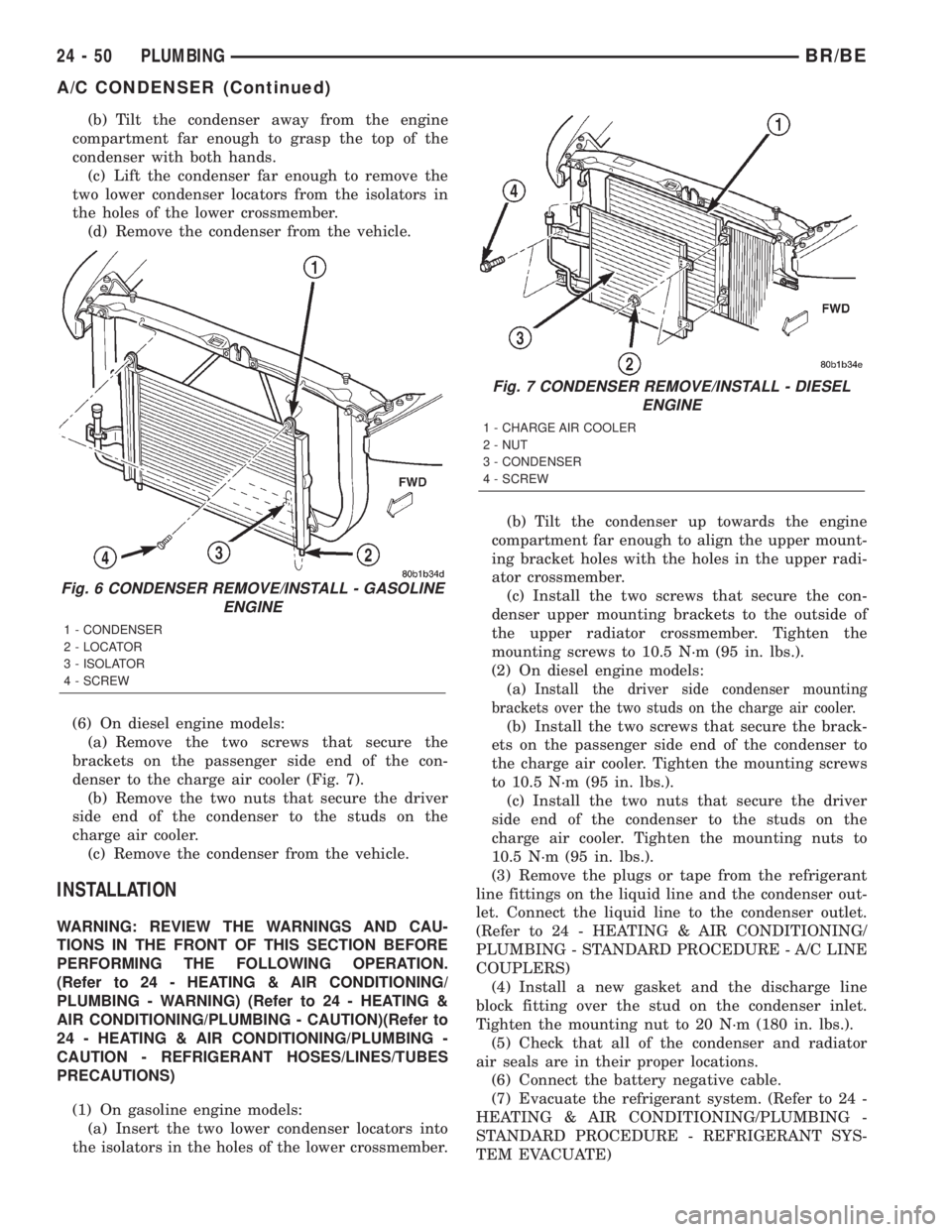
(b) Tilt the condenser away from the engine
compartment far enough to grasp the top of the
condenser with both hands.
(c) Lift the condenser far enough to remove the
two lower condenser locators from the isolators in
the holes of the lower crossmember.
(d) Remove the condenser from the vehicle.
(6) On diesel engine models:
(a) Remove the two screws that secure the
brackets on the passenger side end of the con-
denser to the charge air cooler (Fig. 7).
(b) Remove the two nuts that secure the driver
side end of the condenser to the studs on the
charge air cooler.
(c) Remove the condenser from the vehicle.
INSTALLATION
WARNING: REVIEW THE WARNINGS AND CAU-
TIONS IN THE FRONT OF THIS SECTION BEFORE
PERFORMING THE FOLLOWING OPERATION.
(Refer to 24 - HEATING & AIR CONDITIONING/
PLUMBING - WARNING) (Refer to 24 - HEATING &
AIR CONDITIONING/PLUMBING - CAUTION)(Refer to
24 - HEATING & AIR CONDITIONING/PLUMBING -
CAUTION - REFRIGERANT HOSES/LINES/TUBES
PRECAUTIONS)
(1) On gasoline engine models:
(a) Insert the two lower condenser locators into
the isolators in the holes of the lower crossmember.(b) Tilt the condenser up towards the engine
compartment far enough to align the upper mount-
ing bracket holes with the holes in the upper radi-
ator crossmember.
(c) Install the two screws that secure the con-
denser upper mounting brackets to the outside of
the upper radiator crossmember. Tighten the
mounting screws to 10.5 N´m (95 in. lbs.).
(2) On diesel engine models:
(a)
Install the driver side condenser mounting
brackets over the two studs on the charge air cooler.
(b) Install the two screws that secure the brack-
ets on the passenger side end of the condenser to
the charge air cooler. Tighten the mounting screws
to 10.5 N´m (95 in. lbs.).
(c) Install the two nuts that secure the driver
side end of the condenser to the studs on the
charge air cooler. Tighten the mounting nuts to
10.5 N´m (95 in. lbs.).
(3) Remove the plugs or tape from the refrigerant
line fittings on the liquid line and the condenser out-
let. Connect the liquid line to the condenser outlet.
(Refer to 24 - HEATING & AIR CONDITIONING/
PLUMBING - STANDARD PROCEDURE - A/C LINE
COUPLERS)
(4) Install a new gasket and the discharge line
block fitting over the stud on the condenser inlet.
Tighten the mounting nut to 20 N´m (180 in. lbs.).
(5) Check that all of the condenser and radiator
air seals are in their proper locations.
(6) Connect the battery negative cable.
(7) Evacuate the refrigerant system. (Refer to 24 -
HEATING & AIR CONDITIONING/PLUMBING -
STANDARD PROCEDURE - REFRIGERANT SYS-
TEM EVACUATE)
Fig. 6 CONDENSER REMOVE/INSTALL - GASOLINE
ENGINE
1 - CONDENSER
2 - LOCATOR
3 - ISOLATOR
4 - SCREW
Fig. 7 CONDENSER REMOVE/INSTALL - DIESEL
ENGINE
1 - CHARGE AIR COOLER
2 - NUT
3 - CONDENSER
4 - SCREW
24 - 50 PLUMBINGBR/BE
A/C CONDENSER (Continued)
Page 2207 of 2255
OPERATION - AIR INJECTION SYSTEM
The air injection system adds a controlled amount
of air to the exhaust gases aiding oxidation of hydro-
carbons and carbon monoxide in the exhaust stream.
The system does not interfere with the ability of the
EGR system (if used) to control nitrous oxide (NOx)
emissions.
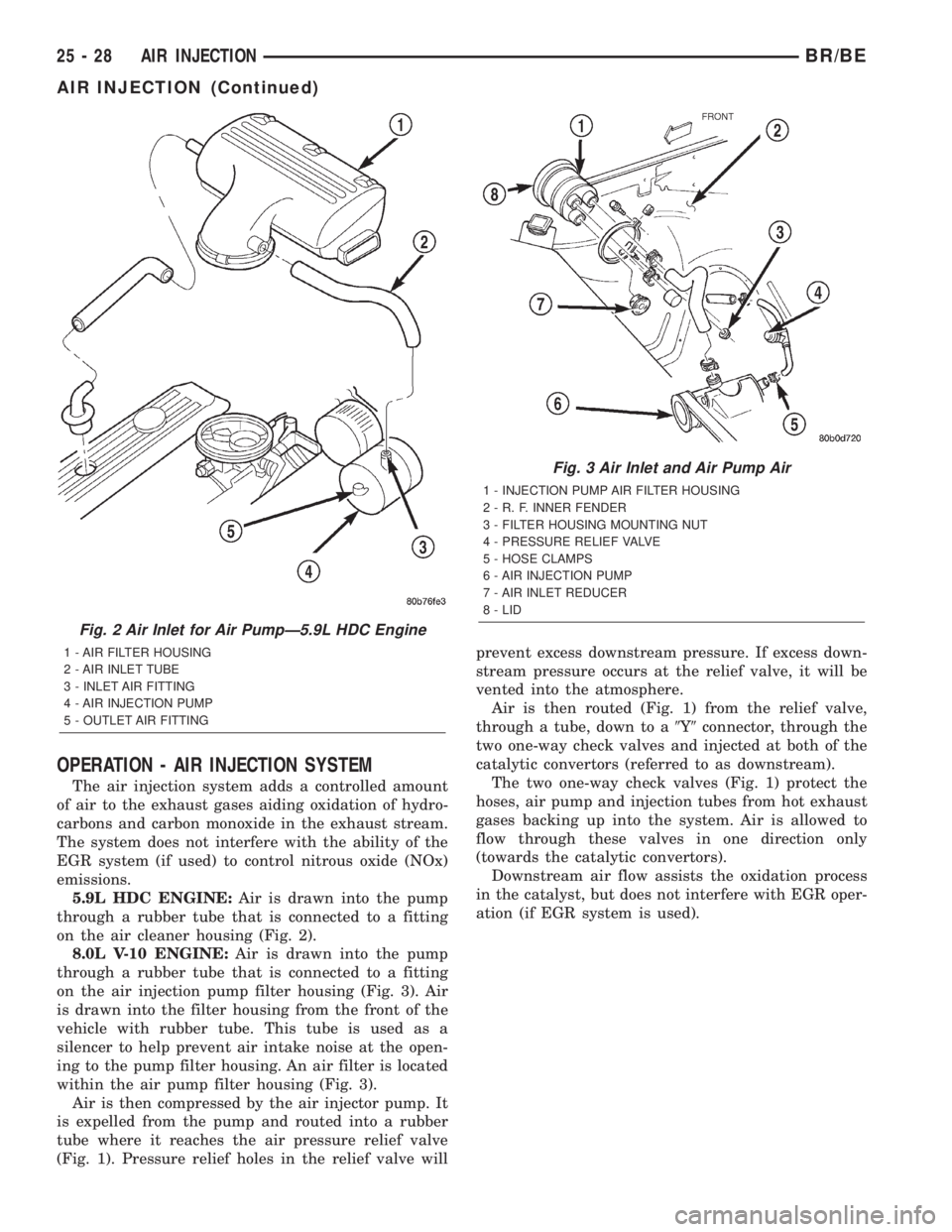
5.9L HDC ENGINE:Air is drawn into the pump
through a rubber tube that is connected to a fitting
on the air cleaner housing (Fig. 2).
8.0L V-10 ENGINE:Air is drawn into the pump
through a rubber tube that is connected to a fitting
on the air injection pump filter housing (Fig. 3). Air
is drawn into the filter housing from the front of the
vehicle with rubber tube. This tube is used as a
silencer to help prevent air intake noise at the open-
ing to the pump filter housing. An air filter is located
within the air pump filter housing (Fig. 3).
Air is then compressed by the air injector pump. It
is expelled from the pump and routed into a rubber
tube where it reaches the air pressure relief valve
(Fig. 1). Pressure relief holes in the relief valve willprevent excess downstream pressure. If excess down-
stream pressure occurs at the relief valve, it will be
vented into the atmosphere.
Air is then routed (Fig. 1) from the relief valve,
through a tube, down to a9Y9connector, through the
two one-way check valves and injected at both of the
catalytic convertors (referred to as downstream).
The two one-way check valves (Fig. 1) protect the
hoses, air pump and injection tubes from hot exhaust
gases backing up into the system. Air is allowed to
flow through these valves in one direction only
(towards the catalytic convertors).
Downstream air flow assists the oxidation process
in the catalyst, but does not interfere with EGR oper-
ation (if EGR system is used).
Fig. 2 Air Inlet for Air PumpÐ5.9L HDC Engine
1 - AIR FILTER HOUSING
2 - AIR INLET TUBE
3 - INLET AIR FITTING
4 - AIR INJECTION PUMP
5 - OUTLET AIR FITTING
Fig. 3 Air Inlet and Air Pump Air
1 - INJECTION PUMP AIR FILTER HOUSING
2 - R. F. INNER FENDER
3 - FILTER HOUSING MOUNTING NUT
4 - PRESSURE RELIEF VALVE
5 - HOSE CLAMPS
6 - AIR INJECTION PUMP
7 - AIR INLET REDUCER
8 - LID
25 - 28 AIR INJECTIONBR/BE
AIR INJECTION (Continued)