Transmission DODGE RAM 2002 Service Repair Manual
[x] Cancel search | Manufacturer: DODGE, Model Year: 2002, Model line: RAM, Model: DODGE RAM 2002Pages: 2255, PDF Size: 62.07 MB
Page 1499 of 2255
MANUAL - NV5600
TABLE OF CONTENTS
page page
MANUAL - NV5600
DESCRIPTION.........................46
OPERATION...........................48
DIAGNOSIS AND TESTING................48
REMOVAL.............................49
DISASSEMBLY.........................49
CLEANING............................63
INSPECTION..........................63
ASSEMBLY............................64
INSTALLATION.........................78
SPECIFICATIONS.......................79SPECIAL TOOLS......................80
ADAPTER HOUSING SEAL - NV5600
REMOVAL.............................85
INSTALLATION.........................85
EXTENSION HOUSING SEAL - NV5600
REMOVAL.............................85
INSTALLATION.........................85
SHIFT COVER - NV5600
REMOVAL.............................86
INSTALLATION.........................86
MANUAL - NV5600
DESCRIPTION
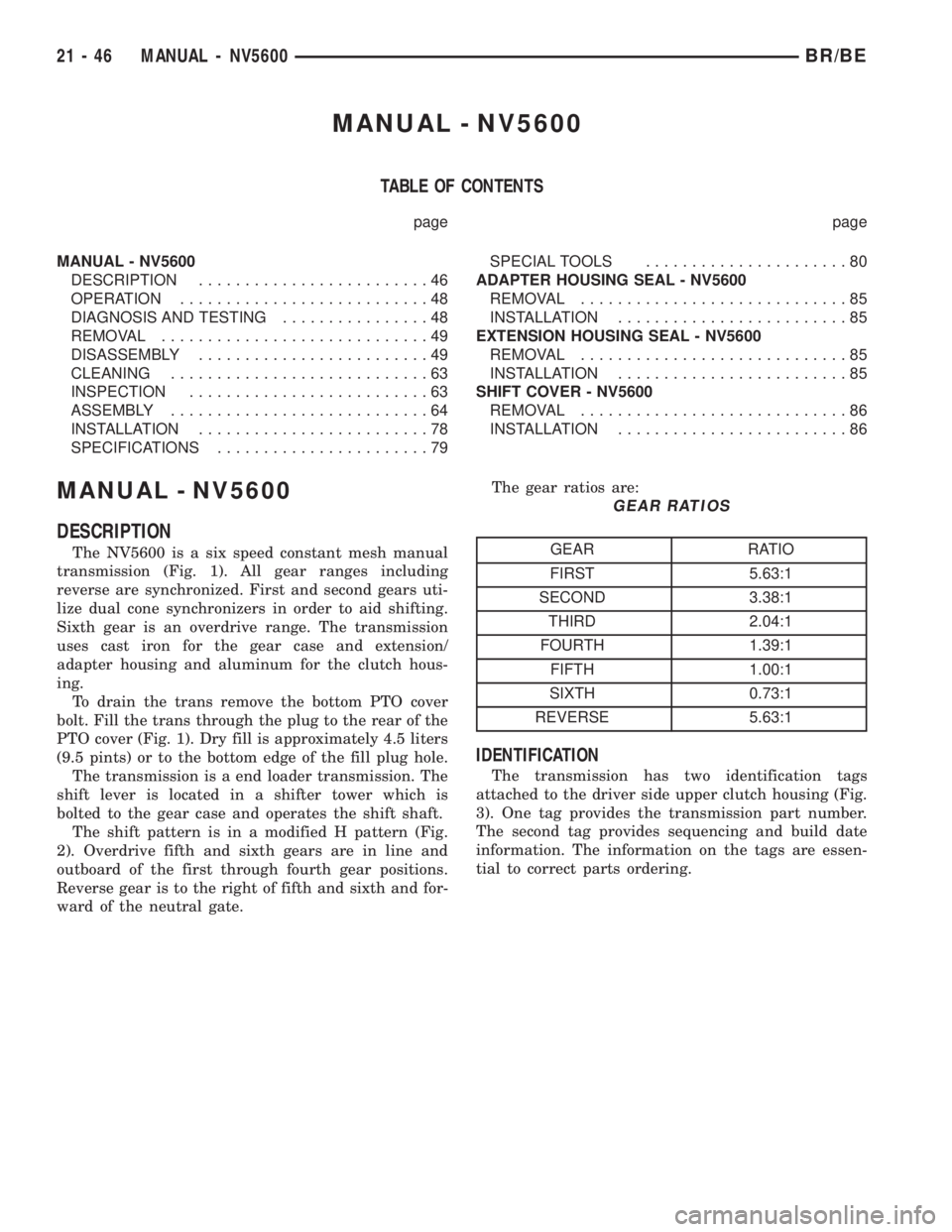
The NV5600 is a six speed constant mesh manual
transmission (Fig. 1). All gear ranges including
reverse are synchronized. First and second gears uti-
lize dual cone synchronizers in order to aid shifting.
Sixth gear is an overdrive range. The transmission
uses cast iron for the gear case and extension/
adapter housing and aluminum for the clutch hous-
ing.
To drain the trans remove the bottom PTO cover
bolt. Fill the trans through the plug to the rear of the
PTO cover (Fig. 1). Dry fill is approximately 4.5 liters
(9.5 pints) or to the bottom edge of the fill plug hole.
The transmission is a end loader transmission. The
shift lever is located in a shifter tower which is
bolted to the gear case and operates the shift shaft.
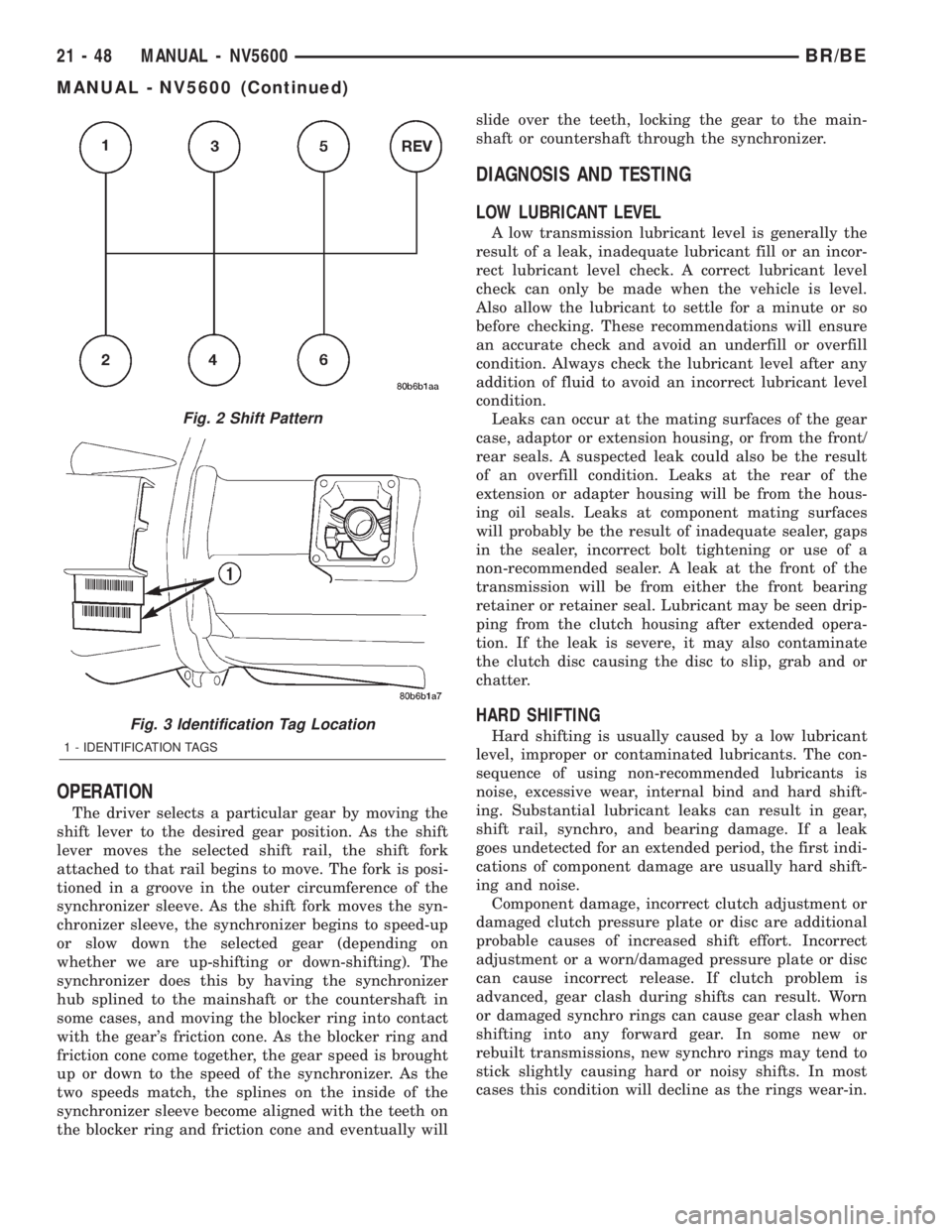
The shift pattern is in a modified H pattern (Fig.
2). Overdrive fifth and sixth gears are in line and
outboard of the first through fourth gear positions.
Reverse gear is to the right of fifth and sixth and for-
ward of the neutral gate.The gear ratios are:
GEAR RATIOS
GEAR RATIO
FIRST 5.63:1
SECOND 3.38:1
THIRD 2.04:1
FOURTH 1.39:1
FIFTH 1.00:1
SIXTH 0.73:1
REVERSE 5.63:1
IDENTIFICATION
The transmission has two identification tags
attached to the driver side upper clutch housing (Fig.
3). One tag provides the transmission part number.
The second tag provides sequencing and build date
information. The information on the tags are essen-
tial to correct parts ordering.
21 - 46 MANUAL - NV5600BR/BE
Page 1500 of 2255
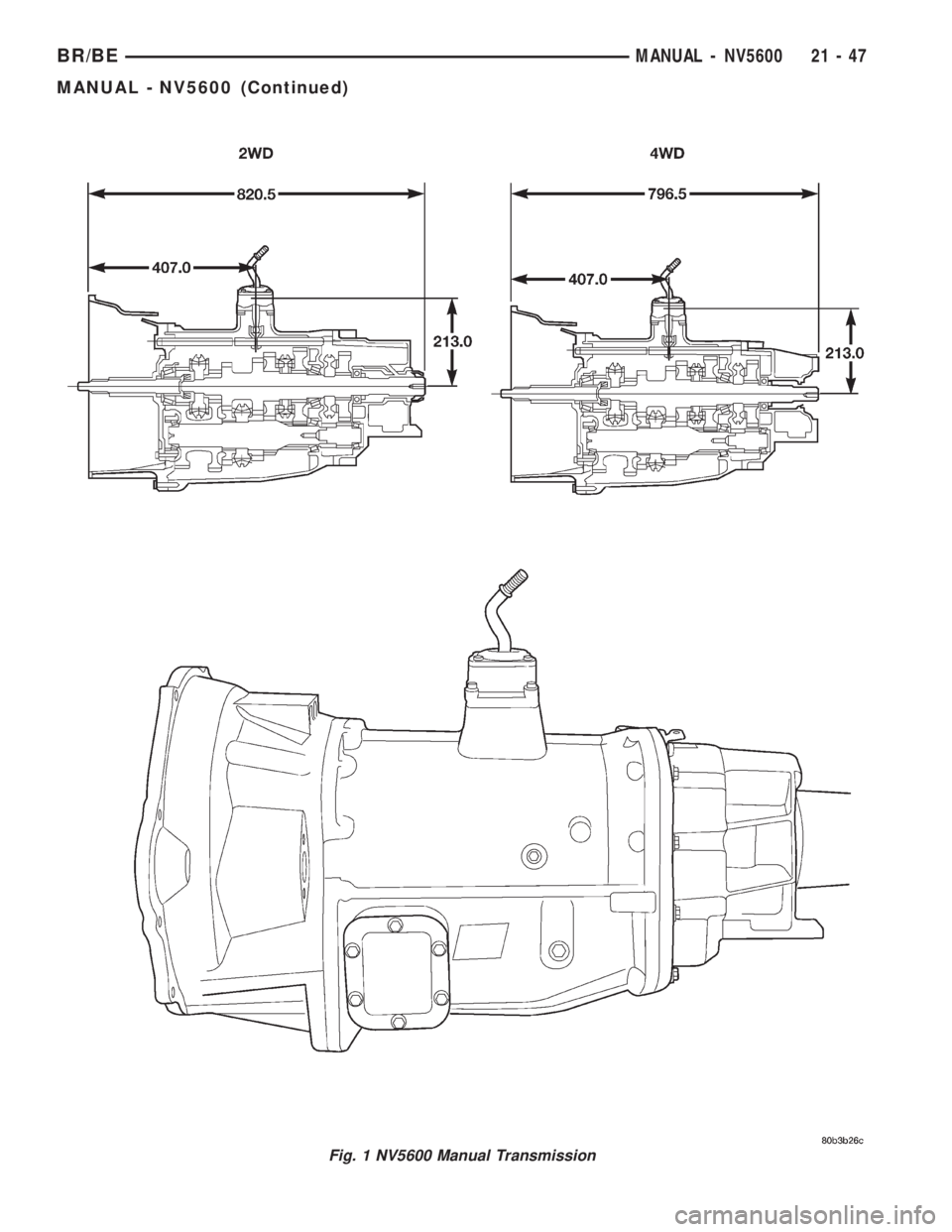
Fig. 1 NV5600 Manual Transmission
BR/BEMANUAL - NV5600 21 - 47
MANUAL - NV5600 (Continued)
Page 1501 of 2255
OPERATION
The driver selects a particular gear by moving the
shift lever to the desired gear position. As the shift
lever moves the selected shift rail, the shift fork
attached to that rail begins to move. The fork is posi-
tioned in a groove in the outer circumference of the
synchronizer sleeve. As the shift fork moves the syn-
chronizer sleeve, the synchronizer begins to speed-up
or slow down the selected gear (depending on
whether we are up-shifting or down-shifting). The
synchronizer does this by having the synchronizer
hub splined to the mainshaft or the countershaft in
some cases, and moving the blocker ring into contact
with the gear's friction cone. As the blocker ring and
friction cone come together, the gear speed is brought
up or down to the speed of the synchronizer. As the
two speeds match, the splines on the inside of the
synchronizer sleeve become aligned with the teeth on
the blocker ring and friction cone and eventually willslide over the teeth, locking the gear to the main-
shaft or countershaft through the synchronizer.
DIAGNOSIS AND TESTING
LOW LUBRICANT LEVEL
A low transmission lubricant level is generally the
result of a leak, inadequate lubricant fill or an incor-
rect lubricant level check. A correct lubricant level
check can only be made when the vehicle is level.
Also allow the lubricant to settle for a minute or so
before checking. These recommendations will ensure
an accurate check and avoid an underfill or overfill
condition. Always check the lubricant level after any
addition of fluid to avoid an incorrect lubricant level
condition.
Leaks can occur at the mating surfaces of the gear
case, adaptor or extension housing, or from the front/
rear seals. A suspected leak could also be the result
of an overfill condition. Leaks at the rear of the
extension or adapter housing will be from the hous-
ing oil seals. Leaks at component mating surfaces
will probably be the result of inadequate sealer, gaps
in the sealer, incorrect bolt tightening or use of a
non-recommended sealer. A leak at the front of the
transmission will be from either the front bearing
retainer or retainer seal. Lubricant may be seen drip-
ping from the clutch housing after extended opera-
tion. If the leak is severe, it may also contaminate
the clutch disc causing the disc to slip, grab and or
chatter.
HARD SHIFTING
Hard shifting is usually caused by a low lubricant
level, improper or contaminated lubricants. The con-
sequence of using non-recommended lubricants is
noise, excessive wear, internal bind and hard shift-
ing. Substantial lubricant leaks can result in gear,
shift rail, synchro, and bearing damage. If a leak
goes undetected for an extended period, the first indi-
cations of component damage are usually hard shift-
ing and noise.
Component damage, incorrect clutch adjustment or
damaged clutch pressure plate or disc are additional
probable causes of increased shift effort. Incorrect
adjustment or a worn/damaged pressure plate or disc
can cause incorrect release. If clutch problem is
advanced, gear clash during shifts can result. Worn
or damaged synchro rings can cause gear clash when
shifting into any forward gear. In some new or
rebuilt transmissions, new synchro rings may tend to
stick slightly causing hard or noisy shifts. In most
cases this condition will decline as the rings wear-in.
Fig. 2 Shift Pattern
Fig. 3 Identification Tag Location
1 - IDENTIFICATION TAGS
21 - 48 MANUAL - NV5600BR/BE
MANUAL - NV5600 (Continued)
Page 1502 of 2255
TRANSMISSION NOISE
Most manual transmissions make some noise dur-
ing normal operation. Rotating gears generate a mild
whine that is audible, but generally only at extreme
speeds. Severe highly audible transmission noise is
generally the initial indicator of a lubricant problem.
Insufficient, improper or contaminated lubricant
will promote rapid wear of gears, synchros, shift
rails, forks and bearings. The overheating caused by
a lubricant problem, can also lead to gear breakage.
REMOVAL
NOTE: Use a heavy duty scissors style transmis-
sion jack for remove of the transmission.
(1) Disconnect battery negative cable.
(2) Shift transmission into Neutral.
(3) Remove screws attaching shift boot to floorpan.
Then slide boot upward on the shift lever.
(4) Remove the bolts holding the shift tower to the
isolator plate and transmission gear case.
(5) Remove the shift tower and isolator plate from
the transmission gear case.
(6) Raise and support vehicle.
(7) Remove skid plate, if equipped.
(8) Mark propeller shaft/shafts and axle yokes for
installation reference.
(9) Remove propeller shaft.
(10) Disconnect and remove exhaust system as
necessary.
(11) Disconnect wires at backup light switch.
(12) Support engine with adjustable safety stand
and wood block.
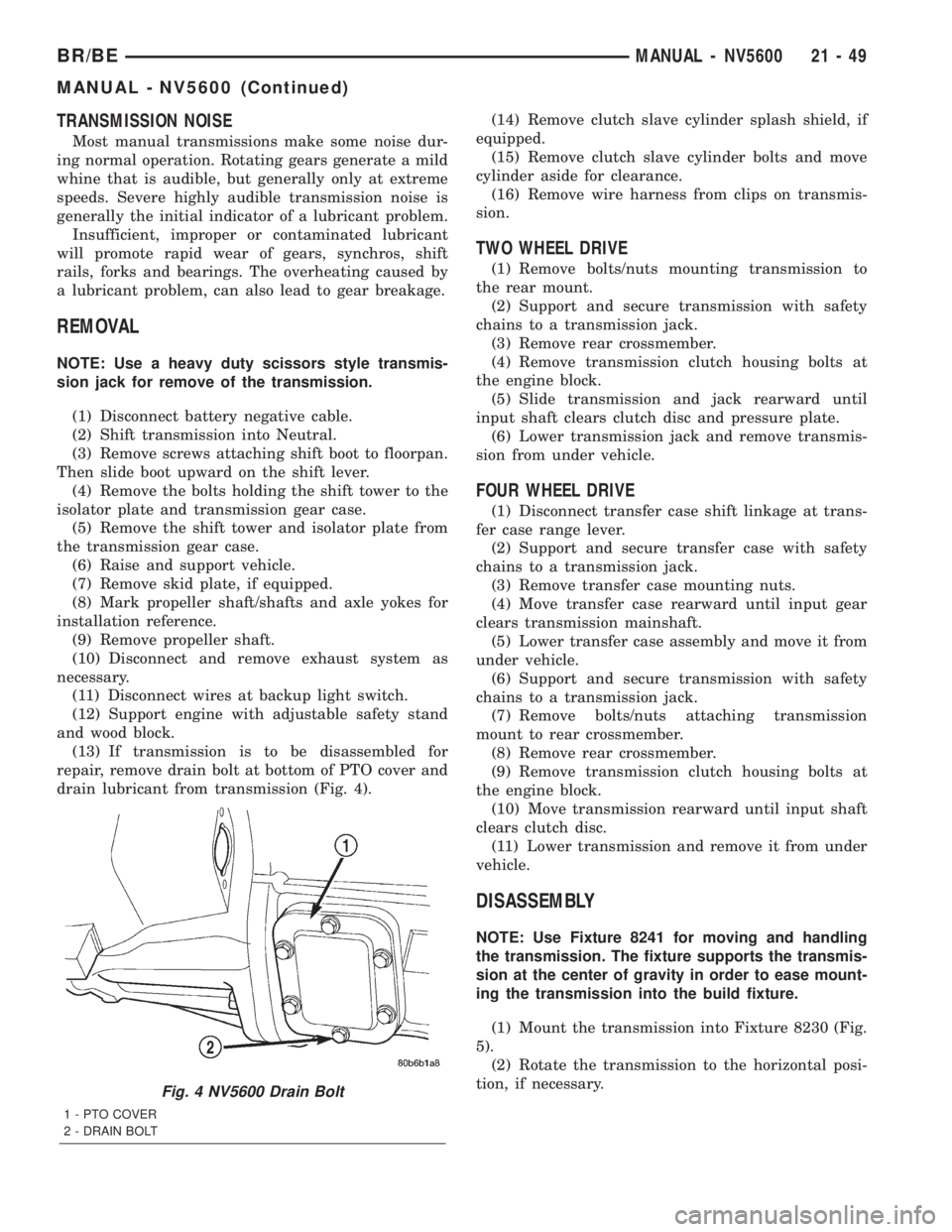
(13) If transmission is to be disassembled for
repair, remove drain bolt at bottom of PTO cover and
drain lubricant from transmission (Fig. 4).(14) Remove clutch slave cylinder splash shield, if
equipped.
(15) Remove clutch slave cylinder bolts and move
cylinder aside for clearance.
(16) Remove wire harness from clips on transmis-
sion.
TWO WHEEL DRIVE
(1) Remove bolts/nuts mounting transmission to
the rear mount.
(2) Support and secure transmission with safety
chains to a transmission jack.
(3) Remove rear crossmember.
(4) Remove transmission clutch housing bolts at
the engine block.
(5) Slide transmission and jack rearward until
input shaft clears clutch disc and pressure plate.
(6) Lower transmission jack and remove transmis-
sion from under vehicle.
FOUR WHEEL DRIVE
(1) Disconnect transfer case shift linkage at trans-
fer case range lever.
(2) Support and secure transfer case with safety
chains to a transmission jack.
(3) Remove transfer case mounting nuts.
(4) Move transfer case rearward until input gear
clears transmission mainshaft.
(5) Lower transfer case assembly and move it from
under vehicle.
(6) Support and secure transmission with safety
chains to a transmission jack.
(7) Remove bolts/nuts attaching transmission
mount to rear crossmember.
(8) Remove rear crossmember.
(9) Remove transmission clutch housing bolts at
the engine block.
(10) Move transmission rearward until input shaft
clears clutch disc.
(11) Lower transmission and remove it from under
vehicle.
DISASSEMBLY
NOTE: Use Fixture 8241 for moving and handling
the transmission. The fixture supports the transmis-
sion at the center of gravity in order to ease mount-
ing the transmission into the build fixture.
(1) Mount the transmission into Fixture 8230 (Fig.
5).
(2) Rotate the transmission to the horizontal posi-
tion, if necessary.
Fig. 4 NV5600 Drain Bolt
1 - PTO COVER
2 - DRAIN BOLT
BR/BEMANUAL - NV5600 21 - 49
MANUAL - NV5600 (Continued)
Page 1503 of 2255
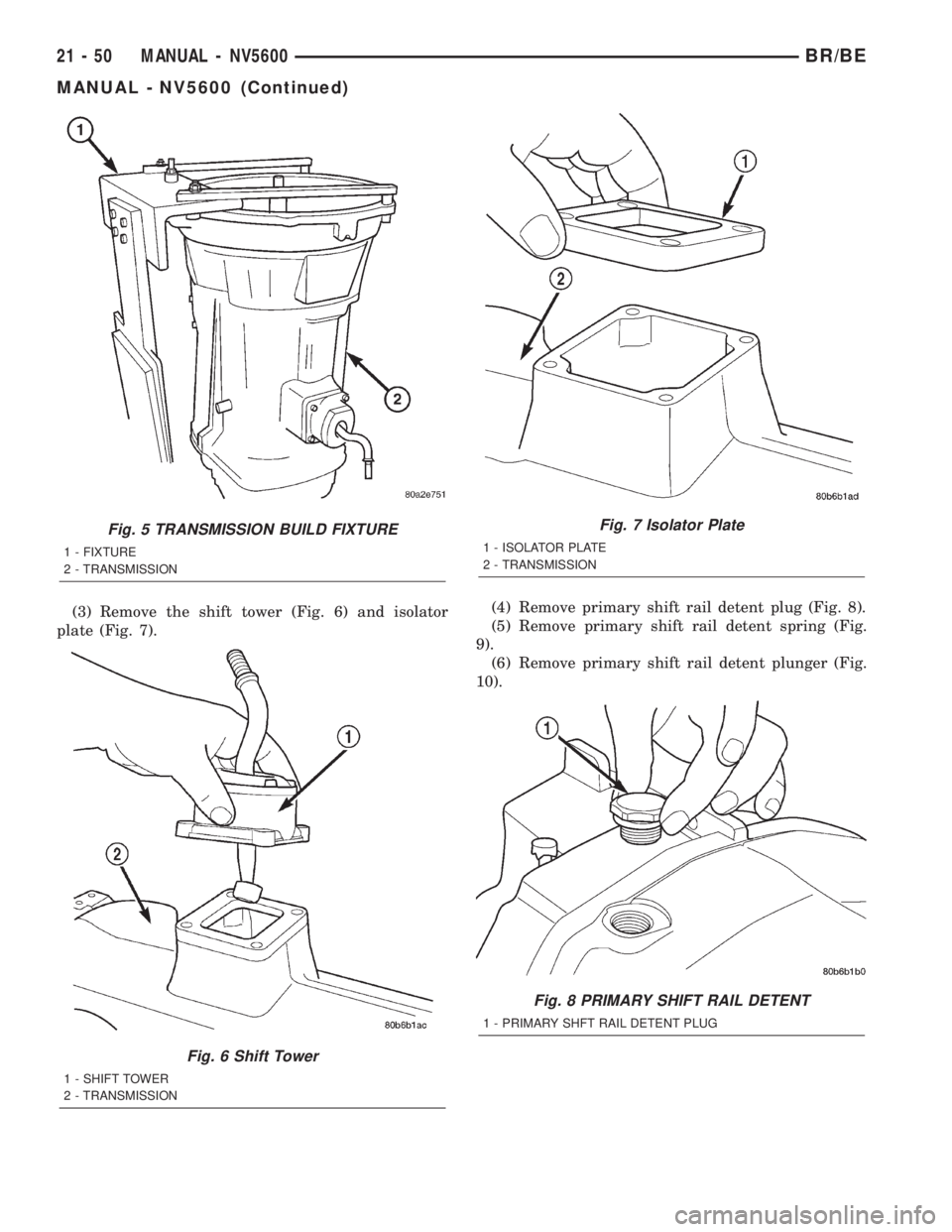
(3) Remove the shift tower (Fig. 6) and isolator
plate (Fig. 7).(4) Remove primary shift rail detent plug (Fig. 8).
(5) Remove primary shift rail detent spring (Fig.
9).
(6) Remove primary shift rail detent plunger (Fig.
10).
Fig. 5 TRANSMISSION BUILD FIXTURE
1 - FIXTURE
2 - TRANSMISSION
Fig. 6 Shift Tower
1 - SHIFT TOWER
2 - TRANSMISSION
Fig. 7 Isolator Plate
1 - ISOLATOR PLATE
2 - TRANSMISSION
Fig. 8 PRIMARY SHIFT RAIL DETENT
1 - PRIMARY SHFT RAIL DETENT PLUG
21 - 50 MANUAL - NV5600BR/BE
MANUAL - NV5600 (Continued)
Page 1504 of 2255
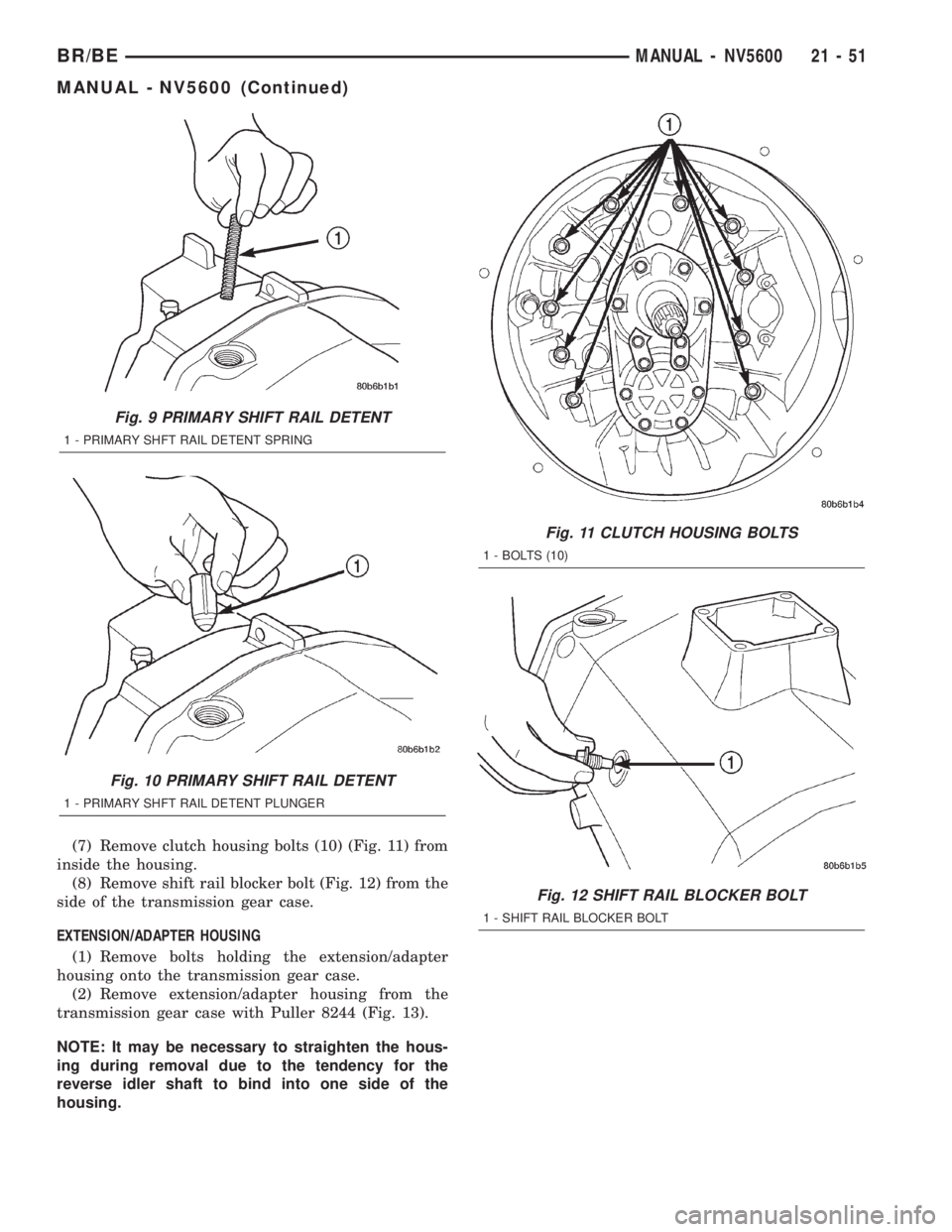
(7) Remove clutch housing bolts (10) (Fig. 11) from
inside the housing.
(8) Remove shift rail blocker bolt (Fig. 12) from the
side of the transmission gear case.
EXTENSION/ADAPTER HOUSING
(1) Remove bolts holding the extension/adapter
housing onto the transmission gear case.
(2) Remove extension/adapter housing from the
transmission gear case with Puller 8244 (Fig. 13).
NOTE: It may be necessary to straighten the hous-
ing during removal due to the tendency for the
reverse idler shaft to bind into one side of the
housing.
Fig. 9 PRIMARY SHIFT RAIL DETENT
1 - PRIMARY SHFT RAIL DETENT SPRING
Fig. 10 PRIMARY SHIFT RAIL DETENT
1 - PRIMARY SHFT RAIL DETENT PLUNGER
Fig. 11 CLUTCH HOUSING BOLTS
1 - BOLTS (10)
Fig. 12 SHIFT RAIL BLOCKER BOLT
1 - SHIFT RAIL BLOCKER BOLT
BR/BEMANUAL - NV5600 21 - 51
MANUAL - NV5600 (Continued)
Page 1507 of 2255
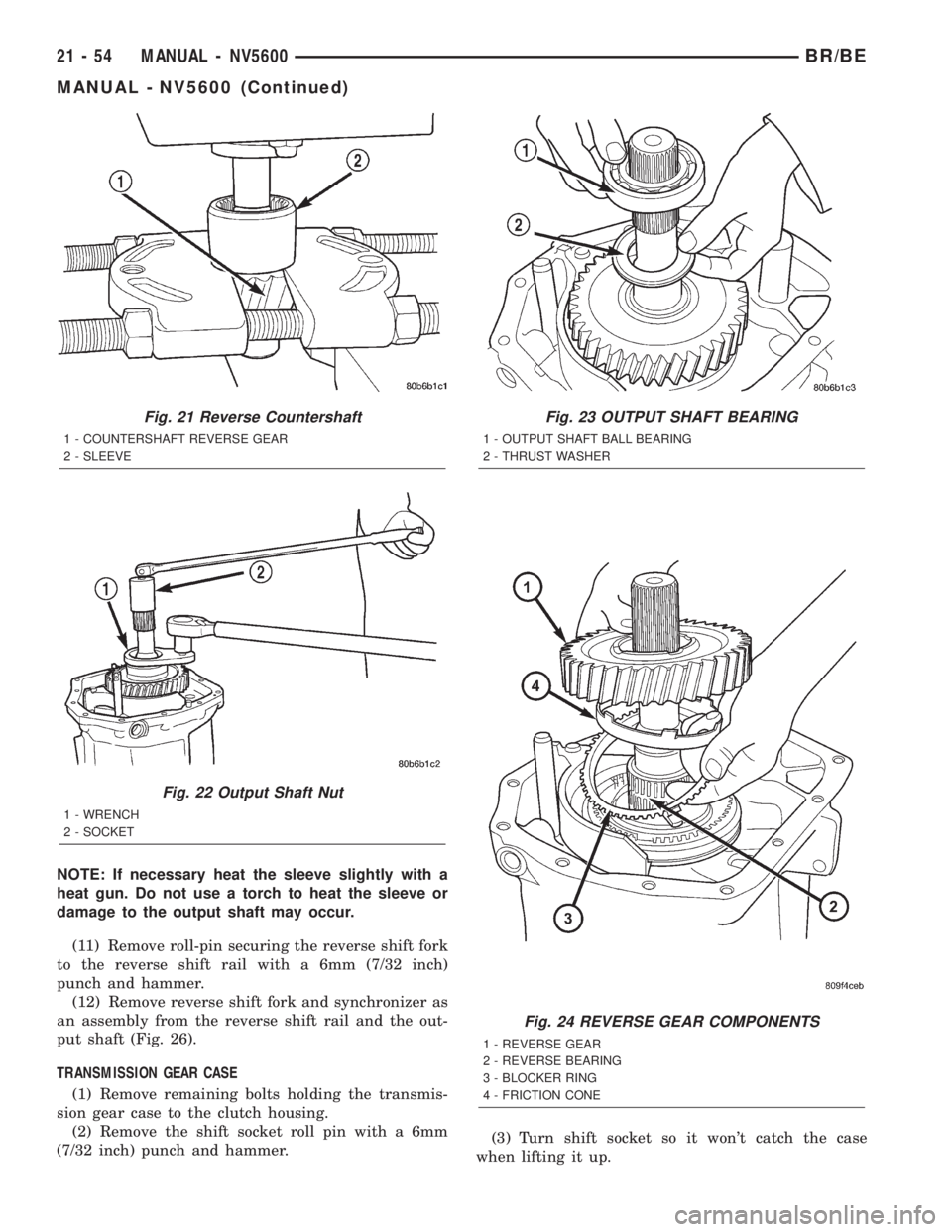
NOTE: If necessary heat the sleeve slightly with a
heat gun. Do not use a torch to heat the sleeve or
damage to the output shaft may occur.
(11) Remove roll-pin securing the reverse shift fork
to the reverse shift rail with a 6mm (7/32 inch)
punch and hammer.
(12) Remove reverse shift fork and synchronizer as
an assembly from the reverse shift rail and the out-
put shaft (Fig. 26).
TRANSMISSION GEAR CASE
(1) Remove remaining bolts holding the transmis-
sion gear case to the clutch housing.
(2) Remove the shift socket roll pin with a 6mm
(7/32 inch) punch and hammer.(3) Turn shift socket so it won't catch the case
when lifting it up.
Fig. 21 Reverse Countershaft
1 - COUNTERSHAFT REVERSE GEAR
2 - SLEEVE
Fig. 22 Output Shaft Nut
1 - WRENCH
2 - SOCKET
Fig. 23 OUTPUT SHAFT BEARING
1 - OUTPUT SHAFT BALL BEARING
2 - THRUST WASHER
Fig. 24 REVERSE GEAR COMPONENTS
1 - REVERSE GEAR
2 - REVERSE BEARING
3 - BLOCKER RING
4 - FRICTION CONE
21 - 54 MANUAL - NV5600BR/BE
MANUAL - NV5600 (Continued)
Page 1508 of 2255
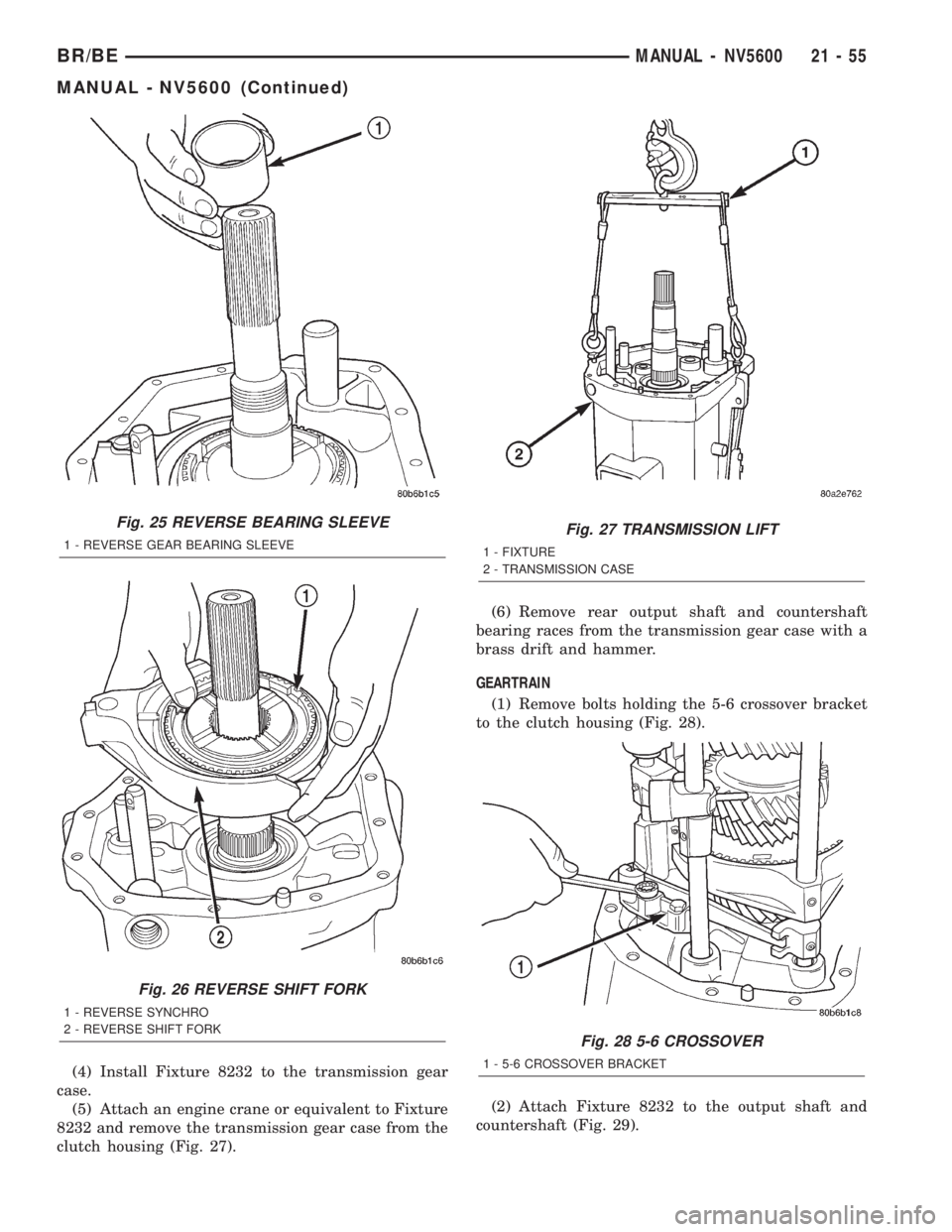
(4) Install Fixture 8232 to the transmission gear
case.
(5) Attach an engine crane or equivalent to Fixture
8232 and remove the transmission gear case from the
clutch housing (Fig. 27).(6) Remove rear output shaft and countershaft
bearing races from the transmission gear case with a
brass drift and hammer.
GEARTRAIN
(1) Remove bolts holding the 5-6 crossover bracket
to the clutch housing (Fig. 28).
(2) Attach Fixture 8232 to the output shaft and
countershaft (Fig. 29).
Fig. 25 REVERSE BEARING SLEEVE
1 - REVERSE GEAR BEARING SLEEVE
Fig. 26 REVERSE SHIFT FORK
1 - REVERSE SYNCHRO
2 - REVERSE SHIFT FORK
Fig. 27 TRANSMISSION LIFT
1 - FIXTURE
2 - TRANSMISSION CASE
Fig. 28 5-6 CROSSOVER
1 - 5-6 CROSSOVER BRACKET
BR/BEMANUAL - NV5600 21 - 55
MANUAL - NV5600 (Continued)
Page 1517 of 2255
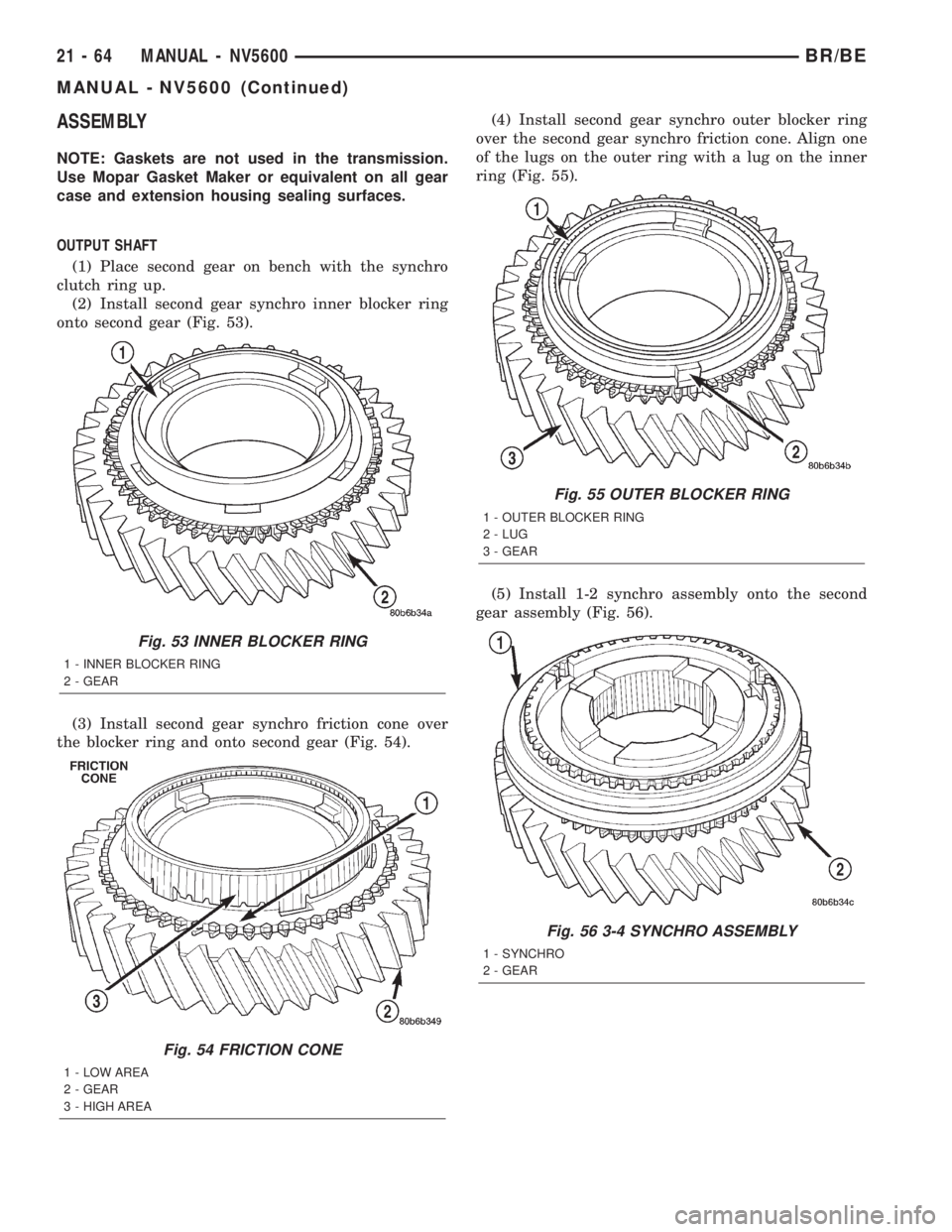
ASSEMBLY
NOTE: Gaskets are not used in the transmission.
Use Mopar Gasket Maker or equivalent on all gear
case and extension housing sealing surfaces.
OUTPUT SHAFT
(1) Place second gear on bench with the synchro
clutch ring up.
(2) Install second gear synchro inner blocker ring
onto second gear (Fig. 53).
(3) Install second gear synchro friction cone over
the blocker ring and onto second gear (Fig. 54).(4) Install second gear synchro outer blocker ring
over the second gear synchro friction cone. Align one
of the lugs on the outer ring with a lug on the inner
ring (Fig. 55).
(5) Install 1-2 synchro assembly onto the second
gear assembly (Fig. 56).
Fig. 53 INNER BLOCKER RING
1 - INNER BLOCKER RING
2 - GEAR
Fig. 54 FRICTION CONE
1 - LOW AREA
2 - GEAR
3 - HIGH AREA
Fig. 55 OUTER BLOCKER RING
1 - OUTER BLOCKER RING
2 - LUG
3 - GEAR
Fig. 56 3-4 SYNCHRO ASSEMBLY
1 - SYNCHRO
2 - GEAR
21 - 64 MANUAL - NV5600BR/BE
MANUAL - NV5600 (Continued)
Page 1526 of 2255
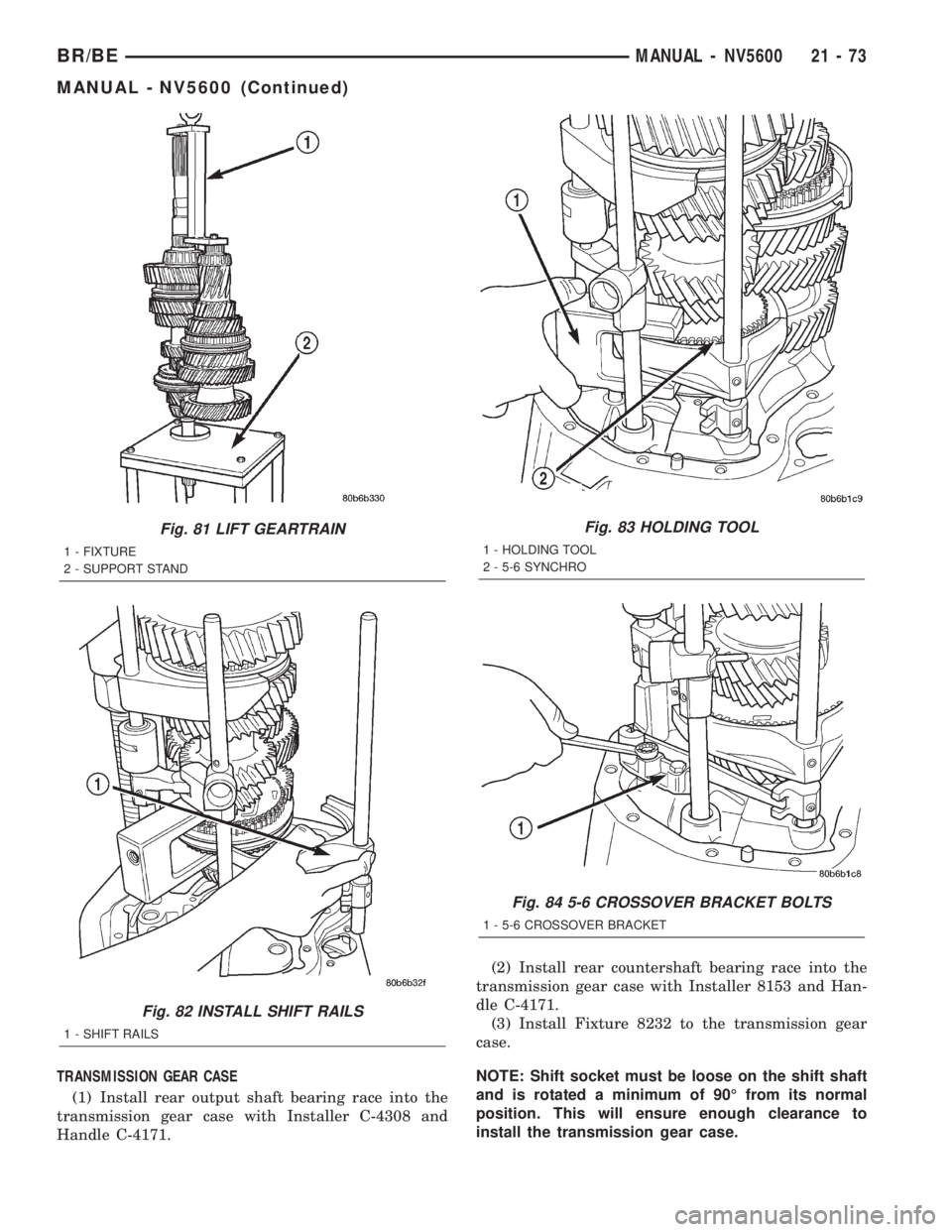
TRANSMISSION GEAR CASE
(1) Install rear output shaft bearing race into the
transmission gear case with Installer C-4308 and
Handle C-4171.(2) Install rear countershaft bearing race into the
transmission gear case with Installer 8153 and Han-
dle C-4171.
(3) Install Fixture 8232 to the transmission gear
case.
NOTE: Shift socket must be loose on the shift shaft
and is rotated a minimum of 90É from its normal
position. This will ensure enough clearance to
install the transmission gear case.
Fig. 81 LIFT GEARTRAIN
1 - FIXTURE
2 - SUPPORT STAND
Fig. 82 INSTALL SHIFT RAILS
1 - SHIFT RAILS
Fig. 83 HOLDING TOOL
1 - HOLDING TOOL
2 - 5-6 SYNCHRO
Fig. 84 5-6 CROSSOVER BRACKET BOLTS
1 - 5-6 CROSSOVER BRACKET
BR/BEMANUAL - NV5600 21 - 73
MANUAL - NV5600 (Continued)