power DODGE RAM 2002 Service Repair Manual
[x] Cancel search | Manufacturer: DODGE, Model Year: 2002, Model line: RAM, Model: DODGE RAM 2002Pages: 2255, PDF Size: 62.07 MB
Page 1842 of 2255
STATOR
Torque multiplication is achieved by locking the
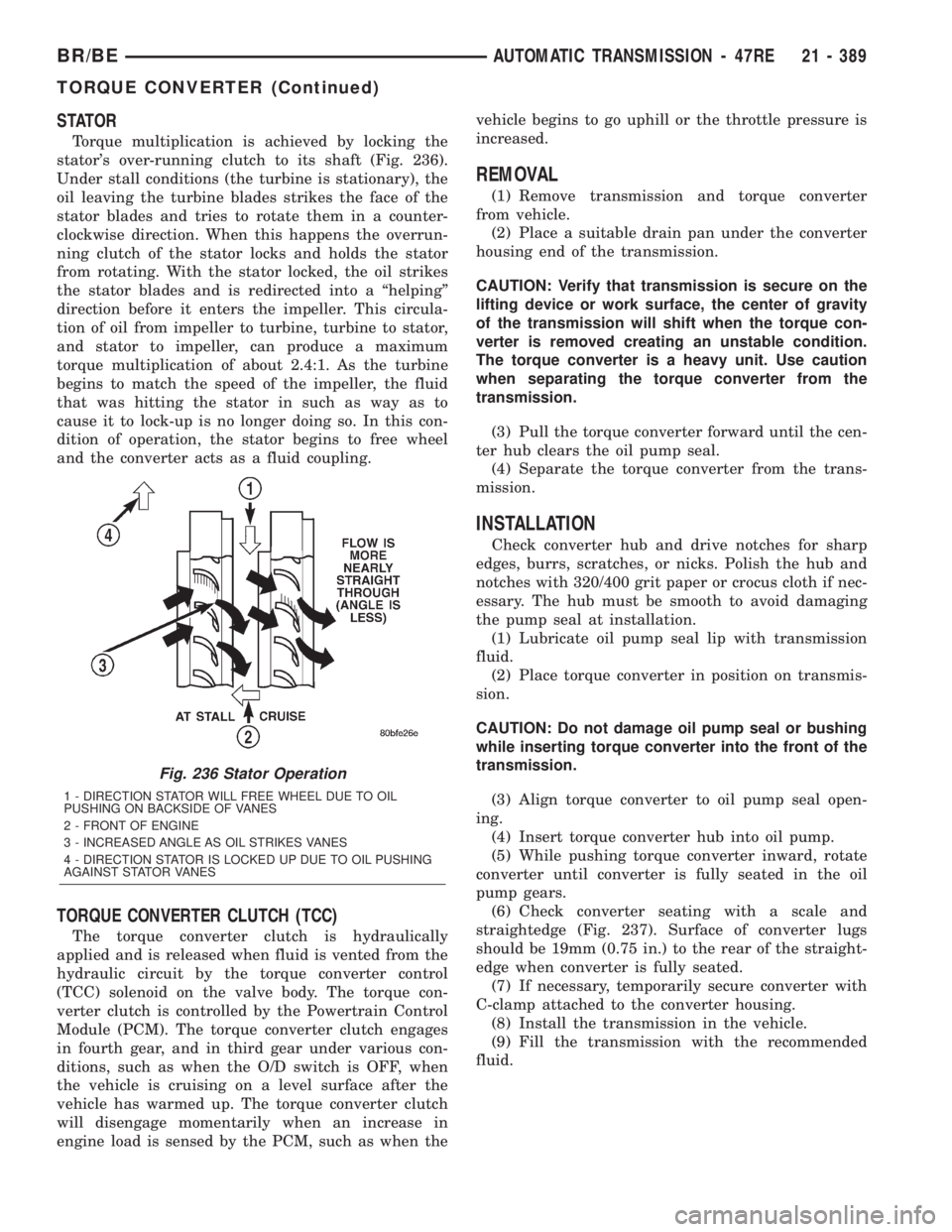
stator's over-running clutch to its shaft (Fig. 236).
Under stall conditions (the turbine is stationary), the
oil leaving the turbine blades strikes the face of the
stator blades and tries to rotate them in a counter-
clockwise direction. When this happens the overrun-
ning clutch of the stator locks and holds the stator
from rotating. With the stator locked, the oil strikes
the stator blades and is redirected into a ªhelpingº
direction before it enters the impeller. This circula-
tion of oil from impeller to turbine, turbine to stator,
and stator to impeller, can produce a maximum
torque multiplication of about 2.4:1. As the turbine
begins to match the speed of the impeller, the fluid
that was hitting the stator in such as way as to
cause it to lock-up is no longer doing so. In this con-
dition of operation, the stator begins to free wheel
and the converter acts as a fluid coupling.
TORQUE CONVERTER CLUTCH (TCC)
The torque converter clutch is hydraulically
applied and is released when fluid is vented from the
hydraulic circuit by the torque converter control
(TCC) solenoid on the valve body. The torque con-
verter clutch is controlled by the Powertrain Control
Module (PCM). The torque converter clutch engages
in fourth gear, and in third gear under various con-
ditions, such as when the O/D switch is OFF, when
the vehicle is cruising on a level surface after the
vehicle has warmed up. The torque converter clutch
will disengage momentarily when an increase in
engine load is sensed by the PCM, such as when thevehicle begins to go uphill or the throttle pressure is
increased.
REMOVAL
(1) Remove transmission and torque converter
from vehicle.
(2) Place a suitable drain pan under the converter
housing end of the transmission.
CAUTION: Verify that transmission is secure on the
lifting device or work surface, the center of gravity
of the transmission will shift when the torque con-
verter is removed creating an unstable condition.
The torque converter is a heavy unit. Use caution
when separating the torque converter from the
transmission.
(3) Pull the torque converter forward until the cen-
ter hub clears the oil pump seal.
(4) Separate the torque converter from the trans-
mission.
INSTALLATION
Check converter hub and drive notches for sharp
edges, burrs, scratches, or nicks. Polish the hub and
notches with 320/400 grit paper or crocus cloth if nec-
essary. The hub must be smooth to avoid damaging
the pump seal at installation.
(1) Lubricate oil pump seal lip with transmission
fluid.
(2) Place torque converter in position on transmis-
sion.
CAUTION: Do not damage oil pump seal or bushing
while inserting torque converter into the front of the
transmission.
(3) Align torque converter to oil pump seal open-
ing.
(4) Insert torque converter hub into oil pump.
(5) While pushing torque converter inward, rotate
converter until converter is fully seated in the oil
pump gears.
(6) Check converter seating with a scale and
straightedge (Fig. 237). Surface of converter lugs
should be 19mm (0.75 in.) to the rear of the straight-
edge when converter is fully seated.
(7) If necessary, temporarily secure converter with
C-clamp attached to the converter housing.
(8) Install the transmission in the vehicle.
(9) Fill the transmission with the recommended
fluid.
Fig. 236 Stator Operation
1 - DIRECTION STATOR WILL FREE WHEEL DUE TO OIL
PUSHING ON BACKSIDE OF VANES
2 - FRONT OF ENGINE
3 - INCREASED ANGLE AS OIL STRIKES VANES
4 - DIRECTION STATOR IS LOCKED UP DUE TO OIL PUSHING
AGAINST STATOR VANES
BR/BEAUTOMATIC TRANSMISSION - 47RE 21 - 389
TORQUE CONVERTER (Continued)
Page 1884 of 2255

exception being when the road surface is covered by
ice and snow.
The low range reduction gear system is operative
in 4LO range only. This range is for extra pulling
power in off road situations. Low range reduction
ratio is 2.72:1.
A front axle disconnect system is used to achieve
two-wheel drive mode. The axle disconnect vacuum
motor is actuated by a vacuum switch on the transfer
case. The switch is operated by the transfer case
range rod.
SHIFT MECHANISM
The transfer case is operated by an adjustable floor
mounted shift linkage. The transfer case shift lever
is directly attached to the shift sector. The sector
operates the range and mode forks within the trans-
fer case.
A straight line shift pattern is used with a NEU-
TRAL detent. Lever range positions are imprinted in
the shift knob.
SHIFTING
The synchronizer components allow the transfer
case to be shifted between the 2H and 4H operating
ranges while the vehicle is in motion. The vehicle
must have the transmission placed in NEUTRAL, or
the clutch depressed in the case of a manual trans-
mission, and be moving less than 2-3 MPH when
shifting into the 4L operating range.
DIAGNOSIS AND TESTING - TRANSFER CASE
Before beginning repair on a suspected transfer
case malfunction, check all other driveline compo-
nents beforehand.
The actual cause of a problem may be related to
such items as: front hubs, axles, propeller shafts,
wheels and tires, transmission, or clutch instead. If
all other driveline components are in good condition
and operating properly, refer to the Diagnosis Chart
for further information.
DIAGNOSIS CHART
Condition Possible Cause Correction
Transfer Case difficult to shift or will
not shift into desired range.1) Vehicle speed too great to permit
shifting.1) Stop vehicle and shift into
desired range. Or, reduce speed to
below 3-4 km/h (2-3 mph) before
attempting the shift.
2) If vehicle was operated for an
extended period in 4H on a dry
paved surface, the driveline torque
load may be causing a bind.2) Stop vehicle and shift the
transmission into neutral. Shift the
transfer case to 2H and operate
vehicle in 2H on dry paved
surfaces.
3) Transfer case external shift
linkage binding.3) Lubricate, repair, or replace
linkage bushings, or tighten loose
components as necessary.
4) Insufficient or incorrect lubricant. 4) Drain and refill to edge of fill hole
with MoparTATF +4, type 9602,
Automatic Transmission fluid.
5) Internal components binding,
worn, or damaged.5) Disassemble the transfer case
and replace worn or damaged
components as necessary.
Transfer Case noisy in all operating
ranges.1) Insufficient or incorrect lubricant. 1) Drain and refill to edge of fill hole
with MoparTATF +4, type 9602,
Automatic Transmission fluid.
BR/BETRANSFER CASE - NV241LD 21 - 431
TRANSFER CASE - NV241LD (Continued)
Page 1918 of 2255
TRANSFER CASE - NV241HD
TABLE OF CONTENTS
page page
TRANSFER CASE - NV241HD
DESCRIPTION........................465
OPERATION..........................467
DIAGNOSIS AND TESTING - TRANSFER
CASE..............................467
REMOVAL............................469
DISASSEMBLY........................469
CLEANING...........................476
INSPECTION.........................476
ASSEMBLY...........................480
INSTALLATION........................494
SPECIFICATIONS
TRANSFER CASE....................495
SPECIAL TOOLS
TRANSFER CASE - NV241HD...........495EXTENSION HOUSING BUSHING AND SEAL
REMOVAL............................497
INSTALLATION........................497
FLUID
STANDARD PROCEDURE - FLUID DRAIN/
REFILL............................497
FRONT OUTPUT SHAFT SEAL
REMOVAL............................498
INSTALLATION........................498
SHIFT LEVER
REMOVAL............................499
INSTALLATION........................500
ADJUSTMENTS
ADJUSTMENT - SHIFT LEVER..........500
TRANSFER CASE - NV241HD
DESCRIPTION
The NV241HD is a part-time transfer case with a
low-range gear system. The transfer case provides
three operating ranges plus a NEUTRAL position.
The low range position provides a gear reduction
ratio of 2.72:1 for increased low speed torque capabil-
ity. Operating ranges are: 2H, 4H, and 4LO.
The synchronizer mechanism consists of a brass
stop ring, synchronizer hub, and the sliding clutch
(Fig. 1). The synchronizer components allow the
transfer case to be shifted between the 2H and 4H
operating ranges while the vehicle is in motion.The gear cases, retainer and extension are all of
aluminum. Drive sprockets and an interconnecting
drive chain are used to transmit engine torque to the
front/rear propeller shafts. The mainshaft, input gear
and front output shaft are supported by ball and nee-
dle bearings.
PTO CAPABILITY
The NV241HD transfer case has power take-off
capability. A PTO gear permanently attached to the
planetary carrier, and a removable PTO cover are
provided for this purpose.
BR/BETRANSFER CASE - NV241HD 21 - 465
Page 1920 of 2255
IDENTIFICATION
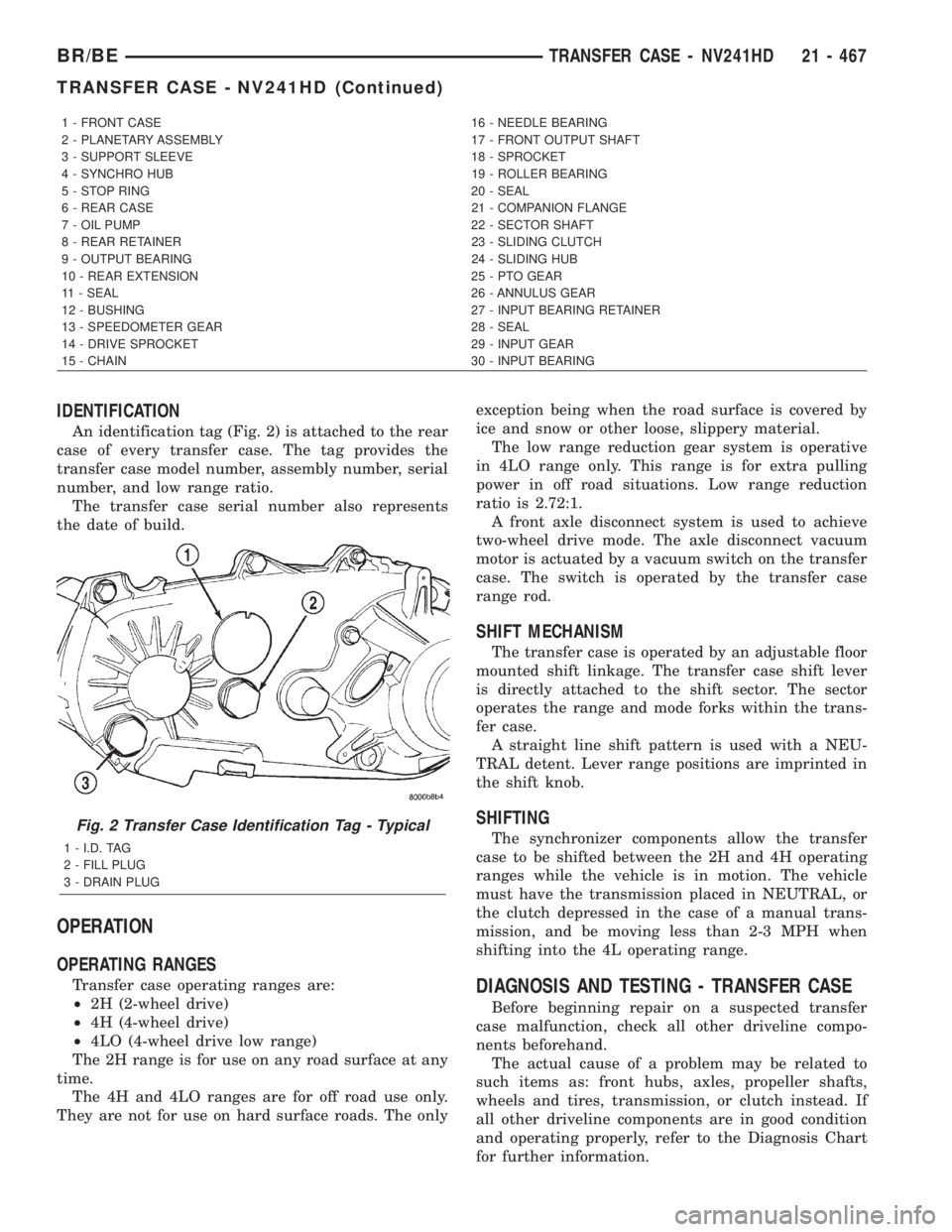
An identification tag (Fig. 2) is attached to the rear
case of every transfer case. The tag provides the
transfer case model number, assembly number, serial
number, and low range ratio.
The transfer case serial number also represents
the date of build.
OPERATION
OPERATING RANGES
Transfer case operating ranges are:
²2H (2-wheel drive)
²4H (4-wheel drive)
²4LO (4-wheel drive low range)
The 2H range is for use on any road surface at any
time.
The 4H and 4LO ranges are for off road use only.
They are not for use on hard surface roads. The onlyexception being when the road surface is covered by
ice and snow or other loose, slippery material.
The low range reduction gear system is operative
in 4LO range only. This range is for extra pulling
power in off road situations. Low range reduction
ratio is 2.72:1.
A front axle disconnect system is used to achieve
two-wheel drive mode. The axle disconnect vacuum
motor is actuated by a vacuum switch on the transfer
case. The switch is operated by the transfer case
range rod.
SHIFT MECHANISM
The transfer case is operated by an adjustable floor
mounted shift linkage. The transfer case shift lever
is directly attached to the shift sector. The sector
operates the range and mode forks within the trans-
fer case.
A straight line shift pattern is used with a NEU-
TRAL detent. Lever range positions are imprinted in
the shift knob.
SHIFTING
The synchronizer components allow the transfer
case to be shifted between the 2H and 4H operating
ranges while the vehicle is in motion. The vehicle
must have the transmission placed in NEUTRAL, or
the clutch depressed in the case of a manual trans-
mission, and be moving less than 2-3 MPH when
shifting into the 4L operating range.
DIAGNOSIS AND TESTING - TRANSFER CASE
Before beginning repair on a suspected transfer
case malfunction, check all other driveline compo-
nents beforehand.
The actual cause of a problem may be related to
such items as: front hubs, axles, propeller shafts,
wheels and tires, transmission, or clutch instead. If
all other driveline components are in good condition
and operating properly, refer to the Diagnosis Chart
for further information.
1 - FRONT CASE 16 - NEEDLE BEARING
2 - PLANETARY ASSEMBLY 17 - FRONT OUTPUT SHAFT
3 - SUPPORT SLEEVE 18 - SPROCKET
4 - SYNCHRO HUB 19 - ROLLER BEARING
5 - STOP RING 20 - SEAL
6 - REAR CASE 21 - COMPANION FLANGE
7 - OIL PUMP 22 - SECTOR SHAFT
8 - REAR RETAINER 23 - SLIDING CLUTCH
9 - OUTPUT BEARING 24 - SLIDING HUB
10 - REAR EXTENSION 25 - PTO GEAR
11 - SEAL 26 - ANNULUS GEAR
12 - BUSHING 27 - INPUT BEARING RETAINER
13 - SPEEDOMETER GEAR 28 - SEAL
14 - DRIVE SPROCKET 29 - INPUT GEAR
15 - CHAIN 30 - INPUT BEARING
Fig. 2 Transfer Case Identification Tag - Typical
1 - I.D. TAG
2 - FILL PLUG
3 - DRAIN PLUG
BR/BETRANSFER CASE - NV241HD 21 - 467
TRANSFER CASE - NV241HD (Continued)
Page 2029 of 2255
Description N´m Ft. lbs. In. lbs.
Center seat/seat frame
bolts25 18 Ð
Cubby bin screws 2 Ð 20
Cup holder screws 2 Ð 20
Door hinge to A-pillar
bolt28 21 Ð
Door latch screw 11 8 Ð
Door latch striker screw 28 21 Ð
Easy entry track/
adjuster track bolts -
front17 12 Ð
Easy entry track/
adjuster track bolts -
rear inboard21 16 Ð
Easy entry track/
adjuster track bolts -
rear outboard45 33 Ð
Front belt buckle
inboard anchor nut45 33 Ð
Front belt retractor
anchor bolt39 28 Ð
Front door glass lift
plate nuts9Ð80
Front door latch screws 10 Ð 89
Front shoulder belt
anchor bolt45 33 Ð
Front shoulder belt
lower anchor bolt39 28 Ð
Front shoulder belt
lower anchor bolt45 33 Ð
Front shoulder belt
upper anchor bolt39 28 Ð
Glove box bin/door
screws2Ð20
Glove box latch striker
screws2Ð20
Glove box opening trim
screws2Ð20
Headlamp/dash wire
harness bulkhead
connector screw3.5 Ð 31
Hood latch release
handle screws3Ð25
Inboard seat back pivot
bolt50 36 Ð
Instrument panel roll
down bracket screws12 9 105Description N´m Ft. lbs. In. lbs.
Instrument panel top
cover screws2Ð20
Instrument panel/dash
panel screws3Ð28
Manual transmission
shifter knob nut27 20 Ð
Quarter vent window
hinge nuts8Ð70
Quarter vent window
latch to glass screws6Ð60
Rear seat support
bracket screws28 21 Ð
Rear view mirror set
screw1Ð15
Seat adjuster track/seat
cushion frame screws25 18 Ð
Seat cushion frame/
mounting bracket bolts25 18 Ð
Seat cushion frame/
power track crossbrace
bolts10 Ð 89
Seat track adjuster bolts 17 12 Ð
Seat track bolts 25 18 Ð
Seat track/frame bolts 25 18 Ð
Slide bar bolts 10 Ð 89
Sliding backlite
latch/keeper screws1.5 Ð 15
Split bench seat back
shoulder bolt49 36 Ð
Split bench seat back to
cushion pivot bolt25 18 Ð
Split bench seat front
anchor bolt54 40 Ð
Split bench seat rear
inboard anchor nut40 30 Ð
Split bench seat rear
outboard anchor nut54 40 Ð
Split bench seat track to
frame bolt25 18 Ð
Split bench/bottom of
center occupant seat
bolt28 21 Ð
Steering column cover
screws2Ð20
Storage bin screws 2 Ð 20
23 - 62 BODYBR/BE
BODY (Continued)
Page 2039 of 2255
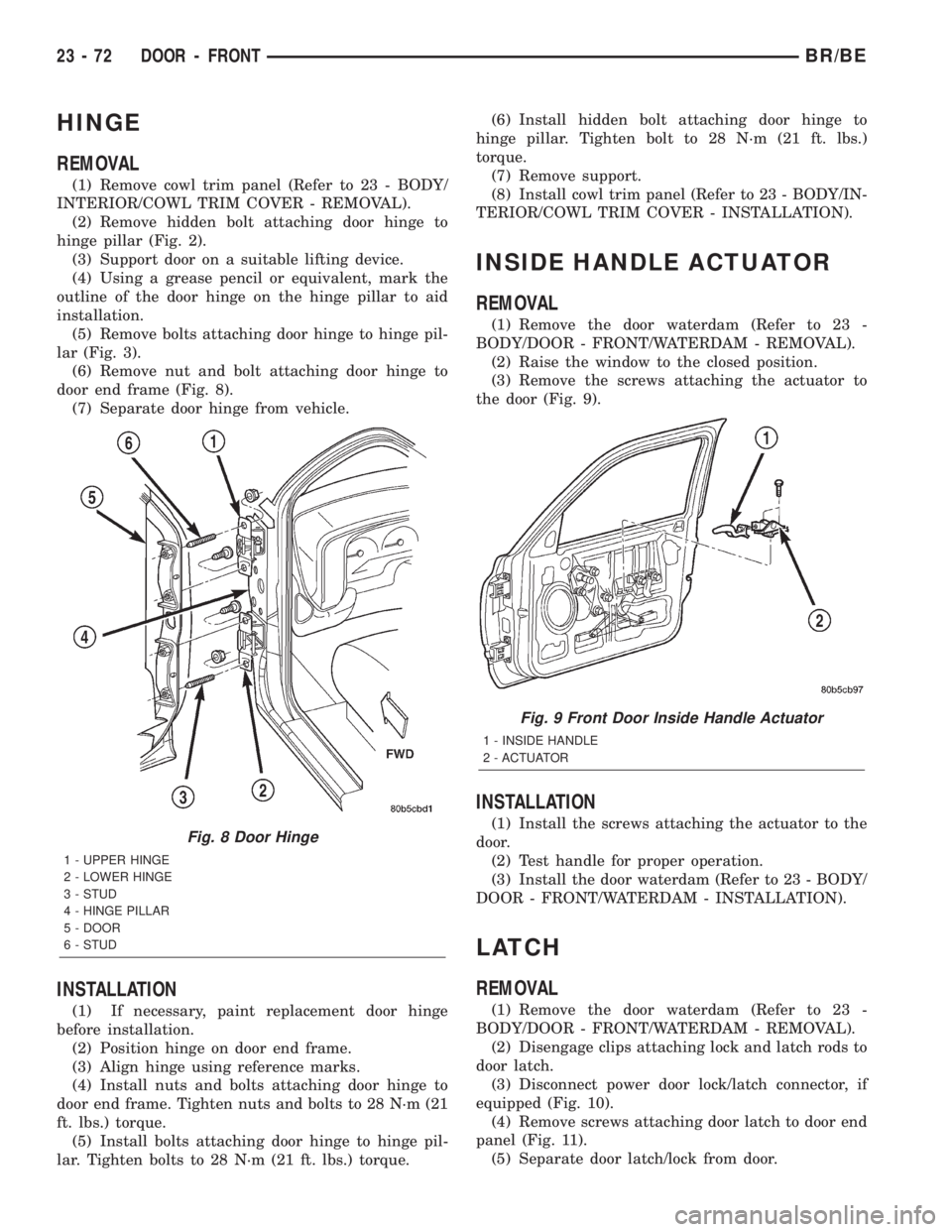
HINGE
REMOVAL
(1) Remove cowl trim panel (Refer to 23 - BODY/
INTERIOR/COWL TRIM COVER - REMOVAL).
(2) Remove hidden bolt attaching door hinge to
hinge pillar (Fig. 2).
(3) Support door on a suitable lifting device.
(4) Using a grease pencil or equivalent, mark the
outline of the door hinge on the hinge pillar to aid
installation.
(5) Remove bolts attaching door hinge to hinge pil-
lar (Fig. 3).
(6) Remove nut and bolt attaching door hinge to
door end frame (Fig. 8).
(7) Separate door hinge from vehicle.
INSTALLATION
(1) If necessary, paint replacement door hinge
before installation.
(2) Position hinge on door end frame.
(3) Align hinge using reference marks.
(4) Install nuts and bolts attaching door hinge to
door end frame. Tighten nuts and bolts to 28 N´m (21
ft. lbs.) torque.
(5) Install bolts attaching door hinge to hinge pil-
lar. Tighten bolts to 28 N´m (21 ft. lbs.) torque.(6) Install hidden bolt attaching door hinge to
hinge pillar. Tighten bolt to 28 N´m (21 ft. lbs.)
torque.
(7) Remove support.
(8) Install cowl trim panel (Refer to 23 - BODY/IN-
TERIOR/COWL TRIM COVER - INSTALLATION).
INSIDE HANDLE ACTUATOR
REMOVAL
(1) Remove the door waterdam (Refer to 23 -
BODY/DOOR - FRONT/WATERDAM - REMOVAL).
(2) Raise the window to the closed position.
(3) Remove the screws attaching the actuator to
the door (Fig. 9).
INSTALLATION
(1) Install the screws attaching the actuator to the
door.
(2) Test handle for proper operation.
(3) Install the door waterdam (Refer to 23 - BODY/
DOOR - FRONT/WATERDAM - INSTALLATION).
LATCH
REMOVAL
(1) Remove the door waterdam (Refer to 23 -
BODY/DOOR - FRONT/WATERDAM - REMOVAL).
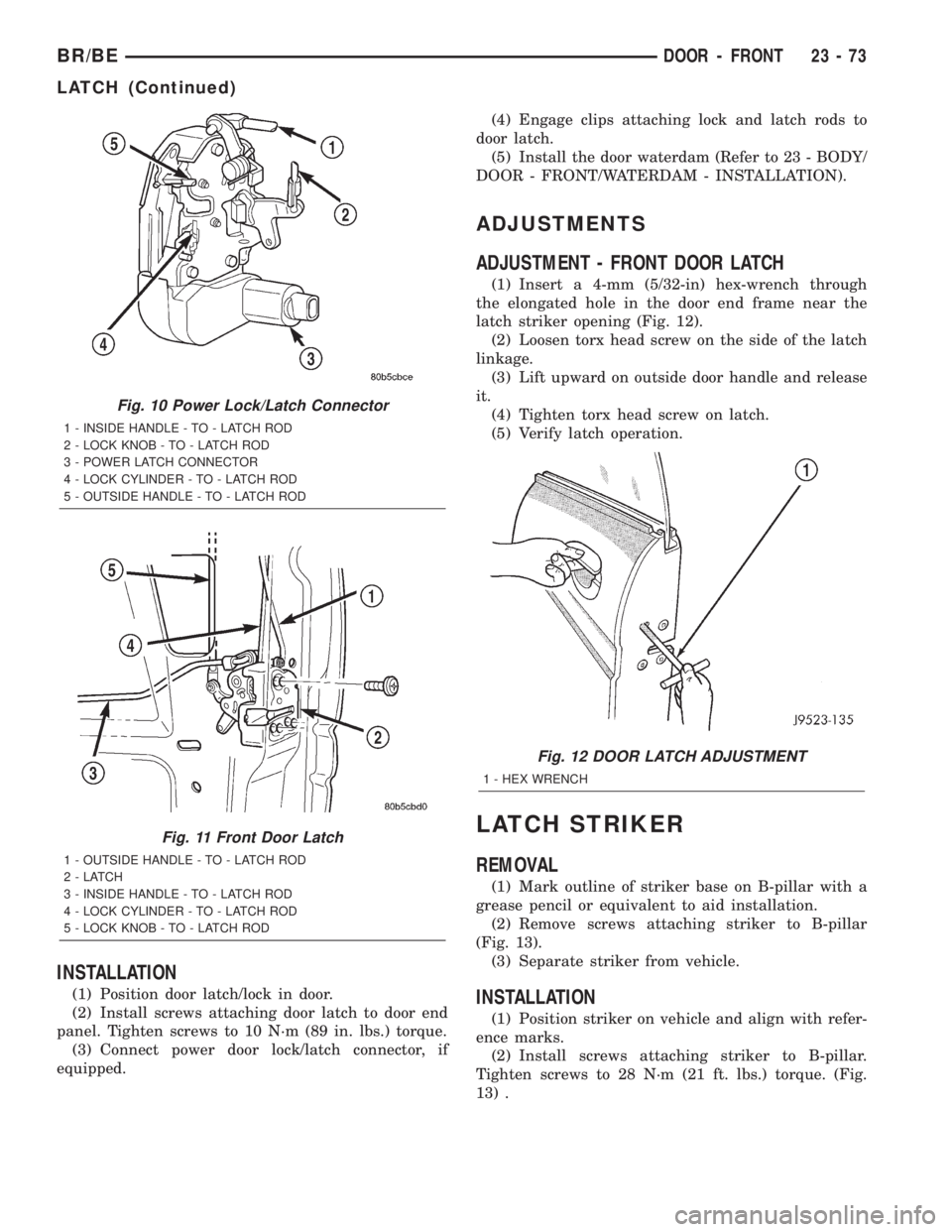
(2) Disengage clips attaching lock and latch rods to
door latch.
(3) Disconnect power door lock/latch connector, if
equipped (Fig. 10).
(4) Remove screws attaching door latch to door end
panel (Fig. 11).
(5) Separate door latch/lock from door.
Fig. 8 Door Hinge
1 - UPPER HINGE
2 - LOWER HINGE
3 - STUD
4 - HINGE PILLAR
5 - DOOR
6 - STUD
Fig. 9 Front Door Inside Handle Actuator
1 - INSIDE HANDLE
2 - ACTUATOR
23 - 72 DOOR - FRONTBR/BE
Page 2040 of 2255
INSTALLATION
(1) Position door latch/lock in door.
(2) Install screws attaching door latch to door end
panel. Tighten screws to 10 N´m (89 in. lbs.) torque.
(3) Connect power door lock/latch connector, if
equipped.(4) Engage clips attaching lock and latch rods to
door latch.
(5) Install the door waterdam (Refer to 23 - BODY/
DOOR - FRONT/WATERDAM - INSTALLATION).
ADJUSTMENTS
ADJUSTMENT - FRONT DOOR LATCH
(1) Insert a 4-mm (5/32-in) hex-wrench through
the elongated hole in the door end frame near the
latch striker opening (Fig. 12).
(2) Loosen torx head screw on the side of the latch
linkage.
(3) Lift upward on outside door handle and release
it.
(4) Tighten torx head screw on latch.
(5) Verify latch operation.
LATCH STRIKER
REMOVAL
(1) Mark outline of striker base on B-pillar with a
grease pencil or equivalent to aid installation.
(2) Remove screws attaching striker to B-pillar
(Fig. 13).
(3) Separate striker from vehicle.
INSTALLATION
(1) Position striker on vehicle and align with refer-
ence marks.
(2) Install screws attaching striker to B-pillar.
Tighten screws to 28 N´m (21 ft. lbs.) torque. (Fig.
13) .
Fig. 10 Power Lock/Latch Connector
1 - INSIDE HANDLE - TO - LATCH ROD
2 - LOCK KNOB - TO - LATCH ROD
3 - POWER LATCH CONNECTOR
4 - LOCK CYLINDER - TO - LATCH ROD
5 - OUTSIDE HANDLE - TO - LATCH ROD
Fig. 11 Front Door Latch
1 - OUTSIDE HANDLE - TO - LATCH ROD
2-LATCH
3 - INSIDE HANDLE - TO - LATCH ROD
4 - LOCK CYLINDER - TO - LATCH ROD
5 - LOCK KNOB - TO - LATCH ROD
Fig. 12 DOOR LATCH ADJUSTMENT
1 - HEX WRENCH
BR/BEDOOR - FRONT 23 - 73
LATCH (Continued)
Page 2042 of 2255
INSTALLATION
(1) Position flag cover on door.
(2) Install nuts attaching mirror flag cover to door
frame.
(3) Install flag door seal.
(4) Install door trim panel. (Refer to 23 - BODY/
DOOR - FRONT/TRIM PANEL - INSTALLATION)
TRIM PANEL
REMOVAL
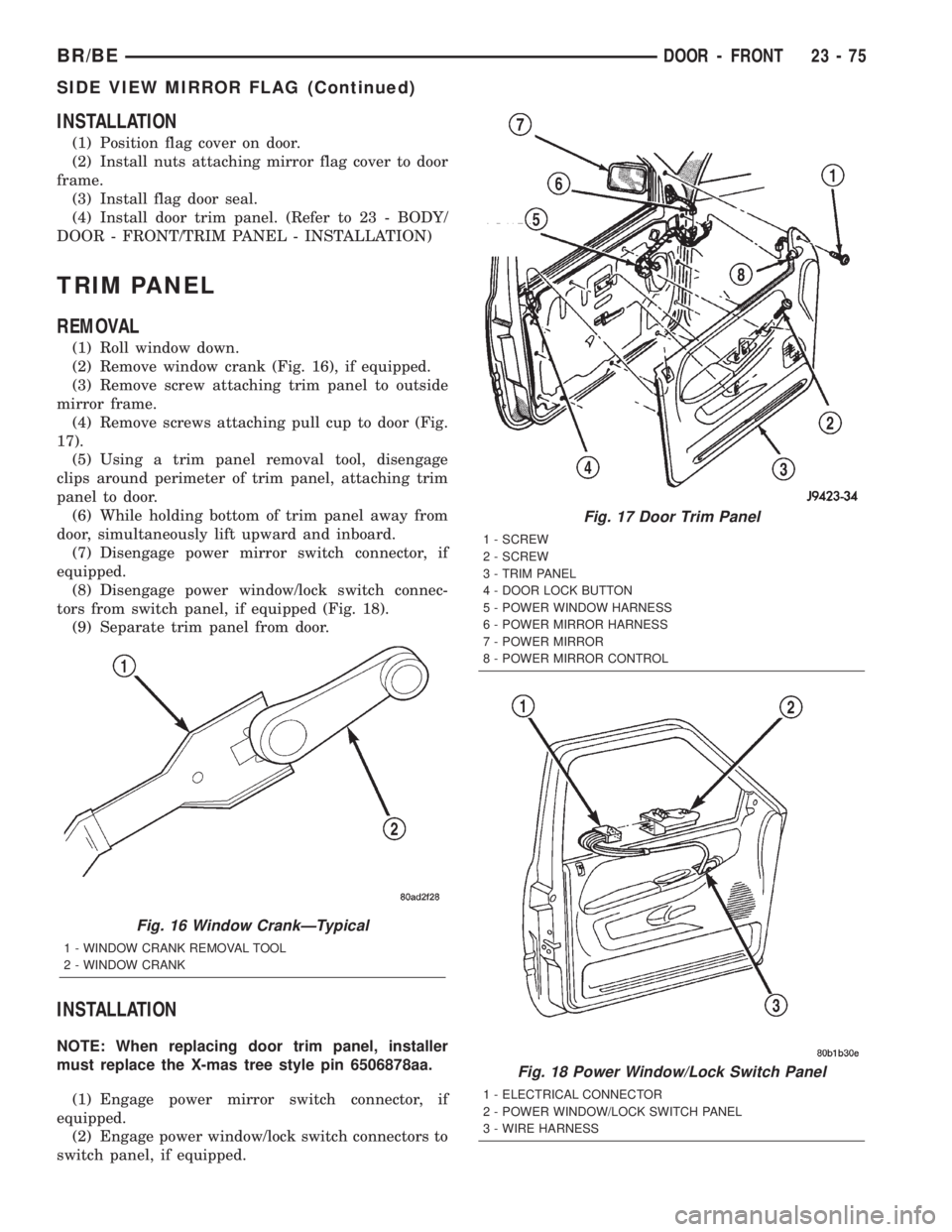
(1) Roll window down.
(2) Remove window crank (Fig. 16), if equipped.
(3) Remove screw attaching trim panel to outside
mirror frame.
(4) Remove screws attaching pull cup to door (Fig.
17).
(5) Using a trim panel removal tool, disengage
clips around perimeter of trim panel, attaching trim
panel to door.
(6) While holding bottom of trim panel away from
door, simultaneously lift upward and inboard.
(7) Disengage power mirror switch connector, if
equipped.
(8) Disengage power window/lock switch connec-
tors from switch panel, if equipped (Fig. 18).
(9) Separate trim panel from door.
INSTALLATION
NOTE: When replacing door trim panel, installer
must replace the X-mas tree style pin 6506878aa.
(1) Engage power mirror switch connector, if
equipped.
(2) Engage power window/lock switch connectors to
switch panel, if equipped.
Fig. 16 Window CrankÐTypical
1 - WINDOW CRANK REMOVAL TOOL
2 - WINDOW CRANK
Fig. 17 Door Trim Panel
1 - SCREW
2 - SCREW
3 - TRIM PANEL
4 - DOOR LOCK BUTTON
5 - POWER WINDOW HARNESS
6 - POWER MIRROR HARNESS
7 - POWER MIRROR
8 - POWER MIRROR CONTROL
Fig. 18 Power Window/Lock Switch Panel
1 - ELECTRICAL CONNECTOR
2 - POWER WINDOW/LOCK SWITCH PANEL
3 - WIRE HARNESS
BR/BEDOOR - FRONT 23 - 75
SIDE VIEW MIRROR FLAG (Continued)
Page 2043 of 2255
(3) Position trim panel on door.
(4) Engage clips around perimeter of trim panel,
attaching trim panel to door.
(5) Install screws attaching pull cup to door.
(6) Install screw attaching trim panel to outside
mirror frame.
(7) Install window crank, if equipped.
WATERDAM
REMOVAL
(1) Remove door trim panel (Refer to 23 - BODY/
DOOR - FRONT/TRIM PANEL - REMOVAL).
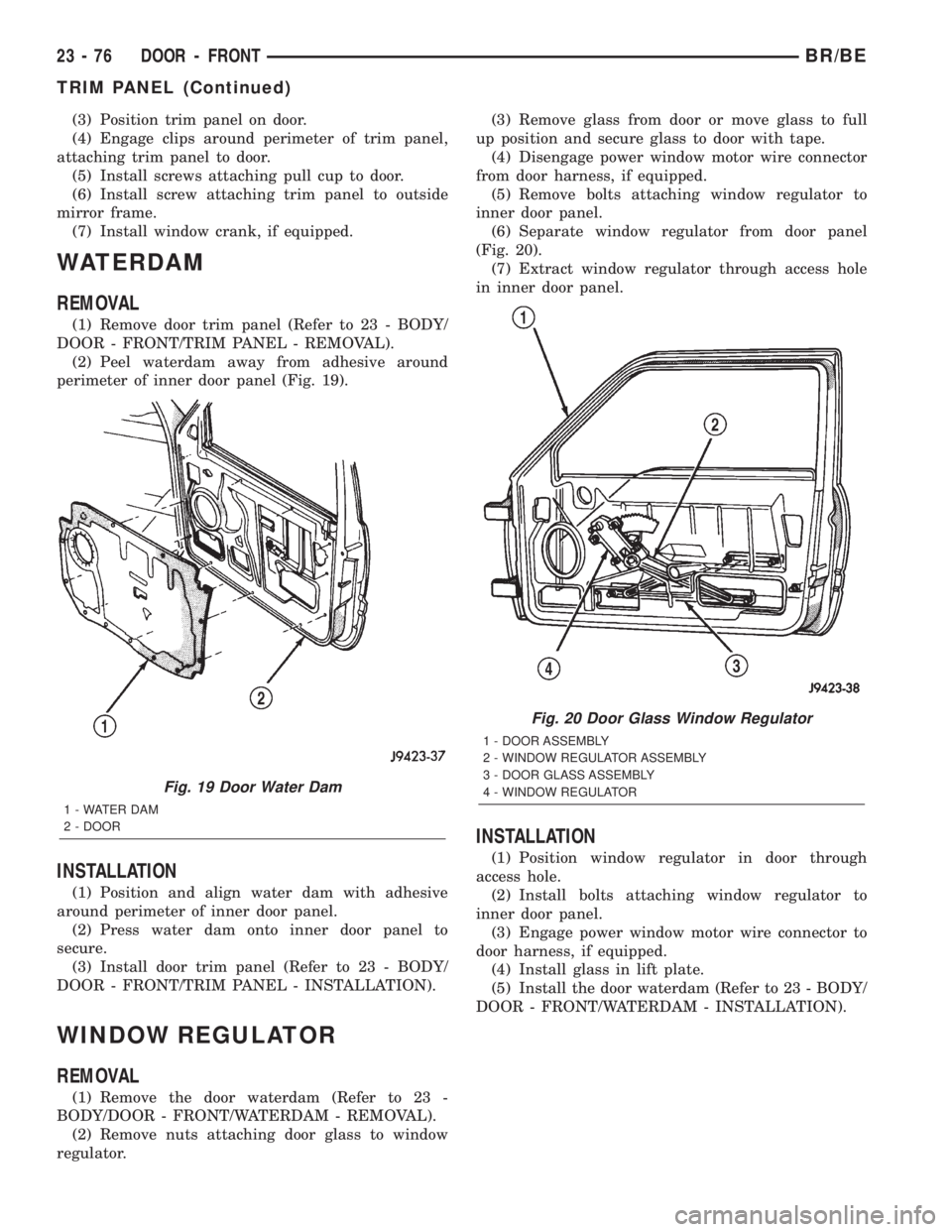
(2) Peel waterdam away from adhesive around
perimeter of inner door panel (Fig. 19).
INSTALLATION
(1) Position and align water dam with adhesive
around perimeter of inner door panel.
(2) Press water dam onto inner door panel to
secure.
(3) Install door trim panel (Refer to 23 - BODY/
DOOR - FRONT/TRIM PANEL - INSTALLATION).
WINDOW REGULATOR
REMOVAL
(1) Remove the door waterdam (Refer to 23 -
BODY/DOOR - FRONT/WATERDAM - REMOVAL).
(2) Remove nuts attaching door glass to window
regulator.(3) Remove glass from door or move glass to full
up position and secure glass to door with tape.
(4) Disengage power window motor wire connector
from door harness, if equipped.
(5) Remove bolts attaching window regulator to
inner door panel.
(6) Separate window regulator from door panel
(Fig. 20).
(7) Extract window regulator through access hole
in inner door panel.
INSTALLATION
(1) Position window regulator in door through
access hole.
(2) Install bolts attaching window regulator to
inner door panel.
(3) Engage power window motor wire connector to
door harness, if equipped.
(4) Install glass in lift plate.
(5) Install the door waterdam (Refer to 23 - BODY/
DOOR - FRONT/WATERDAM - INSTALLATION).
Fig. 19 Door Water Dam
1 - WATER DAM
2 - DOOR
Fig. 20 Door Glass Window Regulator
1 - DOOR ASSEMBLY
2 - WINDOW REGULATOR ASSEMBLY
3 - DOOR GLASS ASSEMBLY
4 - WINDOW REGULATOR
23 - 76 DOOR - FRONTBR/BE
TRIM PANEL (Continued)
Page 2060 of 2255
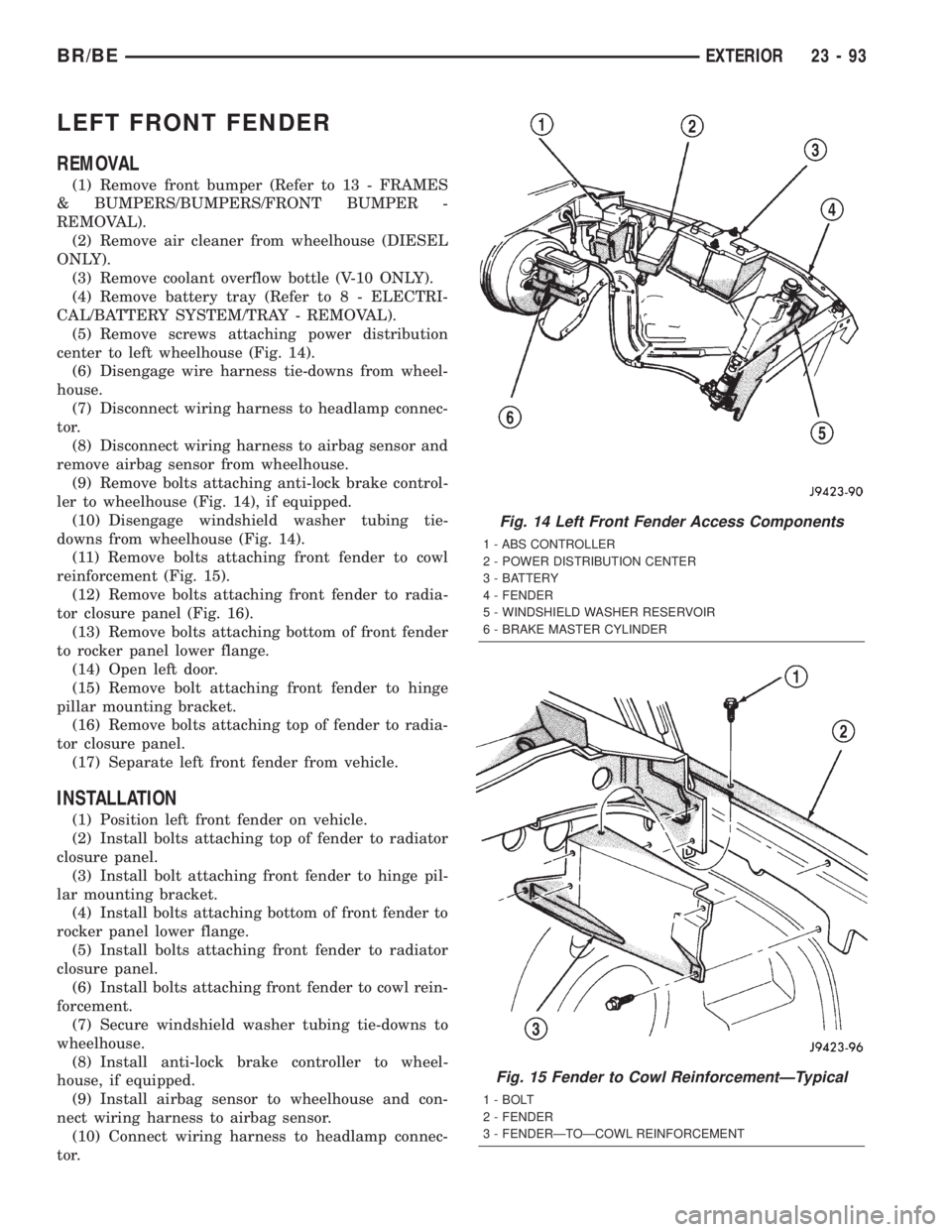
LEFT FRONT FENDER
REMOVAL
(1) Remove front bumper (Refer to 13 - FRAMES
& BUMPERS/BUMPERS/FRONT BUMPER -
REMOVAL).
(2) Remove air cleaner from wheelhouse (DIESEL
ONLY).
(3) Remove coolant overflow bottle (V-10 ONLY).
(4) Remove battery tray (Refer to 8 - ELECTRI-
CAL/BATTERY SYSTEM/TRAY - REMOVAL).
(5) Remove screws attaching power distribution
center to left wheelhouse (Fig. 14).
(6) Disengage wire harness tie-downs from wheel-
house.
(7) Disconnect wiring harness to headlamp connec-
tor.
(8) Disconnect wiring harness to airbag sensor and
remove airbag sensor from wheelhouse.
(9) Remove bolts attaching anti-lock brake control-
ler to wheelhouse (Fig. 14), if equipped.
(10) Disengage windshield washer tubing tie-
downs from wheelhouse (Fig. 14).
(11) Remove bolts attaching front fender to cowl
reinforcement (Fig. 15).
(12) Remove bolts attaching front fender to radia-
tor closure panel (Fig. 16).
(13) Remove bolts attaching bottom of front fender
to rocker panel lower flange.
(14) Open left door.
(15) Remove bolt attaching front fender to hinge
pillar mounting bracket.
(16) Remove bolts attaching top of fender to radia-
tor closure panel.
(17) Separate left front fender from vehicle.
INSTALLATION
(1) Position left front fender on vehicle.
(2) Install bolts attaching top of fender to radiator
closure panel.
(3) Install bolt attaching front fender to hinge pil-
lar mounting bracket.
(4) Install bolts attaching bottom of front fender to
rocker panel lower flange.
(5) Install bolts attaching front fender to radiator
closure panel.
(6) Install bolts attaching front fender to cowl rein-
forcement.
(7) Secure windshield washer tubing tie-downs to
wheelhouse.
(8) Install anti-lock brake controller to wheel-
house, if equipped.
(9) Install airbag sensor to wheelhouse and con-
nect wiring harness to airbag sensor.
(10) Connect wiring harness to headlamp connec-
tor.
Fig. 14 Left Front Fender Access Components
1 - ABS CONTROLLER
2 - POWER DISTRIBUTION CENTER
3 - BATTERY
4 - FENDER
5 - WINDSHIELD WASHER RESERVOIR
6 - BRAKE MASTER CYLINDER
Fig. 15 Fender to Cowl ReinforcementÐTypical
1 - BOLT
2 - FENDER
3 - FENDERÐTOÐCOWL REINFORCEMENT
BR/BEEXTERIOR 23 - 93