clutch DODGE RAM 2003 Service Repair Manual
[x] Cancel search | Manufacturer: DODGE, Model Year: 2003, Model line: RAM, Model: DODGE RAM 2003Pages: 2895, PDF Size: 83.15 MB
Page 2044 of 2895
vent and one-way ball-check-valve located in the
clutch retainer. The check-valve is needed to elimi-
nate the possibility of plate drag caused by centrifu-
gal force acting on the residual fluid trapped in the
clutch piston retainer.
DISASSEMBLY
(1) Remove the waved snap-ring, reaction plate,
clutch plates, and clutch discs.
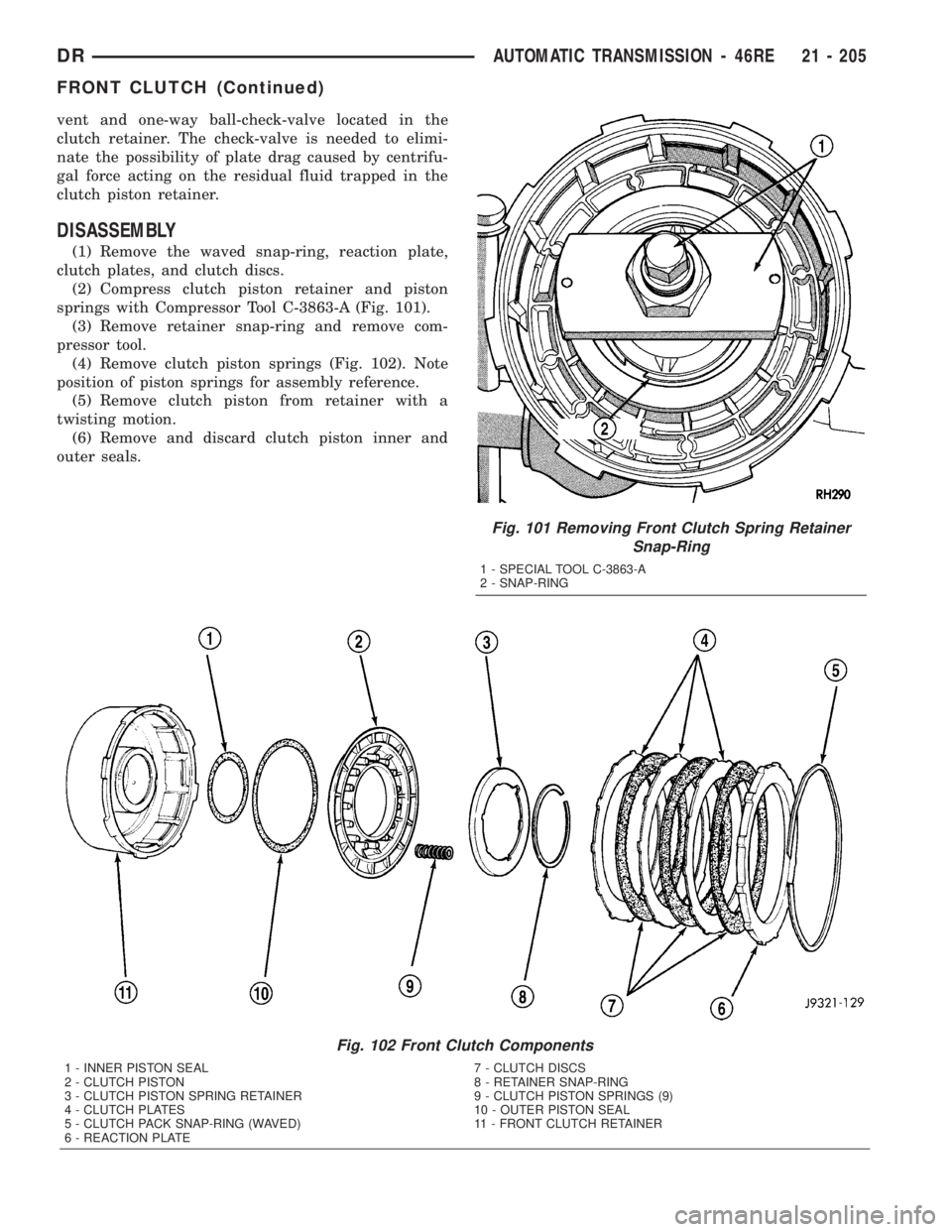
(2) Compress clutch piston retainer and piston
springs with Compressor Tool C-3863-A (Fig. 101).
(3) Remove retainer snap-ring and remove com-
pressor tool.
(4) Remove clutch piston springs (Fig. 102). Note
position of piston springs for assembly reference.
(5) Remove clutch piston from retainer with a
twisting motion.
(6) Remove and discard clutch piston inner and
outer seals.
Fig. 101 Removing Front Clutch Spring Retainer
Snap-Ring
1 - SPECIAL TOOL C-3863-A
2 - SNAP-RING
Fig. 102 Front Clutch Components
1 - INNER PISTON SEAL 7 - CLUTCH DISCS
2 - CLUTCH PISTON 8 - RETAINER SNAP-RING
3 - CLUTCH PISTON SPRING RETAINER 9 - CLUTCH PISTON SPRINGS (9)
4 - CLUTCH PLATES 10 - OUTER PISTON SEAL
5 - CLUTCH PACK SNAP-RING (WAVED) 11 - FRONT CLUTCH RETAINER
6 - REACTION PLATE
DRAUTOMATIC TRANSMISSION - 46RE 21 - 205
FRONT CLUTCH (Continued)
Page 2045 of 2895
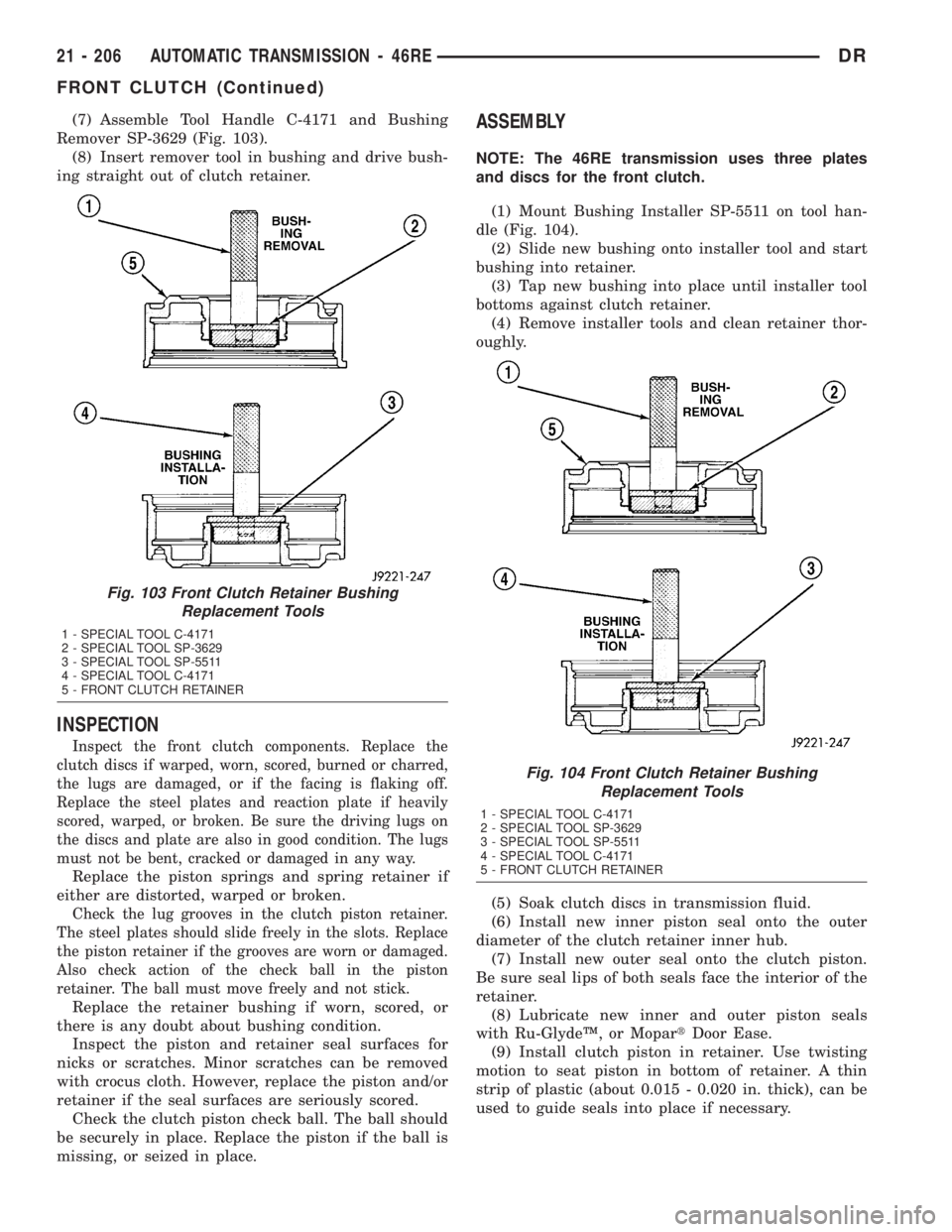
(7) Assemble Tool Handle C-4171 and Bushing
Remover SP-3629 (Fig. 103).
(8) Insert remover tool in bushing and drive bush-
ing straight out of clutch retainer.
INSPECTION
Inspect the front clutch components. Replace the
clutch discs if warped, worn, scored, burned or charred,
the lugs are damaged, or if the facing is flaking off.
Replace the steel plates and reaction plate if heavily
scored, warped, or broken. Be sure the driving lugs on
the discs and plate are also in good condition. The lugs
must not be bent, cracked or damaged in any way.
Replace the piston springs and spring retainer if
either are distorted, warped or broken.
Check the lug grooves in the clutch piston retainer.
The steel plates should slide freely in the slots. Replace
the piston retainer if the grooves are worn or damaged.
Also check action of the check ball in the piston
retainer. The ball must move freely and not stick.
Replace the retainer bushing if worn, scored, or
there is any doubt about bushing condition.
Inspect the piston and retainer seal surfaces for
nicks or scratches. Minor scratches can be removed
with crocus cloth. However, replace the piston and/or
retainer if the seal surfaces are seriously scored.
Check the clutch piston check ball. The ball should
be securely in place. Replace the piston if the ball is
missing, or seized in place.
ASSEMBLY
NOTE: The 46RE transmission uses three plates
and discs for the front clutch.
(1) Mount Bushing Installer SP-5511 on tool han-
dle (Fig. 104).
(2) Slide new bushing onto installer tool and start
bushing into retainer.
(3) Tap new bushing into place until installer tool
bottoms against clutch retainer.
(4) Remove installer tools and clean retainer thor-
oughly.
(5) Soak clutch discs in transmission fluid.
(6) Install new inner piston seal onto the outer
diameter of the clutch retainer inner hub.
(7) Install new outer seal onto the clutch piston.
Be sure seal lips of both seals face the interior of the
retainer.
(8) Lubricate new inner and outer piston seals
with Ru-GlydeŸ, or MopartDoor Ease.
(9) Install clutch piston in retainer. Use twisting
motion to seat piston in bottom of retainer. A thin
strip of plastic (about 0.015 - 0.020 in. thick), can be
used to guide seals into place if necessary.
Fig. 103 Front Clutch Retainer Bushing
Replacement Tools
1 - SPECIAL TOOL C-4171
2 - SPECIAL TOOL SP-3629
3 - SPECIAL TOOL SP-5511
4 - SPECIAL TOOL C-4171
5 - FRONT CLUTCH RETAINER
Fig. 104 Front Clutch Retainer Bushing
Replacement Tools
1 - SPECIAL TOOL C-4171
2 - SPECIAL TOOL SP-3629
3 - SPECIAL TOOL SP-5511
4 - SPECIAL TOOL C-4171
5 - FRONT CLUTCH RETAINER
21 - 206 AUTOMATIC TRANSMISSION - 46REDR
FRONT CLUTCH (Continued)
Page 2046 of 2895
CAUTION: Never push the clutch piston straight in.
This will fold the seals over causing leakage and
clutch slip. In addition, never use any type of metal
tool to help ease the piston seals into place. Metal
tools will cut, shave, or score the seals.
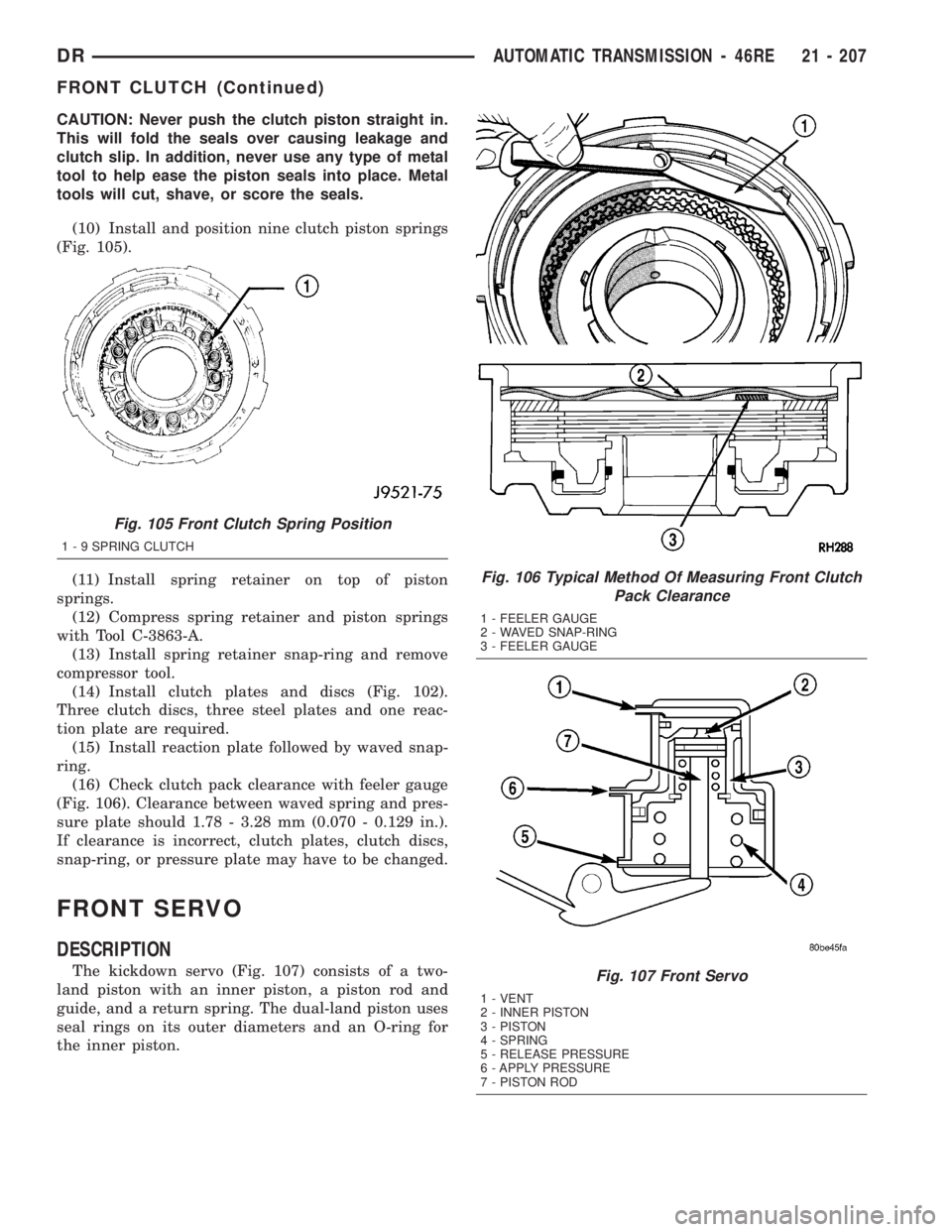
(10) Install and position nine clutch piston springs
(Fig. 105).
(11) Install spring retainer on top of piston
springs.
(12) Compress spring retainer and piston springs
with Tool C-3863-A.
(13) Install spring retainer snap-ring and remove
compressor tool.
(14) Install clutch plates and discs (Fig. 102).
Three clutch discs, three steel plates and one reac-
tion plate are required.
(15) Install reaction plate followed by waved snap-
ring.
(16) Check clutch pack clearance with feeler gauge
(Fig. 106). Clearance between waved spring and pres-
sure plate should 1.78 - 3.28 mm (0.070 - 0.129 in.).
If clearance is incorrect, clutch plates, clutch discs,
snap-ring, or pressure plate may have to be changed.
FRONT SERVO
DESCRIPTION
The kickdown servo (Fig. 107) consists of a two-
land piston with an inner piston, a piston rod and
guide, and a return spring. The dual-land piston uses
seal rings on its outer diameters and an O-ring for
the inner piston.
Fig. 105 Front Clutch Spring Position
1 - 9 SPRING CLUTCH
Fig. 106 Typical Method Of Measuring Front Clutch
Pack Clearance
1 - FEELER GAUGE
2 - WAVED SNAP-RING
3 - FEELER GAUGE
Fig. 107 Front Servo
1 - VENT
2 - INNER PISTON
3 - PISTON
4 - SPRING
5 - RELEASE PRESSURE
6 - APPLY PRESSURE
7 - PISTON ROD
DRAUTOMATIC TRANSMISSION - 46RE 21 - 207
FRONT CLUTCH (Continued)
Page 2047 of 2895
OPERATION
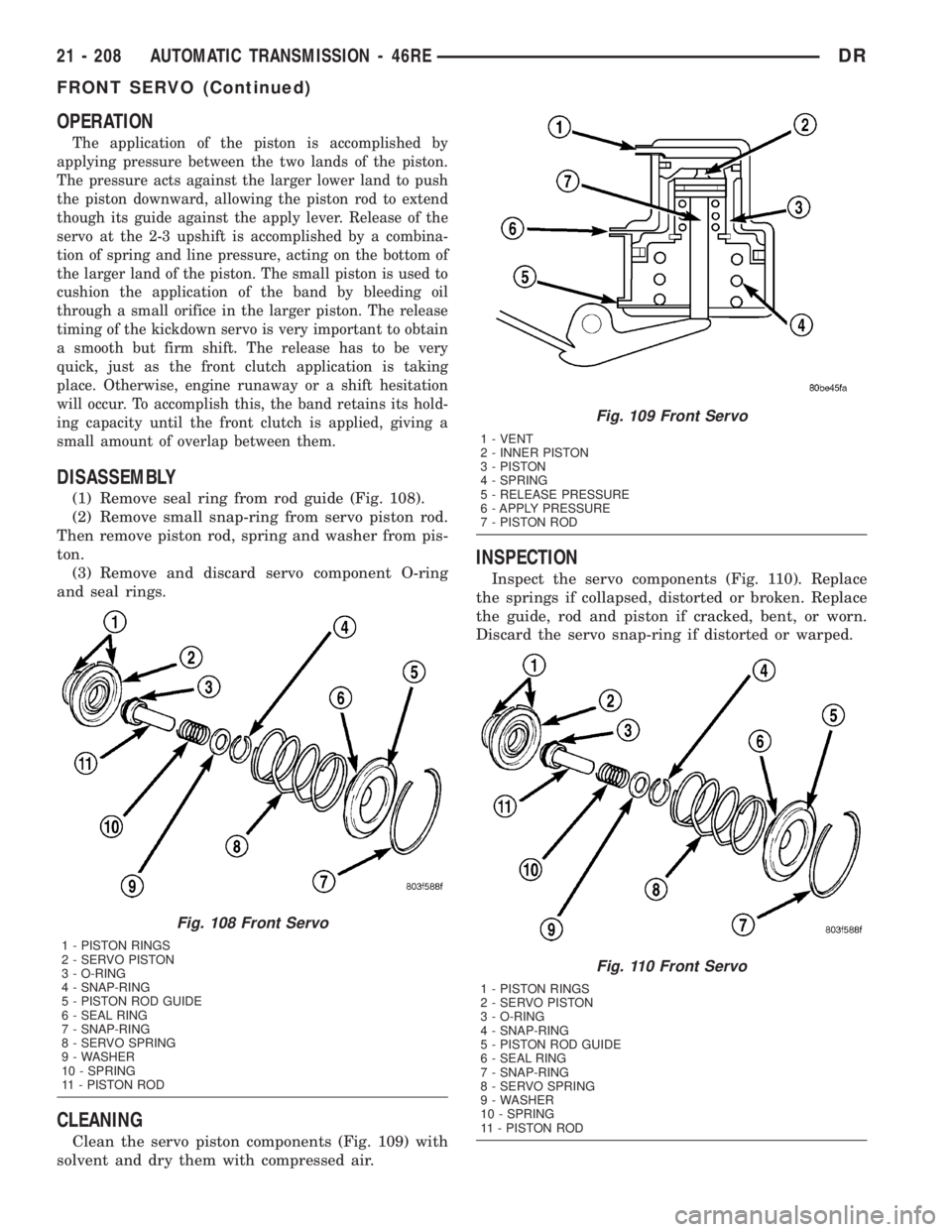
The application of the piston is accomplished by
applying pressure between the two lands of the piston.
The pressure acts against the larger lower land to push
the piston downward, allowing the piston rod to extend
though its guide against the apply lever. Release of the
servo at the 2-3 upshift is accomplished by a combina-
tion of spring and line pressure, acting on the bottom of
the larger land of the piston. The small piston is used to
cushion the application of the band by bleeding oil
through a small orifice in the larger piston. The release
timing of the kickdown servo is very important to obtain
a smooth but firm shift. The release has to be very
quick, just as the front clutch application is taking
place. Otherwise, engine runaway or a shift hesitation
will occur. To accomplish this, the band retains its hold-
ing capacity until the front clutch is applied, giving a
small amount of overlap between them.
DISASSEMBLY
(1) Remove seal ring from rod guide (Fig. 108).
(2) Remove small snap-ring from servo piston rod.
Then remove piston rod, spring and washer from pis-
ton.
(3) Remove and discard servo component O-ring
and seal rings.
CLEANING
Clean the servo piston components (Fig. 109) with
solvent and dry them with compressed air.
INSPECTION
Inspect the servo components (Fig. 110). Replace
the springs if collapsed, distorted or broken. Replace
the guide, rod and piston if cracked, bent, or worn.
Discard the servo snap-ring if distorted or warped.
Fig. 108 Front Servo
1 - PISTON RINGS
2 - SERVO PISTON
3 - O-RING
4 - SNAP-RING
5 - PISTON ROD GUIDE
6 - SEAL RING
7 - SNAP-RING
8 - SERVO SPRING
9 - WASHER
10 - SPRING
11 - PISTON ROD
Fig. 109 Front Servo
1 - VENT
2 - INNER PISTON
3 - PISTON
4 - SPRING
5 - RELEASE PRESSURE
6 - APPLY PRESSURE
7 - PISTON ROD
Fig. 110 Front Servo
1 - PISTON RINGS
2 - SERVO PISTON
3 - O-RING
4 - SNAP-RING
5 - PISTON ROD GUIDE
6 - SEAL RING
7 - SNAP-RING
8 - SERVO SPRING
9 - WASHER
10 - SPRING
11 - PISTON ROD
21 - 208 AUTOMATIC TRANSMISSION - 46REDR
FRONT SERVO (Continued)
Page 2057 of 2895
OVERDRIVE CLUTCH
DESCRIPTION
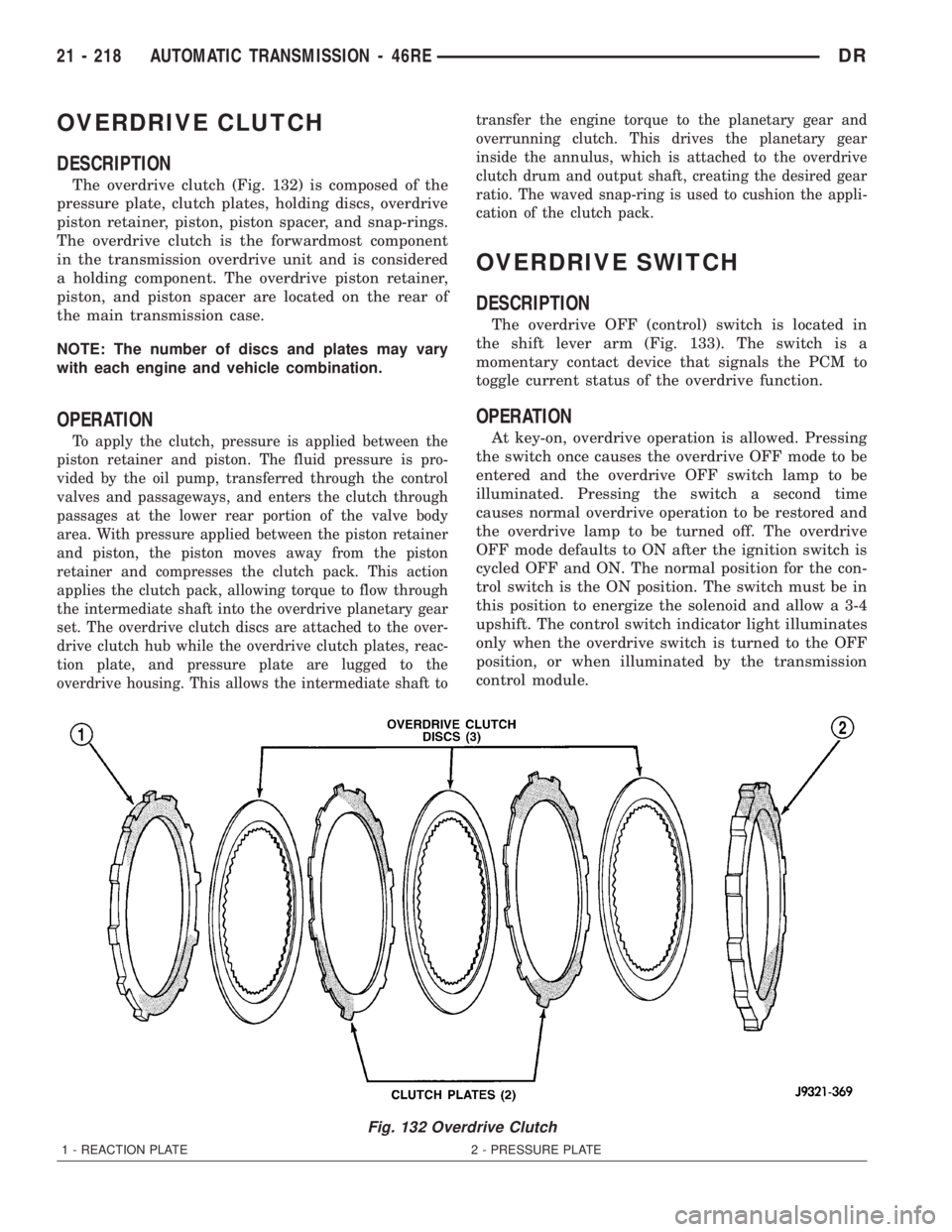
The overdrive clutch (Fig. 132) is composed of the
pressure plate, clutch plates, holding discs, overdrive
piston retainer, piston, piston spacer, and snap-rings.
The overdrive clutch is the forwardmost component
in the transmission overdrive unit and is considered
a holding component. The overdrive piston retainer,
piston, and piston spacer are located on the rear of
the main transmission case.
NOTE: The number of discs and plates may vary
with each engine and vehicle combination.
OPERATION
To apply the clutch, pressure is applied between the
piston retainer and piston. The fluid pressure is pro-
vided by the oil pump, transferred through the control
valves and passageways, and enters the clutch through
passages at the lower rear portion of the valve body
area. With pressure applied between the piston retainer
and piston, the piston moves away from the piston
retainer and compresses the clutch pack. This action
applies the clutch pack, allowing torque to flow through
the intermediate shaft into the overdrive planetary gear
set. The overdrive clutch discs are attached to the over-
drive clutch hub while the overdrive clutch plates, reac-
tion plate, and pressure plate are lugged to the
overdrive housing. This allows the intermediate shaft totransfer the engine torque to the planetary gear and
overrunning clutch. This drives the planetary gear
inside the annulus, which is attached to the overdrive
clutch drum and output shaft, creating the desired gear
ratio. The waved snap-ring is used to cushion the appli-
cation of the clutch pack.
OVERDRIVE SWITCH
DESCRIPTION
The overdrive OFF (control) switch is located in
the shift lever arm (Fig. 133). The switch is a
momentary contact device that signals the PCM to
toggle current status of the overdrive function.
OPERATION
At key-on, overdrive operation is allowed. Pressing
the switch once causes the overdrive OFF mode to be
entered and the overdrive OFF switch lamp to be
illuminated. Pressing the switch a second time
causes normal overdrive operation to be restored and
the overdrive lamp to be turned off. The overdrive
OFF mode defaults to ON after the ignition switch is
cycled OFF and ON. The normal position for the con-
trol switch is the ON position. The switch must be in
this position to energize the solenoid and allow a 3-4
upshift. The control switch indicator light illuminates
only when the overdrive switch is turned to the OFF
position, or when illuminated by the transmission
control module.
Fig. 132 Overdrive Clutch
1 - REACTION PLATE 2 - PRESSURE PLATE
21 - 218 AUTOMATIC TRANSMISSION - 46REDR
Page 2059 of 2895
OVERDRIVE UNIT
REMOVAL
(1) Shift transmission into PARK.
(2) Raise vehicle.
(3) Remove transfer case, if equipped.
(4) Mark propeller shaft universal joint(s) and axle
pinion yoke, or the companion flange and flange
yoke, for alignment reference at installation, if neces-
sary.
(5) Disconnect and remove the rear propeller shaft,
if necessary. (Refer to 3 - DIFFERENTIAL & DRIV-
ELINE/PROPELLER SHAFT/PROPELLER SHAFT -
REMOVAL)
(6) Remove transmission oil pan, remove gasket,
drain oil and reinstall pan.
(7) If overdrive unit had malfunctioned, or if fluid
is contaminated, remove entire transmission. If diag-
nosis indicated overdrive problems only, remove just
the overdrive unit.
(8) Support transmission with transmission jack.
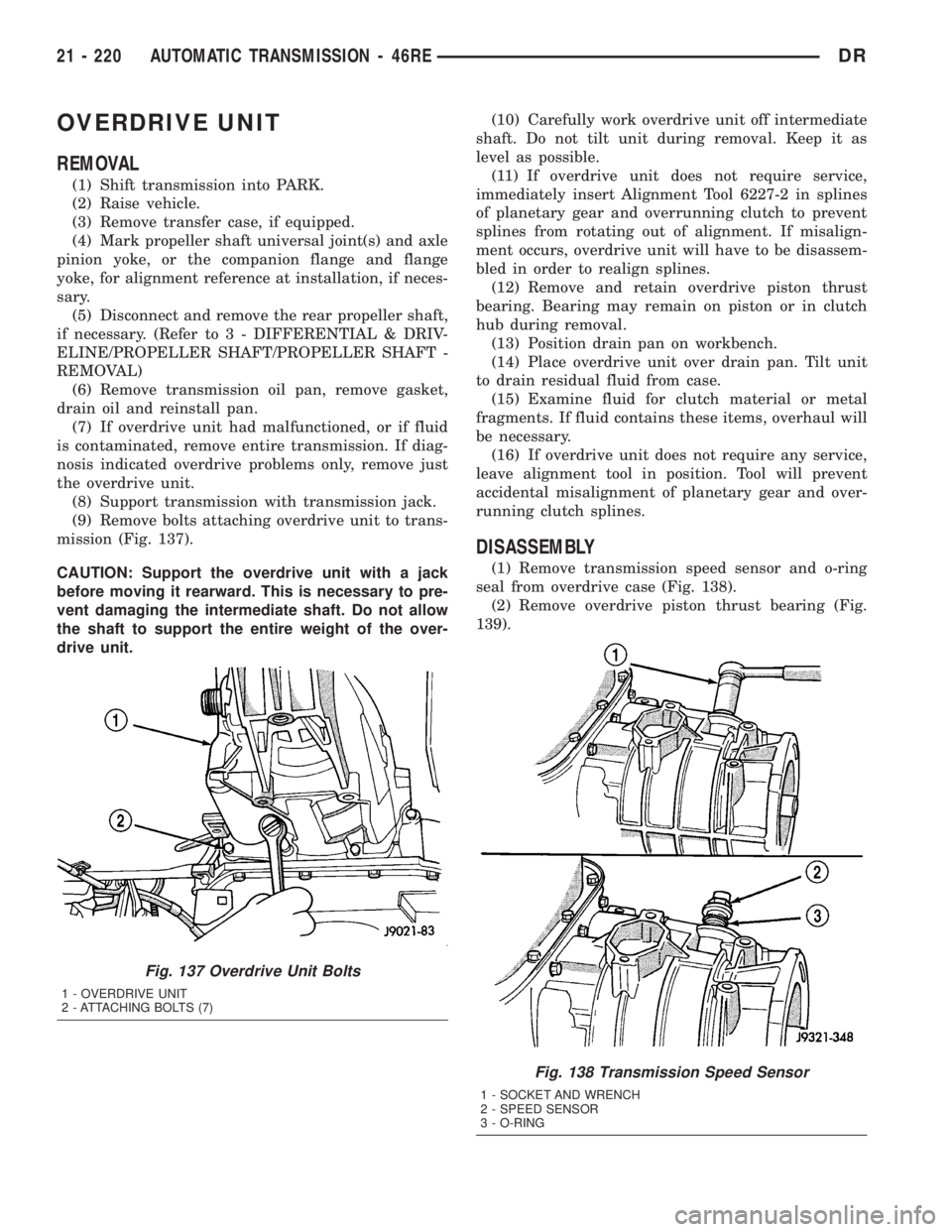
(9) Remove bolts attaching overdrive unit to trans-
mission (Fig. 137).
CAUTION: Support the overdrive unit with a jack
before moving it rearward. This is necessary to pre-
vent damaging the intermediate shaft. Do not allow
the shaft to support the entire weight of the over-
drive unit.(10) Carefully work overdrive unit off intermediate
shaft. Do not tilt unit during removal. Keep it as
level as possible.
(11) If overdrive unit does not require service,
immediately insert Alignment Tool 6227-2 in splines
of planetary gear and overrunning clutch to prevent
splines from rotating out of alignment. If misalign-
ment occurs, overdrive unit will have to be disassem-
bled in order to realign splines.
(12) Remove and retain overdrive piston thrust
bearing. Bearing may remain on piston or in clutch
hub during removal.
(13) Position drain pan on workbench.
(14) Place overdrive unit over drain pan. Tilt unit
to drain residual fluid from case.
(15) Examine fluid for clutch material or metal
fragments. If fluid contains these items, overhaul will
be necessary.
(16) If overdrive unit does not require any service,
leave alignment tool in position. Tool will prevent
accidental misalignment of planetary gear and over-
running clutch splines.
DISASSEMBLY
(1) Remove transmission speed sensor and o-ring
seal from overdrive case (Fig. 138).
(2) Remove overdrive piston thrust bearing (Fig.
139).
Fig. 137 Overdrive Unit Bolts
1 - OVERDRIVE UNIT
2 - ATTACHING BOLTS (7)
Fig. 138 Transmission Speed Sensor
1 - SOCKET AND WRENCH
2 - SPEED SENSOR
3 - O-RING
21 - 220 AUTOMATIC TRANSMISSION - 46REDR
Page 2061 of 2895
OVERDRIVE CLUTCH PACK
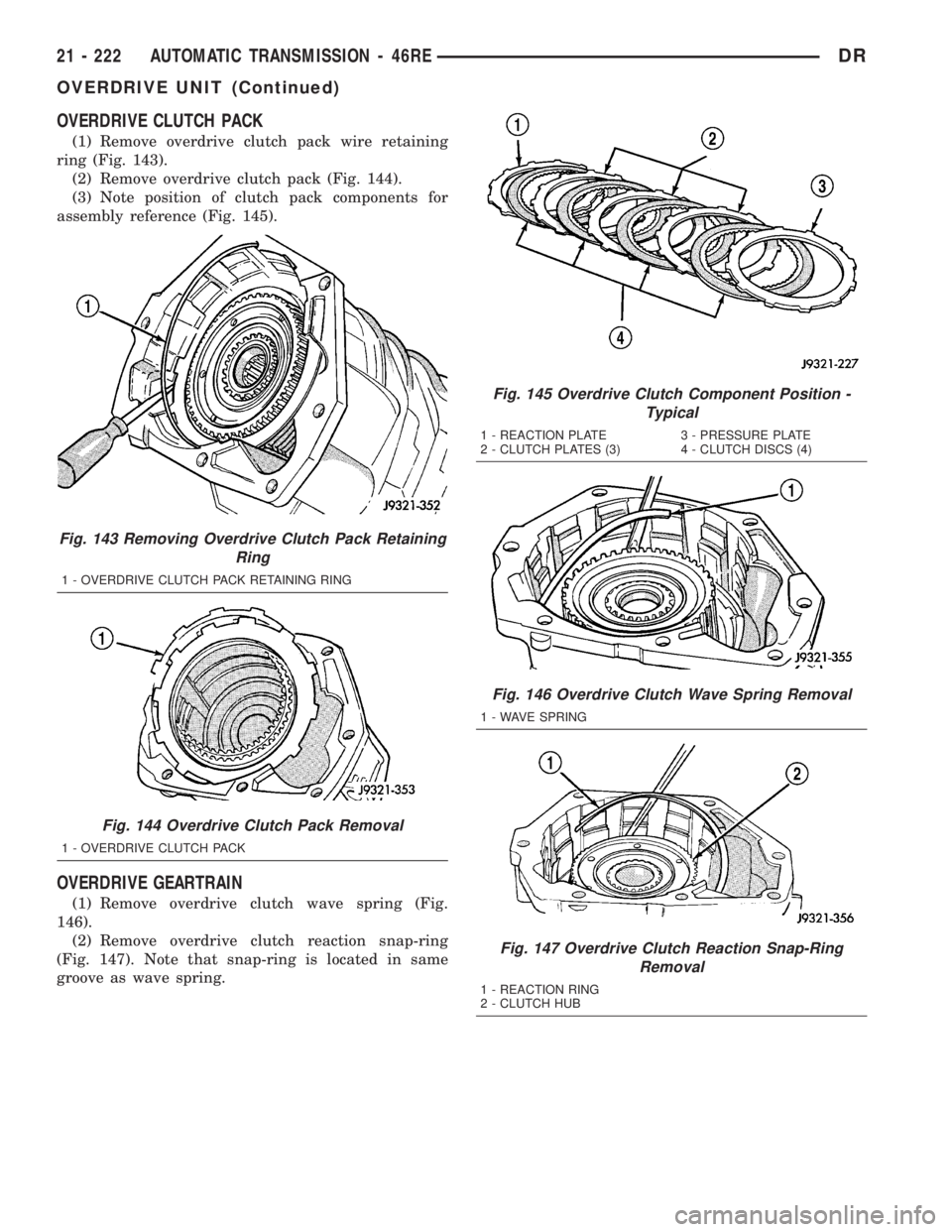
(1) Remove overdrive clutch pack wire retaining
ring (Fig. 143).
(2) Remove overdrive clutch pack (Fig. 144).
(3) Note position of clutch pack components for
assembly reference (Fig. 145).
OVERDRIVE GEARTRAIN
(1) Remove overdrive clutch wave spring (Fig.
146).
(2) Remove overdrive clutch reaction snap-ring
(Fig. 147). Note that snap-ring is located in same
groove as wave spring.
Fig. 143 Removing Overdrive Clutch Pack Retaining
Ring
1 - OVERDRIVE CLUTCH PACK RETAINING RING
Fig. 144 Overdrive Clutch Pack Removal
1 - OVERDRIVE CLUTCH PACK
Fig. 145 Overdrive Clutch Component Position -
Typical
1 - REACTION PLATE 3 - PRESSURE PLATE
2 - CLUTCH PLATES (3) 4 - CLUTCH DISCS (4)
Fig. 146 Overdrive Clutch Wave Spring Removal
1 - WAVE SPRING
Fig. 147 Overdrive Clutch Reaction Snap-Ring
Removal
1 - REACTION RING
2 - CLUTCH HUB
21 - 222 AUTOMATIC TRANSMISSION - 46REDR
OVERDRIVE UNIT (Continued)
Page 2063 of 2895
DIRECT CLUTCH, HUB AND SPRING
WARNING: THE NEXT STEP IN DISASSEMBLY
INVOLVES COMPRESSING THE DIRECT CLUTCH
SPRING. IT IS EXTREMELY IMPORTANT THAT PROPER
EQUIPMENT BE USED TO COMPRESS THE SPRING AS
SPRING FORCE IS APPROXIMATELY 830 POUNDS. USE
SPRING COMPRESSOR TOOL 6227-1 AND A HYDRAU-
LIC SHOP PRESS WITH A MINIMUM RAM TRAVEL OF
5-6 INCHES. THE PRESS MUST ALSO HAVE A BED
THAT CAN BE ADJUSTED UP OR DOWN AS REQUIRED.
RELEASE CLUTCH SPRING TENSION SLOWLY AND
COMPLETELY TO AVOID PERSONAL INJURY.
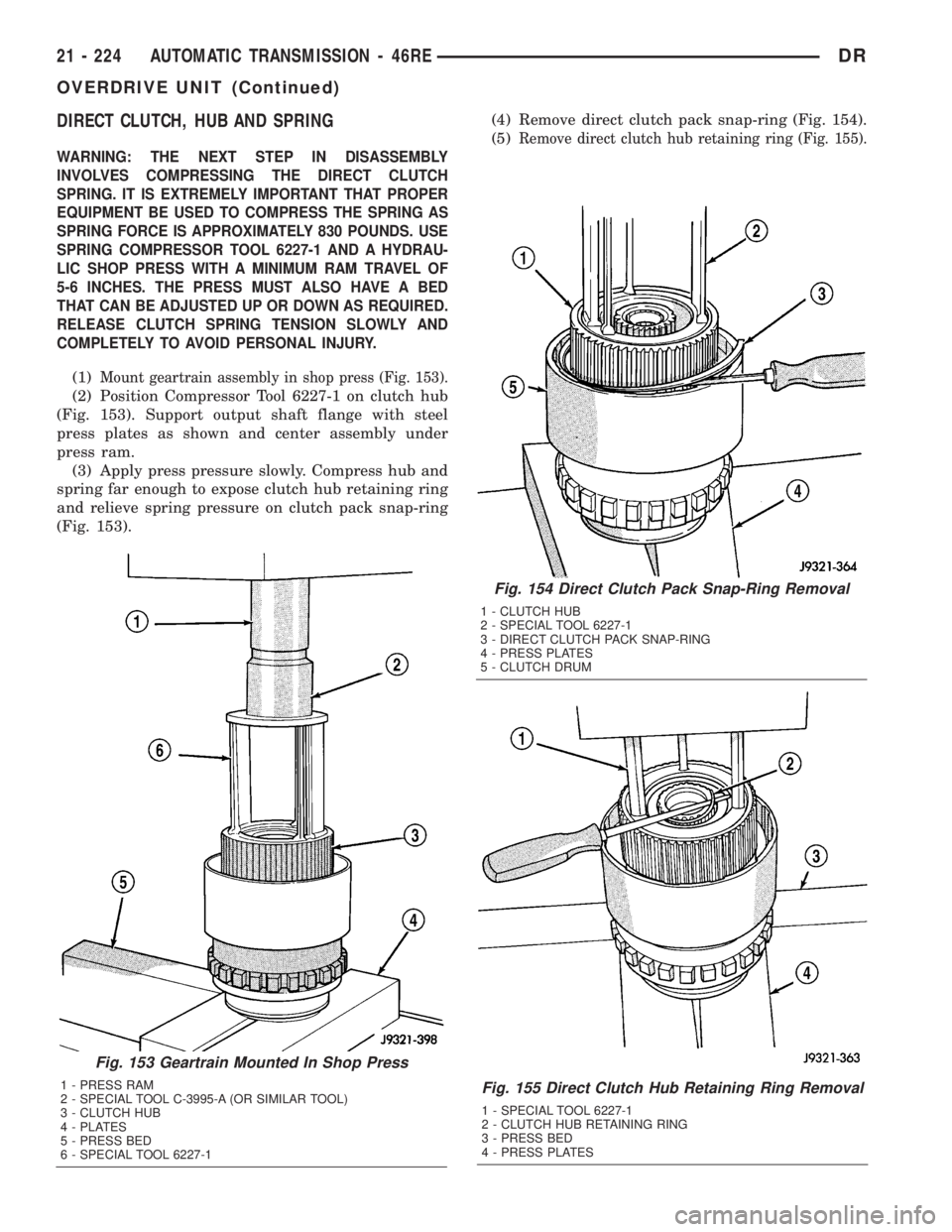
(1)Mount geartrain assembly in shop press (Fig. 153).
(2) Position Compressor Tool 6227-1 on clutch hub
(Fig. 153). Support output shaft flange with steel
press plates as shown and center assembly under
press ram.
(3) Apply press pressure slowly. Compress hub and
spring far enough to expose clutch hub retaining ring
and relieve spring pressure on clutch pack snap-ring
(Fig. 153).(4) Remove direct clutch pack snap-ring (Fig. 154).
(5)
Remove direct clutch hub retaining ring (Fig. 155).
Fig. 153 Geartrain Mounted In Shop Press
1 - PRESS RAM
2 - SPECIAL TOOL C-3995-A (OR SIMILAR TOOL)
3 - CLUTCH HUB
4 - PLATES
5 - PRESS BED
6 - SPECIAL TOOL 6227-1
Fig. 154 Direct Clutch Pack Snap-Ring Removal
1 - CLUTCH HUB
2 - SPECIAL TOOL 6227-1
3 - DIRECT CLUTCH PACK SNAP-RING
4 - PRESS PLATES
5 - CLUTCH DRUM
Fig. 155 Direct Clutch Hub Retaining Ring Removal
1 - SPECIAL TOOL 6227-1
2 - CLUTCH HUB RETAINING RING
3 - PRESS BED
4 - PRESS PLATES
21 - 224 AUTOMATIC TRANSMISSION - 46REDR
OVERDRIVE UNIT (Continued)
Page 2064 of 2895
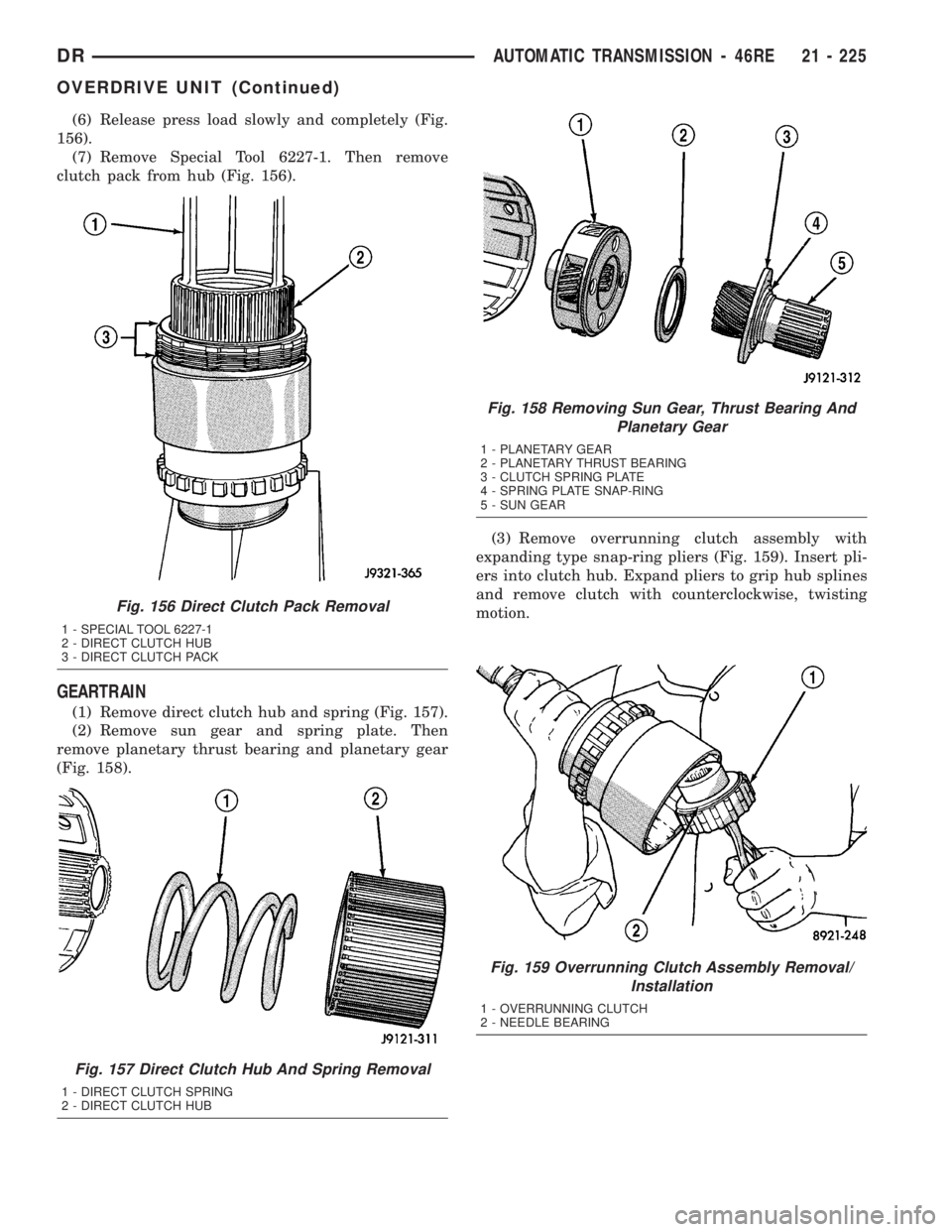
(6) Release press load slowly and completely (Fig.
156).
(7) Remove Special Tool 6227-1. Then remove
clutch pack from hub (Fig. 156).
GEARTRAIN
(1) Remove direct clutch hub and spring (Fig. 157).
(2) Remove sun gear and spring plate. Then
remove planetary thrust bearing and planetary gear
(Fig. 158).(3) Remove overrunning clutch assembly with
expanding type snap-ring pliers (Fig. 159). Insert pli-
ers into clutch hub. Expand pliers to grip hub splines
and remove clutch with counterclockwise, twisting
motion.
Fig. 159 Overrunning Clutch Assembly Removal/
Installation
1 - OVERRUNNING CLUTCH
2 - NEEDLE BEARING
Fig. 156 Direct Clutch Pack Removal
1 - SPECIAL TOOL 6227-1
2 - DIRECT CLUTCH HUB
3 - DIRECT CLUTCH PACK
Fig. 157 Direct Clutch Hub And Spring Removal
1 - DIRECT CLUTCH SPRING
2 - DIRECT CLUTCH HUB
Fig. 158 Removing Sun Gear, Thrust Bearing And
Planetary Gear
1 - PLANETARY GEAR
2 - PLANETARY THRUST BEARING
3 - CLUTCH SPRING PLATE
4 - SPRING PLATE SNAP-RING
5 - SUN GEAR
DRAUTOMATIC TRANSMISSION - 46RE 21 - 225
OVERDRIVE UNIT (Continued)
Page 2065 of 2895
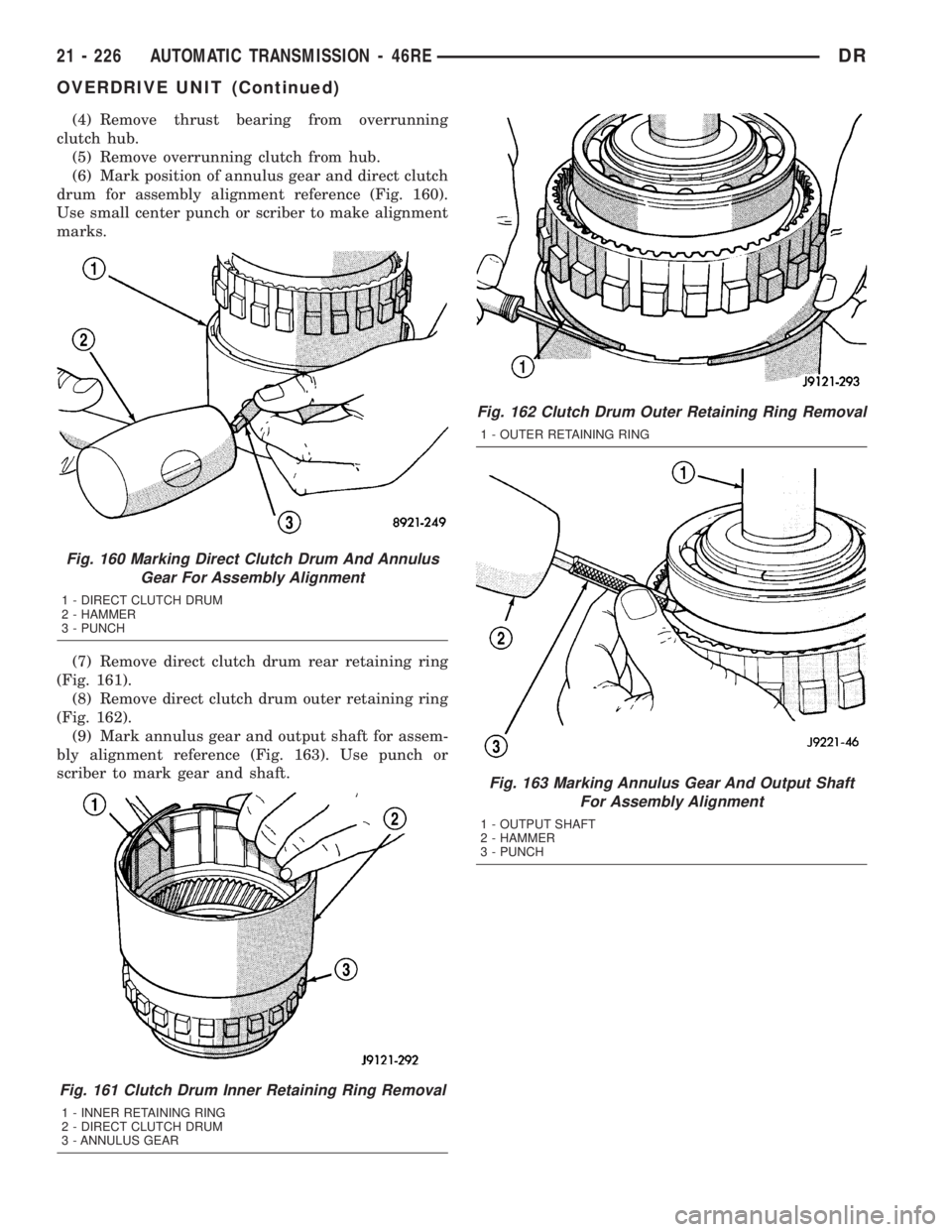
(4) Remove thrust bearing from overrunning
clutch hub.
(5) Remove overrunning clutch from hub.
(6) Mark position of annulus gear and direct clutch
drum for assembly alignment reference (Fig. 160).
Use small center punch or scriber to make alignment
marks.
(7) Remove direct clutch drum rear retaining ring
(Fig. 161).
(8) Remove direct clutch drum outer retaining ring
(Fig. 162).
(9) Mark annulus gear and output shaft for assem-
bly alignment reference (Fig. 163). Use punch or
scriber to mark gear and shaft.
Fig. 160 Marking Direct Clutch Drum And Annulus
Gear For Assembly Alignment
1 - DIRECT CLUTCH DRUM
2 - HAMMER
3 - PUNCH
Fig. 161 Clutch Drum Inner Retaining Ring Removal
1 - INNER RETAINING RING
2 - DIRECT CLUTCH DRUM
3 - ANNULUS GEAR
Fig. 162 Clutch Drum Outer Retaining Ring Removal
1 - OUTER RETAINING RING
Fig. 163 Marking Annulus Gear And Output Shaft
For Assembly Alignment
1 - OUTPUT SHAFT
2 - HAMMER
3 - PUNCH
21 - 226 AUTOMATIC TRANSMISSION - 46REDR
OVERDRIVE UNIT (Continued)