Radio DODGE RAM 2003 Service Service Manual
[x] Cancel search | Manufacturer: DODGE, Model Year: 2003, Model line: RAM, Model: DODGE RAM 2003Pages: 2895, PDF Size: 83.15 MB
Page 1111 of 2895
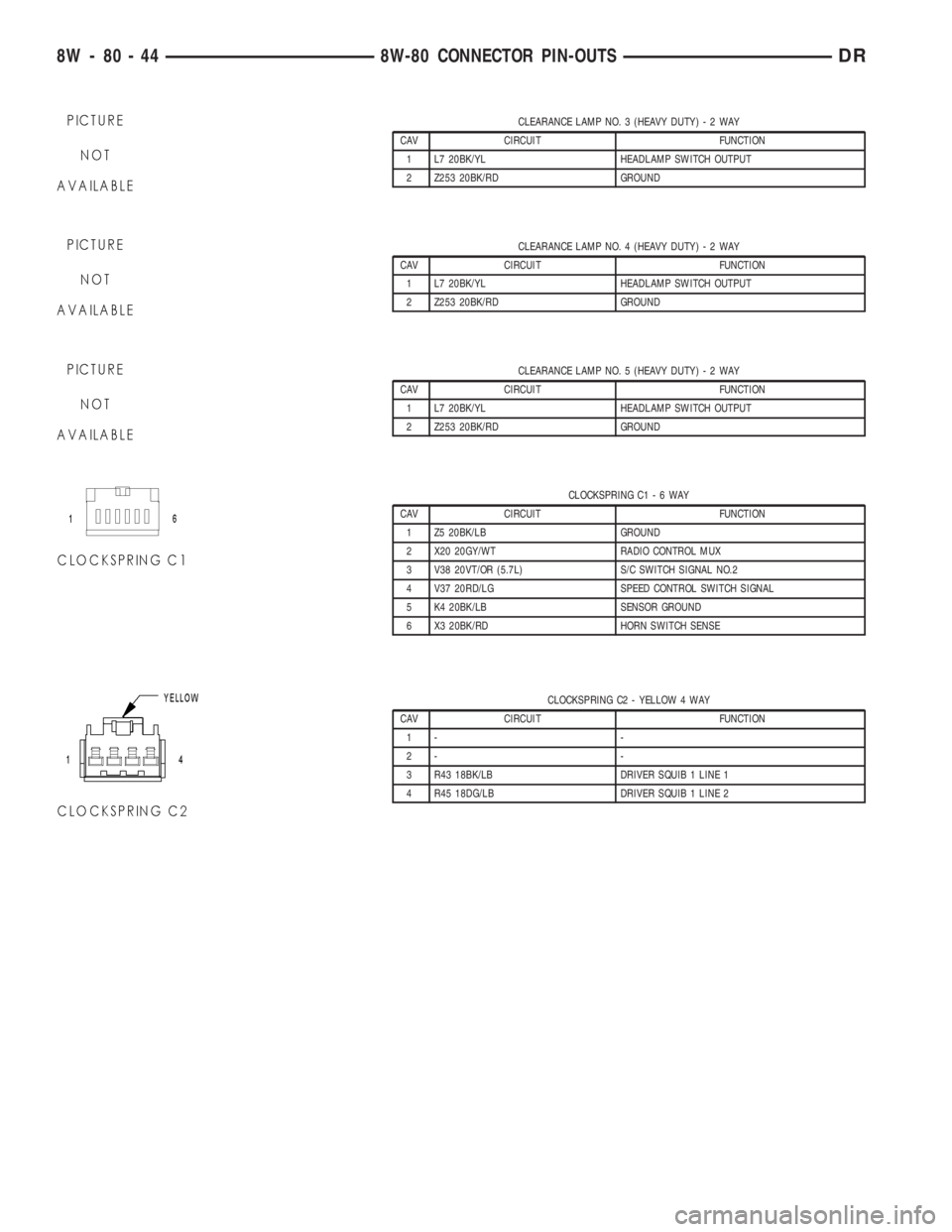
CLEARANCE LAMP NO. 3 (HEAVY DUTY)-2WAY
CAV CIRCUIT FUNCTION
1 L7 20BK/YL HEADLAMP SWITCH OUTPUT
2 Z253 20BK/RD GROUND
CLEARANCE LAMP NO. 4 (HEAVY DUTY)-2WAY
CAV CIRCUIT FUNCTION
1 L7 20BK/YL HEADLAMP SWITCH OUTPUT
2 Z253 20BK/RD GROUND
CLEARANCE LAMP NO. 5 (HEAVY DUTY)-2WAY
CAV CIRCUIT FUNCTION
1 L7 20BK/YL HEADLAMP SWITCH OUTPUT
2 Z253 20BK/RD GROUND
CLOCKSPRING C1-6WAY
CAV CIRCUIT FUNCTION
1 Z5 20BK/LB GROUND
2 X20 20GY/WT RADIO CONTROL MUX
3 V38 20VT/OR (5.7L) S/C SWITCH SIGNAL NO.2
4 V37 20RD/LG SPEED CONTROL SWITCH SIGNAL
5 K4 20BK/LB SENSOR GROUND
6 X3 20BK/RD HORN SWITCH SENSE
CLOCKSPRING C2 - YELLOW 4 WAY
CAV CIRCUIT FUNCTION
1- -
2- -
3 R43 18BK/LB DRIVER SQUIB 1 LINE 1
4 R45 18DG/LB DRIVER SQUIB 1 LINE 2
8W - 80 - 44 8W-80 CONNECTOR PIN-OUTSDR
Page 1112 of 2895
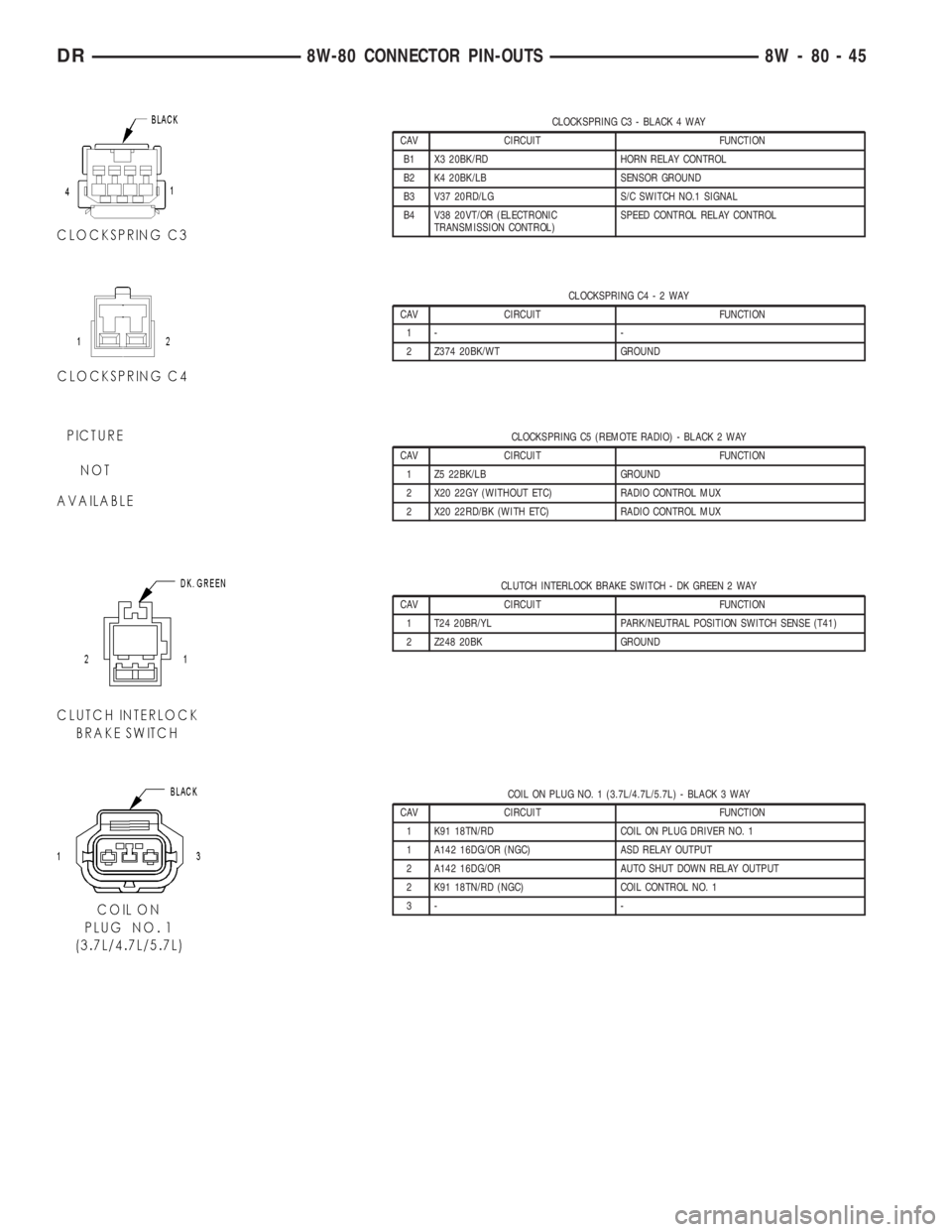
CLOCKSPRING C3 - BLACK 4 WAY
CAV CIRCUIT FUNCTION
B1 X3 20BK/RD HORN RELAY CONTROL
B2 K4 20BK/LB SENSOR GROUND
B3 V37 20RD/LG S/C SWITCH NO.1 SIGNAL
B4 V38 20VT/OR (ELECTRONIC
TRANSMISSION CONTROL)SPEED CONTROL RELAY CONTROL
CLOCKSPRING C4-2WAY
CAV CIRCUIT FUNCTION
1- -
2 Z374 20BK/WT GROUND
CLOCKSPRING C5 (REMOTE RADIO) - BLACK 2 WAY
CAV CIRCUIT FUNCTION
1 Z5 22BK/LB GROUND
2 X20 22GY (WITHOUT ETC) RADIO CONTROL MUX
2 X20 22RD/BK (WITH ETC) RADIO CONTROL MUX
CLUTCH INTERLOCK BRAKE SWITCH - DK GREEN 2 WAY
CAV CIRCUIT FUNCTION
1 T24 20BR/YL PARK/NEUTRAL POSITION SWITCH SENSE (T41)
2 Z248 20BK GROUND
COIL ON PLUG NO. 1 (3.7L/4.7L/5.7L) - BLACK 3 WAY
CAV CIRCUIT FUNCTION
1 K91 18TN/RD COIL ON PLUG DRIVER NO. 1
1 A142 16DG/OR (NGC) ASD RELAY OUTPUT
2 A142 16DG/OR AUTO SHUT DOWN RELAY OUTPUT
2 K91 18TN/RD (NGC) COIL CONTROL NO. 1
3- -
DR8W-80 CONNECTOR PIN-OUTS 8W - 80 - 45
Page 1135 of 2895
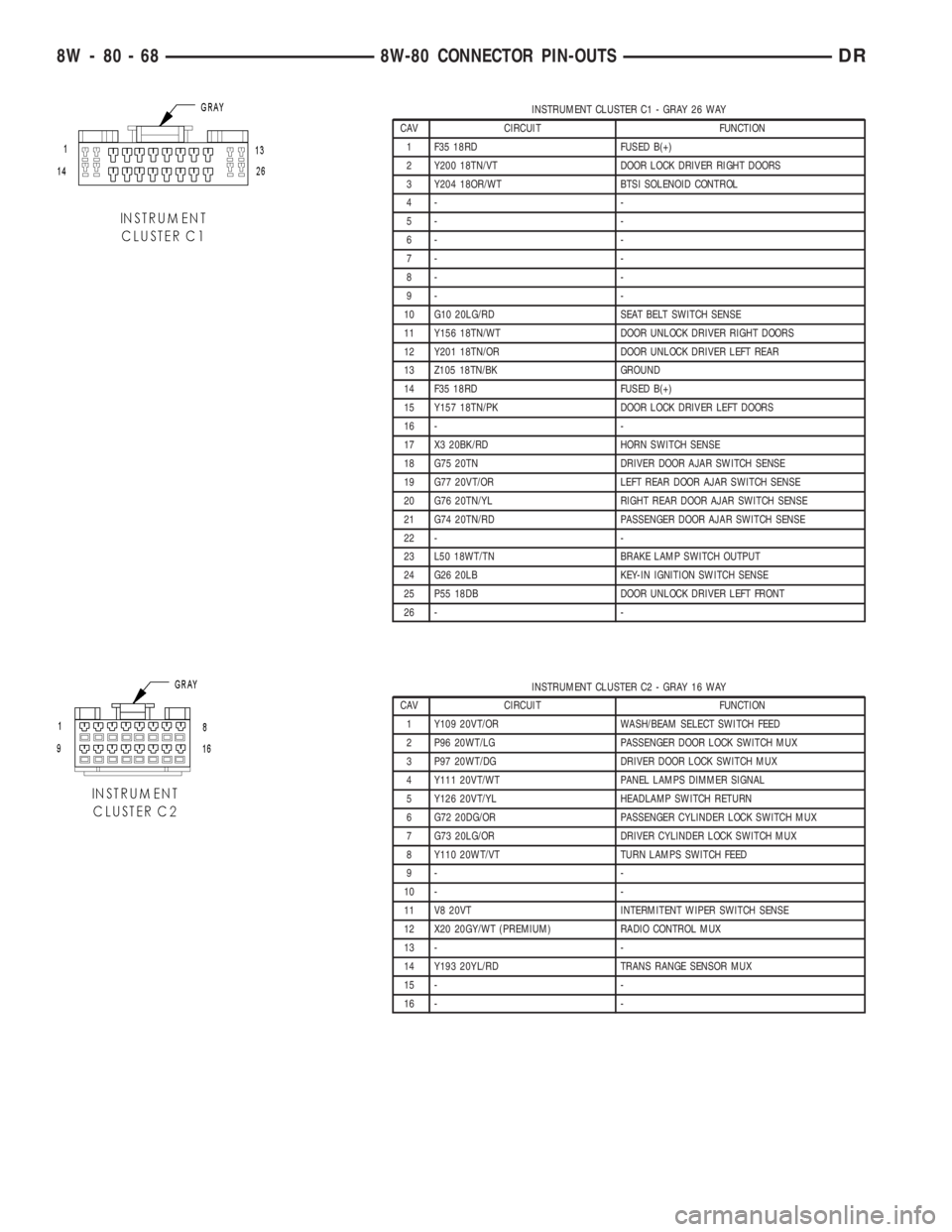
INSTRUMENT CLUSTER C1 - GRAY 26 WAY
CAV CIRCUIT FUNCTION
1 F35 18RD FUSED B(+)
2 Y200 18TN/VT DOOR LOCK DRIVER RIGHT DOORS
3 Y204 18OR/WT BTSI SOLENOID CONTROL
4- -
5- -
6- -
7- -
8- -
9- -
10 G10 20LG/RD SEAT BELT SWITCH SENSE
11 Y156 18TN/WT DOOR UNLOCK DRIVER RIGHT DOORS
12 Y201 18TN/OR DOOR UNLOCK DRIVER LEFT REAR
13 Z105 18TN/BK GROUND
14 F35 18RD FUSED B(+)
15 Y157 18TN/PK DOOR LOCK DRIVER LEFT DOORS
16 - -
17 X3 20BK/RD HORN SWITCH SENSE
18 G75 20TN DRIVER DOOR AJAR SWITCH SENSE
19 G77 20VT/OR LEFT REAR DOOR AJAR SWITCH SENSE
20 G76 20TN/YL RIGHT REAR DOOR AJAR SWITCH SENSE
21 G74 20TN/RD PASSENGER DOOR AJAR SWITCH SENSE
22 - -
23 L50 18WT/TN BRAKE LAMP SWITCH OUTPUT
24 G26 20LB KEY-IN IGNITION SWITCH SENSE
25 P55 18DB DOOR UNLOCK DRIVER LEFT FRONT
26 - -
INSTRUMENT CLUSTER C2 - GRAY 16 WAY
CAV CIRCUIT FUNCTION
1 Y109 20VT/OR WASH/BEAM SELECT SWITCH FEED
2 P96 20WT/LG PASSENGER DOOR LOCK SWITCH MUX
3 P97 20WT/DG DRIVER DOOR LOCK SWITCH MUX
4 Y111 20VT/WT PANEL LAMPS DIMMER SIGNAL
5 Y126 20VT/YL HEADLAMP SWITCH RETURN
6 G72 20DG/OR PASSENGER CYLINDER LOCK SWITCH MUX
7 G73 20LG/OR DRIVER CYLINDER LOCK SWITCH MUX
8 Y110 20WT/VT TURN LAMPS SWITCH FEED
9- -
10 - -
11 V8 20VT INTERMITENT WIPER SWITCH SENSE
12 X20 20GY/WT (PREMIUM) RADIO CONTROL MUX
13 - -
14 Y193 20YL/RD TRANS RANGE SENSOR MUX
15 - -
16 - -
8W - 80 - 68 8W-80 CONNECTOR PIN-OUTSDR
Page 1161 of 2895
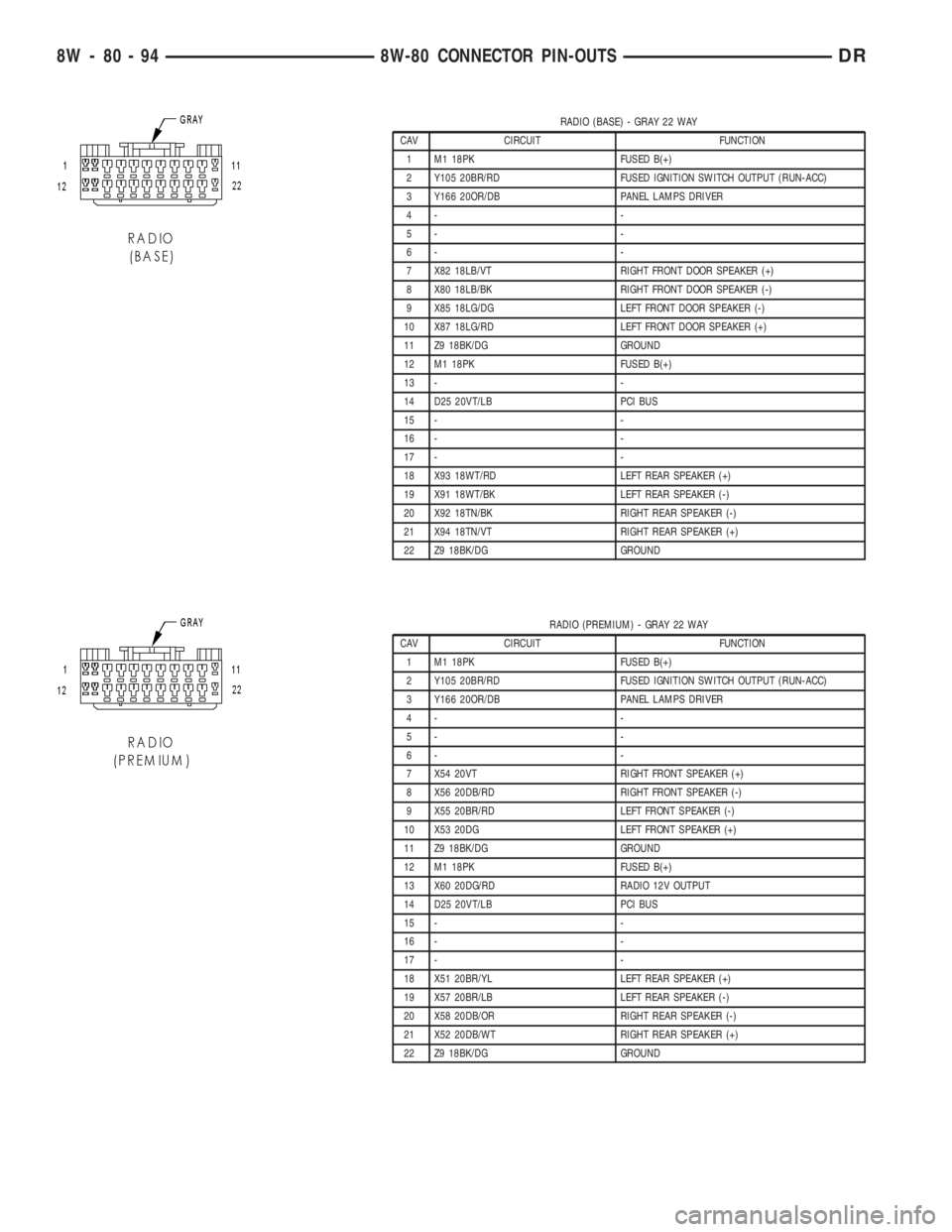
RADIO (BASE) - GRAY 22 WAY
CAV CIRCUIT FUNCTION
1 M1 18PK FUSED B(+)
2 Y105 20BR/RD FUSED IGNITION SWITCH OUTPUT (RUN-ACC)
3 Y166 20OR/DB PANEL LAMPS DRIVER
4- -
5- -
6- -
7 X82 18LB/VT RIGHT FRONT DOOR SPEAKER (+)
8 X80 18LB/BK RIGHT FRONT DOOR SPEAKER (-)
9 X85 18LG/DG LEFT FRONT DOOR SPEAKER (-)
10 X87 18LG/RD LEFT FRONT DOOR SPEAKER (+)
11 Z9 18BK/DG GROUND
12 M1 18PK FUSED B(+)
13 - -
14 D25 20VT/LB PCI BUS
15 - -
16 - -
17 - -
18 X93 18WT/RD LEFT REAR SPEAKER (+)
19 X91 18WT/BK LEFT REAR SPEAKER (-)
20 X92 18TN/BK RIGHT REAR SPEAKER (-)
21 X94 18TN/VT RIGHT REAR SPEAKER (+)
22 Z9 18BK/DG GROUND
RADIO (PREMIUM) - GRAY 22 WAY
CAV CIRCUIT FUNCTION
1 M1 18PK FUSED B(+)
2 Y105 20BR/RD FUSED IGNITION SWITCH OUTPUT (RUN-ACC)
3 Y166 20OR/DB PANEL LAMPS DRIVER
4- -
5- -
6- -
7 X54 20VT RIGHT FRONT SPEAKER (+)
8 X56 20DB/RD RIGHT FRONT SPEAKER (-)
9 X55 20BR/RD LEFT FRONT SPEAKER (-)
10 X53 20DG LEFT FRONT SPEAKER (+)
11 Z9 18BK/DG GROUND
12 M1 18PK FUSED B(+)
13 X60 20DG/RD RADIO 12V OUTPUT
14 D25 20VT/LB PCI BUS
15 - -
16 - -
17 - -
18 X51 20BR/YL LEFT REAR SPEAKER (+)
19 X57 20BR/LB LEFT REAR SPEAKER (-)
20 X58 20DB/OR RIGHT REAR SPEAKER (-)
21 X52 20DB/WT RIGHT REAR SPEAKER (+)
22 Z9 18BK/DG GROUND
8W - 80 - 94 8W-80 CONNECTOR PIN-OUTSDR
Page 1162 of 2895
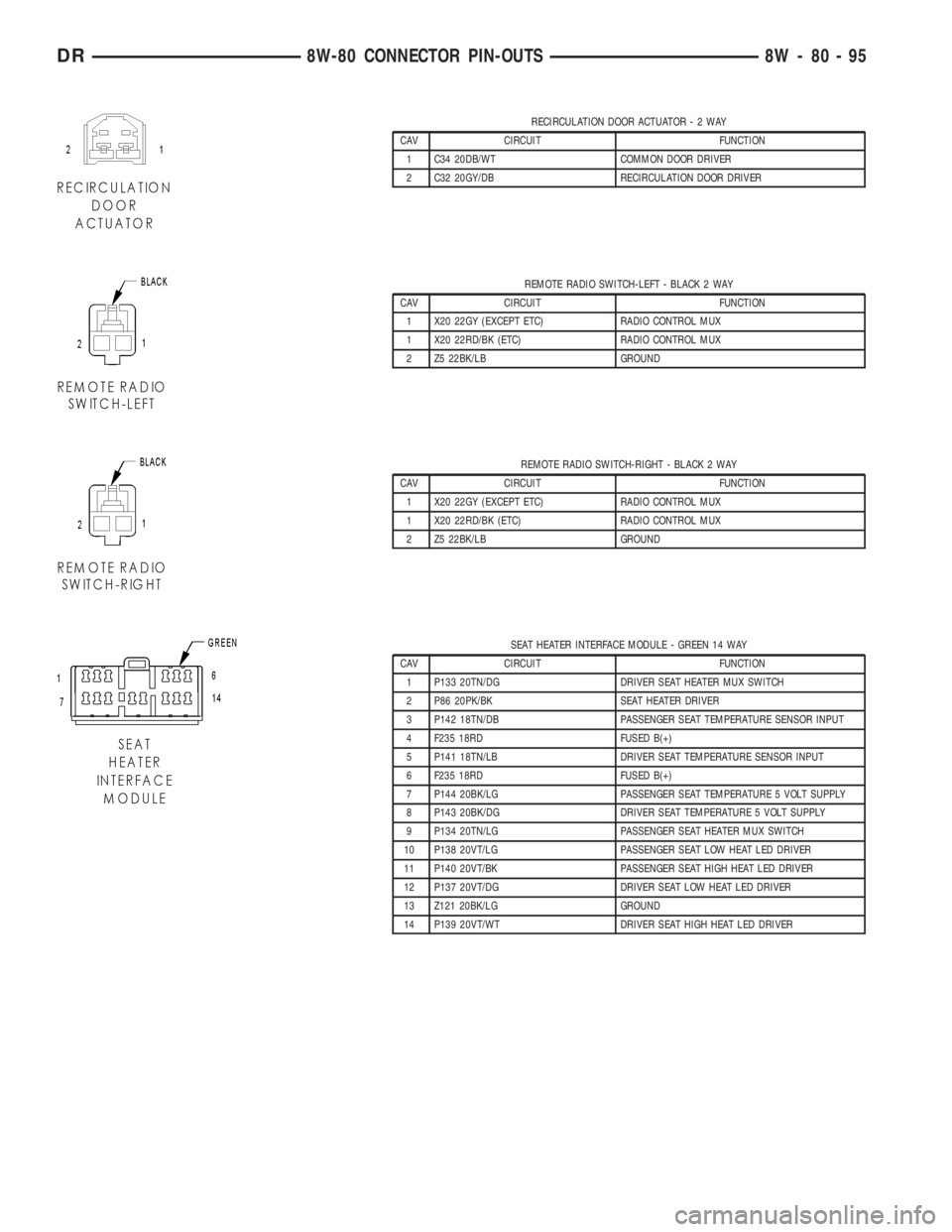
RECIRCULATION DOOR ACTUATOR-2WAY
CAV CIRCUIT FUNCTION
1 C34 20DB/WT COMMON DOOR DRIVER
2 C32 20GY/DB RECIRCULATION DOOR DRIVER
REMOTE RADIO SWITCH-LEFT - BLACK 2 WAY
CAV CIRCUIT FUNCTION
1 X20 22GY (EXCEPT ETC) RADIO CONTROL MUX
1 X20 22RD/BK (ETC) RADIO CONTROL MUX
2 Z5 22BK/LB GROUND
REMOTE RADIO SWITCH-RIGHT - BLACK 2 WAY
CAV CIRCUIT FUNCTION
1 X20 22GY (EXCEPT ETC) RADIO CONTROL MUX
1 X20 22RD/BK (ETC) RADIO CONTROL MUX
2 Z5 22BK/LB GROUND
SEAT HEATER INTERFACE MODULE - GREEN 14 WAY
CAV CIRCUIT FUNCTION
1 P133 20TN/DG DRIVER SEAT HEATER MUX SWITCH
2 P86 20PK/BK SEAT HEATER DRIVER
3 P142 18TN/DB PASSENGER SEAT TEMPERATURE SENSOR INPUT
4 F235 18RD FUSED B(+)
5 P141 18TN/LB DRIVER SEAT TEMPERATURE SENSOR INPUT
6 F235 18RD FUSED B(+)
7 P144 20BK/LG PASSENGER SEAT TEMPERATURE 5 VOLT SUPPLY
8 P143 20BK/DG DRIVER SEAT TEMPERATURE 5 VOLT SUPPLY
9 P134 20TN/LG PASSENGER SEAT HEATER MUX SWITCH
10 P138 20VT/LG PASSENGER SEAT LOW HEAT LED DRIVER
11 P140 20VT/BK PASSENGER SEAT HIGH HEAT LED DRIVER
12 P137 20VT/DG DRIVER SEAT LOW HEAT LED DRIVER
13 Z121 20BK/LG GROUND
14 P139 20VT/WT DRIVER SEAT HIGH HEAT LED DRIVER
DR8W-80 CONNECTOR PIN-OUTS 8W - 80 - 95
Page 1184 of 2895
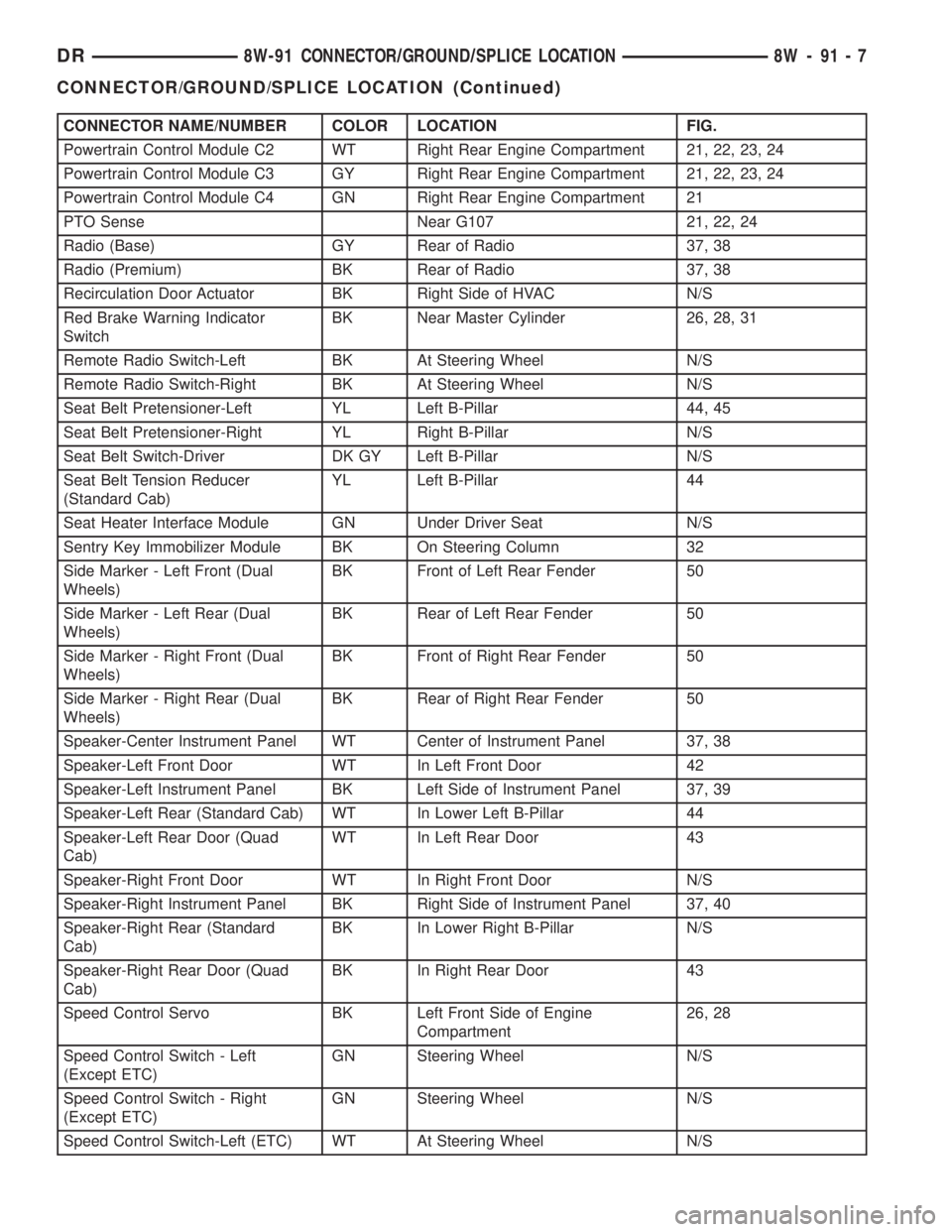
CONNECTOR NAME/NUMBER COLOR LOCATION FIG.
Powertrain Control Module C2 WT Right Rear Engine Compartment 21, 22, 23, 24
Powertrain Control Module C3 GY Right Rear Engine Compartment 21, 22, 23, 24
Powertrain Control Module C4 GN Right Rear Engine Compartment 21
PTO Sense Near G107 21, 22, 24
Radio (Base) GY Rear of Radio 37, 38
Radio (Premium) BK Rear of Radio 37, 38
Recirculation Door Actuator BK Right Side of HVAC N/S
Red Brake Warning Indicator
SwitchBK Near Master Cylinder 26, 28, 31
Remote Radio Switch-Left BK At Steering Wheel N/S
Remote Radio Switch-Right BK At Steering Wheel N/S
Seat Belt Pretensioner-Left YL Left B-Pillar 44, 45
Seat Belt Pretensioner-Right YL Right B-Pillar N/S
Seat Belt Switch-Driver DK GY Left B-Pillar N/S
Seat Belt Tension Reducer
(Standard Cab)YL Left B-Pillar 44
Seat Heater Interface Module GN Under Driver Seat N/S
Sentry Key Immobilizer Module BK On Steering Column 32
Side Marker - Left Front (Dual
Wheels)BK Front of Left Rear Fender 50
Side Marker - Left Rear (Dual
Wheels)BK Rear of Left Rear Fender 50
Side Marker - Right Front (Dual
Wheels)BK Front of Right Rear Fender 50
Side Marker - Right Rear (Dual
Wheels)BK Rear of Right Rear Fender 50
Speaker-Center Instrument Panel WT Center of Instrument Panel 37, 38
Speaker-Left Front Door WT In Left Front Door 42
Speaker-Left Instrument Panel BK Left Side of Instrument Panel 37, 39
Speaker-Left Rear (Standard Cab) WT In Lower Left B-Pillar 44
Speaker-Left Rear Door (Quad
Cab)WT In Left Rear Door 43
Speaker-Right Front Door WT In Right Front Door N/S
Speaker-Right Instrument Panel BK Right Side of Instrument Panel 37, 40
Speaker-Right Rear (Standard
Cab)BK In Lower Right B-Pillar N/S
Speaker-Right Rear Door (Quad
Cab)BK In Right Rear Door 43
Speed Control Servo BK Left Front Side of Engine
Compartment26, 28
Speed Control Switch - Left
(Except ETC)GN Steering Wheel N/S
Speed Control Switch - Right
(Except ETC)GN Steering Wheel N/S
Speed Control Switch-Left (ETC) WT At Steering Wheel N/S
DR8W-91 CONNECTOR/GROUND/SPLICE LOCATION 8W - 91 - 7
CONNECTOR/GROUND/SPLICE LOCATION (Continued)
Page 1245 of 2895
IOD FUSE
DESCRIPTION
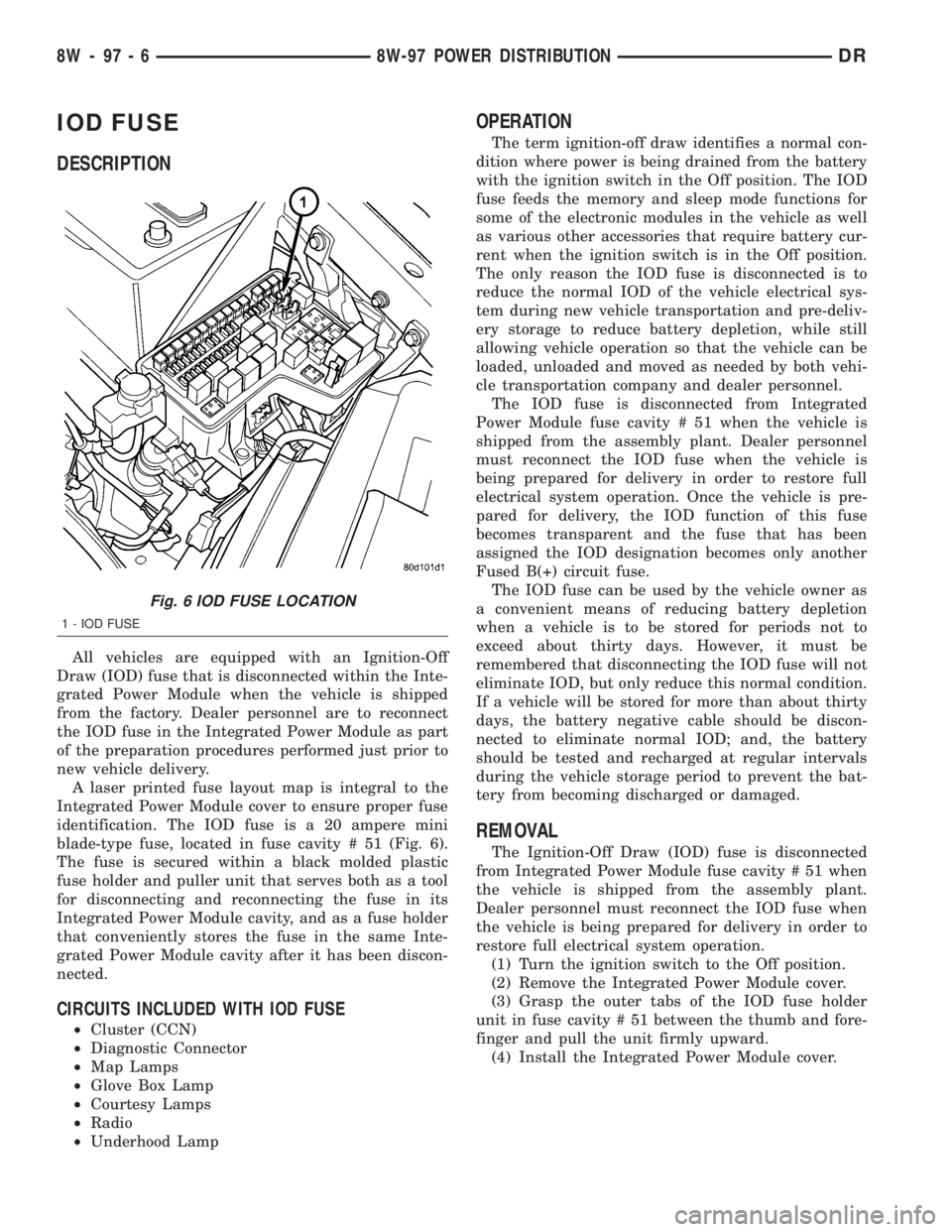
All vehicles are equipped with an Ignition-Off
Draw (IOD) fuse that is disconnected within the Inte-
grated Power Module when the vehicle is shipped
from the factory. Dealer personnel are to reconnect
the IOD fuse in the Integrated Power Module as part
of the preparation procedures performed just prior to
new vehicle delivery.
A laser printed fuse layout map is integral to the
Integrated Power Module cover to ensure proper fuse
identification. The IOD fuse is a 20 ampere mini
blade-type fuse, located in fuse cavity # 51 (Fig. 6).
The fuse is secured within a black molded plastic
fuse holder and puller unit that serves both as a tool
for disconnecting and reconnecting the fuse in its
Integrated Power Module cavity, and as a fuse holder
that conveniently stores the fuse in the same Inte-
grated Power Module cavity after it has been discon-
nected.
CIRCUITS INCLUDED WITH IOD FUSE
²Cluster (CCN)
²Diagnostic Connector
²Map Lamps
²Glove Box Lamp
²Courtesy Lamps
²Radio
²Underhood Lamp
OPERATION
The term ignition-off draw identifies a normal con-
dition where power is being drained from the battery
with the ignition switch in the Off position. The IOD
fuse feeds the memory and sleep mode functions for
some of the electronic modules in the vehicle as well
as various other accessories that require battery cur-
rent when the ignition switch is in the Off position.
The only reason the IOD fuse is disconnected is to
reduce the normal IOD of the vehicle electrical sys-
tem during new vehicle transportation and pre-deliv-
ery storage to reduce battery depletion, while still
allowing vehicle operation so that the vehicle can be
loaded, unloaded and moved as needed by both vehi-
cle transportation company and dealer personnel.
The IOD fuse is disconnected from Integrated
Power Module fuse cavity # 51 when the vehicle is
shipped from the assembly plant. Dealer personnel
must reconnect the IOD fuse when the vehicle is
being prepared for delivery in order to restore full
electrical system operation. Once the vehicle is pre-
pared for delivery, the IOD function of this fuse
becomes transparent and the fuse that has been
assigned the IOD designation becomes only another
Fused B(+) circuit fuse.
The IOD fuse can be used by the vehicle owner as
a convenient means of reducing battery depletion
when a vehicle is to be stored for periods not to
exceed about thirty days. However, it must be
remembered that disconnecting the IOD fuse will not
eliminate IOD, but only reduce this normal condition.
If a vehicle will be stored for more than about thirty
days, the battery negative cable should be discon-
nected to eliminate normal IOD; and, the battery
should be tested and recharged at regular intervals
during the vehicle storage period to prevent the bat-
tery from becoming discharged or damaged.
REMOVAL
The Ignition-Off Draw (IOD) fuse is disconnected
from Integrated Power Module fuse cavity # 51 when
the vehicle is shipped from the assembly plant.
Dealer personnel must reconnect the IOD fuse when
the vehicle is being prepared for delivery in order to
restore full electrical system operation.
(1) Turn the ignition switch to the Off position.
(2) Remove the Integrated Power Module cover.
(3) Grasp the outer tabs of the IOD fuse holder
unit in fuse cavity # 51 between the thumb and fore-
finger and pull the unit firmly upward.
(4) Install the Integrated Power Module cover.
Fig. 6 IOD FUSE LOCATION
1 - IOD FUSE
8W - 97 - 6 8W-97 POWER DISTRIBUTIONDR
Page 1321 of 2895
(2) Spray a small stream of water (spray bottle) at
the suspected leak area.
(3) If engine RPM'S change, the area of the sus-
pected leak has been found.
(4) Repair as required.
REMOVAL
(1) Disconnect negative cable from battery.
(2) Remove resonator assembly and air inlet hose.
(3) Disconnect throttle and speed control cables.
(4) Disconnect electrical connectors for the follow-
ing components: Refer to FUEL SYSTEM for compo-
nent locations.
²Manifold Absolute Pressure (MAP) Sensor
²Intake Air Temperature (IAT) Sensor
²Throttle Position (TPS) Sensor
²Coolant Temperature (CTS) Sensor
²Idle Air Control (IAC) Motor
(5) Disconnect vapor purge hose, brake booster
hose, speed control servo hose, positive crankcase
ventilation (PCV) hose.
(6) Disconnect generator electrical connections.
(7) Disconnect air conditioning compressor electri-
cal connections.(8) D
isconnect left and right radio suppressor straps.
(9) Disconnect and remove ignition coil towers.
(10) Remove top oil dipstick tube retaining bolt
and ground strap.
(11) Bleed fuel system. Refer to FUEL SYSTEM.
(12) Remove fuel rail.
(13) Remove throttle body assembly and mounting
bracket.
(14) Drain cooling system below coolant tempera-
ture level. Refer to COOLING SYSTEM.
(15) Remove the heater hoses from the engine
front cover and the heater core.
(16) Unclip and remove heater hoses and tubes
from intake manifold.
(17) Remove coolant temperature sensor. Refer to
FUEL SYSTEM.
(18) Remove intake manifold retaining fasteners in
reverse order of tightening sequence.
(19) Remove intake manifold.
INSTALLATION
(1) Install intake manifold gaskets.
(2) Install intake manifold.
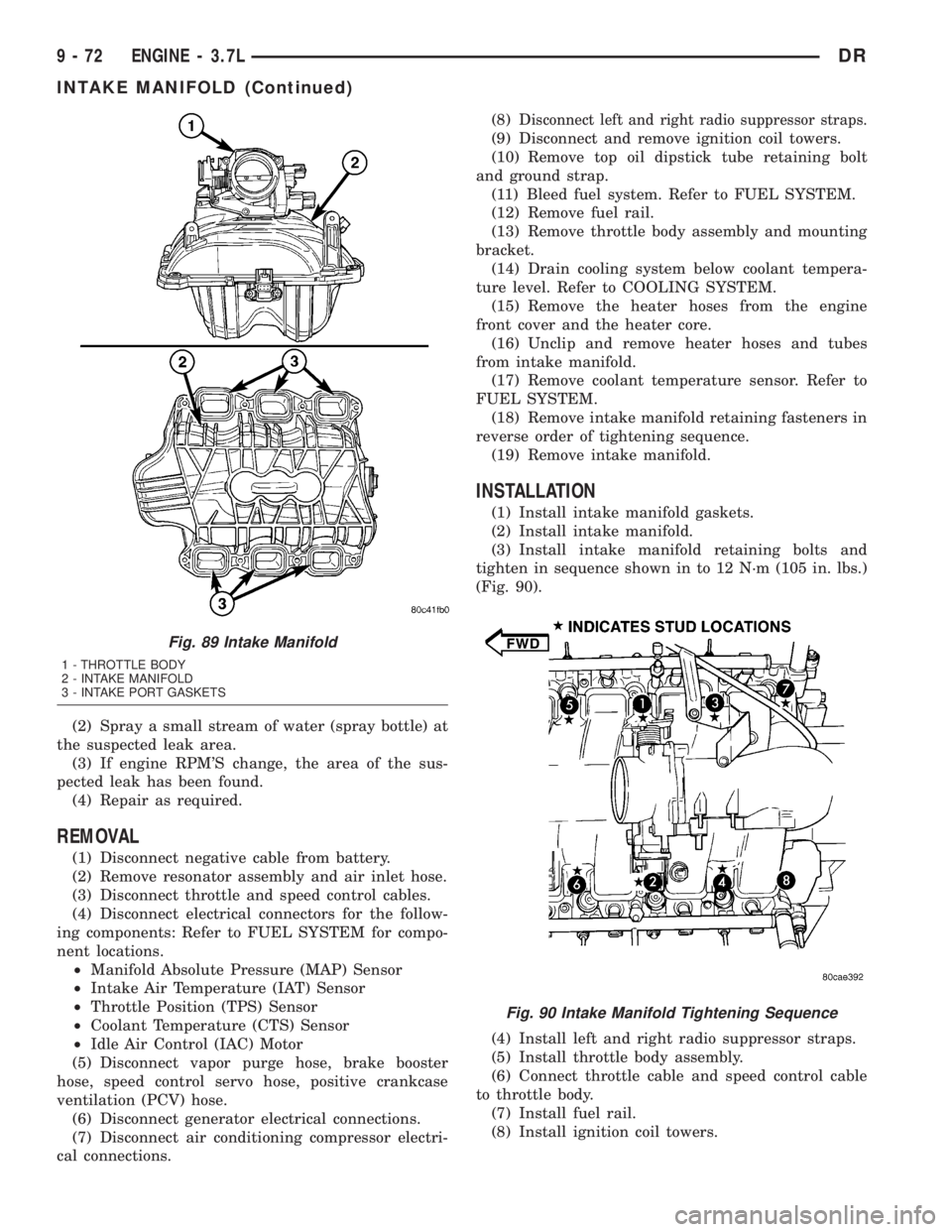
(3) Install intake manifold retaining bolts and
tighten in sequence shown in to 12 N´m (105 in. lbs.)
(Fig. 90).
(4) Install left and right radio suppressor straps.
(5) Install throttle body assembly.
(6) Connect throttle cable and speed control cable
to throttle body.
(7) Install fuel rail.
(8) Install ignition coil towers.
Fig. 89 Intake Manifold
1 - THROTTLE BODY
2 - INTAKE MANIFOLD
3 - INTAKE PORT GASKETS
Fig. 90 Intake Manifold Tightening Sequence
9 - 72 ENGINE - 3.7LDR
INTAKE MANIFOLD (Continued)
Page 1406 of 2895
INSTALLATION
(1) Position the oil pump onto the crankshaft and
install one oil pump retaining bolts.
(2) Position the primary timing chain tensioner
and install three retaining bolts.
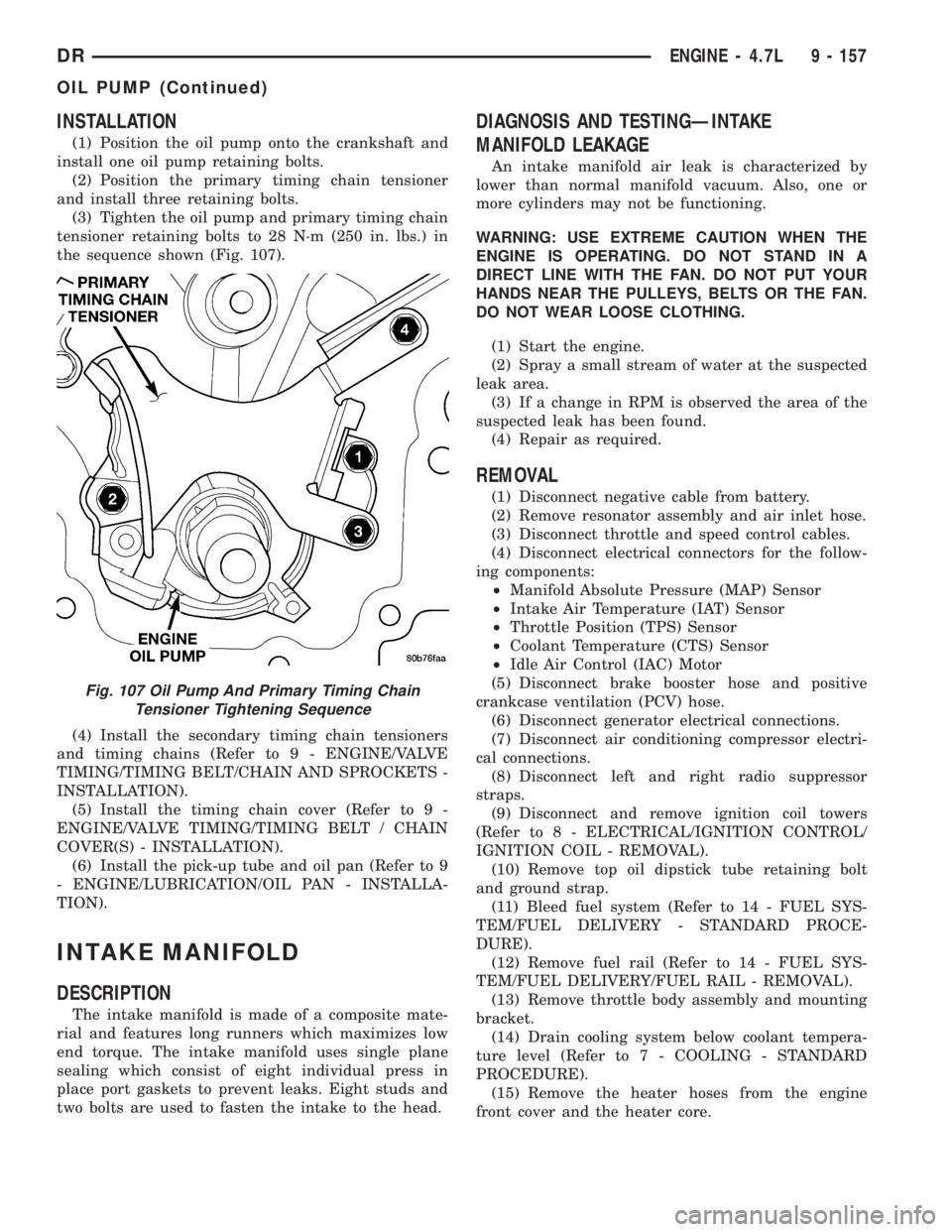
(3) Tighten the oil pump and primary timing chain
tensioner retaining bolts to 28 N´m (250 in. lbs.) in
the sequence shown (Fig. 107).
(4) Install the secondary timing chain tensioners
and timing chains (Refer to 9 - ENGINE/VALVE
TIMING/TIMING BELT/CHAIN AND SPROCKETS -
INSTALLATION).
(5) Install the timing chain cover (Refer to 9 -
ENGINE/VALVE TIMING/TIMING BELT / CHAIN
COVER(S) - INSTALLATION).
(6) Install the pick-up tube and oil pan (Refer to 9
- ENGINE/LUBRICATION/OIL PAN - INSTALLA-
TION).
INTAKE MANIFOLD
DESCRIPTION
The intake manifold is made of a composite mate-
rial and features long runners which maximizes low
end torque. The intake manifold uses single plane
sealing which consist of eight individual press in
place port gaskets to prevent leaks. Eight studs and
two bolts are used to fasten the intake to the head.
DIAGNOSIS AND TESTINGÐINTAKE
MANIFOLD LEAKAGE
An intake manifold air leak is characterized by
lower than normal manifold vacuum. Also, one or
more cylinders may not be functioning.
WARNING: USE EXTREME CAUTION WHEN THE
ENGINE IS OPERATING. DO NOT STAND IN A
DIRECT LINE WITH THE FAN. DO NOT PUT YOUR
HANDS NEAR THE PULLEYS, BELTS OR THE FAN.
DO NOT WEAR LOOSE CLOTHING.
(1) Start the engine.
(2) Spray a small stream of water at the suspected
leak area.
(3) If a change in RPM is observed the area of the
suspected leak has been found.
(4) Repair as required.
REMOVAL
(1) Disconnect negative cable from battery.
(2) Remove resonator assembly and air inlet hose.
(3) Disconnect throttle and speed control cables.
(4) Disconnect electrical connectors for the follow-
ing components:
²Manifold Absolute Pressure (MAP) Sensor
²Intake Air Temperature (IAT) Sensor
²Throttle Position (TPS) Sensor
²Coolant Temperature (CTS) Sensor
²Idle Air Control (IAC) Motor
(5) Disconnect brake booster hose and positive
crankcase ventilation (PCV) hose.
(6) Disconnect generator electrical connections.
(7) Disconnect air conditioning compressor electri-
cal connections.
(8) Disconnect left and right radio suppressor
straps.
(9) Disconnect and remove ignition coil towers
(Refer to 8 - ELECTRICAL/IGNITION CONTROL/
IGNITION COIL - REMOVAL).
(10) Remove top oil dipstick tube retaining bolt
and ground strap.
(11) Bleed fuel system (Refer to 14 - FUEL SYS-
TEM/FUEL DELIVERY - STANDARD PROCE-
DURE).
(12) Remove fuel rail (Refer to 14 - FUEL SYS-
TEM/FUEL DELIVERY/FUEL RAIL - REMOVAL).
(13) Remove throttle body assembly and mounting
bracket.
(14) Drain cooling system below coolant tempera-
ture level (Refer to 7 - COOLING - STANDARD
PROCEDURE).
(15) Remove the heater hoses from the engine
front cover and the heater core.
Fig. 107 Oil Pump And Primary Timing Chain
Tensioner Tightening Sequence
DRENGINE - 4.7L 9 - 157
OIL PUMP (Continued)
Page 1407 of 2895
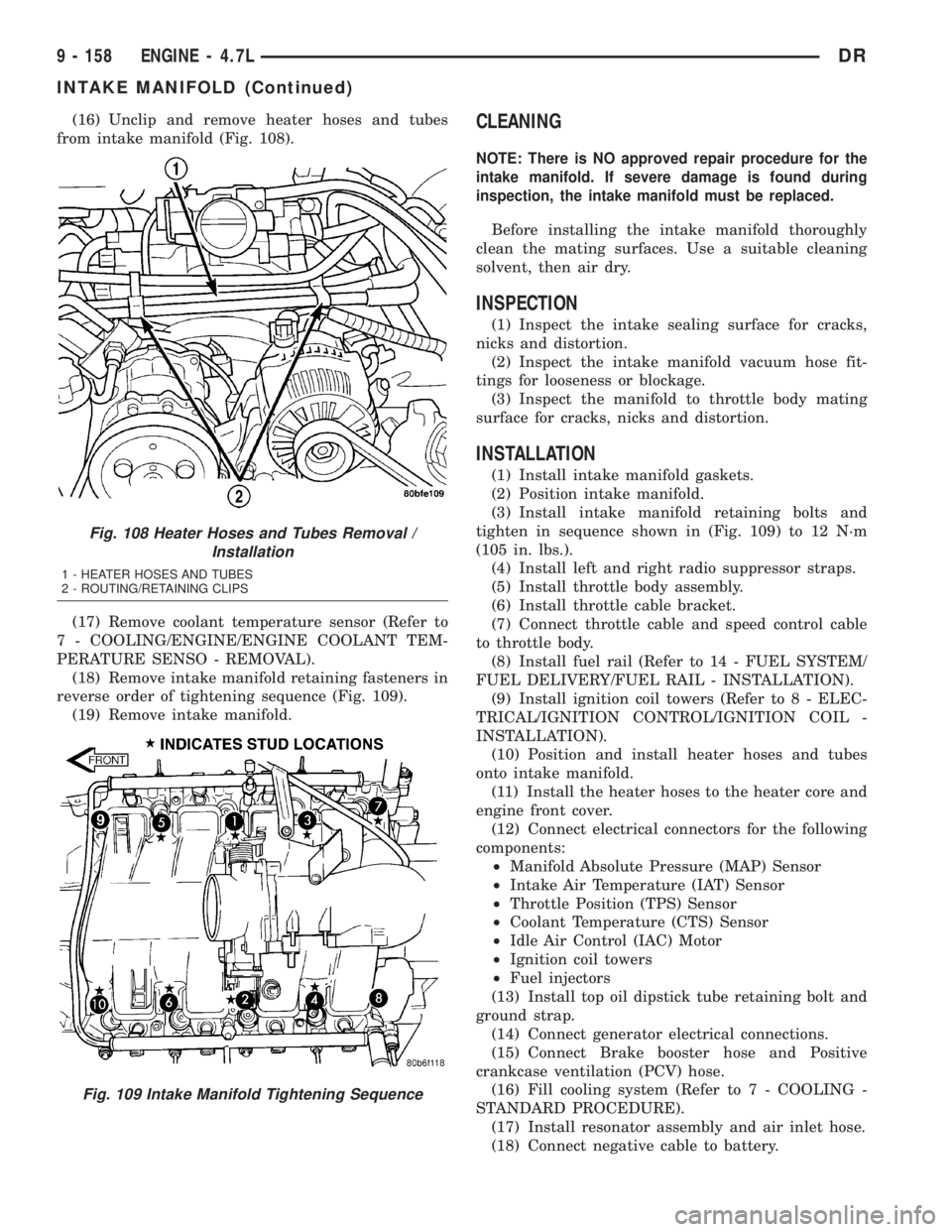
(16) Unclip and remove heater hoses and tubes
from intake manifold (Fig. 108).
(17) Remove coolant temperature sensor (Refer to
7 - COOLING/ENGINE/ENGINE COOLANT TEM-
PERATURE SENSO - REMOVAL).
(18) Remove intake manifold retaining fasteners in
reverse order of tightening sequence (Fig. 109).
(19) Remove intake manifold.CLEANING
NOTE: There is NO approved repair procedure for the
intake manifold. If severe damage is found during
inspection, the intake manifold must be replaced.
Before installing the intake manifold thoroughly
clean the mating surfaces. Use a suitable cleaning
solvent, then air dry.
INSPECTION
(1) Inspect the intake sealing surface for cracks,
nicks and distortion.
(2) Inspect the intake manifold vacuum hose fit-
tings for looseness or blockage.
(3) Inspect the manifold to throttle body mating
surface for cracks, nicks and distortion.
INSTALLATION
(1) Install intake manifold gaskets.
(2) Position intake manifold.
(3) Install intake manifold retaining bolts and
tighten in sequence shown in (Fig. 109) to 12 N´m
(105 in. lbs.).
(4) Install left and right radio suppressor straps.
(5) Install throttle body assembly.
(6) Install throttle cable bracket.
(7) Connect throttle cable and speed control cable
to throttle body.
(8) Install fuel rail (Refer to 14 - FUEL SYSTEM/
FUEL DELIVERY/FUEL RAIL - INSTALLATION).
(9) Install ignition coil towers (Refer to 8 - ELEC-
TRICAL/IGNITION CONTROL/IGNITION COIL -
INSTALLATION).
(10) Position and install heater hoses and tubes
onto intake manifold.
(11) Install the heater hoses to the heater core and
engine front cover.
(12) Connect electrical connectors for the following
components:
²Manifold Absolute Pressure (MAP) Sensor
²Intake Air Temperature (IAT) Sensor
²Throttle Position (TPS) Sensor
²Coolant Temperature (CTS) Sensor
²Idle Air Control (IAC) Motor
²Ignition coil towers
²Fuel injectors
(13) Install top oil dipstick tube retaining bolt and
ground strap.
(14) Connect generator electrical connections.
(15) Connect Brake booster hose and Positive
crankcase ventilation (PCV) hose.
(16) Fill cooling system (Refer to 7 - COOLING -
STANDARD PROCEDURE).
(17) Install resonator assembly and air inlet hose.
(18) Connect negative cable to battery.
Fig. 108 Heater Hoses and Tubes Removal /
Installation
1 - HEATER HOSES AND TUBES
2 - ROUTING/RETAINING CLIPS
Fig. 109 Intake Manifold Tightening Sequence
9 - 158 ENGINE - 4.7LDR
INTAKE MANIFOLD (Continued)