lock DODGE RAM SRT-10 2006 Service Repair Manual
[x] Cancel search | Manufacturer: DODGE, Model Year: 2006, Model line: RAM SRT-10, Model: DODGE RAM SRT-10 2006Pages: 5267, PDF Size: 68.7 MB
Page 1663 of 5267
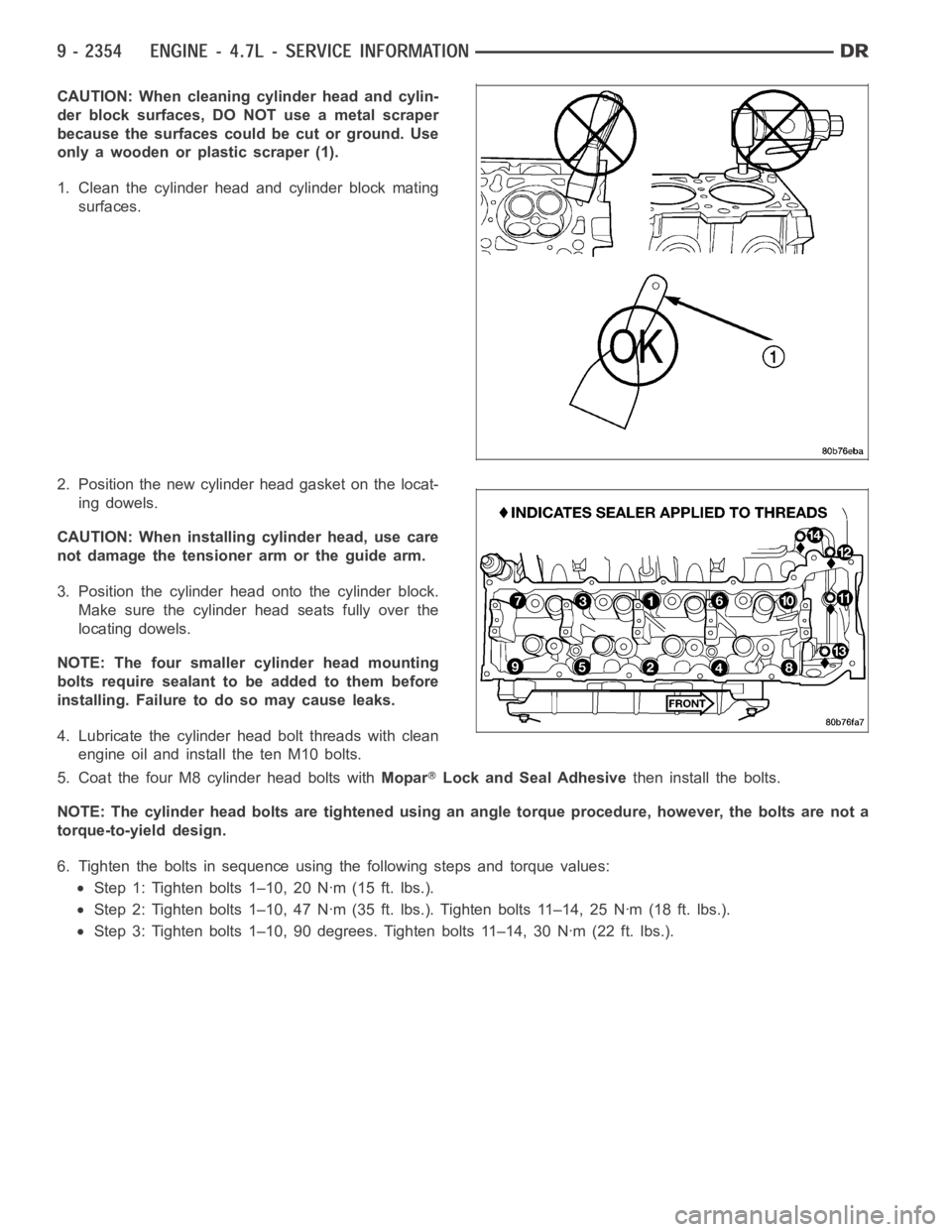
CAUTION: When cleaning cylinder head and cylin-
der block surfaces, DO NOT use a metal scraper
because the surfaces could be cut or ground. Use
only a wooden or plastic scraper (1).
1. Clean the cylinder head and cylinder block mating
surfaces.
2. Position the new cylinder head gasket on the locat-
ing dowels.
CAUTION: When installing cylinder head, use care
not damage the tensioner arm or the guide arm.
3. Position the cylinder head onto the cylinder block.
Make sure the cylinder head seats fully over the
locating dowels.
NOTE: The four smaller cylinder head mounting
bolts require sealant to be added to them before
installing. Failure to do so may cause leaks.
4. Lubricate the cylinder head bolt threads with clean
engine oil and install the ten M10 bolts.
5. Coat the four M8 cylinder head bolts withMopar
Lock and Seal Adhesivethen install the bolts.
NOTE: The cylinder head bolts are tightened using an angle torque procedure, however, the bolts are not a
torque-to-yield design.
6. Tighten the bolts in sequence using the following steps and torque values:
Step 1: Tighten bolts 1–10, 20 Nꞏm (15 ft. lbs.).
Step 2: Tighten bolts 1–10, 47 Nꞏm (35 ft. lbs.). Tighten bolts 11–14, 25 Nꞏm(18 ft. lbs.).
Step 3: Tighten bolts 1–10, 90 degrees. Tighten bolts 11–14, 30 Nꞏm (22 ft. lbs.).
Page 1665 of 5267
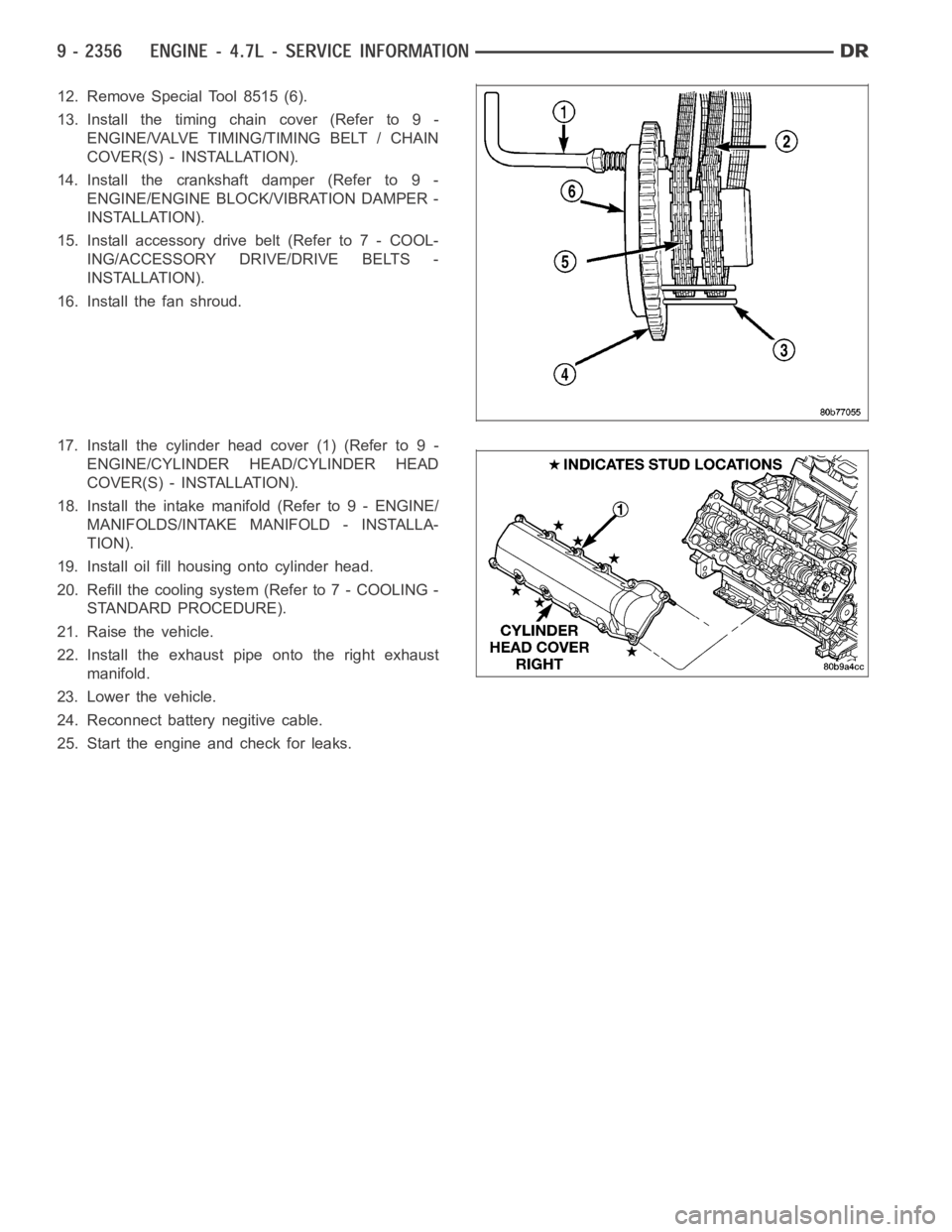
12. Remove Special Tool 8515 (6).
13. Install the timing chain cover (Refer to 9 -
ENGINE/VALVE TIMING/TIMING BELT / CHAIN
COVER(S) - INSTALLATION).
14. Install the crankshaft damper (Refer to 9 -
ENGINE/ENGINE BLOCK/VIBRATION DAMPER -
INSTALLATION).
15. Install accessory drive belt (Refer to 7 - COOL-
ING/ACCESSORY DRIVE/DRIVE BELTS -
INSTALLATION).
16. Install the fan shroud.
17. Install the cylinder head cover (1) (Refer to 9 -
ENGINE/CYLINDER HEAD/CYLINDER HEAD
COVER(S) - INSTALLATION).
18. Install the intake manifold (Refer to 9 - ENGINE/
MANIFOLDS/INTAKE MANIFOLD - INSTALLA-
TION).
19. Install oil fill housing onto cylinder head.
20. Refill the cooling system (Refer to 7 - COOLING -
STANDARD PROCEDURE).
21. Raise the vehicle.
22. Install the exhaust pipe onto the right exhaust
manifold.
23. Lower the vehicle.
24. Reconnect battery negitive cable.
25. Start the engine and check for leaks.
Page 1666 of 5267
CAMSHAFT - LEFT
DESCRIPTION
The camshafts consist of powdered metal steel lobes which are sinter-bonded to a steel tube. A steel post or nose
piece is friction-welded to the steel camshaft tube. Five bearing journals are machined into the camshaft, four on the
steel tube and one on the steel nose piece. Camshaft end play is controlled by two thrust walls that border the nose
piece journal. Engine oil enters the hollow camshafts at the third journaland lubricates every intake lobe rocker
throughadrilledpassageintheintakelobe.
REMOVAL
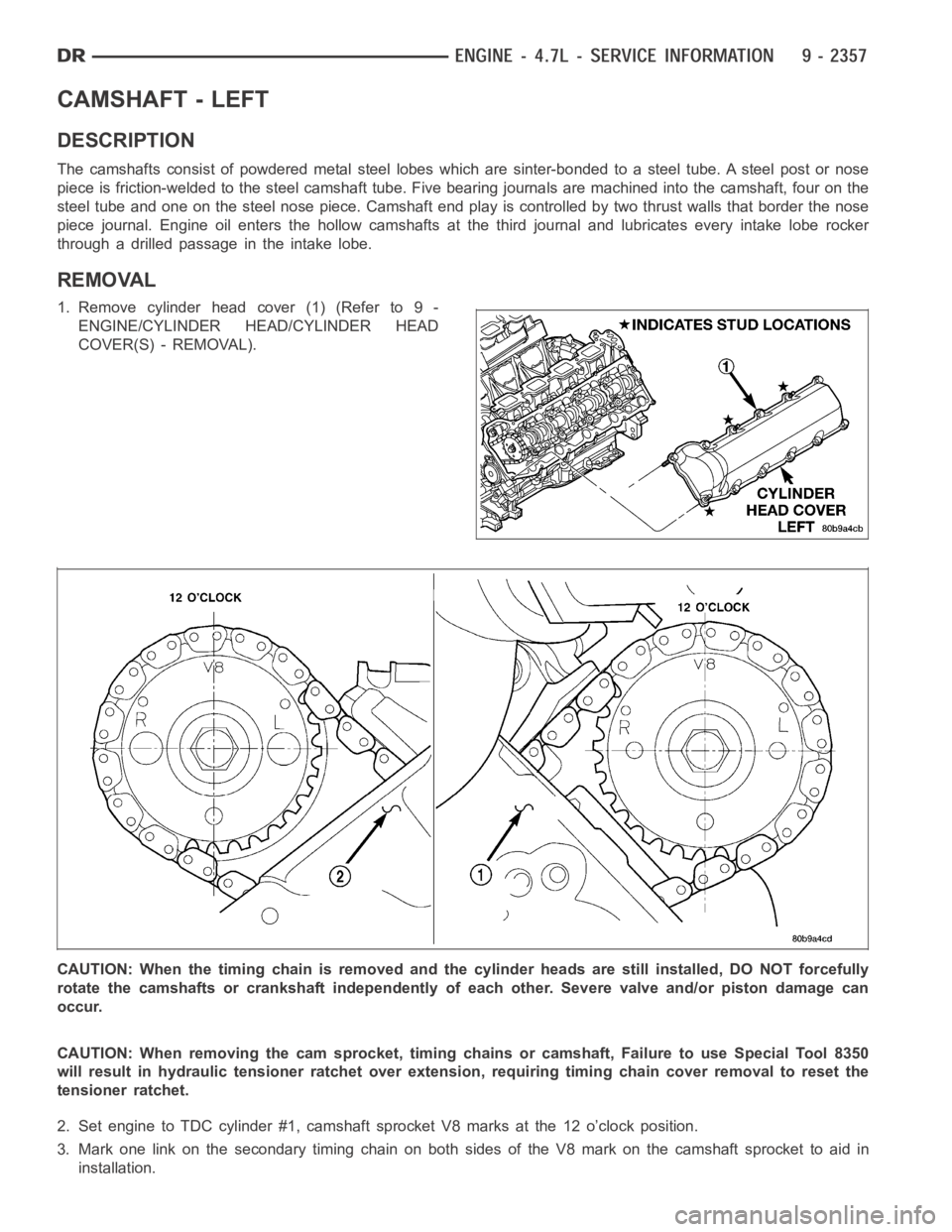
1. Remove cylinder head cover (1) (Refer to 9 -
ENGINE/CYLINDER HEAD/CYLINDER HEAD
COVER(S) - REMOVAL).
CAUTION: When the timing chain is removed and the cylinder heads are still installed, DO NOT forcefully
rotate the camshafts or crankshaft independently of each other. Severe valve and/or piston damage can
occur.
CAUTION: When removing the cam sprocket, timing chains or camshaft, Failure to use Special Tool 8350
will result in hydraulic tensioner ratchet over extension, requiring timing chain cover removal to reset the
tensioner ratchet.
2. Set engine to TDC cylinder #1, camshaft sprocket V8 marks at the 12 o’clock position.
3. Mark one link on the secondary timing chain on both sides of the V8 mark on the camshaft sprocket to aid in
installation.
Page 1667 of 5267
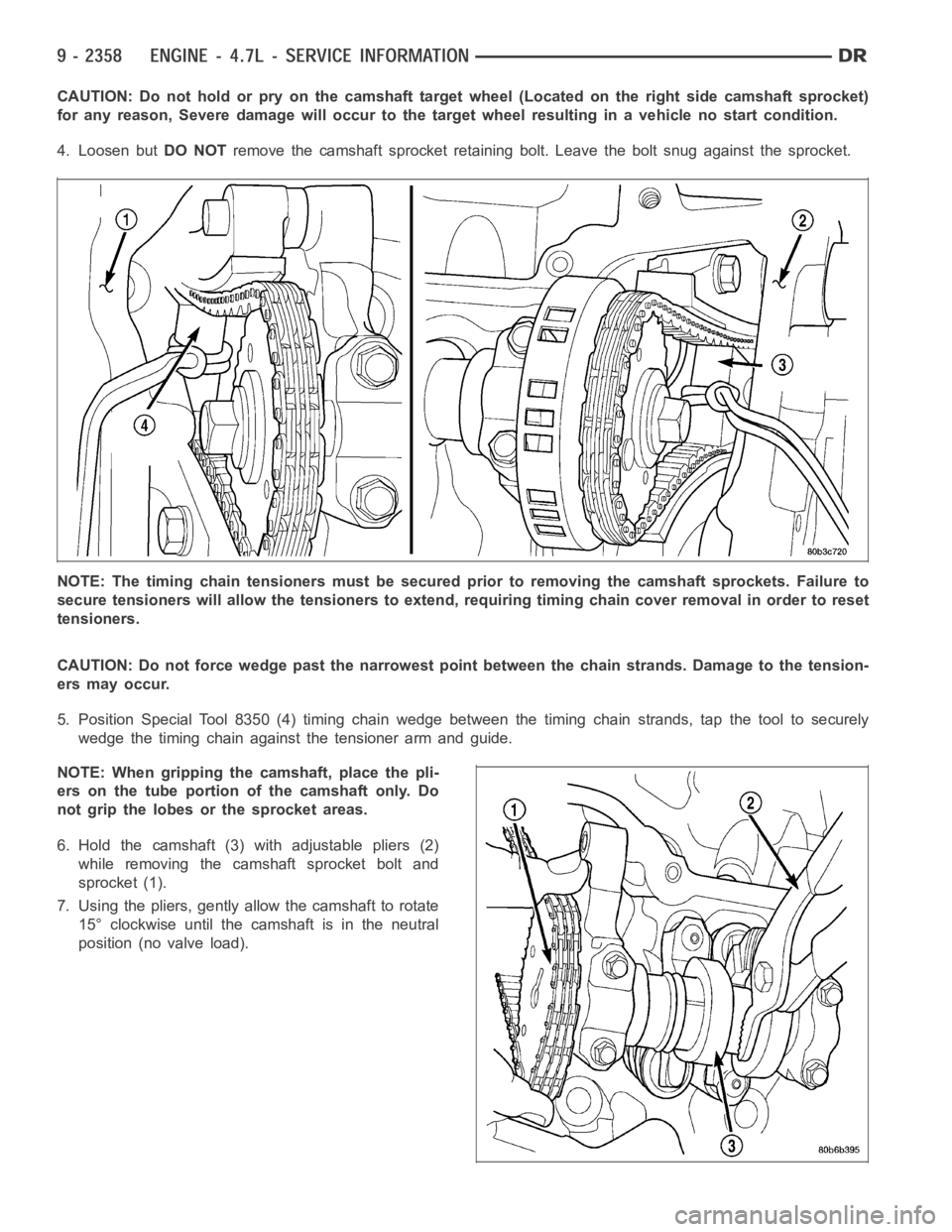
CAUTION: Do not hold or pry on the camshaft target wheel (Located on the right side camshaft sprocket)
for any reason, Severe damage will occur to the target wheel resulting in a vehicle no start condition.
4. Loosen butDO NOTremove the camshaft sprocket retaining bolt. Leave the bolt snug against the sprocket.
NOTE: The timing chain tensioners must be secured prior to removing the camshaft sprockets. Failure to
secure tensioners will allow the tensioners to extend, requiring timing chain cover removal in order to reset
tensioners.
CAUTION: Do not force wedge past the narrowest point between the chain strands. Damage to the tension-
ers may occur.
5. Position Special Tool 8350 (4) timing chain wedge between the timing chain strands, tap the tool to securely
wedge the timing chain against the tensioner arm and guide.
NOTE: When gripping the camshaft, place the pli-
ers on the tube portion of the camshaft only. Do
not grip the lobes or the sprocket areas.
6. Hold the camshaft (3) with adjustable pliers (2)
while removing the camshaft sprocket bolt and
sprocket (1).
7. Using the pliers, gently allow the camshaft to rotate
15° clockwise until the camshaft is in the neutral
position (no valve load).
Page 1668 of 5267
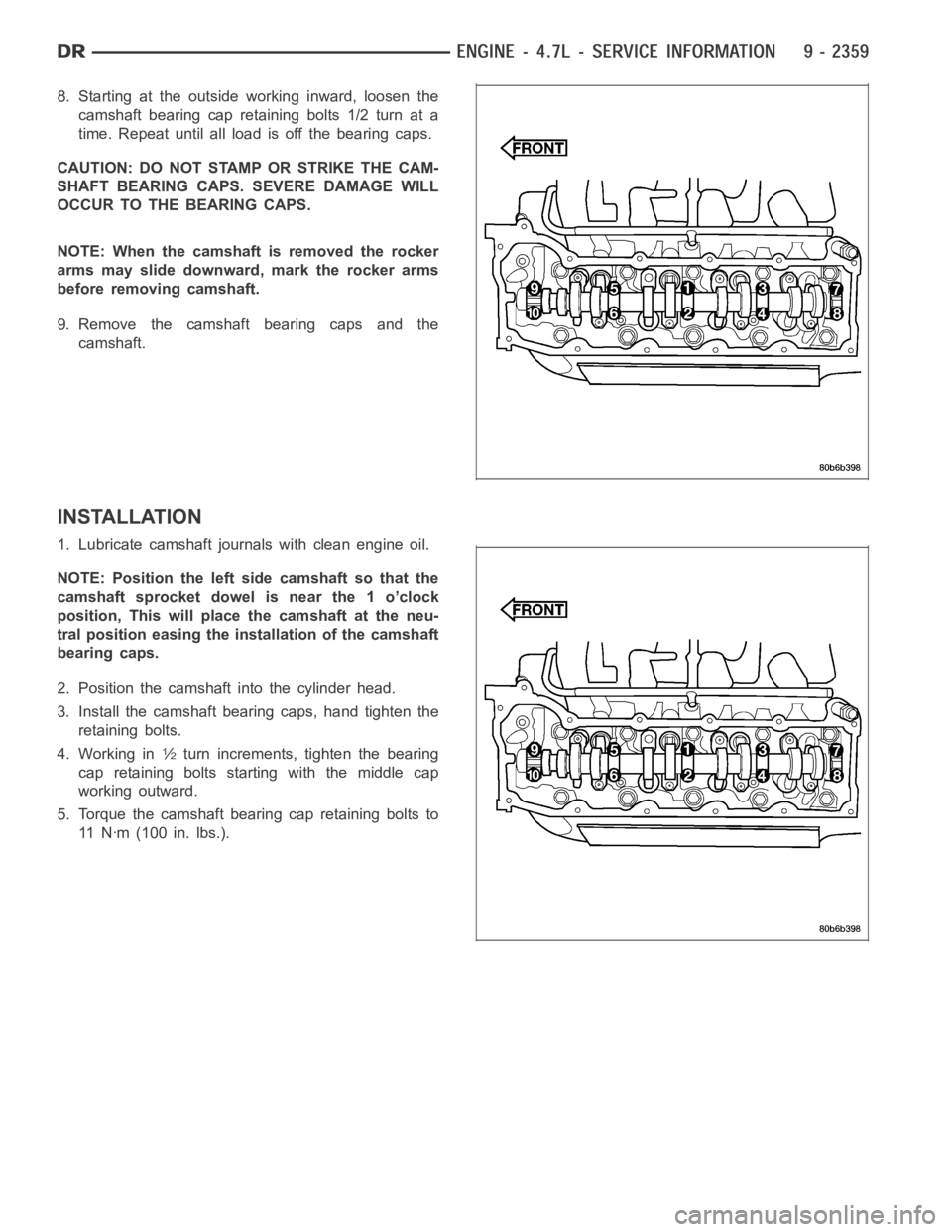
8. Starting at the outside working inward, loosen the
camshaft bearing cap retaining bolts 1/2 turn at a
time. Repeat until all load is off the bearing caps.
CAUTION: DO NOT STAMP OR STRIKE THE CAM-
SHAFT BEARING CAPS. SEVERE DAMAGE WILL
OCCUR TO THE BEARING CAPS.
NOTE: When the camshaft is removed the rocker
arms may slide downward, mark the rocker arms
before removing camshaft.
9. Remove the camshaft bearing caps and the
camshaft.
INSTALLATION
1. Lubricate camshaft journals with clean engine oil.
NOTE: Position the left side camshaft so that the
camshaft sprocket dowel is near the 1 o’clock
position, This will place the camshaft at the neu-
tral position easing the installation of the camshaft
bearing caps.
2. Position the camshaft into the cylinder head.
3. Install the camshaft bearing caps, hand tighten the
retaining bolts.
4. Working in
1⁄2turn increments, tighten the bearing
cap retaining bolts starting with the middle cap
working outward.
5. Torque the camshaft bearing cap retaining bolts to
11 N ꞏm ( 1 0 0 i n . l b s . ) .
Page 1671 of 5267
CAMSHAFT - RIGHT
DESCRIPTION
The camshafts consist of powdered metal steel lobes which are sinter-bonded to a steel tube. A steel post or nose
piece is friction-welded to the steel camshaft tube. Five bearing journals are machined into the camshaft, four on the
steel tube and one on the steel nose piece. Camshaft end play is controlled by two thrust walls that border the nose
piece journal. Engine oil enters the hollow camshafts at the third journaland lubricates every intake lobe rocker
throughadrilledpassageintheintakelobe.
REMOVAL
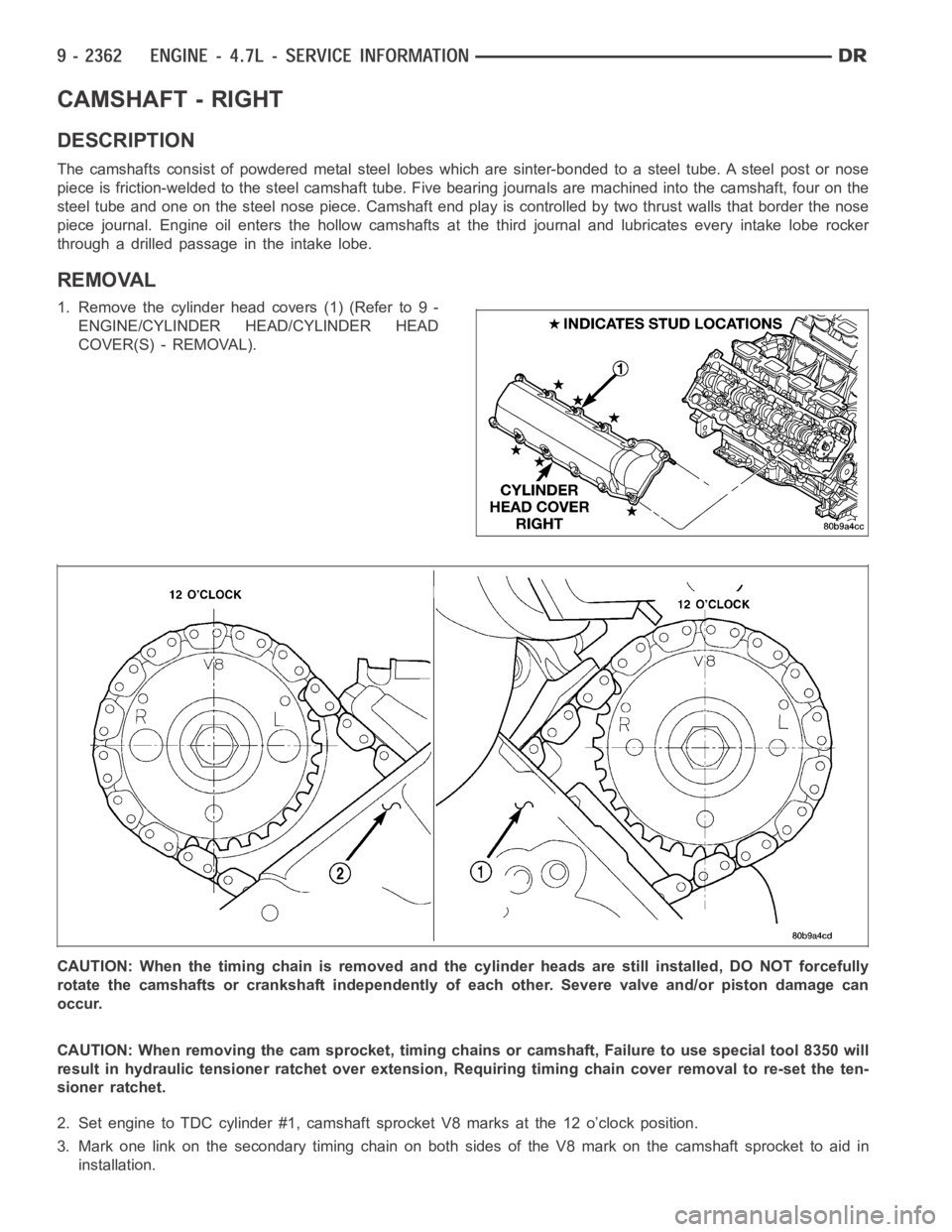
1. Remove the cylinder head covers (1) (Refer to 9 -
ENGINE/CYLINDER HEAD/CYLINDER HEAD
COVER(S) - REMOVAL).
CAUTION: When the timing chain is removed and the cylinder heads are still installed, DO NOT forcefully
rotate the camshafts or crankshaft independently of each other. Severe valve and/or piston damage can
occur.
CAUTION: When removing the cam sprocket, timing chains or camshaft, Failure to use special tool 8350 will
result in hydraulic tensioner ratchet over extension, Requiring timing chain cover removal to re-set the ten-
sioner ratchet.
2. Set engine to TDC cylinder #1, camshaft sprocket V8 marks at the 12 o’clock position.
3. Mark one link on the secondary timing chain on both sides of the V8 mark on the camshaft sprocket to aid in
installation.
Page 1673 of 5267
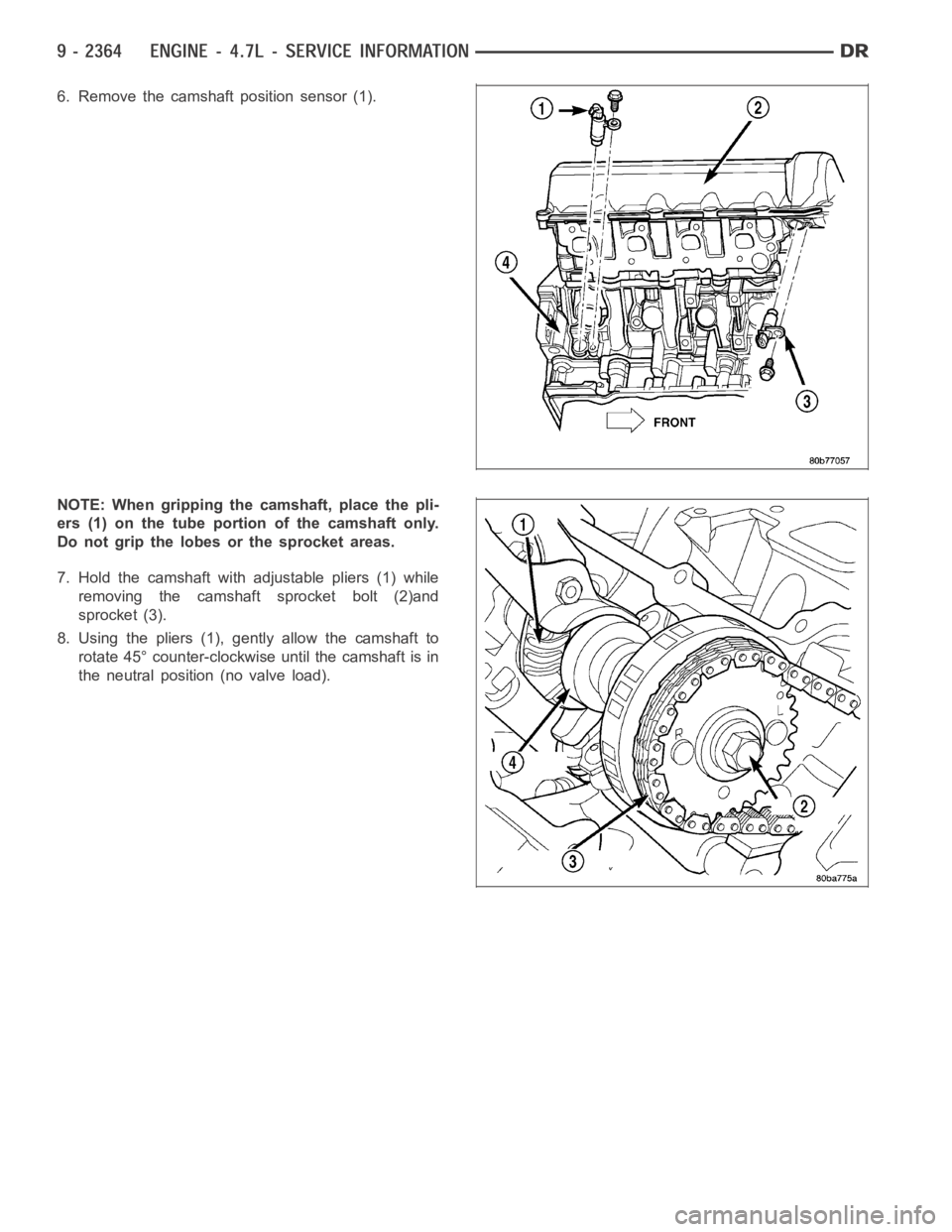
6. Remove the camshaft position sensor (1).
NOTE: When gripping the camshaft, place the pli-
ers (1) on the tube portion of the camshaft only.
Do not grip the lobes or the sprocket areas.
7. Hold the camshaft with adjustable pliers (1) while
removing the camshaft sprocket bolt (2)and
sprocket (3).
8. Using the pliers (1), gently allow the camshaft to
rotate 45° counter-clockwise until the camshaft is in
the neutral position (no valve load).
Page 1674 of 5267
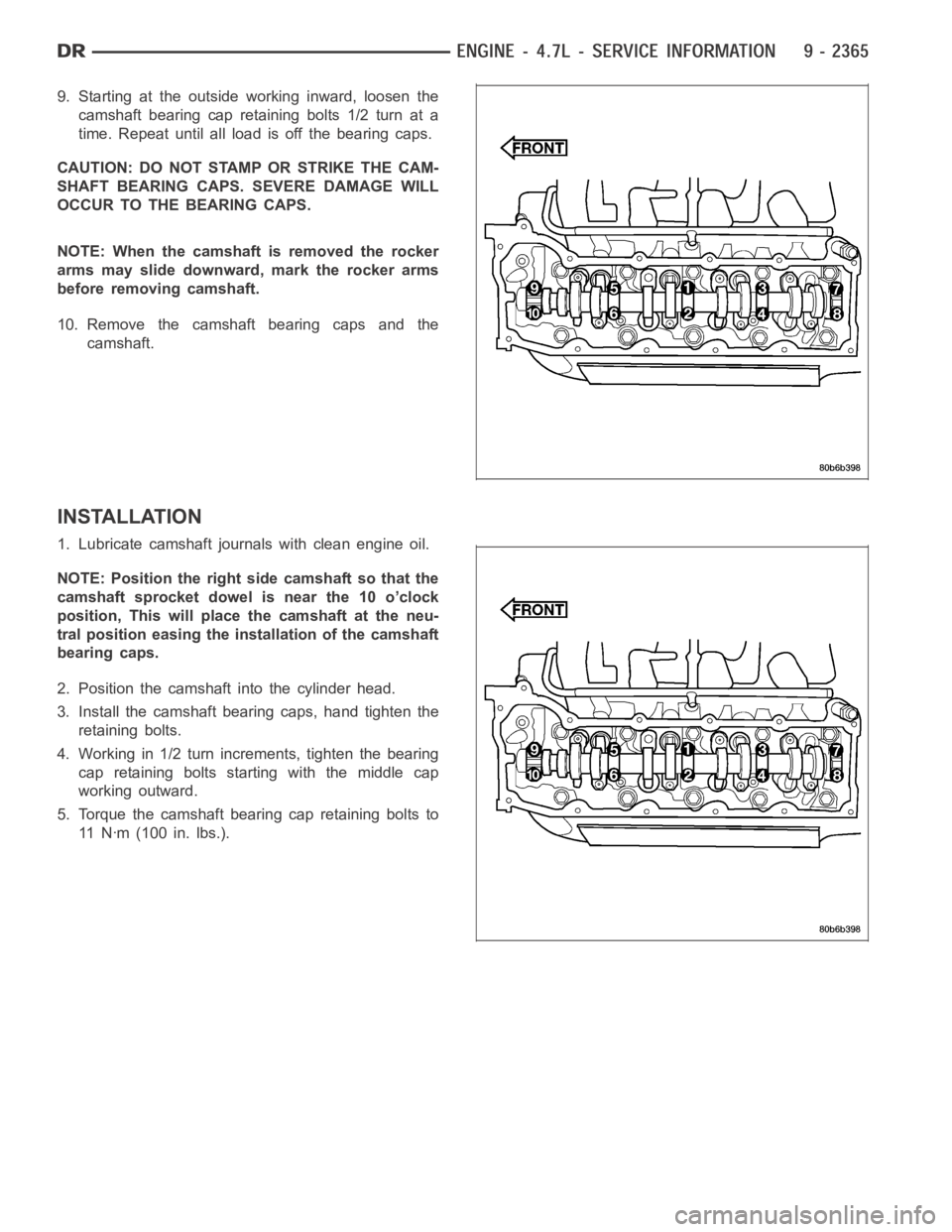
9. Starting at the outside working inward, loosen the
camshaft bearing cap retaining bolts 1/2 turn at a
time. Repeat until all load is off the bearing caps.
CAUTION: DO NOT STAMP OR STRIKE THE CAM-
SHAFT BEARING CAPS. SEVERE DAMAGE WILL
OCCUR TO THE BEARING CAPS.
NOTE: When the camshaft is removed the rocker
arms may slide downward, mark the rocker arms
before removing camshaft.
10. Remove the camshaft bearing caps and the
camshaft.
INSTALLATION
1. Lubricate camshaft journals with clean engine oil.
NOTE: Position the right side camshaft so that the
camshaft sprocket dowel is near the 10 o’clock
position, This will place the camshaft at the neu-
tral position easing the installation of the camshaft
bearing caps.
2. Position the camshaft into the cylinder head.
3. Install the camshaft bearing caps, hand tighten the
retaining bolts.
4. Working in 1/2 turn increments, tighten the bearing
cap retaining bolts starting with the middle cap
working outward.
5. Torque the camshaft bearing cap retaining bolts to
11 N ꞏm ( 1 0 0 i n . l b s . ) .
Page 1680 of 5267
VALVES & SEATS - INTAKE/EXHAUST
DESCRIPTION
The valves are made of heat resistant steel and have chrome plated stems to prevent scuffing. Each valve is actu-
ated by a roller rocker arm which pivots on a stationary lash adjuster. All valves use three bead lock keepers to
retain the springs and promote valve rotation.
REMOVAL
NOTE: The cylinder heads must be removed in
order to perform this procedure.
1. Remove rocker arms and lash adjusters (Refer to 9
- ENGINE/CYLINDER HEAD/ROCKER ARM /
ADJUSTER ASSY - REMOVAL).
2. Remove the camshaft bearing caps and the cam-
shaft.
NOTE: All valve springs and valves are removed in
the same manner; this procedure only covers one
valve and valve spring.
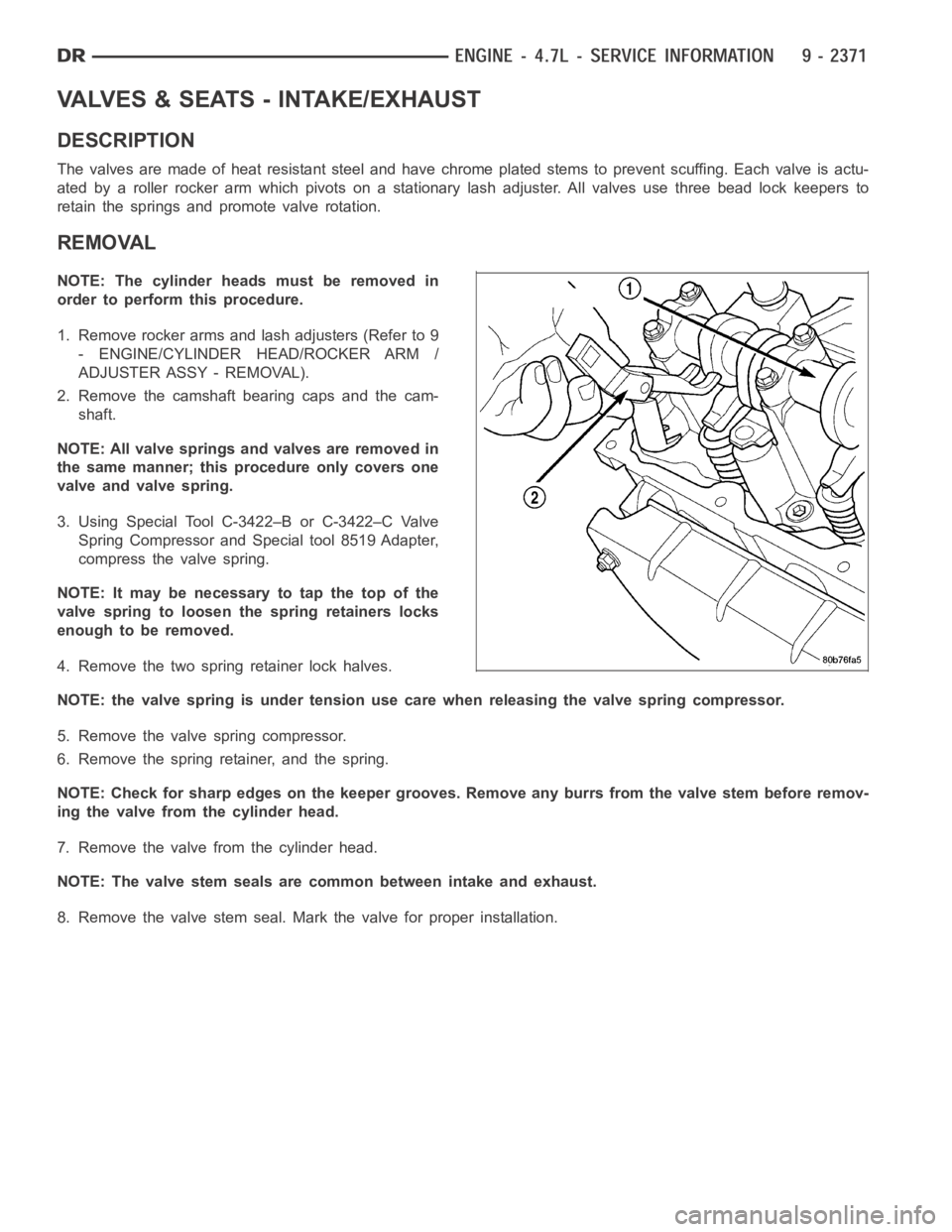
3. Using Special Tool C-3422–B or C-3422–C Valve
Spring Compressor and Special tool 8519 Adapter,
compress the valve spring.
NOTE: It may be necessary to tap the top of the
valve spring to loosen the spring retainers locks
enough to be removed.
4. Remove the two spring retainer lock halves.
NOTE: the valve spring is under tension use care when releasing the valve spring compressor.
5. Remove the valve spring compressor.
6. Remove the spring retainer, and the spring.
NOTE: Check for sharp edges on the keeper grooves. Remove any burrs from thevalvestembeforeremov-
ing the valve from the cylinder head.
7. Remove the valve from the cylinder head.
NOTE: The valve stem seals are common between intake and exhaust.
8. Remove the valve stem seal. Mark the valve for proper installation.
Page 1681 of 5267
TESTING VALVE SPRINGS
NOTE: Whenever the valves are removed from the
cylinder head it is recommended that the valve
springs be inspected and tested for reuse.
Inspect the valve springs for physical signs of wear or
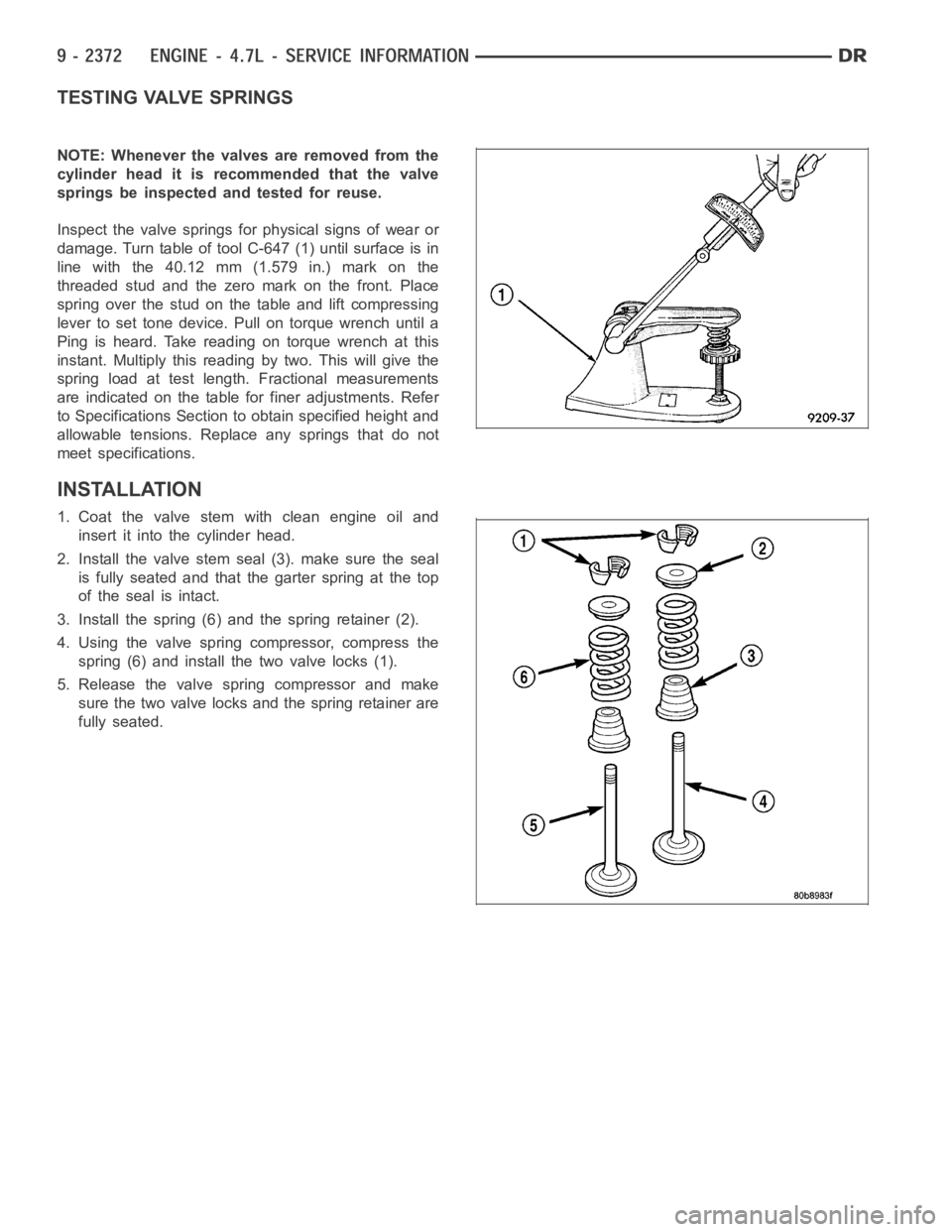
damage. Turn table of tool C-647 (1) until surface is in
line with the 40.12 mm (1.579 in.) mark on the
threaded stud and the zero mark on the front. Place
spring over the stud on the table and lift compressing
lever to set tone device. Pull on torque wrench until a
Ping is heard. Take reading on torque wrench at this
instant. Multiply this reading by two. This will give the
spring load at test length. Fractional measurements
are indicated on the table for finer adjustments. Refer
to Specifications Section to obtain specified height and
allowable tensions. Replace any springs that do not
meet specifications.
INSTALLATION
1. Coat the valve stem with clean engine oil and
insert it into the cylinder head.
2. Install the valve stem seal (3). make sure the seal
is fully seated and that the garter spring at the top
of the seal is intact.
3. Install the spring (6) and the spring retainer (2).
4. Using the valve spring compressor, compress the
spring (6) and install the two valve locks (1).
5. Release the valve spring compressor and make
sure the two valve locks and the spring retainer are
fully seated.