fuse DODGE RAM SRT-10 2006 Service User Guide
[x] Cancel search | Manufacturer: DODGE, Model Year: 2006, Model line: RAM SRT-10, Model: DODGE RAM SRT-10 2006Pages: 5267, PDF Size: 68.7 MB
Page 158 of 5267
P1696-EEPROM MEMORY WRITE DENIED/INVALID
For a complete wiring diagramRefer to Section 8W.
When Monitored:
Continuously with the ignition on.
Set Condition:
An attempt to program/write to the internal EEPROM failed, Also checks at power down. One Trip Fault. Three
good trips to turn off the MIL.
Possible Causes
PCM
Always perform the Pre-Diagnostic Troubleshooting procedure before proceeding. (Refer to 9 - ENGINE -
DIAGNOSIS AND TESTING).
Diagnostic Test
1.SCAN TOOL DISPLAYS A WRITE FAILURE
With a scan tool, perform the SRI Memory Test.
Does scan tool display Write Failure?
Ye s>>
Replace and program the Powertrain Control Module per Service Information.
Perform the POWERTRAIN VERIFICATION TEST. (Refer to 9 - ENGINE - STANDARD PROCEDURE)
No>>
Go To 2
2.SCAN TOOL DISPLAYS A WRITE REFUSED
With the a scan tool, perform the SRI Memory Test.
Does the scan tool display Write Refused?
Ye s>>
Go To 3
No>>
Go To 4
3.PCM REFUSED 2ND TEST
With a scan tool, perform the SRI Memory Test a third time.
NOTE: Retest the SRI Memory two more times.
Does the scan tool display Write Refused again?
Ye s>>
Replace and program the Powertrain Control Module per Service Information.
Perform the POWERTRAIN VERIFICATION TEST. (Refer to 9 - ENGINE - STANDARD PROCEDURE)
No>>
Te s t C o m p l e t e .
4.SCAN TOOL DISPLAYS SRI MILEAGE INVALID
With a scan tool, perform the SRI Memory Test.
Does the scan tool display SRI Mileage Invalid?
Ye s>>
Update the mileage and retest the SRI Memory.
Perform the POWERTRAIN VERIFICATION TEST. (Refer to 9 - ENGINE - STANDARD PROCEDURE)
No>>
Go To 5
Page 160 of 5267
P1697-EMR (SRI) MILEAGE NOT STORED
For a complete wiring diagramRefer to Section 8W.
When Monitored:
Continuously with the ignition on.
Set Condition:
An attempt to program/write to the internal EEPROM failed, Also checks at powerdown. One Trip Fault. Three
good trips to turn off the MIL.
Possible Causes
PCM
Always perform the Pre-Diagnostic Troubleshooting procedure before proceeding. (Refer to 9 - ENGINE -
DIAGNOSIS AND TESTING).
Diagnostic Test
1.SCAN TOOL DISPLAYS A WRITE FAILURE
With a scan tool, perform the SRI Memory Test.
Does scan tool display Write Failure?
Ye s>>
Replace and program the Powertrain Control Module per Service Information.
Perform the POWERTRAIN VERIFICATION TEST. (Refer to 9 - ENGINE - STANDARD PROCEDURE)
No>>
Go To 2
2.SCAN TOOL DISPLAYS A WRITE REFUSED
With the a scan tool, perform the SRI Memory Test.
Does the scan tool display Write Refused?
Ye s>>
Go To 3
No>>
Go To 4
3.PCM REFUSED 2ND TEST
With a scan tool, perform the SRI Memory Test a third time.
NOTE: Retest the SRI Memory two more times.
Does the scan tool display Write Refused again?
Ye s>>
Replace and program the Powertrain Control Module per Service Information.
Perform the POWERTRAIN VERIFICATION TEST. (Refer to 9 - ENGINE - STANDARD PROCEDURE)
No>>
Te s t C o m p l e t e .
4.SCAN TOOL DISPLAYS SRI MILEAGE INVALID
With a scan tool, perform the SRI Memory Test.
Does the scan tool display SRI Mileage Invalid?
Ye s>>
Update the mileage and retest the SRI Memory.
Perform the POWERTRAIN VERIFICATION TEST. (Refer to 9 - ENGINE - STANDARD PROCEDURE)
No>>
Go To 5
Page 351 of 5267
When Monitored:
The engine running. The engine speed greater than 1157 RPM.
Set Condition:
The battery sensed voltage is 1 volt below the charging goal for 13.47 seconds. The PCM senses the battery
voltage turns off the field driver and senses the battery voltage again. Ifthe voltages are the same, the code
is set. One Trip Fault. Three good trips to turn off the MIL.
Possible Causes
EXCESSIVE RESISTANCE IN THE BATTERY POSITIVE CIRCUIT
EXCESSIVE RESISTANCE IN THE CASE GROUND
(K20) GEN FIELD CONTROL CIRCUIT SHORTED TO VOLTAGE
(K20) GEN FIELD CONTROL CIRCUIT OPEN
(K20) GEN FIELD CONTROL CIRCUIT SHORTED TO GROUND
(Z20) GEN GROUND CIRCUIT OPEN
GENERATOR
PCM
Always perform the Pre-Diagnostic Troubleshooting procedure before proceeding. (Refer to 9 - ENGINE -
DIAGNOSIS AND TESTING).
Diagnostic Test
1.ACTIVE DTC
NOTE: Inspect the vehicle for aftermarket accessories that may exceed theGenerator System output.
Ignition on, engine not running.
NOTE: The battery must be fully charged.
NOTE: The Generator belt tension and condition must be checked before continuing.
With a scan tool, read DTCs.
With a scan tool, erase DTCs.
Start the engine.
Allow the idle to stabilize.
Ignition on, engine not running.
With the scan tool, read DTCs.
Is the DTC active at this time?
Ye s>>
Go To 2
No>>
Refer to the INTERMITTENT CONDITION Diagnostic Procedure.
Perform the POWERTRAIN VERIFICATION TEST. (Refer to 9 - ENGINE - STANDARD PROCEDURE)
2.FUSED B+ CIRCUIT HIGH RESISTANCE
WARNING: When the engine is operating, do not stand in direct line with the fan. Do not put your hands
near the pulleys, belts, or fan. Do notwear loose clothing. Failure to follow these instructions can result in
personal injury or death.
Ignition on, engine not running.
Measure the voltage between the Generator B+ Output Terminal and the Battery+ Post.
Start the engine.
Is the voltage above 0.4 of a volt?
Ye s>>
Repair the excessive resistance in the battery positive circuit between the Generator and Battery.
Perform the POWERTRAIN VERIFICATION TEST. (Refer to 9 - ENGINE - STANDARD PROCEDURE)
No>>
Go To 3
Page 355 of 5267
P2610-PCM INTERNAL SHUTDOWN TIMER FAST RATIONALITY
For a complete wiring diagramRefer to Section 8W.
When Monitored:
Ignition on and battery voltage greater than 10 volts.
Set Condition:
Internal PCM failure detected. One Trip Fault. Three good trips to turn offthe MIL.
Possible Causes
PCM FUSED IGNITION SWITCH CIRCUIT
PCM INTERNAL
Always perform the Pre-Diagnostic Troubleshooting procedure before proceeding. (Refer to 9 - ENGINE -
DIAGNOSIS AND TESTING).
Diagnostic Test
1.PCM IGNITION CIRCUITS
Turn the ignition off.
Disconnect the C1 PCM harness connector.
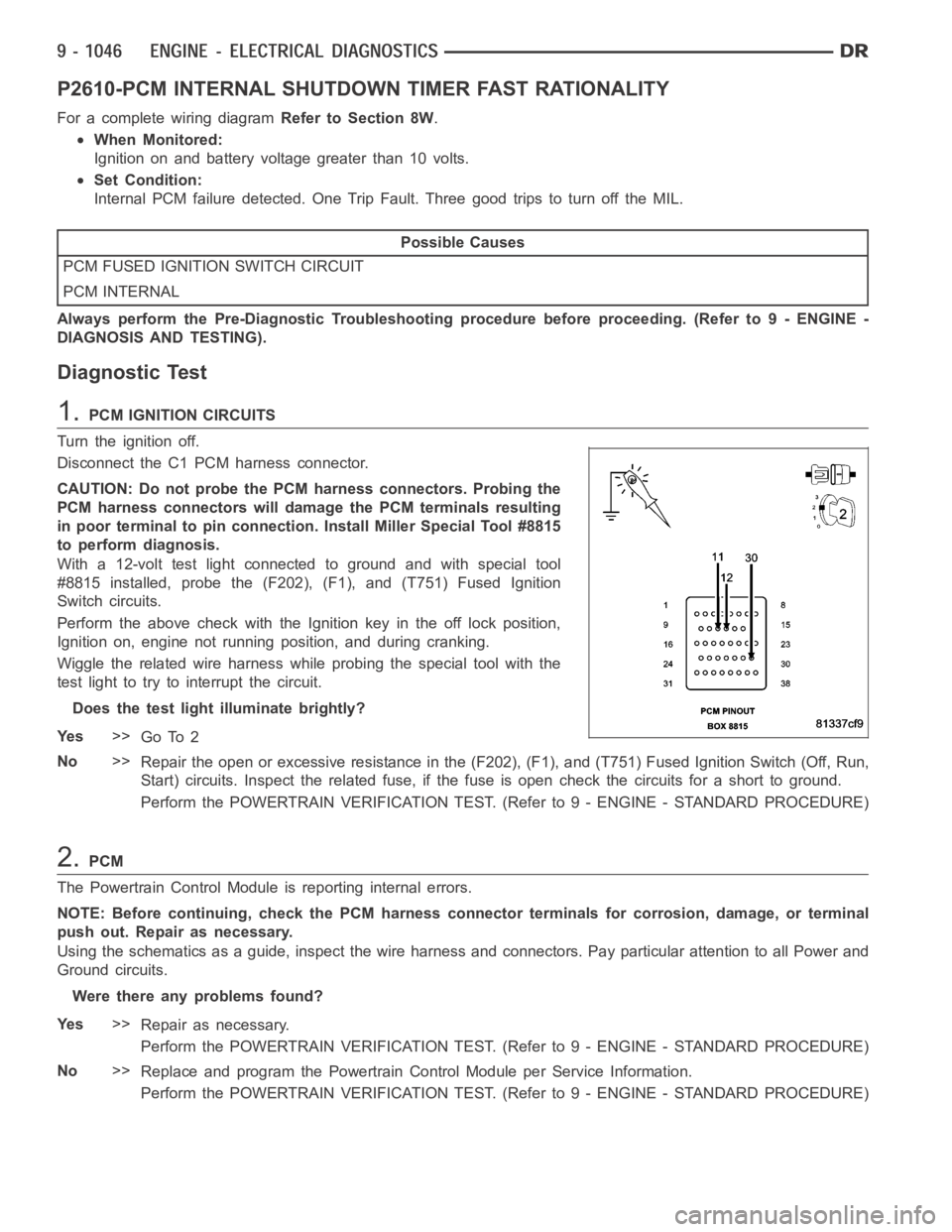
CAUTION: Do not probe the PCM harness connectors. Probing the
PCM harness connectors will damage the PCM terminals resulting
in poor terminal to pin connection. Install Miller Special Tool #8815
to perform diagnosis.
With a 12-volt test light connected to ground and with special tool
#8815 installed, probe the (F202), (F1), and (T751) Fused Ignition
Switch circuits.
Perform the above check with the Ignition key in the off lock position,
Ignition on, engine not running position, and during cranking.
Wiggle the related wire harness while probing the special tool with the
test light to try to interrupt the circuit.
Does the test light illuminate brightly?
Ye s>>
Go To 2
No>>
Repair the open or excessive resistance in the (F202), (F1), and (T751) Fused Ignition Switch (Off, Run,
Start) circuits. Inspect the related fuse, if the fuse is open check the circuits for a short to ground.
Perform the POWERTRAIN VERIFICATION TEST. (Refer to 9 - ENGINE - STANDARD PROCEDURE)
2.PCM
The Powertrain Control Module is reporting internal errors.
NOTE: Before continuing, check the PCM harness connector terminals for corrosion, damage, or terminal
push out. Repair as necessary.
Using the schematics as a guide, inspect the wire harness and connectors. Pay particular attention to all Power and
Ground circuits.
Were there any problems found?
Ye s>>
Repair as necessary.
Perform the POWERTRAIN VERIFICATION TEST. (Refer to 9 - ENGINE - STANDARD PROCEDURE)
No>>
Replace and program the Powertrain Control Module per Service Information.
Perform the POWERTRAIN VERIFICATION TEST. (Refer to 9 - ENGINE - STANDARD PROCEDURE)
Page 395 of 5267
U0101-LOST COMMUNICATION WITH TCM
For a complete wiring diagramRefer to Section 8W.
When Monitored:
Ignition run time is greater than 1 second. Battery voltage between 9 and 16volts. Engine run time greater
than 3 seconds.
Set Condition:
The PCM doesn’t receive a Bus Message from the Transmission Control Modulefor 7 consecutive seconds.
One trip failure. The circuit is continuously monitored.
Possible Causes
PCM FUSED IGNITION SWITCH OUTPUT CIRCUIT CHECK
BUS FAILURE OPEN OR SHORTED CONDITION
PCI BUS UNABLE TO COMMUNICATE WITH THE SCAN TOOL
PCM
Refer to 8 - ELECTRICAL/ELECTRONIC CONTROL MODULES - DIAGNOSIS AND TESTING for diagnostic
procedures and for further possible causes.
Diagnostic Test
1.ACTIVE DTC
Ignition on, engine not running.
With the scan tool, erase DTCs.
Cycle the ignition key on and off several times. Leaving the ignition on forat least 20 seconds.
With the scan tool, read DTCs.
Does the DTC reset?
Ye s>>
Go To 2
No>>
Refer to the INTERMITTENT CONDITIONSymptom (Diagnostic Procedure).
Perform the POWERTRAIN VERIFICATION TEST. (Refer to 9 - ENGINE - STANDARD PROCEDURE)
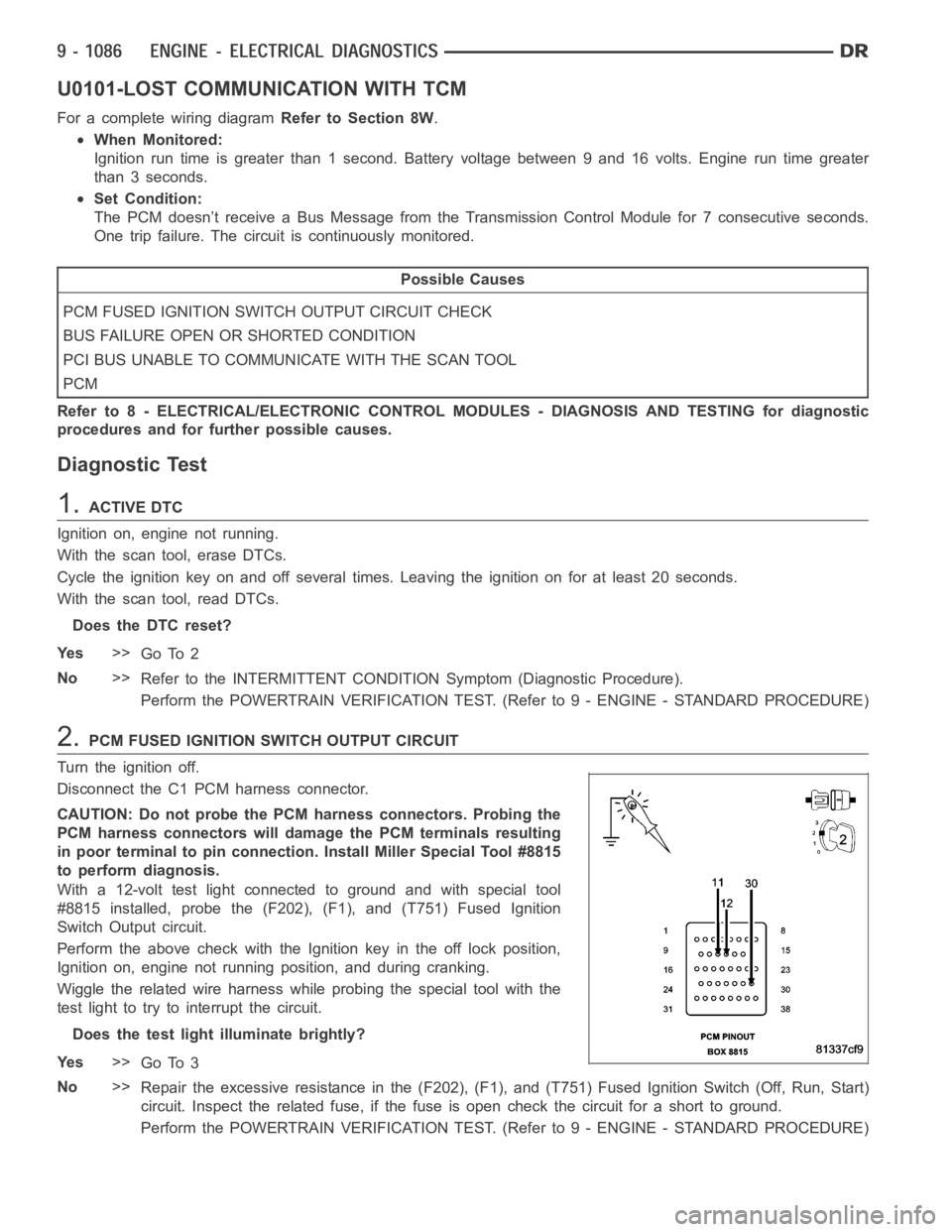
2.PCM FUSED IGNITION SWITCH OUTPUT CIRCUIT
Turn the ignition off.
Disconnect the C1 PCM harness connector.
CAUTION: Do not probe the PCM harness connectors. Probing the
PCM harness connectors will damage the PCM terminals resulting
in poor terminal to pin connection. Install Miller Special Tool #8815
to perform diagnosis.
With a 12-volt test light connected to ground and with special tool
#8815 installed, probe the (F202), (F1), and (T751) Fused Ignition
Switch Output circuit.
Perform the above check with the Ignition key in the off lock position,
Ignition on, engine not running position, and during cranking.
Wiggle the related wire harness while probing the special tool with the
test light to try to interrupt the circuit.
Does the test light illuminate brightly?
Ye s>>
Go To 3
No>>
Repair the excessive resistance in the (F202), (F1), and (T751) Fused Ignition Switch (Off, Run, Start)
circuit. Inspect the related fuse, if the fuse is open check the circuit fora short to ground.
Perform the POWERTRAIN VERIFICATION TEST. (Refer to 9 - ENGINE - STANDARD PROCEDURE)
Page 433 of 5267
Possible Causes
NO START PRE-TEST
POWERTRAIN FUSES OPEN
SECONDARY INDICATORS PRESENT
ENGINE MECHANICAL
(K342) ASD RELAY OUTPUT CIRCUITS OPEN
FUEL CONTAMINATION
Diagnostic Test
1.NO START PRE-TEST
NOTE: The following list of items must be checked before continuing with any no start tests.
The battery must be fully charged and in good condition. A low charged battery may produce invalid test results. If
the battery is low, charge the battery and then attempt to start the vehicleby cranking the engine for 15 seconds,
3 consecutive times.
This will allow any DTCs to set that may have been erased due to a dead battery.
Try to communicate with PCM if not able to communicate check fuses.
Make sure the Powers and Ground to the PCM are OK.
Make sure the PCM communicates with the scan tool and that there are no DTCs stored in the PCM memory. If the
PCM reports a No Response condition, refer to section 8 Electrical Electronic Control Module Electrical Diagnostics
for the proper tests.
Read the PCM DTCs with the scan tool. If any DTCs are present, they must be repaired before continuing with any
other No Start diagnostic tests. Refer to the Table of Contents for the related P-code that is reported by the PCM.
Make sure that the Bus is functional. Attempt to communicate with the Instrument Cluster and VTSS, If you are
unable to establish communications refer to 8 Electrical Electronic Control Module Electrical Diagnostics for the
proper Diagnostic procedures.
The Sentry Key Immobilizer System mustbe operating properly. Check for proper communication with the scan tool
and check for DTCs that may be stored in the Sentry Key Immobilizer Module (SKIM). Repair the DTC(s) before
continuing.
If no DTCs are found, using the scan tool, select Clear PCM (BATT Disconnect).
Crank the engine several times. Using the scan tool, read DTCs. If a DTC is present perform the DTC diagnostics
before continuing.
Were any problems found?
Ye s>>
Repair as necessary.
Perform the POWERTRAIN VERIFICATION TEST. (Refer to 9 - ENGINE - STANDARD PROCEDURE)
No>>
Go To 2
2.OPEN FUSE
Check for any open fuses in the IPM or Junction Block that may be related to theNoStartcondition.
Are any of the fuses open?
Ye s>>
Replace the open fuse and check the related circuit(s) for a short to ground.
Perform the POWERTRAIN VERIFICATION TEST. (Refer to 9 - ENGINE - STANDARD PROCEDURE)
No>>
Go To 3
Page 434 of 5267
3.SECONDARY INDICATORS PRESENT
Ignition on, engine not running.
With the scan tool, under DTCs & Related Functions, read the Secondary Indicators while cranking the engine.
Are there any Secondary Indicators present while cranking the engine?
Ye s>>
Refer to the Engine Electrical Diagnostics group and perform the tests related to the secondary indicator
that is reported by the scan tool.
Perform the POWERTRAIN VERIFICATION TEST. (Refer to 9 - ENGINE - STANDARD PROCEDURE)
No>>
Go To 4
4.ENGINE MECHANICAL
Check for any of the following conditions/mechanical problems.
ENGINE VALVE TIMING - must be within specifications, check for broken timing components
ENGINE COMPRESSION - must be within specifications
ENGINE EXHAUST SYSTEM - must be free of any restrictions or leaks.
Are there any engine mechanical problems?
Ye s>>
Repair as necessary.
Perform the POWERTRAIN VERIFICATION TEST. (Refer to 9 - ENGINE - STANDARD PROCEDURE)
No>>
Go To 5
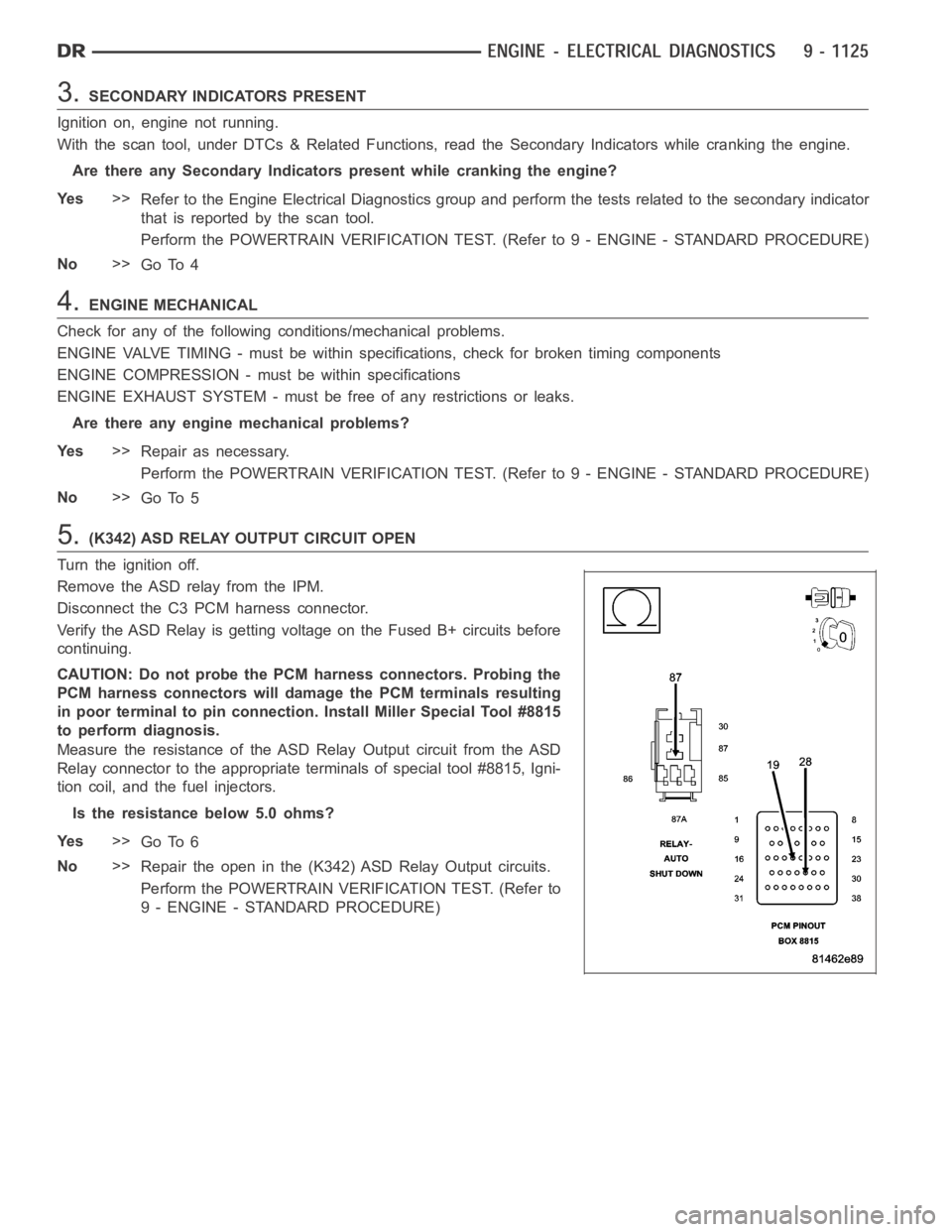
5.(K342) ASD RELAY OUTPUT CIRCUIT OPEN
Turn the ignition off.
Remove the ASD relay from the IPM.
Disconnect the C3 PCM harness connector.
Verify the ASD Relay is getting voltageontheFusedB+circuitsbefore
continuing.
CAUTION: Do not probe the PCM harness connectors. Probing the
PCM harness connectors will damage the PCM terminals resulting
in poor terminal to pin connection. Install Miller Special Tool #8815
to perform diagnosis.
Measure the resistance of the ASD Relay Output circuit from the ASD
Relay connector to the appropriate terminals of special tool #8815, Igni-
tion coil, and the fuel injectors.
Is the resistance below 5.0 ohms?
Ye s>>
Go To 6
No>>
Repair the open in the (K342)ASD Relay Output circuits.
Perform the POWERTRAIN VERIFICATION TEST. (Refer to
9 - ENGINE - STANDARD PROCEDURE)
Page 438 of 5267
Possible Causes
MECHANICAL CONDITION
BATTERY CIRCUIT RESISTANCE TOO HIGH
FUSED IGNITION SWITCH OUTPUT CIRCUITS
FUSED B+ CIRCUIT OPEN
(T752) STARTER RELAY CONTROL CIRCUIT OPEN
(T750) STARTER RELAY OUTPUT CIRCUIT OPEN
TRANSMISSION RANGE SENSOR
STARTER RELAY
STARTER
Diagnostic Test
1.MECHANICAL CONDITION
NOTE: Verify the battery is fully charged and capable of passing a load testbefore continuing.
WARNING: Make sure the battery is disconnected, then wait two minutes before proceeding. Failure to do
so may result in personal injury or possible death.
Turn the engine over by hand to make sure the engine is not seized.
Is the engine able to turn over?
Ye s>>
Go To 2
No>>
Repair the mechanical condition preventing the starter motor from cranking.
Perform the POWERTRAIN VERIFICATION TEST. (Refer to 9 - ENGINE - STANDARD PROCEDURE)
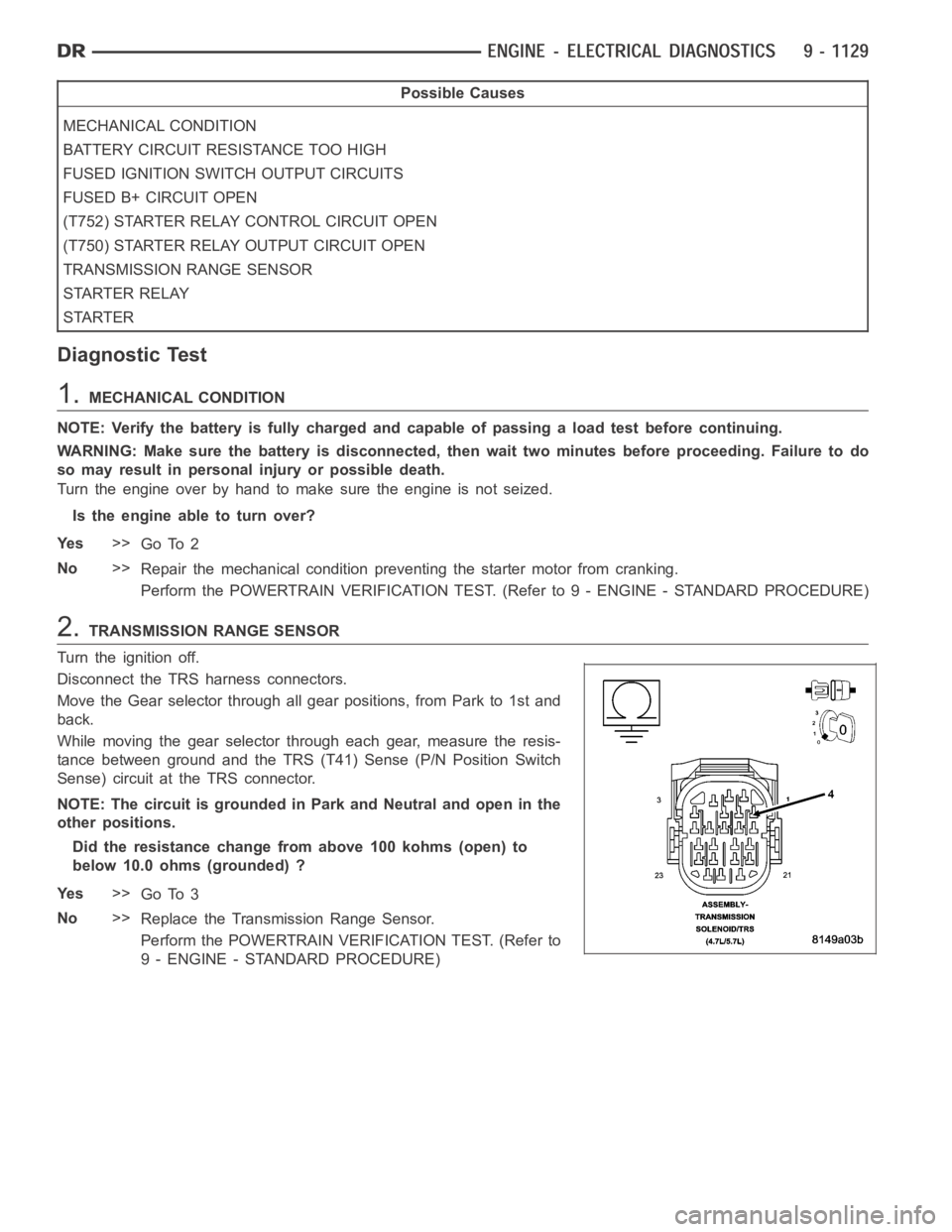
2.TRANSMISSION RANGE SENSOR
Turn the ignition off.
Disconnect the TRS harness connectors.
Move the Gear selector through all gear positions, from Park to 1st and
back.
While moving the gear selector through each gear, measure the resis-
tance between ground and the TRS (T41) Sense (P/N Position Switch
Sense) circuit at the TRS connector.
NOTE: The circuit is grounded in Park and Neutral and open in the
other positions.
Did the resistance change from above 100 kohms (open) to
below 10.0 ohms (grounded) ?
Ye s>>
Go To 3
No>>
Replace the Transmission Range Sensor.
Perform the POWERTRAIN VERIFICATION TEST. (Refer to
9 - ENGINE - STANDARD PROCEDURE)
Page 439 of 5267
3.EXCESSIVE RESISTANCE IN THE BATTERY CIRCUIT
Turn the ignition off.
Check the Battery Cables for excessive resistance using the service information procedure.
Did either Battery Cable have a voltage drop greater than 0.2 of a volt?
Ye s>>
Repair the excessive resistance in the Battery circuit.
Perform the POWERTRAIN VERIFICATION TEST. (Refer to 9 - ENGINE - STANDARD PROCEDURE)
No>>
Go To 4
4.STARTER RELAY
Turn ignition off.
Remove the Starter Relay from IPM.
CAUTION: The Parking Brake must be on and the Transmission must be in park for a vehicle equipped with
an automatic transmission.
WARNING: When the engine is operating, do not stand in direct line with the fan. Do not put your hands
near the pulleys, belts, or fan. Do notwear loose clothing. Failure to follow these instructions can result in
personal injury or death.
Briefly connect a jumper wire from the Internal Fused B+ circuit to the (T750) Starter Relay Output circuit.
Did the Starter Motor crank the engine?
Ye s>>
Go To 5
No>>
Go To 7
5.(T751) FUSED IGNITION SWITCH OUTPUT CIRCUIT
Ignition on, engine not running.
Using a 12-volt test light, probe the (T751) Fused Ignition Switch Output circuit in the Starter Relay connector.
While observing 12-volt test light, hold ignition key in the start position.
Does the test light illuminate brightly?
Ye s>>
Go To 6
No>>
Repair the excessive resistance in the(T751)FusedIgnitionSwitchOutput circuit. Inspect related fuses
and repair as necessary.
Perform the POWERTRAIN VERIFICATION TEST. (Refer to 9 - ENGINE - STANDARD PROCEDURE)
Page 440 of 5267
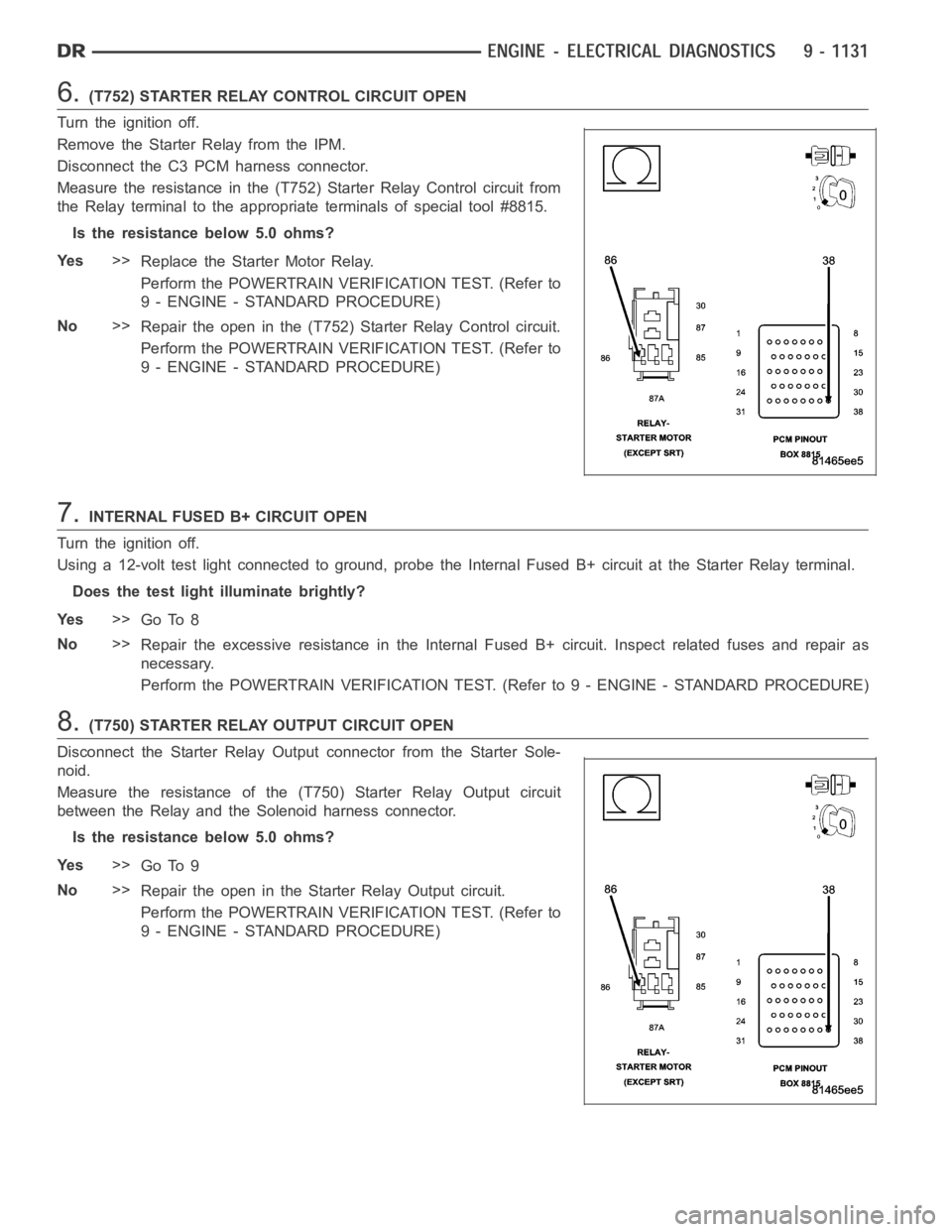
6.(T752) STARTER RELAY CONTROL CIRCUIT OPEN
Turn the ignition off.
Remove the Starter Relay from the IPM.
Disconnect the C3 PCM harness connector.
Measure the resistance in the (T752) Starter Relay Control circuit from
the Relay terminal to the appropriate terminals of special tool #8815.
Is the resistance below 5.0 ohms?
Ye s>>
Replace the Starter Motor Relay.
Perform the POWERTRAIN VERIFICATION TEST. (Refer to
9 - ENGINE - STANDARD PROCEDURE)
No>>
Repair the open in the (T752) Starter Relay Control circuit.
Perform the POWERTRAIN VERIFICATION TEST. (Refer to
9 - ENGINE - STANDARD PROCEDURE)
7.INTERNAL FUSED B+ CIRCUIT OPEN
Turn the ignition off.
Using a 12-volt test light connected to ground, probe the Internal Fused B+circuit at the Starter Relay terminal.
Does the test light illuminate brightly?
Ye s>>
Go To 8
No>>
Repair the excessive resistance in the Internal Fused B+ circuit. Inspectrelated fuses and repair as
necessary.
Perform the POWERTRAIN VERIFICATION TEST. (Refer to 9 - ENGINE - STANDARD PROCEDURE)
8.(T750) STARTER RELAY OUTPUT CIRCUIT OPEN
Disconnect the Starter Relay Output connector from the Starter Sole-
noid.
Measure the resistance of the (T750) Starter Relay Output circuit
between the Relay and the Solenoid harness connector.
Is the resistance below 5.0 ohms?
Ye s>>
Go To 9
No>>
Repair the open in the Starter Relay Output circuit.
Perform the POWERTRAIN VERIFICATION TEST. (Refer to
9 - ENGINE - STANDARD PROCEDURE)