refrigerant type DODGE RAM SRT-10 2006 Service User Guide
[x] Cancel search | Manufacturer: DODGE, Model Year: 2006, Model line: RAM SRT-10, Model: DODGE RAM SRT-10 2006Pages: 5267, PDF Size: 68.7 MB
Page 5136 of 5267
COMPRESSOR-A/C
DESCRIPTION
A/C COMPRESSOR
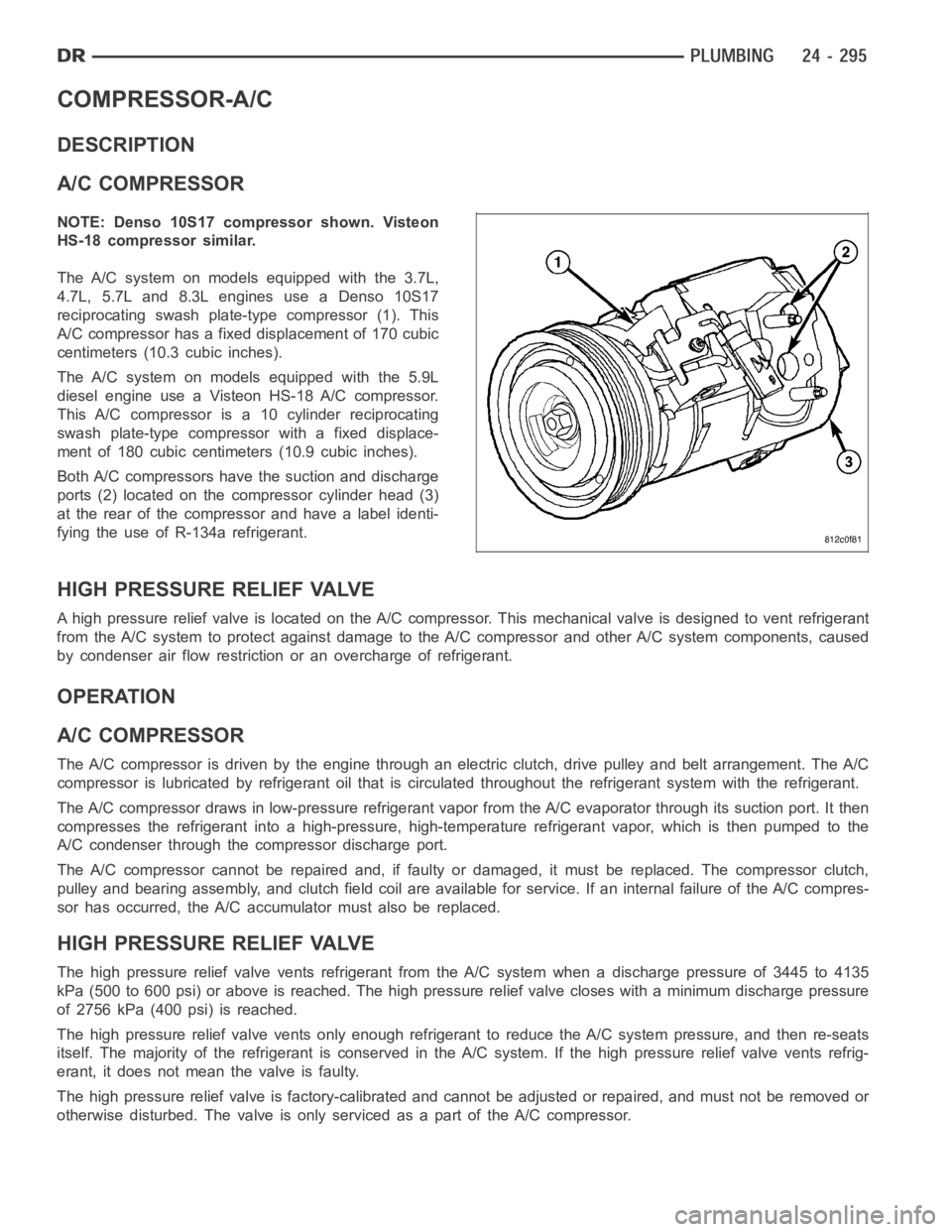
NOTE: Denso 10S17 compressor shown. Visteon
HS-18 compressor similar.
The A/C system on models equipped with the 3.7L,
4.7L, 5.7L and 8.3L engines use a Denso 10S17
reciprocating swash plate-type compressor (1). This
A/C compressor has a fixed displacement of 170 cubic
centimeters (10.3 cubic inches).
The A/C system on models equipped with the 5.9L
diesel engine use a Visteon HS-18 A/C compressor.
This A/C compressor is a 10 cylinder reciprocating
swash plate-type compressor with a fixed displace-
ment of 180 cubic centimeters (10.9 cubic inches).
Both A/C compressors have the suction and discharge
ports (2) located on the compressor cylinder head (3)
at the rear of the compressor and have a label identi-
fying the use of R-134a refrigerant.
HIGH PRESSURE RELIEF VALVE
A high pressure relief valve is located on the A/C compressor. This mechanical valve is designed to vent refrigerant
from the A/C system to protect against damage to the A/C compressor and other A/C system components, caused
by condenser air flow restriction or an overcharge of refrigerant.
OPERATION
A/C COMPRESSOR
The A/C compressor is driven by the engine through an electric clutch, drive pulley and belt arrangement. The A/C
compressor is lubricated by refrigerant oil that is circulated throughout the refrigerant system with the refrigerant.
The A/C compressor draws in low-pressure refrigerant vapor from the A/C evaporator through its suction port. It then
compresses the refrigerant into a high-pressure, high-temperature refrigerant vapor, which is then pumped to the
A/C condenser through the compressor discharge port.
The A/C compressor cannot be repaired and, if faulty or damaged, it must be replaced. The compressor clutch,
pulley and bearing assembly, and clutch field coil are available for service. If an internal failure of the A/C compres-
sor has occurred, the A/C accumulator must also be replaced.
HIGH PRESSURE RELIEF VALVE
The high pressure relief valve vents refrigerant from the A/C system when adischarge pressure of 3445 to 4135
kPa (500 to 600 psi) or above is reached. The high pressure relief valve closes with a minimum discharge pressure
of 2756 kPa (400 psi) is reached.
The high pressure relief valve vents only enough refrigerant to reduce theA/C system pressure, and then re-seats
itself. The majority of the refrigerant is conserved in the A/C system. If the high pressure relief valve vents refrig-
erant, it does not mean the valve is faulty.
The high pressure relief valve is factory-calibrated and cannot be adjusted or repaired, and must not be removed or
otherwise disturbed. The valve is only serviced as a part of the A/C compressor.
Page 5141 of 5267
1. Recover the refrigerant from the refrigerant system
(Refer to 24 - HEATING & AIR CONDITIONING/
PLUMBING - STANDARD PROCEDURE -
REFRIGERANT SYSTEM RECOVERY).
2. Disconnect and isolate the negative battery cable.
3. Remove the accessory drive belt (Refer to 7 -
COOLING/ACCESSORY DRIVE/BELTS-DRIVE -
REMOVAL).
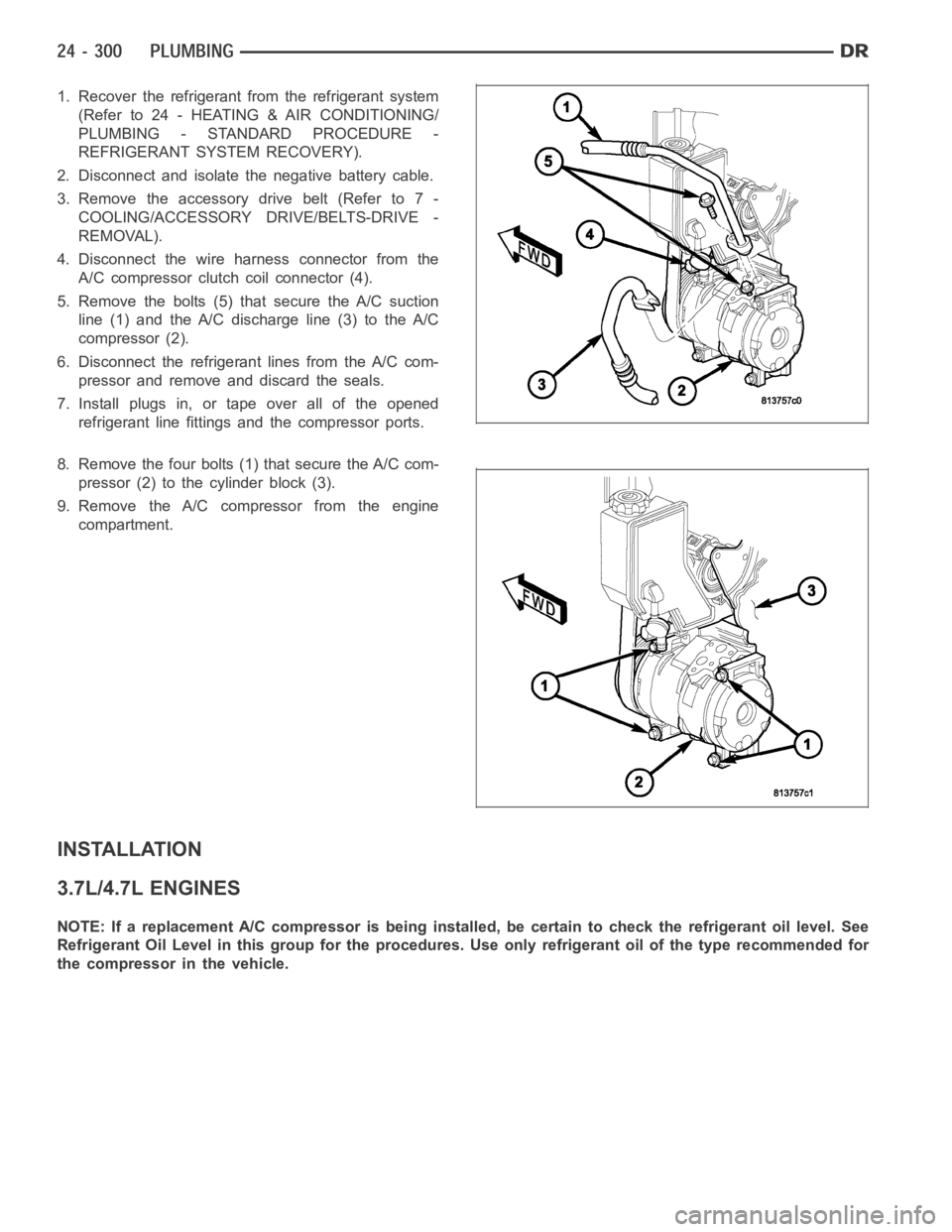
4. Disconnect the wire harness connector from the
A/C compressor clutch coil connector (4).
5. Remove the bolts (5) that secure the A/C suction
line (1) and the A/C discharge line (3) to the A/C
compressor (2).
6. Disconnect the refrigerant lines from the A/C com-
pressor and remove and discard the seals.
7. Install plugs in, or tape over all of the opened
refrigerant line fittings and the compressor ports.
8. Remove the four bolts (1) that secure the A/C com-
pressor (2) to the cylinder block (3).
9. Remove the A/C compressor from the engine
compartment.
INSTALLATION
3.7L/4.7L ENGINES
NOTE: If a replacement A/C compressor is being installed, be certain to check the refrigerant oil level. See
Refrigerant Oil Level in this group for the procedures. Use only refrigerant oil of the type recommended for
the compressor in the vehicle.
Page 5142 of 5267
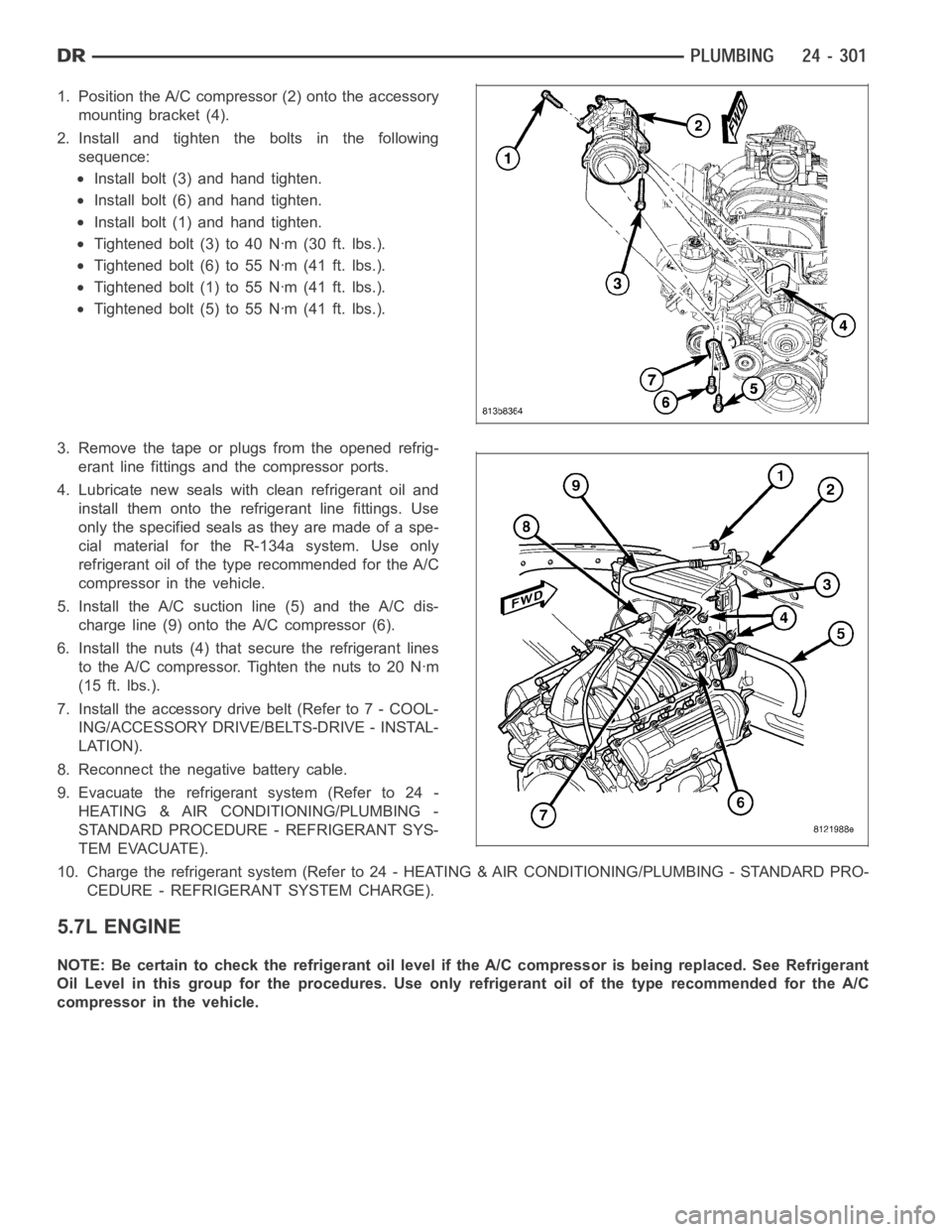
1. Position the A/C compressor (2) onto the accessory
mounting bracket (4).
2. Install and tighten the bolts in the following
sequence:
Install bolt (3) and hand tighten.
Install bolt (6) and hand tighten.
Install bolt (1) and hand tighten.
Tightened bolt (3) to 40 Nꞏm (30 ft. lbs.).
Tightened bolt (6) to 55 Nꞏm (41 ft. lbs.).
Tightened bolt (1) to 55 Nꞏm (41 ft. lbs.).
Tightened bolt (5) to 55 Nꞏm (41 ft. lbs.).
3. Remove the tape or plugs from the opened refrig-
erant line fittings and the compressor ports.
4. Lubricate new seals with clean refrigerant oil and
install them onto the refrigerant line fittings. Use
only the specified seals as they are made of a spe-
cial material for the R-134a system. Use only
refrigerant oil of the type recommended for the A/C
compressor in the vehicle.
5. Install the A/C suction line (5) and the A/C dis-
charge line (9) onto the A/C compressor (6).
6. Install the nuts (4) that secure the refrigerant lines
to the A/C compressor. Tighten the nuts to 20 Nꞏm
(15 ft. lbs.).
7. Install the accessory drive belt (Refer to 7 - COOL-
ING/ACCESSORY DRIVE/BELTS-DRIVE - INSTAL-
LATION).
8. Reconnect the negative battery cable.
9. Evacuate the refrigerant system (Refer to 24 -
HEATING & AIR CONDITIONING/PLUMBING -
STANDARD PROCEDURE - REFRIGERANT SYS-
TEM EVACUATE).
10. Charge the refrigerant system (Refer to 24 - HEATING & AIR CONDITIONING/PLUMBING - STANDARD PRO-
CEDURE - REFRIGERANT SYSTEM CHARGE).
5.7L ENGINE
NOTE: Be certain to check the refrigerant oil level if the A/C compressor isbeing replaced. See Refrigerant
Oil Level in this group for the procedures. Use only refrigerant oil of the type recommended for the A/C
compressor in the vehicle.
Page 5143 of 5267
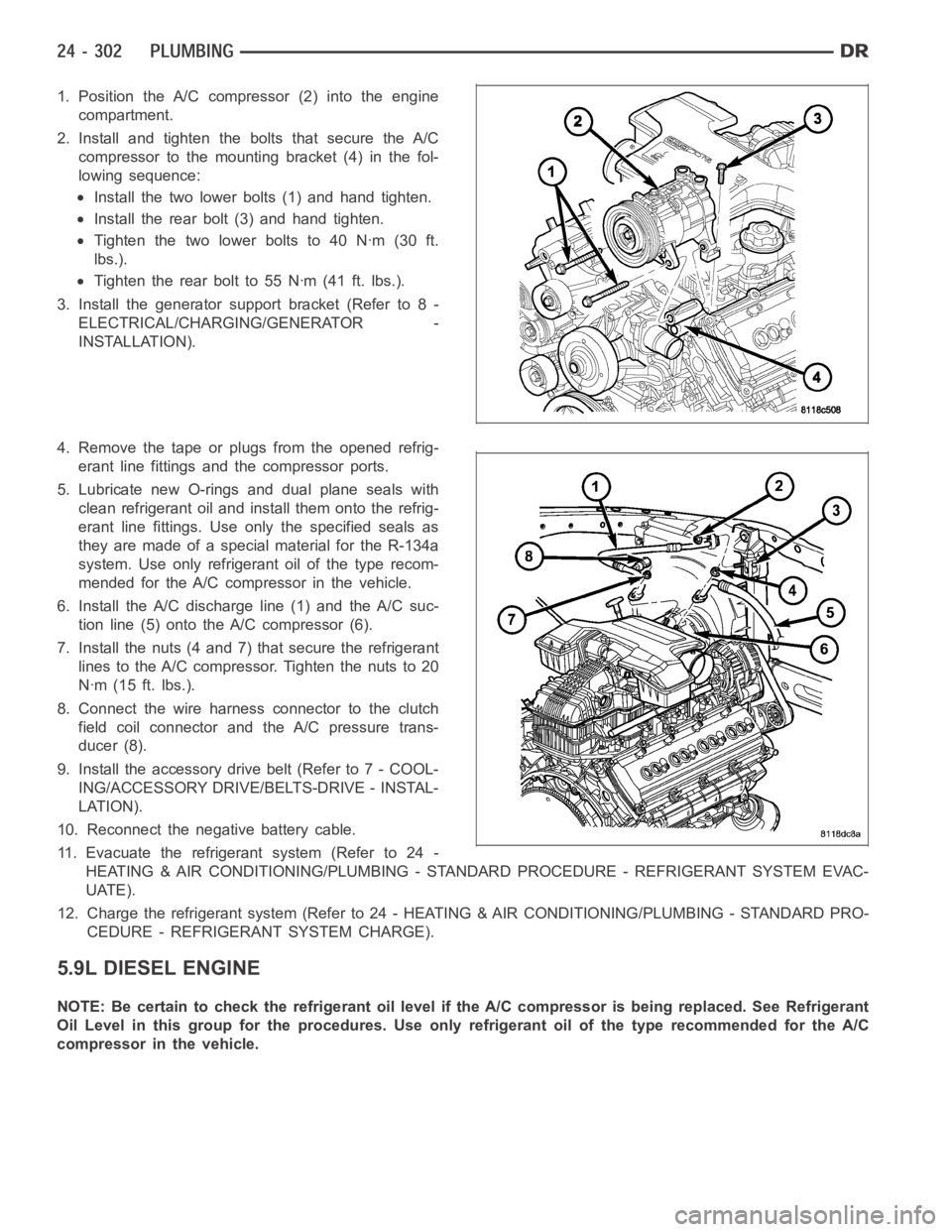
1. Position the A/C compressor (2) into the engine
compartment.
2. Install and tighten the bolts that secure the A/C
compressor to the mounting bracket (4) in the fol-
lowing sequence:
Install the two lower bolts (1) and hand tighten.
Install the rear bolt (3) and hand tighten.
Tightenthetwolowerboltsto40Nꞏm(30ft.
lbs.).
Tighten the rear bolt to 55 Nꞏm (41 ft. lbs.).
3. Install the generator support bracket (Refer to 8 -
ELECTRICAL/CHARGING/GENERATOR -
INSTALLATION).
4. Remove the tape or plugs from the opened refrig-
erant line fittings and the compressor ports.
5. Lubricate new O-rings and dual plane seals with
clean refrigerant oil and install them onto the refrig-
erant line fittings. Use only the specified seals as
they are made of a special material for the R-134a
system. Use only refrigerant oil of the type recom-
mended for the A/C compressor in the vehicle.
6. Install the A/C discharge line (1) and the A/C suc-
tion line (5) onto the A/C compressor (6).
7. Install the nuts (4 and 7) that secure the refrigerant
lines to the A/C compressor. Tighten the nuts to 20
Nꞏm (15 ft. lbs.).
8. Connect the wire harness connector to the clutch
field coil connector and the A/C pressure trans-
ducer (8).
9. Install the accessory drive belt (Refer to 7 - COOL-
ING/ACCESSORY DRIVE/BELTS-DRIVE - INSTAL-
LATION).
10. Reconnect the negative battery cable.
11. Evacuate the refrigerant system (Refer to 24 -
HEATING & AIR CONDITIONING/PLUMBING - STANDARD PROCEDURE - REFRIGERANT SYSTEM EVAC-
UATE).
12. Charge the refrigerant system (Refer to 24 - HEATING & AIR CONDITIONING/PLUMBING - STANDARD PRO-
CEDURE - REFRIGERANT SYSTEM CHARGE).
5.9L DIESEL ENGINE
NOTE: Be certain to check the refrigerant oil level if the A/C compressor isbeing replaced. See Refrigerant
Oil Level in this group for the procedures. Use only refrigerant oil of the type recommended for the A/C
compressor in the vehicle.
Page 5144 of 5267
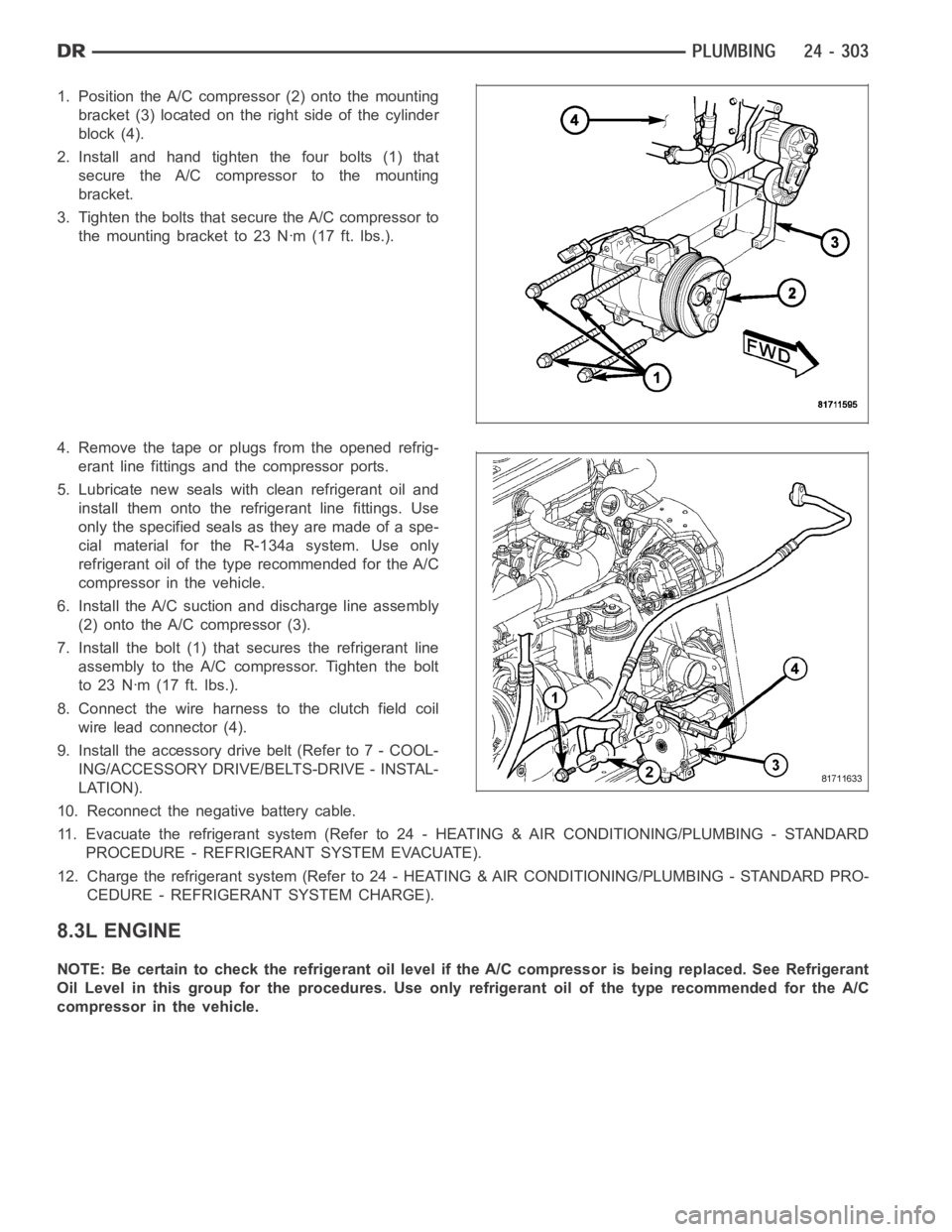
1. Position the A/C compressor (2) onto the mounting
bracket (3) located on the right side of the cylinder
block (4).
2. Install and hand tighten the four bolts (1) that
secure the A/C compressor to the mounting
bracket.
3. Tighten the bolts that secure the A/C compressor to
themountingbracketto23Nꞏm(17ft.lbs.).
4. Remove the tape or plugs from the opened refrig-
erant line fittings and the compressor ports.
5. Lubricate new seals with clean refrigerant oil and
install them onto the refrigerant line fittings. Use
only the specified seals as they are made of a spe-
cial material for the R-134a system. Use only
refrigerant oil of the type recommended for the A/C
compressor in the vehicle.
6. Install the A/C suction and discharge line assembly
(2) onto the A/C compressor (3).
7. Install the bolt (1) that secures the refrigerant line
assembly to the A/C compressor. Tighten the bolt
to 23 Nꞏm (17 ft. lbs.).
8. Connect the wire harness to the clutch field coil
wire lead connector (4).
9. Install the accessory drive belt (Refer to 7 - COOL-
ING/ACCESSORY DRIVE/BELTS-DRIVE - INSTAL-
LATION).
10. Reconnect the negative battery cable.
11. Evacuate the refrigerant system (Refer to 24 - HEATING & AIR CONDITIONING/PLUMBING - STANDARD
PROCEDURE - REFRIGERANT SYSTEM EVACUATE).
12. Charge the refrigerant system (Refer to 24 - HEATING & AIR CONDITIONING/PLUMBING - STANDARD PRO-
CEDURE - REFRIGERANT SYSTEM CHARGE).
8.3L ENGINE
NOTE: Be certain to check the refrigerant oil level if the A/C compressor isbeing replaced. See Refrigerant
Oil Level in this group for the procedures. Use only refrigerant oil of the type recommended for the A/C
compressor in the vehicle.
Page 5145 of 5267
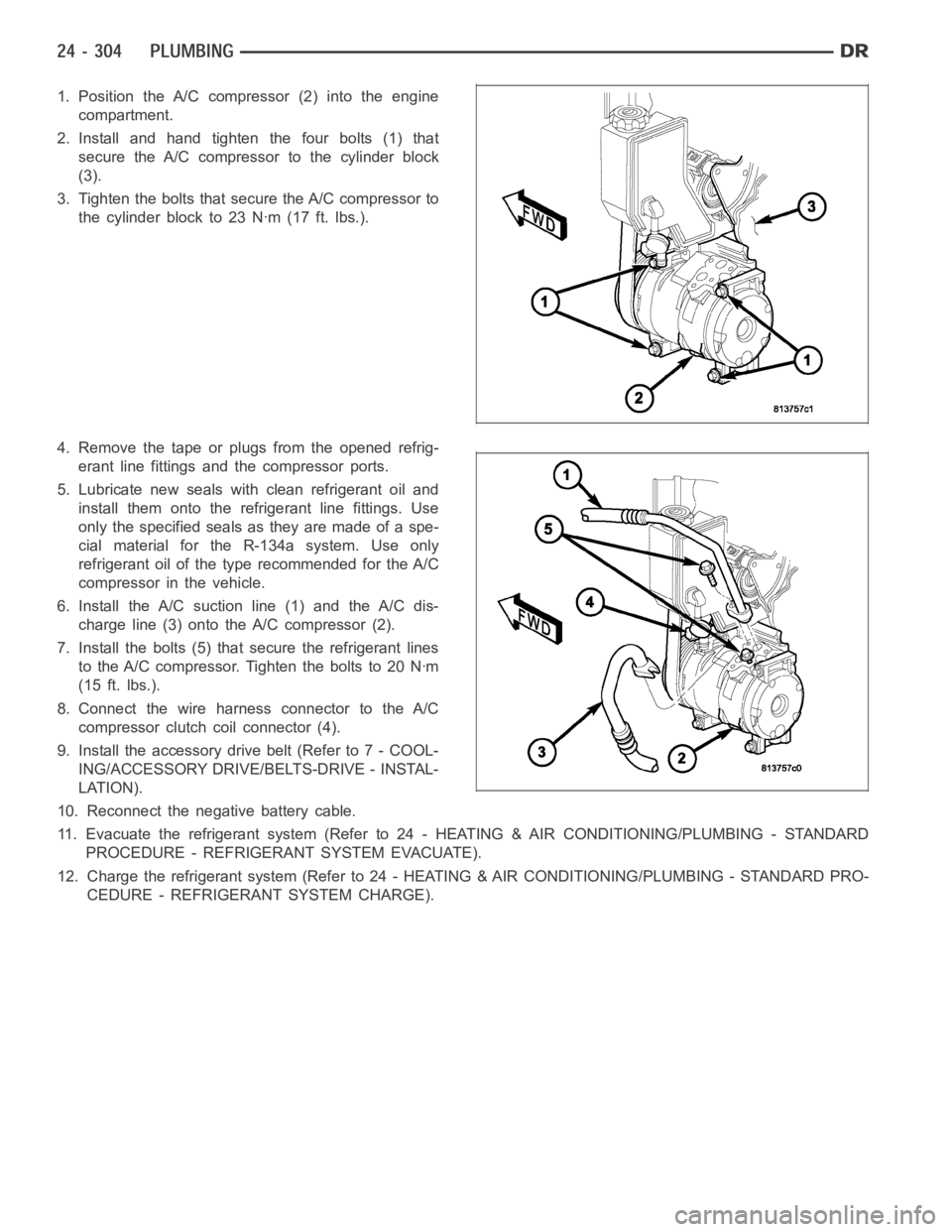
1. Position the A/C compressor (2) into the engine
compartment.
2. Install and hand tighten the four bolts (1) that
secure the A/C compressor to the cylinder block
(3).
3. Tighten the bolts that secure the A/C compressor to
the cylinder block to 23 Nꞏm (17 ft. lbs.).
4. Remove the tape or plugs from the opened refrig-
erant line fittings and the compressor ports.
5. Lubricate new seals with clean refrigerant oil and
install them onto the refrigerant line fittings. Use
only the specified seals as they are made of a spe-
cial material for the R-134a system. Use only
refrigerant oil of the type recommended for the A/C
compressor in the vehicle.
6. Install the A/C suction line (1) and the A/C dis-
charge line (3) onto the A/C compressor (2).
7. Install the bolts (5) that secure the refrigerant lines
to the A/C compressor. Tighten the bolts to 20 Nꞏm
(15 ft. lbs.).
8. Connect the wire harness connector to the A/C
compressor clutch coil connector (4).
9. Install the accessory drive belt (Refer to 7 - COOL-
ING/ACCESSORY DRIVE/BELTS-DRIVE - INSTAL-
LATION).
10. Reconnect the negative battery cable.
11. Evacuate the refrigerant system (Refer to 24 - HEATING & AIR CONDITIONING/PLUMBING - STANDARD
PROCEDURE - REFRIGERANT SYSTEM EVACUATE).
12. Charge the refrigerant system (Refer to 24 - HEATING & AIR CONDITIONING/PLUMBING - STANDARD PRO-
CEDURE - REFRIGERANT SYSTEM CHARGE).
Page 5148 of 5267
INSTALLATION
3.7L/4.7L/5.7L ENGINES
NOTE: If the A/C condenser is being replaced, add 30 milliliters (1 fluid ounce) of refrigerant oil to the refrig-
erant system. Use only refrigerant oil of the type recommended for the A/C compressor in the vehicle.
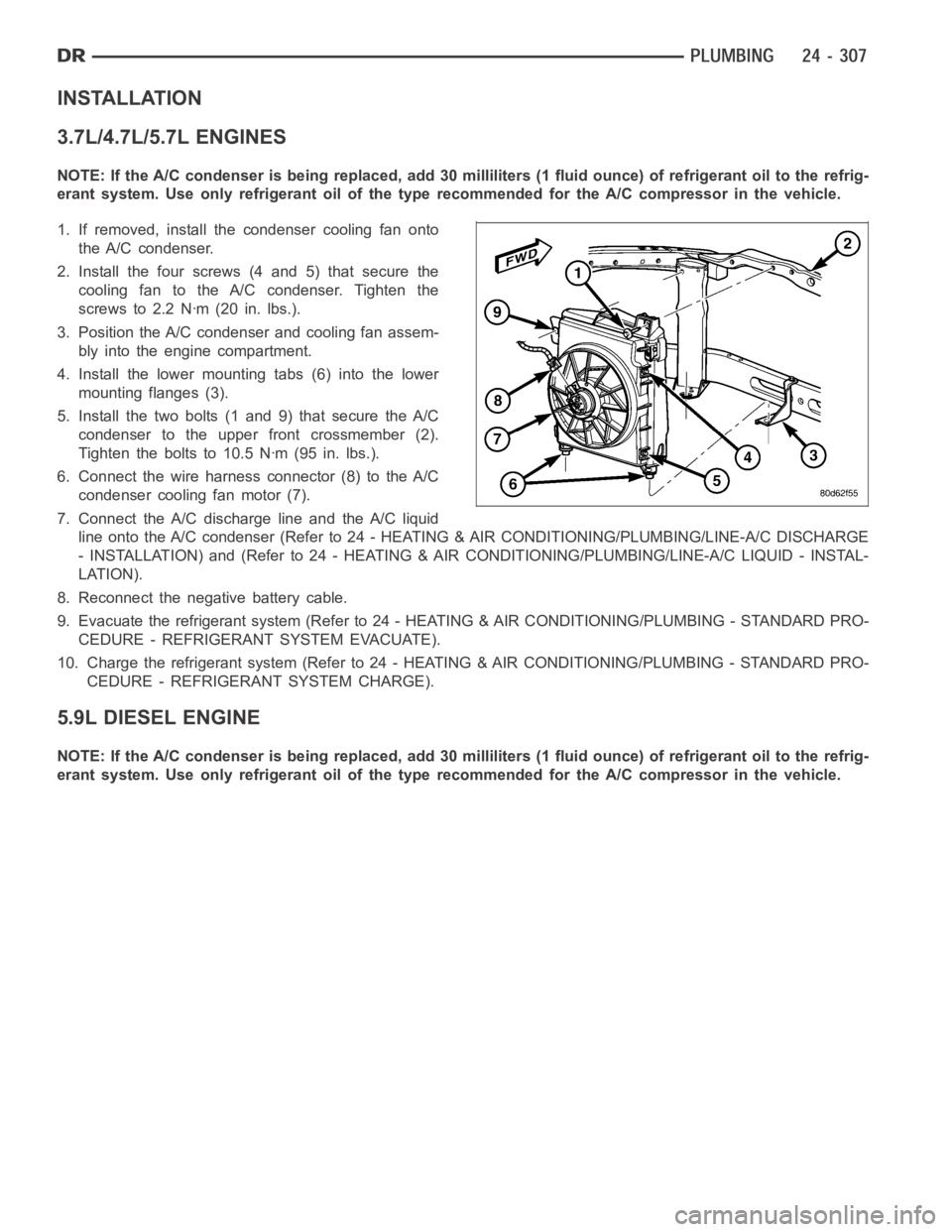
1. If removed, install the condenser cooling fan onto
the A/C condenser.
2. Install the four screws (4 and 5) that secure the
cooling fan to the A/C condenser. Tighten the
screws to 2.2 Nꞏm (20 in. lbs.).
3. Position the A/C condenser and cooling fan assem-
bly into the engine compartment.
4. Install the lower mounting tabs (6) into the lower
mounting flanges (3).
5. Install the two bolts (1 and 9) that secure the A/C
condenser to the upper front crossmember (2).
Tighten the bolts to 10.5 Nꞏm (95 in. lbs.).
6. Connect the wire harness connector (8) to the A/C
condenser cooling fan motor (7).
7. Connect the A/C discharge line and the A/C liquid
line onto the A/C condenser (Refer to 24 - HEATING & AIR CONDITIONING/PLUMBING/LINE-A/C DISCHARGE
- INSTALLATION) and (Refer to 24 - HEATING & AIR CONDITIONING/PLUMBING/LINE-A/C LIQUID - INSTAL-
LATION).
8. Reconnect the negative battery cable.
9. Evacuate the refrigerant system (Refer to 24 - HEATING & AIR CONDITIONING/PLUMBING - STANDARD PRO-
CEDURE - REFRIGERANT SYSTEM EVACUATE).
10. Charge the refrigerant system (Refer to 24 - HEATING & AIR CONDITIONING/PLUMBING - STANDARD PRO-
CEDURE - REFRIGERANT SYSTEM CHARGE).
5.9L DIESEL ENGINE
NOTE: If the A/C condenser is being replaced, add 30 milliliters (1 fluid ounce) of refrigerant oil to the refrig-
erant system. Use only refrigerant oil of the type recommended for the A/C compressor in the vehicle.
Page 5149 of 5267
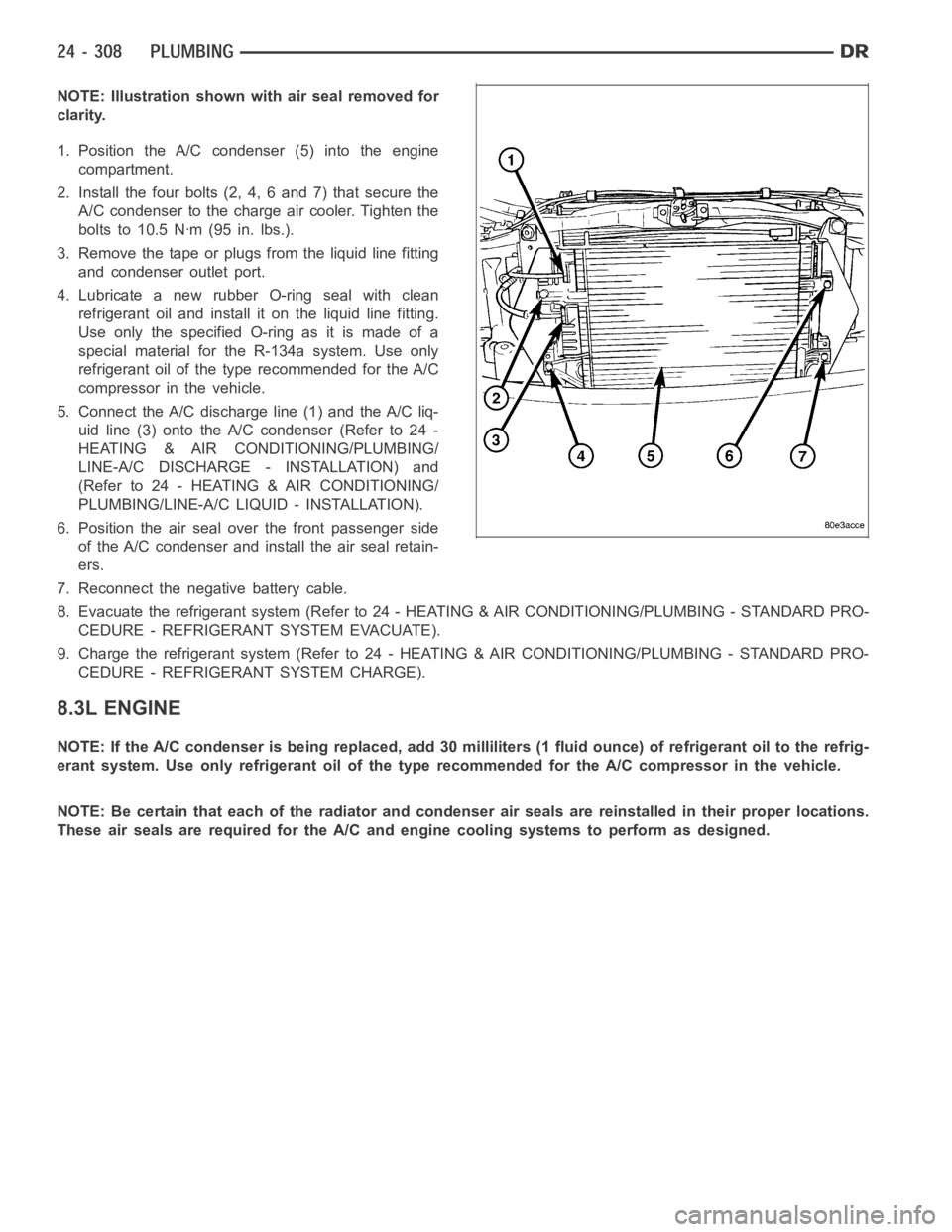
NOTE: Illustration shown with air seal removed for
clarity.
1. Position the A/C condenser (5) into the engine
compartment.
2. Install the four bolts (2, 4, 6 and 7) that secure the
A/C condenser to the charge air cooler. Tighten the
bolts to 10.5 Nꞏm (95 in. lbs.).
3. Remove the tape or plugs from the liquid line fitting
and condenser outlet port.
4. Lubricate a new rubber O-ring seal with clean
refrigerant oil and install it on the liquid line fitting.
UseonlythespecifiedO-ringasitismadeofa
special material for the R-134a system. Use only
refrigerant oil of the type recommended for the A/C
compressor in the vehicle.
5. Connect the A/C discharge line (1) and the A/C liq-
uid line (3) onto the A/C condenser (Refer to 24 -
HEATING & AIR CONDITIONING/PLUMBING/
LINE-A/C DISCHARGE - INSTALLATION) and
(Refer to 24 - HEATING & AIR CONDITIONING/
PLUMBING/LINE-A/C LIQUID - INSTALLATION).
6. Position the air seal over the front passenger side
of the A/C condenser and install the air seal retain-
ers.
7. Reconnect the negative battery cable.
8. Evacuate the refrigerant system (Refer to 24 - HEATING & AIR CONDITIONING/PLUMBING - STANDARD PRO-
CEDURE - REFRIGERANT SYSTEM EVACUATE).
9. Charge the refrigerant system (Refer to 24 - HEATING & AIR CONDITIONING/PLUMBING - STANDARD PRO-
CEDURE - REFRIGERANT SYSTEM CHARGE).
8.3L ENGINE
NOTE: If the A/C condenser is being replaced, add 30 milliliters (1 fluid ounce) of refrigerant oil to the refrig-
erant system. Use only refrigerant oil of the type recommended for the A/C compressor in the vehicle.
NOTE: Be certain that each of the radiator and condenser air seals are reinstalled in their proper locations.
These air seals are required for the A/C and engine cooling systems to perform as designed.
Page 5153 of 5267
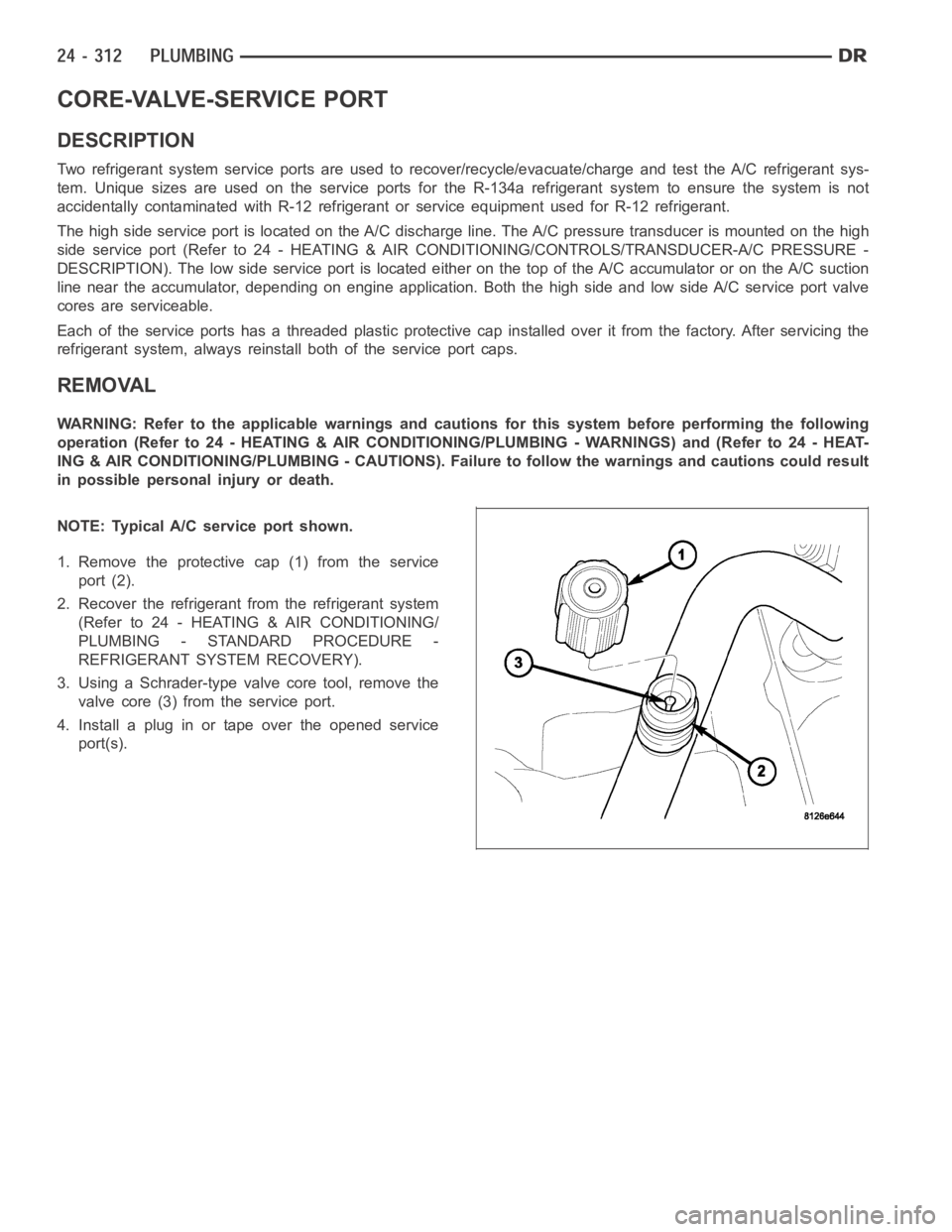
CORE-VALVE-SERVICE PORT
DESCRIPTION
Two refrigerant system service ports are used to recover/recycle/evacuate/charge and test the A/C refrigerant sys-
tem. Unique sizes are used on the service ports for the R-134a refrigerant system to ensure the system is not
accidentally contaminated with R-12 refrigerant or service equipment used for R-12 refrigerant.
The high side service port is located on the A/C discharge line. The A/C pressure transducer is mounted on the high
side service port (Refer to 24 - HEATING & AIR CONDITIONING/CONTROLS/TRANSDUCER-A/C PRESSURE -
DESCRIPTION). The low side service port is located either on the top of the A/C accumulator or on the A/C suction
line near the accumulator, depending on engine application. Both the highside and low side A/C service port valve
cores are serviceable.
Each of the service ports has a threaded plastic protective cap installed over it from the factory. After servicing the
refrigerant system, always reinstall both of the service port caps.
REMOVAL
WARNING: Refer to the applicable warnings and cautions for this system before performing the following
operation (Refer to 24 - HEATING & AIR CONDITIONING/PLUMBING - WARNINGS) and (Refer to 24 - HEAT-
ING & AIR CONDITIONING/PLUMBING - CAUTIONS). Failure to follow the warnings and cautions could result
in possible personal injury or death.
NOTE: Typical A/C service port shown.
1. Remove the protective cap (1) from the service
port (2).
2. Recover the refrigerant from the refrigerant system
(Refer to 24 - HEATING & AIR CONDITIONING/
PLUMBING - STANDARD PROCEDURE -
REFRIGERANT SYSTEM RECOVERY).
3. Using a Schrader-type valve core tool, remove the
valve core (3) from the service port.
4. Install a plug in or tape over the opened service
port(s).
Page 5154 of 5267
INSTALLATION
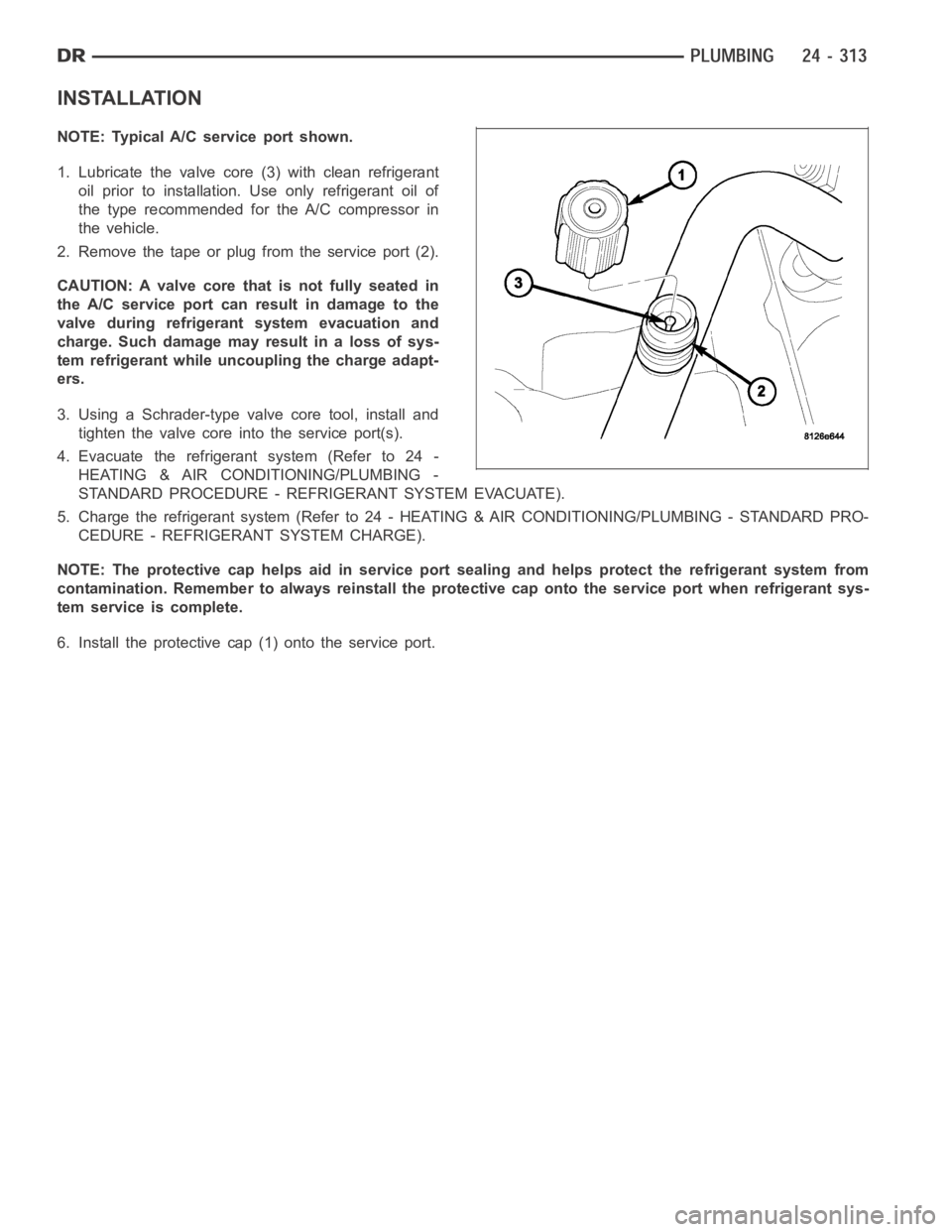
NOTE: Typical A/C service port shown.
1. Lubricate the valve core (3) with clean refrigerant
oil prior to installation. Use only refrigerant oil of
the type recommended for the A/C compressor in
the vehicle.
2. Remove the tape or plug from the service port (2).
CAUTION: A valve core that is not fully seated in
the A/C service port can result in damage to the
valve during refrigerant system evacuation and
charge. Such damage may result in a loss of sys-
tem refrigerant while uncoupling the charge adapt-
ers.
3. Using a Schrader-type valve core tool, install and
tighten the valve core into the service port(s).
4. Evacuate the refrigerant system (Refer to 24 -
HEATING & AIR CONDITIONING/PLUMBING -
STANDARD PROCEDURE - REFRIGERANT SYSTEM EVACUATE).
5. Charge the refrigerant system (Refer to 24 - HEATING & AIR CONDITIONING/PLUMBING - STANDARD PRO-
CEDURE - REFRIGERANT SYSTEM CHARGE).
NOTE: The protective cap helps aid in service port sealing and helps protect the refrigerant system from
contamination. Remember to always reinstall the protective cap onto the service port when refrigerant sys-
tem service is complete.
6. Install the protective cap (1) onto the service port.