coolant DODGE RAM SRT-10 2006 Service Owner's Manual
[x] Cancel search | Manufacturer: DODGE, Model Year: 2006, Model line: RAM SRT-10, Model: DODGE RAM SRT-10 2006Pages: 5267, PDF Size: 68.7 MB
Page 911 of 5267
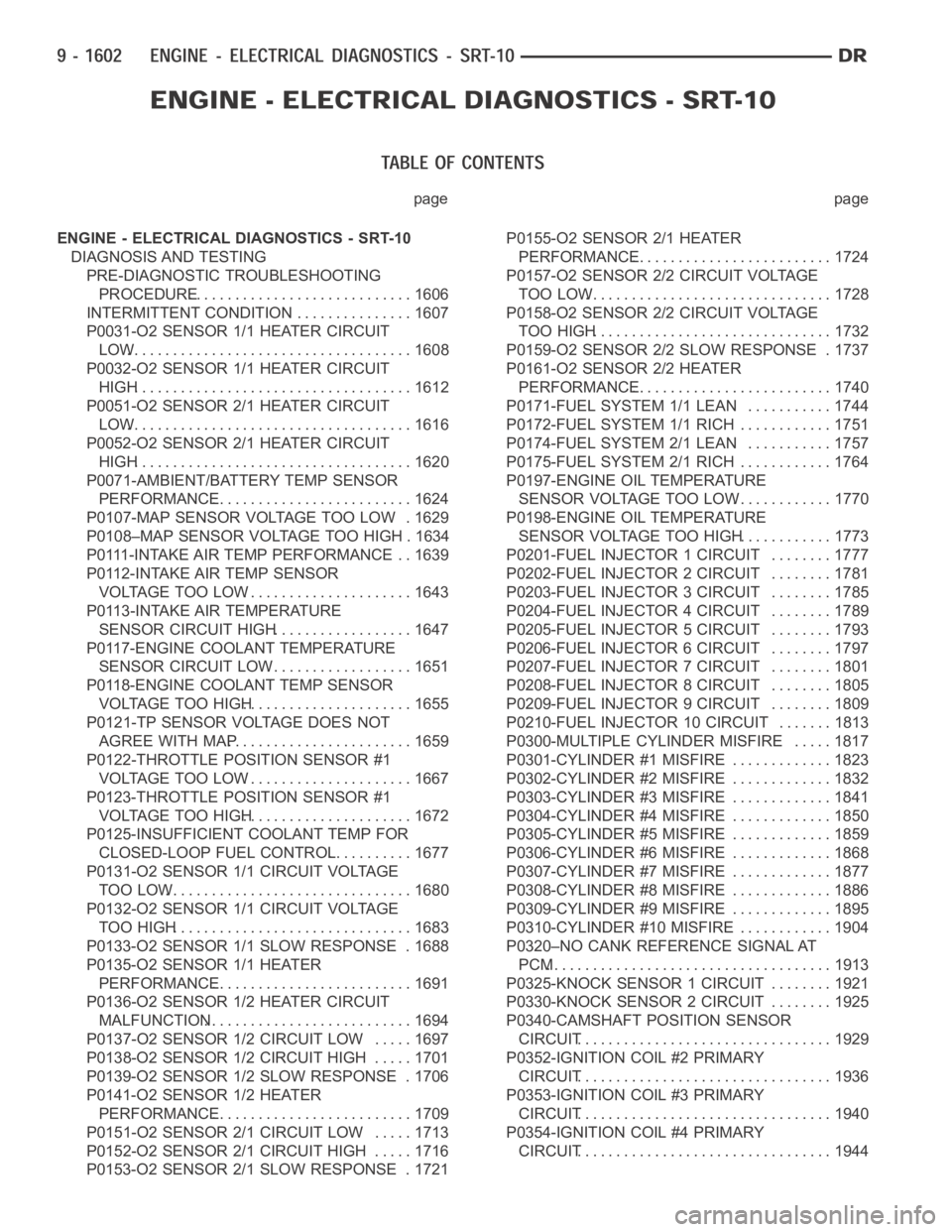
page page
ENGINE - ELECTRICAL DIAGNOSTICS - SRT-10
DIAGNOSIS AND TESTING
PRE-DIAGNOSTIC TROUBLESHOOTING
PROCEDURE............................. 1606
INTERMITTENT CONDITION ............... 1607
P0031-O2 SENSOR 1/1 HEATER CIRCUIT
LOW..................................... 1608
P0032-O2 SENSOR 1/1 HEATER CIRCUIT
HIGH.................................... 1612
P0051-O2 SENSOR 2/1 HEATER CIRCUIT
LOW..................................... 1616
P0052-O2 SENSOR 2/1 HEATER CIRCUIT
HIGH.................................... 1620
P0071-AMBIENT/BATTERY TEMP SENSOR
PERFORMANCE.......................... 1624
P0107-MAP SENSOR VOLTAGE TOO LOW . 1629
P0108–MAP SENSOR VOLTAGE TOO HIGH . 1634
P0111-INTAKE AIR TEMP PERFORMANCE . . 1639
P0112-INTAKE AIR TEMP SENSOR
VOLTAGE TOO LOW...................... 1643
P0113-INTAKE AIR TEMPERATURE
SENSOR CIRCUIT HIGH.................. 1647
P0117-ENGINE COOLANT TEMPERATURE
SENSOR CIRCUIT LOW................... 1651
P0118-ENGINE COOLANT TEMP SENSOR
VOLTAGE TOO HIGH...................... 1655
P0121-TP SENSOR VOLTAGE DOES NOT
AGREE WITH MAP........................ 1659
P0122-THROTTLE POSITION SENSOR #1
VOLTAGE TOO LOW...................... 1667
P0123-THROTTLE POSITION SENSOR #1
VOLTAGE TOO HIGH...................... 1672
P0125-INSUFFICIENT COOLANT TEMP FOR
CLOSED-LOOP FUEL CONTROL........... 1677
P0131-O2 SENSOR 1/1 CIRCUIT VOLTAGE
TOO LOW................................ 1680
P0132-O2 SENSOR 1/1 CIRCUIT VOLTAGE
TOO HIGH............................... 1683
P0133-O2 SENSOR 1/1 SLOW RESPONSE . 1688
P0135-O2 SENSOR 1/1 HEATER
PERFORMANCE.......................... 1691
P0136-O2 SENSOR 1/2 HEATER CIRCUIT
MALFUNCTION........................... 1694
P0137-O2 SENSOR 1/2 CIRCUIT LOW ..... 1697
P0138-O2 SENSOR 1/2 CIRCUIT HIGH ..... 1701
P0139-O2 SENSOR 1/2 SLOW RESPONSE . 1706
P0141-O2 SENSOR 1/2 HEATER
PERFORMANCE.......................... 1709
P0151-O2 SENSOR 2/1 CIRCUIT LOW ..... 1713
P0152-O2 SENSOR 2/1 CIRCUIT HIGH ..... 1716
P0153-O2 SENSOR 2/1 SLOW RESPONSE . 1721P0155-O2 SENSOR 2/1 HEATER
PERFORMANCE.......................... 1724
P0157-O2 SENSOR 2/2 CIRCUIT VOLTAGE
TOO LOW................................ 1728
P0158-O2 SENSOR 2/2 CIRCUIT VOLTAGE
TOO HIGH............................... 1732
P0159-O2 SENSOR 2/2 SLOW RESPONSE . 1737
P0161-O2 SENSOR 2/2 HEATER
PERFORMANCE.......................... 1740
P0171-FUEL SYSTEM 1/1 LEAN ........... 1744
P0172-FUEL SYSTEM 1/1 RICH ............ 1751
P0174-FUEL SYSTEM 2/1 LEAN ........... 1757
P0175-FUEL SYSTEM 2/1 RICH ............ 1764
P0197-ENGINE OIL TEMPERATURE
SENSOR VOLTAGE TOO LOW............. 1770
P0198-ENGINE OIL TEMPERATURE
SENSOR VOLTAGE TOO HIGH............ 1773
P0201-FUEL INJECTOR 1 CIRCUIT ........ 1777
P0202-FUEL INJECTOR 2 CIRCUIT ........ 1781
P0203-FUEL INJECTOR 3 CIRCUIT ........ 1785
P0204-FUEL INJECTOR 4 CIRCUIT ........ 1789
P0205-FUEL INJECTOR 5 CIRCUIT ........ 1793
P0206-FUEL INJECTOR 6 CIRCUIT ........ 1797
P0207-FUEL INJECTOR 7 CIRCUIT ........ 1801
P0208-FUEL INJECTOR 8 CIRCUIT ........ 1805
P0209-FUEL INJECTOR 9 CIRCUIT ........ 1809
P0210-FUEL INJECTOR 10 CIRCUIT....... 1813
P0300-MULTIPLE CYLINDER MISFIRE ..... 1817
P0301-CYLINDER #1 MISFIRE ............. 1823
P0302-CYLINDER #2 MISFIRE ............. 1832
P0303-CYLINDER #3 MISFIRE ............. 1841
P0304-CYLINDER #4 MISFIRE ............. 1850
P0305-CYLINDER #5 MISFIRE ............. 1859
P0306-CYLINDER #6 MISFIRE ............. 1868
P0307-CYLINDER #7 MISFIRE ............. 1877
P0308-CYLINDER #8 MISFIRE ............. 1886
P0309-CYLINDER #9 MISFIRE ............. 1895
P0310-CYLINDER #10 MISFIRE ............ 1904
P0320–NO CANK REFERENCE SIGNAL AT
PCM..................................... 1913
P0325-KNOCK SENSOR 1 CIRCUIT ........ 1921
P0330-KNOCK SENSOR 2 CIRCUIT ........ 1925
P0340-CAMSHAFT POSITION SENSOR
CIRCUIT................................. 1929
P0352-IGNITION COIL #2 PRIMARY
CIRCUIT................................. 1936
P0353-IGNITION COIL #3 PRIMARY
CIRCUIT................................. 1940
P0354-IGNITION COIL #4 PRIMARY
CIRCUIT................................. 1944
Page 934 of 5267
When Monitored:
With the ignition on and no Battery Temperature Sensor Open or Short Faultspresent.
Set Condition:
After 5 warm cycles have occurred (coolant increases at least 22°C (40°F) to a minimum of 71°C (160°F) and
the odometer mileage has increased 196.6 miles and the Battery Temperature has changed less than 4°C
(7.2°F) change in temperature. One trip fault.
Possible Causes
GOOD TRIP EQUAL TO ZERO
(K25) BATTERY TEMP SIGNAL CIRCUIT SHORTED TO VOLTAGE
BATTERY TEMPERATURE SENSOR
RESISTANCE IN THE (K25) BATTERY TEMP SENSOR SIGNAL CIRCUIT
RESISTANCE IN THE (K900) SENSOR GROUND CIRCUIT
(K25) BATTERY TEMP SENSOR SIGNAL CIRCUIT SHORTED TO GROUND
PCM
Always perform the Pre-Diagnostic Troubleshooting procedure before proceeding. (Refer to 9 - ENGINE -
DIAGNOSIS AND TESTING)
1.GOOD TRIP EQUAL TO ZERO
Ignition on, engine not running.
With the scan tool, read DTCs and record the related Freeze Frame data.
Is the Good Trip Counter equal to zero?
Ye s>>
Go To 2
No>>
Refer to the INTERMITTENT CONDITION Symptom. (Refer to 9 - ENGINE - DIAGNOSIS AND TEST-
ING)
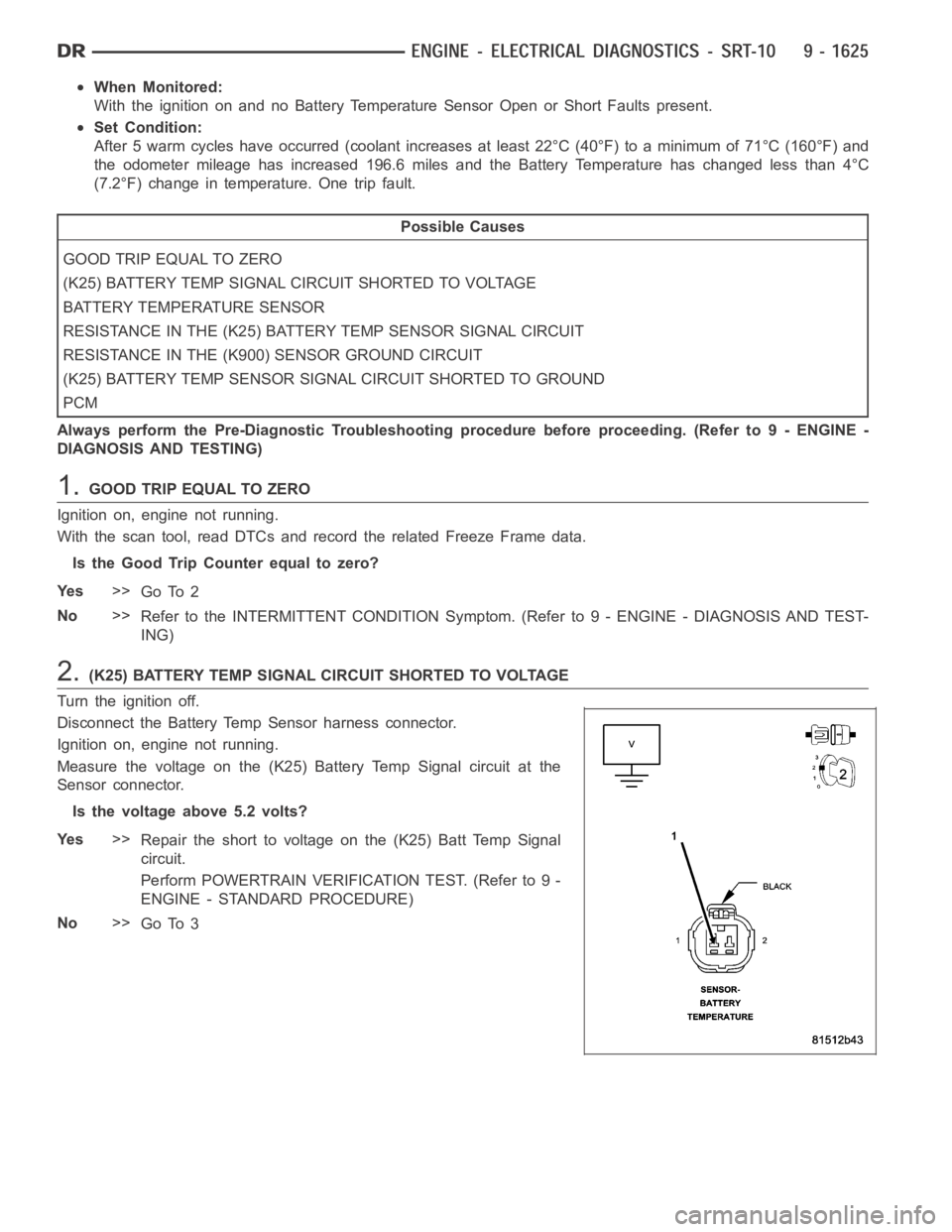
2.(K25) BATTERY TEMP SIGNAL CIRCUIT SHORTED TO VOLTAGE
Turn the ignition off.
Disconnect the Battery Temp Sensor harness connector.
Ignition on, engine not running.
Measure the voltage on the (K25) Battery Temp Signal circuit at the
Sensor connector.
Is the voltage above 5.2 volts?
Ye s>>
Repair the short to voltage on the (K25) Batt Temp Signal
circuit.
Perform POWERTRAIN VERIFICATION TEST. (Refer to 9 -
ENGINE - STANDARD PROCEDURE)
No>>
Go To 3
Page 949 of 5267
When Monitored:
With the ignition on and no Intake Air Temperature Sensor open/shorted faults present.
Set Condition:
After 5 warm cycles have occurred (coolant increases at least 22°C (40°F) to a minimum of 71°C (160°F) and
the odometer mileage has increased 196.6 miles and the Intake Air Temperature has had less than 5°C (9°F)
change in temperature.
Possible Causes
RESISTANCE IN THE (K21) IAT SENSOR SIGNAL CIRCUIT
RESISTANCE IN THE (K900) SENSOR GROUND CIRCUIT
IAT SENSOR
PCM
Always perform the Pre-Diagnostic Troubleshooting procedure before proceeding. (Refer to 9 - ENGINE -
DIAGNOSIS AND TESTING)
1.GOOD TRIP EQUAL TO ZERO
Ignition on, engine not running.
With the scan tool, read DTCs and record the related Freeze Frame data.
Is the Good Trip Counter equal to zero?
Ye s>>
Go To 2
No>>
Refer to the INTERMITTENT CONDITION Diagnostic Procedure. (Refer to 9 - ENGINE - DIAGNOSIS
AND TESTING)
2.IAT SENSOR VOLTAGE ABOVE 4.6 VOLTS
Turn the ignition off.
Disconnect the Intake Air Temperature Sensor harness connector.
Ignition on, engine not running.
With the scan tool, read the IAT voltage.
Is the voltage above 4.6 volts?
Ye s>>
Go To 3
No>>
Go To 5
Page 960 of 5267
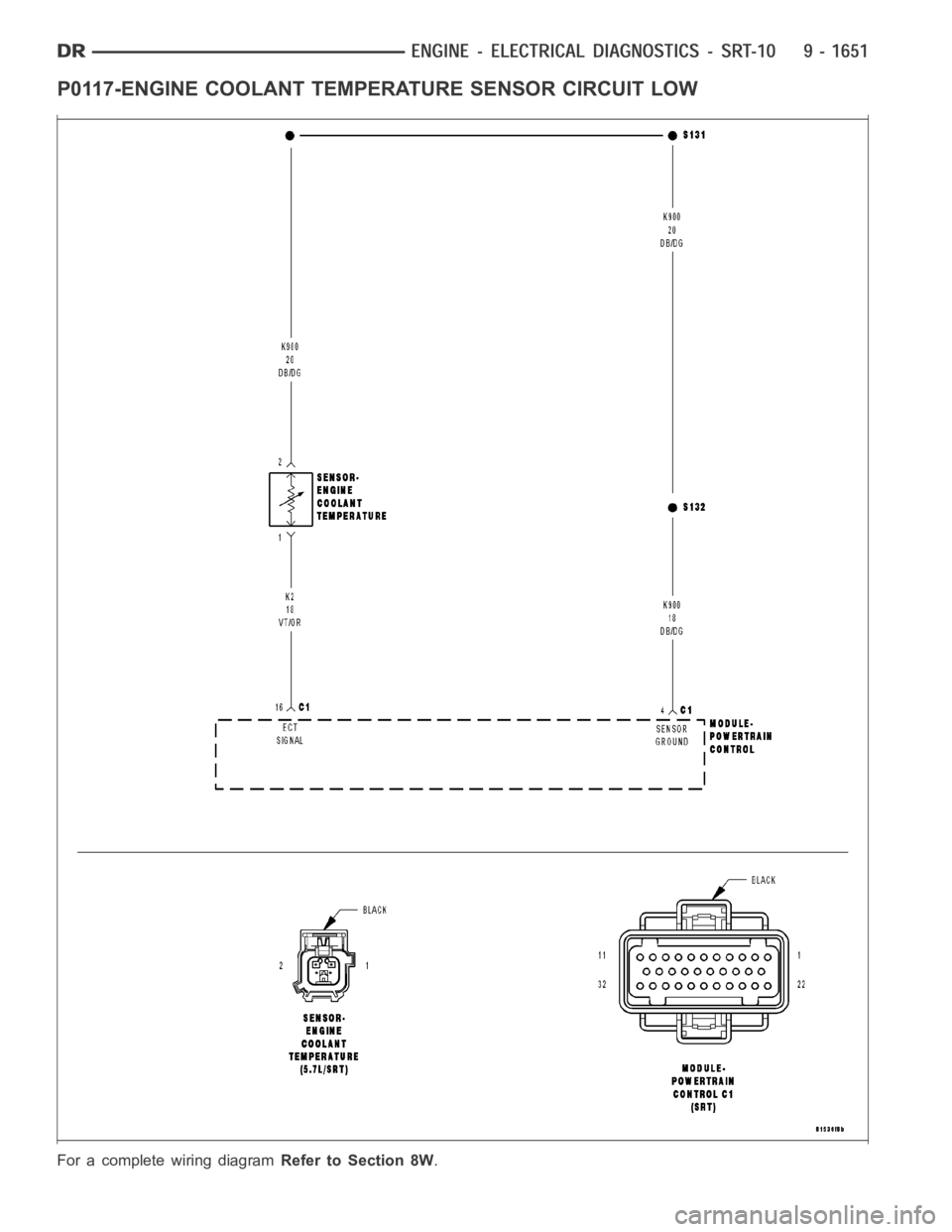
P0117-ENGINE COOLANT TEMPERATURE SENSOR CIRCUIT LOW
For a complete wiring diagramRefer to Section 8W.
Page 961 of 5267
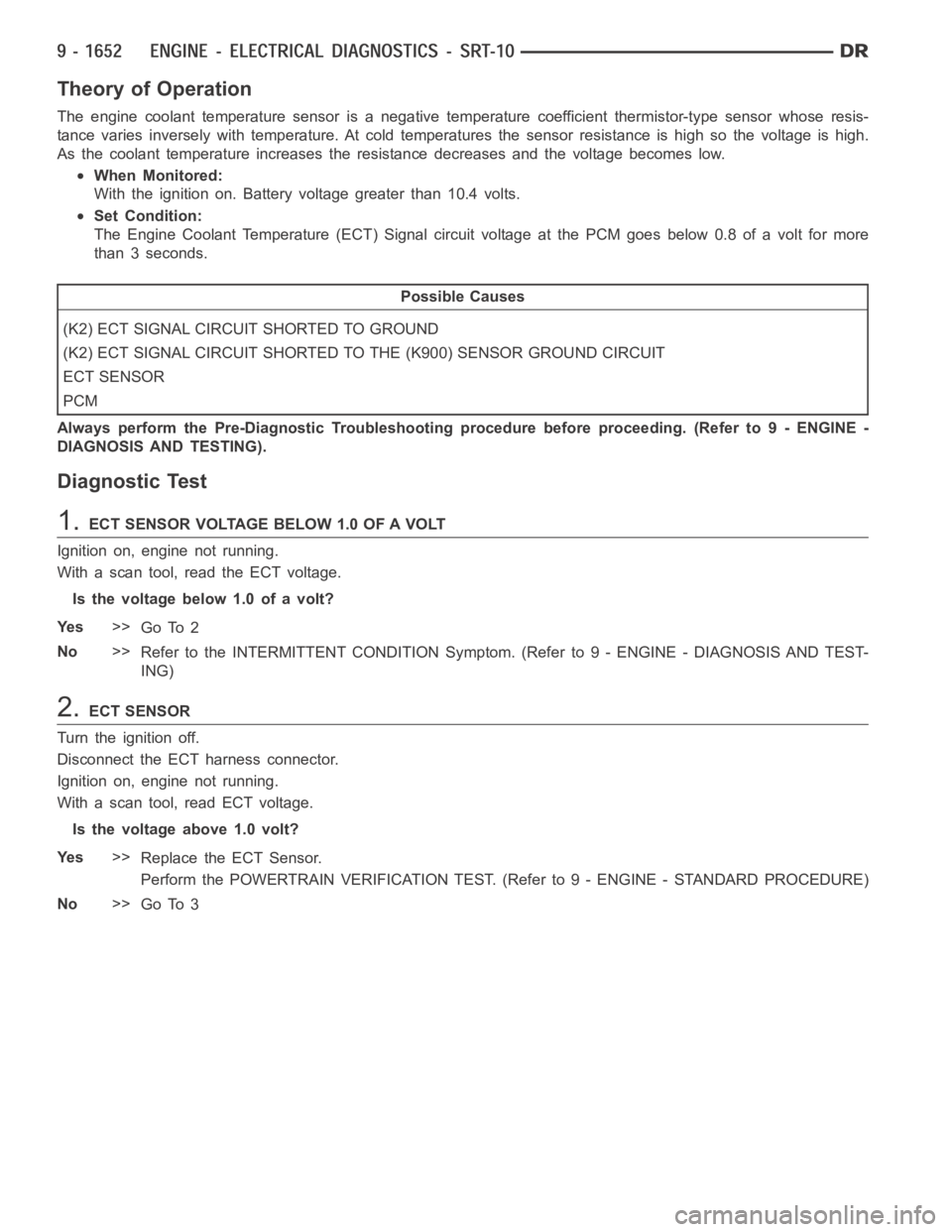
Theory of Operation
The engine coolant temperature sensor is a negative temperature coefficient thermistor-type sensor whose resis-
tance varies inversely with temperature. At cold temperatures the sensorresistance is high so the voltage is high.
As the coolant temperature increases the resistance decreases and the voltage becomes low.
When Monitored:
With the ignition on. Battery voltage greater than 10.4 volts.
Set Condition:
The Engine Coolant Temperature (ECT) Signal circuit voltage at the PCM goes below 0.8 of a volt for more
than 3 seconds.
Possible Causes
(K2) ECT SIGNAL CIRCUIT SHORTED TO GROUND
(K2) ECT SIGNAL CIRCUIT SHORTED TO THE (K900) SENSOR GROUND CIRCUIT
ECT SENSOR
PCM
Always perform the Pre-Diagnostic Troubleshooting procedure before proceeding. (Refer to 9 - ENGINE -
DIAGNOSIS AND TESTING).
Diagnostic Test
1.ECT SENSOR VOLTAGE BELOW 1.0 OF A VOLT
Ignition on, engine not running.
With a scan tool, read the ECT voltage.
Is the voltage below 1.0 of a volt?
Ye s>>
Go To 2
No>>
Refer to the INTERMITTENT CONDITION Symptom. (Refer to 9 - ENGINE - DIAGNOSIS AND TEST-
ING)
2.ECT SENSOR
Turn the ignition off.
Disconnect the ECT harness connector.
Ignition on, engine not running.
With a scan tool, read ECT voltage.
Is the voltage above 1.0 volt?
Ye s>>
Replace the ECT Sensor.
Perform the POWERTRAIN VERIFICATION TEST. (Refer to 9 - ENGINE - STANDARD PROCEDURE)
No>>
Go To 3
Page 964 of 5267
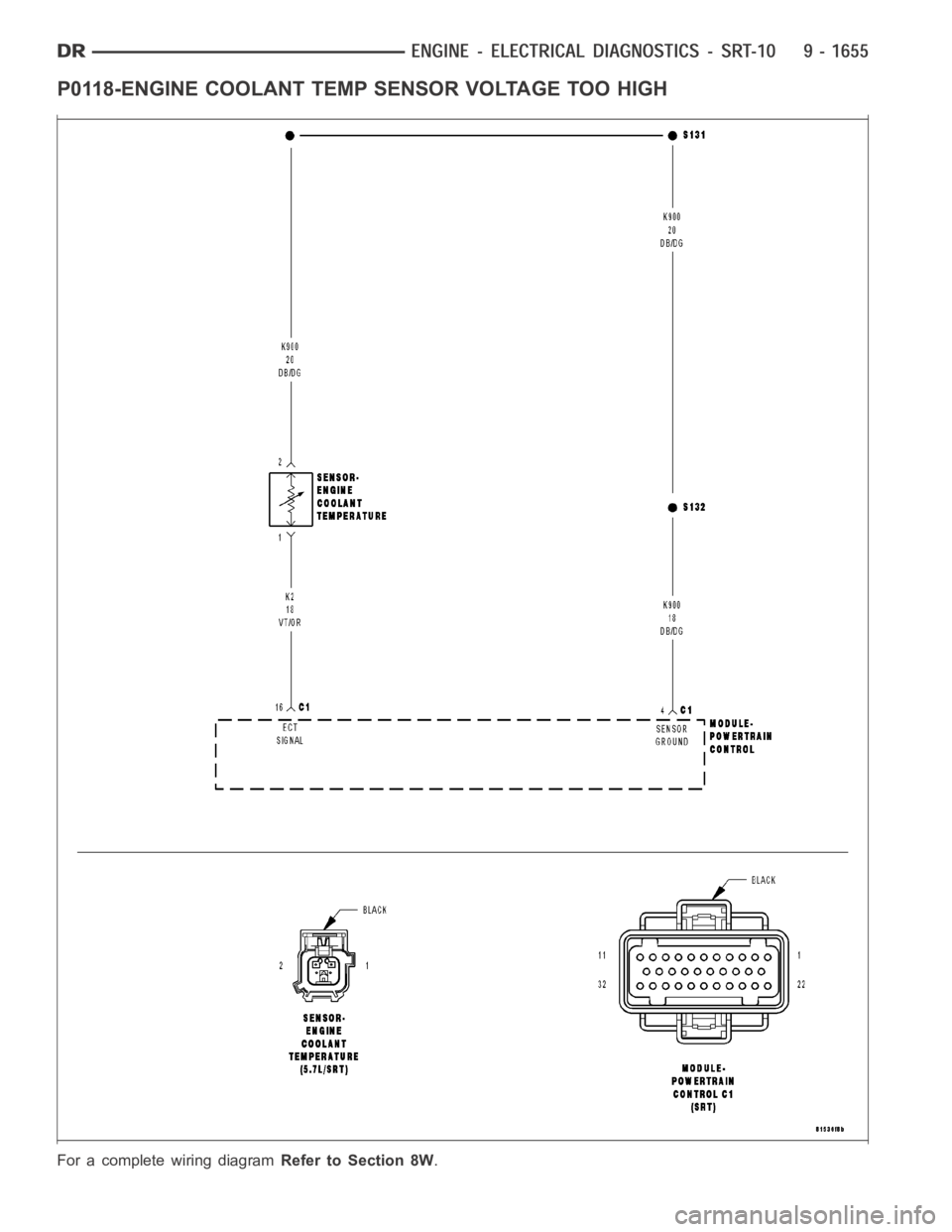
P0118-ENGINE COOLANT TEMP SENSOR VOLTAGE TOO HIGH
For a complete wiring diagramRefer to Section 8W.
Page 965 of 5267
When Monitored:
With the ignition on. Battery voltage greater than 10.4 volts.
Set Condition:
The Engine Coolant Temperature (ECT) sensor circuit voltage at the PCM is greater than 4.94 volts for more
than 3.0 seconds.
Possible Causes
(K2) ECT SIGNAL CIRCUIT SHORTED TO BATTERY VOLTAGE
(K2) ECT SIGNAL CIRCUIT OPEN
(K900) SENSOR GROUND CIRCUIT OPEN
ECT SENSOR
PCM
Always perform the Pre-Diagnostic Troubleshooting procedure before proceeding. (Refer to 9 - ENGINE -
DIAGNOSIS AND TESTING).
Diagnostic Test
1.ECT SENSOR VOLTAGE ABOVE 4.94 VOLTS
Ignition on, engine not running.
With a scan tool, read the ECT voltage.
Is the voltage above 4.94 volts?
Ye s>>
Go To 2
No>>
Refer to the INTERMITTENT CONDITION Symptom. (Refer to 9 - ENGINE - DIAGNOSIS AND TEST-
ING)
2.ECT SENSOR
Turn the ignition off.
Disconnect the ECT harness connector.
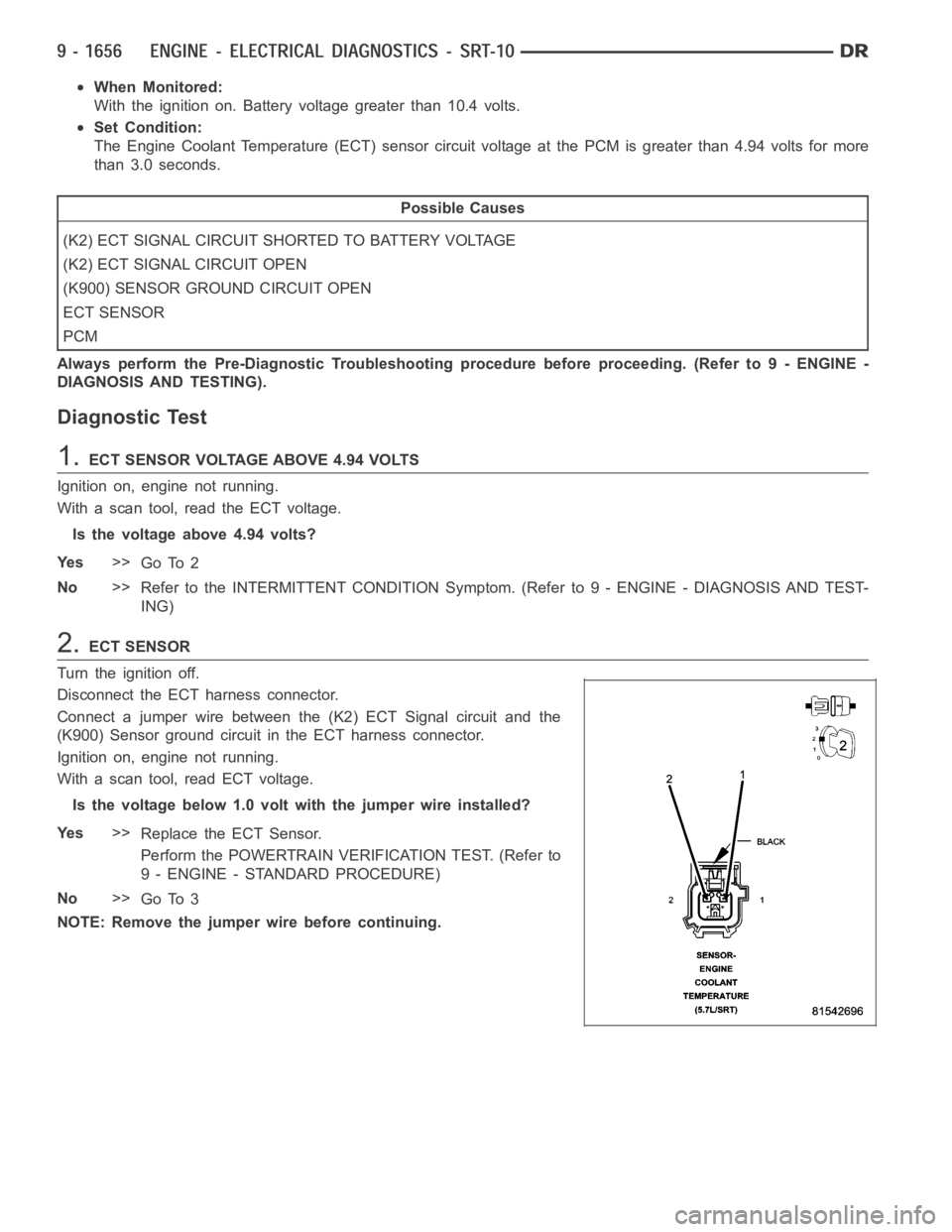
Connect a jumper wire between the (K2) ECT Signal circuit and the
(K900) Sensor ground circuit in the ECT harness connector.
Ignition on, engine not running.
With a scan tool, read ECT voltage.
Is the voltage below 1.0 volt with the jumper wire installed?
Ye s>>
Replace the ECT Sensor.
Perform the POWERTRAIN VERIFICATION TEST. (Refer to
9 - ENGINE - STANDARD PROCEDURE)
No>>
Go To 3
NOTE: Remove the jumper wire before continuing.
Page 986 of 5267
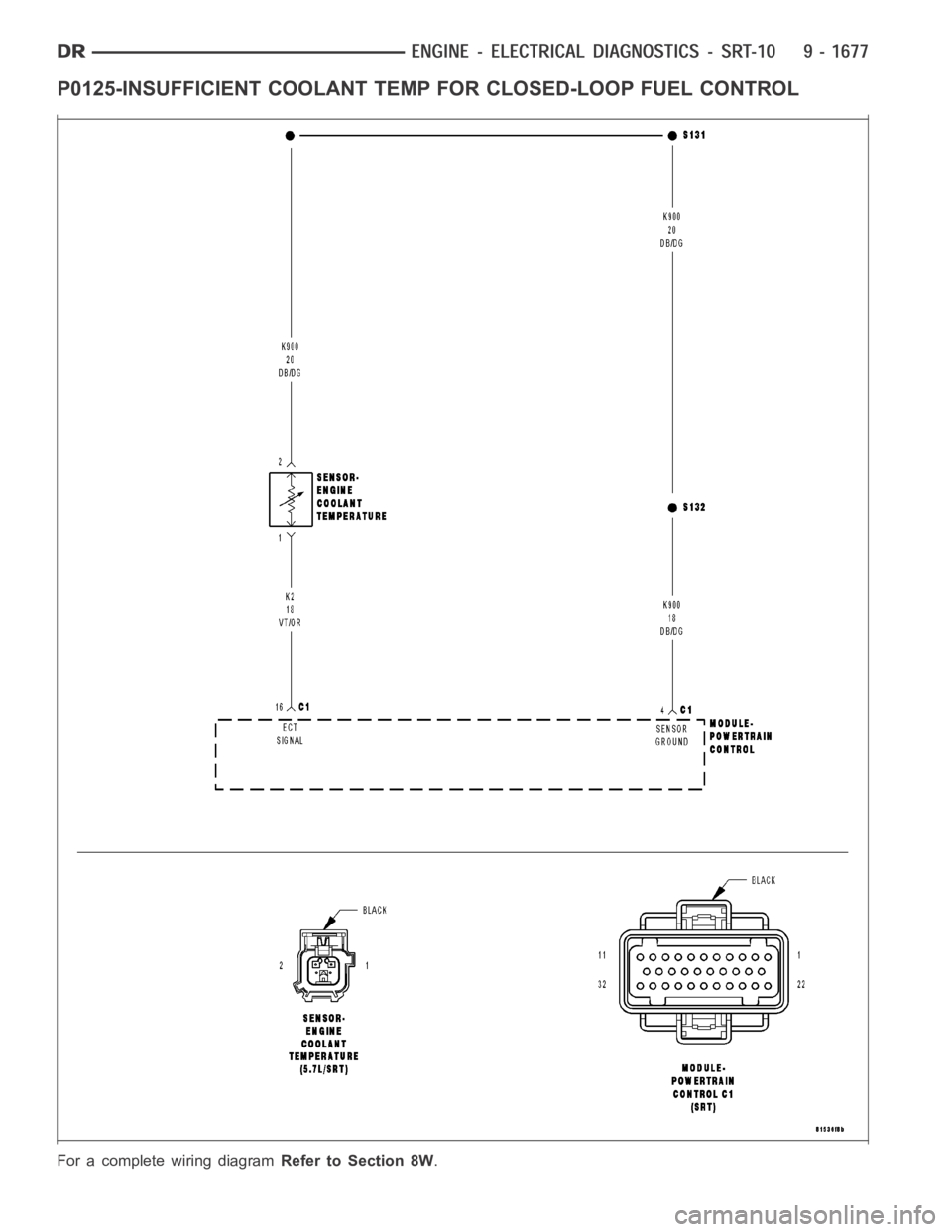
P0125-INSUFFICIENT COOLANT TEMP FOR CLOSED-LOOP FUEL CONTROL
For a complete wiring diagramRefer to Section 8W.
Page 987 of 5267
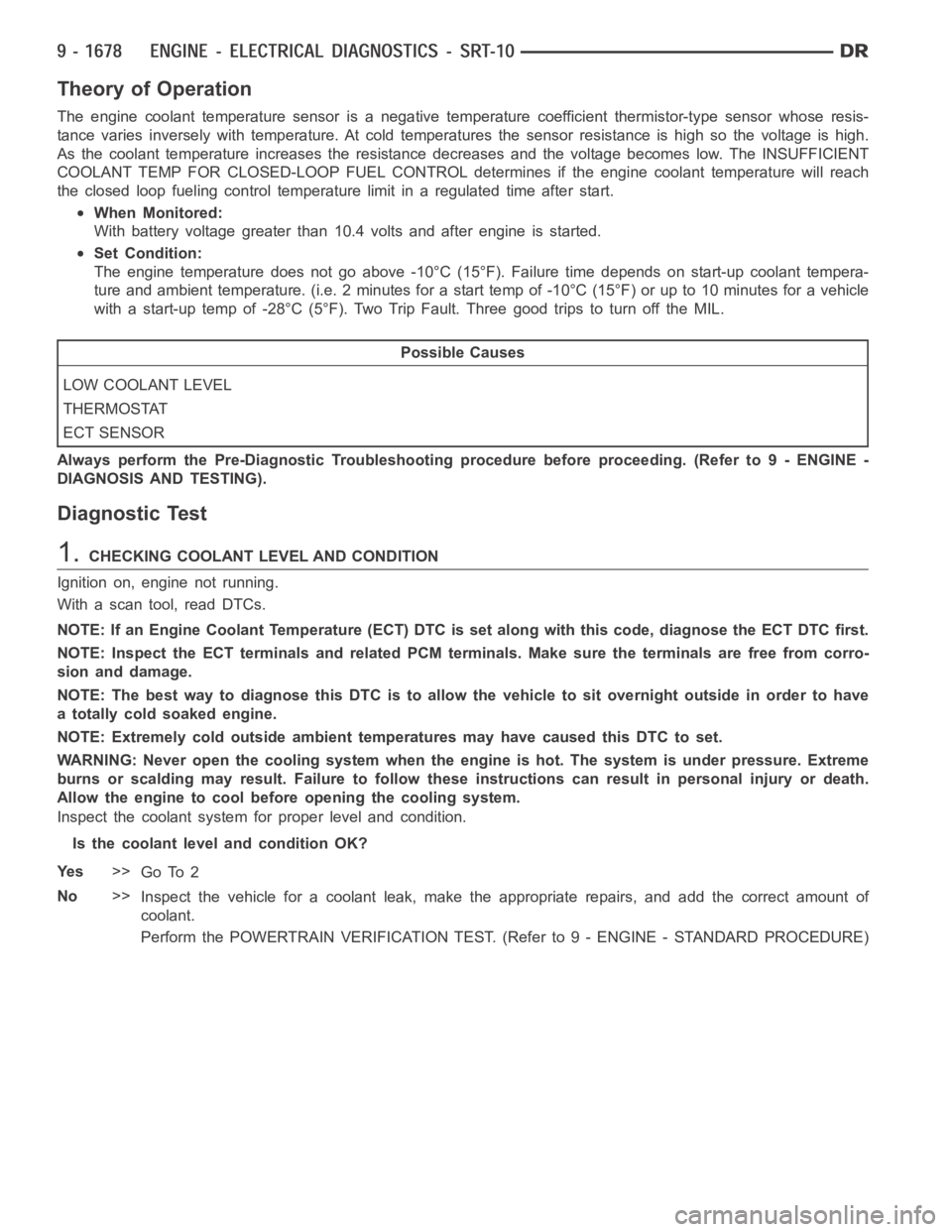
Theory of Operation
The engine coolant temperature sensor is a negative temperature coefficient thermistor-type sensor whose resis-
tance varies inversely with temperature. At cold temperatures the sensorresistance is high so the voltage is high.
As the coolant temperature increases the resistance decreases and the voltage becomes low. The INSUFFICIENT
COOLANT TEMP FOR CLOSED-LOOP FUEL CONTROL determines if the engine coolant temperature will reach
theclosedloopfuelingcontroltemperaturelimitinaregulatedtimeafterstart.
When Monitored:
With battery voltage greater than 10.4 volts and after engine is started.
Set Condition:
The engine temperature does not go above -10°C (15°F). Failure time depends on start-up coolant tempera-
ture and ambient temperature. (i.e. 2 minutes for a start temp of -10°C (15°F) or up to 10 minutes for a vehicle
with a start-up temp of -28°C (5°F). Two Trip Fault. Three good trips to turnoff the MIL.
Possible Causes
LOW COOLANT LEVEL
THERMOSTAT
ECT SENSOR
Always perform the Pre-Diagnostic Troubleshooting procedure before proceeding. (Refer to 9 - ENGINE -
DIAGNOSIS AND TESTING).
Diagnostic Test
1.CHECKING COOLANT LEVEL AND CONDITION
Ignition on, engine not running.
With a scan tool, read DTCs.
NOTE: If an Engine Coolant Temperature (ECT) DTC is set along with this code, diagnose the ECT DTC first.
NOTE: Inspect the ECT terminals and related PCM terminals. Make sure the terminals are free from corro-
sion and damage.
NOTE: The best way to diagnose this DTC is to allow the vehicle to sit overnight outside in order to have
a totally cold soaked engine.
NOTE: Extremely cold outside ambient temperatures may have caused this DTCtoset.
WARNING: Never open the cooling system when the engine is hot. The system isunder pressure. Extreme
burns or scalding may result. Failure to follow these instructions can result in personal injury or death.
Allow the engine to cool before opening the cooling system.
Inspect the coolant system for proper level and condition.
Is the coolant level and condition OK?
Ye s>>
Go To 2
No>>
Inspect the vehicle for a coolant leak, make the appropriate repairs, and add the correct amount of
coolant.
Perform the POWERTRAIN VERIFICATION TEST. (Refer to 9 - ENGINE - STANDARD PROCEDURE)
Page 988 of 5267
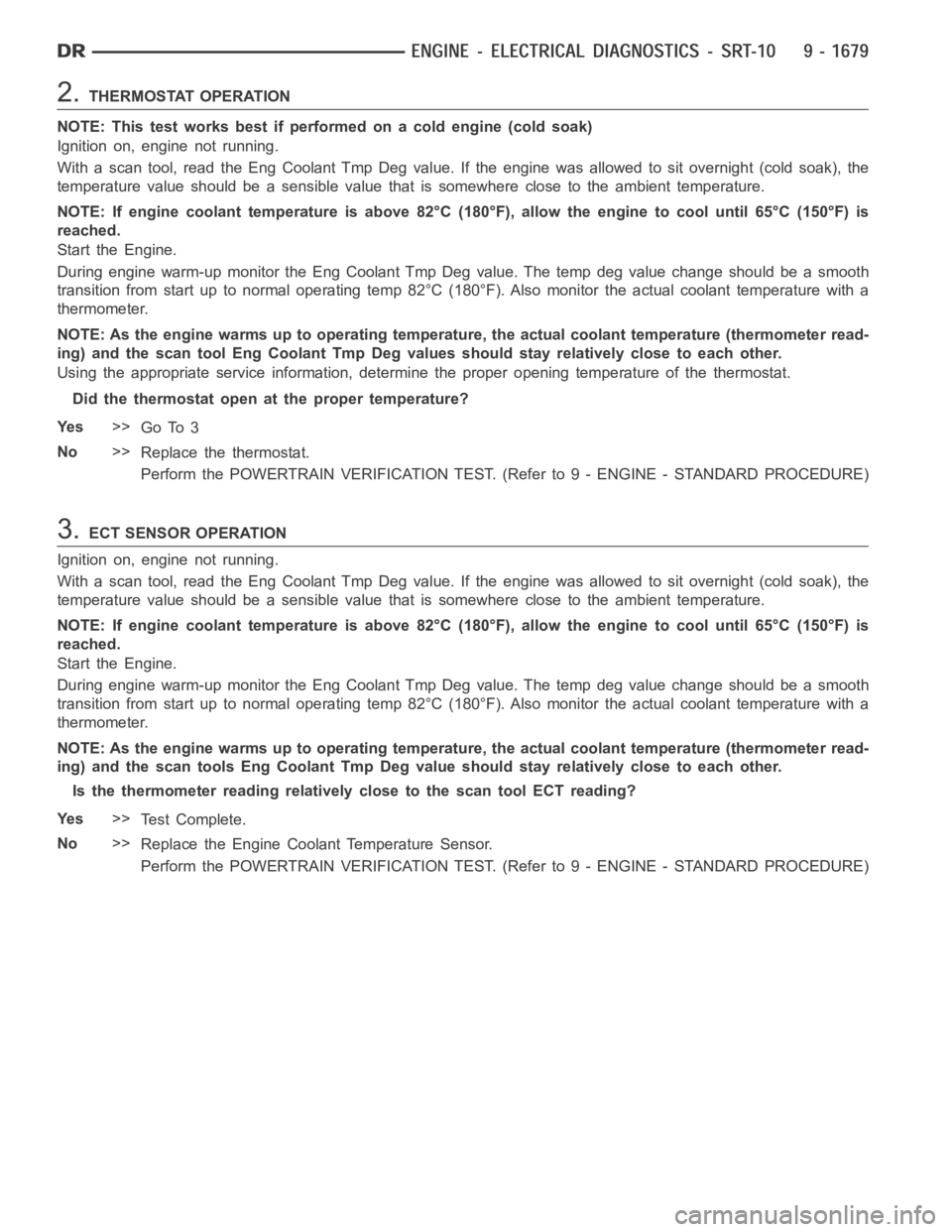
2.THERMOSTAT OPERATION
NOTE: This test works best if performed on a cold engine (cold soak)
Ignition on, engine not running.
With a scan tool, read the Eng Coolant Tmp Deg value. If the engine was allowed to sit overnight (cold soak), the
temperature value should be a sensible value that is somewhere close to theambient temperature.
NOTE: If engine coolant temperature is above 82°C (180°F), allow the engine to cool until 65°C (150°F) is
reached.
Start the Engine.
During engine warm-up monitor the Eng Coolant Tmp Deg value. The temp deg value change should be a smooth
transition from start up to normal operating temp 82°C (180°F). Also monitor the actual coolant temperature with a
thermometer.
NOTE: As the engine warms up to operating temperature, the actual coolant temperature (thermometer read-
ing) and the scan tool Eng Coolant Tmp Deg values should stay relatively close to each other.
Using the appropriate service information, determine the proper openingtemperature of the thermostat.
Did the thermostat open at the proper temperature?
Ye s>>
Go To 3
No>>
Replace the thermostat.
Perform the POWERTRAIN VERIFICATION TEST. (Refer to 9 - ENGINE - STANDARD PROCEDURE)
3.ECT SENSOR OPERATION
Ignition on, engine not running.
With a scan tool, read the Eng Coolant Tmp Deg value. If the engine was allowed to sit overnight (cold soak), the
temperature value should be a sensible value that is somewhere close to theambient temperature.
NOTE: If engine coolant temperature is above 82°C (180°F), allow the engine to cool until 65°C (150°F) is
reached.
Start the Engine.
During engine warm-up monitor the Eng Coolant Tmp Deg value. The temp deg value change should be a smooth
transition from start up to normal operating temp 82°C (180°F). Also monitor the actual coolant temperature with a
thermometer.
NOTE: As the engine warms up to operating temperature, the actual coolant temperature (thermometer read-
ing) and the scan tools Eng Coolant Tmp Deg value should stay relatively close to each other.
Is the thermometer reading relatively close to the scan tool ECT reading?
Ye s>>
Te s t C o m p l e t e .
No>>
Replace the Engine Coolant Temperature Sensor.
Perform the POWERTRAIN VERIFICATION TEST. (Refer to 9 - ENGINE - STANDARD PROCEDURE)