lock DODGE RAM SRT-10 2006 Service Repair Manual
[x] Cancel search | Manufacturer: DODGE, Model Year: 2006, Model line: RAM SRT-10, Model: DODGE RAM SRT-10 2006Pages: 5267, PDF Size: 68.7 MB
Page 1997 of 5267
LUBRICATION
DESCRIPTION
A gear driven gerotor type oil pump is mounted behind the front gear cover inthe lower right portion on the engine.
OPERATION
A gerotor style oil pump draws oil from the crankcase through the suction tube and delivers it through the block
where it enters the oil cooler cover and pressure regulator valve. When oilpressure exceeds 517 kPa (75 PSI), the
valve opens exposing the dump port, which routes excess oil back to the oil pump.
At the same time, oil is directed to a cast in passage in the oil cooler cover,leading to the oil cooler element. As the
oil travels through the element plates, it is cooled by engine coolant traveling past the outside of the plates. It is
then routed to the oil filter head and through a full flow oil filter. If a plugged filter is encountered, the filter by-pass
valve opens, allowing unfiltered oil to lubricate the engine. This condition can be avoided by frequent oil and filter
changes, per the maintenance schedules found in the owners manual. The by-pass valve is calibrated to open when
it sees a pressure drop of more than 345 kPa (50 psi) across the oil filter.
The oil filter head then divides the oil between the engine and the turbocharger. The turbocharger receives filtered,
cooled and pressurized oil through a supply line from the filter head. The oil lubricates the turbocharger and returns
to the pan by way of a drain tube connecting the bottom of the turbocharger toa tube in the cylinder block.
Page 1999 of 5267
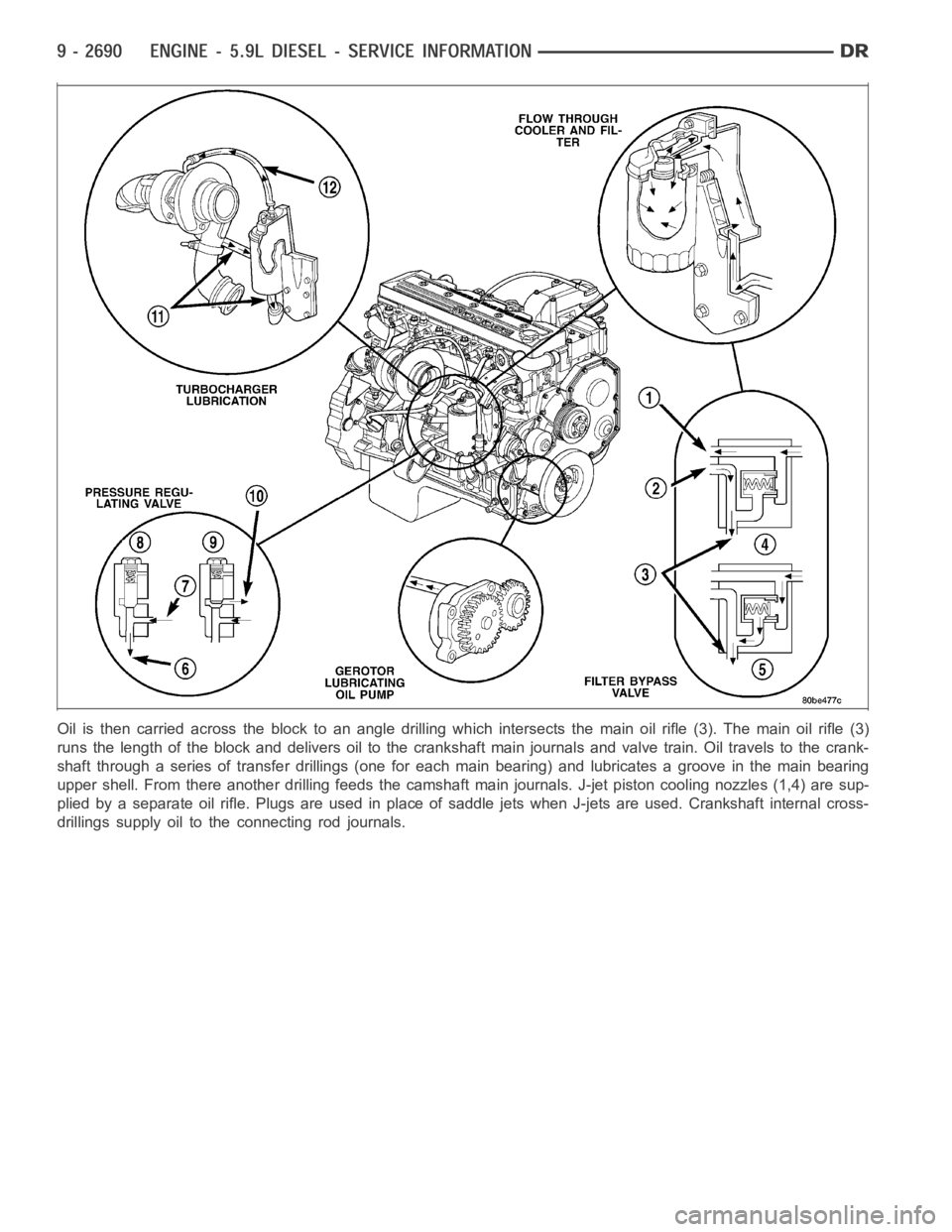
Oil is then carried across the block toan angle drilling which intersects the main oil rifle (3). The main oil rifle (3)
runs the length of the block and delivers oil to the crankshaft main journals and valve train. Oil travels to the crank-
shaft through a series of transfer drillings (one for each main bearing) and lubricates a groove in the main bearing
upper shell. From there another drilling feeds the camshaft main journals. J-jet piston cooling nozzles (1,4) are sup-
plied by a separate oil rifle. Plugs are used in place of saddle jets when J-jets are used. Crankshaft internal cross-
drillings supply oil to the connecting rod journals.
Page 2005 of 5267
PA N - E N G I N E O I L
REMOVAL
1. Disconnect the battery negative cables.
2. Install engine support fixture # 8534.
3. Raise vehicle on hoist.
4. Disconnect starter cables from starter motor.
5. Remove transmission and transfer case (if equipped).
6. Remove flywheel or flexplate.
7. Remove starter motor (Refer to 8 - ELECTRICAL/STARTING/STARTER MOTOR -REMOVAL) and transmission
adapter plate assembly.
WARNING: HOT OIL CAN CAUSE PERSONAL INJURY.
8. Drain the engine oil (Refer to 9 - ENGINE/LUBRICATION/OIL - STANDARD PROCEDURE).
9. Install the oil pan drain plug if sealing surface is not damaged and tighten to 50 Nꞏm (37 ft. lbs.) torque.
10. Remove oil pan bolts, break the pan to block seal, and lower pan slightlyandremoveoilsuctiontubefasteners.
11. Remove oil pan and suction tube.
CLEANING
Remove all gasket material from the oil pan and cylinder block sealing surfaces. Extra effort may be required
around T-joint areas. Clean oil pan and flush suction tube with a suitable solvent.
INSPECTION
Inspect the oil pan, suction tube, and tube braces for cracks and damage. Replace any defective component.
Inspect the oil drain plug and drain hole threads. Inspect the oil pan sealing surface for straightness. Repair any
minor imperfections with a ball-peen hammer. Do not attempt to repair an oil pan by welding.
INSTALLATION
1. Fill the T-joint between the pan rail/gear housing and pan rail/rear seal retainer with sealant. Use MoparSilicone
Rubber Adhesive Sealant or equivalent.
2. Place suction tube in oil pan and guide them into place. Slide oil pan gasket into postion.Using a new tube to
block gasket, install and tighten the suction tube bolts by hand. Startingwith the oil pump inlet bolts, tighten the
bolts to 24 Nꞏm (18 ft. lbs.) torque. Tighten the remaining tube brace boltsto 43 Nꞏm (32 ft. lbs.) torque.
3. Starting in the center and working outward, tighten the oil pan bolts to 28Nꞏm(21ft.lbs.)torque.
4. Install the flywheel housing assembly with the starter motor attached and tighten bolts to 77 Nꞏm (57 ft. lbs.)
torque.
5. Connect starter motor cables.
NOTE: A new clamping ring must be used on early or late builds, automatic or manual. Do not reuse clamp-
ing ring.
6. Install the flywheel to crankshaft adapter. Torque to 137 Nꞏm (101 ft. lbs.).
7. Install transmission and transfer case (if equipped).
8. Lower vehicle.
9. Remove the engine support fixture # 8534.
10. Install battery negative cables.
11. Fill the crankcase with new engine oil.
12. Start engine and check for leaks. Stop engine, check oil level, and adjust, if necessary.
Page 2007 of 5267
SWITCH - OIL PRESSURE
REMOVAL
1. Disconnect the battery negative cables.
2. Disconnect the oil pressure switch connector.
3. Usingasuitablesocket,removetheoil pressure switch from the block (counter-clockwise).
INSTALLATION
1. If the switch is not being replaced, replace and lubricate the o-ring.
2. Install the oil pressure switch and tighten to 18 Nꞏm (159 in. lbs.) torque.
3. Connect oil pressure switch connector.
4. Connect the battery negative cables.
5. Start engine and check for oil leaks at the switch.
Page 2008 of 5267
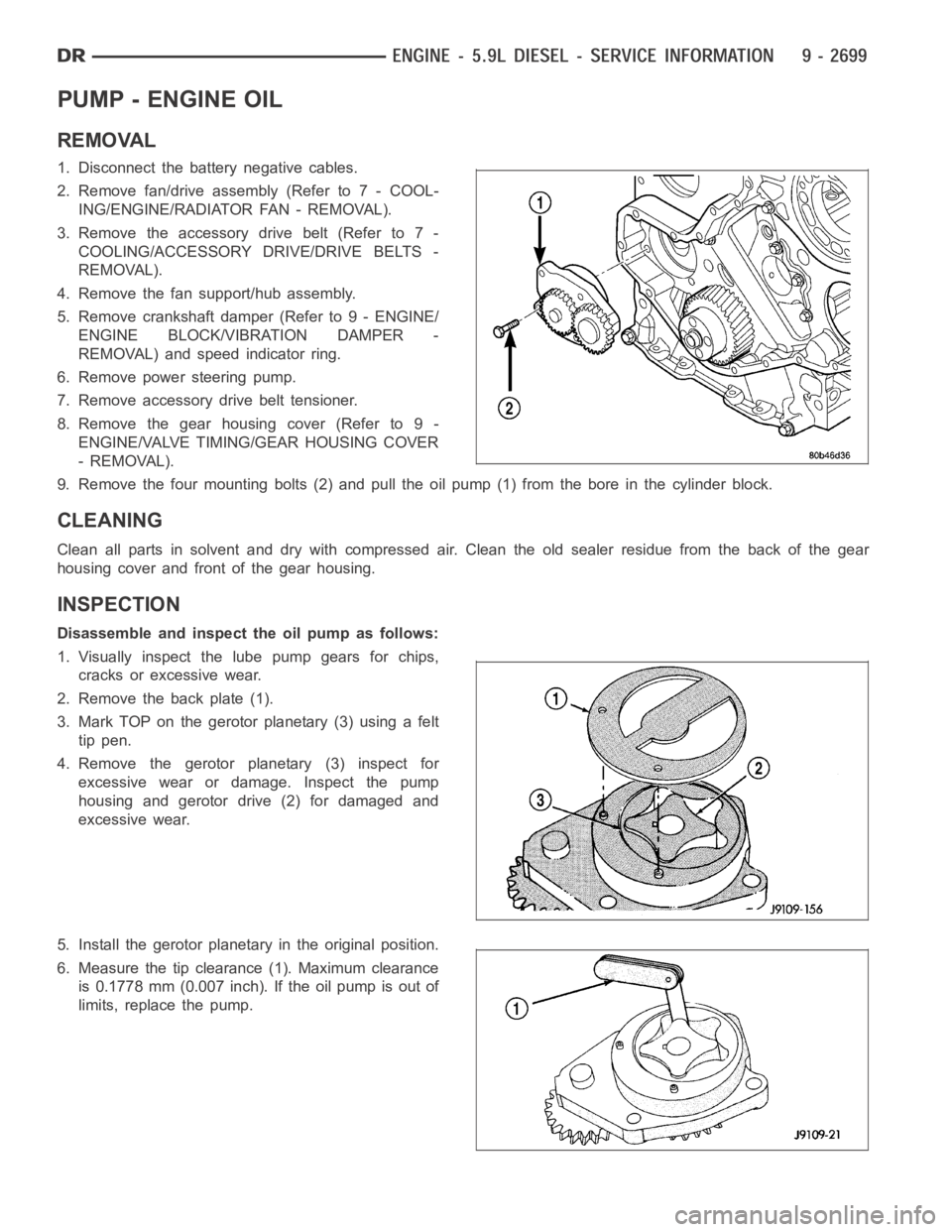
PUMP - ENGINE OIL
REMOVAL
1. Disconnect the battery negative cables.
2. Remove fan/drive assembly (Refer to 7 - COOL-
ING/ENGINE/RADIATOR FAN - REMOVAL).
3. Remove the accessory drive belt (Refer to 7 -
COOLING/ACCESSORY DRIVE/DRIVE BELTS -
REMOVAL).
4. Remove the fan support/hub assembly.
5. Remove crankshaft damper (Refer to 9 - ENGINE/
ENGINE BLOCK/VIBRATION DAMPER -
REMOVAL) and speed indicator ring.
6. Remove power steering pump.
7. Remove accessory drive belt tensioner.
8. Remove the gear housing cover (Refer to 9 -
ENGINE/VALVE TIMING/GEAR HOUSING COVER
- REMOVAL).
9. Remove the four mounting bolts (2) and pull the oil pump (1) from the bore in the cylinder block.
CLEANING
Clean all parts in solvent and dry with compressed air. Clean the old sealerresidue from the back of the gear
housing cover and front of the gear housing.
INSPECTION
Disassemble and inspect the oil pump as follows:
1. Visually inspect the lube pump gears for chips,
cracks or excessive wear.
2. Remove the back plate (1).
3. Mark TOP on the gerotor planetary (3) using a felt
tip pen.
4. Remove the gerotor planetary (3) inspect for
excessive wear or damage. Inspect the pump
housing and gerotor drive (2) for damaged and
excessive wear.
5. Install the gerotor planetary in the original position.
6. Measure the tip clearance (1). Maximum clearance
is 0.1778 mm (0.007 inch). If the oil pump is out of
limits, replace the pump.
Page 2009 of 5267
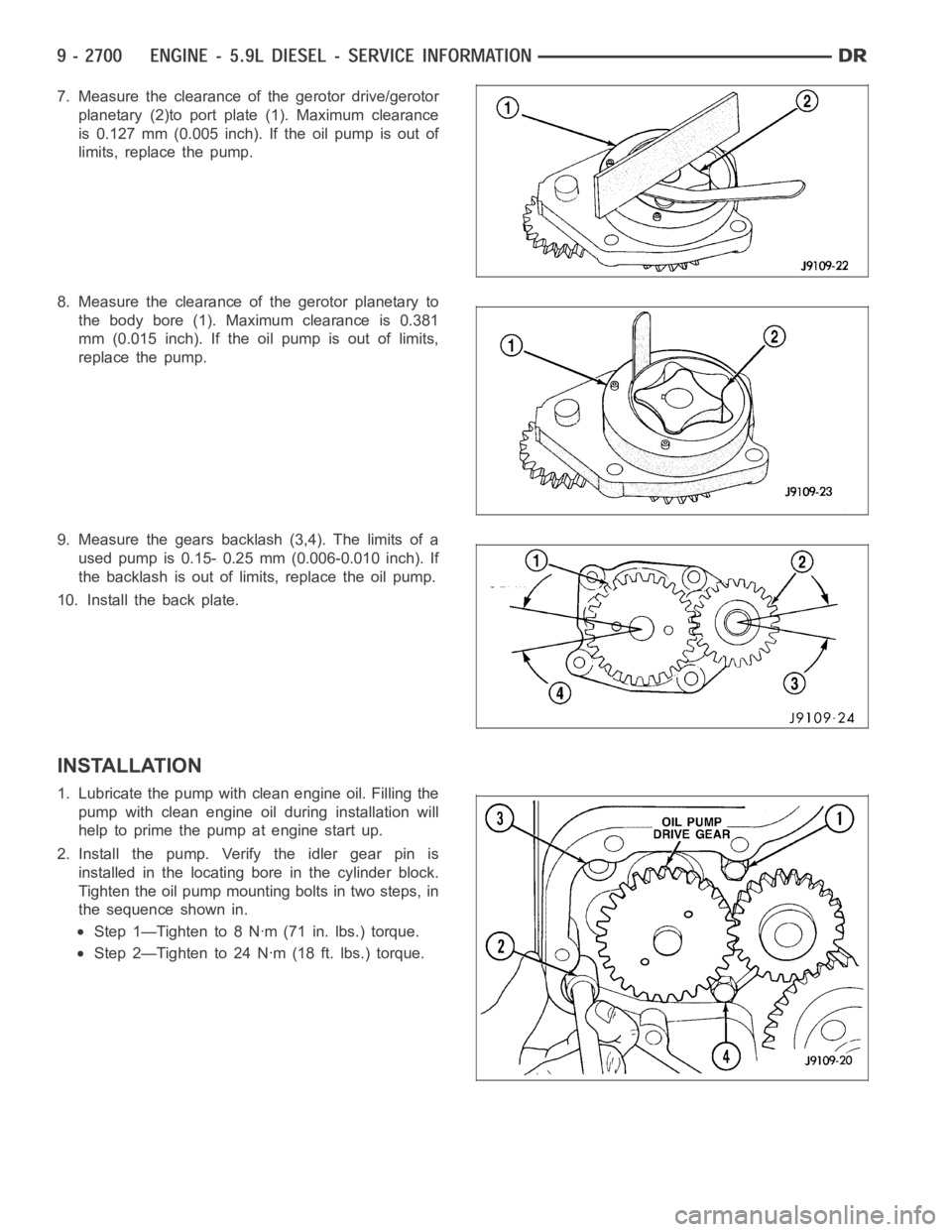
7. Measure the clearance of the gerotor drive/gerotor
planetary (2)to port plate (1). Maximum clearance
is 0.127 mm (0.005 inch). If the oil pump is out of
limits, replace the pump.
8. Measure the clearance of the gerotor planetary to
the body bore (1). Maximum clearance is 0.381
mm (0.015 inch). If the oil pump is out of limits,
replace the pump.
9. Measure the gears backlash (3,4). The limits of a
used pump is 0.15- 0.25 mm (0.006-0.010 inch). If
the backlash is out of limits, replace the oil pump.
10. Install the back plate.
INSTALLATION
1. Lubricate the pump withclean engine oil. Filling the
pump with clean engine oil during installation will
help to prime the pump at engine start up.
2. Install the pump. Verify the idler gear pin is
installed in the locating bore in the cylinder block.
Tighten the oil pump mounting bolts in two steps, in
the sequence shown in.
Step 1—Tighten to 8 Nꞏm (71 in. lbs.) torque.
Step 2—Tighten to 24 Nꞏm (18 ft. lbs.) torque.
Page 2010 of 5267
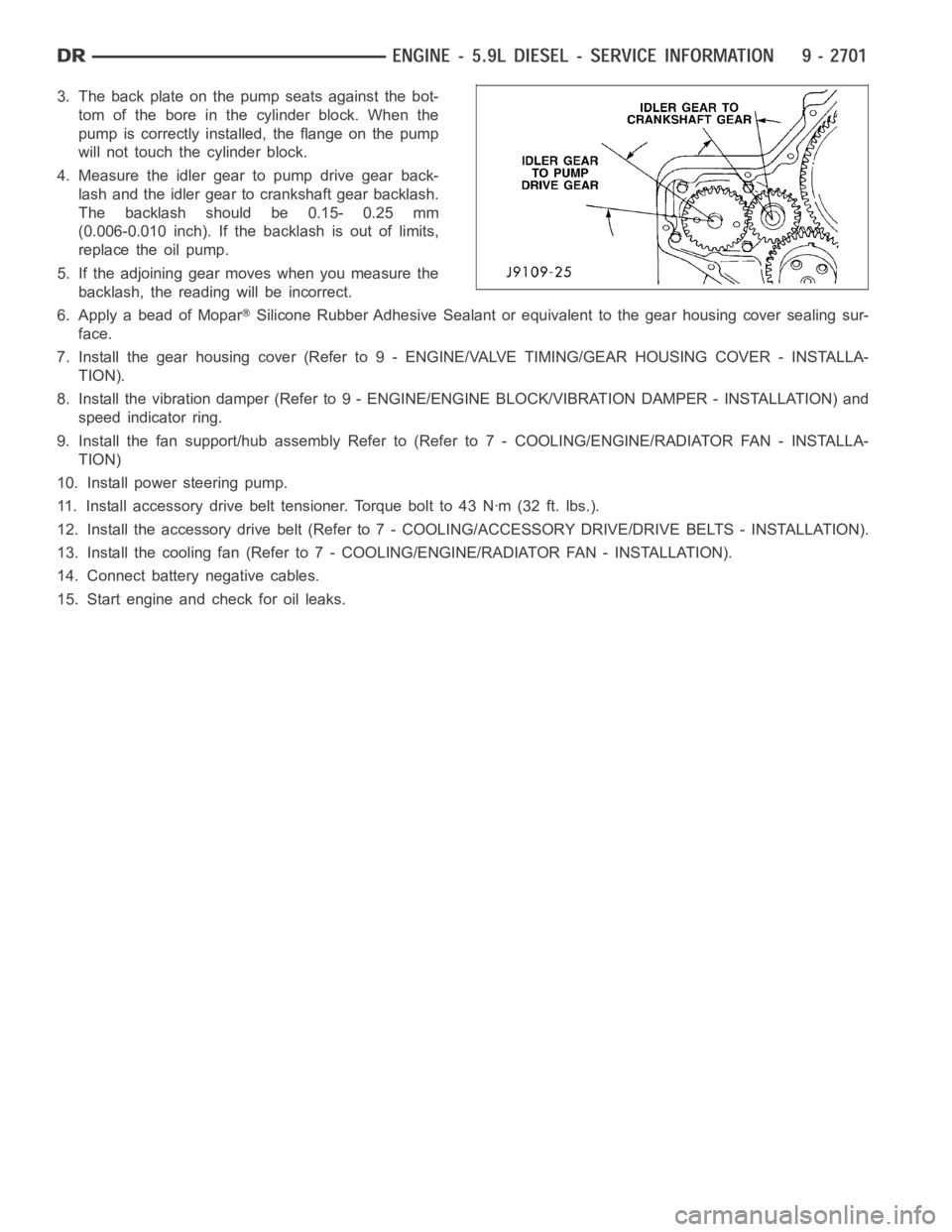
3. The back plate on the pump seats against the bot-
tom of the bore in the cylinder block. When the
pump is correctly installed, the flange on the pump
will not touch the cylinder block.
4. Measure the idler gear to pump drive gear back-
lash and the idler gear to crankshaft gear backlash.
The backlash should be 0.15- 0.25 mm
(0.006-0.010 inch). If the backlash is out of limits,
replace the oil pump.
5. If the adjoining gear moves when you measure the
backlash, the reading will be incorrect.
6. Apply a bead of Mopar
Silicone Rubber Adhesive Sealant or equivalent to the gear housing cover sealing sur-
face.
7. Install the gear housing cover (Refer to 9 - ENGINE/VALVE TIMING/GEAR HOUSING COVER - INSTALLA-
TION).
8. Install the vibration damper (Refer to 9 - ENGINE/ENGINE BLOCK/VIBRATION DAMPER - INSTALLATION) and
speed indicator ring.
9. Install the fan support/hub assemblyRefer to (Refer to 7 - COOLING/ENGINE/RADIATOR FAN - INSTALLA-
TION)
10. Install power steering pump.
11. Install accessory drive belt tensioner. Torque bolt to 43 Nꞏm (32 ft. lbs.).
12. Install the accessory drive belt (Refer to 7 - COOLING/ACCESSORY DRIVE/DRIVE BELTS - INSTALLATION).
13. Install the cooling fan (Refer to 7 - COOLING/ENGINE/RADIATOR FAN - INSTALLATION).
14. Connect battery negative cables.
15. Start engine and check for oil leaks.
Page 2012 of 5267
CLEANING
Clean manifold in solvent and blow dry with compressed air.
Clean cylinder block gasket surfaces using a suitable solvent.
The plenum pan rail must be clean and dry (free of all foreign material).
INSPECTION
Inspect manifold for cracks.
Inspect mating surfaces of manifold for flatness with a straightedge.
INSTALLATION
1. Using a new gasket, install the intake manifold cover.
2. Install the cover-to-cylinder head bolts that do not hold down the fuel rail.Tightentheboltsto24Nꞏm(18ft.lbs.)
torque.
3. Install the high pressure rail and fuel lines (Refer to 14 - FUEL SYSTEM/FUEL DELIVERY/FUEL LINES -
INSTALLATION).
4. Using two (2) new gaskets, install the intake air grid heater and air inlet housing.
5. Connect the manifold air temperature/pressure sensor connector.
6. Install and tighten the air intake heater power supply nut to 14 Nꞏm (120 in. lbs.) torque.
7. Install oil dipstick tube support at fuel filter housing.
8. Install the engine oil dipstick tube and mounting bolt.
9. Position the charge air cooler outlet tube onto the air inlet housing. Tightentheclampsto11Nꞏm(100in.lbs.)
torque.
10. Attach the engine wire harness to the air inlet housing.
11. Prime the fuel system. Refer to the fuel priming procedure in Group 14, Fuel System.
12. Connect the battery negative cables.
Page 2013 of 5267
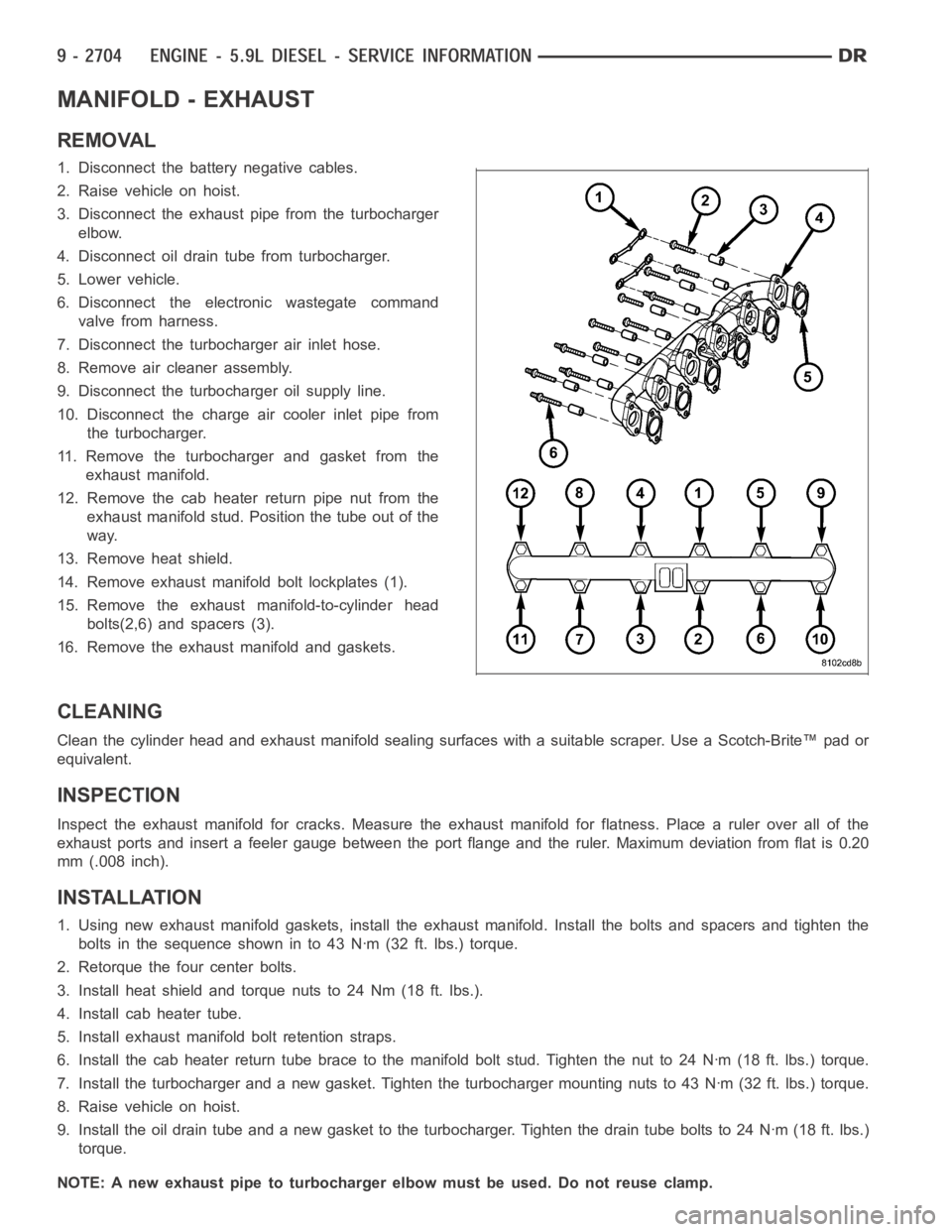
MANIFOLD - EXHAUST
REMOVAL
1. Disconnect the battery negative cables.
2. Raise vehicle on hoist.
3. Disconnect the exhaust pipe from the turbocharger
elbow.
4. Disconnect oil drain tube from turbocharger.
5. Lower vehicle.
6. Disconnect the electronic wastegate command
valve from harness.
7. Disconnect the turbocharger air inlet hose.
8. Remove air cleaner assembly.
9. Disconnect the turbocharger oil supply line.
10. Disconnect the charge air cooler inlet pipe from
the turbocharger.
11. Remove the turbocharger and gasket from the
exhaust manifold.
12. Remove the cab heater return pipe nut from the
exhaust manifold stud. Position the tube out of the
way.
13. Remove heat shield.
14. Remove exhaust manifold bolt lockplates (1).
15. Remove the exhaust manifold-to-cylinder head
bolts(2,6) and spacers (3).
16. Remove the exhaust manifold and gaskets.
CLEANING
Clean the cylinder head and exhaust manifold sealing surfaces with a suitable scraper. Use a Scotch-Brite™ pad or
equivalent.
INSPECTION
Inspect the exhaust manifold for cracks. Measure the exhaust manifold forflatness. Place a ruler over all of the
exhaust ports and insert a feeler gauge between the port flange and the ruler. Maximum deviation from flat is 0.20
mm (.008 inch).
INSTALLATION
1. Using new exhaust manifold gaskets, install the exhaust manifold. Install the bolts and spacers and tighten the
bolts in the sequence shown in to 43 Nꞏm (32 ft. lbs.) torque.
2. Retorque the four center bolts.
3. Install heat shield and torque nuts to 24 Nm (18 ft. lbs.).
4. Install cab heater tube.
5. Install exhaust manifold bolt retention straps.
6. Install the cab heater return tube brace to the manifold bolt stud. Tighten the nut to 24 Nꞏm (18 ft. lbs.) torque.
7. Install the turbocharger and a new gasket. Tighten the turbocharger mountingnutsto43Nꞏm(32ft.lbs.)torque.
8. Raise vehicle on hoist.
9. Install the oil drain tube and a new gasket to the turbocharger. Tighten the drain tube bolts to 24 Nꞏm (18 ft. lbs.)
torque.
NOTE: A new exhaust pipe to turbocharger elbow must be used. Do not reuse clamp.
Page 2015 of 5267
VALVE TIMING
STANDARD PROCEDURE - TIMING VERIFICATION
1. Remove the cylinder head cover (Refer to 9 - ENGINE/CYLINDER HEAD/CYLINDER HEAD COVER(S) -
REMOVAL).
2. Remove fuel injector from cylindernumber 1 (Refer to 14 - FUEL SYSTEM/FUEL INJECTION/FUEL INJECTOR
- REMOVAL).
3. Using Special Tool 7471B rotate the engine until the TDC mark on the damper is at 12 o’clock.
4. Using a 8 in.x 1/4 in. dowel rod inserted into cylinder number 1, rock the crankshaft back and forth to verify
piston number 1 is at TDC.
5. With cylinder number still at TDC, inspect the keyway on the crankshaft gear for proper alignment (12 o’clock
position).
6. If the keyway is not at 12 o’clock position replace the crankshaft gear assembly.
7. If the keyway is at 12 o’clock position, remove front gear cover and verify timing mark alignment between the
camshaft gear and crankshaft gear, if not aligned inspect keyway on camshaft gear.
8. Inspect keyway on camshaft gear for proper alignment with the key in the camshaft, if alignment is off replace
the camshaft/gear assembly.
9. If timing marks alignment is off and no damage is found at either the crankshaft or camshaft gear keyways,
realign timing marks as necessary.