torque DODGE RAM SRT-10 2006 Service Repair Manual
[x] Cancel search | Manufacturer: DODGE, Model Year: 2006, Model line: RAM SRT-10, Model: DODGE RAM SRT-10 2006Pages: 5267, PDF Size: 68.7 MB
Page 4010 of 5267
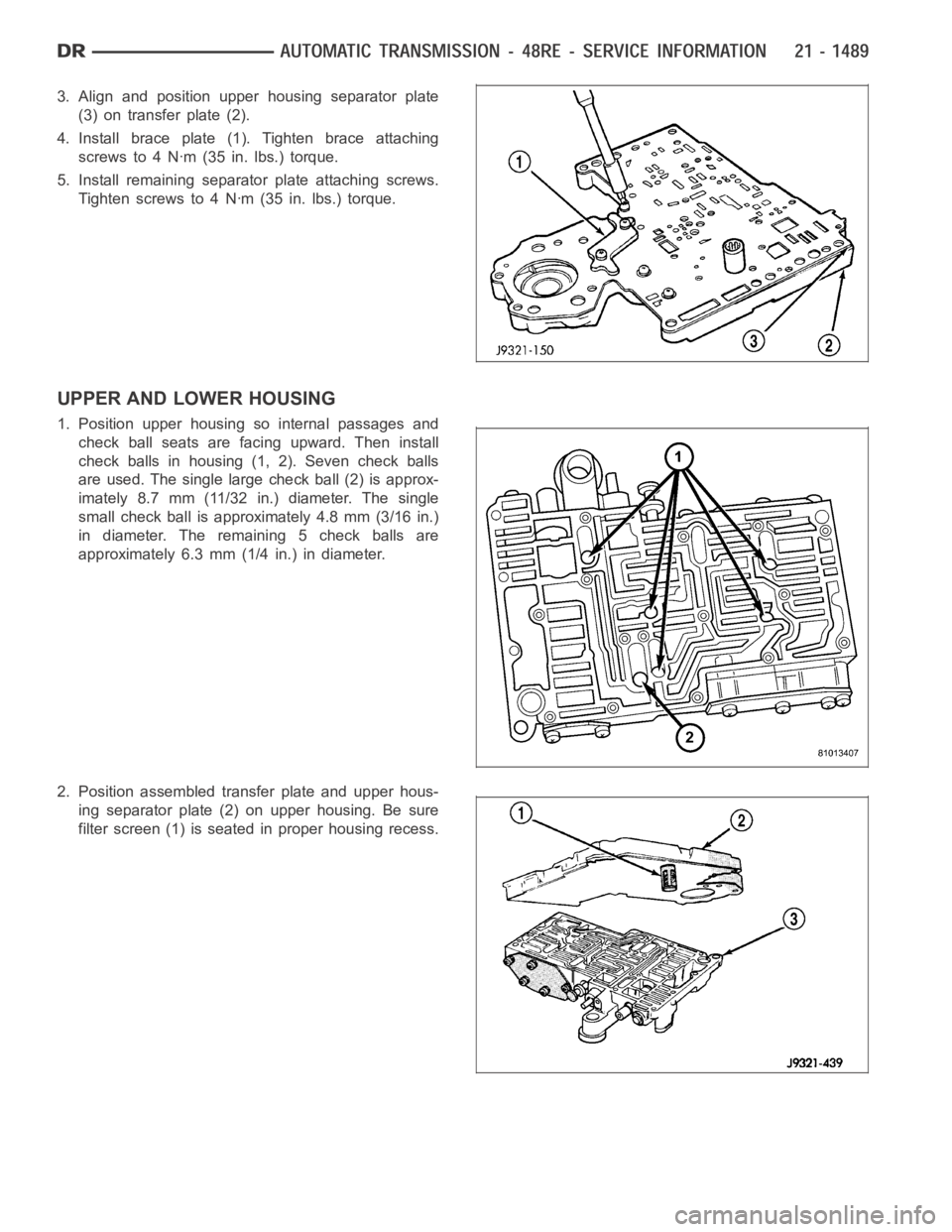
3. Align and position upper housing separator plate
(3) on transfer plate (2).
4. Install brace plate (1). Tighten brace attaching
screws to 4 Nꞏm (35 in. lbs.) torque.
5. Install remaining separator plate attaching screws.
Tighten screws to 4 Nꞏm (35 in. lbs.) torque.
UPPER AND LOWER HOUSING
1. Position upper housing so internal passages and
check ball seats are facing upward. Then install
check balls in housing (1, 2). Seven check balls
are used. The single large check ball (2) is approx-
imately 8.7 mm (11/32 in.) diameter. The single
small check ball is approximately 4.8 mm (3/16 in.)
in diameter. The remaining 5 check balls are
approximately 6.3 mm (1/4 in.) in diameter.
2. Position assembled transfer plate and upper hous-
ing separator plate (2) on upper housing. Be sure
filter screen (1) is seated in proper housing recess.
Page 4011 of 5267
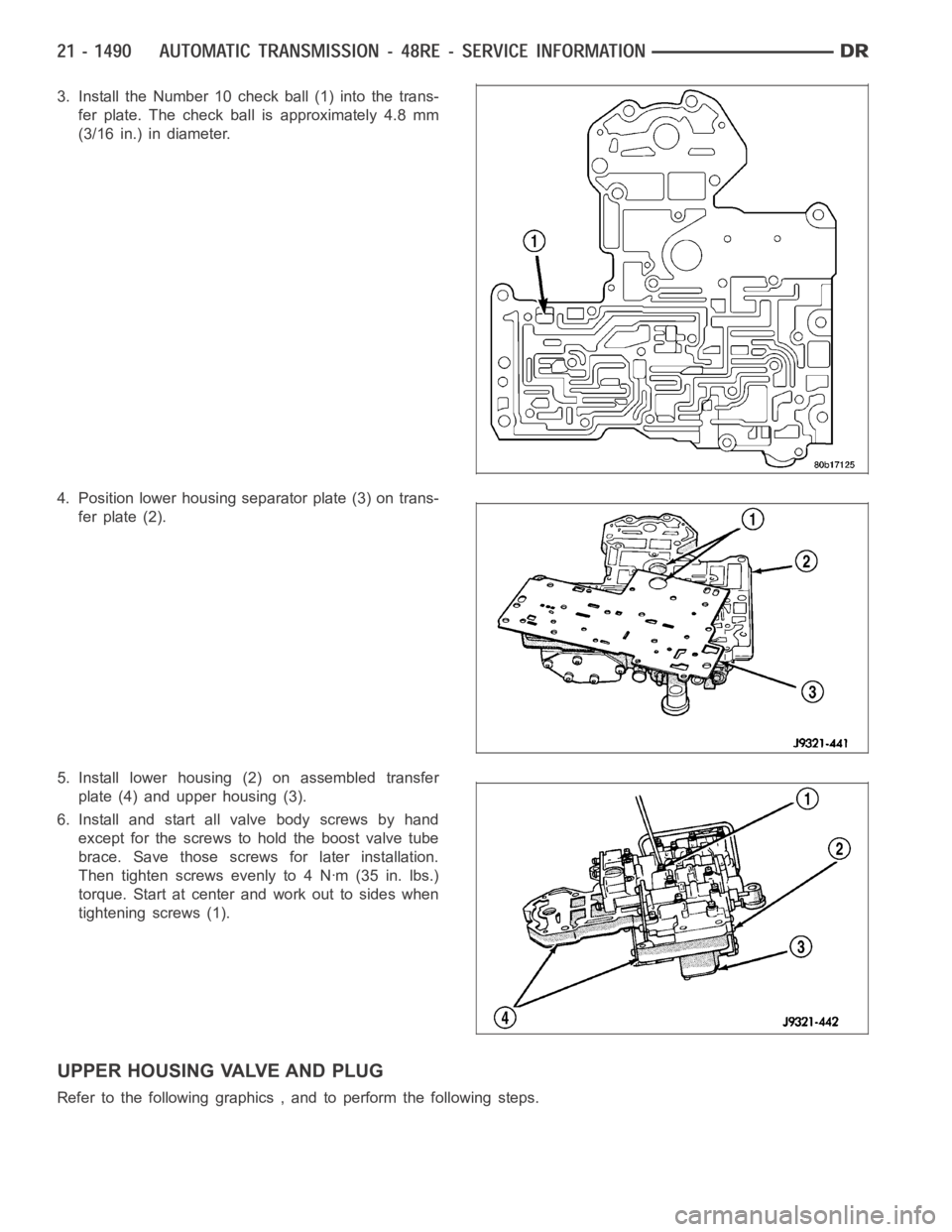
3. Install the Number 10 check ball (1) into the trans-
fer plate. The check ball is approximately 4.8 mm
(3/16 in.) in diameter.
4. Position lower housing separator plate (3) on trans-
fer plate (2).
5. Install lower housing (2) on assembled transfer
plate (4) and upper housing (3).
6. Install and start all valve body screws by hand
except for the screws to hold the boost valve tube
brace. Save those screws for later installation.
Then tighten screws evenly to 4 Nꞏm (35 in. lbs.)
torque. Start at center and work out to sides when
tightening screws (1).
UPPER HOUSING VALVE AND PLUG
Refer to the following graphics , and to perform the following steps.
Page 4012 of 5267
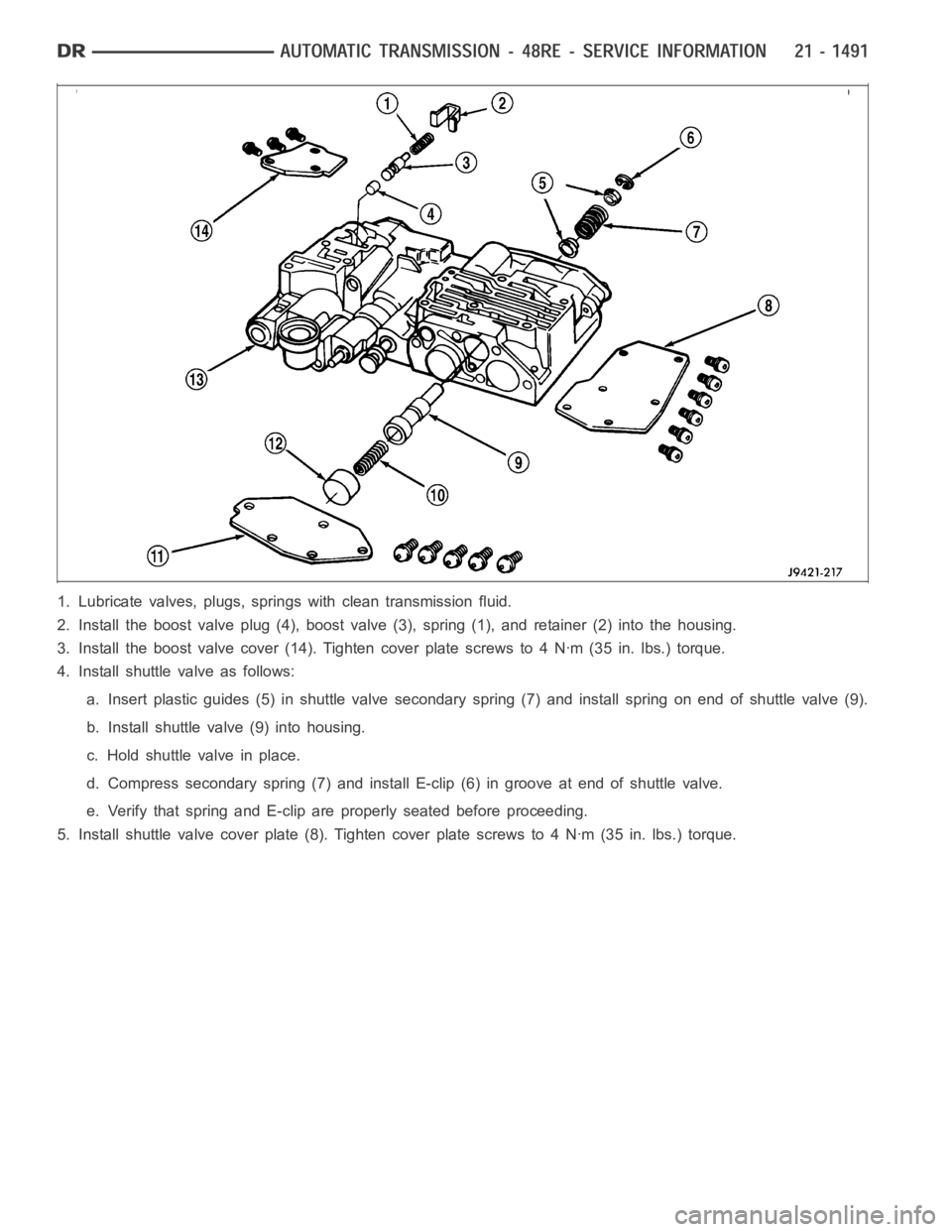
1. Lubricate valves, plugs, springs with clean transmission fluid.
2. Install the boost valve plug (4), boost valve (3), spring (1), and retainer (2) into the housing.
3. Install the boost valve cover (14). Tighten cover plate screws to 4 Nꞏm (35 in. lbs.) torque.
4. Install shuttle valve as follows:
a. Insert plastic guides (5) in shuttle valve secondary spring (7) and install spring on end of shuttle valve (9).
b. Install shuttle valve (9) into housing.
c. Hold shuttle valve in place.
d. Compress secondary spring (7) and install E-clip (6) in groove at end of shuttle valve.
e. Verify that spring and E-clip are properly seated before proceeding.
5. Install shuttle valve cover plate (8). Tighten cover plate screws to 4 Nꞏm (35 in. lbs.) torque.
Page 4013 of 5267
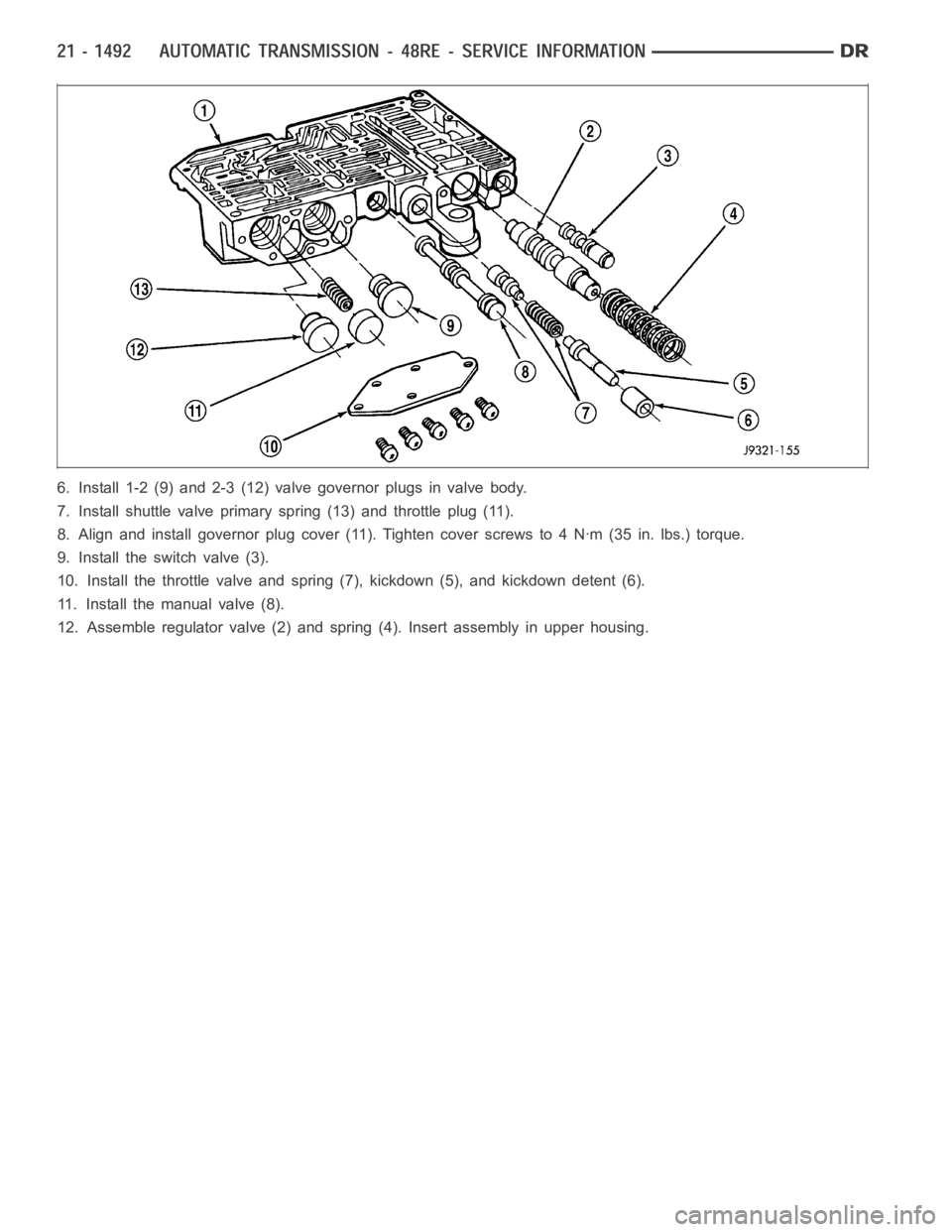
6. Install 1-2 (9) and 2-3 (12) valve governor plugs in valve body.
7. Install shuttle valve primary spring (13) and throttle plug (11).
8. Align and install governor plug cover (11). Tighten cover screws to 4 Nꞏm(35 in. lbs.) torque.
9. Install the switch valve (3).
10. Install the throttle valve and spring (7), kickdown (5), and kickdown detent (6).
11. Install the manual valve (8).
12. Assemble regulator valve (2) and spring (4). Insert assembly in upper housing.
Page 4015 of 5267
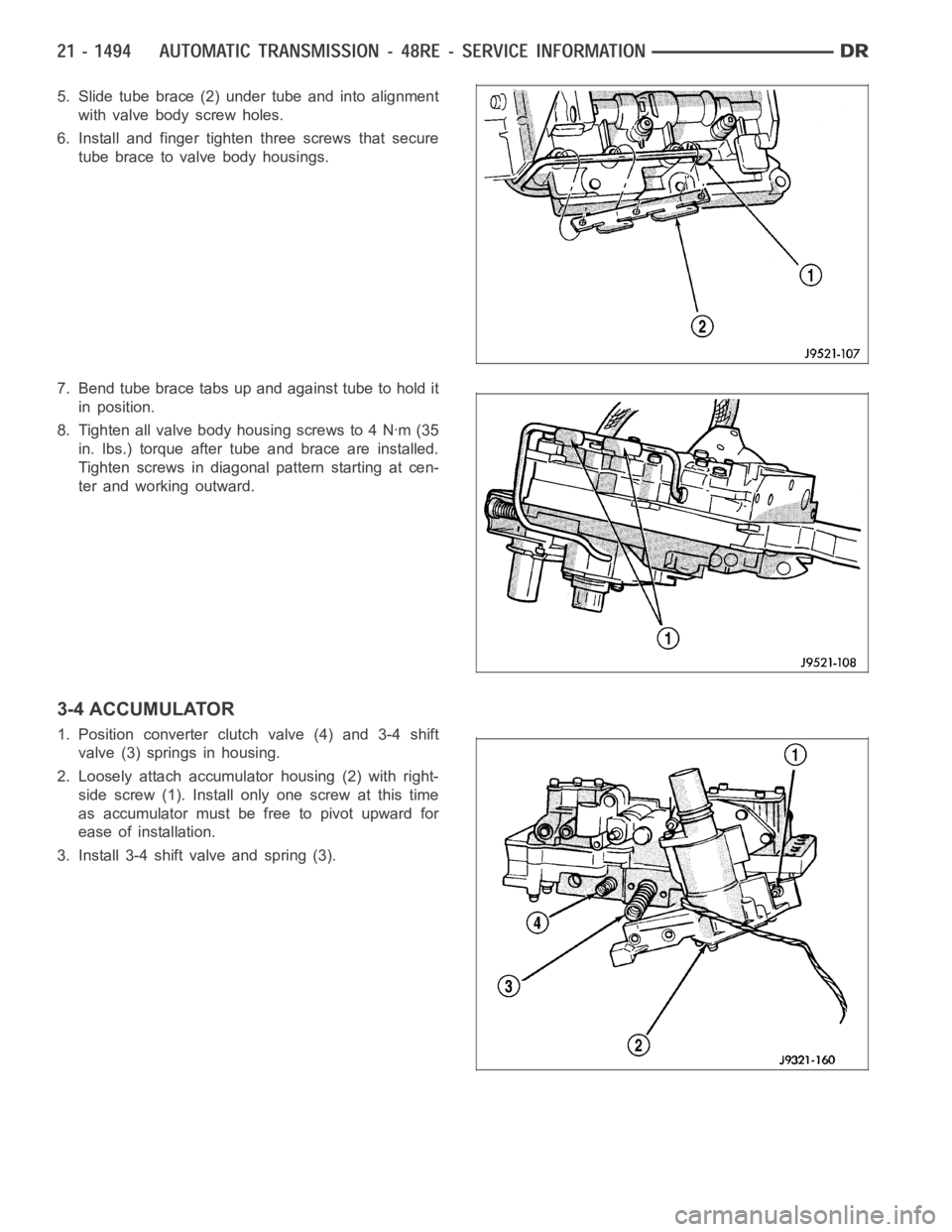
5. Slide tube brace (2) under tube and into alignment
with valve body screw holes.
6. Install and finger tighten three screws that secure
tube brace to valve body housings.
7. Bend tube brace tabs up and against tube to hold it
in position.
8. Tighten all valve body housing screws to 4 Nꞏm (35
in. lbs.) torque after tube and brace are installed.
Tighten screws in diagonal pattern starting at cen-
ter and working outward.
3-4 ACCUMULATOR
1. Position converter clutch valve (4) and 3-4 shift
valve (3) springs in housing.
2. Loosely attach accumulator housing (2) with right-
side screw (1). Install only one screw at this time
as accumulator must be free to pivot upward for
ease of installation.
3. Install 3-4 shift valve and spring (3).
Page 4017 of 5267
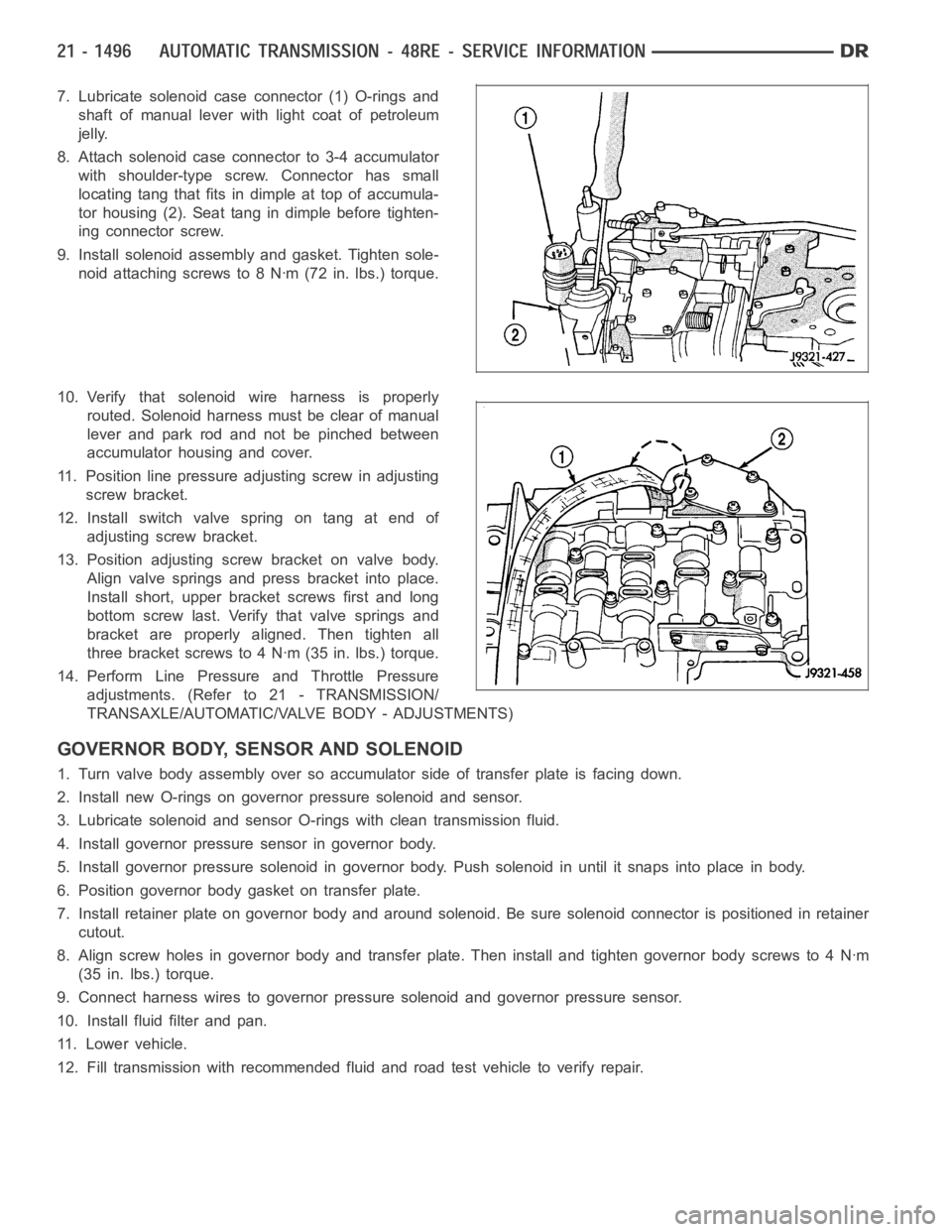
7. Lubricate solenoid case connector (1) O-rings and
shaft of manual lever with light coat of petroleum
jelly.
8. Attach solenoid case connector to 3-4 accumulator
with shoulder-type screw. Connector has small
locating tang that fits indimple at top of accumula-
tor housing (2). Seat tang in dimple before tighten-
ing connector screw.
9. Install solenoid assembly and gasket. Tighten sole-
noid attaching screws to 8 Nꞏm (72 in. lbs.) torque.
10. Verify that solenoid wire harness is properly
routed. Solenoid harness must be clear of manual
lever and park rod and not be pinched between
accumulator housing and cover.
11. Position line pressure adjusting screw in adjusting
screw bracket.
12. Install switch valve spring on tang at end of
adjusting screw bracket.
13. Position adjusting screw bracket on valve body.
Align valve springs and press bracket into place.
Install short, upper bracket screws first and long
bottom screw last. Verify that valve springs and
bracket are properly aligned. Then tighten all
three bracket screws to 4 Nꞏm (35 in. lbs.) torque.
14. Perform Line Pressure and Throttle Pressure
adjustments. (Refer to 21 - TRANSMISSION/
TRANSAXLE/AUTOMATIC/VALVE BODY - ADJUSTMENTS)
GOVERNOR BODY, SENSOR AND SOLENOID
1. Turn valve body assembly over so accumulator side of transfer plate is facing down.
2. Install new O-rings on governor pressure solenoid and sensor.
3. Lubricate solenoid and sensor O-rings with clean transmission fluid.
4. Install governor pressure sensor in governor body.
5. Install governor pressure solenoid in governor body. Push solenoid in until it snaps into place in body.
6. Position governor body gasket on transfer plate.
7. Install retainer plate on governor body and around solenoid. Be sure solenoid connector is positioned in retainer
cutout.
8. Align screw holes in governor body and transfer plate. Then install and tighten governor body screws to 4 Nꞏm
(35 in. lbs.) torque.
9. Connect harness wires to governor pressure solenoid and governor pressure sensor.
10. Install fluid filter and pan.
11. Lower vehicle.
12. Fill transmission with recommended fluid and road test vehicle to verify repair.
Page 4018 of 5267
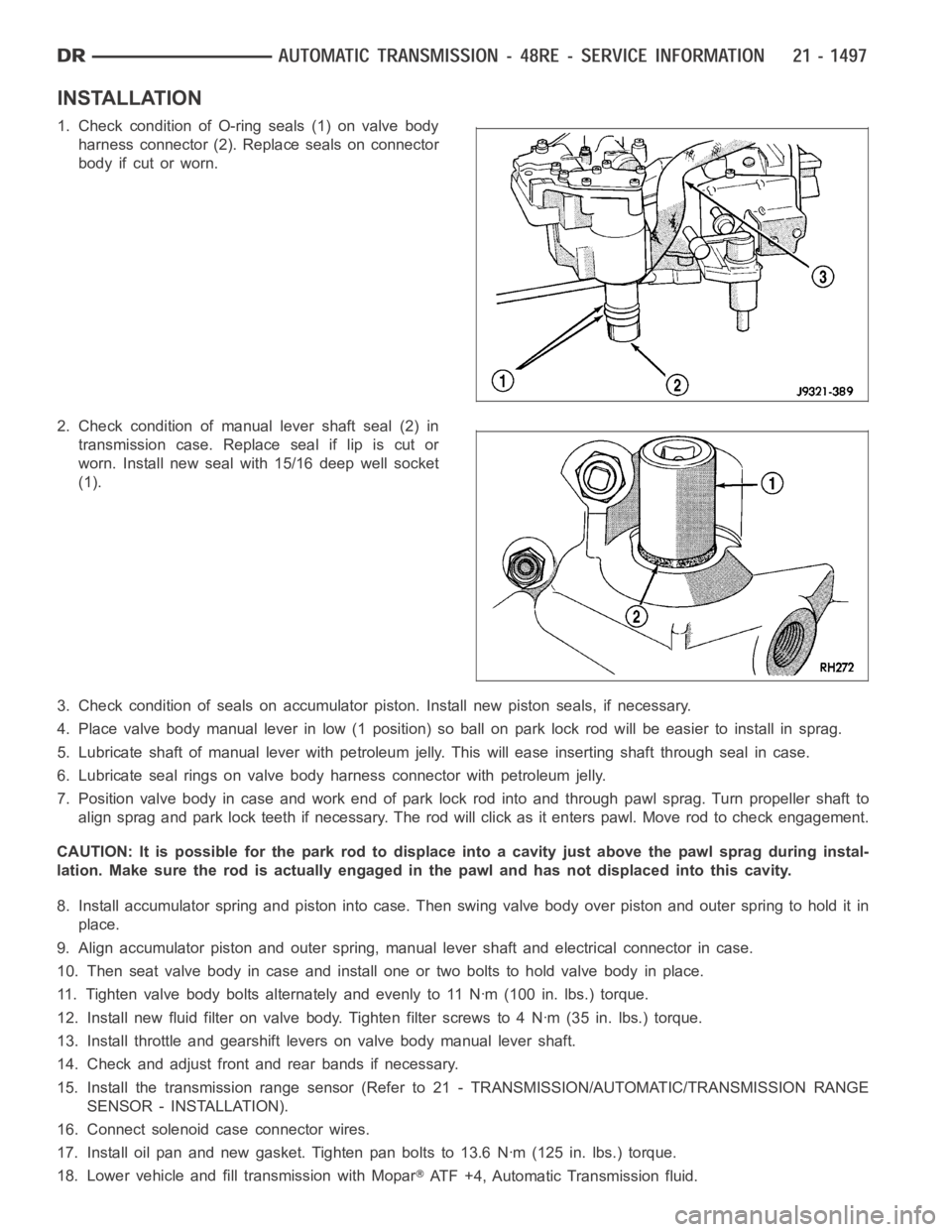
INSTALLATION
1. Check condition of O-ring seals (1) on valve body
harness connector (2). Replace seals on connector
body if cut or worn.
2. Check condition of manual lever shaft seal (2) in
transmission case. Replace seal if lip is cut or
worn. Install new seal with 15/16 deep well socket
(1).
3. Check condition of seals on accumulator piston. Install new piston seals, if necessary.
4. Place valve body manual lever in low (1 position) so ball on park lock rod will be easier to install in sprag.
5. Lubricate shaft of manual lever with petroleum jelly. This will ease inserting shaft through seal in case.
6. Lubricate seal rings on valve body harness connector with petroleum jelly.
7. Position valve body in case and work end of park lock rod into and through pawl sprag. Turn propeller shaft to
align sprag and park lock teeth if necessary. The rod will click as it enterspawl. Move rod to check engagement.
CAUTION: It is possible for the park rod to displace into a cavity just abovethe pawl sprag during instal-
lation. Make sure the rod is actually engaged in the pawl and has not displaced into this cavity.
8. Install accumulator spring and piston into case. Then swing valve body overpistonandouterspringtoholditin
place.
9. Align accumulator piston and outer spring, manual lever shaft and electrical connector in case.
10. Then seat valve body in case and install one or two bolts to hold valve bodyinplace.
11. Tighten valve body bolts alternately and evenly to 11 Nꞏm (100 in. lbs.)torque.
12. Install new fluid filter on valve body. Tighten filter screws to 4 Nꞏm (35 in. lbs.) torque.
13. Install throttle and gearshift levers on valve body manual lever shaft.
14. Check and adjust front and rear bands if necessary.
15. Install the transmission range sensor (Refer to 21 - TRANSMISSION/AUTOMATIC/TRANSMISSION RANGE
SENSOR - INSTALLATION).
16. Connect solenoid case connector wires.
17. Install oil pan and new gasket. Tighten pan bolts to 13.6 Nꞏm (125 in. lbs.) torque.
18. Lower vehicle and fill transmission with Mopar
ATF +4, Automatic Transmission fluid.
Page 4085 of 5267
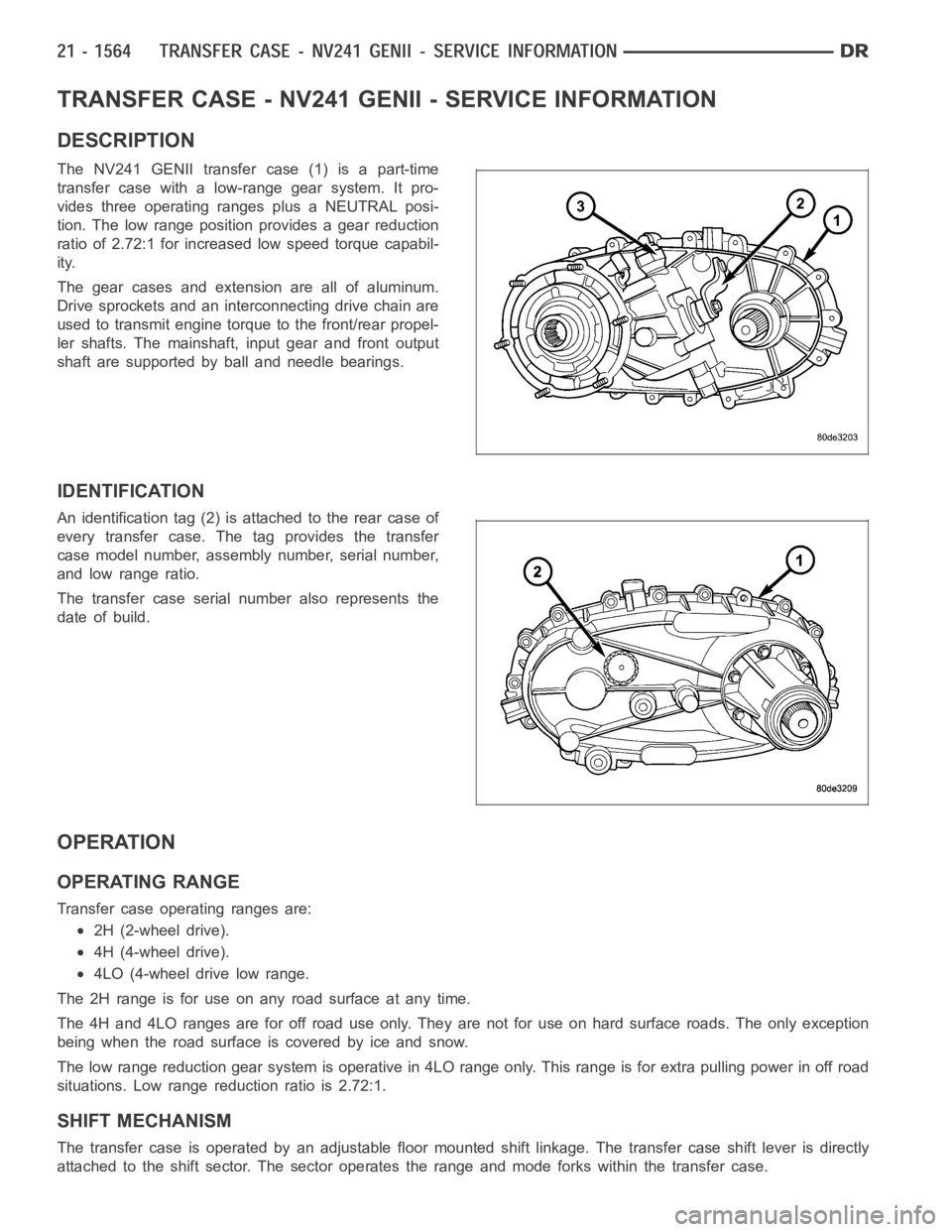
TRANSFER CASE - NV241 GENII - SERVICE INFORMATION
DESCRIPTION
The NV241 GENII transfer case (1) is a part-time
transfer case with a low-range gear system. It pro-
vides three operating ranges plus a NEUTRAL posi-
tion. The low range position provides a gear reduction
ratio of 2.72:1 for increased low speed torque capabil-
ity.
The gear cases and extension are all of aluminum.
Drive sprockets and an interconnecting drive chain are
used to transmit engine torque to the front/rear propel-
ler shafts. The mainshaft, input gear and front output
shaft are supported by ball and needle bearings.
IDENTIFICATION
An identification tag (2) is attached to the rear case of
every transfer case. The tag provides the transfer
case model number, assembly number, serial number,
and low range ratio.
The transfer case serial number also represents the
date of build.
OPERATION
OPERATING RANGE
Transfer case operating ranges are:
2H (2-wheel drive).
4H (4-wheel drive).
4LO (4-wheel drive low range.
The 2H range is for use on any road surface at any time.
The 4H and 4LO ranges are for off road use only. They are not for use on hard surface roads. The only exception
being when the road surface is covered by ice and snow.
The low range reduction gear system is operative in 4LO range only. This range is for extra pulling power in off road
situations. Low range reduction ratio is 2.72:1.
SHIFT MECHANISM
The transfer case is operated by an adjustable floor mounted shift linkage. The transfer case shift lever is directly
attached to the shift sector. The sector operates the range and mode forks within the transfer case.
Page 4086 of 5267
A straight line shift pattern is used with a NEUTRAL detent. Lever range positions are imprinted in the shift knob.
SHIFTING
The transfer case can be shifted between the 2H and 4H operating ranges while the vehicle is in motion. The vehi-
cle must have the transmission placed in NEUTRAL, or the clutch depressed in the case of a manual transmission,
and be moving less than 2-3 MPH when shifting into and out of the 4L operatingrange.
DIAGNOSIS AND TESTING - TRANSFER CASE - NV241 GENII
Before beginning repair on a suspected transfer case malfunction, check all other driveline components beforehand.
The actual cause of a problem may be related to such items as: front hubs, axles, propeller shafts, wheels and tires,
transmission, or clutch instead. If all other driveline components are ingood condition and operating properly, refer
to the Diagnosis Chart for further information.
DIAGNOSIS CHART
Condition Possible Cause Correction
Transfer Case difficult to shift or will
not shift into desired range.1) Vehicle speed too great to permit
shifting.1) Stop vehicle and shift into
desired range. Or, reduce speed to
below 3-4 km/h (2-3 mph) before
attempting the shift.
2) If vehicle was operated for an
extended period in 4H on a dry
paved surface, the driveline torque
load may be causing a bind.2) Stop vehicle and shift the
transmission into neutral. Shift the
transfer case to 2H and operate
vehicle in 2H on dry paved
surfaces.
3) Transfer case external shift
linkage binding.3) Lubricate, repair, or replace
linkage bushings, or tighten loose
components as necessary.
4) Insufficient or incorrect lubricant. 4) Drain and refill to edge of fillhole
with Mopar
ATF +4, Automatic
Transmission fluid.
5) Internal components binding,
worn, or damaged.5) Disassemble the transfer case
and replace worn or damaged
components as necessary.
Transfer Case noisy in all operating
ranges.1) Insufficient or incorrect lubricant. 1) Drain and refill to edge of fillhole
with Mopar
ATF +4, Automatic
Transmission fluid.
Noisy in, or jumps out of, four wheel
drive low range.1) Transfer case not completely
engaged in 4L position.1) With the transmission in
NEUTRAL, or the clutch depressed
in the case of a manual
transmission and the vehicle moving
under 3-4 km/h (2-3 mph), shift the
transfer case to NEUTRAL and then
shift into the 4L position.
2) Shift linkage out of adjustment. 2) Adjust linkage.
3) Shift linkage loose or binding. 3) Tighten, lubricate, or repair
linkage as necessary.
4) Range fork damaged, inserts
worn, or fork is binding on the shift
rail.4) Disassemble unit and repair as
necessary.
5) Low range gear worn or
damaged.5) Disassemble unit and repair as
necessary.
Page 4111 of 5267
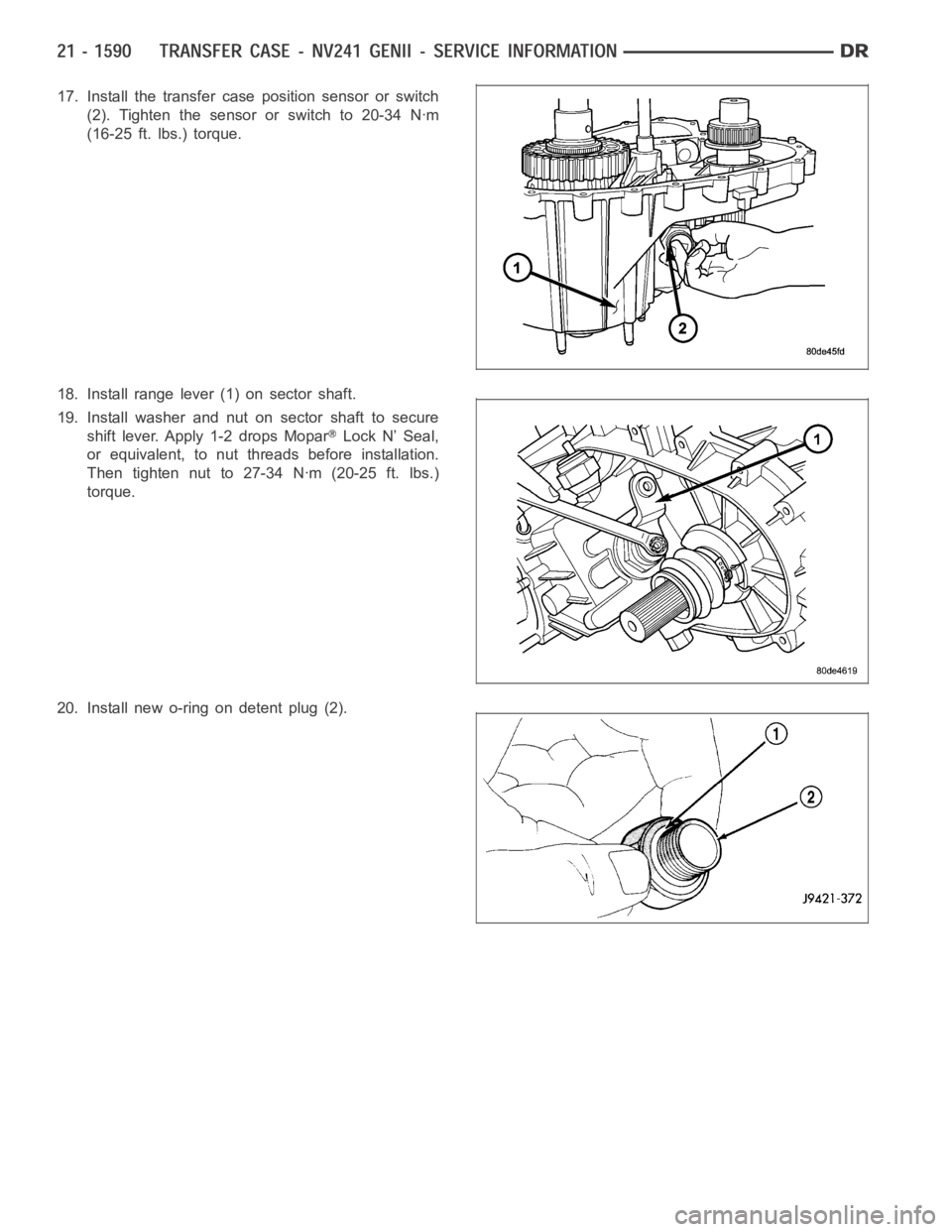
17. Install the transfer case position sensor or switch
(2). Tighten the sensor or switch to 20-34 Nꞏm
(16-25 ft. lbs.) torque.
18. Install range lever (1) on sector shaft.
19. Install washer and nut on sector shaft to secure
shift lever. Apply 1-2 drops Mopar
Lock N’ Seal,
or equivalent, to nut threads before installation.
Then tighten nut to 27-34 Nꞏm (20-25 ft. lbs.)
torque.
20. Install new o-ring on detent plug (2).