torque DODGE RAM SRT-10 2006 Service Repair Manual
[x] Cancel search | Manufacturer: DODGE, Model Year: 2006, Model line: RAM SRT-10, Model: DODGE RAM SRT-10 2006Pages: 5267, PDF Size: 68.7 MB
Page 5195 of 5267
The primary components within the assembly are: A three port solenoid thatactivates both of the functions listed
above; a pump which contains a switch, two check valves and a spring/diaphragm, a canister vent valve (CVV) seal
which contains a spring loaded vent seal valve.
Immediately after a cold start, between predetermined temperature thresholds limits, the three port solenoid is briefly
energized. This initializes the pump by drawing air into the pump cavity and also closes the vent seal. During non
test conditions the vent seal is held open by the pump diaphragm assembly which pushes it open at the full travel
position. The vent seal will remain closed while the pump is cycling due to the reed switch triggering of the three
port solenoid that prevents the diaphragm assembly from reaching full travel. After the brief initialization period, the
solenoid is de-energized allowing atmospheric pressure to enter the pumpcavity, thus permitting the spring to drive
the diaphragm which forces air out of the pump cavity and into the vent system. When the solenoid is energized
and de energized, the cycle is repeated creating flow in typical diaphragmpump fashion. The pump is controlled in
2 modes:
Pump Mode: The pump is cycled at a fixed rate to achieve a rapid pressure build in order to shorten the overall test
length.
Test Mode: The solenoid is energized with a fixed duration pulse. Subsequent fixed pulses occur when the dia-
phragm reaches the Switch closure point.
The spring in the pump is set so that the system will achieve an equalized pressure of about 7.5” H20. The cycle
rate of pump strokes is quite rapid as the system begins to pump up to this pressure. As the pressure increases, the
cycle rate starts to drop off. If there is no leak in the system, the pump would eventually stop pumping at the equal-
ized pressure. If there is a leak, it will continue to pump at a rate representative of the flow characteristic of the size
of the leak. From this information we can determine if the leak is larger than the required detection limit (currently
set at .040” orifice by CARB). If a leak is revealed during the leak test portion of the test, the test is terminated at
the end of the test mode and no further system checks will be performed.
After passing the leak detection phase of the test, system pressure is maintained by turning on the LDP’s solenoid
until the purge system is activated. Purge activation in effect creates a leak. The cycle rate is again interrogated and
when it increases due to the flow through the purge system, the leak check portion of the diagnostic is complete.
The canister vent valve will unseal the system after completion of the testsequence as the pump diaphragm assem-
bly moves to the full travel position.
Evaporative system functionality will be verified by using the stricter evap purge flow monitor. At an appropriate
warm idle the LDP will be energized to seal the canister vent. The purge flowwill be clocked up from some small
value in an attempt to see a shift in the02 control system. If fuel vapor, indicated by a shift in the 02 control, is
present the test is passed. If not, it is assumed that the purge system is notfunctioning in some respect. The LDP
is again turned off and the test is ended.
MISFIRE MONITOR
Excessive engine misfire results in increased catalyst temperature and causes an increase in HC emissions. Severe
misfires could cause catalyst damage. To prevent catalytic convertor damage, the PCM monitors engine misfire.
The Powertrain Control Module (PCM) monitors for misfire during most engine operating conditions (positive torque)
by looking at changes in the crankshaft speed. If a misfire occurs the speedof the crankshaft will vary more than
normal.
FUEL SYSTEM MONITOR
To comply with clean air regulations, vehicles are equipped with catalytic converters. These converters reduce the
emission of hydrocarbons, oxides of nitrogen and carbon monoxide. The catalyst works best when the Air Fuel (A/F)
ratio is at or near the optimum of 14.7 to 1.
The PCM is programmed to maintain the optimum air/fuel ratio of 14.7 to 1. This is done by making short term
corrections in the fuel injector pulse width based on the O2S sensor output. The programmed memory acts as a self
calibration tool that the engine controller uses to compensate for variations in engine specifications, sensor toler-
ances and engine fatigue over the life span of the engine. By monitoring theactual fuel-air ratio with the O2S sen-
sor (short term) and multiplying that with the program long-term (adaptive) memory and comparing that to the limit,
it can be determined whether it will pass an emissions test. If a malfunction occurs such that the PCM cannot main-
tain the optimum A/F ratio, then the MIL will be illuminated.
Page 5203 of 5267
page page
EVAPORATIVE EMISSIONS
DESCRIPTION - EVAP SYSTEM ................ 13
SPECIFICATIONS
TORQUE ................................... 13
SOLENOID-EVAP/PURGE
DESCRIPTION ................................ 14
OPERATION .................................. 14
REMOVAL .................................... 14
INSTALLATION ............................... 14
CAP - FUEL FILLER
DESCRIPTION ................................ 15
OPERATION .................................. 15
REMOVAL
REMOVAL/INSTALLATION ................... 15
PUMP-LEAK DETECTION
DESCRIPTION ................................ 16
OPERATION .................................. 16
REMOVAL .................................... 19
INSTALLATION ............................... 20
ORVR
DESCRIPTION ................................ 21OPERATION .................................. 21
PUMP-NATURAL VAC LEAK DETECTION
DESCRIPTION ................................ 22
OPERATION .................................. 22
REMOVAL .................................... 23
INSTALLATION ............................... 26
VA LV E - P C V
DESCRIPTION ................................ 30
OPERATION .................................. 32
DIAGNOSIS AND TESTING
PCV VALVE - 3.7L V-6/ 4.7L V-8 .............. 33
REMOVAL .................................... 35
INSTALLATION ............................... 36
LINES - VACUUM
DESCRIPTION ................................ 37
CANISTER - VAPOR
DESCRIPTION ................................ 38
OPERATION .................................. 40
REMOVAL .................................... 40
INSTALLATION ............................... 46
Page 5204 of 5267
EVAPORATIVE EMISSIONS
DESCRIPTION - EVAP SYSTEM
The evaporation control system prevents the emission of fuel tank vapors into the atmosphere. When fuel evapo-
rates in the fuel tank, the vapors pass through vent hoses or tubes into the two charcoal filled evaporative canisters.
The canisters temporarily hold the vapors. The Powertrain Control Module(PCM) allows intake manifold vacuum to
draw vapors into the combustion chambers during certain operating conditions.
All gasoline powered engines use a duty cycle purge system. The PCM controls vapor flow by operating the duty
cycle EVAP purge solenoid. Refer to Duty Cycle EVAP Canister Purge Solenoid for additional information.
When equipped with certain emissions packages, a Leak Detection Pump (LDP) will be used as part of the evap-
orative system. This pump is used as a part of OBD II requirements. Refer to Leak Detection Pump for additional
information. Other emissions packages will use a Natural Vacuum Leak Detection (NVLD) system in place of the
LDP. Refer to NVLD for additional information.
NOTE: The hoses used in this system are specially manufactured. If replacement becomes necessary, it is
important to use only fuel resistant hose.
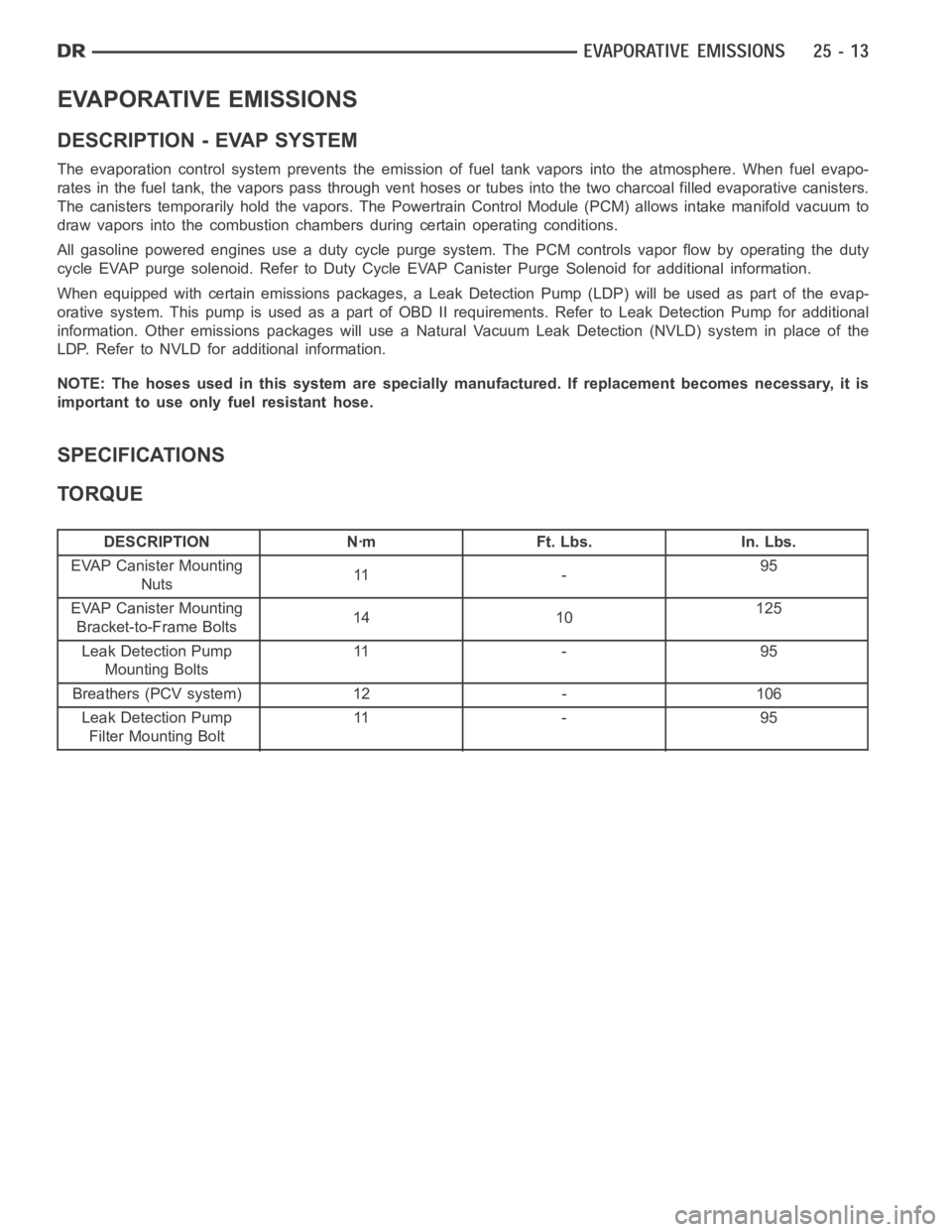
SPECIFICATIONS
TORQUE
DESCRIPTION Nꞏm Ft. Lbs. In. Lbs.
EVAP Canister Mounting
Nuts11 -95
EVAP Canister Mounting
Bracket-to-Frame Bolts14 10125
Leak Detection Pump
Mounting Bolts11 - 9 5
Breathers (PCV system) 12 - 106
Leak Detection Pump
Filter Mounting Bolt11 - 9 5
Page 5225 of 5267
12. The paper should be drawn against the hose opening with noticeable force. This will be after allowing approx-
imately one minute for crankcase pressure to reduce.
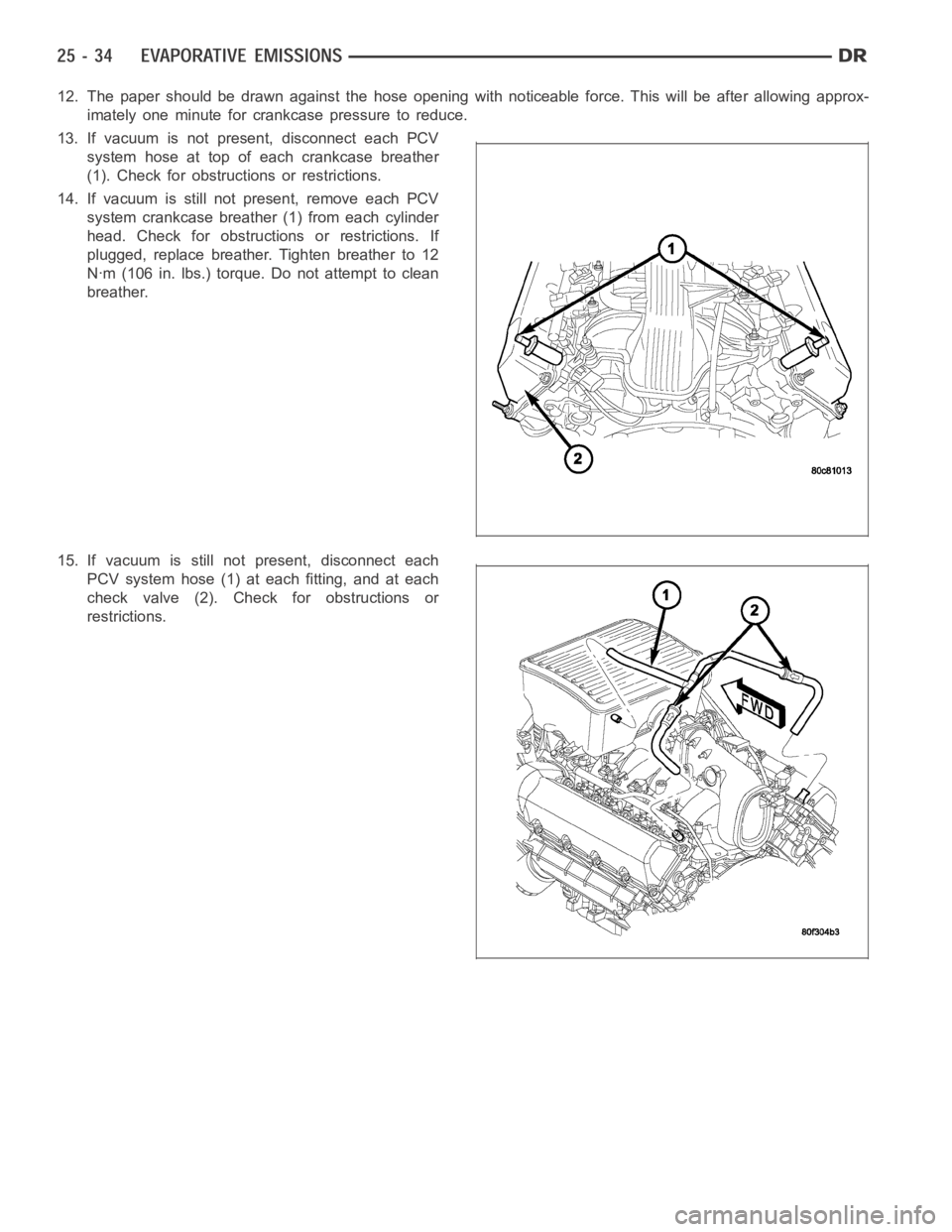
13. If vacuum is not present, disconnect each PCV
system hose at top of each crankcase breather
(1). Check for obstructions or restrictions.
14. If vacuum is still not present, remove each PCV
system crankcase breather (1) from each cylinder
head. Check for obstructions or restrictions. If
plugged, replace breather. Tighten breather to 12
Nꞏm (106 in. lbs.) torque. Do not attempt to clean
breather.
15. If vacuum is still not present, disconnect each
PCV system hose (1) at each fitting, and at each
check valve (2). Check for obstructions or
restrictions.