service DODGE RAM SRT-10 2006 Service Manual PDF
[x] Cancel search | Manufacturer: DODGE, Model Year: 2006, Model line: RAM SRT-10, Model: DODGE RAM SRT-10 2006Pages: 5267, PDF Size: 68.7 MB
Page 228 of 5267
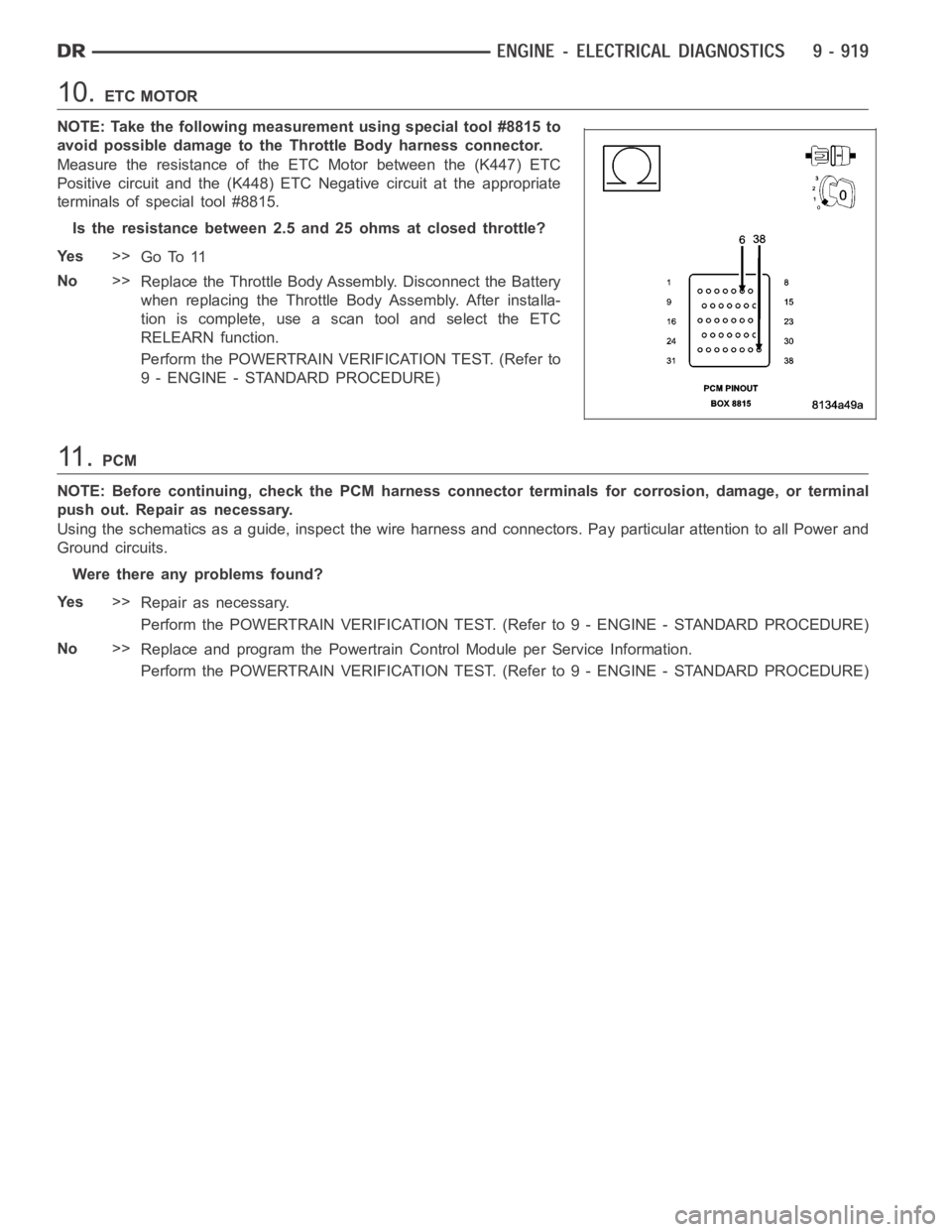
10.ETC MOTOR
NOTE: Take the following measurement using special tool #8815 to
avoid possible damage to the Throttle Body harness connector.
Measure the resistance of the ETC Motor between the (K447) ETC
Positive circuit and the (K448) ETC Negative circuit at the appropriate
terminals of special tool #8815.
Is the resistance between 2.5 and 25 ohms at closed throttle?
Ye s>>
Go To 11
No>>
Replace the Throttle Body Assembly. Disconnect the Battery
when replacing the Throttle Body Assembly. After installa-
tion is complete, use a scan tool and select the ETC
RELEARN function.
Perform the POWERTRAIN VERIFICATION TEST. (Refer to
9 - ENGINE - STANDARD PROCEDURE)
11 .PCM
NOTE: Before continuing, check the PCM harness connector terminals for corrosion, damage, or terminal
push out. Repair as necessary.
Using the schematics as a guide, inspect the wire harness and connectors. Pay particular attention to all Power and
Ground circuits.
Were there any problems found?
Ye s>>
Repair as necessary.
Perform the POWERTRAIN VERIFICATION TEST. (Refer to 9 - ENGINE - STANDARD PROCEDURE)
No>>
Replace and program the Powertrain Control Module per Service Information.
Perform the POWERTRAIN VERIFICATION TEST. (Refer to 9 - ENGINE - STANDARD PROCEDURE)
Page 231 of 5267

3.ACCELERATOR PEDAL POSITION SENSOR
Connect a jumper wire between the (F855) 5-volt Supply circuit and the
(K23) APP Sensor No.1 Signal circuit in the Sensor harness connector.
With a scan tool, monitor the APP Sensor No.1 voltage.
Is the voltage above 4.5 volts?
Ye s>>
Replace the APP Sensor Assembly per Service Information.
After installation is complete, use a scan tool and select the
ETC RELEARN function to relearn the APPS values.
Perform the POWERTRAIN VERIFICATION TEST. (Refer to
9 - ENGINE - STANDARD PROCEDURE)
No>>
Go To 4
NOTE: Remove the jumper wire before continuing.
4.(K23) APP SENSOR NO.1 SIGNAL CIRCUIT OPEN
Turn the ignition off.
Disconnect the C3 PCM harness connector.
CAUTION: Do not probe the PCM harness connectors. Probing the
PCM harness connectors will damage the PCM terminals resulting
in poor terminal to pin connection. Install Miller Special Tool #8815
to perform diagnosis.
Measure the resistance of the (K23) APP Sensor No.1 Signal circuit
from the APP Sensor harness connector to the appropriate terminal of
special tool #8815.
Is the resistance below 5.0 ohms?
Ye s>>
Go To 5
No>>
Repair the open in the (K23) APP Sensor No.1 Signal cir-
cuit.
Perform the POWERTRAIN VERIFICATION TEST. (Refer to
9 - ENGINE - STANDARD PROCEDURE)
Page 234 of 5267
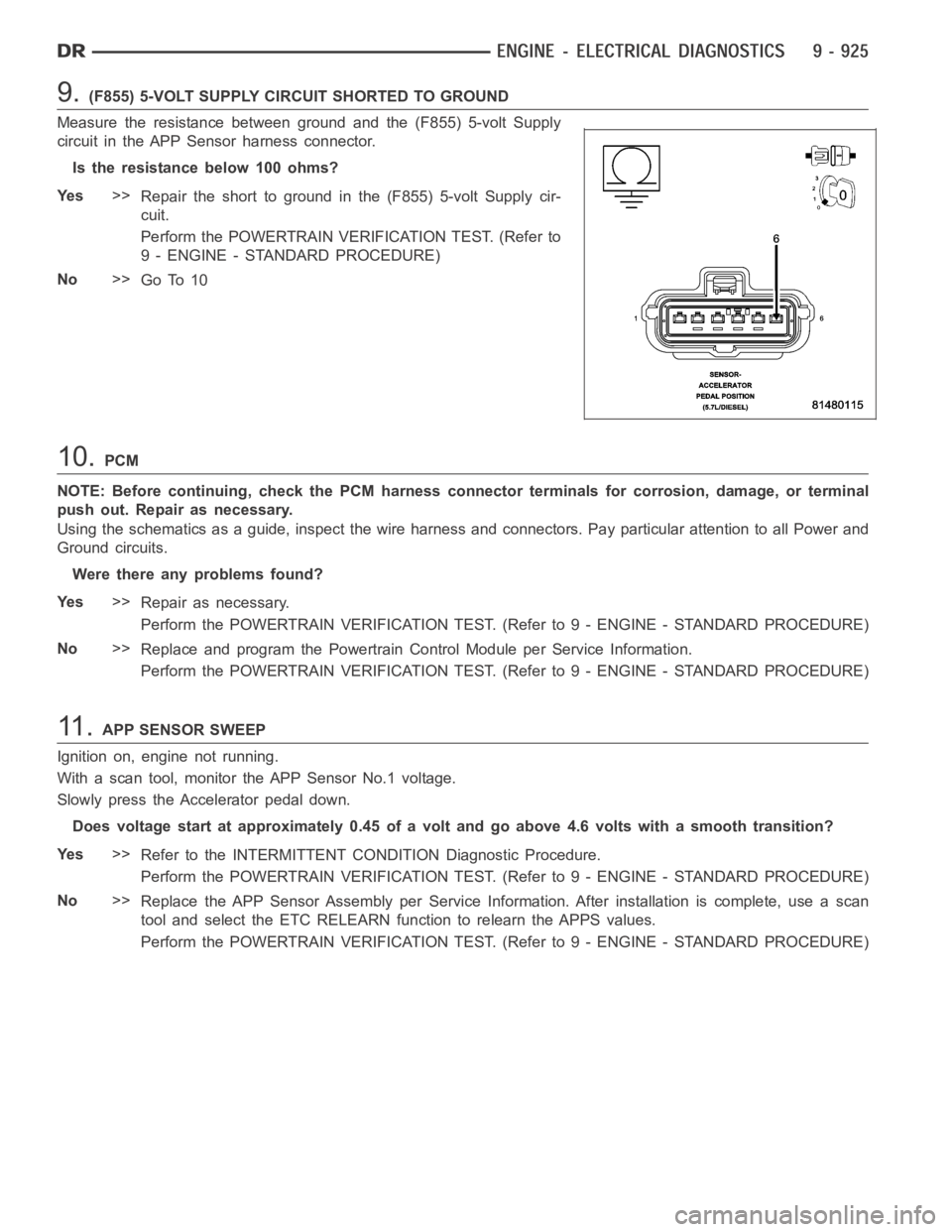
9.(F855) 5-VOLT SUPPLY CIRCUIT SHORTED TO GROUND
Measure the resistance between ground and the (F855) 5-volt Supply
circuit in the APP Sensor harness connector.
Istheresistancebelow100ohms?
Ye s>>
Repair the short to ground in the (F855) 5-volt Supply cir-
cuit.
Perform the POWERTRAIN VERIFICATION TEST. (Refer to
9 - ENGINE - STANDARD PROCEDURE)
No>>
Go To 10
10.PCM
NOTE: Before continuing, check the PCM harness connector terminals for corrosion, damage, or terminal
push out. Repair as necessary.
Using the schematics as a guide, inspect the wire harness and connectors. Pay particular attention to all Power and
Ground circuits.
Were there any problems found?
Ye s>>
Repair as necessary.
Perform the POWERTRAIN VERIFICATION TEST. (Refer to 9 - ENGINE - STANDARD PROCEDURE)
No>>
Replace and program the Powertrain Control Module per Service Information.
Perform the POWERTRAIN VERIFICATION TEST. (Refer to 9 - ENGINE - STANDARD PROCEDURE)
11 .APP SENSOR SWEEP
Ignition on, engine not running.
With a scan tool, monitor the APP Sensor No.1 voltage.
Slowly press the Accelerator pedal down.
Does voltage start at approximately 0.45 of a volt and go above 4.6 volts with a smooth transition?
Ye s>>
Refer to the INTERMITTENT CONDITION Diagnostic Procedure.
Perform the POWERTRAIN VERIFICATION TEST. (Refer to 9 - ENGINE - STANDARD PROCEDURE)
No>>
Replace the APP Sensor Assembly per Service Information. After installation is complete, use a scan
tool and select the ETC RELEARN function to relearn the APPS values.
Perform the POWERTRAIN VERIFICATION TEST. (Refer to 9 - ENGINE - STANDARD PROCEDURE)
Page 236 of 5267
When Monitored:
With the ignition on and no other APPS No.1 DTCs present.
Set Condition:
When APP Sensor No.1 voltage is too high. Engine will additionally idle if the brake pedal is pressed or has
failed. Acceleration rate and Engine output are limited. One trip fault and the code will set within 5 seconds.
ETC light is flashing.
Possible Causes
(K23) APP SENSOR NO.1 SIGNAL CIRCUIT SHORTED TO BATTERY VOLTAGE
(K23) APP SENSOR NO.1 SIGNAL SHORTED TO THE (F855) 5-VOLT SUPPLY CIRCUIT
(K23) APP SENSOR NO.1 SIGNAL SHORTED TO THE (F856) 5-VOLT SUPPLY CIRCUIT
(K167) APP SENSOR NO.1 RETURN CIRCUIT OPEN
APP SENSOR
PCM
Always perform the Pre-Diagnostic Troubleshooting procedure before proceeding. (Refer to 9 - ENGINE -
DIAGNOSIS AND TESTING).
Diagnostic Test
1.APPS NO.1 VOLTAGE ABOVE 4.8 VOLTS
Ignition on, engine not running.
With a scan tool, read the APP Sensor No.1 voltage.
Is the voltage above 4.8 volts?
Ye s>>
Go To 2
No>>
Go To 8
2.ACCELERATOR PEDAL POSITION SENSOR
Turn the ignition off.
Disconnect the APP Sensor harness connector.
Ignition on, engine not running.
With a scan tool, monitor the Accelerator Pedal Position Sensor voltage.
Is the voltage between 4.5 and 5.2 volts?
Ye s>>
Go To 3
No>>
Replace the APP Sensor Assembly per Service Information. After installation is complete, use a scan
tool and select the ETC RELEARN function to relearn the APPS values.
Perform the POWERTRAIN VERIFICATION TEST. (Refer to 9 - ENGINE - STANDARD PROCEDURE)
Page 238 of 5267
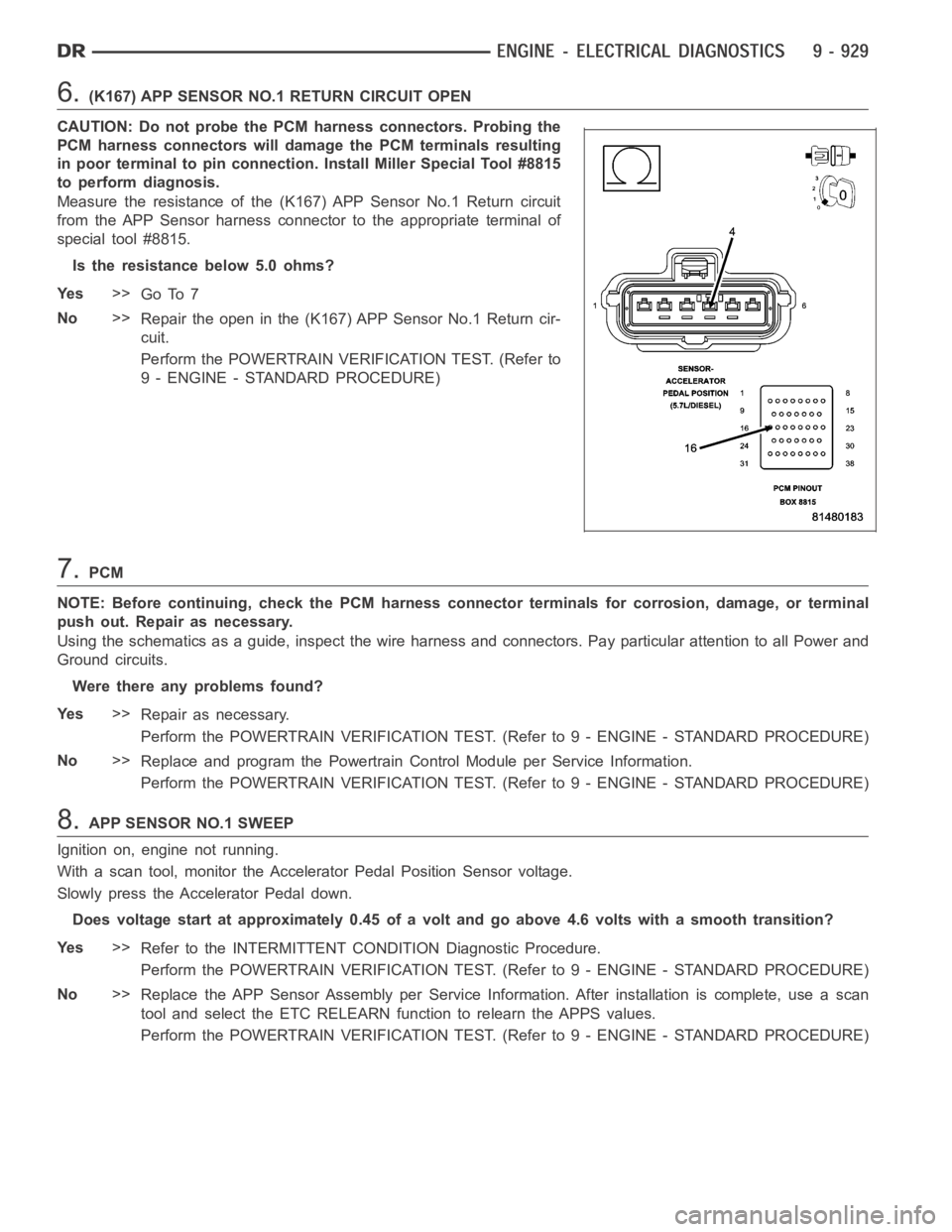
6.(K167) APP SENSOR NO.1 RETURN CIRCUIT OPEN
CAUTION: Do not probe the PCM harness connectors. Probing the
PCM harness connectors will damage the PCM terminals resulting
in poor terminal to pin connection. Install Miller Special Tool #8815
to perform diagnosis.
Measure the resistance of the (K167) APP Sensor No.1 Return circuit
from the APP Sensor harness connector to the appropriate terminal of
special tool #8815.
Is the resistance below 5.0 ohms?
Ye s>>
Go To 7
No>>
Repair the open in the (K167) APP Sensor No.1 Return cir-
cuit.
Perform the POWERTRAIN VERIFICATION TEST. (Refer to
9 - ENGINE - STANDARD PROCEDURE)
7.PCM
NOTE: Before continuing, check the PCM harness connector terminals for corrosion, damage, or terminal
push out. Repair as necessary.
Using the schematics as a guide, inspect the wire harness and connectors. Pay particular attention to all Power and
Ground circuits.
Were there any problems found?
Ye s>>
Repair as necessary.
Perform the POWERTRAIN VERIFICATION TEST. (Refer to 9 - ENGINE - STANDARD PROCEDURE)
No>>
Replace and program the Powertrain Control Module per Service Information.
Perform the POWERTRAIN VERIFICATION TEST. (Refer to 9 - ENGINE - STANDARD PROCEDURE)
8.APP SENSOR NO.1 SWEEP
Ignition on, engine not running.
With a scan tool, monitor the Accelerator Pedal Position Sensor voltage.
Slowly press the Accelerator Pedal down.
Does voltage start at approximately 0.45 of a volt and go above 4.6 volts with a smooth transition?
Ye s>>
Refer to the INTERMITTENT CONDITION Diagnostic Procedure.
Perform the POWERTRAIN VERIFICATION TEST. (Refer to 9 - ENGINE - STANDARD PROCEDURE)
No>>
Replace the APP Sensor Assembly per Service Information. After installation is complete, use a scan
tool and select the ETC RELEARN function to relearn the APPS values.
Perform the POWERTRAIN VERIFICATION TEST. (Refer to 9 - ENGINE - STANDARD PROCEDURE)
Page 241 of 5267
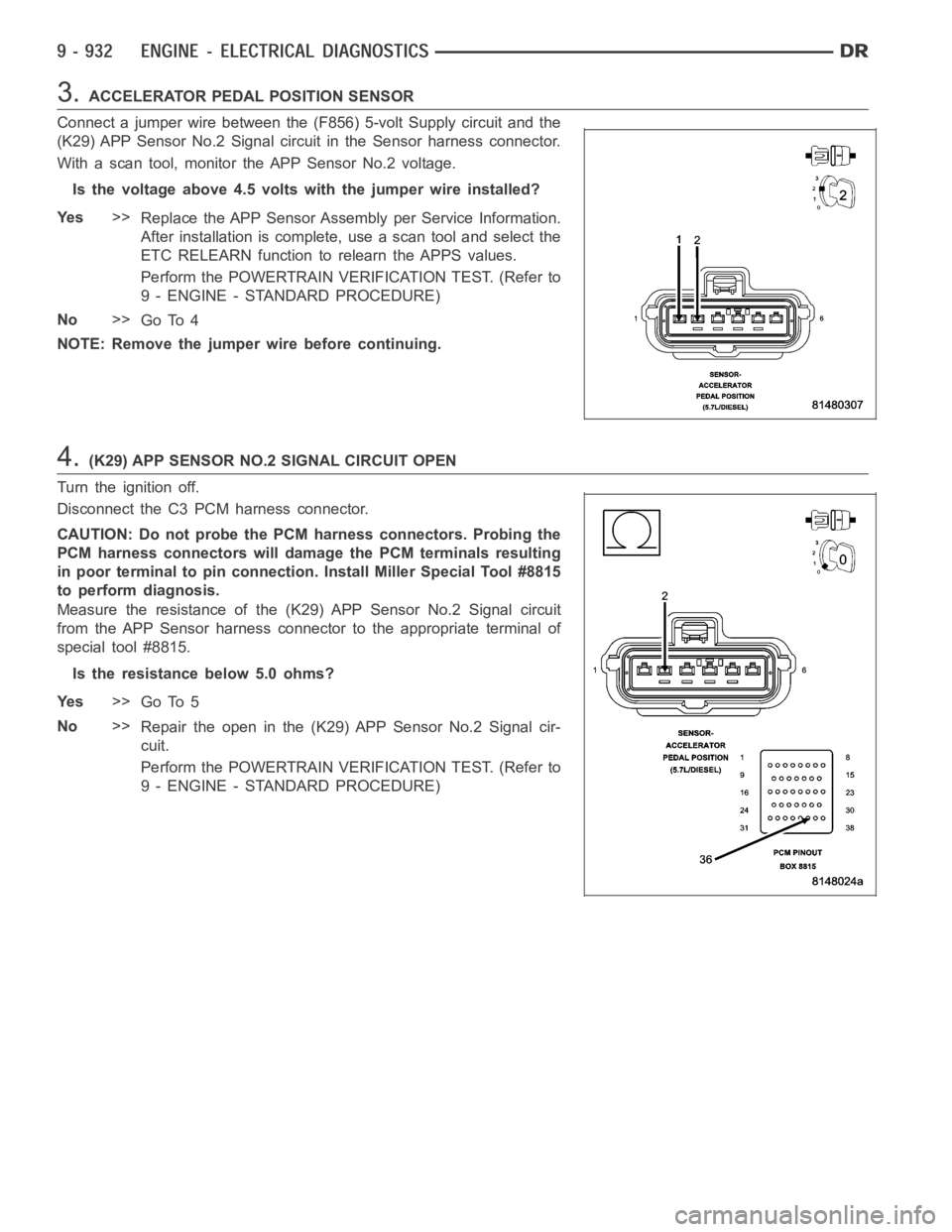
3.ACCELERATOR PEDAL POSITION SENSOR
Connect a jumper wire between the (F856) 5-volt Supply circuit and the
(K29) APP Sensor No.2 Signal circuit in the Sensor harness connector.
With a scan tool, monitor the APP Sensor No.2 voltage.
Is the voltage above 4.5 volts with the jumper wire installed?
Ye s>>
Replace the APP Sensor Assembly per Service Information.
After installation is complete, use a scan tool and select the
ETC RELEARN function to relearn the APPS values.
Perform the POWERTRAIN VERIFICATION TEST. (Refer to
9 - ENGINE - STANDARD PROCEDURE)
No>>
Go To 4
NOTE: Remove the jumper wire before continuing.
4.(K29) APP SENSOR NO.2 SIGNAL CIRCUIT OPEN
Turn the ignition off.
Disconnect the C3 PCM harness connector.
CAUTION: Do not probe the PCM harness connectors. Probing the
PCM harness connectors will damage the PCM terminals resulting
in poor terminal to pin connection. Install Miller Special Tool #8815
to perform diagnosis.
Measure the resistance of the (K29) APP Sensor No.2 Signal circuit
from the APP Sensor harness connector to the appropriate terminal of
special tool #8815.
Is the resistance below 5.0 ohms?
Ye s>>
Go To 5
No>>
Repair the open in the (K29) APP Sensor No.2 Signal cir-
cuit.
Perform the POWERTRAIN VERIFICATION TEST. (Refer to
9 - ENGINE - STANDARD PROCEDURE)
Page 244 of 5267
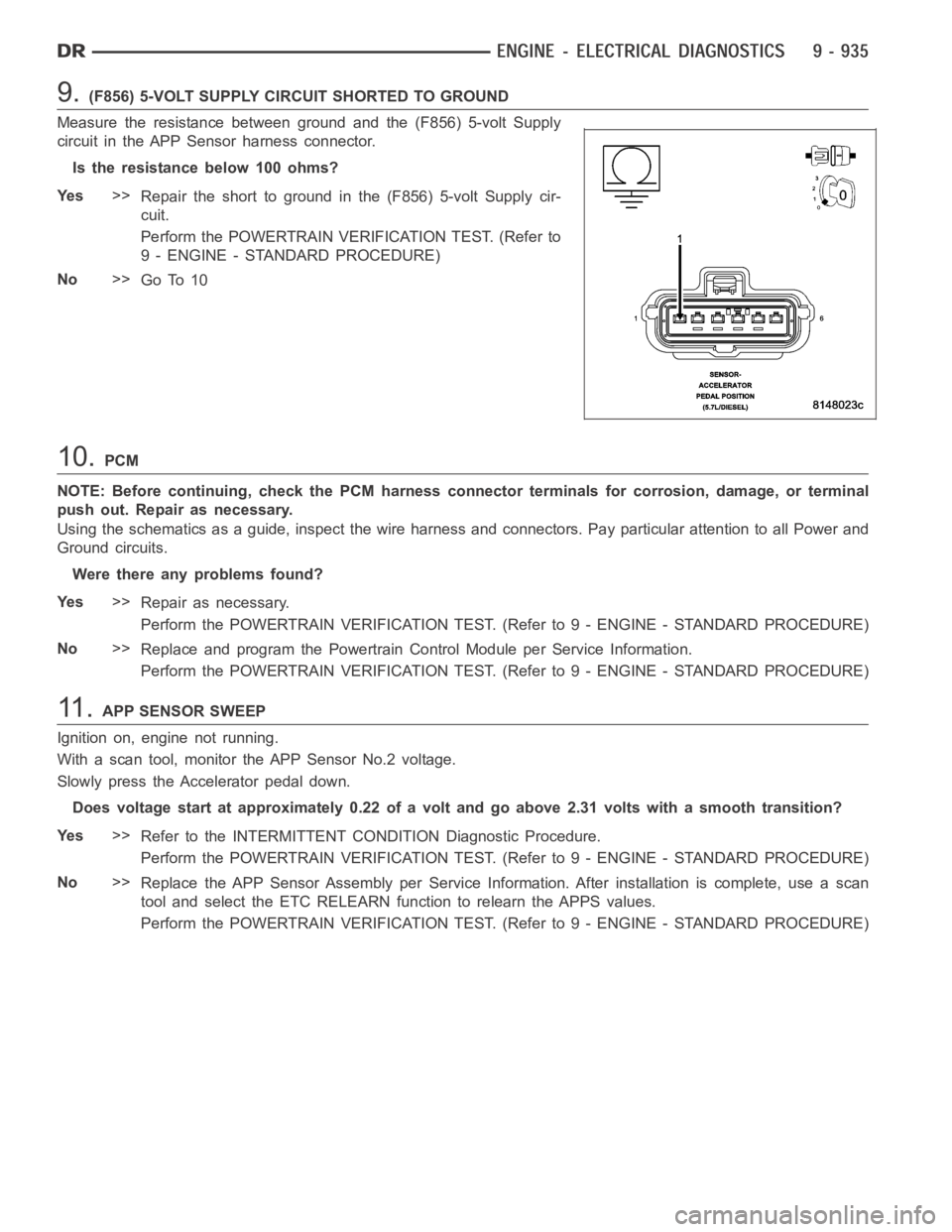
9.(F856) 5-VOLT SUPPLY CIRCUIT SHORTED TO GROUND
Measure the resistance between ground and the (F856) 5-volt Supply
circuit in the APP Sensor harness connector.
Istheresistancebelow100ohms?
Ye s>>
Repair the short to ground in the (F856) 5-volt Supply cir-
cuit.
Perform the POWERTRAIN VERIFICATION TEST. (Refer to
9 - ENGINE - STANDARD PROCEDURE)
No>>
Go To 10
10.PCM
NOTE: Before continuing, check the PCM harness connector terminals for corrosion, damage, or terminal
push out. Repair as necessary.
Using the schematics as a guide, inspect the wire harness and connectors. Pay particular attention to all Power and
Ground circuits.
Were there any problems found?
Ye s>>
Repair as necessary.
Perform the POWERTRAIN VERIFICATION TEST. (Refer to 9 - ENGINE - STANDARD PROCEDURE)
No>>
Replace and program the Powertrain Control Module per Service Information.
Perform the POWERTRAIN VERIFICATION TEST. (Refer to 9 - ENGINE - STANDARD PROCEDURE)
11 .APP SENSOR SWEEP
Ignition on, engine not running.
With a scan tool, monitor the APP Sensor No.2 voltage.
Slowly press the Accelerator pedal down.
Does voltage start at approximately 0.22 of a volt and go above 2.31 volts with a smooth transition?
Ye s>>
Refer to the INTERMITTENT CONDITION Diagnostic Procedure.
Perform the POWERTRAIN VERIFICATION TEST. (Refer to 9 - ENGINE - STANDARD PROCEDURE)
No>>
Replace the APP Sensor Assembly per Service Information. After installation is complete, use a scan
tool and select the ETC RELEARN function to relearn the APPS values.
Perform the POWERTRAIN VERIFICATION TEST. (Refer to 9 - ENGINE - STANDARD PROCEDURE)
Page 246 of 5267
When Monitored:
With the ignition on and no other APPS No.2 DTCs present.
Set Condition:
When APP Sensor No.2 voltage is too high. Idle is additionally forced any time the brake is applied or failed.
Acceleration rate and Engine output are limited. One trip fault and the code will set within 5 seconds. ETC light
is flashing.
Possible Causes
(K29) APP SENSOR NO.2 SIGNAL CIRCUIT SHORTED TO BATTERY VOLTAGE
(K29) APP SENSOR NO.2 SIGNAL SHORTED TO THE (F856) 5-VOLT SUPPLY CIRCUIT
(K29) APP SENSOR NO.2 SIGNAL SHORTED TO THE (F855) 5-VOLT SUPPLY CIRCUIT
(K400) APP SENSOR NO.2 RETURN CIRCUIT OPEN
APP SENSOR
PCM
Always perform the Pre-Diagnostic Troubleshooting procedure before proceeding. (Refer to 9 - ENGINE -
DIAGNOSIS AND TESTING).
Diagnostic Test
1.APPS NO.2 VOLTAGE ABOVE 3.0 VOLTS
Ignition on, engine not running.
With a scan tool, read the APP Sensor No.2 voltage.
NOTE: Diagnose any 5-Volt Supply DTCs before continuing.
Is the voltage above 3.0 volts?
Ye s>>
Go To 2
No>>
Go To 8
2.ACCELERATOR PEDAL POSITION SENSOR
Turn the ignition off.
Disconnect the APPS harness connector.
Ignition on, engine not running.
With a scan tool, monitor the Accelerator Pedal Position Sensor voltage.
Is the voltage above 3.0 volts?
Ye s>>
Go To 3
No>>
Replace the APP Sensor Assembly per Service Information. After installation is complete, use a scan
tool and select the ETC RELEARN function to relearn the APPS values.
Perform the POWERTRAIN VERIFICATION TEST. (Refer to 9 - ENGINE - STANDARD PROCEDURE)
Page 248 of 5267
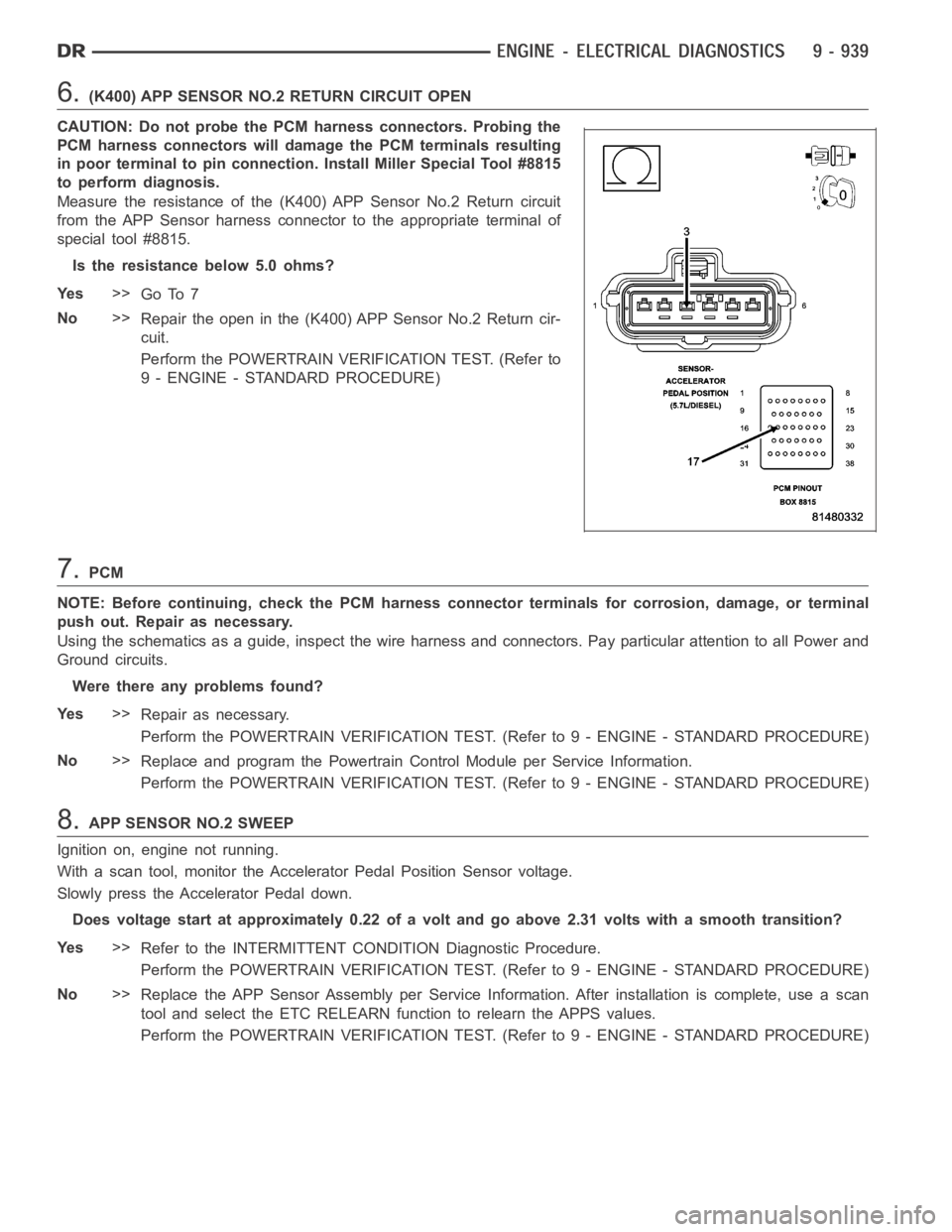
6.(K400) APP SENSOR NO.2 RETURN CIRCUIT OPEN
CAUTION: Do not probe the PCM harness connectors. Probing the
PCM harness connectors will damage the PCM terminals resulting
in poor terminal to pin connection. Install Miller Special Tool #8815
to perform diagnosis.
Measure the resistance of the (K400) APP Sensor No.2 Return circuit
from the APP Sensor harness connector to the appropriate terminal of
special tool #8815.
Is the resistance below 5.0 ohms?
Ye s>>
Go To 7
No>>
Repair the open in the (K400) APP Sensor No.2 Return cir-
cuit.
Perform the POWERTRAIN VERIFICATION TEST. (Refer to
9 - ENGINE - STANDARD PROCEDURE)
7.PCM
NOTE: Before continuing, check the PCM harness connector terminals for corrosion, damage, or terminal
push out. Repair as necessary.
Using the schematics as a guide, inspect the wire harness and connectors. Pay particular attention to all Power and
Ground circuits.
Were there any problems found?
Ye s>>
Repair as necessary.
Perform the POWERTRAIN VERIFICATION TEST. (Refer to 9 - ENGINE - STANDARD PROCEDURE)
No>>
Replace and program the Powertrain Control Module per Service Information.
Perform the POWERTRAIN VERIFICATION TEST. (Refer to 9 - ENGINE - STANDARD PROCEDURE)
8.APP SENSOR NO.2 SWEEP
Ignition on, engine not running.
With a scan tool, monitor the Accelerator Pedal Position Sensor voltage.
Slowly press the Accelerator Pedal down.
Does voltage start at approximately 0.22 of a volt and go above 2.31 volts with a smooth transition?
Ye s>>
Refer to the INTERMITTENT CONDITION Diagnostic Procedure.
Perform the POWERTRAIN VERIFICATION TEST. (Refer to 9 - ENGINE - STANDARD PROCEDURE)
No>>
Replace the APP Sensor Assembly per Service Information. After installation is complete, use a scan
tool and select the ETC RELEARN function to relearn the APPS values.
Perform the POWERTRAIN VERIFICATION TEST. (Refer to 9 - ENGINE - STANDARD PROCEDURE)
Page 256 of 5267
10.PCM
NOTE: Before continuing, check the PCM harness connector terminals for corrosion, damage, or terminal
push out. Repair as necessary.
Using the schematics as a guide, inspect the wire harness and connectors. Pay particular attention to all Power and
Ground circuits.
Were there any problems found?
Ye s>>
Repair as necessary.
Perform the POWERTRAIN VERIFICATION TEST. (Refer to 9 - ENGINE - STANDARD PROCEDURE)
No>>
Replace and program the Powertrain Control Module per Service Information.
Perform the POWERTRAIN VERIFICATION TEST. (Refer to 9 - ENGINE - STANDARD PROCEDURE)
11 .THROTTLE FOLLOWER TEST
Ignition on, engine not running.
With a scan tool, perform the Throttle Follower Test and monitor the TP Sensor No.1 or No.2 voltage.
Slowly press the throttle pedal down.
The voltage for TP Sensor No.1 should start at approximately 0.8 of a volt and increase to above 4.2 volts.
The voltage for TP Sensor No.2 should start at approximately 4.2 volts and decrease to approximately 0.8 of a volt.
Is the voltage within the range of the listed specification for the appropriate Sensor?
Ye s>>
Refer to the INTERMITTENT CONDITION Diagnostic Procedure.
Perform the POWERTRAIN VERIFICATION TEST. (Refer to 9 - ENGINE - STANDARD PROCEDURE)
No>>
Disconnect the Battery when replacing the Throttle Body Assembly. Replace the Throttle Body Assem-
bly. After installation is complete, use a scan tool and select the ETC RELEARN function.
Perform the POWERTRAIN VERIFICATION TEST. (Refer to 9 - ENGINE - STANDARD PROCEDURE)