lock DODGE RAM SRT-10 2006 Service Repair Manual
[x] Cancel search | Manufacturer: DODGE, Model Year: 2006, Model line: RAM SRT-10, Model: DODGE RAM SRT-10 2006Pages: 5267, PDF Size: 68.7 MB
Page 3819 of 5267
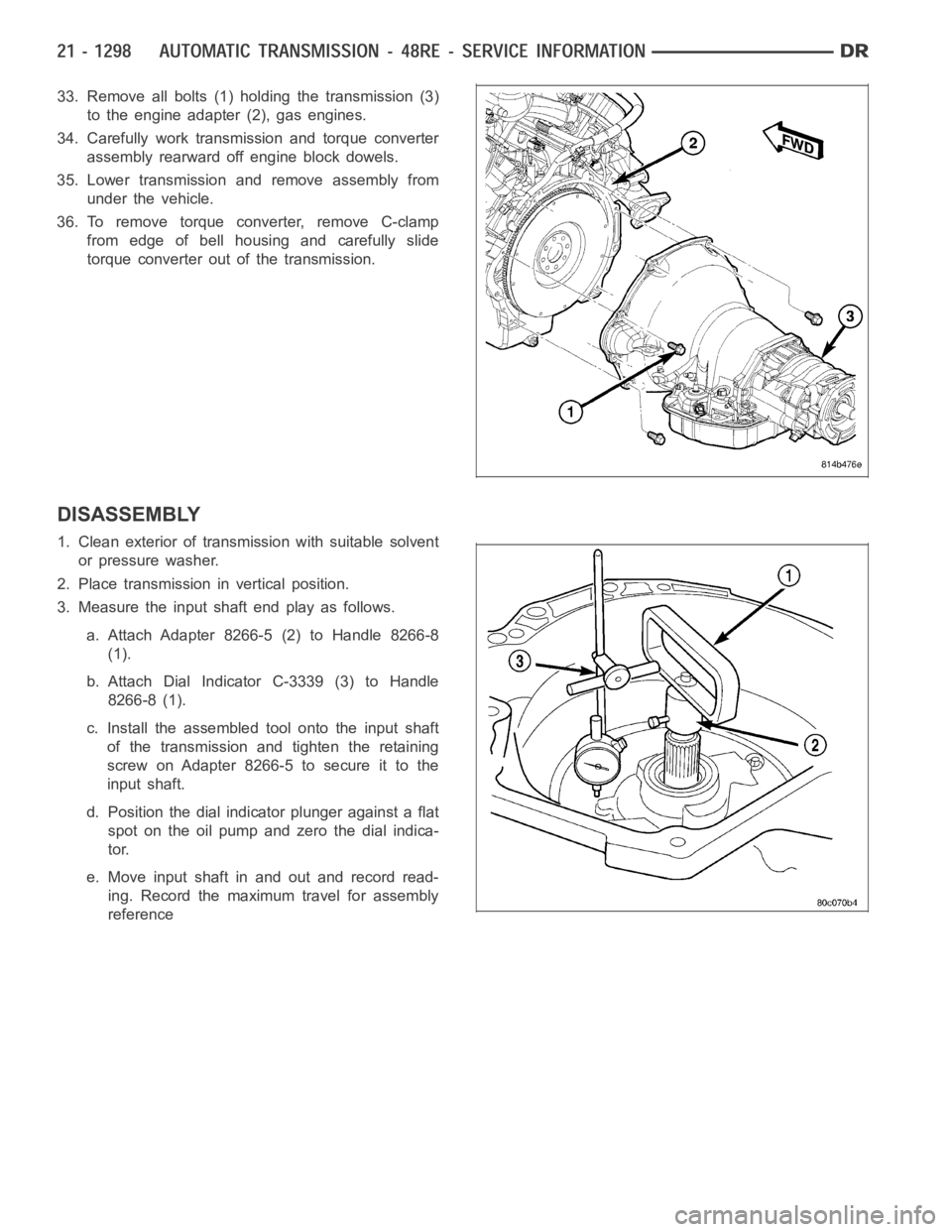
33. Remove all bolts (1) holding the transmission (3)
to the engine adapter (2), gas engines.
34. Carefully work transmission and torque converter
assembly rearward off engine block dowels.
35. Lower transmission and remove assembly from
under the vehicle.
36. To remove torque converter, remove C-clamp
from edge of bell housing and carefully slide
torque converter out of the transmission.
DISASSEMBLY
1. Clean exterior of transmission with suitable solvent
or pressure washer.
2. Place transmission in vertical position.
3. Measure the input shaft end play as follows.
a. Attach Adapter 8266-5 (2) to Handle 8266-8
(1).
b. Attach Dial Indicator C-3339 (3) to Handle
8266-8 (1).
c. Install the assembled tool onto the input shaft
of the transmission and tighten the retaining
screw on Adapter 8266-5 to secure it to the
input shaft.
d. Position the dial indicator plunger against a flat
spot on the oil pump and zero the dial indica-
tor.
e. Move input shaft in and out and record read-
ing. Record the maximum travel for assembly
reference
Page 3825 of 5267
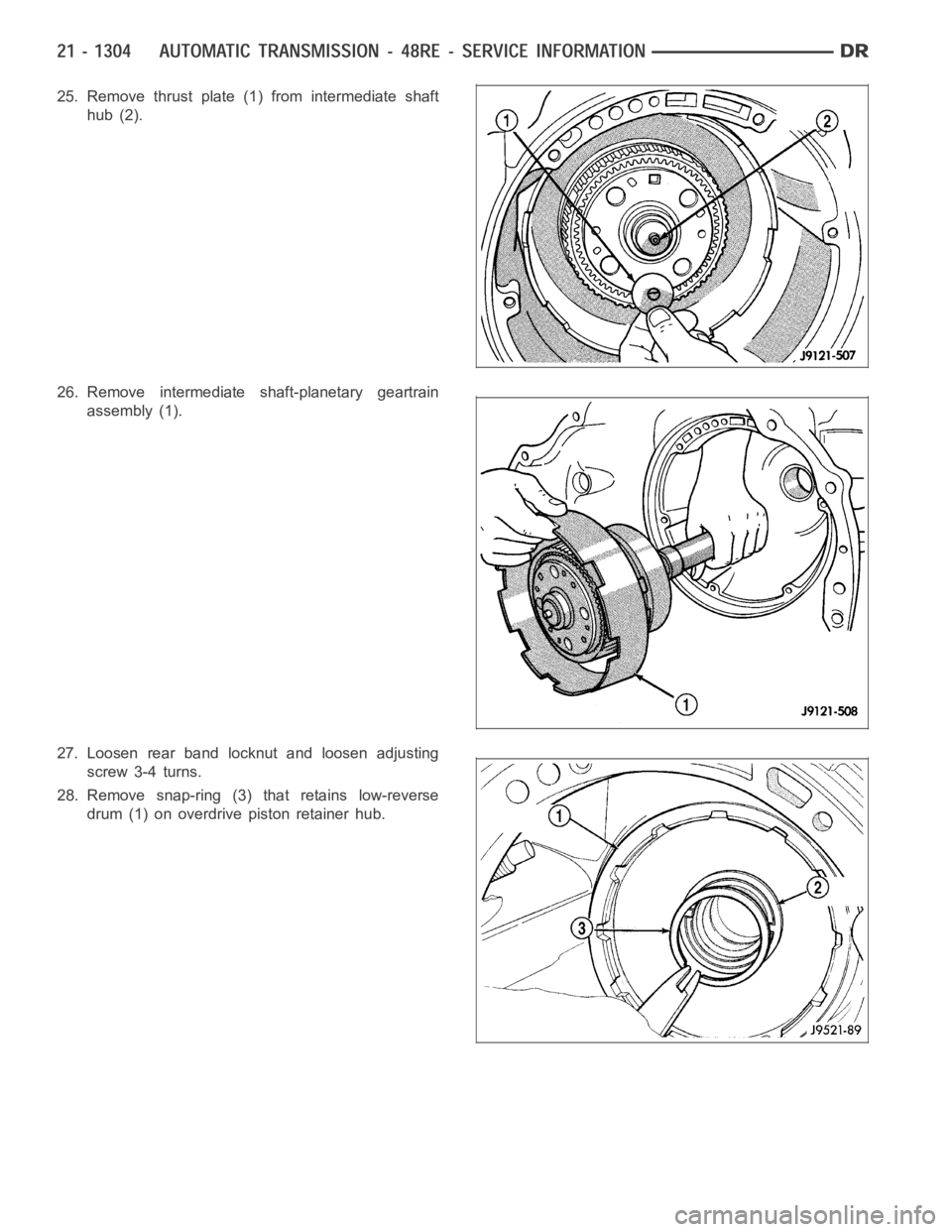
25. Remove thrust plate (1) from intermediate shaft
hub (2).
26. Remove intermediate shaft-planetary geartrain
assembly (1).
27. Loosen rear band locknut and loosen adjusting
screw 3-4 turns.
28. Remove snap-ring (3) that retains low-reverse
drum (1) on overdrive piston retainer hub.
Page 3827 of 5267
32. Remove rear band adjusting lever and reaction
pin.
33. Remove rear band.
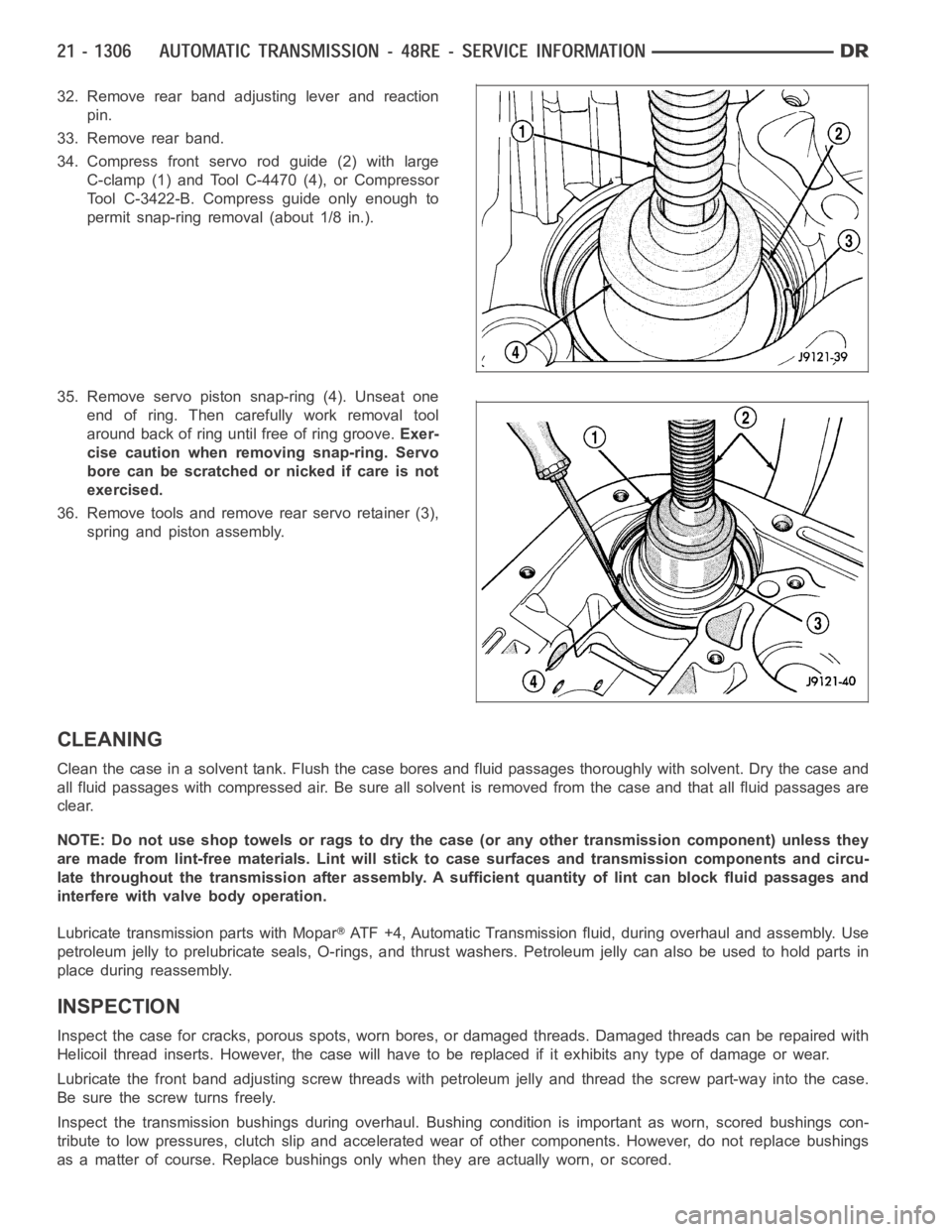
34. Compress front servo rod guide (2) with large
C-clamp (1) and Tool C-4470 (4), or Compressor
Tool C-3422-B. Compress guide only enough to
permit snap-ring removal (about 1/8 in.).
35. Remove servo piston snap-ring (4). Unseat one
end of ring. Then carefully work removal tool
around back of ring until free of ring groove.Exer-
cise caution when removing snap-ring. Servo
bore can be scratched or nicked if care is not
exercised.
36. Remove tools and remove rear servo retainer (3),
spring and piston assembly.
CLEANING
Clean the case in a solvent tank. Flush the case bores and fluid passages thoroughly with solvent. Dry the case and
all fluid passages with compressed air. Be sure all solvent is removed fromthe case and that all fluid passages are
clear.
NOTE: Do not use shop towels or rags to dry the case (or any other transmission component) unless they
aremadefromlint-freematerials.Lintwillsticktocasesurfacesandtransmission components and circu-
late throughout the transmission after assembly. A sufficient quantity of lint can block fluid passages and
interfere with valve body operation.
Lubricate transmission parts with Mopar
ATF +4, Automatic Transmission fluid, during overhaul and assembly. Use
petroleum jelly to prelubricate seals, O-rings, and thrust washers. Petroleumjellycanalsobeusedtoholdpartsin
place during reassembly.
INSPECTION
Inspect the case for cracks, porous spots, worn bores, or damaged threads.Damaged threads can be repaired with
Helicoil thread inserts. However, the case will have to be replaced if it exhibits any type of damage or wear.
Lubricate the front band adjusting screw threads with petroleum jelly andthread the screw part-way into the case.
Be sure the screw turns freely.
Inspect the transmission bushings during overhaul. Bushing condition isimportant as worn, scored bushings con-
tribute to low pressures, clutch slipand accelerated wear of other components. However, do not replace bushings
as a matter of course. Replace bushings only when they are actually worn, orscored.
Page 3828 of 5267
The use of crocus cloth is permissible where necessary, providing it is usedcarefully.Whenusedonshafts,or
valves, use extreme care to avoid rounding off sharp edges. Sharp edges arevital as they prevent foreign matter
from getting between the valve and valve bore.
Do not reuse oil seals, gaskets, seal rings, or O-rings during overhaul. Replace these parts as a matter of course.
Also do not reuse snap rings or E-clips that are bent or distorted. Replace these parts as well.
ASSEMBLY
Do not allow dirt, grease, or foreign material to enter the case or transmission components during assembly. Keep
the transmission case and components clean. Also make sure the tools and workbench area used for reassembly
operations are equally clean.
Shop towels used for wiping off tools and your hands must be made fromlint freematerials. Lint will stick to trans-
mission parts and could interfere with valve operation or even restrict fluid passages.
Lubricate transmission clutch and gear components with Mopar
ATF +4 during reassembly. Soak clutch discs in
transmission fluid before installation.
Use petroleum jelly on piston seals and o-rings to ease installation. Petroleumjellycanalsobeusedtolubricate
and hold thrust washers and plates in position during assembly.
Do not use chassis grease, bearing grease, white grease, or similar lubricants on any part.These types of
lubricants can eventually block or restrict fluid passages and valve operation. Use petroleum jelly only.
Do not force parts into place. The transmission components and sub-assemblies are easily installed by hand when
properly aligned. If a part seems difficult to install, it is either misaligned or incorrectly assembled. Verify that thrust
washers, thrust plates and seal rings are correctly positioned.
The planetary geartrain, front/rear clutch assemblies and oil pump are all much easier to install when the transmis-
sion case is upright. Either tilt the case upward with wood blocks, or cut a hole in the bench large enough for the
intermediate shaft and rear support. Then lower the shaft and support intothe hole and support the rear of the case
directly on the bench.
FRONT/REAR SERVO
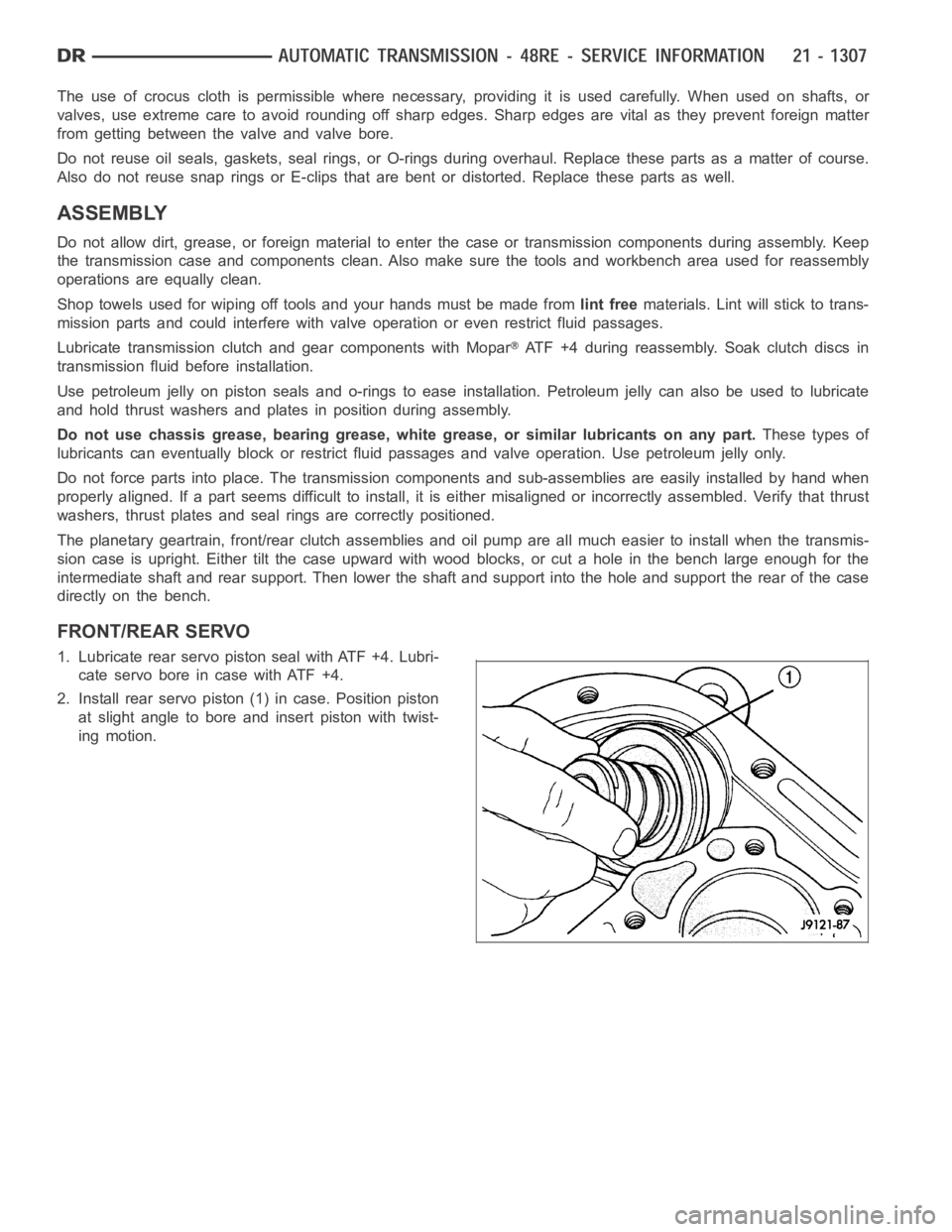
1. Lubricate rear servo piston seal with ATF +4. Lubri-
cateservoboreincasewithATF+4.
2. Install rear servo piston (1) in case. Position piston
at slight angle to bore and insert piston with twist-
ing motion.
Page 3833 of 5267
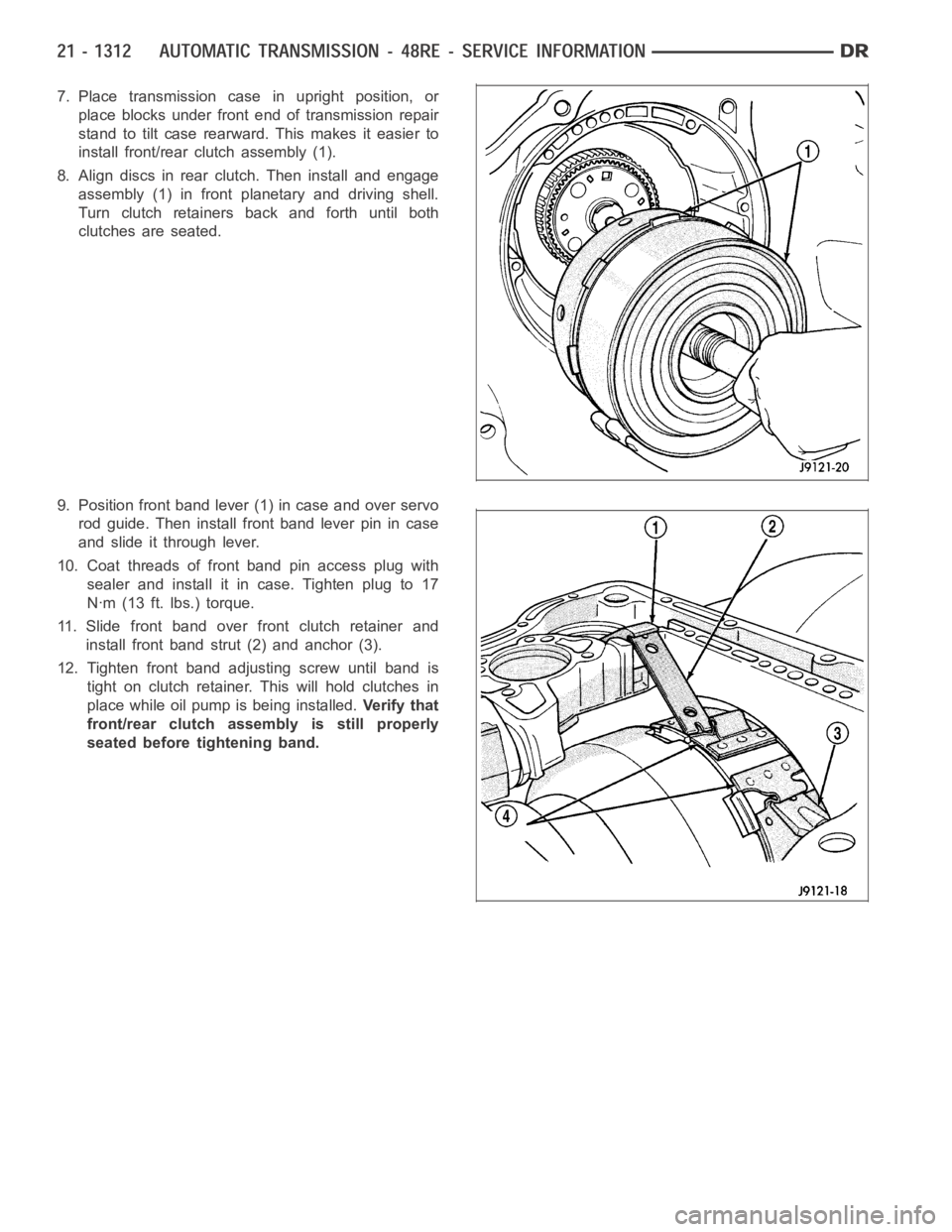
7. Place transmission case in upright position, or
place blocks under front end of transmission repair
stand to tilt case rearward. This makes it easier to
install front/rear clutch assembly (1).
8. Align discs in rear clutch. Then install and engage
assembly (1) in front planetary and driving shell.
Turn clutch retainers back and forth until both
clutches are seated.
9. Position front band lever (1) in case and over servo
rod guide. Then install front band lever pin in case
and slide it through lever.
10. Coat threads of front band pin access plug with
sealer and install it in case. Tighten plug to 17
Nꞏm (13 ft. lbs.) torque.
11. Slide front band over front clutch retainer and
install front band strut (2) and anchor (3).
12. Tighten front band adjusting screw until band is
tight on clutch retainer. This will hold clutches in
place while oil pump is being installed.Ve r i f y t h a t
front/rear clutch assembly is still properly
seated before tightening band.
Page 3837 of 5267
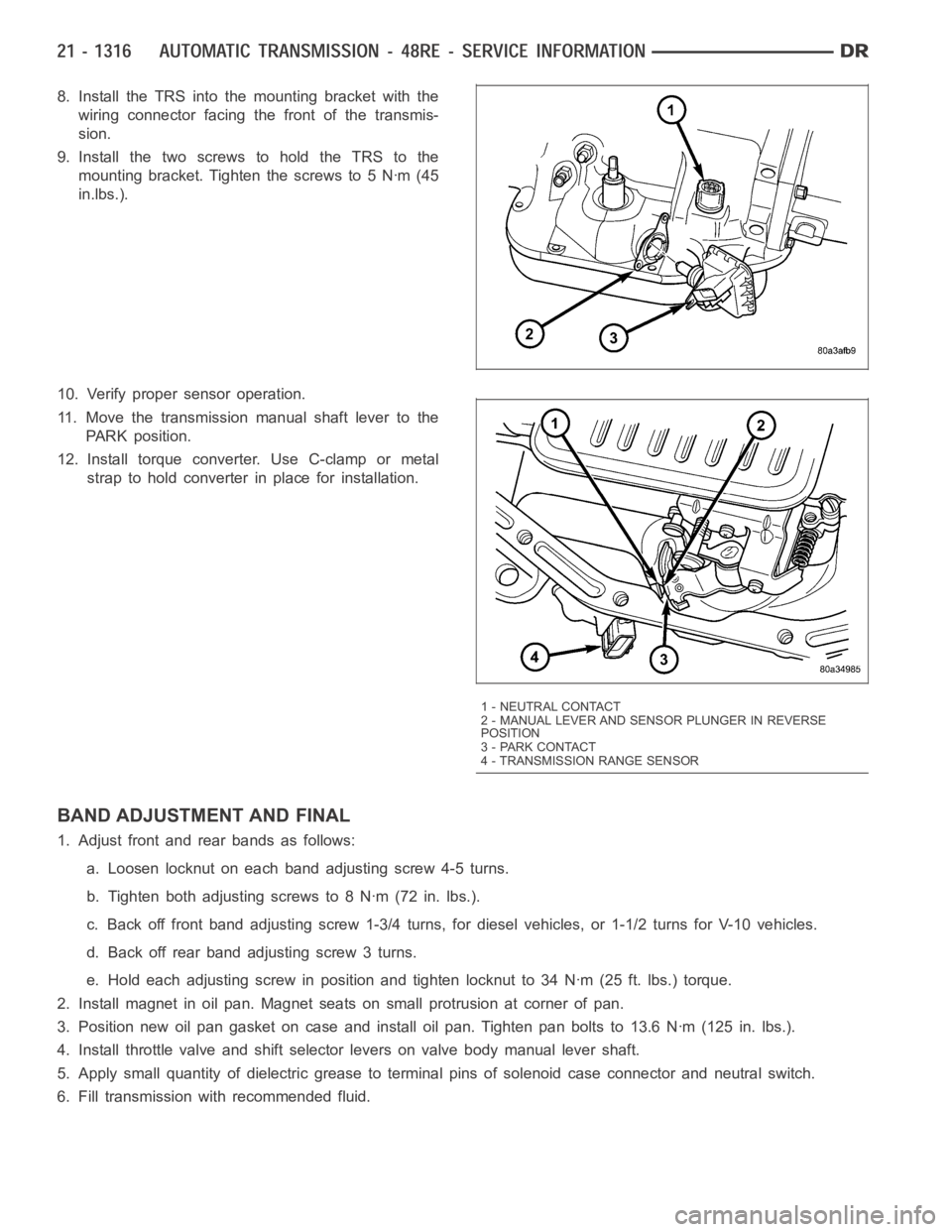
8. Install the TRS into the mounting bracket with the
wiring connector facing the front of the transmis-
sion.
9. Install the two screws to hold the TRS to the
mounting bracket. Tighten the screws to 5 Nꞏm (45
in.lbs.).
10. Verify proper sensor operation.
11. Move the transmission manual shaft lever to the
PARK position.
12. Install torque converter. Use C-clamp or metal
strap to hold converter in place for installation.
BAND ADJUSTMENT AND FINAL
1. Adjust front and rear bands as follows:
a. Loosen locknut on each band adjusting screw 4-5 turns.
b. Tighten both adjusting screws to 8 Nꞏm (72 in. lbs.).
c. Back off front band adjusting screw 1-3/4 turns, for diesel vehicles, or1-1/2 turns for V-10 vehicles.
d. Back off rear band adjusting screw 3 turns.
e. Hold each adjusting screw in position and tighten locknut to 34 Nꞏm (25 ft. lbs.) torque.
2. Install magnet in oil pan. Magnet seats on small protrusion at corner of pan.
3. Position new oil pan gasket on case and install oil pan. Tighten pan boltsto 13.6 Nꞏm (125 in. lbs.).
4. Install throttle valve and shift selector levers on valve body manual lever shaft.
5. Apply small quantity of dielectric grease to terminal pins of solenoid case connector and neutral switch.
6. Fill transmission with recommended fluid.
1 - NEUTRAL CONTACT
2 - MANUAL LEVER AND SENSOR PLUNGER IN REVERSE
POSITION
3 - PARK CONTACT
4 - TRANSMISSION RANGE SENSOR
Page 3838 of 5267
INSTALLATION
1. Check torque converter hub inner and outer diam-
eters and hub drive notches for sharp edges burrs,
scratches, or nicks. Polish the hub and notches
with 320/400 grit paper and crocus cloth if neces-
sary. The hub must be smooth to avoid damaging
pump seal at installation.
2. Lubricate pocket in the rear oil pump seal lip with
transmission fluid.
3. Lubricate converter pilot hub of the crankshaft with
a light coating of Mopar
High Temp Grease.
4. Align and install converter in oil pump.
5. Carefully insert converter in oil pump. Then rotate
converter back and forth until fully seated in pump
gears.
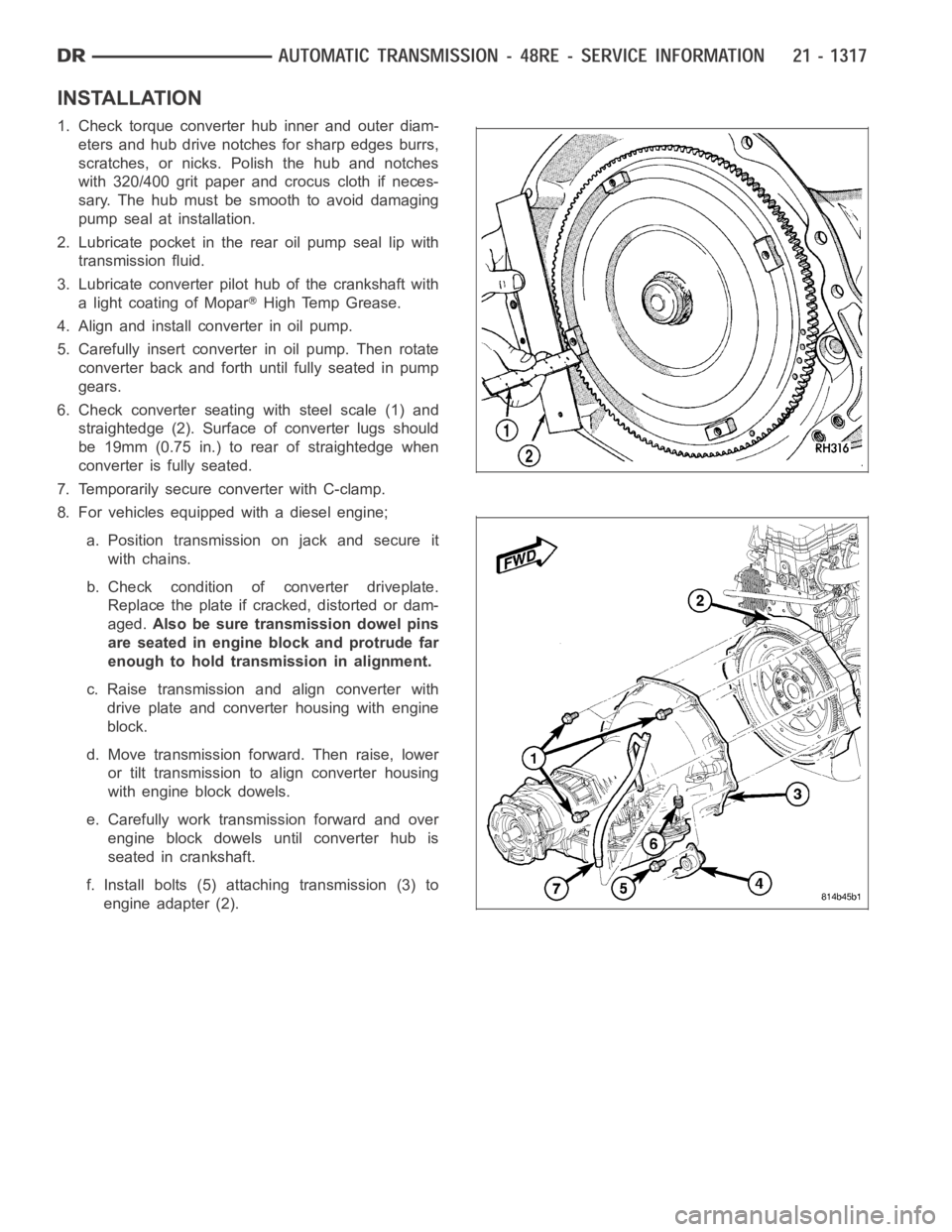
6. Check converter seating with steel scale (1) and
straightedge (2). Surface of converter lugs should
be 19mm (0.75 in.) to rear of straightedge when
converter is fully seated.
7. Temporarily secure converter with C-clamp.
8. For vehicles equipped with a diesel engine;
a. Position transmission on jack and secure it
with chains.
b. Check condition of converter driveplate.
Replace the plate if cracked, distorted or dam-
aged.Also be sure transmission dowel pins
are seated in engine block and protrude far
enough to hold transmission in alignment.
c. Raise transmission and align converter with
drive plate and converter housing with engine
block.
d. Move transmission forward. Then raise, lower
or tilt transmission to align converter housing
with engine block dowels.
e. Carefully work transmission forward and over
engine block dowels until converter hub is
seated in crankshaft.
f. Install bolts (5) attaching transmission (3) to
engine adapter (2).
Page 3839 of 5267
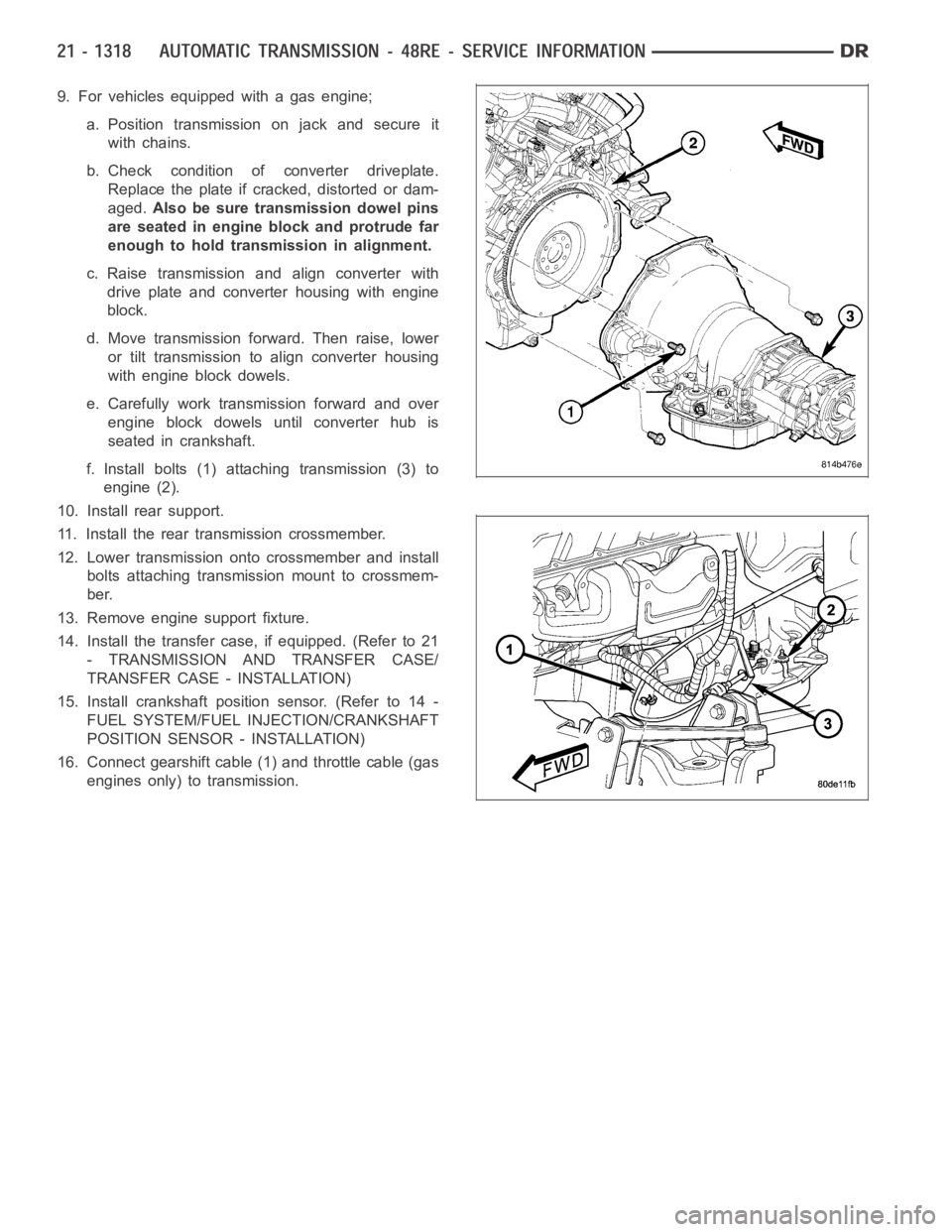
9. For vehicles equipped with a gas engine;
a. Position transmission on jack and secure it
with chains.
b. Check condition of converter driveplate.
Replace the plate if cracked, distorted or dam-
aged.Also be sure transmission dowel pins
are seated in engine block and protrude far
enough to hold transmission in alignment.
c. Raise transmission and align converter with
drive plate and converter housing with engine
block.
d. Move transmission forward. Then raise, lower
or tilt transmission to align converter housing
with engine block dowels.
e. Carefully work transmission forward and over
engine block dowels until converter hub is
seated in crankshaft.
f. Install bolts (1) attaching transmission (3) to
engine (2).
10. Install rear support.
11. Install the rear transmission crossmember.
12. Lower transmission onto crossmember and install
bolts attaching transmission mount to crossmem-
ber.
13. Remove engine support fixture.
14. Install the transfer case, if equipped. (Refer to 21
- TRANSMISSION AND TRANSFER CASE/
TRANSFER CASE - INSTALLATION)
15. Install crankshaft position sensor. (Refer to 14 -
FUEL SYSTEM/FUEL INJECTION/CRANKSHAFT
POSITION SENSOR - INSTALLATION)
16. Connect gearshift cable (1) and throttle cable (gas
engines only) to transmission.
Page 3858 of 5267
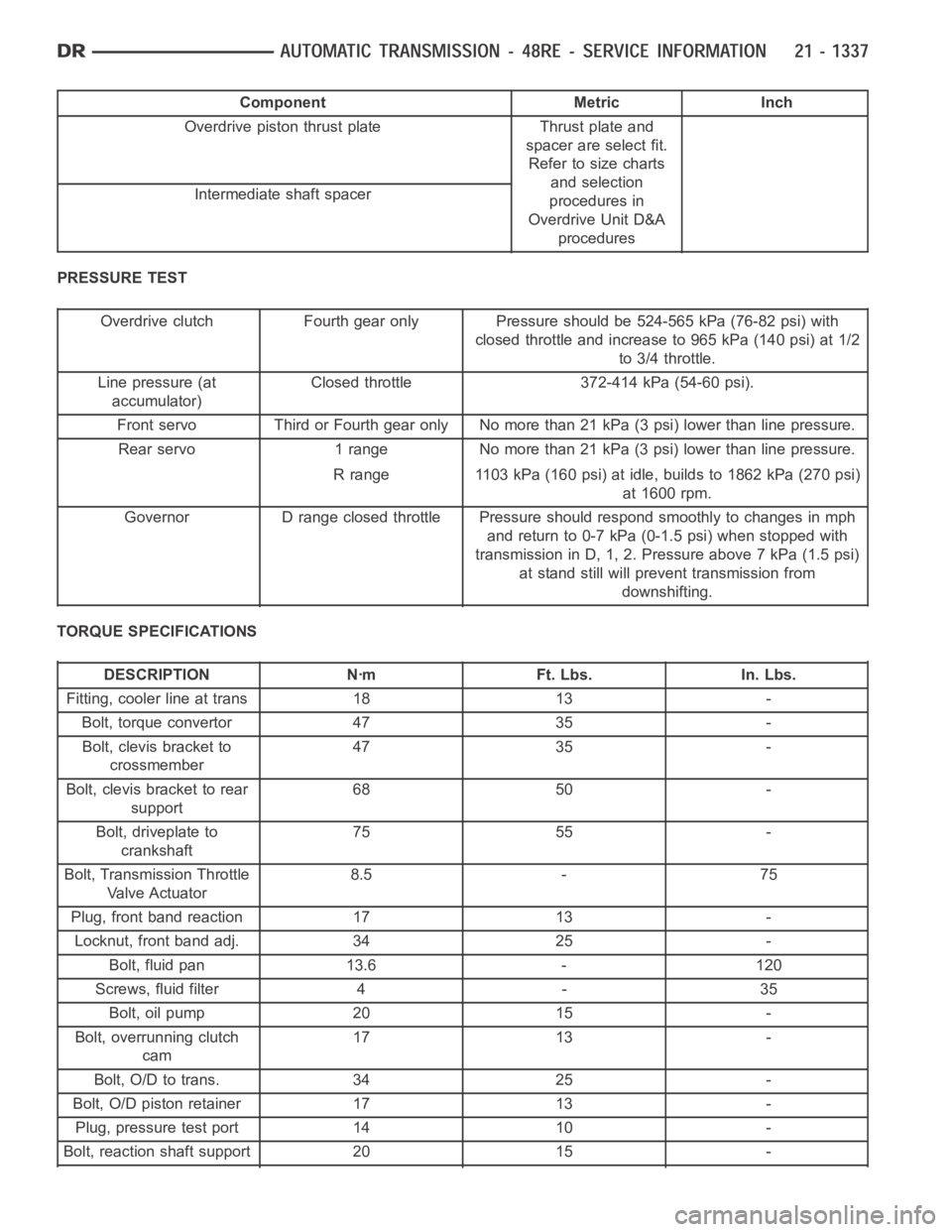
Component Metric Inch
Overdrive piston thrust plate Thrust plate and
spacer are select fit.
Refer to size charts
and selection
procedures in
Overdrive Unit D&A
procedures Intermediateshaft spacer
PRESSURE TEST
Overdrive clutch Fourth gear only Pressure should be 524-565 kPa (76-82 psi) with
closed throttle and increase to 965 kPa (140 psi) at 1/2
to 3/4 throttle.
Line pressure (at
accumulator)Closed throttle 372-414 kPa (54-60 psi).
Front servo Third or Fourth gear only No more than 21 kPa (3 psi) lower than line pressure.
Rearservo 1range Nomorethan21kPa(3psi)lowerthanlinepressure.
R range 1103 kPa (160 psi) at idle, builds to 1862 kPa (270 psi)
at 1600 rpm.
Governor D range closed throttle Pressure should respond smoothly to changes in mph
andreturnto0-7kPa(0-1.5psi)whenstoppedwith
transmission in D, 1, 2. Pressure above 7 kPa (1.5 psi)
at stand still will prevent transmission from
downshifting.
TORQUE SPECIFICATIONS
DESCRIPTION Nꞏm Ft. Lbs. In. Lbs.
Fitting, cooler line at trans 18 13 -
Bolt, torque convertor 47 35 -
Bolt, clevis bracket to
crossmember47 35 -
Bolt, clevis bracket to rear
support68 50 -
Bolt, driveplate to
crankshaft75 55 -
Bolt, Transmission Throttle
Va l v e A c t u a t o r8.5 - 75
Plug, front band reaction 17 13 -
Locknut, front band adj. 34 25 -
Bolt, fluid pan 13.6 - 120
Screws, fluid filter 4 - 35
Bolt, oil pump 20 15 -
Bolt, overrunning clutch
cam17 13 -
Bolt, O/D to trans. 34 25 -
Bolt, O/D piston retainer 17 13 -
Plug, pressure test port 14 10 -
Bolt, reaction shaft support 20 15 -
Page 3859 of 5267
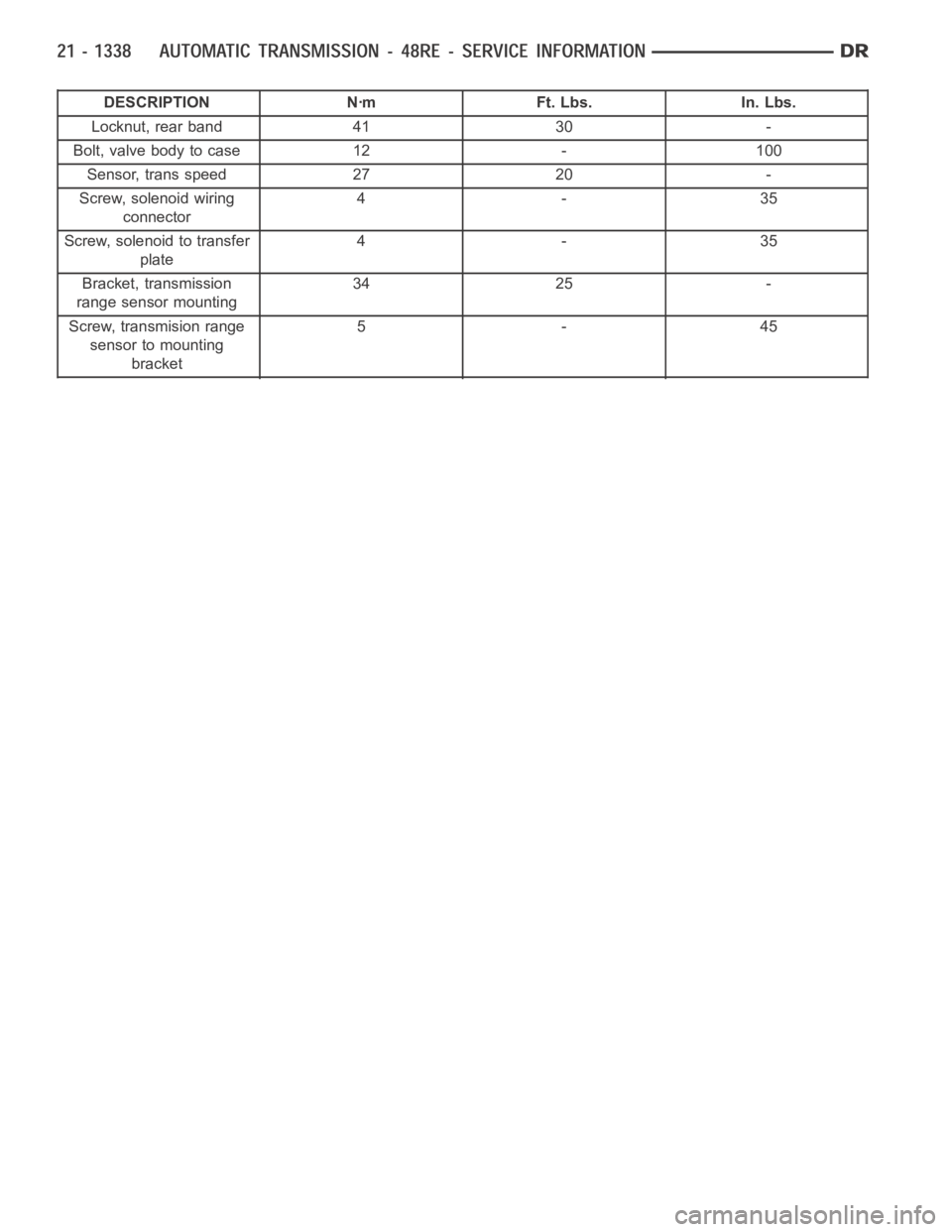
DESCRIPTION Nꞏm Ft. Lbs. In. Lbs.
Locknut, rear band 41 30 -
Bolt, valve body to case 12 - 100
Sensor, trans speed 27 20 -
Screw, solenoid wiring
connector4-35
Screw, solenoid to transfer
plate4-35
Bracket, transmission
range sensor mounting34 25 -
Screw, transmision range
sensor to mounting
bracket5-45