lock DODGE RAM SRT-10 2006 Service Repair Manual
[x] Cancel search | Manufacturer: DODGE, Model Year: 2006, Model line: RAM SRT-10, Model: DODGE RAM SRT-10 2006Pages: 5267, PDF Size: 68.7 MB
Page 3865 of 5267
ADJUSTMENTS
ADJUSTMENT - BANDS
FRONT BAND
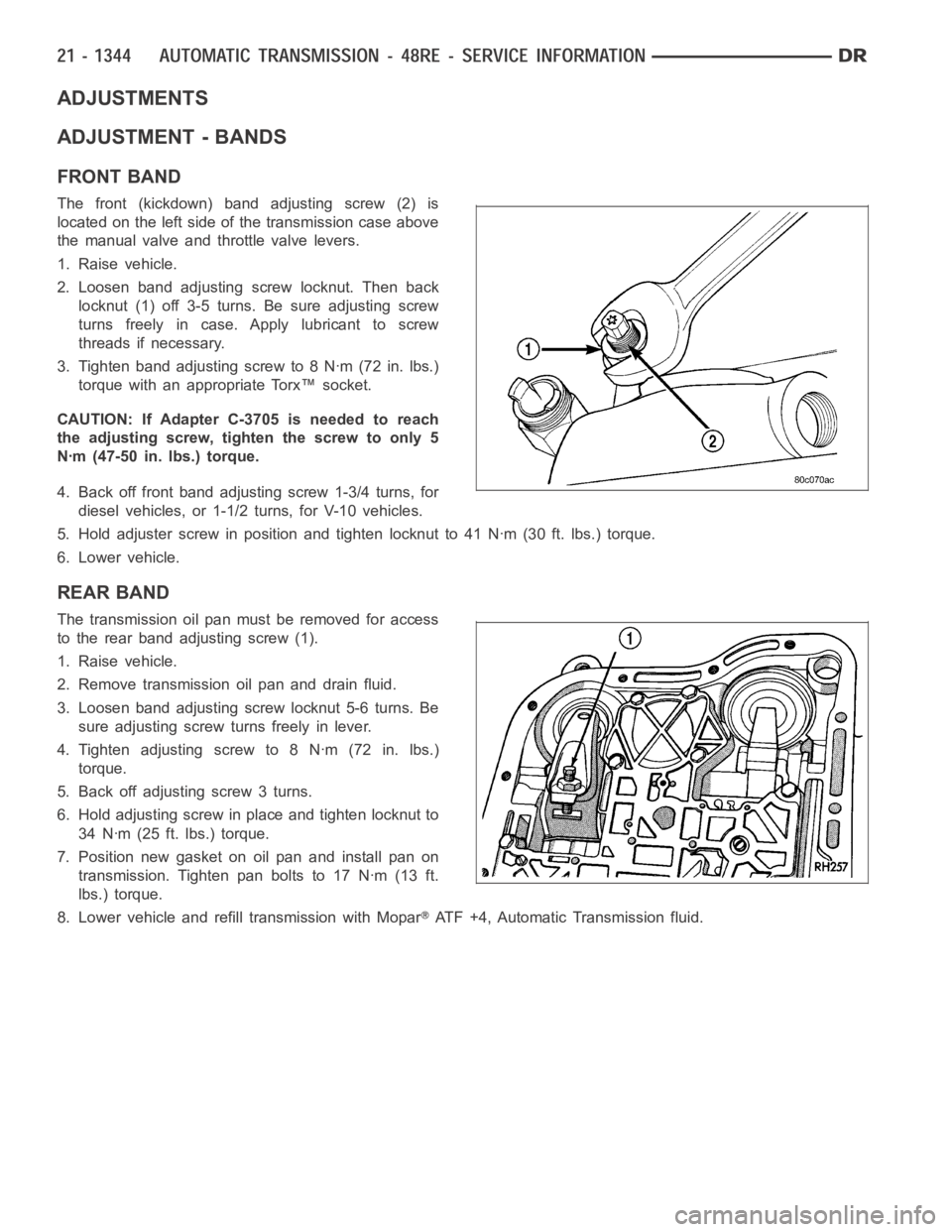
The front (kickdown) band adjusting screw (2) is
located on the left side of the transmission case above
the manual valve and throttle valve levers.
1. Raise vehicle.
2. Loosen band adjusting screw locknut. Then back
locknut (1) off 3-5 turns. Be sure adjusting screw
turns freely in case. Apply lubricant to screw
threads if necessary.
3. Tighten band adjusting screw to 8 Nꞏm (72 in. lbs.)
torque with an appropriate Torx™ socket.
CAUTION: If Adapter C-3705 is needed to reach
the adjusting screw, tighten the screw to only 5
Nꞏm (47-50 in. lbs.) torque.
4. Back off front band adjusting screw 1-3/4 turns, for
diesel vehicles, or 1-1/2 turns, for V-10 vehicles.
5. Hold adjuster screw in position and tighten locknut to 41 Nꞏm (30 ft. lbs.) torque.
6. Lower vehicle.
REAR BAND
The transmission oil pan must be removed for access
to the rear band adjusting screw (1).
1. Raise vehicle.
2. Remove transmission oil pan and drain fluid.
3. Loosen band adjusting screw locknut 5-6 turns. Be
sure adjusting screw turns freely in lever.
4. Tighten adjusting screw to 8 Nꞏm (72 in. lbs.)
torque.
5. Back off adjusting screw 3 turns.
6. Hold adjusting screw in place and tighten locknut to
34 Nꞏm (25 ft. lbs.) torque.
7. Position new gasket on oil pan and install pan on
transmission. Tighten pan bolts to 17 Nꞏm (13 ft.
lbs.) torque.
8. Lower vehicle and refill transmission with Mopar
ATF +4, Automatic Transmission fluid.
Page 3866 of 5267
SYSTEM-BRAKE TRANSMISSION SHIFT INTERLOCK
DESCRIPTION
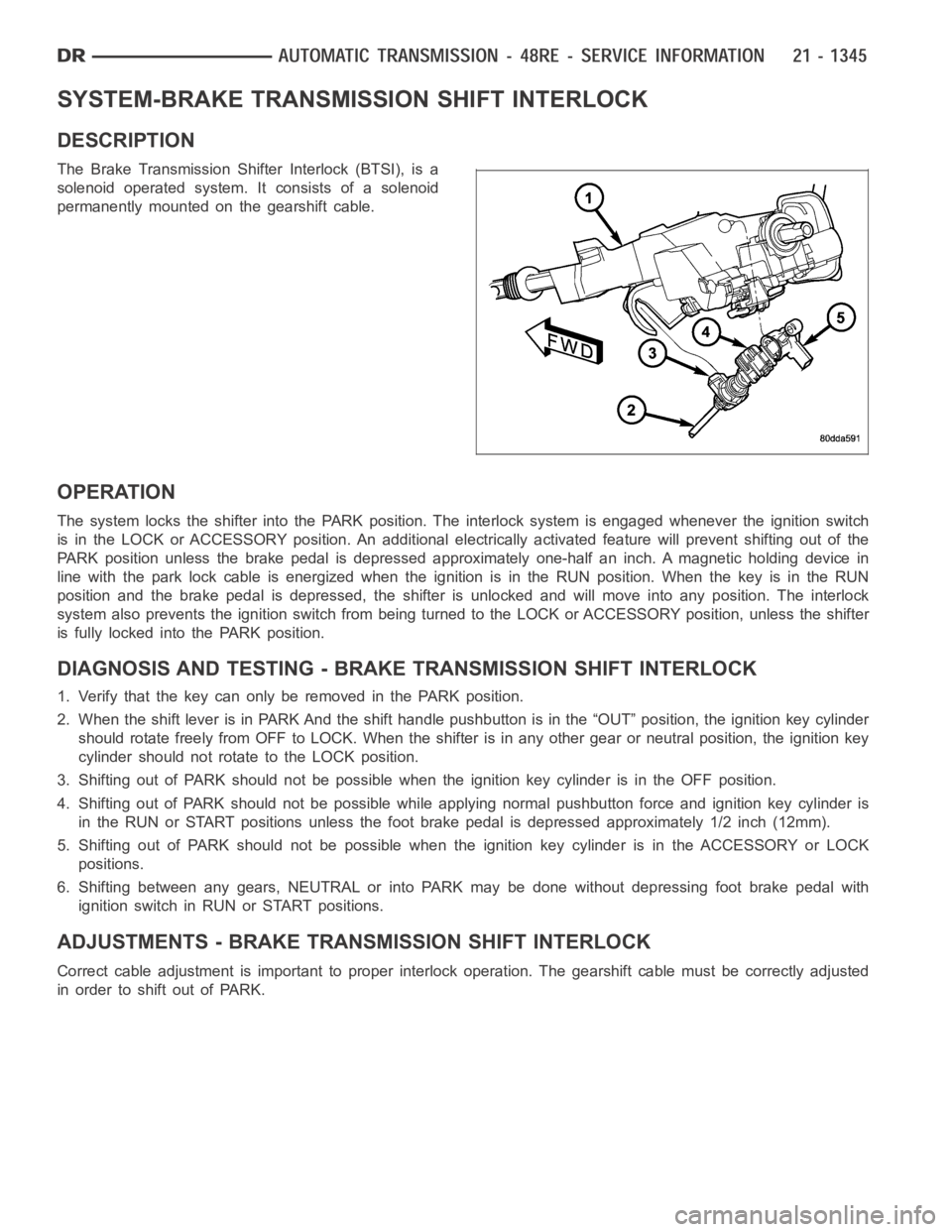
The Brake Transmission Shifter Interlock (BTSI), is a
solenoid operated system. It consists of a solenoid
permanently mounted on the gearshift cable.
OPERATION
The system locks the shifter into the PARK position. The interlock system is engaged whenever the ignition switch
is in the LOCK or ACCESSORY position. An additional electrically activated feature will prevent shifting out of the
PARK position unless the brake pedal is depressed approximately one-halfan inch. A magnetic holding device in
line with the park lock cable is energized when the ignition is in the RUN position. When the key is in the RUN
position and the brake pedal is depressed, the shifter is unlocked and willmove into any position. The interlock
system also prevents the ignition switch from being turned to the LOCK or ACCESSORY position, unless the shifter
is fully locked into the PARK position.
DIAGNOSIS AND TESTING - BRAKE TRANSMISSION SHIFT INTERLOCK
1. Verify that the key can only be removed in the PARK position.
2. When the shift lever is in PARK And the shift handle pushbutton is in the “OUT” position, the ignition key cylinder
should rotate freely from OFF to LOCK. When the shifter is in any other gear or neutral position, the ignition key
cylinder should not rotate to the LOCK position.
3. Shifting out of PARK should not be possible when the ignition key cylinder is in the OFF position.
4. Shifting out of PARK should not be possible while applying normal pushbutton force and ignition key cylinder is
in the RUN or START positions unless the foot brake pedal is depressed approximately 1/2 inch (12mm).
5. Shifting out of PARK should not be possible when the ignition key cylinderisintheACCESSORYorLOCK
positions.
6. Shifting between any gears, NEUTRAL or into PARK may be done without depressing foot brake pedal with
ignition switch in RUN or START positions.
ADJUSTMENTS - BRAKE TRANSMISSION SHIFT INTERLOCK
Correct cable adjustment is important to proper interlock operation. Thegearshift cable must be correctly adjusted
in order to shift out of PARK.
Page 3867 of 5267
ADJUSTMENT PROCEDURE
1. Remove the steering column trim as necessary for
access to the brake transmission shift interlock.
2. Shift the transmission into the PARK position.
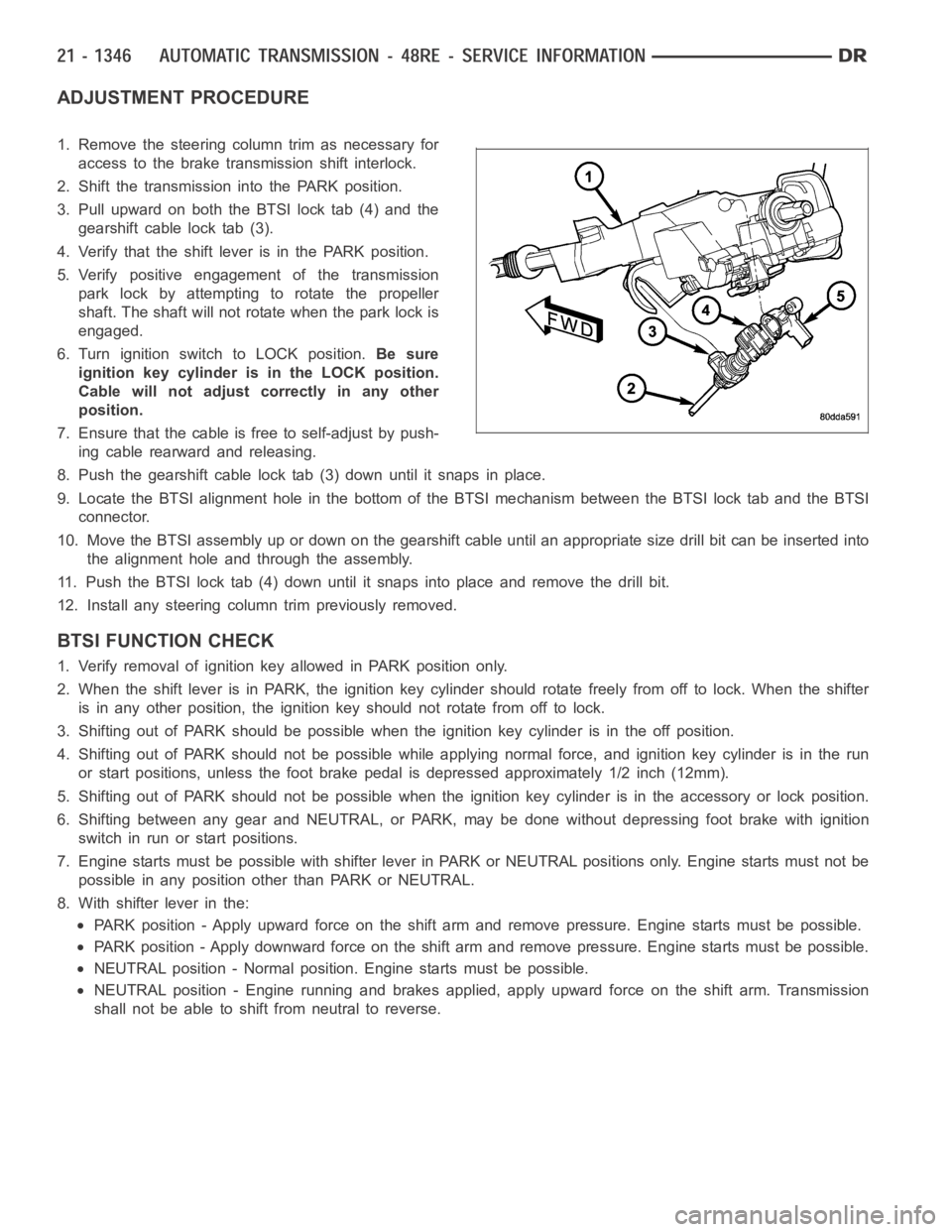
3. Pull upward on both the BTSI lock tab (4) and the
gearshift cable lock tab (3).
4. Verify that the shift lever is in the PARK position.
5. Verify positive engagement of the transmission
park lock by attempting to rotate the propeller
shaft. The shaft will not rotate when the park lock is
engaged.
6. Turn ignition switch to LOCK position.Be sure
ignition key cylinder is in the LOCK position.
Cable will not adjust correctly in any other
position.
7. Ensure that the cable is free to self-adjust by push-
ing cable rearward and releasing.
8. Push the gearshift cable lock tab (3) down until it snaps in place.
9. Locate the BTSI alignment hole in the bottom of the BTSI mechanism betweentheBTSIlocktabandtheBTSI
connector.
10. Move the BTSI assembly up or down on the gearshift cable until an appropriate size drill bit can be inserted into
the alignment hole and through the assembly.
11. Push the BTSI lock tab (4) down until it snaps into place and remove the drill bit.
12. Install any steering column trim previously removed.
BTSI FUNCTION CHECK
1. Verify removal of ignition key allowed in PARK position only.
2. When the shift lever is in PARK, the ignition key cylinder should rotate freely from off to lock. When the shifter
is in any other position, the ignition key should not rotate from off to lock.
3. Shifting out of PARK should be possible when the ignition key cylinder isin the off position.
4. Shifting out of PARK should not be possible while applying normal force,and ignition key cylinder is in the run
or start positions, unless the foot brake pedal is depressed approximately1/2inch(12mm).
5. Shifting out of PARK should not be possible when the ignition key cylinder is in the accessory or lock position.
6. Shifting between any gear and NEUTRAL, or PARK, may be done without depressing foot brake with ignition
switch in run or start positions.
7. Engine starts must be possible with shifter lever in PARK or NEUTRAL positions only. Engine starts must not be
possible in any position other than PARK or NEUTRAL.
8. With shifter lever in the:
PARK position - Apply upward force on the shift arm and remove pressure. Enginestartsmustbepossible.
PARK position - Apply downward force on the shift arm and remove pressure. Engine starts must be possible.
NEUTRAL position - Normal position. Engine starts must be possible.
NEUTRAL position - Engine running and brakes applied, apply upward force on the shift arm. Transmission
shall not be able to shift from neutral to reverse.
Page 3888 of 5267
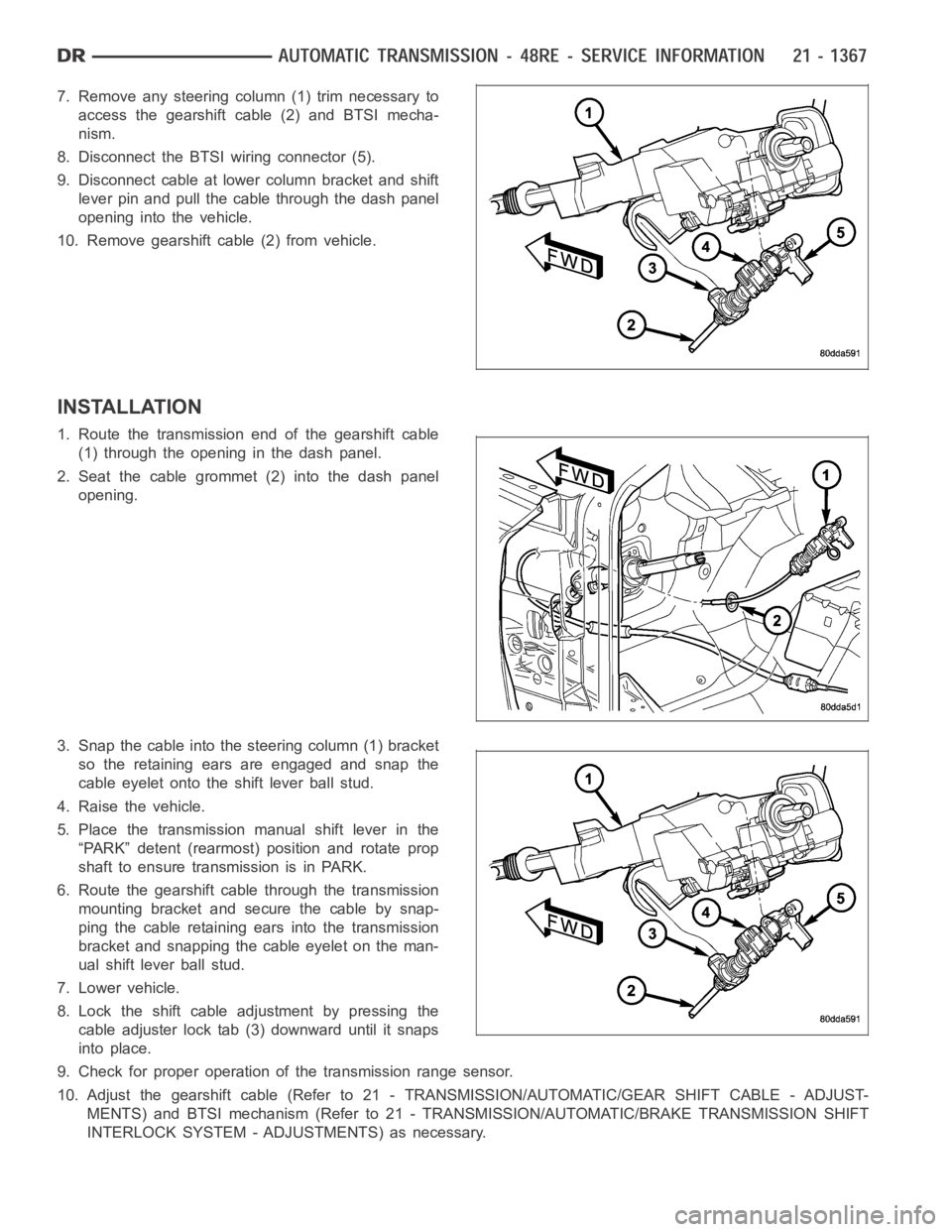
7. Remove any steering column (1) trim necessary to
access the gearshift cable (2) and BTSI mecha-
nism.
8. Disconnect the BTSI wiring connector (5).
9. Disconnect cable at lower column bracket and shift
lever pin and pull the cable through the dash panel
opening into the vehicle.
10. Remove gearshift cable (2) from vehicle.
INSTALLATION
1. Route the transmission end of the gearshift cable
(1) through the opening in the dash panel.
2. Seat the cable grommet (2) into the dash panel
opening.
3. Snap the cable into the steering column (1) bracket
so the retaining ears are engaged and snap the
cable eyelet onto the shift lever ball stud.
4. Raise the vehicle.
5. Place the transmission manual shift lever in the
“PARK” detent (rearmost) position and rotate prop
shaft to ensure transmission is in PARK.
6. Route the gearshift cable through the transmission
mounting bracket and secure the cable by snap-
ping the cable retaining ears into the transmission
bracket and snapping the cable eyelet on the man-
ual shift lever ball stud.
7. Lower vehicle.
8. Lock the shift cable adjustment by pressing the
cable adjuster lock tab (3) downward until it snaps
into place.
9. Check for proper operation of the transmission range sensor.
10. Adjust the gearshift cable (Refer to 21 - TRANSMISSION/AUTOMATIC/GEAR SHIFT CABLE - ADJUST-
MENTS) and BTSI mechanism (Refer to 21 - TRANSMISSION/AUTOMATIC/BRAKE TRANSMISSION SHIFT
INTERLOCK SYSTEM - ADJUSTMENTS) as necessary.
Page 3889 of 5267
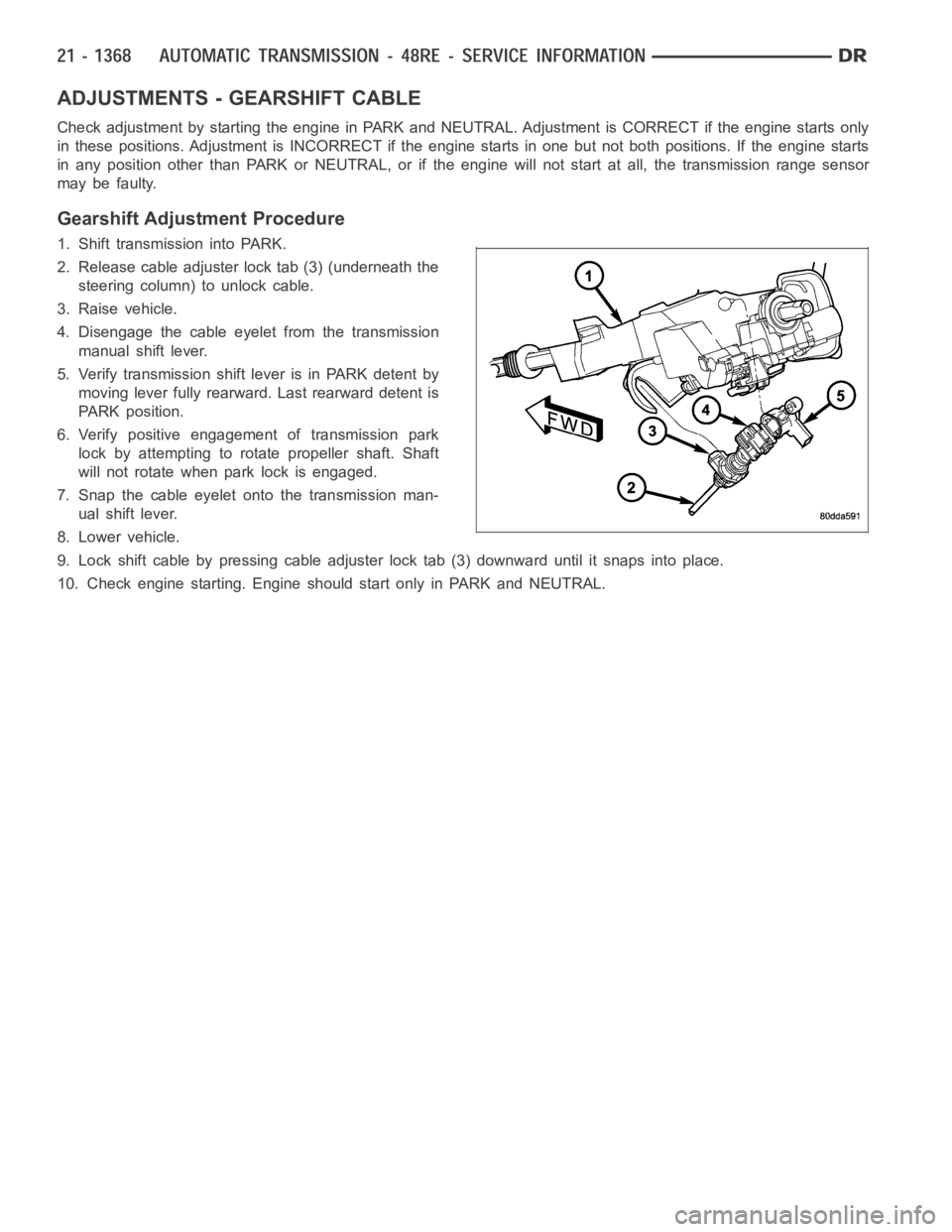
ADJUSTMENTS - GEARSHIFT CABLE
Check adjustment by starting the engine in PARK and NEUTRAL. Adjustment isCORRECT if the engine starts only
in these positions. Adjustment is INCORRECT if the engine starts in one butnot both positions. If the engine starts
in any position other than PARK or NEUTRAL, or if the engine will not start atall, the transmission range sensor
may be faulty.
Gearshift Adjustment Procedure
1. Shift transmission into PARK.
2. Release cable adjuster lock tab (3) (underneath the
steering column) to unlock cable.
3. Raise vehicle.
4. Disengage the cable eyelet from the transmission
manual shift lever.
5. Verify transmission shift lever is in PARK detent by
moving lever fully rearward. Last rearward detent is
PARK position.
6. Verify positive engagement of transmission park
lock by attempting to rotate propeller shaft. Shaft
will not rotate when park lock is engaged.
7. Snap the cable eyelet onto the transmission man-
ual shift lever.
8. Lower vehicle.
9. Lock shift cable by pressing cable adjuster lock tab (3) downward until it snaps into place.
10. Check engine starting. Engine should start only in PARK and NEUTRAL.
Page 3891 of 5267
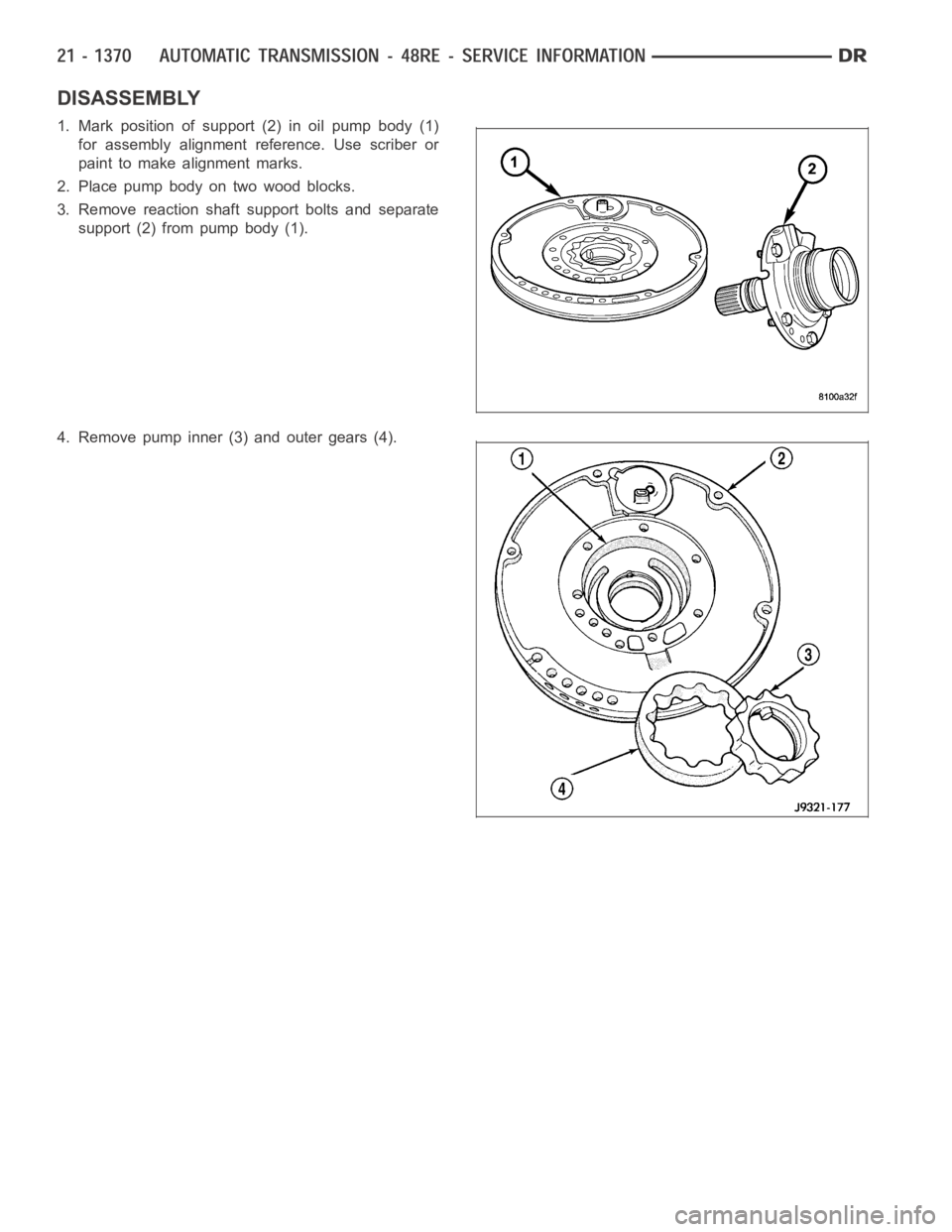
DISASSEMBLY
1. Mark position of support (2) in oil pump body (1)
for assembly alignment reference. Use scriber or
paint to make alignment marks.
2. Place pump body on two wood blocks.
3. Remove reaction shaft support bolts and separate
support (2) from pump body (1).
4. Remove pump inner (3) and outer gears (4).
Page 3907 of 5267
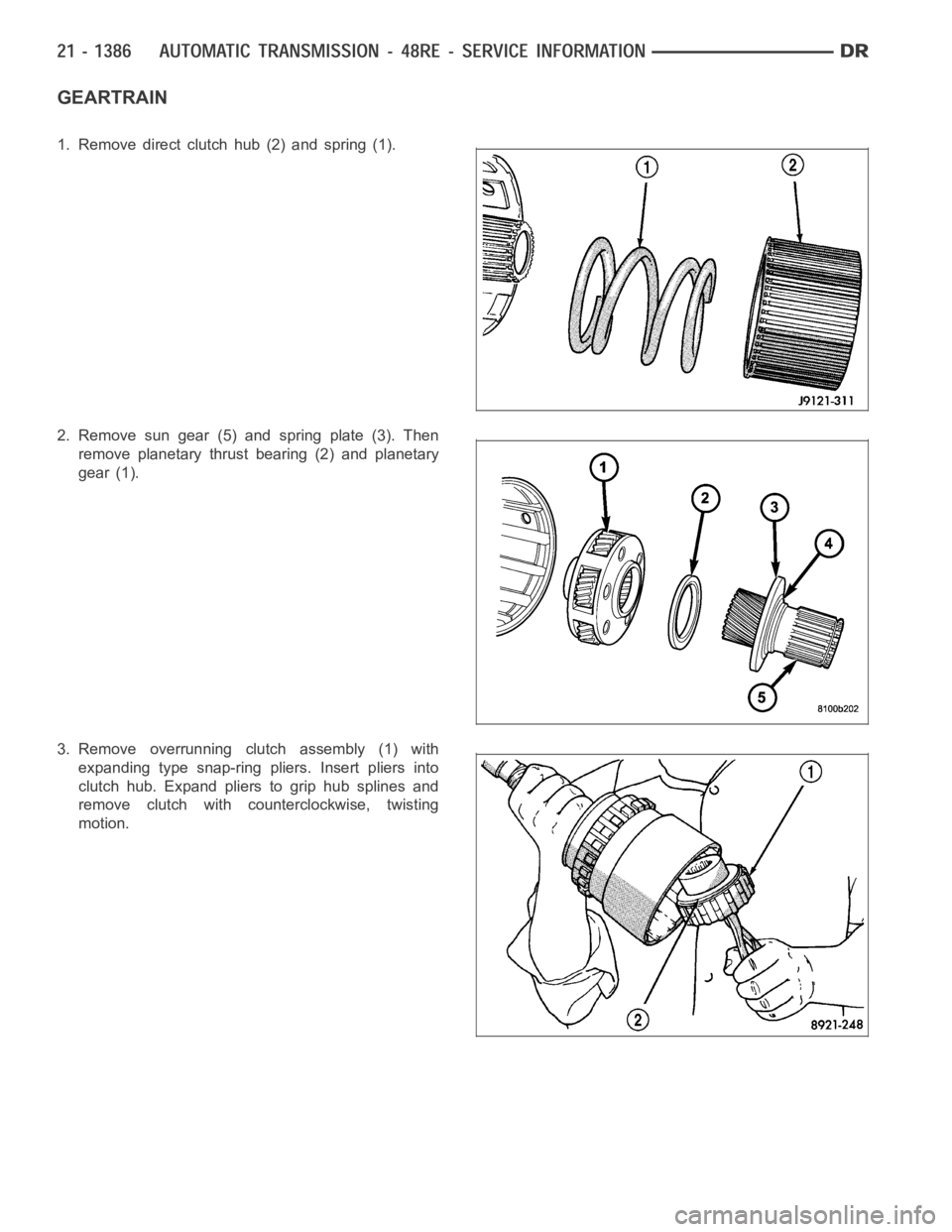
GEARTRAIN
1. Remove direct clutch hub (2) and spring (1).
2. Remove sun gear (5) and spring plate (3). Then
remove planetary thrust bearing (2) and planetary
gear (1).
3. Remove overrunning clutch assembly (1) with
expanding type snap-ring pliers. Insert pliers into
clutch hub. Expand pliers to grip hub splines and
remove clutch with counterclockwise, twisting
motion.
Page 3909 of 5267
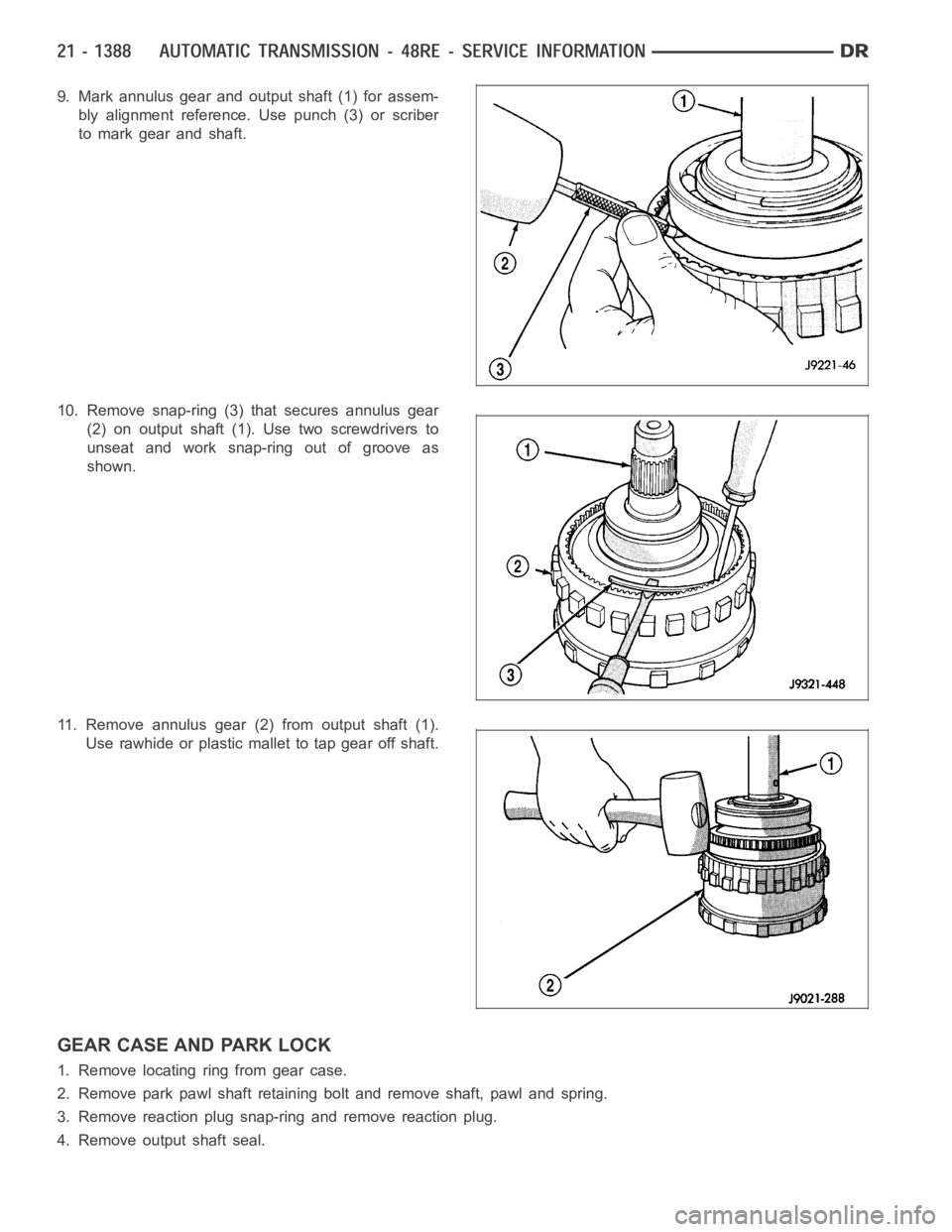
9. Mark annulus gear and output shaft (1) for assem-
bly alignment reference. Use punch (3) or scriber
to mark gear and shaft.
10. Remove snap-ring (3) that secures annulus gear
(2) on output shaft (1). Use two screwdrivers to
unseat and work snap-ring out of groove as
shown.
11. Remove annulus gear (2) from output shaft (1).
Use rawhide or plastic mallet to tap gear off shaft.
GEAR CASE AND PARK LOCK
1. Remove locating ring from gear case.
2. Remove park pawl shaft retaining bolt and remove shaft, pawl and spring.
3. Remove reaction plug snap-ring and remove reaction plug.
4. Remove output shaft seal.
Page 3910 of 5267
CLEANING
Clean the geartrain and case components with solvent. Dry all parts exceptthebearingswithcompressedair.Allow
bearings to air dry.
Do not use shop towels for wiping parts dry unless the towels are made from a lint-free material. A sufficient quan-
tity of lint (from shop towels, cloths, rags, etc.) could plug the transmission filter and fluid passages.
Discard the old case gasket and seals.Do not attempt to salvage these parts. They are not reusable. Replace any
of the overdrive unit snap-rings if distorted or damaged.
Minor nicks or scratches on components can be smoothed with crocus cloth. However, do not attempt to reduce
severescoringonanycomponentswithabrasive materials. Replace severely scored components; do not try to
salvage them.
INSPECTION
Check condition of the park lock components and the overdrive case.
Check the bushings in the overdrive case. Replace the bushings if severelyscored or worn. Also replace the case
seal if loose, distorted, or damaged.
Examine the overdrive and direct clutch discs and plates. Replace the discs if the facing is worn, severely scored,
or burned and flaking off. Replace the clutch plates if worn, heavily scored, or cracked. Check the lugs on the clutch
plates for wear. The plates should slide freely in the drum. Replace the plates or drum if binding occurs.
Check condition of the annulus gear, direct clutch hub, clutch drum and clutch spring. Replace the gear, hub and
drum if worn or damaged. Replace the spring if collapsed, distorted, or cracked.
Be sure the splines and lugs on the gear, drum and hub are in good condition. The clutch plates and discs should
slide freely in these components.
Inspect the thrust bearings and spring plate. Replace the plate if worn or scored. Replace the bearings if rough,
noisy, brinnelled, or worn.
Inspect the planetary gear assembly and the sun gear and bushings. If either the sun gear or the bushings are
damaged, replace the gear and bushings as an assembly. The gear and bushings are not serviced separately.
The planetary carrier and pinions must be in good condition. Also be sure the pinion pins are secure and in good
condition. Replace the carrier if worn or damaged.
Inspect the overrunning clutch and race. The race surface should be smoothand free of scores. Replace the over-
running clutch assembly or the race if either assembly is worn or damaged inany way.
Replace the shaft pilot bushing and inner bushing if damaged. Replace either shaft bearing if rough or noisy.
Replace the bearing snap-rings if distorted or cracked.
Check the machined surfaces on the output shaft. These surfaces should clean and smooth. Very minor nicks or
scratches can be smoothed with crocus cloth. Replace the shaft if worn, scored or damaged in any way.
Inspect the output shaft bushings. The small bushing is the intermediate shaft pilot bushing. The large bushing is the
overrunning clutch hub bushing. Replace either bushing if scored, pitted, cracked, or worn.
Page 3912 of 5267
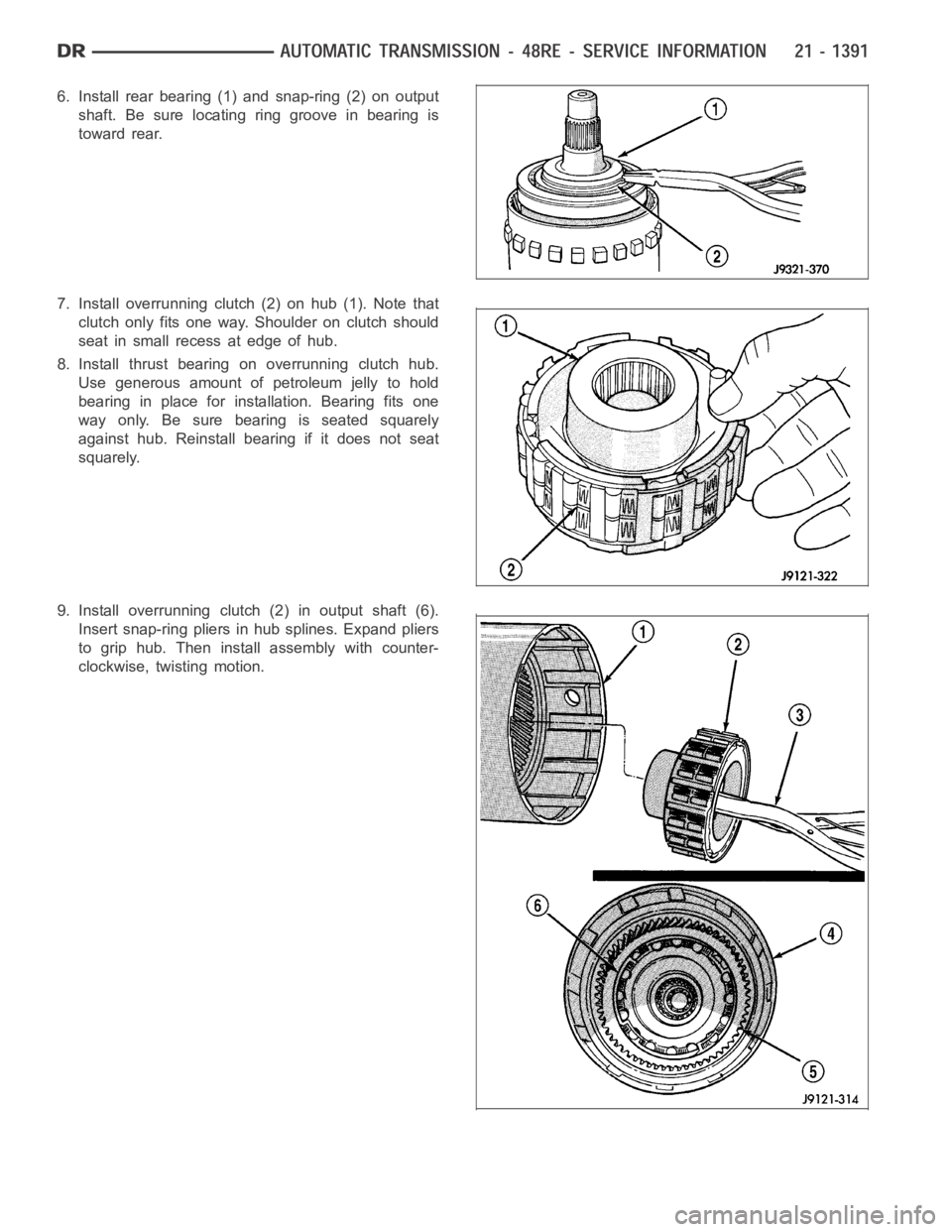
6. Install rear bearing (1) and snap-ring (2) on output
shaft. Be sure locating ring groove in bearing is
toward rear.
7. Install overrunning clutch (2) on hub (1). Note that
clutch only fits one way. Shoulder on clutch should
seat in small recess at edge of hub.
8. Install thrust bearing on overrunning clutch hub.
Use generous amount of petroleum jelly to hold
bearing in place for installation. Bearing fits one
way only. Be sure bearing is seated squarely
against hub. Reinstall bearing if it does not seat
squarely.
9. Install overrunning clutch (2) in output shaft (6).
Insert snap-ring pliers inhub splines. Expand pliers
to grip hub. Then install assembly with counter-
clockwise, twisting motion.