lock DODGE RAM SRT-10 2006 Service Repair Manual
[x] Cancel search | Manufacturer: DODGE, Model Year: 2006, Model line: RAM SRT-10, Model: DODGE RAM SRT-10 2006Pages: 5267, PDF Size: 68.7 MB
Page 5128 of 5267
WARNING: The engine cooling system is designed to develop internal pressures up to 145 kilopascals (21
pounds per square inch). Do not remove or loosen the coolant pressure cap, cylinder block drain plugs,
radiator drain, radiator hoses, heater hoses, or hose clamps while the engine cooling system is hot and
under pressure. Allow the vehicle to cool for a minimum of 15 minutes beforeopening the cooling system
for service. Failure to observe this warning can result in serious burns from the heated engine coolant.
CAUTION
CAUTION: Never add R-12 to a refrigerant system designed to use R-134a. Do not use R-12 equipment or
parts on an R-134a A/C system. These refrigerants are not compatible and damage to the A/C system will
result.
CAUTION: Never use R-12 refrigerant oil in a A/C system designed to use R-134a refrigerant oil. These
refrigerant oils are not compatible and damage to the A/C system will result.
CAUTION: The use of A/C system sealers may result in damage to A/C refrigerant recovery/evacuation/re-
charging equipment and/or A/C system. Many federal, state/provincial and local regulations prohibit the
recharge of A/C systems with known leaks. DaimlerChrysler recommends thedetection of A/C system leaks
through the use of approved leak detectors and fluorescent leak detectiondyes. Vehicles found with A/C
system sealers should be treated as contaminated and replacement of the entire A/C refrigerant system is
recommended. A/C systems found to be contaminated with A/C system sealers, A/C stop-leak products or
seal conditioners voids the warranty for the A/C system.
CAUTION: Recover the refrigerant before opening any fitting or connection. Open the fittings with caution,
even after the system has been discharged. Never open or loosen a connection before recovering the refrig-
erant.
CAUTION: If equipped, do not remove the secondary retention clip from any spring-lock coupler connection
while the refrigerant system is under pressure. Recover the refrigerant before removing the secondary
retention clip. Open the fittings with caution, even after the system has been discharged. Never open or
loosen a connection before recovering the refrigerant.
CAUTION: The internal parts of the A/C system will remain stable as long as moisture-free refrigerant and
refrigerant oil is used. Abnormal amounts of dirt, moisture or air can upset the chemical stability. This may
cause operational troubles or even serious damage if present in more than very small quantities. Before
disconnecting a component, clean the outside of the fittings thoroughly to prevent contamination from
entering the refrigerant system. Keep service tools and the work area clean. Do not open the refrigerant
system or uncap a replacement component until you are ready to service the system. Immediately after
disconnecting a component from the refrigerant system, seal the open fittings with a cap or plug. This will
prevent contamination from entering the A/C system.
CAUTION: Refrigerant oil will absorb moisture from the atmosphere if leftuncapped. Do not open a con-
tainer of refrigerant oil until you are ready to use it. Replace the cap on the oil container immediately after
using. Store refrigerant oil only in a clean, airtight, and moisture-freecontainer.
CAUTION: Do not overcharge the refrigerant system. Overcharging will cause excessive compressor head
pressure and can cause compressor noise and A/C system failure.
Page 5130 of 5267
STANDARD PROCEDURE
REFRIGERANT SYSTEM SERVICE EQUIPMENT
WARNING: Eye protection must be worn when servicing an A/C refrigerant system. Turn all valves off
(rotate clockwise) on the equipment being used before connecting or disconnecting service equipment from
the refrigerant system. Failure to observe these warnings may result in personal injury or death.
WARNING: Refer to the applicable warnings and cautions for this system before performing the following
operation (Refer to 24 - HEATING & AIR CONDITIONING/PLUMBING - WARNINGS) and (Refer to 24 - HEAT-
ING & AIR CONDITIONING/PLUMBING - CAUTIONS). Failure to follow the warnings and cautions could result
in possible personal injury or death.
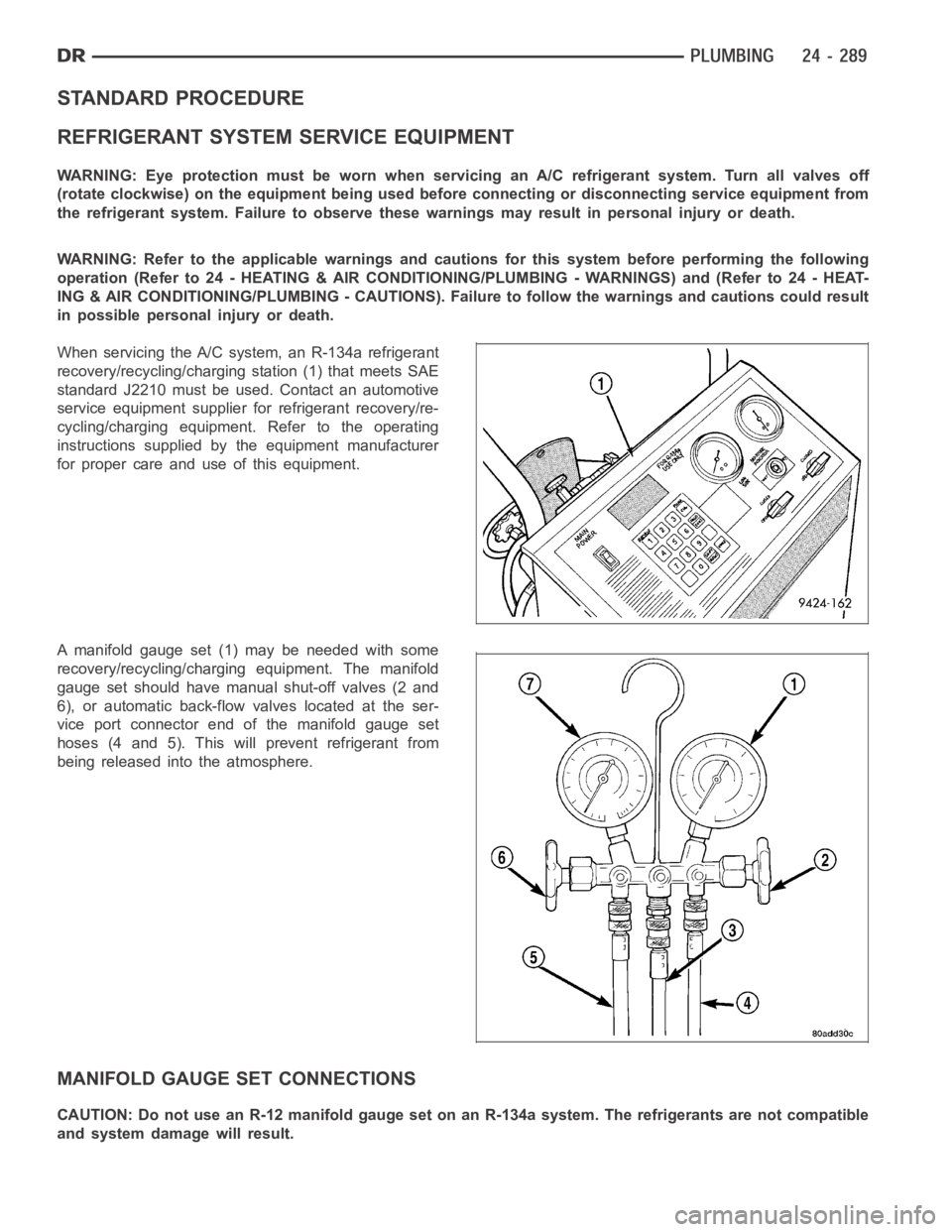
When servicing the A/C system, an R-134a refrigerant
recovery/recycling/charging station (1) that meets SAE
standard J2210 must be used. Contact an automotive
service equipment supplier for refrigerant recovery/re-
cycling/charging equipment. Refer to the operating
instructions supplied by the equipment manufacturer
for proper care and use of this equipment.
A manifold gauge set (1) may be needed with some
recovery/recycling/charging equipment. The manifold
gauge set should have manual shut-off valves (2 and
6), or automatic back-flow valves located at the ser-
vice port connector end of the manifold gauge set
hoses (4 and 5). This will prevent refrigerant from
being released into the atmosphere.
MANIFOLD GAUGE SET CONNECTIONS
CAUTION: Do not use an R-12 manifold gauge set on an R-134a system. The refrigerants are not compatible
and system damage will result.
Page 5134 of 5267
1. Disconnect and isolate the negative battery cable.
2. Recover the refrigerant from the refrigerant system
(Refer to 24 - HEATING & AIR CONDITIONING/
PLUMBING - STANDARD PROCEDURE -
REFRIGERANT RECOVERY).
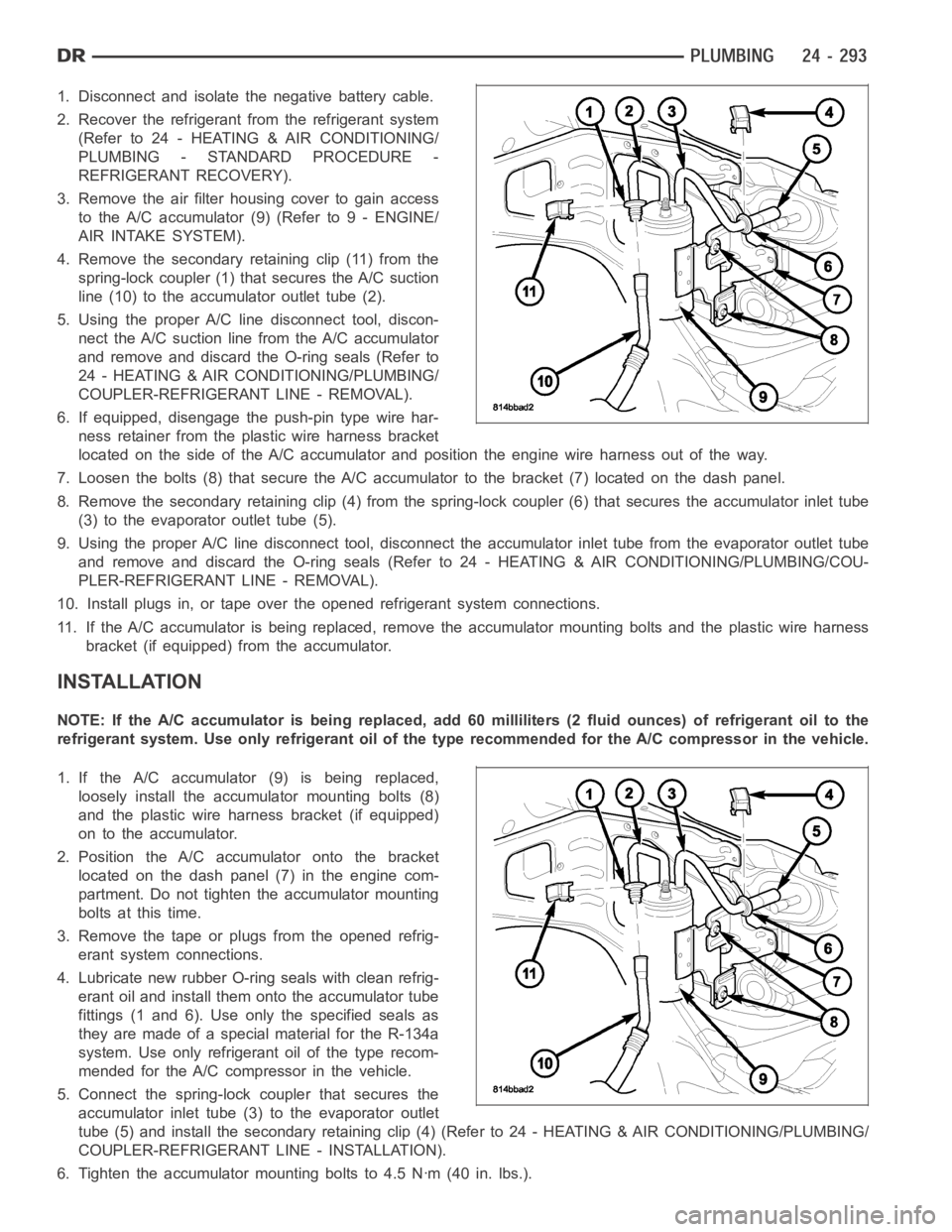
3. Remove the air filter housing cover to gain access
to the A/C accumulator (9) (Refer to 9 - ENGINE/
AIR INTAKE SYSTEM).
4. Remove the secondary retaining clip (11) from the
spring-lock coupler (1) that secures the A/C suction
line (10) to the accumulator outlet tube (2).
5. Using the proper A/C line disconnect tool, discon-
nect the A/C suction line from the A/C accumulator
and remove and discard the O-ring seals (Refer to
24 - HEATING & AIR CONDITIONING/PLUMBING/
COUPLER-REFRIGERANT LINE - REMOVAL).
6. If equipped, disengage the push-pin type wire har-
ness retainer from the plastic wire harness bracket
located on the side of the A/C accumulator and position the engine wire harness out of the way.
7. Loosen the bolts (8) that secure the A/C accumulator to the bracket (7) located on the dash panel.
8. Remove the secondary retaining clip (4) from the spring-lock coupler (6) that secures the accumulator inlet tube
(3) to the evaporator outlet tube (5).
9. Using the proper A/C line disconnect tool, disconnect the accumulator inlet tube from the evaporator outlet tube
and remove and discard the O-ring seals (Refer to 24 - HEATING & AIR CONDITIONING/PLUMBING/COU-
PLER-REFRIGERANT LINE - REMOVAL).
10. Install plugs in, or tape over the opened refrigerant system connections.
11. If the A/C accumulator is being replaced, remove the accumulator mounting bolts and the plastic wire harness
bracket (if equipped) from the accumulator.
INSTALLATION
NOTE: If the A/C accumulator is being replaced, add 60 milliliters (2 fluidounces) of refrigerant oil to the
refrigerant system. Use only refrigerant oil of the type recommended for the A/C compressor in the vehicle.
1. If the A/C accumulator (9) is being replaced,
loosely install the accumulator mounting bolts (8)
and the plastic wire harness bracket (if equipped)
on to the accumulator.
2. Position the A/C accumulator onto the bracket
located on the dash panel (7) in the engine com-
partment. Do not tighten the accumulator mounting
bolts at this time.
3. Remove the tape or plugs from the opened refrig-
erant system connections.
4. Lubricate new rubber O-ring seals with clean refrig-
erant oil and install them onto the accumulator tube
fittings (1 and 6). Use only the specified seals as
they are made of a special material for the R-134a
system. Use only refrigerant oil of the type recom-
mended for the A/C compressor in the vehicle.
5. Connect the spring-lock coupler that secures the
accumulator inlet tube (3) to the evaporator outlet
tube (5) and install the secondary retaining clip (4) (Refer to 24 - HEATING& AIR CONDITIONING/PLUMBING/
COUPLER-REFRIGERANT LINE - INSTALLATION).
6. Tighten the accumulator mounting bolts to 4.5 Nꞏm (40 in. lbs.).
Page 5140 of 5267
1. Recover the refrigerant from the refrigerant system
(Refer to 24 - HEATING & AIR CONDITIONING/
PLUMBING - STANDARD PROCEDURE -
REFRIGERANT SYSTEM RECOVERY).
2. Disconnect and isolate the negative battery cable.
3. Remove the accessory drive belt (Refer to 7 -
COOLING/ACCESSORY DRIVE/BELTS-DRIVE -
REMOVAL).
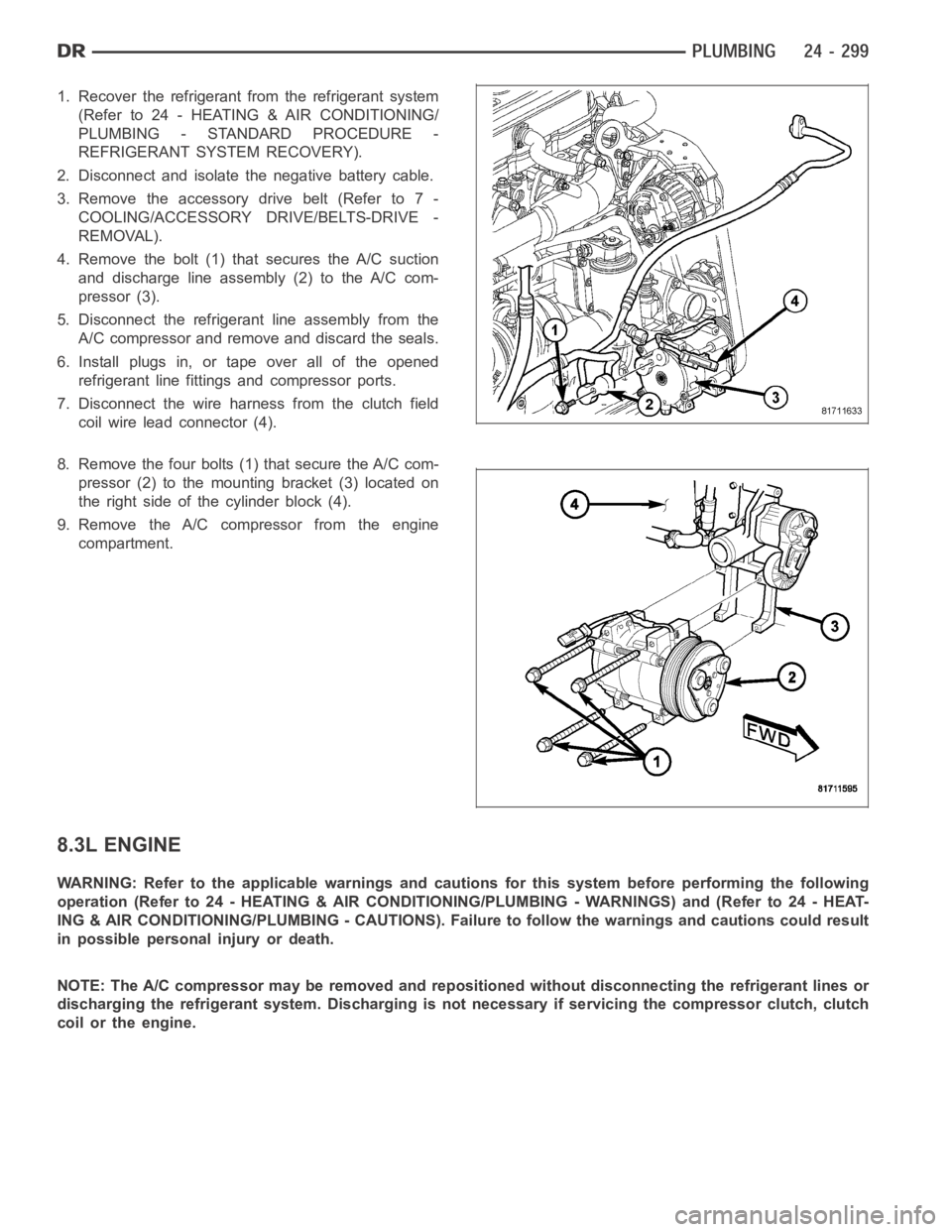
4. Remove the bolt (1) that secures the A/C suction
and discharge line assembly (2) to the A/C com-
pressor (3).
5. Disconnect the refrigerant line assembly from the
A/C compressor and remove and discard the seals.
6. Install plugs in, or tape over all of the opened
refrigerant line fittings and compressor ports.
7. Disconnect the wire harness from the clutch field
coil wire lead connector (4).
8. Remove the four bolts (1) that secure the A/C com-
pressor (2) to the mounting bracket (3) located on
the right side of the cylinder block (4).
9. Remove the A/C compressor from the engine
compartment.
8.3L ENGINE
WARNING: Refer to the applicable warnings and cautions for this system before performing the following
operation (Refer to 24 - HEATING & AIR CONDITIONING/PLUMBING - WARNINGS) and (Refer to 24 - HEAT-
ING & AIR CONDITIONING/PLUMBING - CAUTIONS). Failure to follow the warnings and cautions could result
in possible personal injury or death.
NOTE: The A/C compressor may be removed and repositioned without disconnecting the refrigerant lines or
discharging the refrigerant system. Discharging is not necessary if servicing the compressor clutch, clutch
coil or the engine.
Page 5141 of 5267
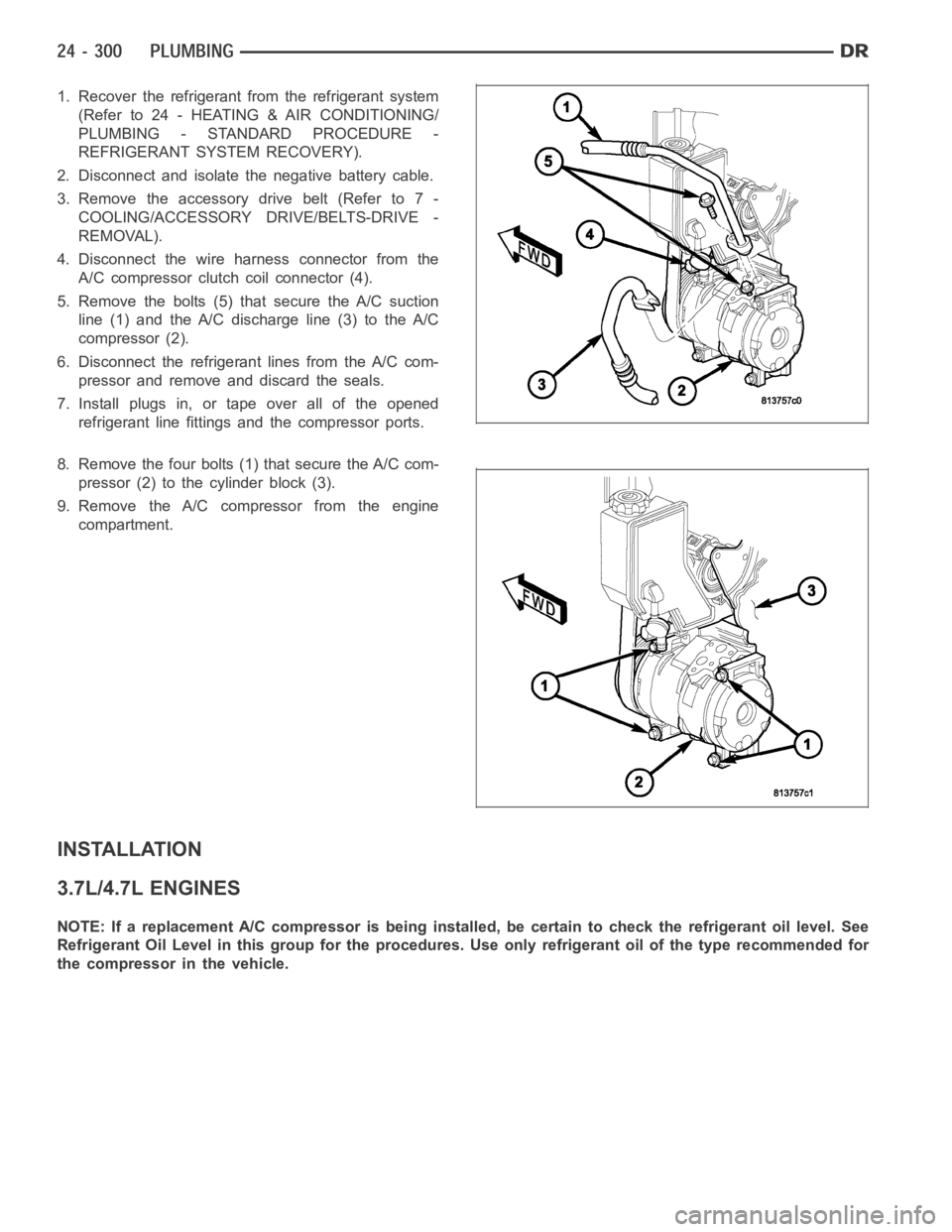
1. Recover the refrigerant from the refrigerant system
(Refer to 24 - HEATING & AIR CONDITIONING/
PLUMBING - STANDARD PROCEDURE -
REFRIGERANT SYSTEM RECOVERY).
2. Disconnect and isolate the negative battery cable.
3. Remove the accessory drive belt (Refer to 7 -
COOLING/ACCESSORY DRIVE/BELTS-DRIVE -
REMOVAL).
4. Disconnect the wire harness connector from the
A/C compressor clutch coil connector (4).
5. Remove the bolts (5) that secure the A/C suction
line (1) and the A/C discharge line (3) to the A/C
compressor (2).
6. Disconnect the refrigerant lines from the A/C com-
pressor and remove and discard the seals.
7. Install plugs in, or tape over all of the opened
refrigerant line fittings and the compressor ports.
8. Remove the four bolts (1) that secure the A/C com-
pressor (2) to the cylinder block (3).
9. Remove the A/C compressor from the engine
compartment.
INSTALLATION
3.7L/4.7L ENGINES
NOTE: If a replacement A/C compressor is being installed, be certain to check the refrigerant oil level. See
Refrigerant Oil Level in this group for the procedures. Use only refrigerant oil of the type recommended for
the compressor in the vehicle.
Page 5144 of 5267
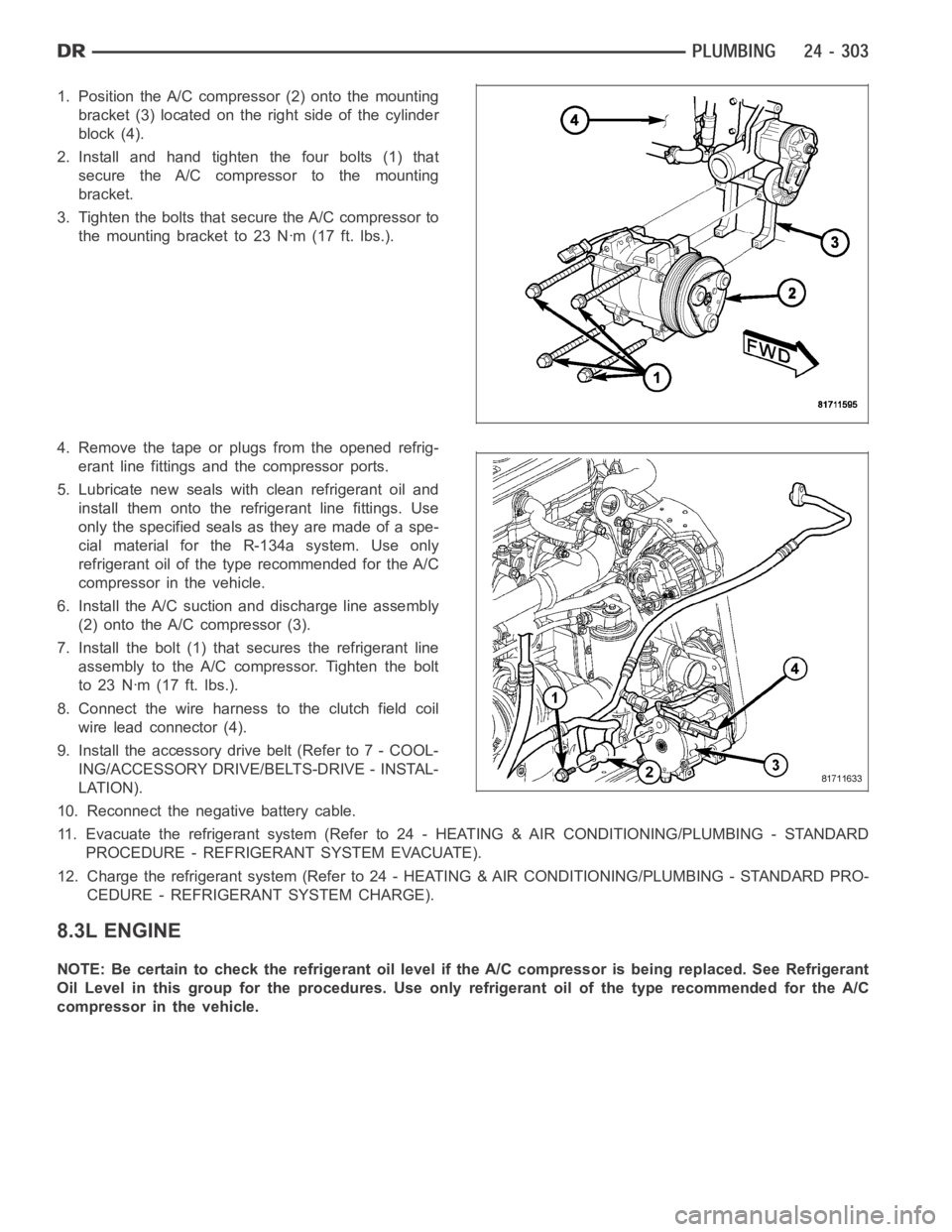
1. Position the A/C compressor (2) onto the mounting
bracket (3) located on the right side of the cylinder
block (4).
2. Install and hand tighten the four bolts (1) that
secure the A/C compressor to the mounting
bracket.
3. Tighten the bolts that secure the A/C compressor to
themountingbracketto23Nꞏm(17ft.lbs.).
4. Remove the tape or plugs from the opened refrig-
erant line fittings and the compressor ports.
5. Lubricate new seals with clean refrigerant oil and
install them onto the refrigerant line fittings. Use
only the specified seals as they are made of a spe-
cial material for the R-134a system. Use only
refrigerant oil of the type recommended for the A/C
compressor in the vehicle.
6. Install the A/C suction and discharge line assembly
(2) onto the A/C compressor (3).
7. Install the bolt (1) that secures the refrigerant line
assembly to the A/C compressor. Tighten the bolt
to 23 Nꞏm (17 ft. lbs.).
8. Connect the wire harness to the clutch field coil
wire lead connector (4).
9. Install the accessory drive belt (Refer to 7 - COOL-
ING/ACCESSORY DRIVE/BELTS-DRIVE - INSTAL-
LATION).
10. Reconnect the negative battery cable.
11. Evacuate the refrigerant system (Refer to 24 - HEATING & AIR CONDITIONING/PLUMBING - STANDARD
PROCEDURE - REFRIGERANT SYSTEM EVACUATE).
12. Charge the refrigerant system (Refer to 24 - HEATING & AIR CONDITIONING/PLUMBING - STANDARD PRO-
CEDURE - REFRIGERANT SYSTEM CHARGE).
8.3L ENGINE
NOTE: Be certain to check the refrigerant oil level if the A/C compressor isbeing replaced. See Refrigerant
Oil Level in this group for the procedures. Use only refrigerant oil of the type recommended for the A/C
compressor in the vehicle.
Page 5145 of 5267
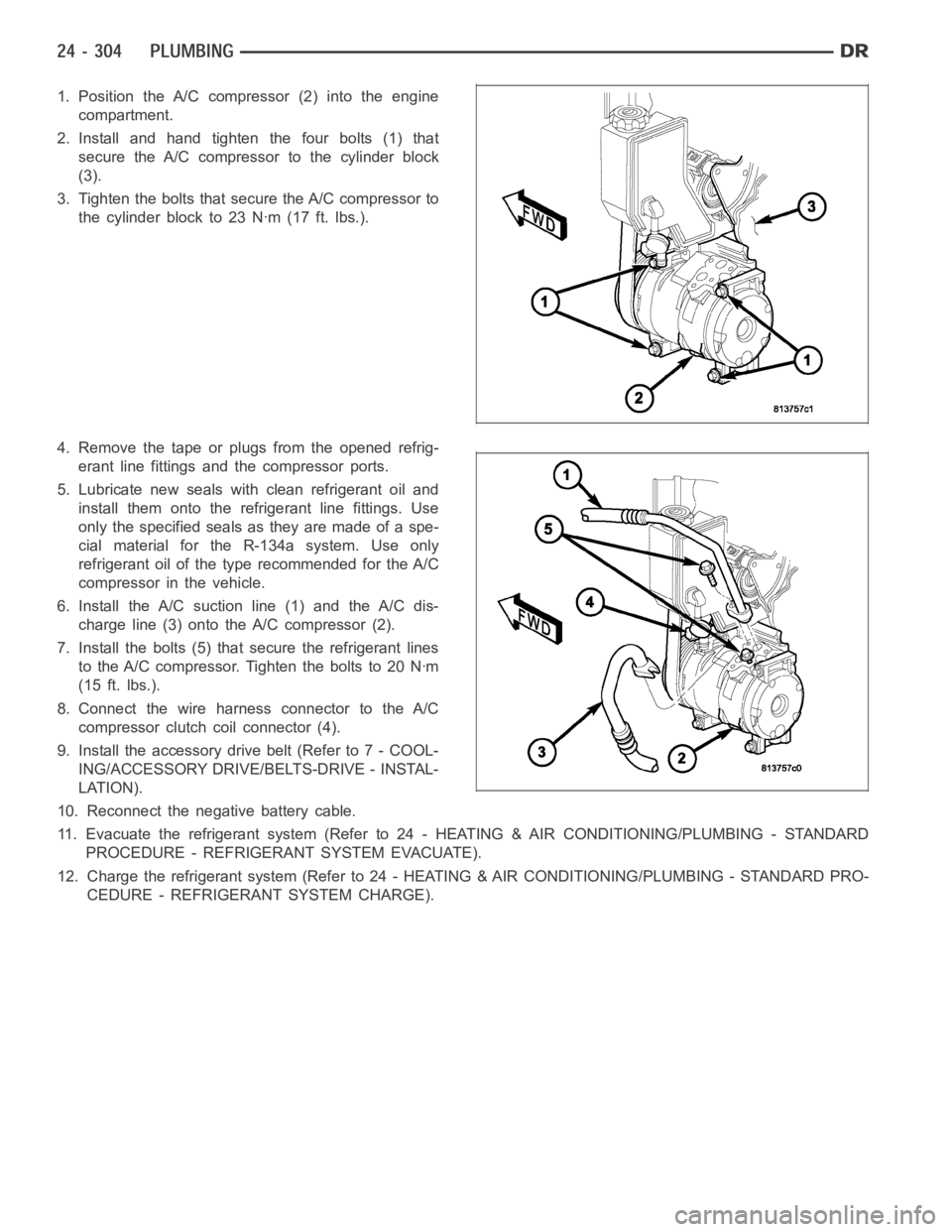
1. Position the A/C compressor (2) into the engine
compartment.
2. Install and hand tighten the four bolts (1) that
secure the A/C compressor to the cylinder block
(3).
3. Tighten the bolts that secure the A/C compressor to
the cylinder block to 23 Nꞏm (17 ft. lbs.).
4. Remove the tape or plugs from the opened refrig-
erant line fittings and the compressor ports.
5. Lubricate new seals with clean refrigerant oil and
install them onto the refrigerant line fittings. Use
only the specified seals as they are made of a spe-
cial material for the R-134a system. Use only
refrigerant oil of the type recommended for the A/C
compressor in the vehicle.
6. Install the A/C suction line (1) and the A/C dis-
charge line (3) onto the A/C compressor (2).
7. Install the bolts (5) that secure the refrigerant lines
to the A/C compressor. Tighten the bolts to 20 Nꞏm
(15 ft. lbs.).
8. Connect the wire harness connector to the A/C
compressor clutch coil connector (4).
9. Install the accessory drive belt (Refer to 7 - COOL-
ING/ACCESSORY DRIVE/BELTS-DRIVE - INSTAL-
LATION).
10. Reconnect the negative battery cable.
11. Evacuate the refrigerant system (Refer to 24 - HEATING & AIR CONDITIONING/PLUMBING - STANDARD
PROCEDURE - REFRIGERANT SYSTEM EVACUATE).
12. Charge the refrigerant system (Refer to 24 - HEATING & AIR CONDITIONING/PLUMBING - STANDARD PRO-
CEDURE - REFRIGERANT SYSTEM CHARGE).
Page 5155 of 5267
COUPLER-REFRIGERANT LINE
DESCRIPTION
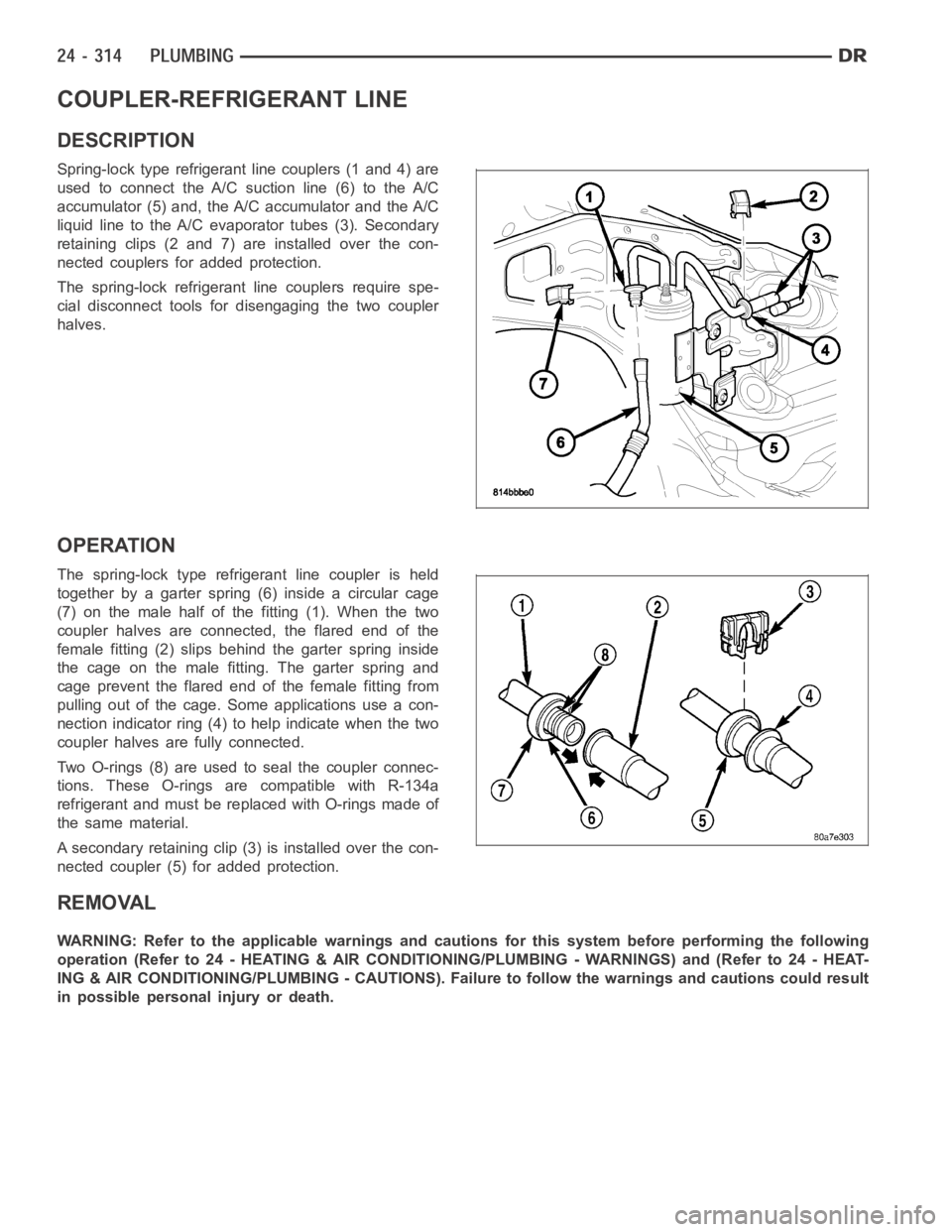
Spring-lock type refrigerant line couplers (1 and 4) are
used to connect the A/C suction line (6) to the A/C
accumulator (5) and, the A/C accumulator and the A/C
liquid line to the A/C evaporator tubes (3). Secondary
retaining clips (2 and 7) are installed over the con-
nected couplers for added protection.
The spring-lock refrigerant line couplers require spe-
cial disconnect tools for disengaging the two coupler
halves.
OPERATION
The spring-lock type refrigerant line coupler is held
together by a garter spring (6) inside a circular cage
(7) on the male half of the fitting (1). When the two
coupler halves are connected, the flared end of the
female fitting (2) slips behind the garter spring inside
the cage on the male fitting. The garter spring and
cage prevent the flared end of the female fitting from
pulling out of the cage. Some applications use a con-
nection indicator ring (4) to help indicate when the two
coupler halves are fully connected.
Two O-rings (8) are used to seal the coupler connec-
tions. These O-rings are compatible with R-134a
refrigerant and must be replaced with O-rings made of
the same material.
A secondary retaining clip (3) is installed over the con-
nected coupler (5) for added protection.
REMOVAL
WARNING: Refer to the applicable warnings and cautions for this system before performing the following
operation (Refer to 24 - HEATING & AIR CONDITIONING/PLUMBING - WARNINGS) and (Refer to 24 - HEAT-
ING & AIR CONDITIONING/PLUMBING - CAUTIONS). Failure to follow the warnings and cautions could result
in possible personal injury or death.
Page 5156 of 5267
1. Recover the refrigerant from the refrigerant system
(Refer to 24 - HEATING & AIR CONDITIONING/
PLUMBING - STANDARD PROCEDURE -
REFRIGERANT SYSTEM RECOVERY).
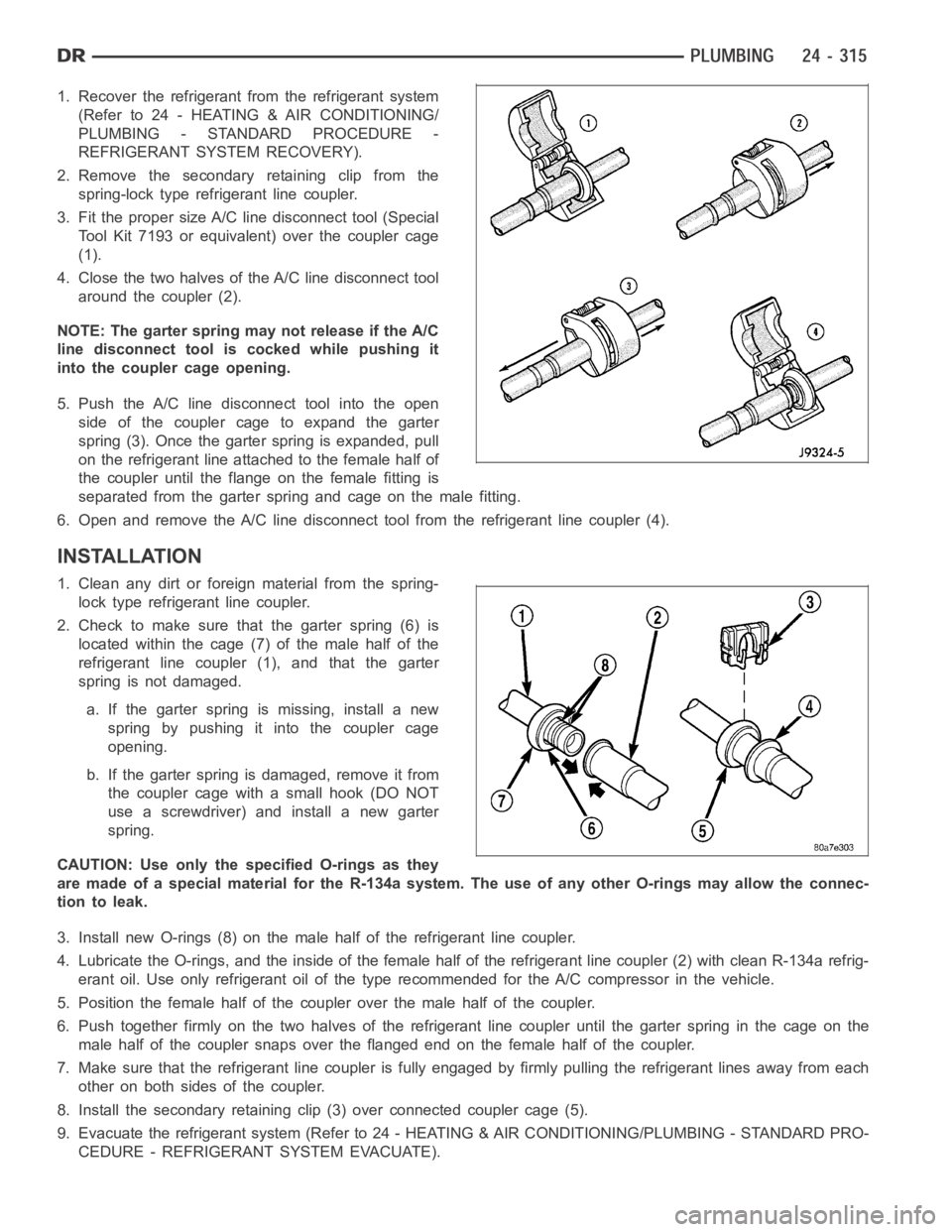
2. Remove the secondary retaining clip from the
spring-lock type refrigerant line coupler.
3. Fit the proper size A/C line disconnect tool (Special
Tool Kit 7193 or equivalent) over the coupler cage
(1).
4. Close the two halves of the A/C line disconnect tool
around the coupler (2).
NOTE: The garter spring may not release if the A/C
line disconnect tool is cocked while pushing it
into the coupler cage opening.
5. Push the A/C line disconnect tool into the open
side of the coupler cage to expand the garter
spring (3). Once the garter spring is expanded, pull
on the refrigerant line attached to the female half of
the coupler until the flange on the female fitting is
separated from the garter spring and cage on the male fitting.
6. Open and remove the A/C line disconnect tool from the refrigerant line coupler (4).
INSTALLATION
1. Clean any dirt or foreign material from the spring-
lock type refrigerant line coupler.
2. Check to make sure that the garter spring (6) is
located within the cage (7) of the male half of the
refrigerant line coupler (1), and that the garter
spring is not damaged.
a. If the garter spring is missing, install a new
spring by pushing it into the coupler cage
opening.
b. If the garter spring is damaged, remove it from
the coupler cage with a small hook (DO NOT
use a screwdriver) and install a new garter
spring.
CAUTION: Use only the specified O-rings as they
are made of a special material for the R-134a system. The use of any other O-rings may allow the connec-
tion to leak.
3. Install new O-rings (8) on the male half of the refrigerant line coupler.
4. Lubricate the O-rings, and the inside of the female half of the refrigerant line coupler (2) with clean R-134a refrig-
erant oil. Use only refrigerant oil of the type recommended for the A/C compressor in the vehicle.
5. Position the female half of the coupler over the male half of the coupler.
6. Push together firmly on the two halves of the refrigerant line coupler until the garter spring in the cage on the
male half of the coupler snaps over the flanged end on the female half of the coupler.
7. Make sure that the refrigerant line coupler is fully engaged by firmly pulling the refrigerant lines away from each
other on both sides of the coupler.
8. Install the secondary retaining clip (3) over connected coupler cage (5).
9. Evacuate the refrigerant system (Refer to 24 - HEATING & AIR CONDITIONING/PLUMBING - STANDARD PRO-
CEDURE - REFRIGERANT SYSTEM EVACUATE).
Page 5158 of 5267
EVAPORATOR-A/C
DESCRIPTION
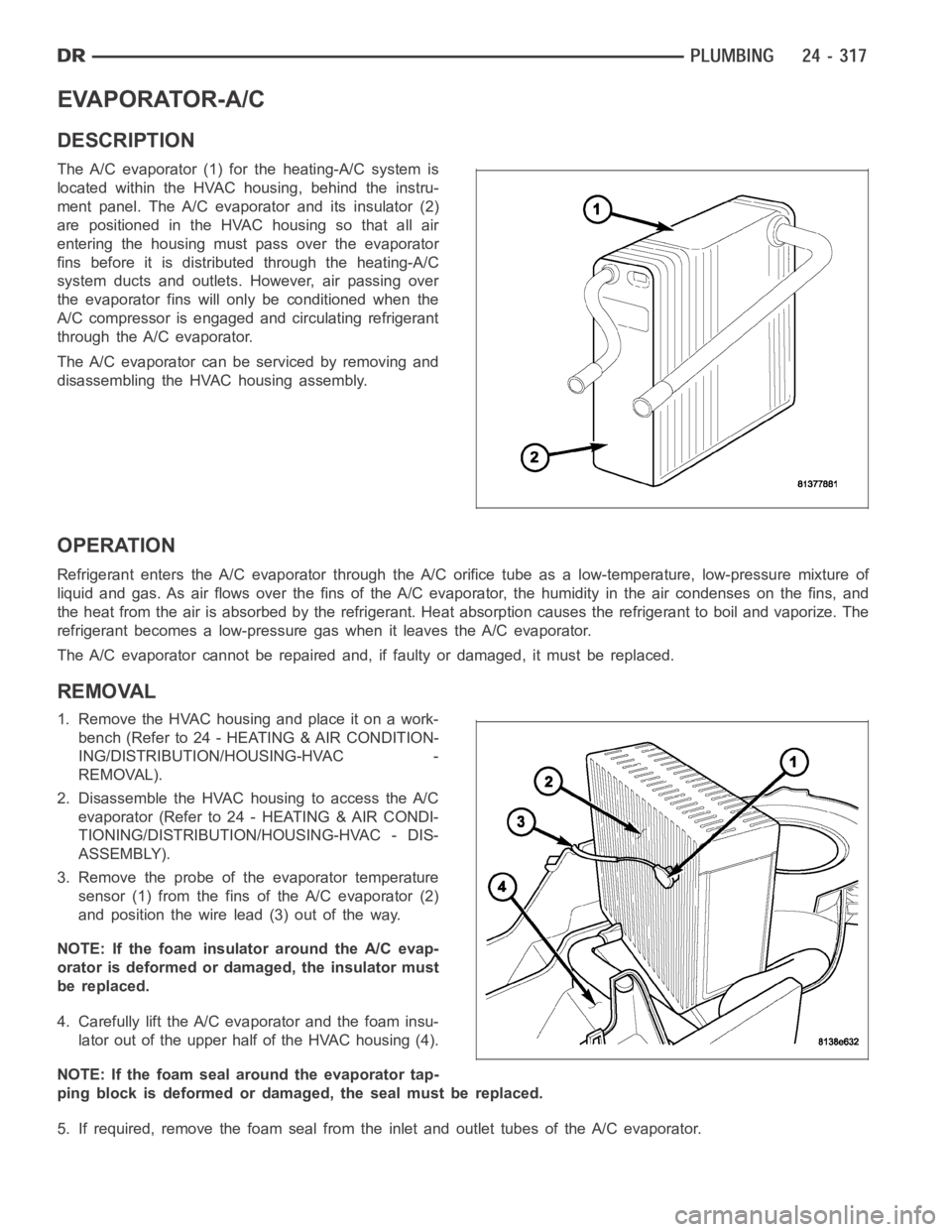
The A/C evaporator (1) for the heating-A/C system is
located within the HVAC housing, behind the instru-
ment panel. The A/C evaporator and its insulator (2)
are positioned in the HVAC housing so that all air
entering the housing must pass over the evaporator
fins before it is distributed through the heating-A/C
system ducts and outlets. However, air passing over
the evaporator fins will only be conditioned when the
A/C compressor is engaged and circulating refrigerant
through the A/C evaporator.
The A/C evaporator can be serviced by removing and
disassembling the HVAC housing assembly.
OPERATION
Refrigerant enters the A/C evaporator through the A/C orifice tube as a low-temperature, low-pressure mixture of
liquid and gas. As air flows over the fins of the A/C evaporator, the humidity in the air condenses on the fins, and
the heat from the air is absorbed by the refrigerant. Heat absorption causes the refrigerant to boil and vaporize. The
refrigerant becomes a low-pressure gas when it leaves the A/C evaporator.
The A/C evaporator cannot be repaired and, if faulty or damaged, it must be replaced.
REMOVAL
1. RemovetheHVAChousingandplaceitonawork-
bench (Refer to 24 - HEATING & AIR CONDITION-
ING/DISTRIBUTION/HOUSING-HVAC -
REMOVAL).
2. Disassemble the HVAC housing to access the A/C
evaporator (Refer to 24 - HEATING & AIR CONDI-
TIONING/DISTRIBUTION/HOUSING-HVAC - DIS-
ASSEMBLY).
3. Remove the probe of the evaporator temperature
sensor (1) from the fins of the A/C evaporator (2)
and position the wire lead (3) out of the way.
NOTE: If the foam insulator around the A/C evap-
orator is deformed or damaged, the insulator must
be replaced.
4. Carefully lift the A/C evaporator and the foam insu-
lator out of the upper half of the HVAC housing (4).
NOTE: If the foam seal around the evaporator tap-
ping block is deformed or damaged, the seal must be replaced.
5. If required, remove the foam seal from the inlet and outlet tubes of the A/Cevaporator.