warning DODGE SPRINTER 2006 1.G Owners Manual
[x] Cancel search | Manufacturer: DODGE, Model Year: 2006, Model line: SPRINTER, Model: DODGE SPRINTER 2006 1.GPages: 330, PDF Size: 10.82 MB
Page 235 of 330
WHAT TO DO IN EMERGENCIES 235
6
Procedure:
1. Park the vehicle on a firm, level, non-slippery
surface.
2. Switch on the hazard warning flasher switch, apply
the parking brake, and place the transmission
selector in "P".3. Everyone must leave the vehicle before you jack it
up.
4. Everyone must leave the danger zone, before
jacking the vehicle.
5. The vehicle must be safeguarded in accordance
with legal regulations (such as using a warning
triangle).
6. Prevent vehicle from rolling away by blocking
wheels with wheel chocks (not supplied with
vehicle) or sizable wood block or stone.
On a level road, place one chock in front of and one
behind the wheel that is diagonally opposite to the
wheel being changed.
When changing a wheel on mild uphill or downhill
grades, place chocks on the downhill side blocking
both wheels of the other axle.
WARNING!
Do not jack the vehicle up more than 1.2 in (30
mm) between the tire and the surface. Otherwise,
the vehicle may tip over and may cause serious in-
jury or death to you or others.
Always lower the vehicle onto sufficient capacity
jack stands before working under the vehicle.
Precautions when changing a wheel:
For tire inflation pressures, see “Tire Pressures”
For the torque, refer to "Installing a wheel";
Do not damage, grease or oil wheel bolts or their
threads.
WARNING!
Do not change wheels on either steep uphill or
downhill grades. The vehicle may begin to move
and fall from the jack which could cause personal
injury and property damage.
Page 236 of 330
236 WHAT TO DO IN EMERGENCIES
Spare Wheel Location
NOTE: Lug wrench and jack, refer to "Vehicle Tool
Kit". For reasons of safety, check at regular intervals
that the spare wheel is properly secured.
WARNING!
If the rear cargo doors are opened to 90° (detent
position), the rear lights will be concealed. The ve-
hicle is then not sufficiently safeguarded at the
rear and may only be seen by other road users
when they are close to the vehicle. This could lead
to an accident.
The vehicle must then be clearly marked in
accordance with state and local laws, e.g., with a
warning triangle.
WARNING!
The spare wheel holder should be reattached once
the wheel has been changed.
Regularly check the spare wheel fastening.
A loose spare wheel or spare wheel holder could
be loosen or could move around the vehicle
interior uncontrollably in the event of sudden
braking, a rapid change in direction or an
accident. This increases the risk of injury to
vehicle occupants and other road users in these
situations.
Do not use retreaded/remolded tires. This process
does not always permit previous damage to be
detected. Therefore vehicle safety cannot be
guaranteed if retreaded/remolded tires are fitted.
Page 239 of 330
WHAT TO DO IN EMERGENCIES 239
6
JACK Using the Jack
The jack is located together with the vehicle tool kit
under the hatch in the front passenger footwell, refer to
"Vehicle Tool Kit".
1. Loosen the wheel bolts before raising the vehicle.
2. Close the release valve on the jack.
3. Assemble the pump lever provided and insert it
into the socket on the jack.
4. Secure the lever by turning it clockwise in the
socket.
Position the jack under the appropriate jack point and
raise the vehicle by pumping the lever.
WARNING!
To avoid the risk of serious or fatal injuries or vehicle
damage, please bear the following points in mind:
The jack is intended only for raising the vehicle
briefly, for instance, when changing a wheel. If it is
not designed to enable work to be carried out
underneath the vehicle.
Do not crawl under the jacked-up vehicle. For work
under the vehicle, stands must be used.
The jack must be placed on a firm, flat surface only.
Do not change wheels on uphill or downhill
gradients under any circumstances.
Make sure that no persons are present in the vehicle
when jacking up the vehicle.
Do not start the engine while the vehicle is raised.
Make sure that the distance between the underside
of the tires and the ground does not exceed 1.2 in (30
mm). Otherwise the vehicle may tip over.
Page 243 of 330
WHAT TO DO IN EMERGENCIES 243
6NOTE: The optional light alloy wheels are supplied
with 5 short wheel lug bolts enclosed for the steel spare
wheel in the vehicle tool kit.
Before fitting the spare wheel, clean rust and dirt off
the contact surfaces of the wheel and the wheel hub,
and from the wheel bolts.
Note the specified wheel and tire size, tire load
capacity and speed code.
Do not change the tire’s direction of rotation.
Do not damage, grease or oil wheel bolts or their
threads.
WARNING!
Different wheel bolts are required for pressed
steel and light-alloy wheels.
Incorrect wheel lug bolts for the wheels could
work loose, thereby causing you to lose control of
the vehicle. This could cause an accident resulting
in severe personal injuries and and property
damage.
WARNING!
Incorrect mounting bolts or improperly tightened
mounting bolts can cause the wheel to come off.
To avoid the risk of serious or fatal injuries or ve-
hicle damage, please bear the following points in
mind:
Always replace wheel bolts that are damaged or
rusted.
Never apply oil or grease to wheel bolts
If a wheel hub thread is damaged, you must not
drive the vehicle. Consult a qualified specialist
workshop.
Only use genuine DaimlerChrysler wheel bolts
specified for your vehicle’s rims.
Page 244 of 330
244 WHAT TO DO IN EMERGENCIES
Centering wheels with wheel bolts/nuts
If dual assemblies are used, before placement the
inner wheel should be inspected to ensure that all
ball bearing rings are in proper position.
Install the wheel and snug the wheel bolts/nuts.
Slightly tighten wheel bolts/nuts.
Slowly open jack release valve to lower vehicle until
tire is resting on ground.
WARNING!
Do not tighten the wheel bolts and wheel nuts
completely while the vehicle is still jacked up.
The vehicle could tip.
Page 246 of 330
246 WHAT TO DO IN EMERGENCIES
JUMP STARTING
If the battery is dead, the engine can be started with
jumper cables from another vehicle’s battery.
WARNING!
After changing a wheel, you must, for safety reasons,
have the specified tightening torque checked. The
wheels could otherwise work loose.
check the tire inflation pressure and correct it if
necessary.
retighten the wheel bolts and wheel nuts to the
specified tightening torque once the vehicle has
been driven for 30 miles (50 km). If new or
repainted wheels are fitted, the wheel bolts or nuts
must be retightened again after about 600 to 3,000
miles (about 1,000 to 5,000 km).
have a reversed direction of tire rotation corrected
as soon as possible at a qualified specialist
workshop. The vehicle handling characteristics
could otherwise be affected.WARNING!
A battery will produce hydrogen gas, which is
flammable and very explosive. Avoid open flames
and the formation of sparks in the vicinity of the
batteries. Refrain from smoking or cell phone use.
Avoid improper connection of jumper cables.
Observe safety precautions when handling
batteries.
Exercise care near moving engine components and
electrical cables.
Failure to follow these directions will cause
damage to the electronic components and can lead
to a battery explosion and severe injury or death.
Page 247 of 330
WHAT TO DO IN EMERGENCIES 247
6
A dead battery can freeze at a temperature of 14°F
(–10°C). Never try to start the engine if the battery
is frozen. Thaw the battery out first.
Only use a battery of the same rated voltage and of
approximately the same capacity for jump-starting.
The two vehicles must not touch.
Switch off all electrical accessories.
Run the vehicle with the booster battery at idle.
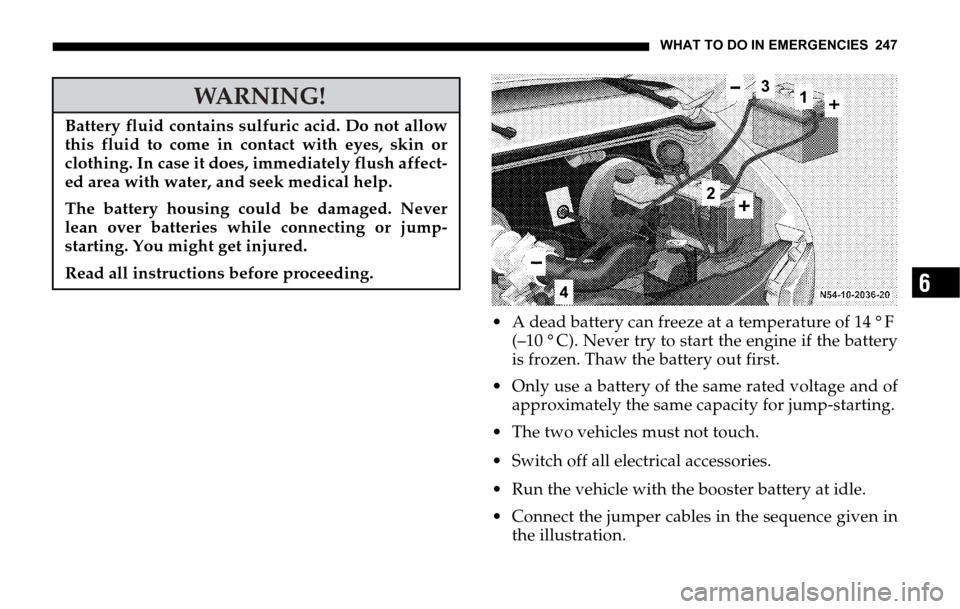
Connect the jumper cables in the sequence given in
the illustration.
WARNING!
Battery fluid contains sulfuric acid. Do not allow
this fluid to come in contact with eyes, skin or
clothing. In case it does, immediately flush affect-
ed area with water, and seek medical help.
The battery housing could be damaged. Never
lean over batteries while connecting or jump-
starting. You might get injured.
Read all instructions before proceeding.
Page 249 of 330
WHAT TO DO IN EMERGENCIES 249
6
*Vehicle Type 2500 onlyIf the Engine is Damaged
For towing distances up to 30 miles (about 50 km)
Shift gear selector lever to "N" position.
Do not exceed a towing speed of 30 mph (50 km / h).
For towing distances greater than 30 miles (about
50 km)
Remove the propeller shafts leading to the drive
axles.
The vehicle can be towed without restriction.
If the Transmission is Damaged
Remove the propeller shafts leading to the drive
axles.
If the Front Axle is Damaged
Raise the front axle.
Observe the same towing restrictions as for engine
damage.
If the Rear Axle is Damaged
Raise the rear axle.
NOTE: Comply with local legal regulations regarding
towing vehicles.
WARNING!
Do not tow the vehicle if the key cannot be turned
in the ignition lock.
If the key cannot be turned, the ignition lock re-
mains locked and the vehicle cannot be steered.
With the engine not running there is no power
assistance for the braking and steering systems.
In this case, it is important to keep in mind that a
considerably higher degree of effort is necessary
to brake and steer the vehicle.
The vehicle must not be towed with the front axle
raised and the key in position 2 in the ignition
lock as the drive wheels could then lock due to the
acceleration skid control (ASR) or the optional
Electronic Stability Program (ESP
®)*.
Page 255 of 330
MAINTAINING YOUR VEHICLE 255
7
SPRINTER ORIGINAL PARTS
Every authorized Sprinter Dealer maintains a stock of
Sprinter original parts for maintenance and repair work.
Over 6,000 retailers around the world guarantee that
you can be supplied with Sprinter original parts
wherever you are. Over 300,000 different parts and
assemblies, including parts for older vehicle models,
are distributed from a central parts warehouse using
an optimally tuned logistics concept.
Sprinter original parts are subjected to the most
stringent quality inspections and will ensure that the
vehicle is maintained at a high level of operating
efficiency and safety, and that it maintains its value.
Each part has been specifically designed and
manufactured or selected and approved for use in
Sprinter vehicles.
It is therefore best to use only Sprinter original parts.
For cost-effective repairs in accordance with sound
recycling principles, the use of non-genuine parts and
accessories not authorized by the manufacturer could
damage the vehicle or compromise its durability or safety.
When ordering original parts, always provide the
vehicle identification number and the engine number. SERVICE PRODUCTS
Mechanical elements and the lubricants used for them
must be carefully matched.
For this reason, only brands tested and approved by
the manufacturer should be used. Please contact your
Sprinter Dealer to obtain the necessary information.
No lubricant additives should be used.
The use of such additives could affect your warranty
rights. Information is available from any authorized
Sprinter Dealer.
For specifications of engine oils, coolant and brake
fluid, contact your authorized Sprinter Dealer.
WARNING!
If handled incorrectly, service products can consti-
tute a health risk for people and an environmental
hazard.
Always observe relevant guidelines for handling,
storing and disposing of service products.
Page 256 of 330

256 MAINTAINING YOUR VEHICLE
Disposal of Service Products
Dispose of service products and of parts which come
into contact with them (e.g. filters) in an
environmentally responsible manner. Comply with
applicable bars and regulations.
EMISSION RELATED COMPONENT WARRANTY
STATEMENT
The Manufacturer warrants to the original and each
subsequent owner of a Sprinter heavy-duty on
highway diesel engine that:
(1) the engine was designed, built and equipped so as
to conform at the time of sale with the applicable
regulations adopted by the Federal Environmental
Protection Agency, and
(2) the emission control system of such engine is free
from defects in materials and workmanship which
would cause it not to conform with those regulations
for a period of use of five years or 100 000 miles or
3 000 hours of engine operation, whichever occurs
first.REGULAR CHECKS
WARNING!
When the hood is open, there is a risk of injury
due to very hot engine components.
When the engine is running or the key is in posi-
tion 2 in the ignition lock, there is a risk of injury
due to moving engine components and the electri-
cal system.
If you see flames or smoke coming from the
engine compartment, or if the coolant temperature
gauge indicates that the engine is overheated, do
not open the hood. Move away from vehicle and
do not open the hood until the engine has cooled.
If necessary, call the fire department.