warning DODGE SPRINTER 2006 1.G Owners Manual
[x] Cancel search | Manufacturer: DODGE, Model Year: 2006, Model line: SPRINTER, Model: DODGE SPRINTER 2006 1.GPages: 330, PDF Size: 10.82 MB
Page 263 of 330
MAINTAINING YOUR VEHICLE 263
7
A regular check is included in the maintenance service.
Checking Coolant Level
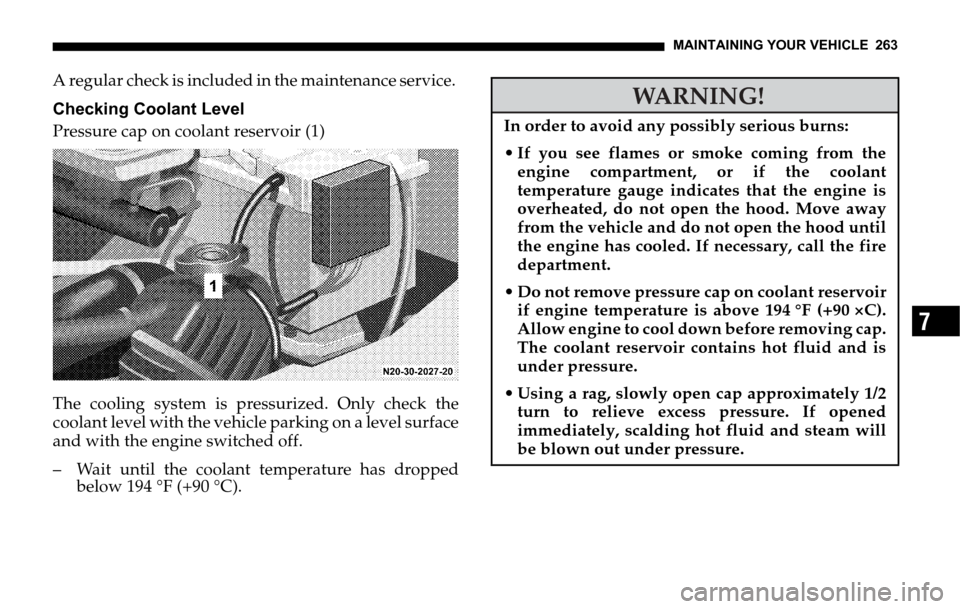
Pressure cap on coolant reservoir (1)
The cooling system is pressurized. Only check the
coolant level with the vehicle parking on a level surface
and with the engine switched off.
– Wait until the coolant temperature has dropped
below 194 °F (+90 °C).
WARNING!
In order to avoid any possibly serious burns:
If you see flames or smoke coming from the
engine compartment, or if the coolant
temperature gauge indicates that the engine is
overheated, do not open the hood. Move away
from the vehicle and do not open the hood until
the engine has cooled. If necessary, call the fire
department.
Do not remove pressure cap on coolant reservoir
if engine temperature is above 194 °F (+90 ×C).
Allow engine to cool down before removing cap.
The coolant reservoir contains hot fluid and is
under pressure.
Using a rag, slowly open cap approximately 1/2
turn to relieve excess pressure. If opened
immediately, scalding hot fluid and steam will
be blown out under pressure.
Page 264 of 330

264 MAINTAINING YOUR VEHICLE
Open the hood.
At first, only turn the pressure cap on coolant
reservoir to the first detent to release the pressure
from the cooling system. Only then should the
pressure cap be removed completely.
To add coolant:
If the engine is cold:
Add coolant until the coolant level reaches the base
area which is visible through the filler opening (area
moistened).If the engine is already at its regular operating
temperature:
Add coolant until the coolant level is about 0.6 inch
(1.5 cm) above the base area which is visible
through the filler opening.
Replace and tighten the pressure cap on coolant
reservoir.
If a large quantity of coolant has been lost, or if smaller
amounts are lost at regular intervals, have the engine
cooling system examined by an authorized Sprinter
Dealer.
For coolant composition and water quality, contact
your Sprinter Dealer.
WARNING!
Do not spill antifreeze on hot engine parts. Anti-
freeze contains ethylene glycol which may burn
if it comes into contact with hot engine parts.
Check coolant level only with the engine
switched off and the key in position 0 in the
ignition lock.
Page 265 of 330

MAINTAINING YOUR VEHICLE 265
7
WINTER OPERATION
Have your vehicle winterized by an authorized
Sprinter Dealer before the onset of winter.
Have the engine oil changed, if the engine oil filled
is not approved for winter use.
Coolant: antifreeze/anti-corrosion concentration in
the coolant checked.
Windshield washer system and headlamp cleaning
system (optional): add windshield washer fluid
"winter wash" to the water, depending on ambient
temperatures.
Battery: the battery will lose capacity as
temperatures drop. Only a well-charged battery will
ensure reliable engine starting even at low outside
temperatures.
Tires: fit M+S radial tires with a minimum tread
depth of approximately 1/6 in (4 mm) on all wheels
for the winter season.BATTERIES
The standard battery is located in the engine
compartment.
WARNING!
Failure to follow these instructions can result in
severe personal injuries and death.
Never lean over batteries while connecting, you
might get injured, if the battery explodes.
Battery fluid contains sulfuric acid. Do not allow
this fluid to come in contact with eyes, skin or
clothing. In case it does, immediately flush
affected area with water and seek medical help if
necessary.
A battery will also produce hydrogen gas, which
is flammable and explosive. Keep flames or
sparks away from battery, avoid improper
connection of jumper cables, smoking etc.
Use only impact-resistant batteries with a central
gas release cover to prevent corrosion damage and
to prevent occupants from caustic burns in the
event of an accident.
Page 267 of 330

MAINTAINING YOUR VEHICLE 267
7
Charging the Battery
Disconnect the battery before charging it with a battery
charger.
Comply with the operating instructions for the battery
charger.
To ensure that the battery is disposed of in an
environmentally responsible manner, it should only be
replaced by an authorized Sprinter Dealer.
Batteries contain material that can harm the
environment with improper disposal.
Large 12 volt storage batteries contain lead.
Recycling of batteries is the preferred method of
disposal.
Many states require sellers of batteries to accept old
batteries for recycling.
WARNING!
Use only refrigerants and compressor lubricants
approved by the manufacturer for your air
conditioning system. Some unapproved
refrigerants are flammable and can explode,
injuring you. Other unapproved refrigerants or
lubricants can cause the system to fail, requiring
costly repairs. Refer to Section 3 of the Warranty
Information Book for additional warranty
information.
The air conditioning system contains refrigerant
under high pressure. To avoid risk of personal
injury or damage to the system, adding
refrigerant or any repair requiring lines to be
disconnected should be done by an experienced
repairman.
Page 269 of 330
MAINTAINING YOUR VEHICLE 269
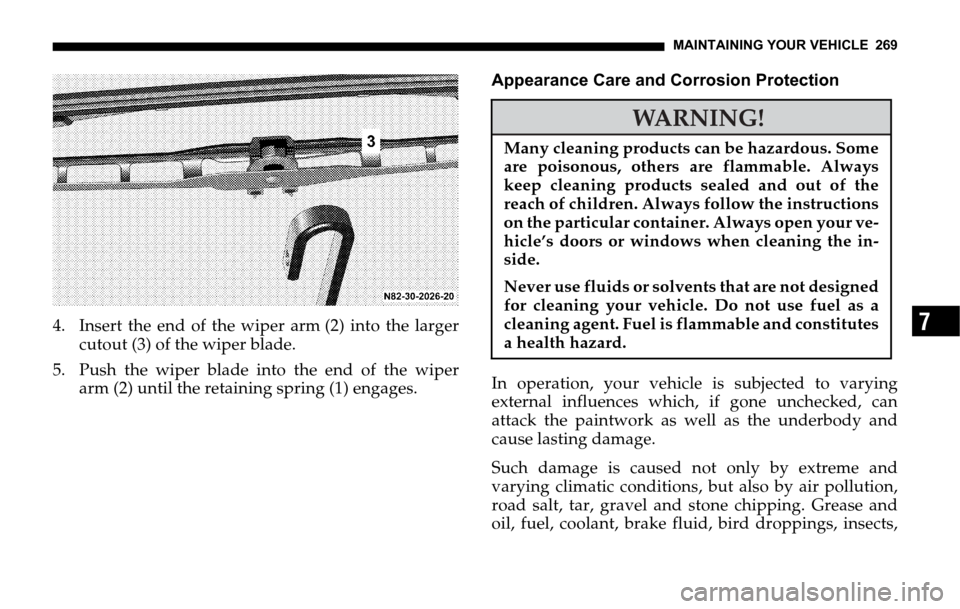
74. Insert the end of the wiper arm (2) into the larger
cutout (3) of the wiper blade.
5. Push the wiper blade into the end of the wiper
arm (2) until the retaining spring (1) engages.Appearance Care and Corrosion Protection
In operation, your vehicle is subjected to varying
external influences which, if gone unchecked, can
attack the paintwork as well as the underbody and
cause lasting damage.
Such damage is caused not only by extreme and
varying climatic conditions, but also by air pollution,
road salt, tar, gravel and stone chipping. Grease and
oil, fuel, coolant, brake fluid, bird droppings, insects,
WARNING!
Many cleaning products can be hazardous. Some
are poisonous, others are flammable. Always
keep cleaning products sealed and out of the
reach of children. Always follow the instructions
on the particular container. Always open your ve-
hicle’s doors or windows when cleaning the in-
side.
Never use fluids or solvents that are not designed
for cleaning your vehicle. Do not use fuel as a
cleaning agent. Fuel is flammable and constitutes
a health hazard.
Page 270 of 330

270 MAINTAINING YOUR VEHICLE
tree resins etc. should be removed immediately to
avoid paint damage. Frequent washing reduces and/
or eliminates the aggressiveness and potency of the
above adverse influences.
More frequent washings are necessary to deal with
unfavorable conditions; for example operation near the
ocean, in industrial areas (smoke, exhaust emissions),
or during the winter months.
You should check your vehicle from time to time for
stone chipping or other damage. Any damage should
be repaired as soon as possible to prevent the start of
corrosion.
In doing so, do not neglect the underside of the vehicle.
A prerequisite for a thorough check is a washing of the
underbody followed by a thorough inspection.
Damaged areas need to be undercoated again.
Your vehicle has been treated at the factory with a wax-
base rustproofing in the body cavities which will last
for the lifetime of the vehicle. Post-production
treatment is neither necessary nor recommended by
DaimlerChrysler Corporation.Because of the possibility of incompatibility between
materials used in the production process and others
applied later.
Scratches, corrosive deposits, corrosion or damage due
to negligent or incorrect care cannot always be
removed or repaired with car-care products. In such
cases it is best to seek aid by your authorized Sprinter
Dealer.
The following topics deal with the cleaning and care of
your vehicle and give important "how-to" information
as well as references to car-care products.
WARNING!
Never use openings in the bodywork as steps.
You could otherwise damage the vehicle and it
could lead to an accident.
CAUTION!
Do not use abrasive or strong cleaning materials
such as steel wool or scouring powder, which will
scratch metal and painted surfaces.
Page 271 of 330

MAINTAINING YOUR VEHICLE 271
7
Power Washer
When using a power washer for cleaning the vehicle
always observe manufacturers’ operating instructions.Automatic Car Wash
If the vehicle is very dirty, prewash it before you drive
into the car wash.
Fold in the exterior mirrors before washing the vehicle
in an automatic car wash and make sure that the
windshield wiper switch is in position 0.
The exterior mirrors and windshield wipers could
otherwise be damaged.
Make sure that mirrors are fully folded out after
leaving the automatic car wash.
CAUTION!
Never use a round nozzle to power wash tires. The
intense jet of water can result in damage to the
tire. Always replace a damaged tire.
Always keep the jet of water moving across the
surface. To avoid damaging the vehicle, do not
aim the water jet directly at electrical components,
end of electrical lines, electrical connectors, intake
or ventilation openings, brake hoses, door joints,
seals, other rubber parts.
WARNING!
Smears impair visibility, which is impaired fur-
ther by unfavourable conditions (e.g. fog, dark-
ness, driving snow).
If a wax preservative is sprayed on after washing
the vehicle, wipe off the wax from the windshield
and the wiper blade rubbers. This will prevent
smears forming on the windshield.
Page 273 of 330
MAINTAINING YOUR VEHICLE 273
7
When washing the underbody, do not forget to clean
the inner sides of the wheels.
Ornamental Moldings
For regular cleaning and care of very dirty chrome-
plated parts, use a chrome cleaner.
Headlamps, Taillamps, Identification Lamps, Turn
Signal Lenses
Use a mild car wash detergent with plenty of water.
To prevent scratches, never apply strong force and use
only a soft, non-scratchy cloth when cleaning the
lenses. Do not attempt to wipe dirty lenses with a dry
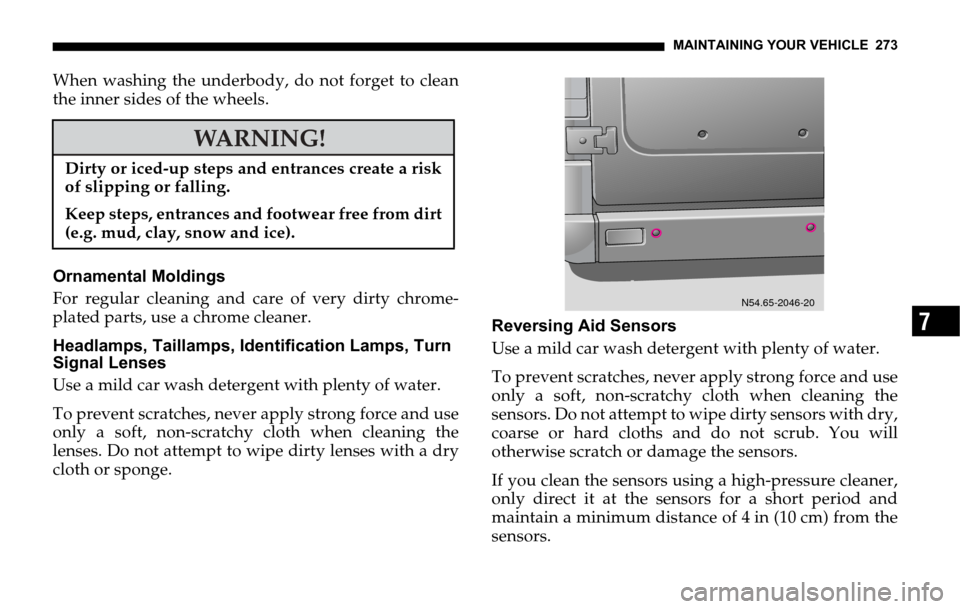
cloth or sponge.Reversing Aid Sensors
Use a mild car wash detergent with plenty of water.
To prevent scratches, never apply strong force and use
only a soft, non-scratchy cloth when cleaning the
sensors. Do not attempt to wipe dirty sensors with dry,
coarse or hard cloths and do not scrub. You will
otherwise scratch or damage the sensors.
If you clean the sensors using a high-pressure cleaner,
only direct it at the sensors for a short period and
maintain a minimum distance of 4in (10cm) from the
sensors.
WARNING!
Dirty or iced-up steps and entrances create a risk
of slipping or falling.
Keep steps, entrances and footwear free from dirt
(e.g. mud, clay, snow and ice).
N54.65-2046-20
Page 274 of 330
274 MAINTAINING YOUR VEHICLE
Window Cleaning
Use a window cleaning solution on all glass surfaces.
An automotive glass cleaner is recommended.
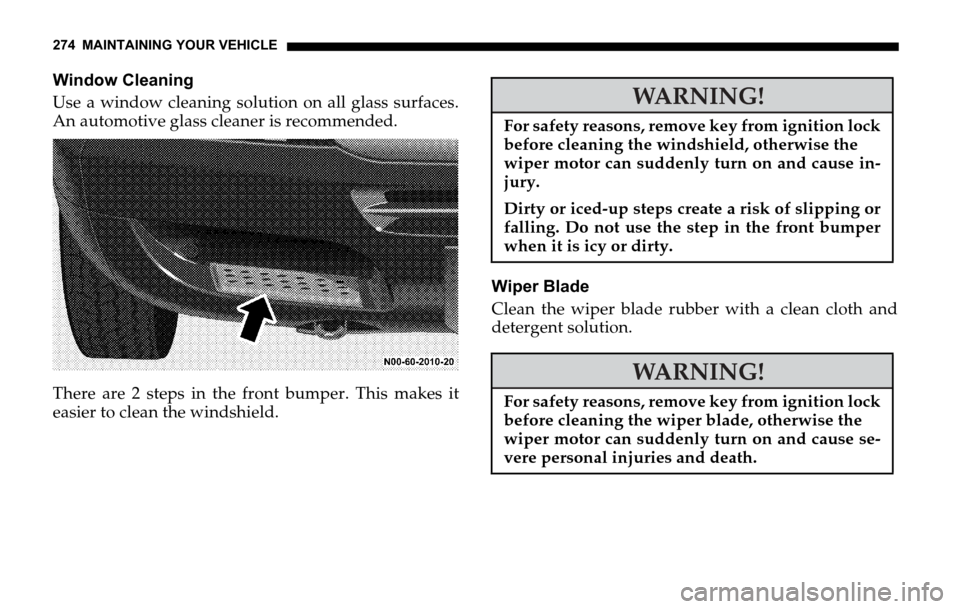
There are 2 steps in the front bumper. This makes it
easier to clean the windshield.Wiper Blade
Clean the wiper blade rubber with a clean cloth and
detergent solution.
WARNING!
For safety reasons, remove key from ignition lock
before cleaning the windshield, otherwise the
wiper motor can suddenly turn on and cause in-
jury.
Dirty or iced-up steps create a risk of slipping or
falling. Do not use the step in the front bumper
when it is icy or dirty.
WARNING!
For safety reasons, remove key from ignition lock
before cleaning the wiper blade, otherwise the
wiper motor can suddenly turn on and cause se-
vere personal injuries and death.
Page 275 of 330

MAINTAINING YOUR VEHICLE 275
7
Light Alloy Wheels
A wheel care product should be used for regular
cleaning of the light alloy wheels.
If possible, clean wheels once a week, using a soft
bristle brush and a strong spray of water.
Follow instructions on container.
NOTE: Use only acid-free cleaning materials. The acid
could lead to corrosion.
Instrument Cluster
Use a gentle dishwashing detergent or mild detergent
for delicate fabrics as a washing solution. Wipe with a
cloth moistened in lukewarm solution. Do not use
scouring agents.
Steering Wheel and Gear Selector Lever
Wipe with a damp cloth and dry thoroughly or clean
with a leather care product.Cup Holder
Use a gentle dishwashing detergent or mild detergent
for delicate fabrics as a washing solution. Wipe with a
cloth moistened in lukewarm solution. Do not use
scouring agents.
Seat Belts
The webbing must not be treated with chemical
cleaning agents. Use only clear, lukewarm water and
soap. Do not dry the webbing at temperatures above
176°F (+80°C) or in direct sunlight.
Headliner and Shelf Below Rear Window
Clean with soft bristle brush, or use a dry-shampoo
cleaner in case of excessive dirt.
WARNING!
Do not bleach or dye seat belts as this may severe-
ly weaken them. Due to this treatment they may
not be able to provide adequate protection. For ex-
ample, in a crash the belts can be torn.