light DODGE SPRINTER 2006 1.G Repair Manual
[x] Cancel search | Manufacturer: DODGE, Model Year: 2006, Model line: SPRINTER, Model: DODGE SPRINTER 2006 1.GPages: 330, PDF Size: 10.82 MB
Page 193 of 330

STARTING AND OPERATING 193
5
Tire Sizes for Sprinter Vehicles
1. Vehicles with programmed top speed limit of 68
mph (109 km/h) only.
Design Standard
Depending on the design standards used, the tire size
molded into the sidewall may have no letter or a letter
(1) preceding the tire width or the tire load rating
designation.
Letter "LT" preceding the tire width designation:
Light Truck tire based on U.S. design standards.
Letter "C" preceding the tire load rating designation:
Commercial vehicle tire based on European design
standards.Tire Width
The tire width (2) indicates the nominal tire width in
mm.
Aspect Ratio
The aspect ratio (3) is the dimensional relationship
between tire section height and section width and is
expressed in percentage. The aspect ratio is arrived at
by dividing section height by section width.
Tire Code
The tire code (4) indicates the tire construction type.
The “R” stands for radial tire type. Letter “D” means
diagonal or bias ply construction; letter “B” means
belted-bias ply construction.
Rim Diameter
The rim diameter (5) is the diameter of the bead seat,
not the diameter of the rim edge. Rim diameter is
indicated in inches (in).
Tire Load Rating
The tire load rating (6) is a numerical code associated
with the maximum load a tire can support. Sprinter type
2500 C/HC/SHC 3500 C/HC/SHC
225/70 R 15 C 112/110 R
(115 N)195/70 R 15 C 104/102 R
LT 225/75 R 16 115/112 N LT 225/75 R 16 115/112 N
LT 225/75 R 16 115/112 L
1LT 225/75 R 16 115/112 L1
Page 214 of 330
214 STARTING AND OPERATING
BLEEDING DIESEL FUEL SYSTEM
If the fuel tank was run empty, the diesel fuel system
must be bled after refueling before starting the engine.
Turn the key in the ignition lock to position 2 for at
least 30 seconds.
Return the key to position 0.
Start the engine three to four times.
The malfunction indicator light (MIL) ± must go
out.
NOTE: Too many attempts to start the engine could
drain the battery. If the engine does not start after
several attempts, consult an authorized Sprinter
Dealer.DRAINING FUEL FILTER WITH WATER
SEPARATOR
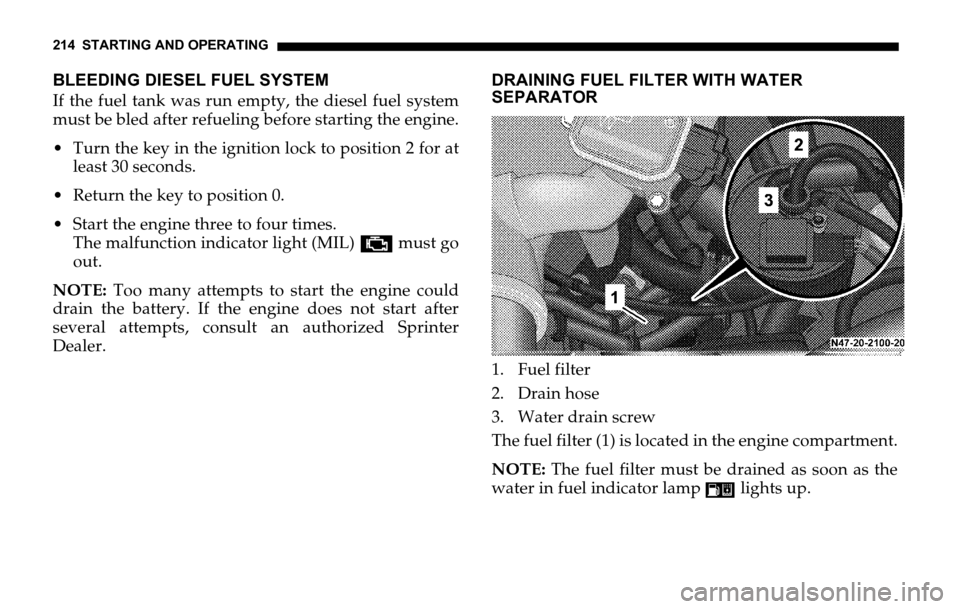
1. Fuel filter
2. Drain hose
3. Water drain screw
The fuel filter (1) is located in the engine compartment.
NOTE: The fuel filter must be drained as soon as the
water in fuel indicator lamp lights up.
Page 215 of 330
STARTING AND OPERATING 215
5
NOTE: Prior to opening water drain screw (3), place a
suitable receptacle underneath the drain hose (2). Turn
water drain screw (3) on and off only by hand.
Diesel fuels and diesel fuel mixtures must be disposed
of properly; we recommend water be drained from fuel
filters by an authorized Sprinter Dealer.
Draining Fuel Filter
Stop the engine.
Shift gear selector lever to ‘‘P’’ position.
Open the hood.
Place a suitable receptacle underneath the drain
hose (2).
Turn the key in the ignition lock to position 2. Open immediately the water drain screw (3) about 1
turn (counterclockwise) until fluid emerges. Ensure
that the fluid is collected in the receptacle.
Close the water drain screw (3) as soon as about 0.25
US qt (0.2 liters) are emerged.
After draining, return the key in the ignition lock to
position 0.
Dispose of the collected fluid in an environmentally
responsible manner.
If the filter is still saturated, drain the filter once
more.
After draining, the engine may run briefly but stall for
lack of fuel. If this occurs, bleed the system.
NOTE: Should the water in the fuel indicator lamp
still not go out after the fuel filter has been drained
twice, the cause should be examined by an authorized
Sprinter Dealer.
CAUTION!
Delaying draining of the fuel filter for a
considerable time after the indicator lamp lights
up may lead to engine damage.
Page 225 of 330

STARTING AND OPERATING 225
5
Towing a Trailer
There are many different laws, including speed limit
restrictions, having to do with trailer towing. Make
sure that your vehicle-trailer combination will be legal,
not only for where you reside, but also for where you
will be driving. A good source for this information can
be the police or local authorities.
Before you start driving with the trailer, check the
trailer hitch, break-away switch, safety chains,
electrical connections, lighting and tires. Also adjust
the mirrors to permit unobstructed view beyond rear
of trailer.
If the trailer has electric brakes, start your vehicle and
trailer moving slowly, and then apply only the trailer
brake controller by hand to be sure the brakes are
working properly.
When towing a trailer, check occasionally to be sure
that the load is secure, and that lighting and trailer
brakes (if so equipped) are functioning properly.
Always secure items in the trailer to prevent load shifts
while driving.Take into consideration that when towing a trailer, the
handling characteristics are different and less stable
from those when operating the vehicle without a
trailer. It is important to avoid sudden maneuvers. The
vehicle and trailer combination is heavier, and
therefore is limited in acceleration and climbing ability,
and requires longer stopping distances. It is more
prone to reacting to side wind gusts, and requires more
sensitive steering input.
In order to gain skill and an understanding of the
vehicle’s behavior, you should practice turning, stopping
and backing up in an area which is free from traffic.
If possible, do not brake abruptly, but rather engage
the brake slightly at first to permit the trailer to activate
its brake. Then increase the braking force.
Page 232 of 330
232 WHAT TO DO IN EMERGENCIES
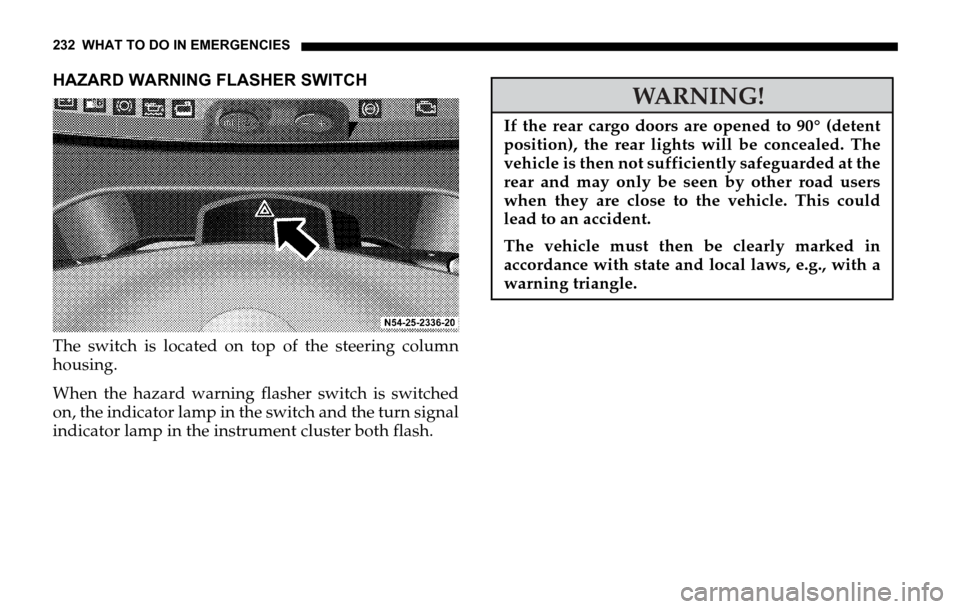
HAZARD WARNING FLASHER SWITCH
The switch is located on top of the steering column
housing.
When the hazard warning flasher switch is switched
on, the indicator lamp in the switch and the turn signal
indicator lamp in the instrument cluster both flash.
WARNING!
If the rear cargo doors are opened to 90° (detent
position), the rear lights will be concealed. The
vehicle is then not sufficiently safeguarded at the
rear and may only be seen by other road users
when they are close to the vehicle. This could
lead to an accident.
The vehicle must then be clearly marked in
accordance with state and local laws, e.g., with a
warning triangle.
Page 236 of 330
236 WHAT TO DO IN EMERGENCIES
Spare Wheel Location
NOTE: Lug wrench and jack, refer to "Vehicle Tool
Kit". For reasons of safety, check at regular intervals
that the spare wheel is properly secured.
WARNING!
If the rear cargo doors are opened to 90° (detent
position), the rear lights will be concealed. The ve-
hicle is then not sufficiently safeguarded at the
rear and may only be seen by other road users
when they are close to the vehicle. This could lead
to an accident.
The vehicle must then be clearly marked in
accordance with state and local laws, e.g., with a
warning triangle.
WARNING!
The spare wheel holder should be reattached once
the wheel has been changed.
Regularly check the spare wheel fastening.
A loose spare wheel or spare wheel holder could
be loosen or could move around the vehicle
interior uncontrollably in the event of sudden
braking, a rapid change in direction or an
accident. This increases the risk of injury to
vehicle occupants and other road users in these
situations.
Do not use retreaded/remolded tires. This process
does not always permit previous damage to be
detected. Therefore vehicle safety cannot be
guaranteed if retreaded/remolded tires are fitted.
Page 242 of 330
242 WHAT TO DO IN EMERGENCIES
REMOVING A WHEEL
1. Loosen the wheel bolts/nuts.
2. Jack up the vehicle until the wheel is clear of the
ground.
3. Unscrew the wheel bolts and remove the wheel
(keep the wheel bolts clean).
NOTE: If the vehicle moves forwards or backwards
while it is being jacked-up, lower it again and
reposition the jack. When the vehicle is jacked-up, the
jack must stand vertically (plumb-line).INSTALLING A WHEEL
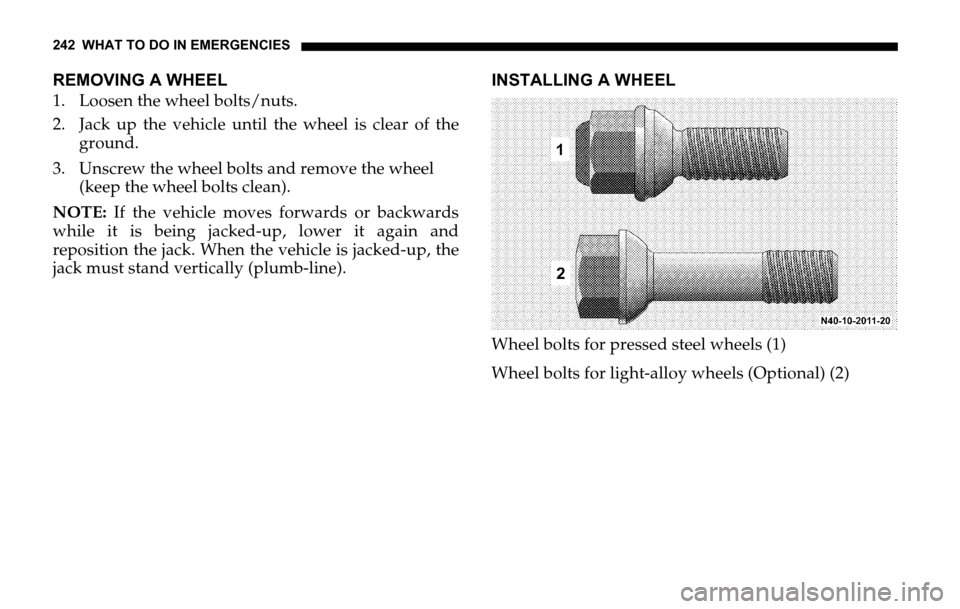
Wheel bolts for pressed steel wheels (1)
Wheel bolts for light-alloy wheels (Optional) (2)
Page 243 of 330
WHAT TO DO IN EMERGENCIES 243
6NOTE: The optional light alloy wheels are supplied
with 5 short wheel lug bolts enclosed for the steel spare
wheel in the vehicle tool kit.
Before fitting the spare wheel, clean rust and dirt off
the contact surfaces of the wheel and the wheel hub,
and from the wheel bolts.
Note the specified wheel and tire size, tire load
capacity and speed code.
Do not change the tire’s direction of rotation.
Do not damage, grease or oil wheel bolts or their
threads.
WARNING!
Different wheel bolts are required for pressed
steel and light-alloy wheels.
Incorrect wheel lug bolts for the wheels could
work loose, thereby causing you to lose control of
the vehicle. This could cause an accident resulting
in severe personal injuries and and property
damage.
WARNING!
Incorrect mounting bolts or improperly tightened
mounting bolts can cause the wheel to come off.
To avoid the risk of serious or fatal injuries or ve-
hicle damage, please bear the following points in
mind:
Always replace wheel bolts that are damaged or
rusted.
Never apply oil or grease to wheel bolts
If a wheel hub thread is damaged, you must not
drive the vehicle. Consult a qualified specialist
workshop.
Only use genuine DaimlerChrysler wheel bolts
specified for your vehicle’s rims.
Page 244 of 330

244 WHAT TO DO IN EMERGENCIES
Centering wheels with wheel bolts/nuts
If dual assemblies are used, before placement the
inner wheel should be inspected to ensure that all
ball bearing rings are in proper position.
Install the wheel and snug the wheel bolts/nuts.
Slightly tighten wheel bolts/nuts.
Slowly open jack release valve to lower vehicle until
tire is resting on ground.
WARNING!
Do not tighten the wheel bolts and wheel nuts
completely while the vehicle is still jacked up.
The vehicle could tip.
Page 245 of 330

WHAT TO DO IN EMERGENCIES 245
6
Tighten the wheel bolts/nuts in a crosswise pattern
to the specified torque with a torque wrench.
Remove jack and stow it in the vehicle tool kit.
Check the tire inflation pressure.
Re-tighten the wheel bolts/nuts to the specified
torque with a torque wrench after a distance of 30
miles (about 50 km).
Vehicle
Type2500 C/H/SHC 3500 C/HC/SHC
Tire225/70 R 15 C LT 225/775 R 16 195/70 R 15 C LT 225/75 R 16
Rimsteel
6J x 15 ET75light-alloy
7J x 15 ET76steel
6J x 15 ET75light-alloy
6.5J x 16 ET70steel
5.5J x 15 HMA115steel
6J x 16 HMA129.5
Wheel
fittingwheel bolts wheel nuts
Tightening
torque133 lbf.ft ±7 lbf.ft
(180 N.m ±10 N.m)177 lbf.ft ±7 lbf.ft
(240 N.m ±10 N.m)133 lbf.ft ±7 lbf.ft
(180 N.m ±10 N.m)