light DODGE SPRINTER 2006 1.G Workshop Manual
[x] Cancel search | Manufacturer: DODGE, Model Year: 2006, Model line: SPRINTER, Model: DODGE SPRINTER 2006 1.GPages: 330, PDF Size: 10.82 MB
Page 162 of 330
162 STARTING AND OPERATING
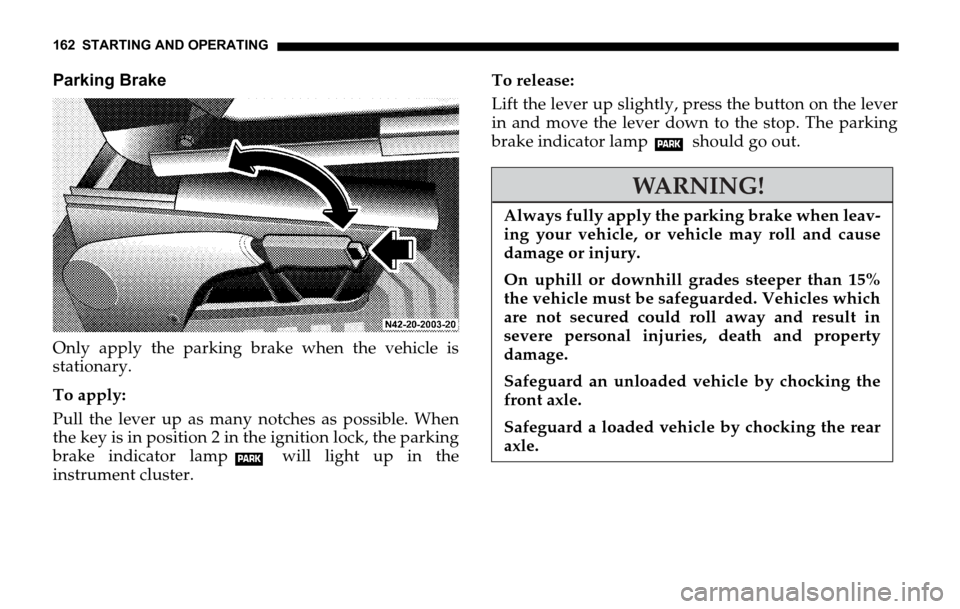
Parking Brake
Only apply the parking brake when the vehicle is
stationary.
To apply:
Pull the lever up as many notches as possible. When
the key is in position 2 in the ignition lock, the parking
brake indicator lamp will light up in the
instrument cluster.To release:
Lift the lever up slightly, press the button on the lever
in and move the lever down to the stop. The parking
brake indicator lamp should go out.
WARNING!
Always fully apply the parking brake when leav-
ing your vehicle, or vehicle may roll and cause
damage or injury.
On uphill or downhill grades steeper than 15%
the vehicle must be safeguarded. Vehicles which
are not secured could roll away and result in
severe personal injuries, death and property
damage.
Safeguard an unloaded vehicle by chocking the
front axle.
Safeguard a loaded vehicle by chocking the rear
axle.
Page 164 of 330
164 STARTING AND OPERATING
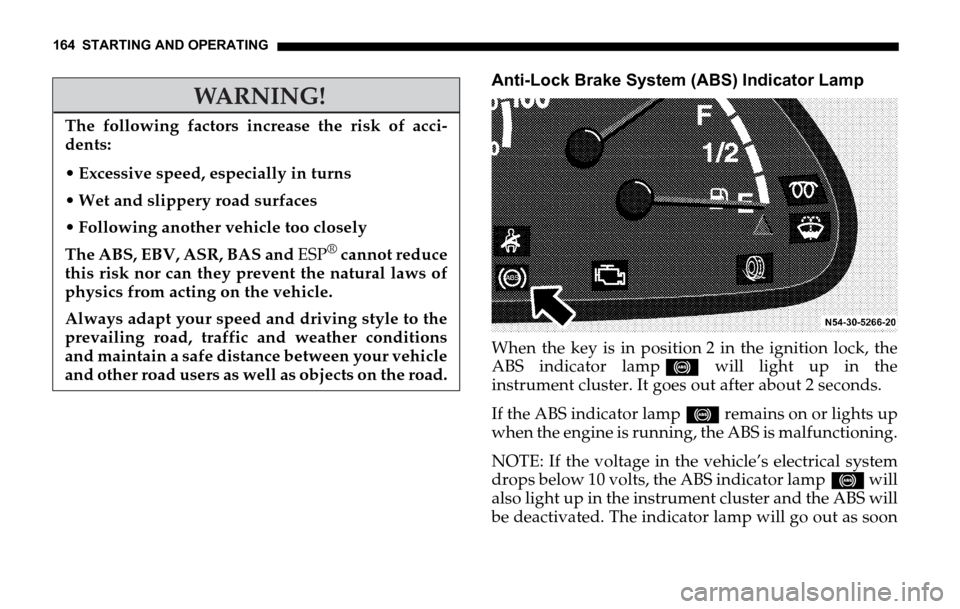
Anti-Lock Brake System (ABS) Indicator Lamp
When the key is in position 2 in the ignition lock, the
ABS indicator lamp- will light up in the
instrument cluster. It goes out after about 2 seconds.
If the ABS indicator lamp- remains on or lights up
when the engine is running, the ABS is malfunctioning.
NOTE: If the voltage in the vehicle’s electrical system
drops below 10 volts, the ABS indicator lamp- will
also light up in the instrument cluster and the ABS will
be deactivated. The indicator lamp will go out as soon
WARNING!
The following factors increase the risk of acci-
dents:
Excessive speed, especially in turns
Wet and slippery road surfaces
Following another vehicle too closely
The ABS, EBV, ASR, BAS and ESP
® cannot reduce
this risk nor can they prevent the natural laws of
physics from acting on the vehicle.
Always adapt your speed and driving style to the
prevailing road, traffic and weather conditions
and maintain a safe distance between your vehicle
and other road users as well as objects on the road.
Page 165 of 330

STARTING AND OPERATING 165
5
as the voltage reaches this level again – the ABS is then
reactivated.
If ABS malfunctions, the other driving safety systems
are deactivated. The handling and braking
characteristics of your vehicle change. The other
braking and driving systems still function normally.
I
Anti-Lock Brake System (ABS)
ABS prevents the wheels from locking at any speed
above about 5 mph (8 km/h), regardless of road
surface conditions. The vehicle remains steerable even
if the brakes are applied fully.
A light vibrating of the steering wheel and pulsating of
the brake pedal indicate that the ABS is working.
On slippery road surfaces, the ABS will respond even
with light brake pedal pressure because of the
increased likelihood of locking wheels. The pulsating
brake pedal can be an indication of hazardous road
conditions and works as a reminder to take extra care
while driving.
WARNING!
If the ABS indicator lamp- does not go out or
lights up again while driving, the ABS is malfunc-
tioning. If ABS malfunctions, the other driving
safety systems are deactivated. The vehicle’s brak-
ing characteristics may be affected. There is an in-
creased risk that your vehicle could skid in the
event of sharp braking. Have the malfunction
traced and repaired without delay by an autho-
rized Sprinter Dealer.
Adapt your speed and driving style to the
prevailing road, traffic and weather conditions.
Driving too fast increases the risk of an accident.
Page 167 of 330
STARTING AND OPERATING 167
5
Electronic Brake Force Distribution (EBD)
The electronic brake force distribution (EBD) prevents
the rear wheels from being overbraked when there is
little load on the rear axle or if there is not much friction
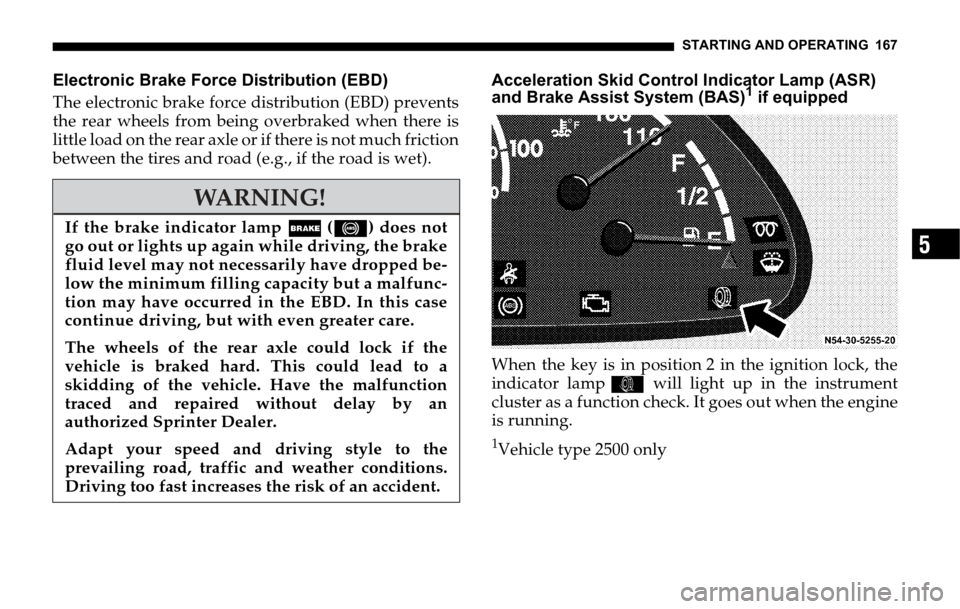
between the tires and road (e.g., if the road is wet).Acceleration Skid Control Indicator Lamp (ASR)
and Brake Assist System (BAS)1 if equipped
When the key is in position 2 in the ignition lock, the
indicator lampk will light up in the instrument
cluster as a function check. It goes out when the engine
is running.
1Vehicle type 2500 only
WARNING!
If the brake indicator lamp ;(-) does not
go out or lights up again while driving, the brake
fluid level may not necessarily have dropped be-
low the minimum filling capacity but a malfunc-
tion may have occurred in the EBD. In this case
continue driving, but with even greater care.
The wheels of the rear axle could lock if the
vehicle is braked hard. This could lead to a
skidding of the vehicle. Have the malfunction
traced and repaired without delay by an
authorized Sprinter Dealer.
Adapt your speed and driving style to the
prevailing road, traffic and weather conditions.
Driving too fast increases the risk of an accident.
Page 168 of 330

168 STARTING AND OPERATING
If the indicator lampk remains on or lights up
when the engine is running, the acceleration skid
control (ASR) or the brake assist system (BAS)
1 is
malfunctioning.
Then the ASR will be switched off automatically.
NOTE: If the ABS is malfunctioning or the voltage in
the vehicle’s electrical system drops below 10 volts, the
indicator lampk will also light up in the instrument
cluster and the ASR and the BAS
1 will be deactivated.
The indicator lamp will go out as soon as the voltage
reaches this level again or the ABS is operational again
– the ASR and the BAS
1 are then reactivated.
If a malfunction is present in the acceleration skid
control (ASR), the engine’s power output may be
reduced.
1Vehicle type 2500 only
WARNING!
If the indicator lampk remains on, the acceler-
ation skid control (ASR) or the brake assist system
(BAS)
1 is malfunctioning.
Your vehicle’s handling characteristics can
change. Drive with extra caution.
Have the malfunction traced and repaired as soon
as possible by an authorized Sprinter Dealer.
Page 169 of 330
STARTING AND OPERATING 169
5
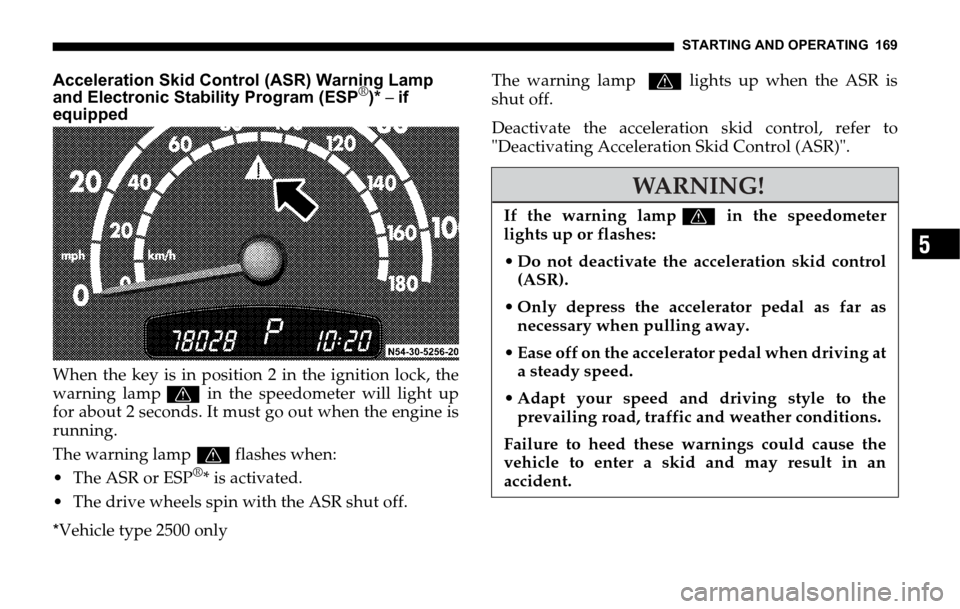
Acceleration Skid Control (ASR) Warning Lamp
and Electronic Stability Program (ESP®)* – if
equipped
When the key is in position 2 in the ignition lock, the
warning lampv in the speedometer will light up
for about 2 seconds. It must go out when the engine is
running.
The warning lampv flashes when:
The ASR or ESP
®* is activated.
The drive wheels spin with the ASR shut off.
*Vehicle type 2500 onlyThe warning lamp v lights up when the ASR is
shut off.
Deactivate the acceleration skid control, refer to
"Deactivating Acceleration Skid Control (ASR)".
WARNING!
If the warning lampv in the speedometer
lights up or flashes:
Do not deactivate the acceleration skid control
(ASR).
Only depress the accelerator pedal as far as
necessary when pulling away.
Ease off on the accelerator pedal when driving at
a steady speed.
Adapt your speed and driving style to the
prevailing road, traffic and weather conditions.
Failure to heed these warnings could cause the
vehicle to enter a skid and may result in an
accident.
Page 172 of 330

172 STARTING AND OPERATING
To deactivate the ASR:
Press the upper section of the switch – the warning
lamp v in the speedometer lights up.
Traction control continues to cut in if, for example, a
wheel on one side of the vehicle reaches its limit of
adhesion. The wheel is then braked to increase the
vehicle’s overall traction.
The warning lamp v will flash in the speedometer
at any speed when a tire reaches its limit of adhesion
and spins.
To activate the ASR:
Press the upper section of the switch again – the
warning lamp v in the speedometer goes out.Brake Assist System (BAS) (vehicle type 2500 only)
The Brake Assist System (BAS) operates in emergency
situations. If you apply the brakes very quickly, the
BAS automatically provides full brake boost, thereby
potentially reducing braking distance.
Apply continuous full braking pressure until the
emergency braking situation is over.
The ABS will prevent the wheels from locking.
When you release the brake pedal, the brakes function
again as normal. The BAS is then deactivated.
WARNING!
If the indicator lamp k remains on, a malfunc-
tion may not only have occurred in the ASR sys-
tem but also in the BAS.
The handling and braking characteristics of your
vehicle change. Drive with extra caution.
Have the malfunction traced and repaired as soon
as possible by an authorized Sprinter Dealer.
Page 173 of 330
STARTING AND OPERATING 173
5
For the indicator lamp k refer to "Indicator Lamp
Acceleration Skid Control (ASR) and Brake Assist
System (BAS)
".
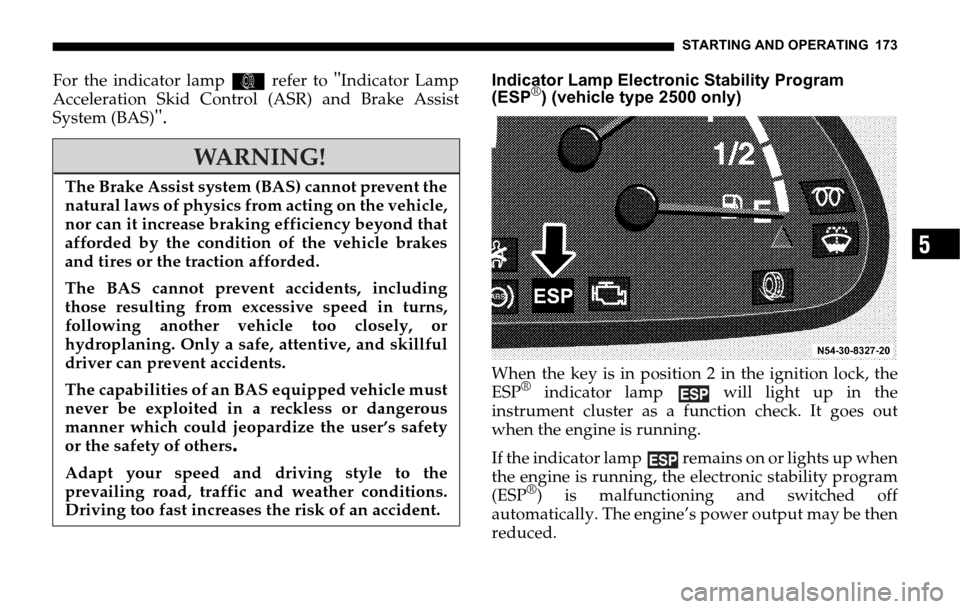
Indicator Lamp Electronic Stability Program
(ESP®) (vehicle type 2500 only)
When the key is in position 2 in the ignition lock, the
ESP
® indicator lamp will light up in the
instrument cluster as a function check. It goes out
when the engine is running.
If the indicator lamp remains on or lights up when
the engine is running, the electronic stability program
(ESP
®) is malfunctioning and switched off
automatically. The engine’s power output may be then
reduced.
WARNING!
The Brake Assist system (BAS) cannot prevent the
natural laws of physics from acting on the vehicle,
nor can it increase braking efficiency beyond that
afforded by the condition of the vehicle brakes
and tires or the traction afforded.
The BAS cannot prevent accidents, including
those resulting from excessive speed in turns,
following another vehicle too closely, or
hydroplaning. Only a safe, attentive, and skillful
driver can prevent accidents.
The capabilities of an BAS equipped vehicle must
never be exploited in a reckless or dangerous
manner which could jeopardize the user’s safety
or the safety of others
.
Adapt your speed and driving style to the
prevailing road, traffic and weather conditions.
Driving too fast increases the risk of an accident.
Page 174 of 330

174 STARTING AND OPERATING
NOTE: If the ABS is malfunctioning or the voltage in
the vehicle’s electrical system drops below 10 volts, the
indicator lamp will also light up in the instrument
cluster and the ESP
® will be deactivated. The indicator
lamp will go out as soon as the voltage reaches this
level again or the ABS is operational again – the ESP
®
is then reactivated.Electronic Stability Program (ESP
®) (vehicle type
2500 only)
The Electronic Stability Program (ESP
®) monitors the
vehicle’s traction (force of adhesive friction between
the tires and the road surface) and handling.
The ESP
® recognizes when a wheel is spinning or if the
vehicle starts to skid. By applying brakes to the
appropriate wheel and by limiting engine output, the
ESP
® works to stabilize the vehicle. The ESP® is
especially useful while driving off and on wet or
slippery road surfaces.
The warning lamp v in the speedometer flashes
when the ESP
® is engaged, refer also to "Warning
Lamp Acceleration Skid Control (ASR) and Electronic
Stability Program (ESP
®)".
If wheels with tires of a different size than those offered
by an authorized Sprinter Dealer are used, the correct
operation of the ESP
® cannot be guaranteed.
WARNING!
If the ESP® indicator lamp remains on, the
electronic stability program (ESP®) is malfunc-
tioning. The vehicle stability will no longer be au-
tomatically regulated in good time.
The danger that your vehicle breaks into a skid, is
increased in certain driving situations. Drive with
extra caution.
Have the ESP
® repaired as soon as possible by an
authorized Spinter Dealer.
Page 182 of 330

182 STARTING AND OPERATING
Treadwear indicators (TWI) are required by law. These
indicators are located in six places on the tread
circumference and become visible at a tread depth of
approximately 1/16 in (1.6 mm), at which point the tire
is considered worn and should be replaced.
Recommended minimum tire tread depth:
Summer tires 1/8 in (3 mm)
Winter tires 1/6 in (4 mm)Storing Tires
Cleaning Tires
Direction of Rotation
An arrow on the sidewall indicates the intended
direction of rotation (spinning) of the tire which
means, the wheel must mounted in the direction of
rotation.
WARNING!
Although the applicable federal motor vehicle
safety laws consider a tire to be worn when the
treadwear indicators (TWI) become visible at ap-
proximately 1/16 in (1.6 mm), do not allow your
tires to wear down to that level. As tread depth ap-
proaches 1/8 in (3 mm) for summer tires or 1/6 in 4
mm) for winter tires, the adhesion properties on a
wet road are sharply reduced.
Depending upon the weather and/or road surface
conditions), the tire traction varies widely.
WARNING!
Keep unmounted tires in a cool, dry place with as
little exposure to light as possible. Protect tires
from contact with oil, grease and diesel fuel.
WARNING!
Never use a round nozzle to power wash tires. The
intense jet of water can result in damage to the
tire.
Always replace a damaged tire.