ECU DODGE SPRINTER 2007 2.G User Guide
[x] Cancel search | Manufacturer: DODGE, Model Year: 2007, Model line: SPRINTER, Model: DODGE SPRINTER 2007 2.GPages: 393, PDF Size: 7.61 MB
Page 64 of 393
63 Controls in detail
Opening and closing
3
\1To close: make sure that the left-hand
rear door is closed.
\1Pull the right-hand rear door firmly
closed by the door handle.
\1To lock: slide catch2 to the right.
Only the rear door is locked.
The white marking is no longer visible.Using the central locking switch, you can
centrally lock or unlock from the inside ei-
ther the entire vehicle or the sliding doors
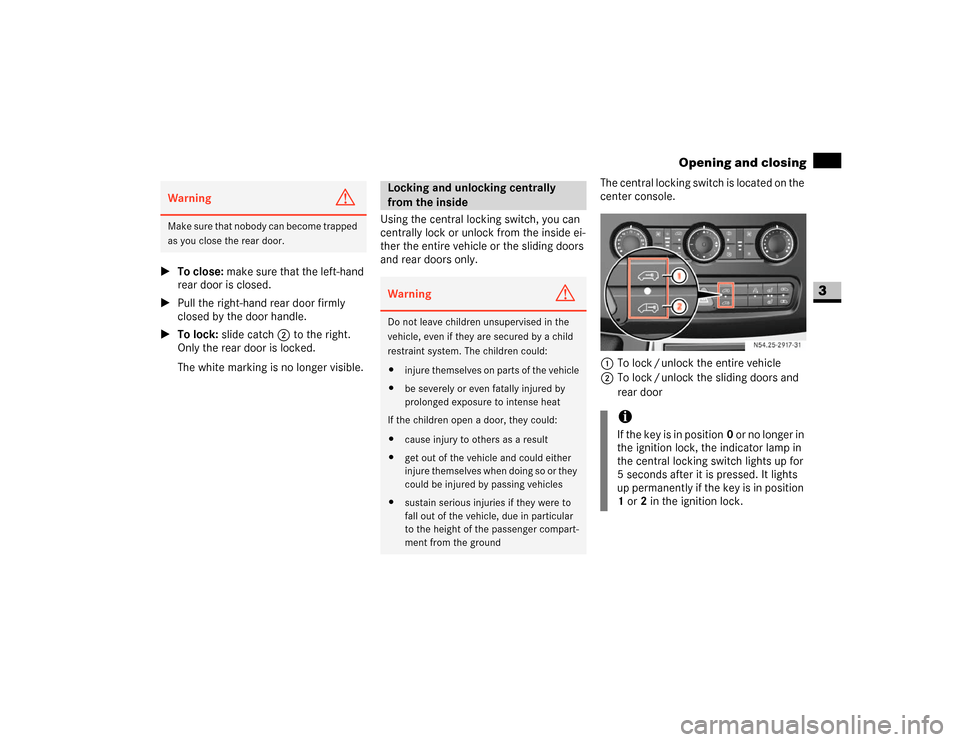
and rear doors only.The central locking switch is located on the
center console.
1To lock / unlock the entire vehicle
2To lock / unlock the sliding doors and
rear doorWarning
G
M a k e s u r e t h a t n o b o d y c a n b e c o m e t r a p p e d
as you close the rear door.
Locking and unlocking centrally
from the insideWarning
G
Do not leave children unsupervised in the
vehicle, even if they are secured by a child
restraint system. The children could:
\4injure themselves on parts of the vehicle
\4be severely or even fatally injured by
prolonged exposure to intense heat
If the children open a door, they could:
\4cause injury to others as a result
\4get out of the vehicle and could either
injure themselves when doing so or they
could be injured by passing vehicles
\4sustain serious injuries if they were to
fall out of the vehicle, due in particular
to the height of the passenger compart-
ment from the ground
iIf the key is in position0 or no longer in
the ignition lock, the indicator lamp in
the central locking switch lights up for
5 seconds after it is pressed. It lights
up permanently if the key is in position
1 or2 in the ignition lock.
N54.25-2917-31
Page 77 of 393
76 Controls in detailSteering wheel adjustment
3
\3 Steering wheel adjustment
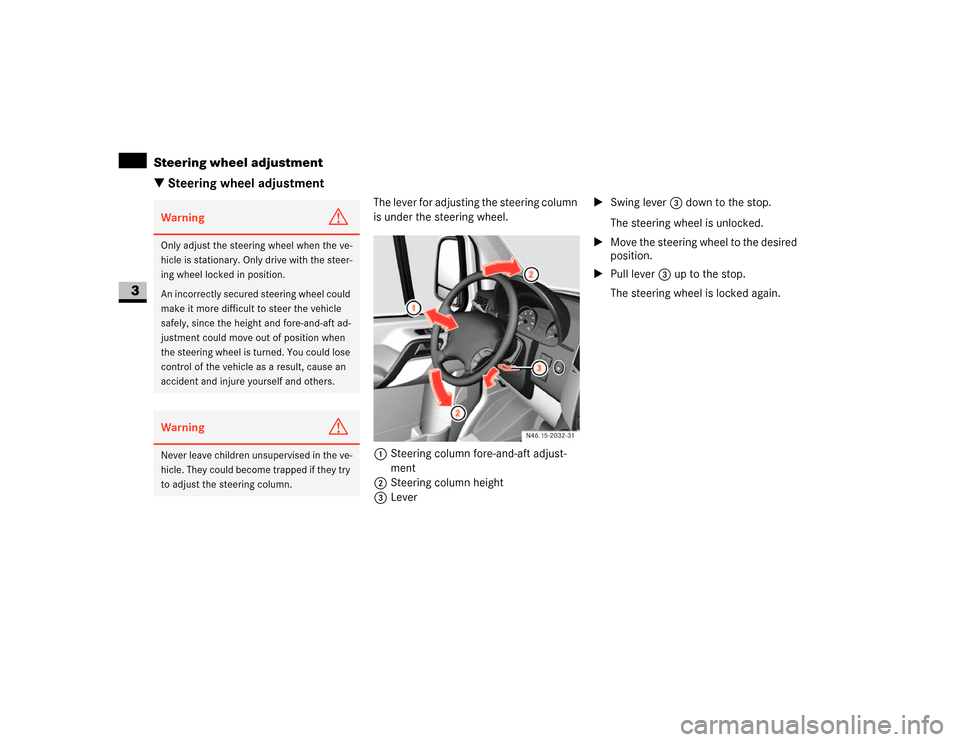
The lever for adjusting the steering column
is under the steering wheel.
1Steering column fore-and-aft adjust-
ment
2Steering column height
3Lever\1Swing lever 3 down to the stop.
The steering wheel is unlocked.
\1Move the steering wheel to the desired
position.
\1Pull lever3 up to the stop.
The steering wheel is locked again.
Warning
G
Only adjust the steering wheel when the ve-
hicle is stationary. Only drive with the steer-
ing wheel locked in position.
An incorrectly secured steering wheel could
make it more difficult to steer the vehicle
safely, since the height and fore-and-aft ad-
justment could move out of position when
the steering wheel is turned. You could lose
control of the vehicle as a result, cause an
accident and injure yourself and others.Warning
G
Never leave children unsupervised in the ve-
hicle. They could become trapped if they try
to adjust the steering column.
N46.15-2032-31
Page 111 of 393
110 Controls in detailDriving and parking
3
\3 Driving and parking
\1Before each journey, check the vehicle
lighting and the general condition of
the vehicle.
\1Observe the general driving tips at the
end of this section (\2page 116).
You will find information on:
\4regular checks (\2page 181)
\4driving in winter (\2page 235)
\4driving when towing a trailer
(\2page 175)
\4and other driving tips
in the “Operation” section (\2page 173).
Warning
G
T h e m o v e m e n t o f t h e p e d a l s m u s t n o t b e o b -
structed. The vehicle’s operating and road
safety are otherwise jeopardized.
Objects could fall and get caught between
the pedals if you accelerate or brake sud-
denly. You will no longer be able to brake or
accelerate. You could cause an accident,
which could result in injury to yourself and
others.
\4If floor mats and carpets are used, make
sure that these are secured correctly
and cannot slip and that there is suffi-
cient pedal clearance.
\4Do not place any objects in the driver’s
footwell.
\4Store and secure all loose objects so
they cannot get into the driver’s footwell
while the vehicle is in motion.
Warning
G
The doors could open of their own accord
while the vehicle is in motion if they are not
fully closed. For this reason, please make
sure that all the doors are properly closed
and locked before driving off (\2page 52).
Starting the engineWarning
G
Never run the engine in an enclosed space.
The exhaust fumes contain poisonous car-
bon monoxide. Breathing in exhaust fumes
constitutes a health hazard and can lead to
loss of consciousness and death.Warning
G
A seat belt that is worn incorrectly or not at
all, or that is not correctly engaged in the
seat belt buckle, cannot perform its intend-
ed protective function. In certain circum-
stances, you could then be seriously or even
fatally injured. Make sure, therefore, that all
occupants – in particular, expectant moth-
ers – wear their seat belt correctly at all
times.
Page 115 of 393
114 Controls in detailDriving and parking
3
ParkingWarning
G
Only remove the key from the ignition lock
when the vehicle is stationary, since it is not
possible to steer the vehicle with the key re-
moved.
Always apply the handbrake after parking
the vehicle.
Never leave children unsupervised in the ve-
hicle. They could release the handbrake.
This could lead to a serious or fatal accident.
Warning
G
Always switch off the engine and apply the
handbrake before leaving the vehicle.
The vehicle could roll away if it is not
secured.
On uphill or downhill gradients steeper than
15%:
\4apply the handbrake
\4secure an unloaded vehicle by chocking
the front axle (\2page 303)
\4secure a loaded vehicle by, for example,
chocking the rear axle (\2page 303)!
CAUTION
Whenever you park the vehicle, always
remove the key to prevent the battery
from excessively discharging.
For vehicles which are out of use for ex-
tended periods and have a battery iso-
lating switch*, switch off the electrical
system (\2page 197).
Warning
G
Make sure that the exhaust system does not
come into contact with highly flammable
materials, e.g. dry grass or gasoline. The
flammable material could otherwise ignite
and set vehicle components on fire.Warning
G
Regulations in some countries require the
parking lamps to be switched on to illumi-
nate the vehicle for other road users if
parked on a public road at night. In built-up
areas, night reflectors can also be used.
Observe legal requirements.
Page 117 of 393
116 Controls in detailDriving and parking
3
Stopping the engine
\1Apply handbrake (\2page 115).
\1Move selector lever to P.
\1Turn key to position 0 (\2page 67) in
the ignition lock and remove it.
The immobilizer is activated.\1Secure the vehicle at the front axle if
unloaded and at the rear axle if loaded,
e.g. using a chock (\2page 303).
Drinking and drivingSteering
!
CAUTION
If the coolant temperature is raised,
e.g. following driving in mountainous
terrain, run the engine at idling speed
for a further 1 or 2 minutes before you
switch off the engine. This allows the
coolant temperature to return to nor-
mal again.
iWhen parking on steep uphill or down-
hill gradients, turn the front wheels to-
wards the curb.iYou can only remove the key from the
ignition lock when the selector lever is
in positionP.
General driving tipsWarning
G
Drinking and driving and/or taking drugs
and driving are very dangerous combina-
tions. Even a small amount of alcohol or
drugs can affect your reflexes, perceptions
and judgment. The possibility of a serious or
even fatal accident is sharply increased
when you drink or take drugs and drive.
Never drink or take drugs and drive or allow
anyone to drive after drinking or taking
drugs.
Warning
G
There is no power-steering assistance when
the engine is not running.
You will need to use significantly more force
to steer and could therefore lose control of
the vehicle and cause an accident.
Never switch off the engine while driving.!
CAUTION
Do not hold the steering wheel in its
end positions for longer than neces-
sary (e.g. when turning or maneuver-
ing).
The hydraulic pump can be damaged
by the increased temperature of the
hydraulic fluid.
Page 125 of 393
124 Controls in detailAutomatic transmission
3
Stopping
If you are only stopping briefly:
\1leave the selector lever in the drive po-
sition
\1secure the vehicle against rolling away
using the brake pedal
Maneuvering
Maneuvering in a tight space:
\1Control the speed by braking carefully.
\1Accelerate only slightly and avoid jolt-
ing.Trailer towing
\1Run the engine in the moderate engine
speed range on steep uphill gradients.
\1Depending on the uphill or downhill
gradient, shift down to shift range3 or
2 (\2page 123), even if cruise control*
is switched on.
Working on the vehicle
iFor rapid maneuvering (e.g. to rock the
vehicle out of snow or slush), you can
shift back and forth between drive
positionD and reverse gearR at low
speeds without applying the brakes.
Warning
G
Apply the handbrake before working on the
vehicle and shift the automatic transmission
into parking positionP.
The vehicle could otherwise roll away.
Page 148 of 393
147 Controls in detail
Driving systems
3
\3 Driving systemsDriving systems which may form part of
your vehicle are described on the following
pages:
\4Cruise control* (\2page 147), which
you can use to control the speed of
your vehicle
\4Parktronic system*, which is an aid for
parking and maneuvering
(\2page 150)
\4Reverse warning feature*, which helps
you ensure the safety of other road us-
ers (\2page 153)
The ABS, BAS, ESP
®, ASR and EBV driving
safety systems are described in the "Safe-
ty and Security" section (\2page 23).Cruise control maintains the speed of the
vehicle for you.
Use cruise control if road and traffic condi-
tions make it appropriate to maintain a
steady speed for a prolonged period. You
can store any road speed above 20 mph
(30 km/h).
Cruise control*iThe increments for setting speed and
the threshold values for switching on or
automatically switching off cruise con-
trol depend on the digital speedometer
setting, mph or km/h (\2page 99).Warning
G
The cruise control function cannot take ac-
count of road and traffic conditions.
Always pay attention to road and traffic
conditions, even when cruise control is acti-
vated.
Cruise control is only an aid designed to as-
sist driving. You are responsible for the vehi-
cle’s speed and for braking in good time.
If there is a change of drivers, advise the
new driver of the cruising speed that is
stored.Warning
G
Do not use cruise control:
\4if road and traffic conditions do not per-
mit a constant driving speed to be main-
tained (e.g. heavy traffic or winding
roads). You could otherwise cause an
accident.
\4on slippery roads. The drive wheels may
lose their grip when braking or acceler-
ating and the vehicle could skid
\4when visibility is poor, e.g. in fog, heavy
rain or snow
Page 157 of 393
156 Controls in detailTransporting
3
\3 Transporting
For more information about the maximum
roof load and roof carrier systems, please
refer to the "Technical data" section
(\2page 351).
Loading guidelinesWarning
G
Secure and position a load as described in
the loading guidelines. Otherwise, the load
could slide or be thrown around in the event
of strong braking maneuvers, sudden chang-
es of direction or poor road conditions,
thereby injuring you or others. The same ap-
plies to dismantled seats if left inside the ve-
hicle.
Please note that loads increase the risk of
injury during an accident even if you comply
with all loading guidelines.
Observe the notes in the "Securing a load"
section (\2page 158).Warning
G
Do not exceed the vehicle's permissible
gross weight or the permissible axle loads
when loading the vehicle or carrying addi-
tional passengers.
If you exceed the vehicle's permissible axle
loads or the maximum permissible gross
weight when transporting items or carrying
passengers, tire stability and driving safety
are reduced. The vehicle's driving and steer-
ing characteristics would be greatly altered.
Braking and stopping distances would
be significantly longer.
Your vehicle's driving, steering and braking
characteristics change as the vehicle's
gross weight increases or its center of grav-
ity is raised.
Always ensure that loads are distributed
correctly and adapt your driving style in ac-
cordance with the load.Warning
G
After an accident, have a damaged load
compartment floor or damaged load sur-
face, the lashing eyes and lashing materials
inspected by a specialist workshop having
the necessary technical expertise and tools
to carry out the required work.
The manufacturer recommends that you use
an authorized Sprinter Dealer for this pur-
pose. In particular, work relevant to safety
or on safety-related systems must be car-
ried out at a qualified specialist workshop. !
CAUTION
If you are using a roof carrier system,
observe the maximum roof load and
maximum load-bearing capacity of the
roof carrier system.
Page 158 of 393
157 Controls in detail
Transporting
3
Before loading
\1Check the tire pressures and correct
them if necessary (\2page 213).
\1Clean the load compartment floor.
The load compartment floor must be
dry, cleanly swept and free of oil and
dust to reduce the risk of the load slip-
ping.
\1If necessary, place anti-slip mats on the
load compartment floor.During loading
\1Observe the maximum permissible axle
loads and permissible gross weight for
the vehicle.
\1Observe the notes on load distribution
(\2page 158).
\1Secure the load (\2page 158). All
country-specific legal requirements
must be observed.Checks after loading
\1Securing a load: before each journey
and at regular intervals during longer
journeys, check whether the load is
properly secured and take additional
securing measures, if necessary.
\1Doors: close the sliding doors and rear
doors.
\1Tire pressure: adjust the tire pressure
in accordance with the vehicle's load
(\2page 213).
\1Driving characteristics: adapt your
driving style to the load.
!
CAUTION
As soon as the anti-slip mats start to
show signs of permanent deformation,
squashed areas or tears/holes, they
are unsuitable for securing loads and
must be replaced.
!
CAUTION
In passenger vans with the maximum
number of seats, the maximum payload
would cause the permissible rear axle
load to be exceeded.
iBear in mind that your vehicle's unlad-
en weight is increased by the installa-
tion of optional equipment and
accessories.
Warning
G
Make sure that the sliding doors and rear
doors are always closed when the engine is
running.
Otherwise, exhaust fumes could enter the
vehicle interior and poison you.
Page 159 of 393
158 Controls in detailTransporting
3
The load's overall center of gravity should
be as low and central as possible, between
the axles near the rear axle.
For crewbus models:
\1Always transport loads in the load com-
partment.
\1Always place loads flush against the
seat backrests of the rear bench seat.
\1Slide larger and heavier loads as far for-
ward as possible when looking in the
direction of travel. Stack items against
each other behind the rear bench seat.\1Always secure loads with suitable
transport aids or lashing materials.
As the driver of the vehicle, you are respon-
sible for ensuring that the load is secured
against slipping, tipping over, rolling or fall-
ing down, whether driving in normal traffic
situations or on poor road surfaces or as a
result of having to swerve to avoid an ob-
stacle or applying the brakes fully.Failing to secure the load in accordance
with relevant requirements and sound
practice may be a punishable offense, de-
pending on national legislation and the
consequences that arise.
For this reason, observe the legal require-
ments in all countries concerned.
Before each journey and at regular inter-
vals during longer journeys, check whether
the load is secure and take additional ac-
tion to improve any incorrect or inade-
quate safety measures.
\1Fill up any empty spaces between the
load and the load compartment walls
or wheel arches in a form-fitting man-
ner. For this purpose, use solid trans-
port aids, such as chocks, wooden
blocks or storage cushions.Load distribution!
CAUTION
Excessive loads on individual points of
the load compartment floor or load sur-
face have a negative effect on handling
characteristics and could damage the
floor covering.
iObserve the following notes:
\4Do not stack loads higher than the
upper edge of the backrests.
\4Transport loads behind seats that
are not occupied.
\4If the rear bench seat is not occu-
pied, insert the seat belts in a cross-
wise pattern into the opposite belt
buckles.Securing a load
iInformation about how to secure a
load correctly can be obtained from the
manufacturers of transport aids or
lashing materials for securing loads.