ECU DODGE SPRINTER 2007 2.G Owner's Manual
[x] Cancel search | Manufacturer: DODGE, Model Year: 2007, Model line: SPRINTER, Model: DODGE SPRINTER 2007 2.GPages: 393, PDF Size: 7.61 MB
Page 160 of 393
159 Controls in detail
Transporting
3
\1Secure tilt and tip-resistant loads in all
directions by using the lashing points
or lashing eyes and load rails in the
load compartment or on the load sur-
face, according to your vehicle's equip-
ment.
Only use lashing materials that have
been tested according to valid stan-
dards, such as lashing nets and straps.
Always use the lashing points closest
to the load for securing it in place and
place padding around sharp edges.
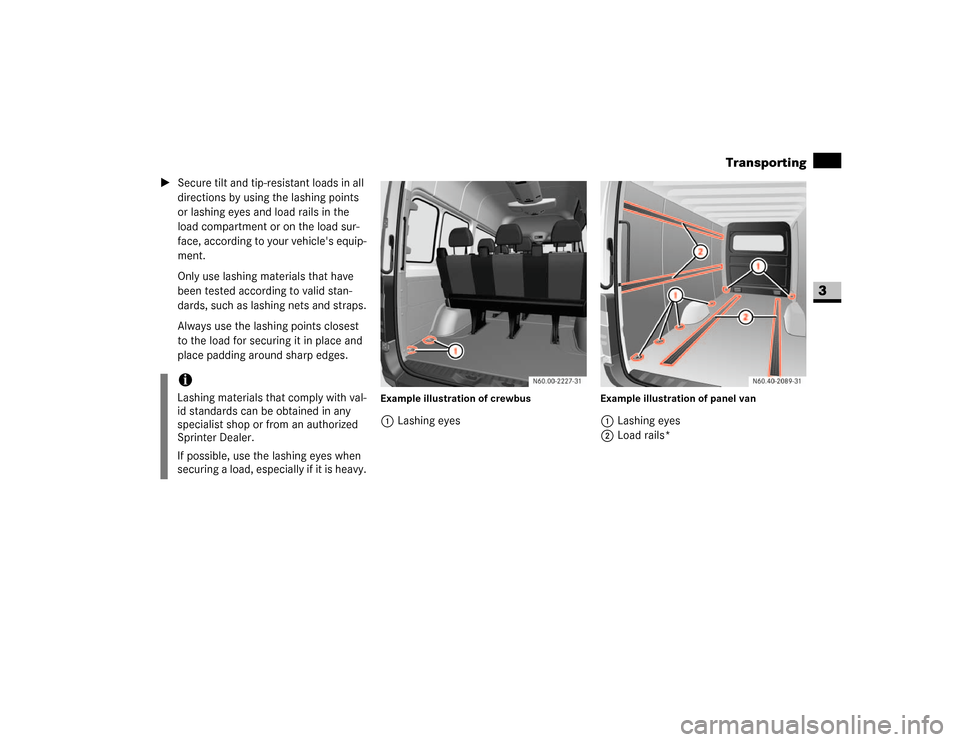
Example illustration of crewbus1Lashing eyes
Example illustration of panel van1Lashing eyes
2Load rails*
iLashing materials that comply with val-
id standards can be obtained in any
specialist shop or from an authorized
Sprinter Dealer.
If possible, use the lashing eyes when
securing a load, especially if it is heavy.
Page 161 of 393
160 Controls in detailTransporting
3
\1Always attach the lashing net or tarps
to all available lashing points. While do-
ing so, make sure that the mounting
hooks cannot open unintentionally.Warning
G
Do not carry out any modifications or repairs
to the lashing points, the lashing eyes or the
lashing materials. The load or the lashing
points could accidentally come loose and
cause serious injury to you or others as well
as damage to property.
Distribute loads evenly between the lashing
points or lashing eyes.
Observe the loading guidelines.iLoose loads should be secured with an
approved lashing net or tarp.
!
CAUTION
Observe the data on the maximum
load-bearing capacity of the individual
lashing points
(\2
page 371).
During full-braking applications, for ex-
ample, forces can be involved that are
much greater than the weight force of
the load.
Always use several lashing points in or-
der to distribute force absorption, and
make sure that the lashing points have
an equal load.
iIf your vehicle has load rails in the floor,
you should position locking rods imme-
diately in front of and behind the load.
The locking rods absorb possible shift-
ing forces directly.
Warning
G
If you tension the lashing straps between
the side walls or between a side wall and the
load compartment floor, the permissible
load for the lashing rails, lashing points or
lashing eyes could be exceeded in the event
of strong braking, sudden changes of direc-
tion or an accident.
The load would no longer be secured, which
could result in serious injuries caused by the
load slipping.
For this reason, do not tension a lashing
strap between the side walls or between a
side wall and the load compartment floor.
Only locking bars or rods may be installed
between the load rails near the side walls.
Observe the operating instructions issued
by the locking bar or locking rod manufac-
turer.
Page 162 of 393
161 Controls in detail
Transporting
3
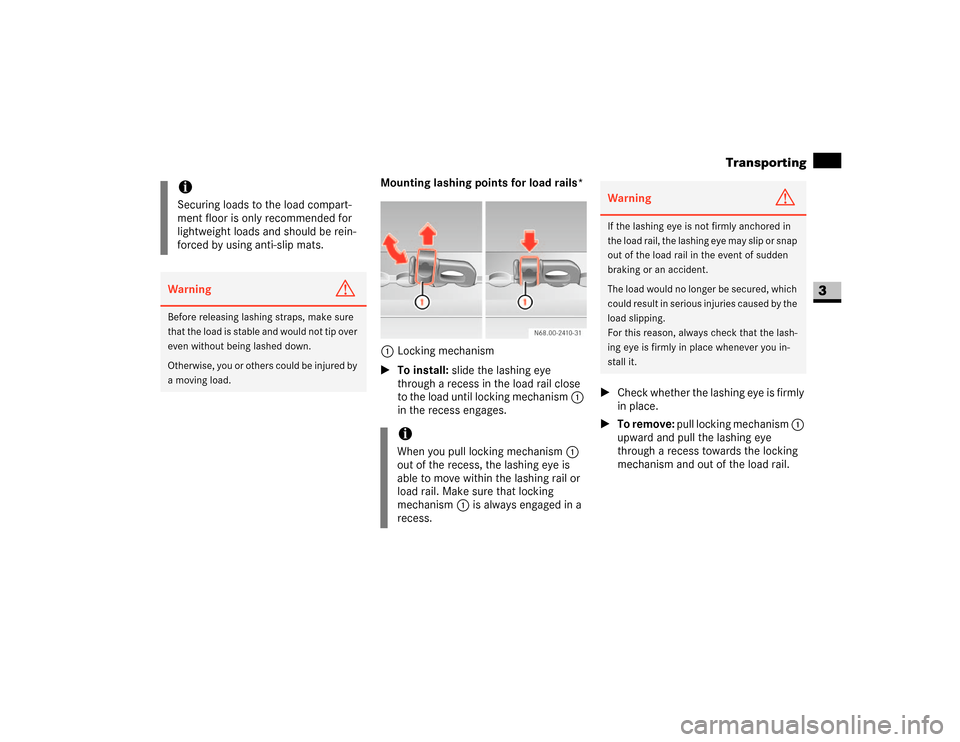
Mounting lashing points for load rails*
1Locking mechanism
\1To install: slide the lashing eye
through a recess in the load rail close
to the load until locking mechanism 1
in the recess engages.\1Check whether the lashing eye is firmly
in place.
\1To remove: pull locking mechanism 1
upward and pull the lashing eye
through a recess towards the locking
mechanism and out of the load rail.
iSecuring loads to the load compart-
ment floor is only recommended for
lightweight loads and should be rein-
forced by using anti-slip mats.Warning
G
Before releasing lashing straps, make sure
that the load is stable and would not tip over
even without being lashed down.
Otherwise, you or others could be injured by
a moving load.
iWhen you pull locking mechanism1
out of the recess, the lashing eye is
able to move within the lashing rail or
load rail. Make sure that locking
mechanism1 is always engaged in a
recess.
Warning
G
If the lashing eye is not firmly anchored in
the load rail, the lashing eye may slip or snap
out of the load rail in the event of sudden
braking or an accident.
The load would no longer be secured, which
could result in serious injuries caused by the
load slipping.
For this reason, always check that the lash-
ing eye is firmly in place whenever you in-
stall it.
Page 163 of 393
162 Controls in detailTransporting
3
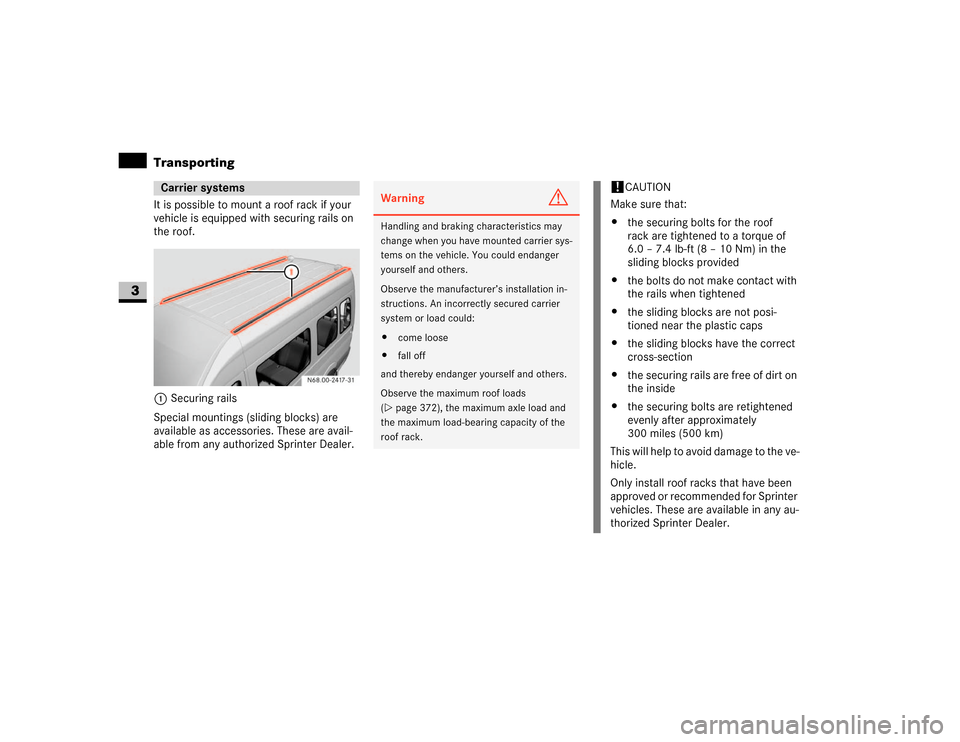
It is possible to mount a roof rack if your
vehicle is equipped with securing rails on
the roof.
1Securing rails
Special mountings (sliding blocks) are
available as accessories. These are avail-
able from any authorized Sprinter Dealer.Carrier systems
Warning
G
Handling and braking characteristics may
change when you have mounted carrier sys-
tems on the vehicle. You could endanger
yourself and others.
Observe the manufacturer’s installation in-
structions. An incorrectly secured carrier
system or load could:
\4come loose
\4fall off
and thereby endanger yourself and others.
Observe the maximum roof loads
(\2page 372), the maximum axle load and
the maximum load-bearing capacity of the
roof rack.
!
CAUTION
Make sure that:
\4the securing bolts for the roof
rack are tightened to a torque of
6.0 – 7.4 lb-ft (8 – 10 Nm) in the
sliding blocks provided
\4the bolts do not make contact with
the rails when tightened
\4the sliding blocks are not posi-
tioned near the plastic caps
\4the sliding blocks have the correct
cross-section
\4the securing rails are free of dirt on
the inside
\4the securing bolts are retightened
evenly after approximately
300 miles (500 km)
This will help to avoid damage to the ve-
hicle.
Only install roof racks that have been
approved or recommended for Sprinter
vehicles. These are available in any au-
thorized Sprinter Dealer.
Page 164 of 393
163 Controls in detail
Transporting
3
Observe the instructions in the “Opera-
tion” section (\2page 175).
!
CAUTION
If you wish to retrofit securing rails,
have them installed at a qualified spe-
cialist workshop which has the neces-
sary specialist knowledge and tools to
carry out the work required. You could
otherwise damage the vehicle.
The manufacturer recommends that
you use an authorized Sprinter Dealer
for this purpose.
Trailer towing
Page 179 of 393
178 OperationDriving tips
4
Attaching a trailer
Please observe the maximum permitted
trailer dimensions (width and length).
Most states and all Canadian provinces re-
quire safety chains between your tow vehi-
cle and the trailer. The chains should be
crisscrossed under the trailer tongue. They
must be attached to the hitch receiver, and
not to the vehicle’s bumper or axle. Be sure
to leave enough slack in the chains to per-
mit turning corners.Towing a trailer
There are many different laws, including
speed limit restrictions, having to do with
trailer towing. Make sure that your vehicle-
trailer combination will be legal, not only
for where you reside, but also for where
you will be driving. A good source for this
information can be the police or local au-
thorities.
Before you start driving with the trailer,
check the trailer hitch, break-away switch,
safety chains, electrical connections, light-
ing and tires. Also adjust the mirrors to
permit an unobstructed view beyond the
rear of the trailer.
If the trailer has electric brakes, start your
vehicle and trailer moving slowly, and then
apply only the trailer brake controller by
hand to be sure that the brakes are work-
ing properly.
When towing a trailer, check occasionally
to be sure that the load is secure, and that
lighting and trailer brakes (if so equipped)
are functioning properly.
iMost states and all Canadian provinces
require a separate brake system at var-
ious trailer weights.
Warning
G
Do not connect a trailer brake system (if
trailer is so equipped) directly to the vehi-
cle’s hydraulic brake system as your vehicle
is equipped with antilock brakes. If you do,
neither the vehicle’s brakes nor the trailer’s
brakes will function properly. This could
cause an accident resulting in property dam-
age, injury or death to you or others.
The provided vehicle electrical wiring har-
ness for trailer towing has a brake signal
wire for hook-up to a brake controller.
Most states and all Canadian provinces re-
quire a break-away switch on trailers with a
separate brake system. The switch activates
the trailer brakes in the possible event that
the trailer might separate from the tow vehi-
cle.
You should consider using a trailer sway
control system. For further information, see
your authorized Sprinter Dealer.
Page 180 of 393
179 Operation
Driving tips
4
Always secure items in the trailer to pre-
vent load shifts while driving.
Take into consideration that when towing a
trailer, the handling characteristics are dif-
ferent and less stable from those when op-
erating the vehicle without a trailer. It is
important to avoid sudden maneuvers.
The vehicle and trailer combination is
heavier, and therefore is limited in acceler-
ation and climbing ability, and requires
longer stopping distances. It is more prone
to reacting to side wind gusts, and requires
more sensitive steering input.
In order to gain skill and an understanding
of the vehicle’s behavior, you should prac-
tice turning , st opping and backing up in a n
area which is free from traffic.
If possible, do not brake abruptly, but rath-
er engage the brake slightly at first to per-
mit the trailer to activate its brake. Then
increase the braking force.
Warning
G
Take into consideration that when towing a
trailer, the handling characteristics are dif-
ferent and less stable from those when op-
erating the vehicle without a trailer.
It is important to avoid sudden maneuvers.
Sudden maneuvers may lead to loss of con-
trol over the vehicle-trailer combination.
This could cause an accident resulting in
property damage or injury to you or others.!
CAUTION
If the transmission hunts between
gears on inclines, manually shift to a
lower gear (select
"4", "3", "2" or
"1").
A lower gear and reduction of speed re-
duces the chance of the engine over-
loading and / or overheating.
When going down a long hill, shift into
a lower gear and use the engine’s brak-
ing effect. Avoid riding the brakes, thus
overheating the vehicle and trailer
brakes.
If the engine coolant rises to an ex-
tremely high temperature (coolant tem-
perature needle approaching the red
zone) when the air conditioner is on,
turn off the air conditioner. Engine
coolant heat can be additionally vented
by opening the windows, switching the
climate control fan speed to high and
setting the temperature control to the
maximum hot position.
Extreme care must be exercised since
your vehicle with a trailer will require
additional passing distance ahead than
when driving without a trailer. Because
your vehicle and trailer is longer than
your vehicle alone, you will also need to
go much farther ahead of the passed
vehicle before you can return to your
lane.
Page 186 of 393
185 Operation
Engine
4
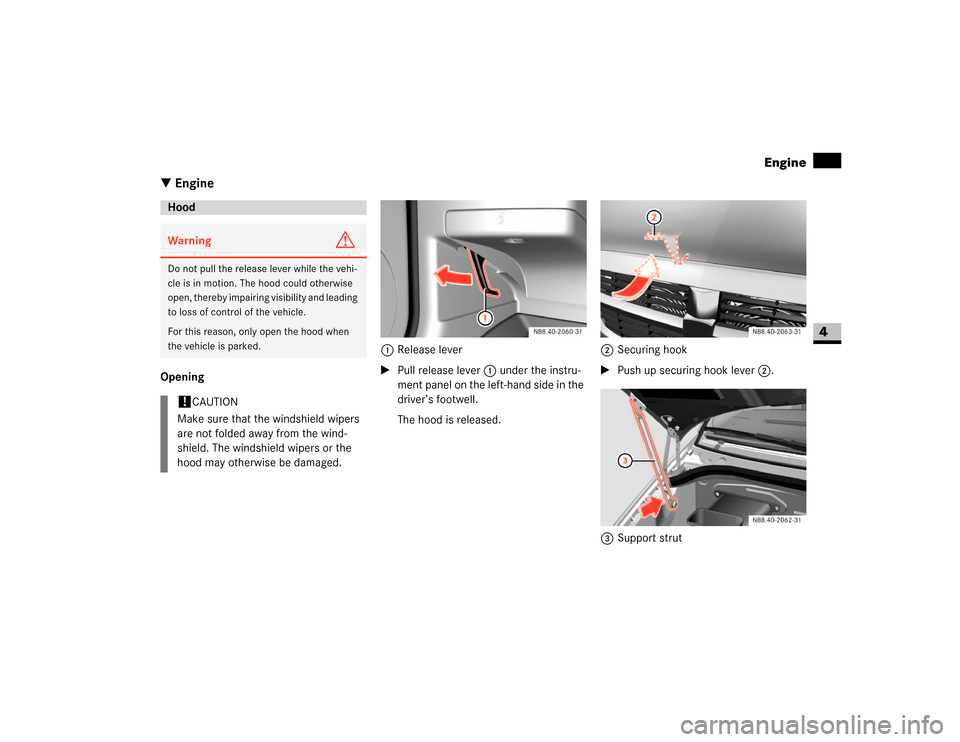
\3 EngineOpening 1Release lever
\1Pull release lever1 under the instru-
ment panel on the left-hand side in the
driver’s footwell.
The hood is released.2Securing hook
\1Push up securing hook lever 2.
3Support strutHoodWarning
G
Do not pull the release lever while the vehi-
cle is in motion. The hood could otherwise
open, thereby impairing visibility and leading
to loss of control of the vehicle.
For this reason, only open the hood when
the vehicle is parked.!
CAUTION
Make sure that the windshield wipers
are not folded away from the wind-
shield. The windshield wipers or the
hood may otherwise be damaged.
N88.40-2060-31
N88.40-2063-31N88.40-2062-31
Page 187 of 393
186 OperationEngine
4
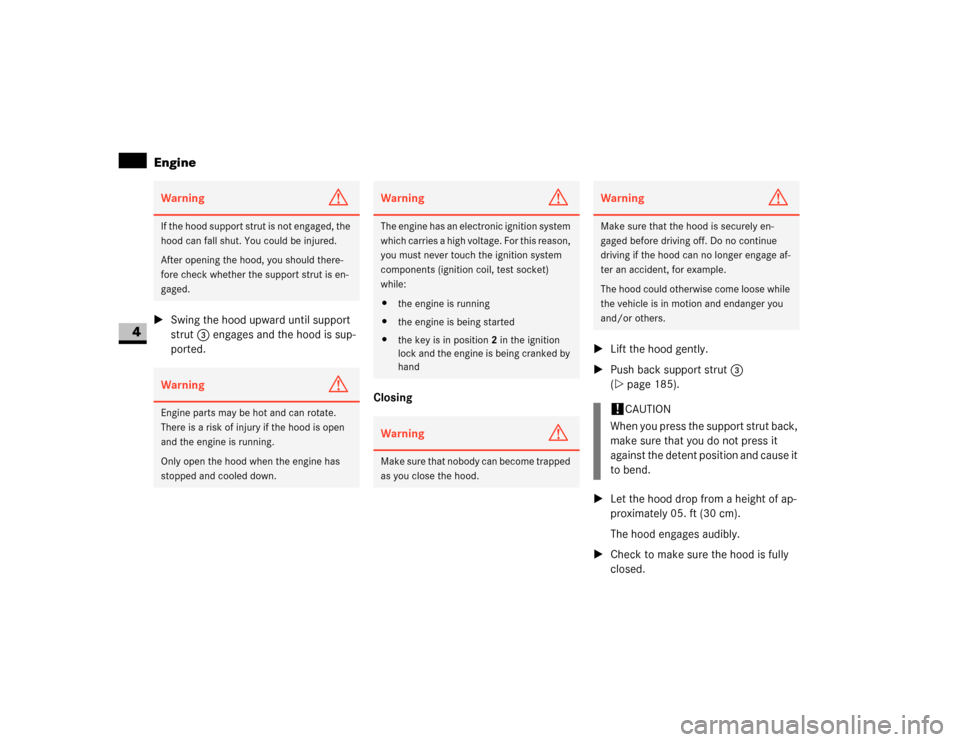
\1Swing the hood upward until support
strut3 engages and the hood is sup-
ported.
Closing\1Lift the hood gently.
\1Push back support strut3
(\2page 185).
\1Let the hood drop from a height of ap-
proximately 05. ft (30 cm).
The hood engages audibly.
\1Check to make sure the hood is fully
closed.Warning
G
If the hood support strut is not engaged, the
hood can fall shut. You could be injured.
After opening the hood, you should there-
fore check whether the support strut is en-
gaged.Warning
G
Engine parts may be hot and can rotate.
There is a risk of injury if the hood is open
and the engine is running.
Only open the hood when the engine has
stopped and cooled down.
Warning
G
The engine has an electronic ignition system
which carries a high voltage. For this reason,
you must never touch the ignition system
components (ignition coil, test socket)
while:
\4the engine is running
\4the engine is being started
\4the key is in position2 in the ignition
lock and the engine is being cranked by
handWarning
G
Make sure that nobody can become trapped
as you close the hood.
Warning
G
Make sure that the hood is securely en-
gaged before driving off. Do no continue
driving if the hood can no longer engage af-
ter an accident, for example.
The hood could otherwise come loose while
the vehicle is in motion and endanger you
and/or others.!
CAUTION
When you press the support strut back,
make sure that you do not press it
against the detent position and cause it
to bend.
Page 196 of 393
195 Operation
Battery
4
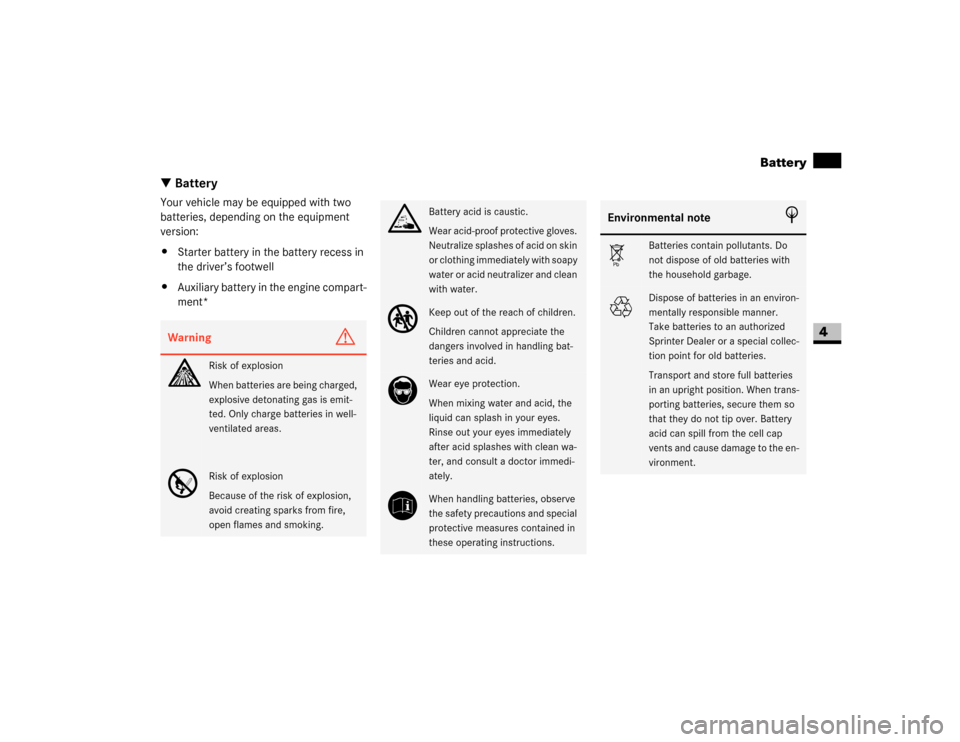
\3 BatteryYour vehicle may be equipped with two
batteries, depending on the equipment
version:
\4Starter battery in the battery recess in
the driver’s footwell
\4Auxiliary battery in the engine compart-
ment*Warning
G
A
Risk of explosion
When batteries are being charged,
explosive detonating gas is emit-
ted. Only charge batteries in well-
ventilated areas.
D
Risk of explosion
Because of the risk of explosion,
avoid creating sparks from fire,
open flames and smoking.
B
Battery acid is caustic.
Wear acid-proof protective gloves.
Neutralize splashes of acid on skin
or clothing immediately with soapy
water or acid neutralizer and clean
with water.
C
Keep out of the reach of children.
Children cannot appreciate the
dangers involved in handling bat-
teries and acid.
E
Wear eye protection.
When mixing water and acid, the
liquid can splash in your eyes.
Rinse out your eyes immediately
after acid splashes with clean wa-
ter, and consult a doctor immedi-
ately.
F
When handling batteries, observe
the safety precautions and special
protective measures contained in
these operating instructions.
Environmental note
H
Á
Batteries contain pollutants. Do
not dispose of old batteries with
the household garbage.
À
Dispose of batteries in an environ-
mentally responsible manner.
Take batteries to an authorized
Sprinter Dealer or a special collec-
tion point for old batteries.
Transport and store full batteries
in an upright position. When trans-
porting batteries, secure them so
that they do not tip over. Battery
acid can spill from the cell cap
vents and cause damage to the en-
vironment.