belt DODGE SPRINTER 2007 2.G User Guide
[x] Cancel search | Manufacturer: DODGE, Model Year: 2007, Model line: SPRINTER, Model: DODGE SPRINTER 2007 2.GPages: 393, PDF Size: 7.61 MB
Page 36 of 393
35 Safety
Occupant safety
2
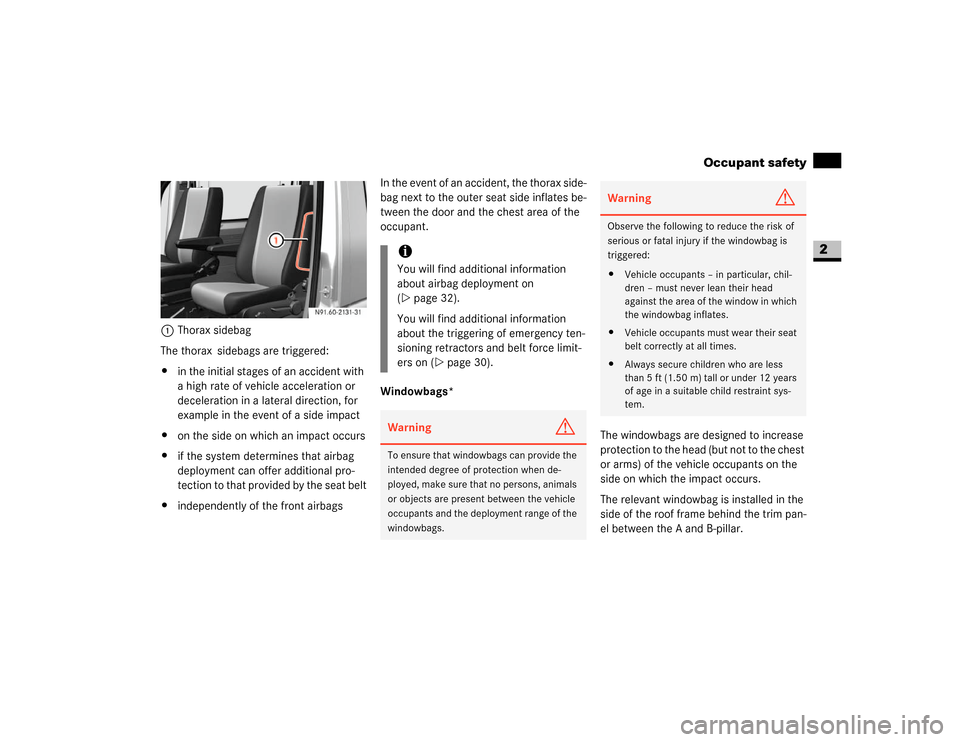
1Thorax sidebag
The thorax sidebags are triggered:
\4in the initial stages of an accident with
a high rate of vehicle acceleration or
deceleration in a lateral direction, for
example in the event of a side impact
\4on the side on which an impact occurs
\4if the system determines that airbag
deployment can offer additional pro-
tection to that provided by the seat belt
\4independently of the front airbagsIn the event of an accident, the thorax side-
bag next to the outer seat side inflates be-
tween the door and the chest area of the
occupant.
Windowbags*
The windowbags are designed to increase
protection to the head (but not to the chest
or arms) of the vehicle occupants on the
side on which the impact occurs.
The relevant windowbag is installed in the
side of the roof frame behind the trim pan-
el between the A and B-pillar.
iYou will find additional information
about airbag deployment on
(\2page 32).
You will find additional information
about the triggering of emergency ten-
sioning retractors and belt force limit-
ers on (\2page 30).Warning
G
To ensure that windowbags can provide the
intended degree of protection when de-
ployed, make sure that no persons, animals
or objects are present between the vehicle
occupants and the deployment range of the
windowbags.
Warning
G
Observe the following to reduce the risk of
serious or fatal injury if the windowbag is
triggered:
\4Vehicle occupants – in particular, chil-
dren – must never lean their head
against the area of the window in which
the windowbag inflates.
\4Vehicle occupants must wear their seat
belt correctly at all times.
\4Always secure children who are less
than 5 ft (1.50 m) tall or under 12 years
of age in a suitable child restraint sys-
tem.
Page 37 of 393
36 SafetyOccupant safety
2
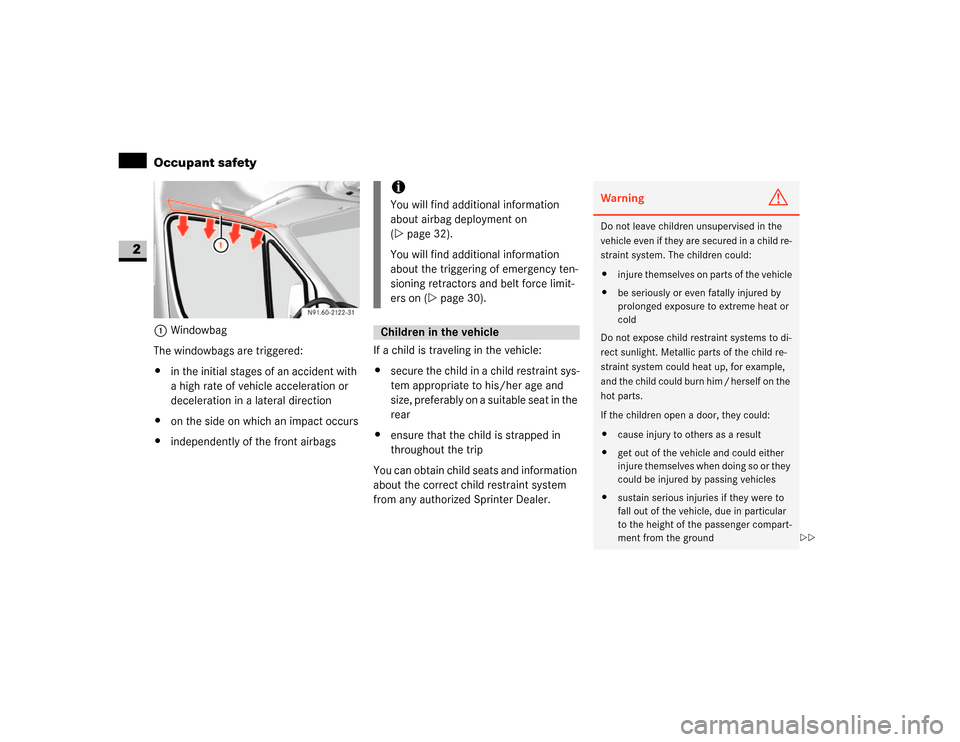
1Windowbag
The windowbags are triggered:
\4in the initial stages of an accident with
a high rate of vehicle acceleration or
deceleration in a lateral direction
\4on the side on which an impact occurs
\4independently of the front airbagsIf a child is traveling in the vehicle:
\4secure the child in a child restraint sys-
tem appropriate to his/her age and
size, preferably on a suitable seat in the
rear
\4ensure that the child is strapped in
throughout the trip
You can obtain child seats and information
about the correct child restraint system
from any authorized Sprinter Dealer.
iYou will find additional information
about airbag deployment on
(\2page 32).
You will find additional information
about the triggering of emergency ten-
sioning retractors and belt force limit-
ers on (\2page 30).Children in the vehicle
Warning
G
Do not leave children unsupervised in the
vehicle even if they are secured in a child re-
straint system. The children could:
\4injure themselves on parts of the vehicle
\4be seriously or even fatally injured by
prolonged exposure to extreme heat or
cold
Do not expose child restraint systems to di-
rect sunlight. Metallic parts of the child re-
straint system could heat up, for example,
and the child could burn him / herself on the
hot parts.
If the children open a door, they could:
\4cause injury to others as a result
\4get out of the vehicle and could either
injure themselves when doing so or they
could be injured by passing vehicles
\4sustain serious injuries if they were to
fall out of the vehicle, due in particular
to the height of the passenger compart-
ment from the ground
\2\2
Page 38 of 393
37 Safety
Occupant safety
2
Child restraint systems
We recommend all infants and children be
properly restrained at all times while the
vehicle is in motion.
All lap-shoulder belts except the driver’s
seat belt have special seat belt retractors
for secure fastening of child restraints.
To fasten a child restraint, follow child re-
straint instructions for mounting. Then pull
the shoulder belt out completely and let it
retract. During seat belt retraction, a ratch-eting sound can be heard to indicate taht
the special seat belt retractor is activated.
The belt is now locked. push down on child
restraint to take up any slack.
To deactivate, release seat belt buckle and
let seat belt retract completely. The seat
belt can again be used in the usual
manner.Do not carry heavy or hard objects inside
the vehicle or load compartment unless they
are secured. You will find further information
under “Transporting156” (\2page 156) and
“Features164” (\2page 164) in the “Con-
trols in detail” section.
An unsecured or incorrectly positioned load
increases the risk of injury to occupants,
particularly children, in the event of:
\4sharp braking
\4a sudden change of direction
\4an accident
Warning
G
Never release the seat belt buckle while the
vehicle is in motion, since the special seat
belt retractor will be deactivated.Warning
G
To reduce the risk of serious or fatal injury to
a child in the event of an accident, sharp
braking or a sudden change in direction:
\4Always secure children less than 5 ft
(1.50 m) tall or under 12 years of age in
a special child restraint system installed
on a suitable vehicle seat, since the seat
belts are not designed for this body size.
\4Do not secure children under 12 years
of age on the co-driver’s seat unless
they are secured in a suitable forward-
facing child restraint system.
\4It is not permitted to secure a child in a
rearward-facing child restraint system
on the co-driver’s seat if the vehicle is
equipped with a co-driver’s airbag.
Only secure a rearward-facing child re-
straint system on a suitable rear seat.
\4Always move the co-driver’s seat to its
rearmost position if you have secured a
child on this seat in a forward-facing
child restraint system.
\4A child must never be carried sitting on
the lap of a vehicle occupant. It would
not be possible to restrain the child as a
result of the forces acting in the event of
an accident, braking or abrupt changes
in direction. The child would be thrown
against parts of the vehicle interior and
be seriously or fatally injured.
\4Vehicle occupants must wear their seat
belt correctly at all times.
Page 39 of 393
38 SafetyOccupant safety
2
The use of infant or child restraints is re-
quired by law in all 50 states, the District
of Columbia, the U.S. territories and all Ca-
nadian provinces.
Infants and small children should be seat-
ed in an appropriate infant or child re-
straint system properly secured by a lap /
shoulder belt or, if so equipped, a top teth-
er anchorage point and a child restraint
lower anchorage system that complies
with U.S. Federal Motor Vehicle Safety
Standards 213 and 225 and Canadian Mo-
tor Vehicle Safety Standard 213 and
210.2.
Warning
G
If the child restraint system is not installed
correctly on a suitable vehicle seat, the child
may not be restrained in the event of an ac-
cident or sudden braking and may be seri-
ously or fatally injured. For this reason,
always observe the installation instructions
issued by the child restraint system manu-
facturer and the intended use for the child
restraint system when fitting it.
It is advisable to install the child restraint
system on one of the rear seats. The child is
generally better protected there.
Do not place objects (for example a cushion)
underneath the child restraint system. The
entire base of the child restraint system
must be in contact with the seat cushion at
all times.
Child restraint systems must not be used
without the original cover. Replace damaged
covers only with original covers.
On the rear seats, only use child restraint sys-
tems recommended by the manufacturer.
Warning
G
If you no longer require the child restraint sys-
tem, remove it from the vehicle or secure it
with the seat belt.
The restraint system could otherwise be
thrown through the vehicle interior in the
event of an accident.Warning
G
A child secured in a child restraint system
could be seriously or fatally injured in the
event of an accident, braking or a sudden
change in direction if the child restraint sys-
tem or its securing system is already dam-
aged or has been subjected to a load in an
accident.
Have restraint systems and their securing
systems which have been damaged or sub-
jected to a load in an accident checked and,
if necessary, replaced immediately at a
qualified specialist workshop which has the
necessary specialist knowledge and tools
for the work required.
The manufacturer recommends that you use
an authorized Sprinter Dealer for this pur-
pose. All work relevant to safety or on safe-
ty-related systems must be carried out at a
qualified specialist workshop.
Page 40 of 393
39 Safety
Occupant safety
2
A statement by the child restraint manu-
facturer of compliance with this standard
can be found on the instruction label on
the restraint and in the instruction manual
provided with the restraint.
When using any infant or child restraint
system, make sure to carefully read and
follow all manufacturer’s instructions for
installation and use.
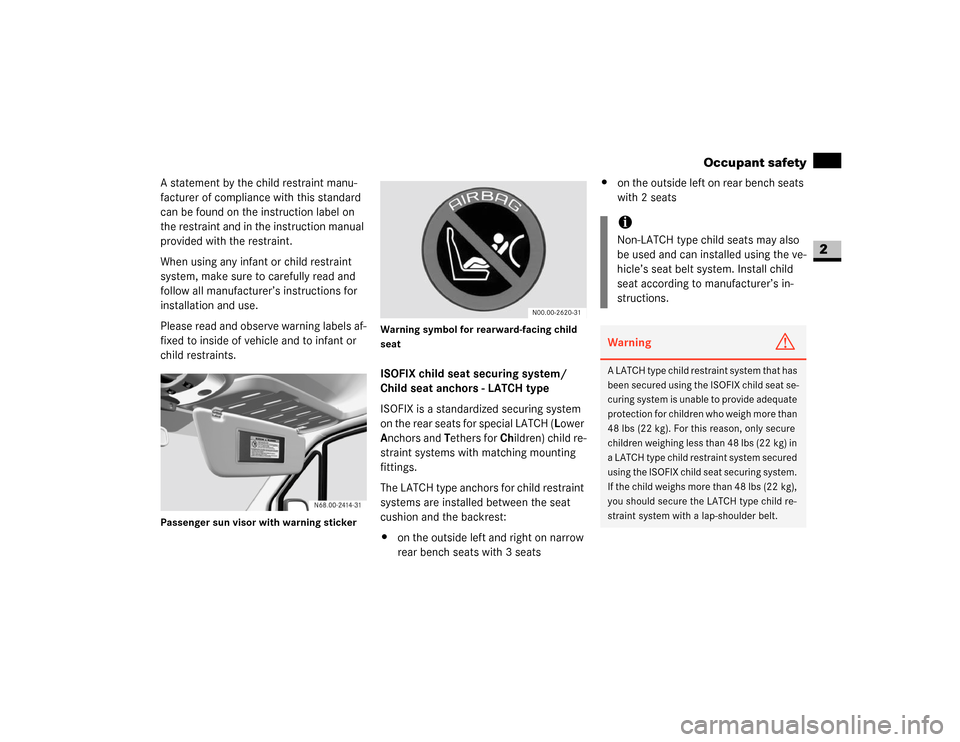
Please read and observe warning labels af-
fixed to inside of vehicle and to infant or
child restraints.Passenger sun visor with warning stickerWarning symbol for rearward-facing child
seat
ISOFIX child seat securing system/
Child seat anchors - LATCH type
ISOFIX is a standardized securing system
on the rear seats for special LATCH (Lower
Anchors and Tethers for Children) child re-
straint systems with matching mounting
fittings.
The LATCH type anchors for child restraint
systems are installed between the seat
cushion and the backrest:
\4on the outside left and right on narrow
rear bench seats with 3 seats\4on the outside left on rear bench seats
with 2 seats
N00.00-2620-31
iNon-LATCH type child seats may also
be used and can installed using the ve-
hicle’s seat belt system. Install child
seat according to manufacturer’s in-
structions.Warning
G
A LATCH type child restraint system that has
been secured using the ISOFIX child seat se-
curing system is unable to provide adequate
protection for children who weigh more than
48 lbs (22 kg). For this reason, only secure
children weighing less than 48 lbs (22 kg) in
a LATCH type child restraint system secured
using the ISOFIX child seat securing system.
If the child weighs more than 48 lbs (22 kg),
you should secure the LATCH type child re-
straint system with a lap-shoulder belt.
Page 41 of 393
40 SafetyOccupant safety
2
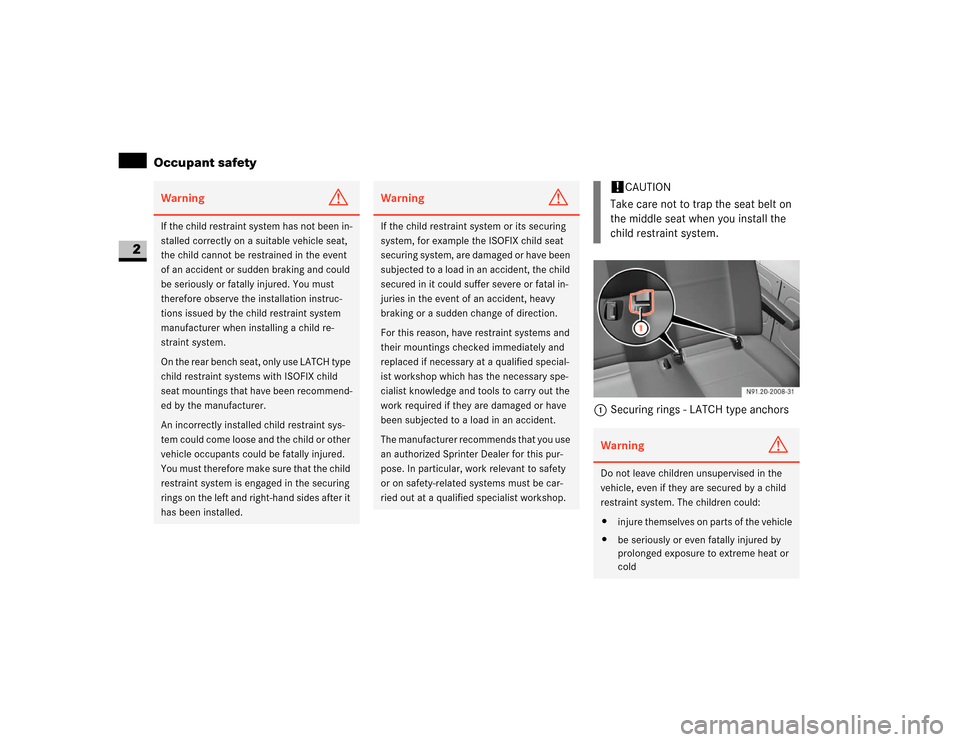
1Securing rings - LATCH type anchors
Warning
G
If the child restraint system has not been in-
stalled correctly on a suitable vehicle seat,
the child cannot be restrained in the event
of an accident or sudden braking and could
be seriously or fatally injured. You must
therefore observe the installation instruc-
tions issued by the child restraint system
manufacturer when installing a child re-
straint system.
On the rear bench seat, only use LATCH type
child restraint systems with ISOFIX child
seat mountings that have been recommend-
ed by the manufacturer.
An incorrectly installed child restraint sys-
tem could come loose and the child or other
vehicle occupants could be fatally injured.
You must therefore make sure that the child
restraint system is engaged in the securing
rings on the left and right-hand sides after it
has been installed.
Warning
G
If the child restraint system or its securing
system, for example the ISOFIX child seat
securing system, are damaged or have been
subjected to a load in an accident, the child
secured in it could suffer severe or fatal in-
juries in the event of an accident, heavy
braking or a sudden change of direction.
For this reason, have restraint systems and
their mountings checked immediately and
replaced if necessary at a qualified special-
ist workshop which has the necessary spe-
cialist knowledge and tools to carry out the
work required if they are damaged or have
been subjected to a load in an accident.
The manufacturer recommends that you use
an authorized Sprinter Dealer for this pur-
pose. In particular, work relevant to safety
or on safety-related systems must be car-
ried out at a qualified specialist workshop.
!
CAUTION
Take care not to trap the seat belt on
the middle seat when you install the
child restraint system.
Warning
G
Do not leave children unsupervised in the
vehicle, even if they are secured by a child
restraint system. The children could:
\4injure themselves on parts of the vehicle
\4be seriously or even fatally injured by
prolonged exposure to extreme heat or
cold
Page 42 of 393
41 Safety
Occupant safety
2
TopTether
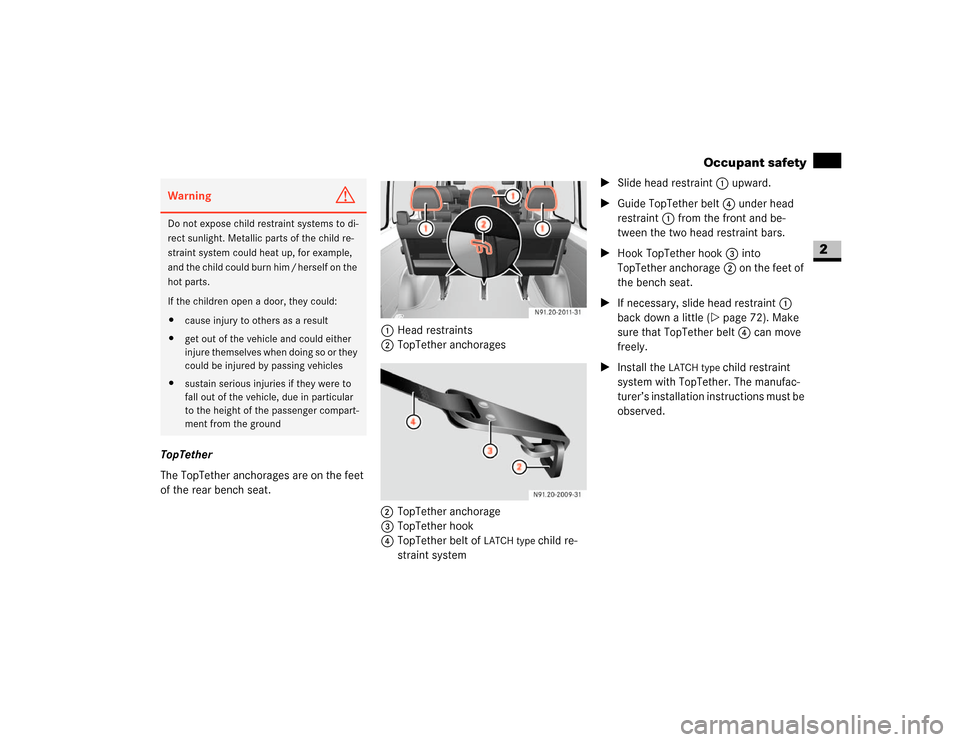
The TopTether anchorages are on the feet
of the rear bench seat.1Head restraints
2TopTether anchorages
2 TopTether anchorage
3TopTether hook
4TopTether belt of
LATCH type
child re-
straint system\1Slide head restraint1 upward.
\1Guide TopTether belt4 under head
restraint1 from the front and be-
tween the two head restraint bars.
\1Hook TopTether hook3 into
TopTether anchorage2 on the feet of
the bench seat.
\1If necessary, slide head restraint1
back down a little (\2page 72). Make
sure that TopTether belt4 can move
freely.
\1Install the
LATCH type
child restraint
system with TopTether. The manufac-
turer’s installation instructions must be
observed.
Warning
G
Do not expose child restraint systems to di-
rect sunlight. Metallic parts of the child re-
straint system could heat up, for example,
and the child could burn him / herself on the
hot parts.
If the children open a door, they could:
\4cause injury to others as a result
\4get out of the vehicle and could either
injure themselves when doing so or they
could be injured by passing vehicles
\4sustain serious injuries if they were to
fall out of the vehicle, due in particular
to the height of the passenger compart-
ment from the ground
Page 69 of 393
68 Controls in detailSeats
3
Driver’s and co-driver’s seatsWarning
G
Only adjust the seats when the vehicle is
stationary and the handbrake is applied. You
could otherwise lose control of the vehicle
as a result of the seat moving and cause an
accident.Warning
G
Make sure that nobody can become trapped
as the seat is adjusted. Never place your
hands under the seat or near to moving
parts.
Your seat must be adjusted in such a way
that you can wear the seat belt correctly
(\2page 27).
Observe the following points:
\4Position the backrest as vertically as
possible and sit upright.
\4Avoid seat positions that do not allow
the seat belt to be routed correctly. The
shoulder section of the seat belt must
be routed across the middle of your
shoulder and must fit closely across
your chest. The lap section of the belt
must be routed as low as possible
across your pelvic area, i.e. across your
hip joints. Never drive with the backrest
tilted too far back.
\4Your arms should be slightly bent when
you are holding the steering wheel.
\4The distance from the pedals should be
such that you can depress them fully.
\4Adjust the head restraint in such a way
that the upper edge of the head restraint
is level with your head.
\4Make sure that you hear the seat en-
gage. Otherwise, the seat is not correct-
ly locked in place.
Injuries may be caused if these notes are
not observed.Warning
G
Avoid seat positions in which you cannot
wear your seat belt correctly. They are a
safety hazard and must therefore be
avoided.
Page 75 of 393
74 Controls in detailSeats
3
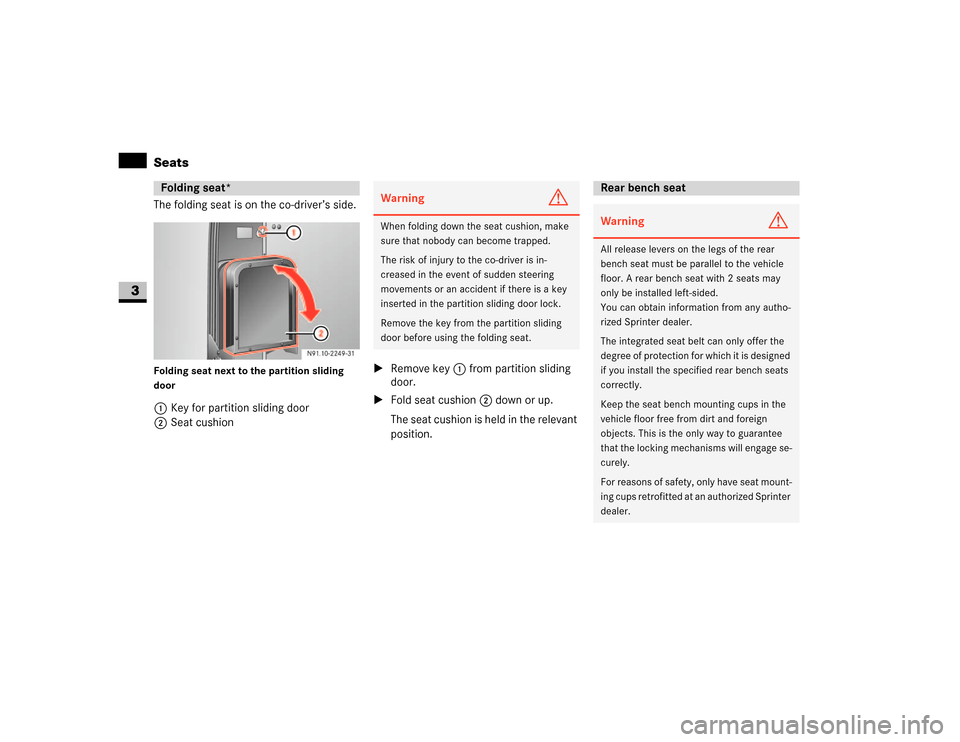
The folding seat is on the co-driver’s side. Folding seat next to the partition sliding
door1Key for partition sliding door
2Seat cushion\1Remove key1 from partition sliding
door.
\1Fold seat cushion2 down or up.
The seat cushion is held in the relevant
position.Folding seat*
Warning
G
When folding down the seat cushion, make
sure that nobody can become trapped.
The risk of injury to the co-driver is in-
creased in the event of sudden steering
movements or an accident if there is a key
inserted in the partition sliding door lock.
Remove the key from the partition sliding
door before using the folding seat.
Rear bench seatWarning
G
All release levers on the legs of the rear
bench seat must be parallel to the vehicle
floor. A rear bench seat with 2 seats may
only be installed left-sided.
You can obtain information from any autho-
rized Sprinter dealer.
The integrated seat belt can only offer the
degree of protection for which it is designed
if you install the specified rear bench seats
correctly.
Keep the seat bench mounting cups in the
vehicle floor free from dirt and foreign
objects. This is the only way to guarantee
that the locking mechanisms will engage se-
curely.
For reasons of safety, only have seat mount-
ing cups retrofitted at an authorized Sprinter
dealer.
Page 111 of 393
110 Controls in detailDriving and parking
3
\3 Driving and parking
\1Before each journey, check the vehicle
lighting and the general condition of
the vehicle.
\1Observe the general driving tips at the
end of this section (\2page 116).
You will find information on:
\4regular checks (\2page 181)
\4driving in winter (\2page 235)
\4driving when towing a trailer
(\2page 175)
\4and other driving tips
in the “Operation” section (\2page 173).
Warning
G
T h e m o v e m e n t o f t h e p e d a l s m u s t n o t b e o b -
structed. The vehicle’s operating and road
safety are otherwise jeopardized.
Objects could fall and get caught between
the pedals if you accelerate or brake sud-
denly. You will no longer be able to brake or
accelerate. You could cause an accident,
which could result in injury to yourself and
others.
\4If floor mats and carpets are used, make
sure that these are secured correctly
and cannot slip and that there is suffi-
cient pedal clearance.
\4Do not place any objects in the driver’s
footwell.
\4Store and secure all loose objects so
they cannot get into the driver’s footwell
while the vehicle is in motion.
Warning
G
The doors could open of their own accord
while the vehicle is in motion if they are not
fully closed. For this reason, please make
sure that all the doors are properly closed
and locked before driving off (\2page 52).
Starting the engineWarning
G
Never run the engine in an enclosed space.
The exhaust fumes contain poisonous car-
bon monoxide. Breathing in exhaust fumes
constitutes a health hazard and can lead to
loss of consciousness and death.Warning
G
A seat belt that is worn incorrectly or not at
all, or that is not correctly engaged in the
seat belt buckle, cannot perform its intend-
ed protective function. In certain circum-
stances, you could then be seriously or even
fatally injured. Make sure, therefore, that all
occupants – in particular, expectant moth-
ers – wear their seat belt correctly at all
times.