belt DODGE SPRINTER 2007 2.G Owner's Manual
[x] Cancel search | Manufacturer: DODGE, Model Year: 2007, Model line: SPRINTER, Model: DODGE SPRINTER 2007 2.GPages: 393, PDF Size: 7.61 MB
Page 112 of 393
111 Controls in detail
Driving and parking
3
\1Before starting the engine, make sure
that all vehicle occupants are wearing
their seat belt correctly (\2page 27)
and the handbrake (\2page 115) is ap-
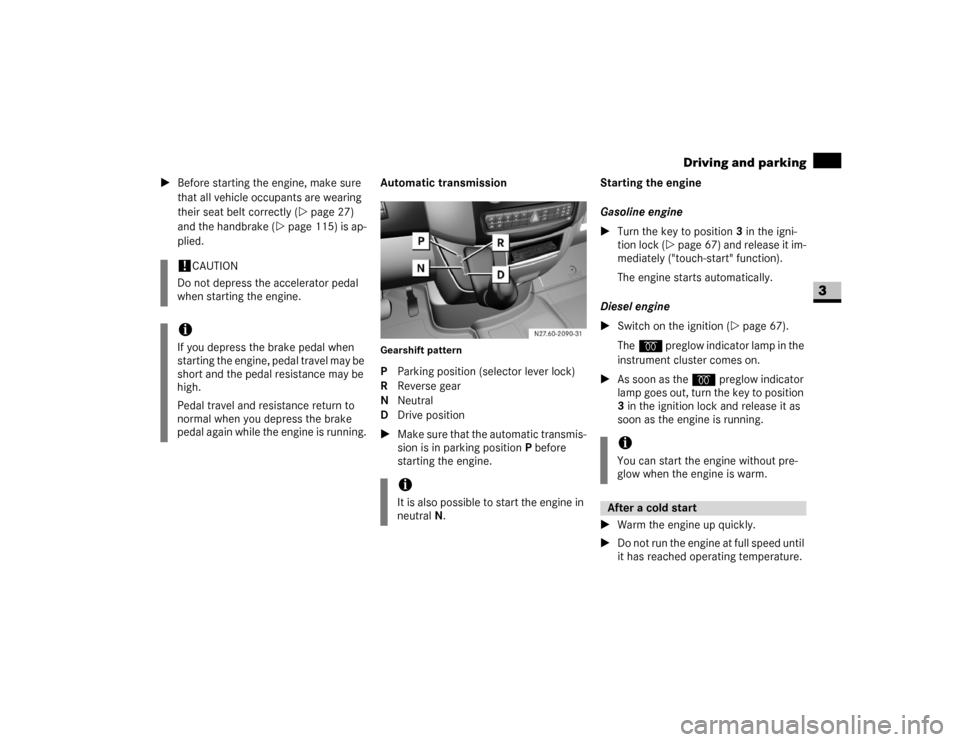
plied.Automatic transmission
Gearshift patternP Parking position (selector lever lock)
R Reverse gear
N Neutral
D Drive position
\1Make sure that the automatic transmis-
sion is in parking position P before
starting the engine.Starting the engine
Gasoline engine
\1Turn the key to position3 in the igni-
tion lock (\2page 67) and release it im-
mediately ("touch-start" function).
The engine starts automatically.
Diesel engine
\1Switch on the ignition (\2page 67).
Theq preglow indicator lamp in the
instrument cluster comes on.
\1As soon as the q preglow indicator
lamp goes out, turn the key to position
3 in the ignition lock and release it as
soon as the engine is running.
\1Warm the engine up quickly.
\1Do not run the engine at full speed until
it has reached operating temperature.
!
CAUTION
Do not depress the accelerator pedal
when starting the engine.
iIf you depress the brake pedal when
starting the engine, pedal travel may be
short and the pedal resistance may be
high.
Pedal travel and resistance return to
normal when you depress the brake
pedal again while the engine is running.
iIt is also possible to start the engine in
neutral N.
iYou can start the engine without pre-
glow when the engine is warm.After a cold start
Page 146 of 393
145 Controls in detail
Open air
3
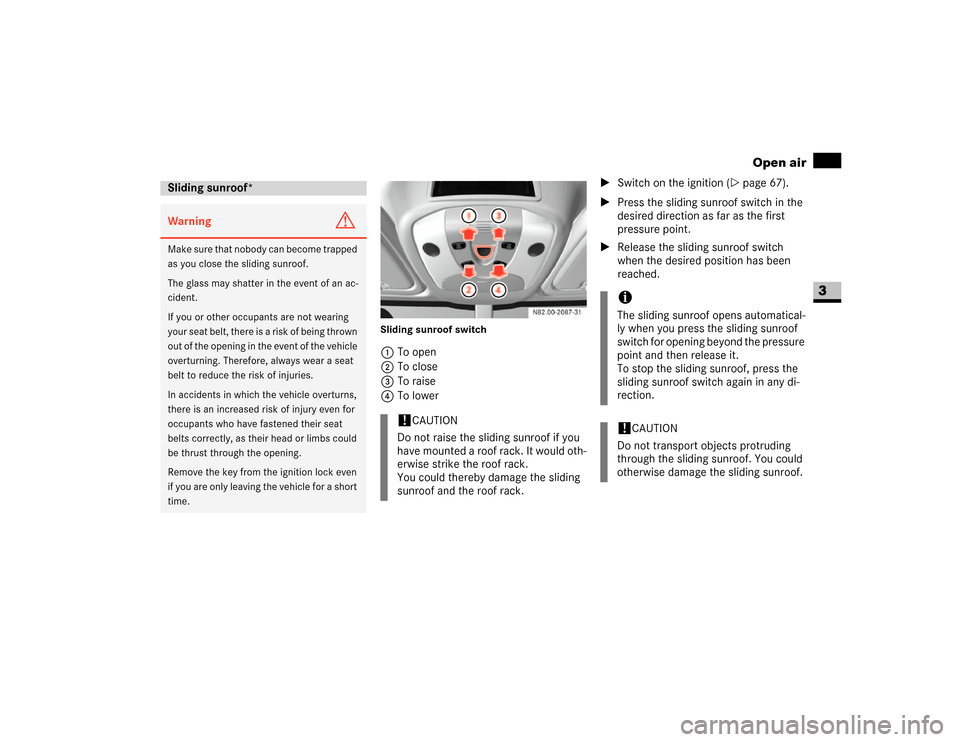
Sliding sunroof switch1To open
2To close
3To raise
4To lower\1Switch on the ignition (\2page 67).
\1Press the sliding sunroof switch in the
desired direction as far as the first
pressure point.
\1Release the sliding sunroof switch
when the desired position has been
reached.
Sliding sunroof*Warning
G
M a k e s u r e t h a t n o b o d y c a n b e c o m e t r a p p e d
as you close the sliding sunroof.
The glass may shatter in the event of an ac-
cident.
If you or other occupants are not wearing
your seat belt, there is a risk of being thrown
out of the opening in the event of the vehicle
overturning. Therefore, always wear a seat
belt to reduce the risk of injuries.
In accidents in which the vehicle overturns,
there is an increased risk of injury even for
occupants who have fastened their seat
belts correctly, as their head or limbs could
be thrust through the opening.
Remove the key from the ignition lock even
if you are only leaving the vehicle for a short
time.
!
CAUTION
Do not raise the sliding sunroof if you
have mounted a roof rack. It would oth-
erwise strike the roof rack.
You could thereby damage the sliding
sunroof and the roof rack.
iThe sliding sunroof opens automatical-
ly when you press the sliding sunroof
switch for opening beyond the pressure
point and then release it.
To stop the sliding sunroof, press the
sliding sunroof switch again in any di-
rection.!
CAUTION
Do not transport objects protruding
through the sliding sunroof. You could
otherwise damage the sliding sunroof.
Page 159 of 393
158 Controls in detailTransporting
3
The load's overall center of gravity should
be as low and central as possible, between
the axles near the rear axle.
For crewbus models:
\1Always transport loads in the load com-
partment.
\1Always place loads flush against the
seat backrests of the rear bench seat.
\1Slide larger and heavier loads as far for-
ward as possible when looking in the
direction of travel. Stack items against
each other behind the rear bench seat.\1Always secure loads with suitable
transport aids or lashing materials.
As the driver of the vehicle, you are respon-
sible for ensuring that the load is secured
against slipping, tipping over, rolling or fall-
ing down, whether driving in normal traffic
situations or on poor road surfaces or as a
result of having to swerve to avoid an ob-
stacle or applying the brakes fully.Failing to secure the load in accordance
with relevant requirements and sound
practice may be a punishable offense, de-
pending on national legislation and the
consequences that arise.
For this reason, observe the legal require-
ments in all countries concerned.
Before each journey and at regular inter-
vals during longer journeys, check whether
the load is secure and take additional ac-
tion to improve any incorrect or inade-
quate safety measures.
\1Fill up any empty spaces between the
load and the load compartment walls
or wheel arches in a form-fitting man-
ner. For this purpose, use solid trans-
port aids, such as chocks, wooden
blocks or storage cushions.Load distribution!
CAUTION
Excessive loads on individual points of
the load compartment floor or load sur-
face have a negative effect on handling
characteristics and could damage the
floor covering.
iObserve the following notes:
\4Do not stack loads higher than the
upper edge of the backrests.
\4Transport loads behind seats that
are not occupied.
\4If the rear bench seat is not occu-
pied, insert the seat belts in a cross-
wise pattern into the opposite belt
buckles.Securing a load
iInformation about how to secure a
load correctly can be obtained from the
manufacturers of transport aids or
lashing materials for securing loads.
Page 207 of 393
206 OperationTires and wheels
4
Placard
For vehicles with a gross weight capacity
less than 10,000 lbs (4500 kg) only.
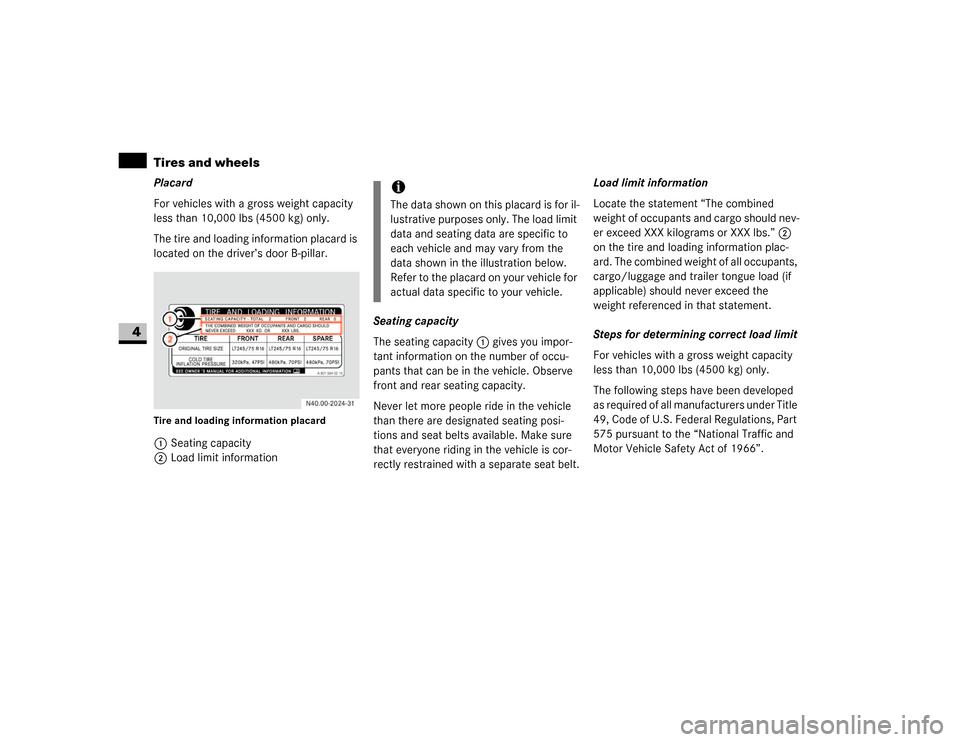
The tire and loading information placard is
located on the driver’s door B-pillar.Tire and loading information placard1Seating capacity
2Load limit informationSeating capacity
The seating capacity1 gives you impor-
tant information on the number of occu-
pants that can be in the vehicle. Observe
front and rear seating capacity.
Never let more people ride in the vehicle
than there are designated seating posi-
tions and seat belts available. Make sure
that everyone riding in the vehicle is cor-
rectly restrained with a separate seat belt.Load limit information
Locate the statement “The combined
weight of occupants and cargo should nev-
er exceed XXX kilograms or XXX lbs.” 2
on the tire and loading information plac-
ard. The combined weight of all occupants,
cargo/luggage and trailer tongue load (if
applicable) should never exceed the
weight referenced in that statement.
Steps for determining correct load limit
For vehicles with a gross weight capacity
less than 10,000 lbs (4500 kg) only.
The following steps have been developed
as required of all manufacturers under Title
49, Code of U.S. Federal Regulations, Part
575 pursuant to the “National Traffic and
Motor Vehicle Safety Act of 1966”.
iThe data shown on this placard is for il-
lustrative purposes only. The load limit
data and seating data are specific to
each vehicle and may vary from the
data shown in the illustration below.
Refer to the placard on your vehicle for
actual data specific to your vehicle.
Page 224 of 393
223 Operation
Tires and wheels
4
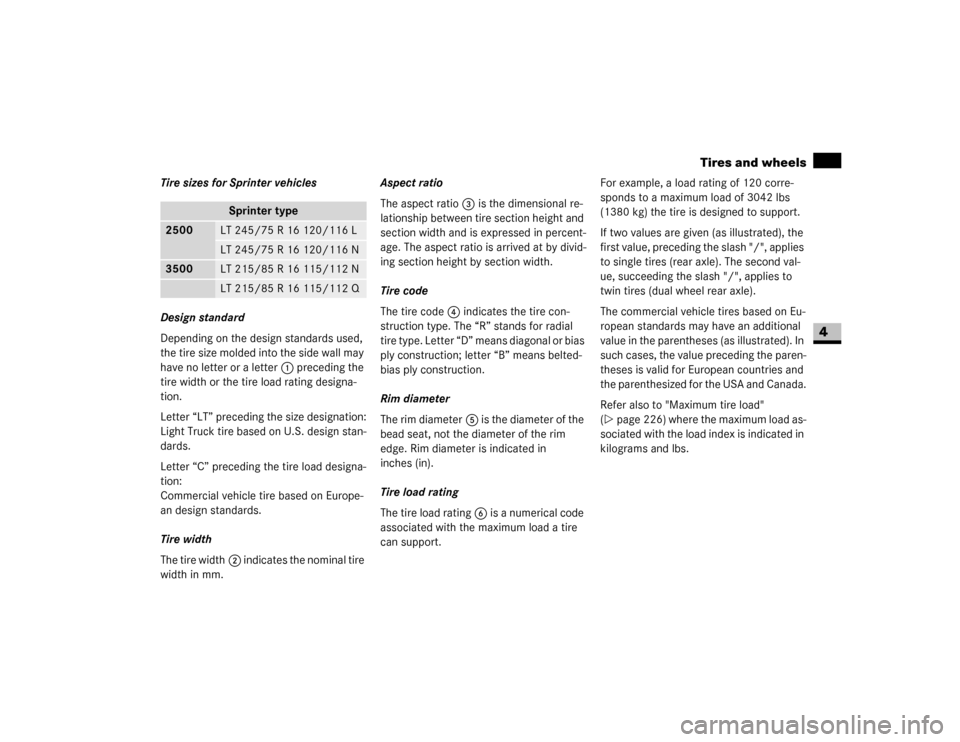
Tire sizes for Sprinter vehicles
Design standard
Depending on the design standards used,
the tire size molded into the side wall may
have no letter or a letter1 preceding the
tire width or the tire load rating designa-
tion.
Letter “LT” preceding the size designation:
Light Truck tire based on U.S. design stan-
dards.
Letter “C” preceding the tire load designa-
tion:
Commercial vehicle tire based on Europe-
an design standards.
Tire width
The tire width2 indicates the nominal tire
width in mm.Aspect ratio
The aspect ratio3 is the dimensional re-
lationship between tire section height and
section width and is expressed in percent-
age. The aspect ratio is arrived at by divid-
ing section height by section width.
Tire code
The tire code4 indicates the tire con-
struction type. The “R” stands for radial
tire type. Letter “D” means diagonal or bias
ply construction; letter “B” means belted-
bias ply construction.
Rim diameter
The rim diameter5 is the diameter of the
bead seat, not the diameter of the rim
edge. Rim diameter is indicated in
inches (in).
Tire load rating
The tire load rating6 is a numerical code
associated with the maximum load a tire
can support.For example, a load rating of 120 corre-
sponds to a maximum load of 3042 lbs
(1380 kg) the tire is designed to support.
If two values are given (as illustrated), the
first value, preceding the slash "/", applies
to single tires (rear axle). The second val-
ue, succeeding the slash "/", applies to
twin tires (dual wheel rear axle).
The commercial vehicle tires based on Eu-
ropean standards may have an additional
value in the parentheses (as illustrated). In
such cases, the value preceding the paren-
theses is valid for European countries and
the parenthesized for the USA and Canada.
Refer also to "Maximum tire load"
(\2page 226) where the maximum load as-
sociated with the load index is indicated in
kilograms and lbs.
Sprinter type
2500
LT 245/75 R 16 120/116 LLT 245/75 R 16 120/116 N
3500
LT 215/85 R 16 115/112 NLT 215/85 R 16 115/112 Q
Page 244 of 393
243 Operation
Cleaning and care of the vehicle
4
Steps
Engine cleaningLight-alloy wheels*
Clean light-alloy wheels on a regular basis.
Outside of windshield and wiper blades
\1Turn key to position1 in ignition lock
(\2page 67).
\1Switch on windshield wipers
(\2page 126).
\1When the wiper arms are vertical, turn
key to position0 in the ignition lock or
remove the key.
\1Fold the wiper arms away from the
windshield until you feel them engage
in place.\1You can now clean the windshield and
the wiper blades.
\1Fold the windshield wipers back again
before you switch on the ignition.Warning
G
Dirty or iced-up steps and entrances create
a risk of slipping or falling.
Keep steps, entrances and footwear free
from dirt (e.g. mud, clay, snow and ice).!
CAUTION
Do not allow water to enter the intake
and ventilation openings.
When cleaning with high-pressure wa-
ter or steam cleaners, the spray must
not be aimed directly at electrical com-
ponents or at the end of electrical
lines.
Treat the engine with preservative
agents after cleaning. Protect the belt
drive system from the preservative
when you do so.
!
CAUTION
Do not use any acidic or alkaline clean-
ing agents. They can cause corrosion of
the wheel bolts (wheel nuts) or the bal-
ancing weight retainers.
!
CAUTION
Do not fold the windshield wipers away
from the windshield unless the hood is
closed. You will otherwise damage the
hood.
Warning
G
Switch off the ignition before cleaning the
windshield or the wiper blades. The wind-
shield wipers could otherwise move and in-
jure you.
Page 247 of 393
246 OperationCleaning and care of the vehicle
4
Seat belts
Remove stains or dirt immediately to pre-
vent damage or the build-up of residues.
!
CAUTION
Clean the seat belts with a mild wash-
ing solution. Do not dry the seat belts in
direct sunlight or at temperatures
above 176 °F (80 °C).
Do not bleach or dye the seat belts.
This could impair the function of the
seat belts.
After driving off-road or on construc-
tion sitesWarning
G
Dirt on the vehicle can affect road and oper-
ating safety.In particular, the following dangers can arise:Stone chippings
Stones trapped between the tires can be
thrown out while the vehicle is in motion and
injure other road users or damage their ve-
hicles (in particular the windshield).
Risk of skidding
Dirt and mud on the tires / road surface re-
duce wheel grip. This is especially so if the
road surface is wet. The vehicle could then
start to skid.
Risk of slipping
Dirt and mud on the steps and entrances
make the steps less safe. As a result you
could slip from the steps and injure yourself.
For this reason, always clean your vehicle
carefully after driving off-road and on con-
struction sites before using public roads.
If you use a high-pressure cleaner or auto-
matic car wash for this purpose, you must
follow the relevant safety instructions in this
section.
Page 251 of 393
250 Practical hintsWhat to do if ...
5
Audible warning signalsWarning
G
Always have maintenance work carried out
at an authorized Sprinter Dealer which has
the necessary specialist knowledge and
tools to carry out the work required.
The manufacturer recommends that you use
an authorized Sprinter Dealer for this pur-
pose.
In particular, work relevant to safety or on
safety-related systems must be carried out
at an authorized Sprinter Dealer. There is a
risk of an accident and injury if this work is
carried out incorrectly.
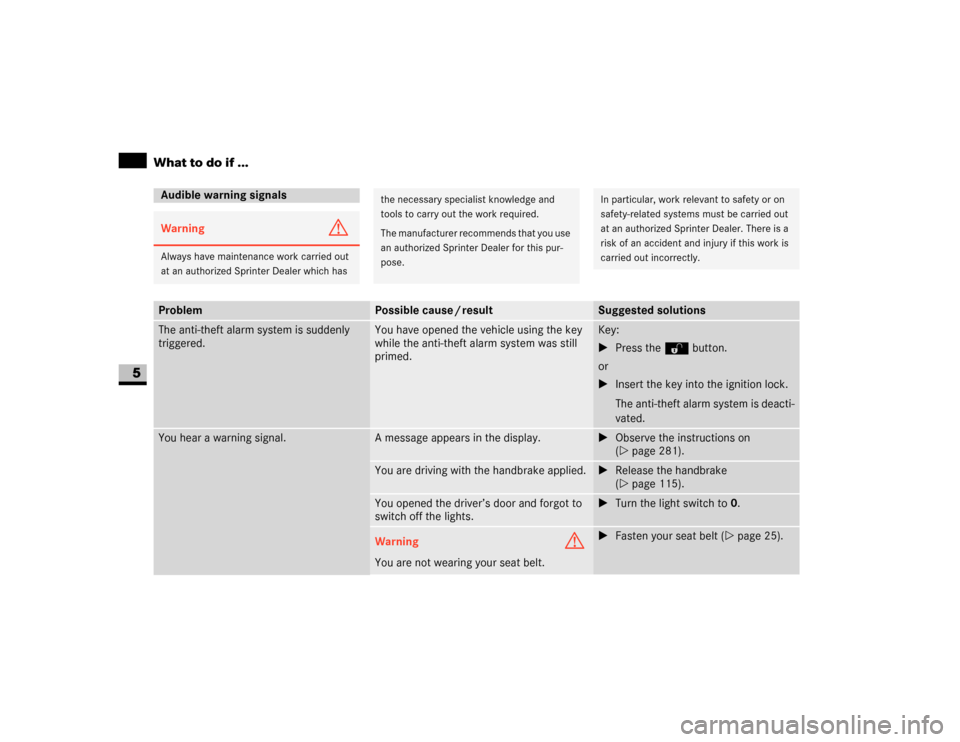
Problem
Possible cause / result
Suggested solutions
The anti-theft alarm system is suddenly
triggered.
You have opened the vehicle using the key
while the anti-theft alarm system was still
primed.
Key:
\1Press theΠbutton.
or
\1Insert the key into the ignition lock.
The anti-theft alarm system is deacti-
vated.
You hear a warning signal.
A message appears in the display.
\1Observe the instructions on
(\2page 281).
You are driving with the handbrake applied.
\1Release the handbrake
(\2page 115).
You opened the driver’s door and forgot to
switch off the lights.
\1Turn the light switch to0.
Warning
G
You are not wearing your seat belt.
\1Fasten your seat belt (\2page 25).
Page 274 of 393
273 Practical hints
What to do if ...
5
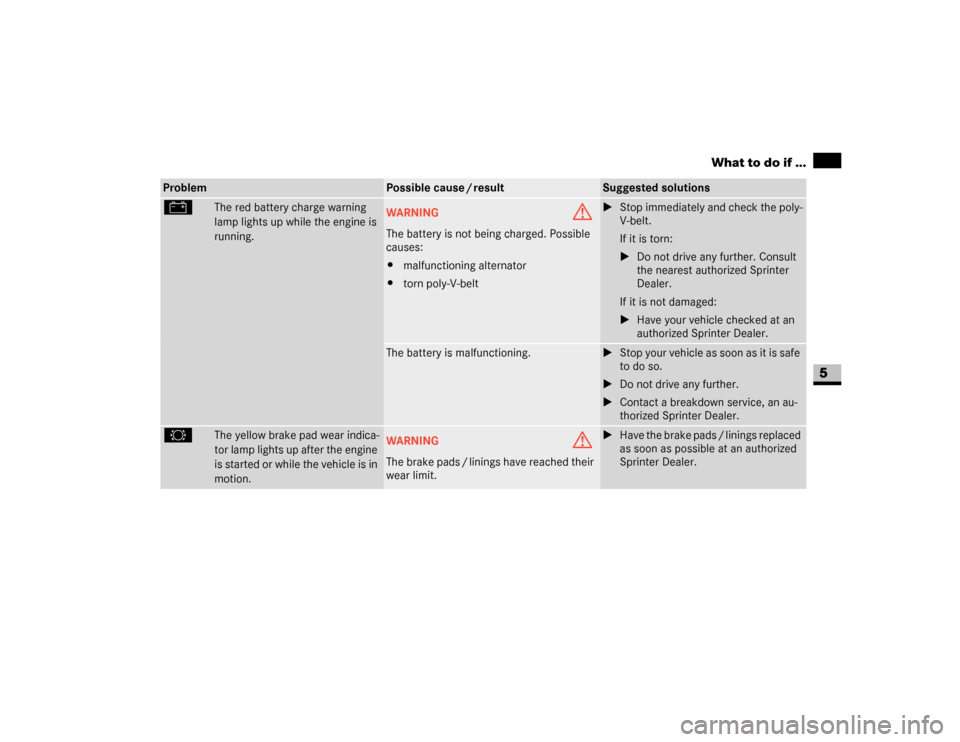
#
The red battery charge warning
lamp lights up while the engine is
running.
WARNING
G
The battery is not being charged. Possible
causes:
\4malfunctioning alternator
\4torn poly-V-belt
\1Stop immediately and check the poly-
V-belt.
If it is torn:
\1Do not drive any further. Consult
the nearest authorized Sprinter
Dealer.
If it is not damaged:
\1Have your vehicle checked at an
authorized Sprinter Dealer.
The battery is malfunctioning.
\1Stop your vehicle as soon as it is safe
to do so.
\1Do not drive any further.
\1Contact a breakdown service, an au-
thorized Sprinter Dealer.
2
The yellow brake pad wear indica-
tor lamp lights up after the engine
is started or while the vehicle is in
motion.
WARNING
G
The brake pads / linings have reached their
wear limit.
\1Have the brake pads / linings replaced
as soon as possible at an authorized
Sprinter Dealer.
Problem
Possible cause / result
Suggested solutions
Page 281 of 393
280 Practical hintsWhat to do if ...
5
Problem
Possible cause / result
Suggested solutions
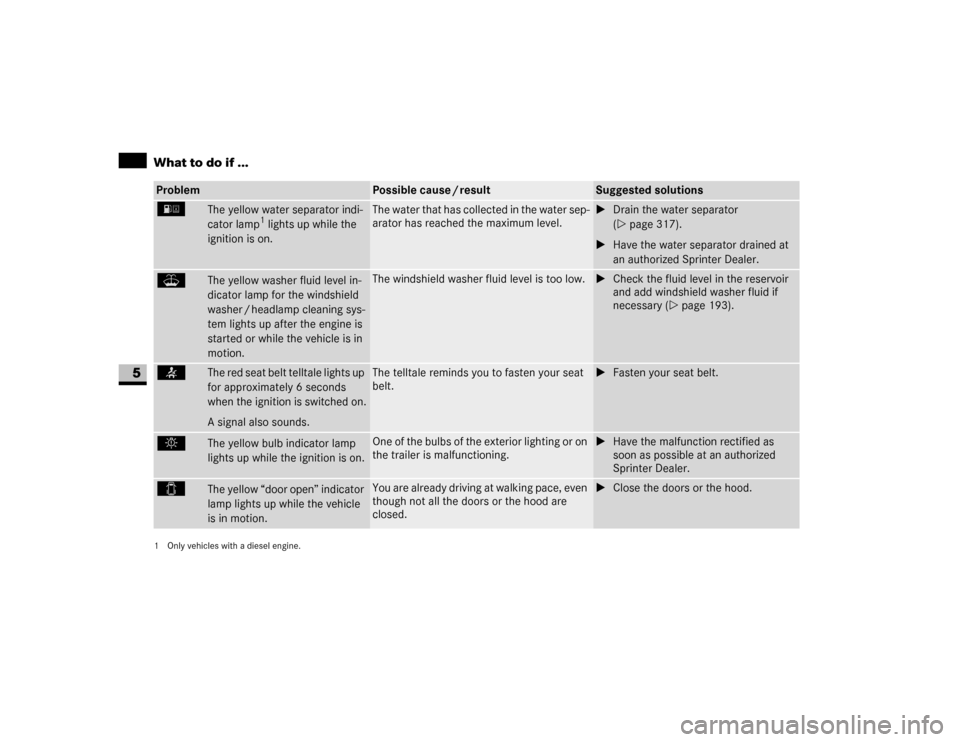
/
The yellow water separator indi-
cator lamp
1 lights up while the
ignition is on.
1 Only vehicles with a diesel engine.
The water that has collected in the water sep-
arator has reached the maximum level.
\1Drain the water separator
(\2page 317).
\1Have the water separator drained at
an authorized Sprinter Dealer.
W
The yellow washer fluid level in-
dicator lamp for the windshield
washer / headlamp cleaning sys-
tem lights up after the engine is
started or while the vehicle is in
motion.
The windshield washer fluid level is too low.
\1Check the fluid level in the reservoir
and add windshield washer fluid if
necessary (\2page 193).
<
The red seat belt telltale lights up
for approximately 6 seconds
when the ignition is switched on.
A signal also sounds.
The telltale reminds you to fasten your seat
belt.
\1Fasten your seat belt.
.
The yellow bulb indicator lamp
lights up while the ignition is on.
One of the bulbs of the exterior lighting or on
the trailer is malfunctioning.
\1Have the malfunction rectified as
soon as possible at an authorized
Sprinter Dealer.
9
The yellow “door open” indicator
lamp lights up while the vehicle
is in motion.
You are already driving at walking pace, even
though not all the doors or the hood are
closed.
\1Close the doors or the hood.