seats DODGE SPRINTER 2007 2.G User Guide
[x] Cancel search | Manufacturer: DODGE, Model Year: 2007, Model line: SPRINTER, Model: DODGE SPRINTER 2007 2.GPages: 393, PDF Size: 7.61 MB
Page 73 of 393
72 Controls in detailSeats
3
Positioning the seat cushion
\1Fold the seat cushion back.
\1Slide the seat cushion under the back-
rest and into rear anchorage2.
\1Fold the seat cushion down.
\1Press the front of the seat cushion
down until it engages in front
anchorage1.
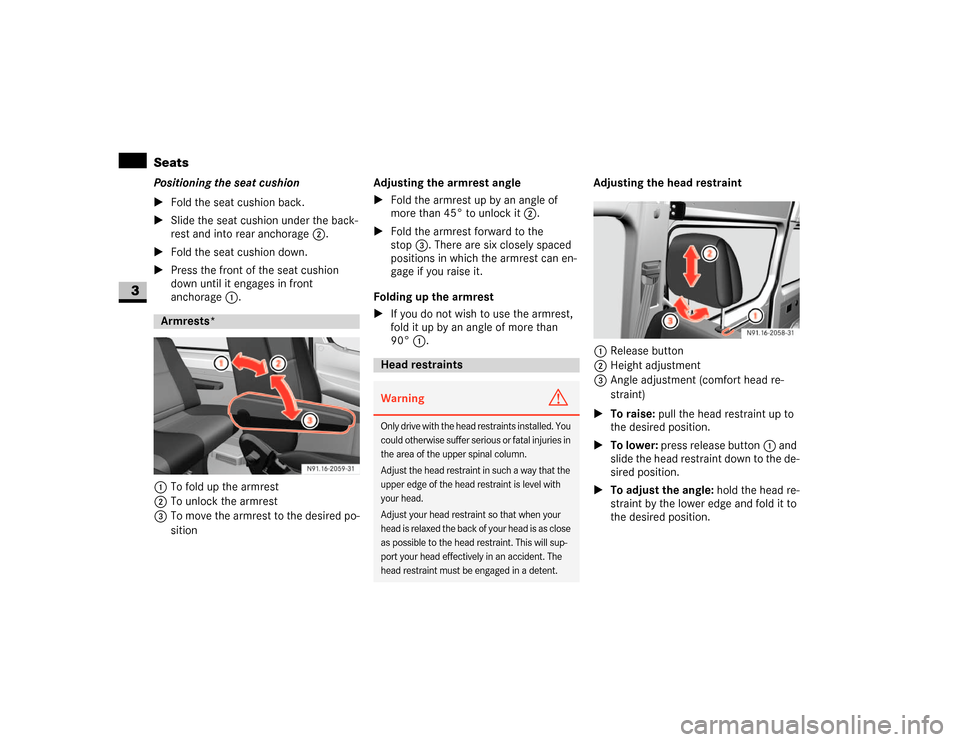
1To fold up the armrest
2To unlock the armrest
3To move the armrest to the desired po-
sitionAdjusting the armrest angle
\1Fold the armrest up by an angle of
more than 45° to unlock it2.
\1Fold the armrest forward to the
stop3. There are six closely spaced
positions in which the armrest can en-
gage if you raise it.
Folding up the armrest
\1If you do not wish to use the armrest,
fold it up by an angle of more than
90°1.Adjusting the head restraint
1Release button
2Height adjustment
3Angle adjustment (comfort head re-
straint)
\1To raise: pull the head restraint up to
the desired position.
\1To lower: press release button1 and
slide the head restraint down to the de-
sired position.
\1To adjust the angle: hold the head re-
straint by the lower edge and fold it to
the desired position.Armrests*
Head restraints Warning
G
Only drive with the head restraints installed. You
could otherwise suffer serious or fatal injuries in
the area of the upper spinal column.
Adjust the head restraint in such a way that the
upper edge of the head restraint is level with
your head.
Adjust your head restraint so that when your
head is relaxed the back of your head is as close
as possible to the head restraint. This will sup-
port your head effectively in an accident. The
head restraint must be engaged in a detent.
Page 74 of 393
73 Controls in detail
Seats
3
Removing the head restraints
\1Pull the head restraint up as far as it
will go.
\1Press release button1 and pull the
head restraint out.
Installing the head restraints
\1Insert the head restraint so that the rod
with the notches is in the direction of
travel on the left.
\1Push the head restraint down until it
engages.The switches for the driver’s and co-
driver’s seat are on the center console.
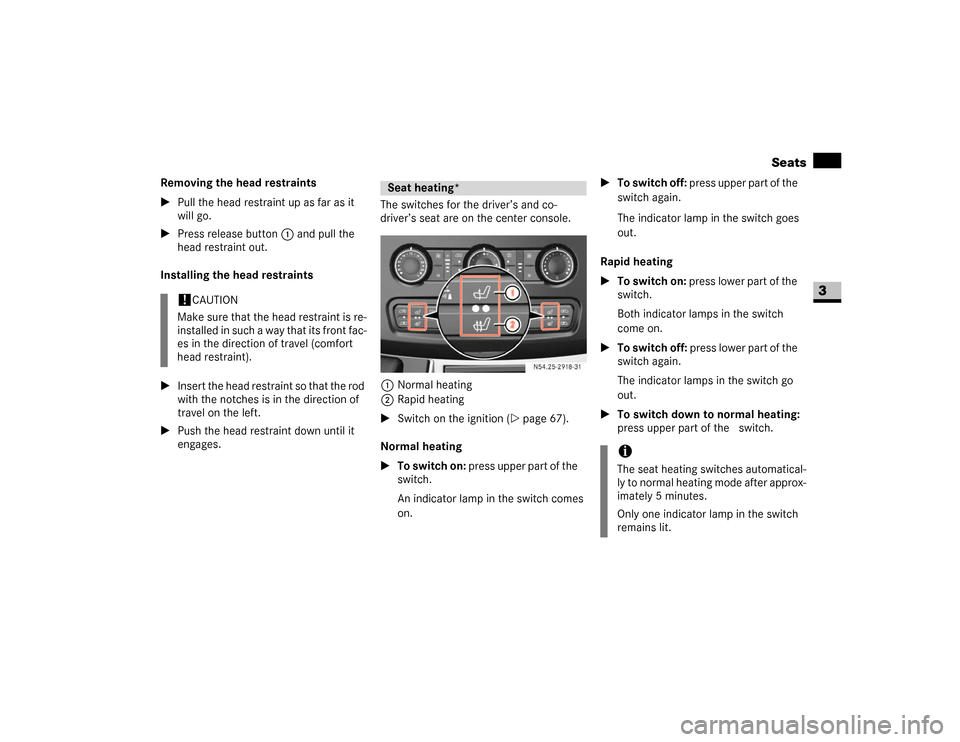
1Normal heating
2Rapid heating
\1Switch on the ignition (\2page 67).
Normal heating
\1To switch on: press upper part of the&
switch.
An indicator lamp in the switch comes
on.\1To switch off: press upper part of the&
switch again.
The indicator lamp in the switch goes
out.
Rapid heating
\1To switch on: press lower part of the
switch.
Both indicator lamps in the switch
come on.
\1To switch off: press lower part of the
switch again.
The indicator lamps in the switch go
out.
\1To switch down to normal heating:
press upper part of the& switch.
!
CAUTION
Make sure that the head restraint is re-
installed in such a way that its front fac-
es in the direction of travel (comfort
head restraint).
Seat heating*
N54.25-2918-31
iThe seat heating switches automatical-
ly to normal heating mode after approx-
imately 5 minutes.
Only one indicator lamp in the switch
remains lit.
Page 75 of 393
74 Controls in detailSeats
3
The folding seat is on the co-driver’s side. Folding seat next to the partition sliding
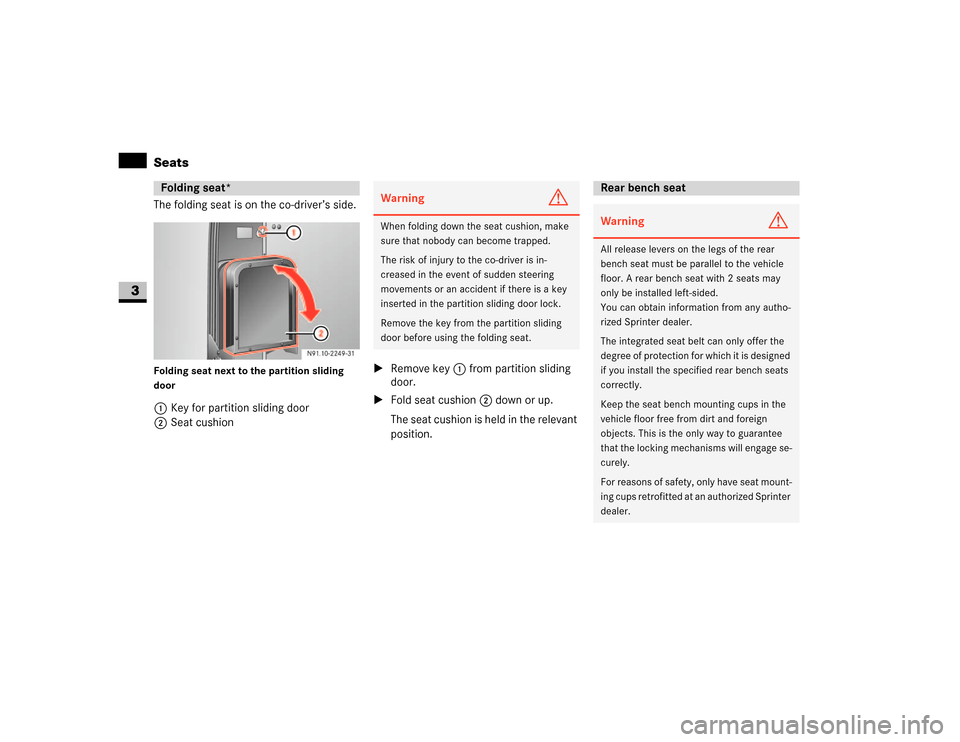
door1Key for partition sliding door
2Seat cushion\1Remove key1 from partition sliding
door.
\1Fold seat cushion2 down or up.
The seat cushion is held in the relevant
position.Folding seat*
Warning
G
When folding down the seat cushion, make
sure that nobody can become trapped.
The risk of injury to the co-driver is in-
creased in the event of sudden steering
movements or an accident if there is a key
inserted in the partition sliding door lock.
Remove the key from the partition sliding
door before using the folding seat.
Rear bench seatWarning
G
All release levers on the legs of the rear
bench seat must be parallel to the vehicle
floor. A rear bench seat with 2 seats may
only be installed left-sided.
You can obtain information from any autho-
rized Sprinter dealer.
The integrated seat belt can only offer the
degree of protection for which it is designed
if you install the specified rear bench seats
correctly.
Keep the seat bench mounting cups in the
vehicle floor free from dirt and foreign
objects. This is the only way to guarantee
that the locking mechanisms will engage se-
curely.
For reasons of safety, only have seat mount-
ing cups retrofitted at an authorized Sprinter
dealer.
Page 76 of 393
75 Controls in detail
Seats
3
Removing the rear bench seat
The locking lever is located underneath the
bench seat, on the feet of the bench seat.
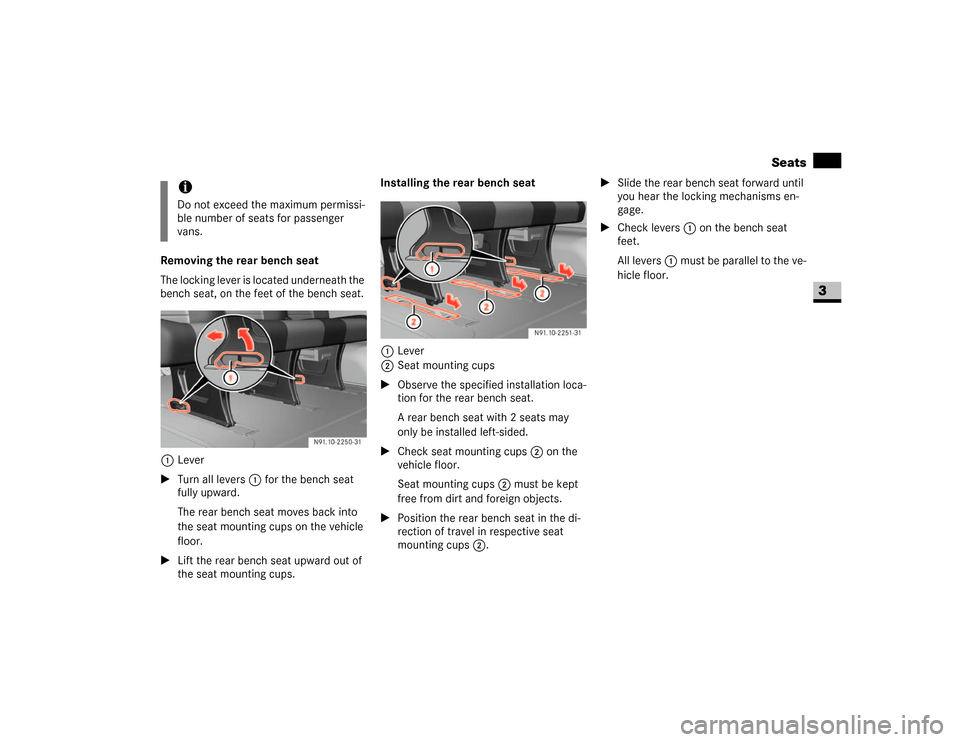
1Lever
\1Turn all levers1 for the bench seat
fully upward.
The rear bench seat moves back into
the seat mounting cups on the vehicle
floor.
\1Lift the rear bench seat upward out of
the seat mounting cups.Installing the rear bench seat
1Lever
2Seat mounting cups
\1Observe the specified installation loca-
tion for the rear bench seat.
A rear bench seat with 2 seats may
only be installed left-sided.
\1Check seat mounting cups 2 on the
vehicle floor.
Seat mounting cups 2 must be kept
free from dirt and foreign objects.
\1Position the rear bench seat in the di-
rection of travel in respective seat
mounting cups 2.\1Slide the rear bench seat forward until
you hear the locking mechanisms en-
gage.
\1Check levers 1 on the bench seat
feet.
All levers1 must be parallel to the ve-
hicle floor.
iDo not exceed the maximum permissi-
ble number of seats for passenger
vans.
Page 157 of 393
156 Controls in detailTransporting
3
\3 Transporting
For more information about the maximum
roof load and roof carrier systems, please
refer to the "Technical data" section
(\2page 351).
Loading guidelinesWarning
G
Secure and position a load as described in
the loading guidelines. Otherwise, the load
could slide or be thrown around in the event
of strong braking maneuvers, sudden chang-
es of direction or poor road conditions,
thereby injuring you or others. The same ap-
plies to dismantled seats if left inside the ve-
hicle.
Please note that loads increase the risk of
injury during an accident even if you comply
with all loading guidelines.
Observe the notes in the "Securing a load"
section (\2page 158).Warning
G
Do not exceed the vehicle's permissible
gross weight or the permissible axle loads
when loading the vehicle or carrying addi-
tional passengers.
If you exceed the vehicle's permissible axle
loads or the maximum permissible gross
weight when transporting items or carrying
passengers, tire stability and driving safety
are reduced. The vehicle's driving and steer-
ing characteristics would be greatly altered.
Braking and stopping distances would
be significantly longer.
Your vehicle's driving, steering and braking
characteristics change as the vehicle's
gross weight increases or its center of grav-
ity is raised.
Always ensure that loads are distributed
correctly and adapt your driving style in ac-
cordance with the load.Warning
G
After an accident, have a damaged load
compartment floor or damaged load sur-
face, the lashing eyes and lashing materials
inspected by a specialist workshop having
the necessary technical expertise and tools
to carry out the required work.
The manufacturer recommends that you use
an authorized Sprinter Dealer for this pur-
pose. In particular, work relevant to safety
or on safety-related systems must be car-
ried out at a qualified specialist workshop. !
CAUTION
If you are using a roof carrier system,
observe the maximum roof load and
maximum load-bearing capacity of the
roof carrier system.
Page 158 of 393
157 Controls in detail
Transporting
3
Before loading
\1Check the tire pressures and correct
them if necessary (\2page 213).
\1Clean the load compartment floor.
The load compartment floor must be
dry, cleanly swept and free of oil and
dust to reduce the risk of the load slip-
ping.
\1If necessary, place anti-slip mats on the
load compartment floor.During loading
\1Observe the maximum permissible axle
loads and permissible gross weight for
the vehicle.
\1Observe the notes on load distribution
(\2page 158).
\1Secure the load (\2page 158). All
country-specific legal requirements
must be observed.Checks after loading
\1Securing a load: before each journey
and at regular intervals during longer
journeys, check whether the load is
properly secured and take additional
securing measures, if necessary.
\1Doors: close the sliding doors and rear
doors.
\1Tire pressure: adjust the tire pressure
in accordance with the vehicle's load
(\2page 213).
\1Driving characteristics: adapt your
driving style to the load.
!
CAUTION
As soon as the anti-slip mats start to
show signs of permanent deformation,
squashed areas or tears/holes, they
are unsuitable for securing loads and
must be replaced.
!
CAUTION
In passenger vans with the maximum
number of seats, the maximum payload
would cause the permissible rear axle
load to be exceeded.
iBear in mind that your vehicle's unlad-
en weight is increased by the installa-
tion of optional equipment and
accessories.
Warning
G
Make sure that the sliding doors and rear
doors are always closed when the engine is
running.
Otherwise, exhaust fumes could enter the
vehicle interior and poison you.
Page 159 of 393
158 Controls in detailTransporting
3
The load's overall center of gravity should
be as low and central as possible, between
the axles near the rear axle.
For crewbus models:
\1Always transport loads in the load com-
partment.
\1Always place loads flush against the
seat backrests of the rear bench seat.
\1Slide larger and heavier loads as far for-
ward as possible when looking in the
direction of travel. Stack items against
each other behind the rear bench seat.\1Always secure loads with suitable
transport aids or lashing materials.
As the driver of the vehicle, you are respon-
sible for ensuring that the load is secured
against slipping, tipping over, rolling or fall-
ing down, whether driving in normal traffic
situations or on poor road surfaces or as a
result of having to swerve to avoid an ob-
stacle or applying the brakes fully.Failing to secure the load in accordance
with relevant requirements and sound
practice may be a punishable offense, de-
pending on national legislation and the
consequences that arise.
For this reason, observe the legal require-
ments in all countries concerned.
Before each journey and at regular inter-
vals during longer journeys, check whether
the load is secure and take additional ac-
tion to improve any incorrect or inade-
quate safety measures.
\1Fill up any empty spaces between the
load and the load compartment walls
or wheel arches in a form-fitting man-
ner. For this purpose, use solid trans-
port aids, such as chocks, wooden
blocks or storage cushions.Load distribution!
CAUTION
Excessive loads on individual points of
the load compartment floor or load sur-
face have a negative effect on handling
characteristics and could damage the
floor covering.
iObserve the following notes:
\4Do not stack loads higher than the
upper edge of the backrests.
\4Transport loads behind seats that
are not occupied.
\4If the rear bench seat is not occu-
pied, insert the seat belts in a cross-
wise pattern into the opposite belt
buckles.Securing a load
iInformation about how to secure a
load correctly can be obtained from the
manufacturers of transport aids or
lashing materials for securing loads.
Page 169 of 393
168 Controls in detailFeatures
3
\1Place the container in cup holder5.
\1Press clamping arm6 onto the con-
tainer.
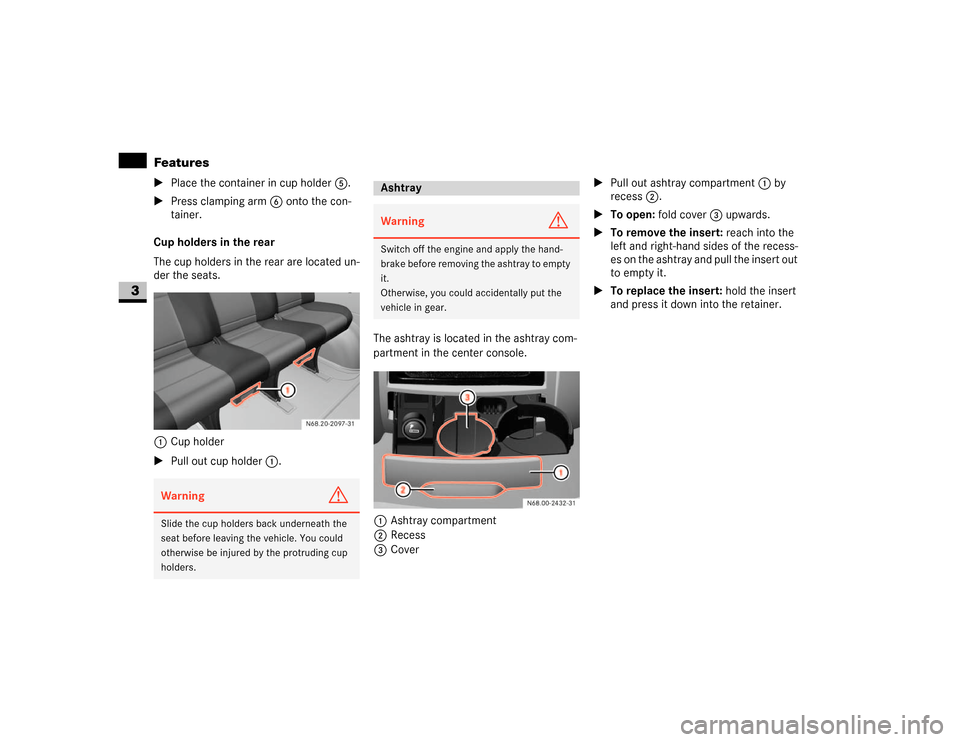
Cup holders in the rear
The cup holders in the rear are located un-
der the seats.
1Cup holder
\1Pull out cup holder1.The ashtray is located in the ashtray com-
partment in the center console.
1Ashtray compartment
2Recess
3Cover\1Pull out ashtray compartment1 by
recess2.
\1To open: fold cover3 upwards.
\1To remove the insert: reach into the
left and right-hand sides of the recess-
es on the ashtray and pull the insert out
to empty it.
\1To replace the insert: hold the insert
and press it down into the retainer.Warning
G
Slide the cup holders back underneath the
seat before leaving the vehicle. You could
otherwise be injured by the protruding cup
holders.
AshtrayWarning
G
Switch off the engine and apply the hand-
brake before removing the ashtray to empty
it.
Otherwise, you could accidentally put the
vehicle in gear.
Page 229 of 393
228 OperationTires and wheels
4
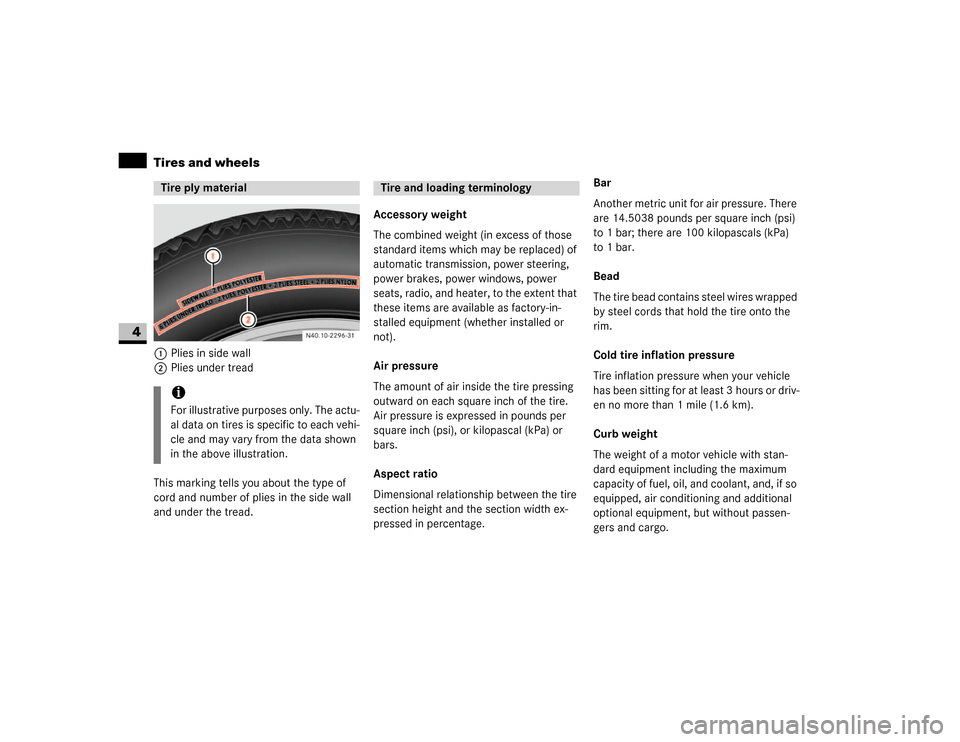
1Plies in side wall
2Plies under tread
This marking tells you about the type of
cord and number of plies in the side wall
and under the tread.Accessory weight
The combined weight (in excess of those
standard items which may be replaced) of
automatic transmission, power steering,
power brakes, power windows, power
seats, radio, and heater, to the extent that
these items are available as factory-in-
stalled equipment (whether installed or
not).
Air pressure
The amount of air inside the tire pressing
outward on each square inch of the tire.
Air pressure is expressed in pounds per
square inch (psi), or kilopascal (kPa) or
bars.
Aspect ratio
Dimensional relationship between the tire
section height and the section width ex-
pressed in percentage.Bar
Another metric unit for air pressure. There
are 14.5038 pounds per square inch (psi)
to 1 bar; there are 100 kilopascals (kPa)
to 1 bar.
Bead
The tire bead contains steel wires wrapped
by steel cords that hold the tire onto the
rim.
Cold tire inflation pressure
Tire inflation pressure when your vehicle
has been sitting for at least 3 hours or driv-
en no more than 1 mile (1.6 km).
Curb weight
The weight of a motor vehicle with stan-
dard equipment including the maximum
capacity of fuel, oil, and coolant, and, if so
equipped, air conditioning and additional
optional equipment, but without passen-
gers and cargo.Tire ply materialiFor illustrative purposes only. The actu-
al data on tires is specific to each vehi-
cle and may vary from the data shown
in the above illustration.
Tire and loading terminology
Page 384 of 393
383 Index
seats
. . . . . . . . . . . . . . . . . . . . . . . . 73
windshield
. . . . . . . . . . . . . . . . . . . 127
Heater booster function
. . . . . . . . 137
Heater booster system
. . . . . . . . . 138
Heating
rear window
. . . . . . . . . . . . . . . . . . 128
seat
. . . . . . . . . . . . . . . . . . . . . . . . . 73
windshield
. . . . . . . . . . . . . . . 127
, 134
High-beam headlamps
. . . . . . . 77
, 307
changing bulbs
. . . . . . . . . . . . . . . 307
High-pressure cleaners
. . . . . . . . . 242
Hood
. . . . . . . . . . . . . . . . . . . . . . . . . 185
Horn . . . . . . . . . . . . . . . . . . . . . . . . . . 13
Hydroplaning
. . . . . . . . . . . . . . . . . . 118
I
Identification lamps
. . . . . . . . . . . . 311
changing bulbs
. . . . . . . . . . . 311
, 313
Ignition lock
. . . . . . . . . . . . . . . . . . . 67
Immobilizer . . . . . . . . . . . . . . . . . . . . 47
Indicator
vehicles with steering wheel buttons
Service due date
. . . . . . . . . . . . 238
vehicles without steering wheel buttons
service due date . . . . . . . . . . . . . 239
Indicator and warning lamps
brake system
. . . . . . . . . . . . . . . . . 269braking
. . . . . . . . . . . . . . . . . . . 268
–??
engine oil level
. . . . . . . . . . . . . . . . 274
seat belt
. . . . . . . . . . . . . . . . . . . . . 280
seat belt reminder
. . . . . . . . . . . . . 280
SRS
. . . . . . . . . . . . . . . . . . . . . . . . 272
water separator
. . . . . . . . . . . . . . . 280
Indicator lamp
ABS
. . . . . . . . . . . . . . . . . . . . . . . . 271
ASR . . . . . . . . . . . . . . . 268
, 269
, 270
BAS
. . . . . . . . . . . . . . . 268
, 269
, 270
battery charge
. . . . . . . . . . . . . . . . 273
brake pad/lining wear
. . . . . . . . . . 273
coolant
. . . . . . . . . . . . . . . . . . . . . . 275
engine diagnostic
. . . . . . . . . . . . . . 277
ESP
® . . . . . . . . . . . . . . 268
, 269
, 272
handbrake
. . . . . . . . . . . . . . . . . . . 114
operating speed governor (ADR)
. . 154
poly-V-belt
. . . . . . . . . . . . . . . . . . . 273
preglow
. . . . . . . . . . . . . . . . . 111
, 276
reserve warning indicator (fuel)
. . . 276
windshield washer/headlamp cleaning
system washer fluid level
. . . . . . . . 280
Inflation pressure
see Tires, Inflation pressures
Information regarding electronic
recording devices
. . . . . . . . . . . . . . . 10
Instrument cluster . . . . . . . . . . . 14
, 84
lighting
. . . . . . . . . . . . . . . . . . . . . . . 85speedometer
. . . . . . . . . . . . . . . . . . 85
tachometer
. . . . . . . . . . . . . . . . . . . 85
vehicles with steering wheel buttons
selecting the language
. . . . . . . . 100
setting the status line . . . . . . . . . 100
Instrument lighting
. . . . . . . . . . . . . . 85
Interior lighting
changing bulbs
. . . . . . . . . . . . . . . . 314
front
. . . . . . . . . . . . . . . . . . . . . . . . . 80
rear . . . . . . . . . . . . . . . . . . . . . . . . . 82
Interior lighting, rear
. . . . . . . . . . . . 82
Interior motion sensor . . . . . . . . . . . 49
Intermittent wipe
. . . . . . . . . . . . . . 126
ISOFIX child seat securing system
. 39
TopTether
. . . . . . . . . . . . . . . . . . . . . 41
J
Jack
jacking points
. . . . . . . . . . . . . . . . 322
preparing
. . . . . . . . . . . . . . . . . . . . 322
storage location
. . . . . . . . . . . . . . . 300
Jump-starting
. . . . . . . . . . . . . . . . . 340
connection point
. . . . . . . . . . . . . . 340
Jump-starting connection point
. . 340
I
J