tires DODGE SPRINTER 2007 2.G User Guide
[x] Cancel search | Manufacturer: DODGE, Model Year: 2007, Model line: SPRINTER, Model: DODGE SPRINTER 2007 2.GPages: 393, PDF Size: 7.61 MB
Page 181 of 393
180 OperationDriving tips
4
If you plan to operate your vehicle in for-
eign countries, please be aware that:
\4service facilities or replacement parts
may not be readily available,
\4unleaded gasoline for vehicles with cat-
alytic converters may not be available;
the use of leaded fuels will damage the
catalysts,
\4gasoline may have a considerably low-
er octane rating, and improper fuel can
cause engine damage.
You will find information about gasoline /
diesel in the “Technical data” section
(\2page 358).You can permanently limit the maximum
speed of your vehicle to 75 mph
(120 km/h).
The manufacturer recommends that you
have the maximum speed programmed at
an authorized Sprinter Dealer. This has the
necessary specialist knowledge and tools
to carry out the required work.Operating the vehicle outside the
USA or Canada
iIf you are traveling in countries where
vehicles are driven on the opposite side
of the road to that in which the vehicle
is registered, you must have the head-
lamps:
\4partially masked (halogen head-
lamps)
\4switched over (bi-xenon head-
lamps)
Relevant information can be obtained
at an authorized Sprinter Dealer.
Programmed maximum speed Warning
G
Exceeding the permissible maximum speed
can cause tire damage, which could lead to
loss of control of the vehicle.
As the driver, you must find out about the
maximum speed of the vehicle and the re-
sulting permissible maximum speed of the
tires (tire and tire pressure).
Never exceed the speed limit for your tires
under any circumstances (\2page 222).
Page 182 of 393
181 Operation
Driving tips
4
Check regularly, e.g. weekly or when refu-
eling:
\4the vehicle lighting
\4the condition of the tires (\2page 201)
and the tire pressures (\2page 210)
\4the engine oil level (\2page 187)
\4the brake fluid level (\2page 192)
\4the fluid level in the windshield washer
system / headlamp cleaning system
reservoir (\2page 193)
\4the contamination level of the rear air-
conditioning air cleaner (\2page 240)
Your vehicle is equipped with monolithic-
type catalytic converters, an important el-
ement in conjunction with the oxygen sen-
sors to achieve substantial control of the
pollutants in the exhaust emissions. Keep
your vehicle in proper operating condition
by following our recommended mainte-
nance instructions as outlined in your Ser-
vice Booklet.Your vehicle is equipped with an oxidation
catalyst, an important element in conjunc-
tion with the oxygen sensors to achieve
substantial control of the pollutants in the
exhaust emissions. Keep your vehicle in
proper operating condition by following
our recommended maintenance instruc-
tions as outlined in your Service Booklet.Regular checksCatalytic converter (gasoline engine)
!
CAUTION
To prevent damage to the catalytic con-
verters, only use premium unleaded
gasoline in this vehicle.
Any noticeable irregularities in engine
operation should be repaired promptly.
Otherwise, excessive unburned fuel
may reach the catalytic converter,
causing it to overheat and potentially
start a fire.
Warning
G
As with any vehicle, do not idle, park or op-
erate this vehicle in areas where combusti-
ble materials such as grass, hay, or leaves
can come into contact with the hot exhaust
system, as these materials could be ignited
and cause a vehicle fire.
Oxidation catalyst (diesel engine)Warning
G
As with any vehicle, do not idle, park or op-
erate this vehicle in areas where combusti-
ble materials such as grass, hay, or leaves
can come into contact with the hot exhaust
system, as these materials could be ignited
and cause a vehicle fire.
Page 200 of 393
199 Operation
Tires and wheels
4
\3 Tires and wheelsThe tires on a new vehicle provide a bal-
ance of many characteristics. They should
be inspected regularly for wear and correct
cold tire inflation pressure. The vehicle
manufacturer strongly recommends using
tires equivalent to the originals in size,
quality and performance when a replace-
ment becomes necessary.
Refer to the tire and loading information
placard on the driver’s door B-pillar
(\2page 373) for the size designation of
your tire.
The service description and load identifica-
tion will be found on the original equip-
ment tire. Failure to use equivalent
replacement tires may adversely affect the
safety, handling, and ride of your Sprinter
vehicle.
Contact an authorized Sprinter Dealer or
an authorized tire dealer with any ques-
tions you may have on tire specifications
or capability.For more information on tire size designa-
tion, load and speed rating, see "Tire label-
ing" (\2page 222).
See an authorized Sprinter Dealer for infor-
mation on tested and recommended rims
and tires for summer and winter operation.
They can also offer advice concerning tire
service and purchase.
!
CAUTION
Only use tires which have been tested
and approved for your Sprinter vehicle
by the vehicle manufacturer. Tires ap-
proved by the vehicle manufacturer are
developed to provide the best possible
performance in conjunction with the
driving safety systems on your Sprinter
vehicle such as ABS, BAS, ASR or
ESP®.
Using tires other than those approved
by the vehicle manufacturer may result
in damage that is not covered by the
Sprinter warranty.
!
CAUTION
Using tires other than those approved
by the vehicle manufacturer can have
detrimental effects, such as
\4poor handling characteristics
\4increased noise
\4increased fuel consumption
Tires and rims not approved by the ve-
hicle manufacturer may, under load,
exhibit dimensional variations and dif-
ferent tire deformation characteristics
that could cause them to come into
contact with the vehicle body or axle
parts. Damage to the tires or the vehi-
cle may be the result.
Page 201 of 393
200 OperationTires and wheels
4
Only use wheels and tires which have been
tested and approved by the vehicle manu-
facturer.
Warning
G
Do not use a tire, wheel size or rating other
than that specified for your Sprinter vehicle.
Some combinations of unapproved tires and
wheels may change suspension dimensions
and performance characteristics, resulting
in changes to steering, handling, and brak-
ing of your Sprinter vehicle. This can cause
unpredictable handling and stress to steer-
ing and suspension components. You could
lose control and have an accident resulting
in serious injury or death. Only use the tire
and wheel sizes with load ratings approved
for your Sprinter vehicle, refer to "Tire and
loading information".
Never use a tire with a smaller load index or
speed index or capacity other than what was
originally equipped on your Sprinter vehicle.
Using a tire with a smaller load index could
result in tire overloading and failure. You
could lose control and have an accident.
Failure to equip the vehicle with tires having
adequate speed capability can result in sud-
den tire failure and loss of vehicle control.
!
CAUTION
Replacing original tires with tires of a
different size may result in false speed-
ometer and odometer readings.
Warning
G
Worn, old tires can cause accidents. If the
tire tread is badly worn, or if the tires have
sustained damage, replace them.
When replacing rims, only use genuine
wheel bolts approved by the vehicle manu-
facturer and specified for the particular rim
type. Failure to do so can result in the bolts
loosening and possibly an accident.
Do not use retreaded/remolded tires. This
process does not always permit previous
damage to be detected. Therefore vehicle
safety cannot be guaranteed if retreaded/
remolded tires are fitted.
Warning
G
Fitting other wheel sizes to the vehicle will
change the vehicle’s handling characteris-
tics and may lead to an accident resulting in
death, severe personal injuries and property
damage.
Only certain tires meeting the tire size/
load/speed rating specifications are certi-
fied to conform to FMVSS 110 for the
Sprinter vehicle at this time. Please check
your side walls of your originally equipped
tires for specific makes/sizes, and speed
load ratings when you need to replace your
tires.
To prevent accidents resulting in possible
death, severe injury or property damage,
use only the tire and wheel sizes with load
ratings approved for your Sprinter vehicle
for your tire replacement.
Refer to "Tire and loading information"
(\2page 205).
Page 202 of 393
201 Operation
Tires and wheels
4
Cuts and punctures in radial tires are re-
pairable only in the tread area because of
side wall flexing. Consult an authorized tire
dealer for radial tire repairs.\4Only use sets of tires and rims of the
same type and make.
\4Tires must be of the correct size for the
rim.
\4Break in new tires for approximately
65 miles (100 km) at moderate
speeds.
\4Regularly check the tires and rims for
damage. Dented or bent rims can
cause tire inflation pressure loss or
damage to the tire beads.
\4If the vehicle is heavily loaded, check
tire inflation pressure and correct as
required.
\4Do not allow your tires to wear down
too far. Adhesion properties on wet
roads are sharply reduced at tread
depths under
1/8in (3 mm) for sum-
mer tires and
1/6in (4 mm) for winter
tires.
Radial-ply tiresWarning
G
Combining radial ply tires with other types
of tires on your Sprinter vehicle will change
the vehicle’s handling characteristics and
may lead to an accident resulting in death,
severe personal injuries and property dam-
age. Always use radial ply tires in sets of 4
(or 6, in case of vehicles with dual rear
wheels).
Never combine them with other types of
tires.
Tire valves (snap-in valves)Warning
G
Sprinter tire valves are tested and approved
under rough operating conditions.
The installation of additional hub caps or
other wheel simulators could cause damage
to the tire valve and lead to a loss of tire
pressure at the valve stem.
Do not install any of these parts on your
Sprinter vehicle. To help ensure safe and re-
liable operation of your Sprinter vehicle,
only use parts and accessories tested and
approved by the vehicle manufacturer for
your Sprinter vehicle.!
CAUTION
For safety reasons, the following tire
valves from the Schrader company
must be used on the vehicles:
\4TR 600 for vehicle model type 2500
\4TR 418 for vehicle model type 3500
Other tire valves could be damaged by
the specified tire pressures.Important guidelines
Page 203 of 393
202 OperationTires and wheels
4
\4When replacing individual tires, you
should mount new tires on the front
wheels first.
The tire inflation pressure should be
checked regularly, i.e. at least each time
you refuel the vehicle. The preferred inter-
val for checking the tire inflation pressure,
however, is before each trip.
For more information on checking tire in-
flation pressure, refer to "Recommended
tire inflation pressure" (\2page 210).Tire inspection
Every time when checking the tire inflation
pressure, the tires should also be inspect-
ed for the following:
\4excessive treadwear, refer to "Tread
depth". the condition of the tread
depths, i.e. uneven tread wear or ex-
cessive treadwear on one side. Turn
the front wheels to full lock if neces-
sary to enable you to check the inner
edge of the front tires more easily. You
must also always check the inside of
the tire tread on the rear wheels.
\4cord or fabric showing through the
tire’s rubber
\4bumps, bulges, cuts, cracks or splits in
the tread or side of the tire
\4foreign objects between the tires
(on vehicles with twin tires)
Replace the tire if any of the above condi-
tions is found.
Also inspect the spare tire periodically for
condition and inflation. Spare tires will age
and become worn over time even if never
used, and thus should be inspected and re-
placed when necessary.Tire damage
Tire damage can be caused
by:
\4the vehicle’s operating conditions
\4tire aging
\4curbs
\4foreign objects
\4insufficient or excessive tire pressures
\4weather and environmental influences
\4contact with oil, grease, fuel, etc.
Tire care and maintenanceWarning
G
Regularly check the tires for damage. Dam-
aged tires can cause tire inflation pressure
loss. As a result, you could lose control of
your vehicle.
Worn, old tires can cause accidents. If the
tire tread is badly worn, or if the tires have
sustained damage, replace them.
Warning
G
Driving over curbs or sharp-edged objects
can cause damage to the tire substructure
which is not visible from the outside.
Damage to the tire substructure cannot be
detected until later and can cause the tire to
burst.
\2\2
Page 204 of 393
203 Operation
Tires and wheels
4
Life of tire
The service life of a tire depends on varying
factors including but not limited to:
\4Driving style
\4Tire inflation pressure
\4Distance drivenTread depth
Do not allow your tires to wear down too
far. Adhesion properties on wet roads are
sharply reduced at tread depths under
1/8in (3 mm) for summer tires and
1/6in
(4 mm) for winter tires.
Treadwear indicators (TWI) are required by
law. These indicators are located in six
places on the tread circumference and be-
come visible at a tread depth of approxi-
mately
1/16
in (1.6 mm), at which point
the tire is considered worn and should be
replaced.
Recommended minimum tire tread depth:
\4Summer tires
1/8in (3 mm)
\4Winter tires
1/6in (4 mm)
You could lose control of the vehicle as a re-
sult, cause an accident and injure yourself
or others.
Avoid driving up against curbs or parking the
vehicle with part of the tire tread surface on
the curb.Warning
G
Tires and spare tire should be replaced after
6 years, regardless of the remaining tread.
Warning
G
Although the applicable federal motor safety
laws consider a tire to be worn when the
Treadwear Indicators (TWI) become visible
at approximately
1/16in (1.6 mm), we rec-
ommend that you do not allow your tires to
wear down to that level. As tread depth ap-
proaches
1/8in (3 mm) for summer tires or
1/6in (4 mm) for winter tires, the adhesion
properties on a wet road are sharply re-
duced.
Depending upon the weather and/or road
surface (conditions), the tire traction varies
widely.
Page 205 of 393
204 OperationTires and wheels
4
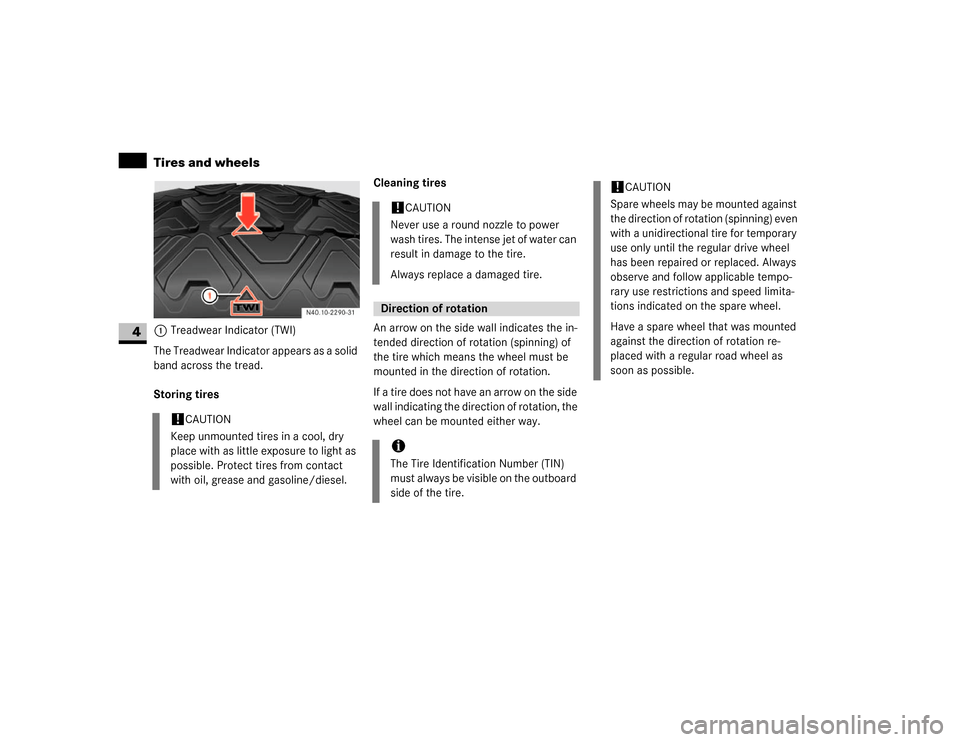
1Treadwear Indicator (TWI)
The Treadwear Indicator appears as a solid
band across the tread.
Storing tiresCleaning tires
An arrow on the side wall indicates the in-
tended direction of rotation (spinning) of
the tire which means the wheel must be
mounted in the direction of rotation.
If a tire does not have an arrow on the side
wall indicating the direction of rotation, the
wheel can be mounted either way.
!
CAUTION
Keep unmounted tires in a cool, dry
place with as little exposure to light as
possible. Protect tires from contact
with oil, grease and gasoline/diesel.
!
CAUTION
Never use a round nozzle to power
wash tires. The intense jet of water can
result in damage to the tire.
Always replace a damaged tire.
Direction of rotationiThe Tire Identification Number (TIN)
must always be visible on the outboard
side of the tire.
!
CAUTION
Spare wheels may be mounted against
the direction of rotation (spinning) even
with a unidirectional tire for temporary
use only until the regular drive wheel
has been repaired or replaced. Always
observe and follow applicable tempo-
rary use restrictions and speed limita-
tions indicated on the spare wheel.
Have a spare wheel that was mounted
against the direction of rotation re-
placed with a regular road wheel as
soon as possible.
Page 206 of 393
205 Operation
Tires and wheels
4
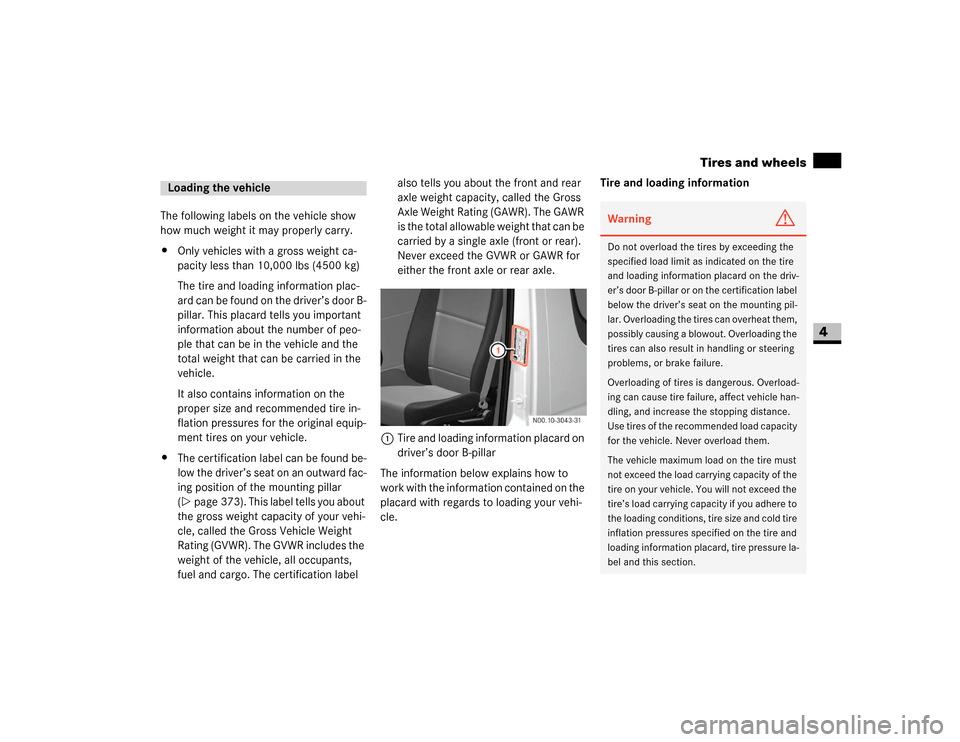
The following labels on the vehicle show
how much weight it may properly carry.
\4Only vehicles with a gross weight ca-
pacity less than 10,000 lbs (4500 kg)
The tire and loading information plac-
ard can be found on the driver’s door B-
pillar. This placard tells you important
information about the number of peo-
ple that can be in the vehicle and the
total weight that can be carried in the
vehicle.
It also contains information on the
proper size and recommended tire in-
flation pressures for the original equip-
ment tires on your vehicle.
\4The certification label can be found be-
low the driver’s seat on an outward fac-
ing position of the mounting pillar
(\2page 373). This label tells you about
the gross weight capacity of your vehi-
cle, called the Gross Vehicle Weight
Rating (GVWR). The GVWR includes the
weight of the vehicle, all occupants,
fuel and cargo. The certification label also tells you about the front and rear
axle weight capacity, called the Gross
Axle Weight Rating (GAWR). The GAWR
is the total allowable weight that can be
carried by a single axle (front or rear).
Never exceed the GVWR or GAWR for
either the front axle or rear axle.
1Tire and loading information placard on
driver’s door B-pillar
The information below explains how to
work with the information contained on the
placard with regards to loading your vehi-
cle.Tire and loading informationLoading the vehicle
Warning
G
Do not overload the tires by exceeding the
specified load limit as indicated on the tire
and loading information placard on the driv-
er’s door B-pillar or on the certification label
below the driver’s seat on the mounting pil-
lar. Overloading the tires can overheat them,
possibly causing a blowout. Overloading the
tires can also result in handling or steering
problems, or brake failure.
Overloading of tires is dangerous. Overload-
ing can cause tire failure, affect vehicle han-
dling, and increase the stopping distance.
Use tires of the recommended load capacity
for the vehicle. Never overload them.
The vehicle maximum load on the tire must
not exceed the load carrying capacity of the
tire on your vehicle. You will not exceed the
tire’s load carrying capacity if you adhere to
the loading conditions, tire size and cold tire
inflation pressures specified on the tire and
loading information placard, tire pressure la-
bel and this section.
Page 207 of 393
206 OperationTires and wheels
4
Placard
For vehicles with a gross weight capacity
less than 10,000 lbs (4500 kg) only.
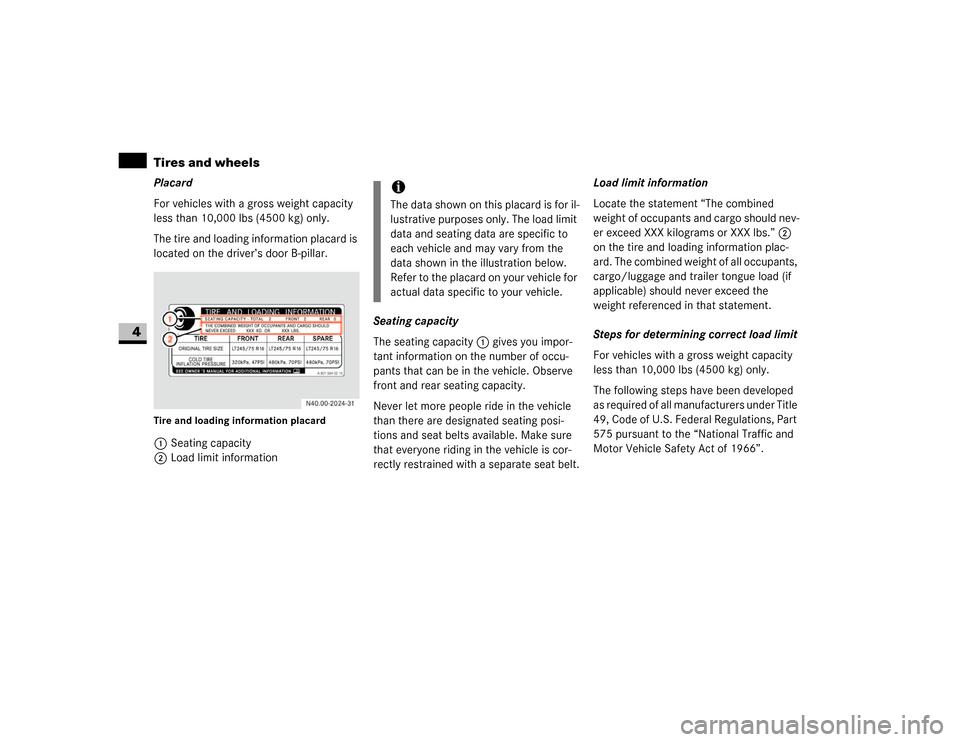
The tire and loading information placard is
located on the driver’s door B-pillar.Tire and loading information placard1Seating capacity
2Load limit informationSeating capacity
The seating capacity1 gives you impor-
tant information on the number of occu-
pants that can be in the vehicle. Observe
front and rear seating capacity.
Never let more people ride in the vehicle
than there are designated seating posi-
tions and seat belts available. Make sure
that everyone riding in the vehicle is cor-
rectly restrained with a separate seat belt.Load limit information
Locate the statement “The combined
weight of occupants and cargo should nev-
er exceed XXX kilograms or XXX lbs.” 2
on the tire and loading information plac-
ard. The combined weight of all occupants,
cargo/luggage and trailer tongue load (if
applicable) should never exceed the
weight referenced in that statement.
Steps for determining correct load limit
For vehicles with a gross weight capacity
less than 10,000 lbs (4500 kg) only.
The following steps have been developed
as required of all manufacturers under Title
49, Code of U.S. Federal Regulations, Part
575 pursuant to the “National Traffic and
Motor Vehicle Safety Act of 1966”.
iThe data shown on this placard is for il-
lustrative purposes only. The load limit
data and seating data are specific to
each vehicle and may vary from the
data shown in the illustration below.
Refer to the placard on your vehicle for
actual data specific to your vehicle.