tires DODGE SPRINTER 2007 2.G Workshop Manual
[x] Cancel search | Manufacturer: DODGE, Model Year: 2007, Model line: SPRINTER, Model: DODGE SPRINTER 2007 2.GPages: 393, PDF Size: 7.61 MB
Page 243 of 393
242 OperationCleaning and care of the vehicle
4
Automatic car wash
You can clean the vehicle in an automatic
car wash from the very start. It is prefera-
ble to use a car wash that does not have
brushes.
If the vehicle is very dirty, prewash it be-
fore you drive into the car wash.
\1Remove the radio / telephone antenna
and fold the exterior mirrors in before
driving into the automatic car wash.After using an automatic car wash, wipe off
wax from the windshield and the wiper
blades. This prevents smears and reduces
wiping noises which can be caused by res-
idue on the windshield.High-pressure cleaners
\1The minimum distance that must be
maintained between the vehicle and
the nozzle of the high-pressure cleaner
is:
\4approximately 2.2 ft (70 cm) for
round-spray jets
\4approximately 1 ft (30 cm) for 25°
flat-spray jets and concentrated-
power jets
\1Move the high-pressure cleaner nozzle
around when cleaning your vehicle.Care of the vehicle!
CAUTION
After cleaning your vehicle, especially
the wheel rims with rim cleaner, do not
simply park the vehicle and leave it.
Rim cleaners can promote corrosion of
the brake discs and the brake pads /
linings. Before parking and leaving the
vehicle after cleaning, always warm the
vehicle up to normal operating temper-
ature first.
!
CAUTION
Make sure that the automatic car wash
is suitable for the size of the vehicle.
If you do not remove the radio / tele-
phone antenna and fold in the exterior
mirrors, there is a possibility that the
antenna, the exterior mirrors or the ve-
hicle could be damaged by the auto-
matic car wash.
!
CAUTION
Make sure that the windshield wiper
switch is set to 0 (\2page 126), other-
wise the rain sensor could be activated,
for example, and the windshield wipers
could be triggered unintentionally. This
could cause damage to the vehicle.
!
CAUTION
Do not use high-pressure cleaners with
round-spray jets for cleaning the tires.
You could otherwise damage the tires.
Have damaged tires replaced.
!
CAUTION
To avoid damage, do not aim directly at
the door joints, brake hoses, electrical
components, connectors or seals.
Page 247 of 393
246 OperationCleaning and care of the vehicle
4
Seat belts
Remove stains or dirt immediately to pre-
vent damage or the build-up of residues.
!
CAUTION
Clean the seat belts with a mild wash-
ing solution. Do not dry the seat belts in
direct sunlight or at temperatures
above 176 °F (80 °C).
Do not bleach or dye the seat belts.
This could impair the function of the
seat belts.
After driving off-road or on construc-
tion sitesWarning
G
Dirt on the vehicle can affect road and oper-
ating safety.In particular, the following dangers can arise:Stone chippings
Stones trapped between the tires can be
thrown out while the vehicle is in motion and
injure other road users or damage their ve-
hicles (in particular the windshield).
Risk of skidding
Dirt and mud on the tires / road surface re-
duce wheel grip. This is especially so if the
road surface is wet. The vehicle could then
start to skid.
Risk of slipping
Dirt and mud on the steps and entrances
make the steps less safe. As a result you
could slip from the steps and injure yourself.
For this reason, always clean your vehicle
carefully after driving off-road and on con-
struction sites before using public roads.
If you use a high-pressure cleaner or auto-
matic car wash for this purpose, you must
follow the relevant safety instructions in this
section.
Page 248 of 393
247 Operation
Cleaning and care of the vehicle
4
\1Clean the vehicle, particularly the light-
ing equipment, windows, exterior mir-
rors, steps, entrances, grab handles,
wheels, tires, wheel housings and li-
cense plates. Observe the notes in this
section.
\1Remove any trapped foreign objects,
e.g. stones.After driving in mud, sand, water or similar
conditions:
\4Check the brake system for operating
safety.
\4Clean the wheels, chassis and brake
system.
\4Check them for damage and have any
damage repaired by an authorized
Sprinter Dealer if necessary.
Warning
G
Dirty brake discs and brake pads / linings
can impair braking power (to the point of to-
tal failure).
You could thereby cause an accident.
Check the brake system for operating safety
by testing the brakes before driving the ve-
hicle onto public roads.
If braking power is impaired, stop the ve-
hicle as soon as it is safe to do so and con-
sult an authorized Sprinter Dealer which has
the necessary specialist knowledge and
tools to carry out the work required.
The manufacturer recommends that you use
an authorized Sprinter Dealer for this pur-
pose. In particular, work relevant to safety
or on safety-related systems must be car-
ried out at an authorized Sprinter Dealer.
Page 280 of 393
279 Practical hints
What to do if ...
5
Warning!
G
Each tire, including the spare (if provided),
should be checked monthly when cold and
inflated to the inflation pressure recom-
mended by the vehicle manufacturer on the
vehicle placard or the tire inflation pressure
label. (If your vehicle has tires of a different
size than the size indicated on the vehicle
placard or the tire inflation pressure label,
you should determine the proper tire infla-
tion pressure for those tires).
As an added safety feature, your vehicle has
been equipped with a Tire Pressure Monitor-
ing System (TPMS) that illuminates a low tire
pressure telltale when one or more of your
tires is significantly underinflated. Accord-
ingly, when the low tire pressure telltale illu-
minates, you should stop and check your
tires as soon as possible, and inflate them to
the proper pressure. Driving on a significant-
ly underinflated tire causes the tire to over-
heat and can lead to tire failure.
Underinflation also reduces fuel efficiency
and tire tread life, and may affect the vehi-
cle’s handling and stopping ability. Please
note that the TPMS is not a substitute for
proper tire maintenance, and it is the driv-
er’s responsibility to maintain correct tire
pressure, even if underinflation has not
reached the level to trigger illumination of
the TPMS low tire pressure telltale.
USA only:
Your vehicle has also been equipped with a
TPMS malfunction indicator to indicate
when the system is not operating properly.
The TPMS malfunction indicator is com-
bined with the low tire pressure telltale.
When the system detects a malfunction, the
telltale will flash for approximately 1 minute
and then remain continuously illuminated.
This sequence will continue upon subse-
quent vehicle start-ups as long as the mal-
function exists. When the malfunction
indicator is illuminated, the system may not
be able to detect or signal low tire pressure
as intended.
TPMS malfunctions may occur for a variety
of reasons, including the installation of in-
compatible replacement or alternate tires or
wheels on the vehicle that prevent the TPMS
from functioning properly. Always check the
TPMS malfunction telltale after replacing
one or more tires or wheels on your vehicle
to ensure that the replacement or alternate
tires and wheels allow the TPMS to continue
to function properly.
Page 284 of 393
283 Practical hints
Display messages
5
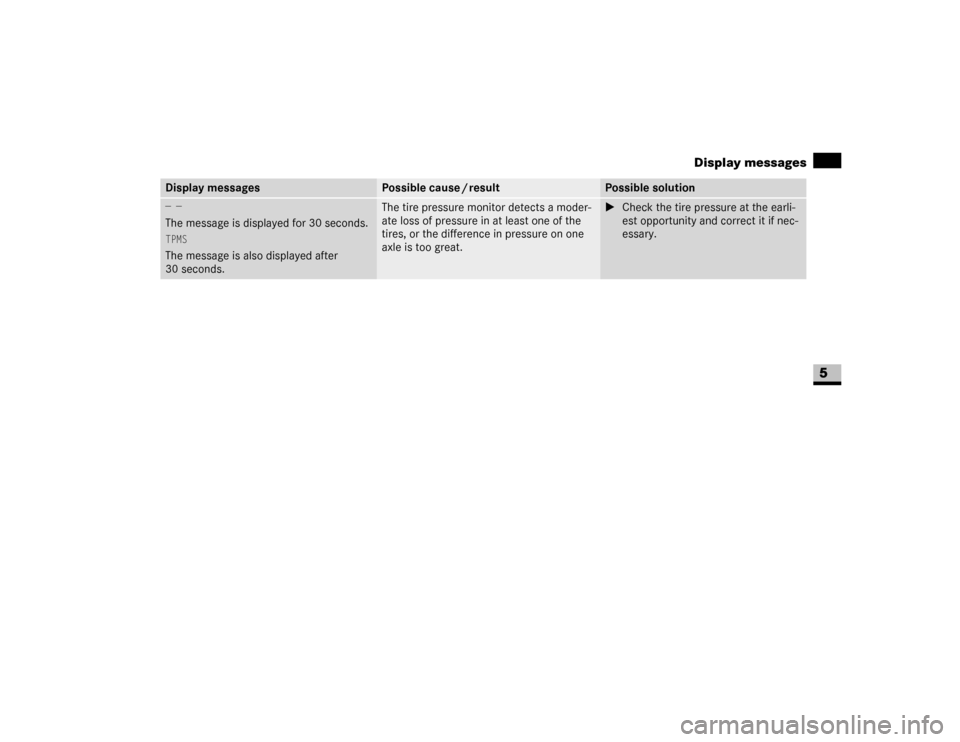
— —The message is displayed for 30 seconds.TPMSThe message is also displayed after
30 seconds.
The tire pressure monitor detects a moder-
ate loss of pressure in at least one of the
tires, or the difference in pressure on one
axle is too great.
\1Check the tire pressure at the earli-
est opportunity and correct it if nec-
essary.
Display messages
Possible cause / result
Possible solution
Page 287 of 393
286 Practical hintsDisplay messages
5
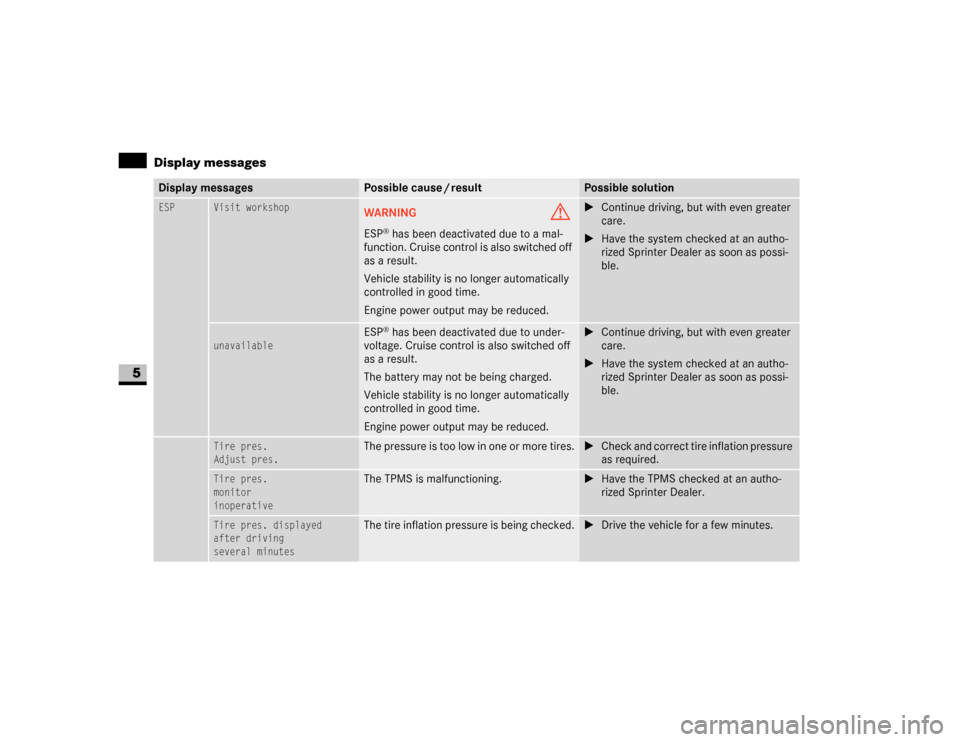
ESP
Visit workshop
WARNING
G
ESP
® has been deactivated due to a mal-
function. Cruise control is also switched off
as a result.
Vehicle stability is no longer automatically
controlled in good time.
Engine power output may be reduced.
\1Continue driving, but with even greater
care.
\1Have the system checked at an autho-
rized Sprinter Dealer as soon as possi-
ble.
unavailable
ESP
® has been deactivated due to under-
voltage. Cruise control is also switched off
as a result.
The battery may not be being charged.
Vehicle stability is no longer automatically
controlled in good time.
Engine power output may be reduced.
\1Continue driving, but with even greater
care.
\1Have the system checked at an autho-
rized Sprinter Dealer as soon as possi-
ble.
Tire pres.
Adjust pres.
The pressure is too low in one or more tires.
\1Check and correct tire inflation pressure
as required.
Tire pres.
monitor
inoperative
The TPMS is malfunctioning.
\1Have the TPMS checked at an autho-
rized Sprinter Dealer.
Tire pres. displayed
after driving
several minutes
The tire inflation pressure is being checked.
\1Drive the vehicle for a few minutes.
Display messages
Possible cause / result
Possible solution
Page 288 of 393
287 Practical hints
Display messages
5
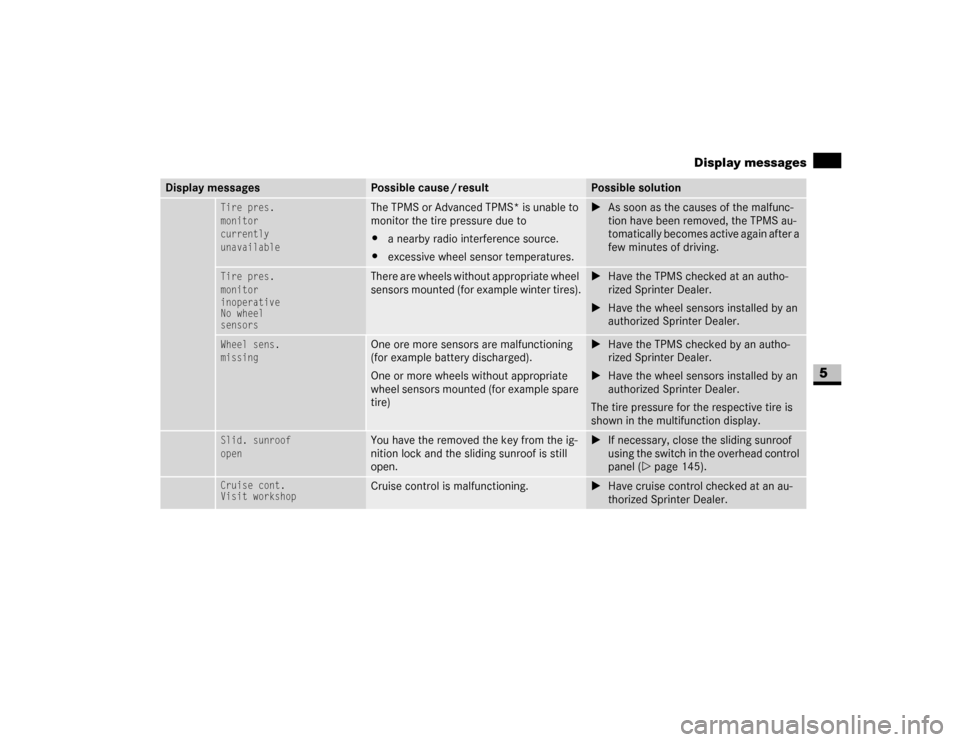
Tire pres.
monitor
currently
unavailable
The TPMS or Advanced TPMS* is unable to
monitor the tire pressure due to
\4a nearby radio interference source.
\4excessive wheel sensor temperatures.
\1As soon as the causes of the malfunc-
tion have been removed, the TPMS au-
tomatically becomes active again after a
few minutes of driving.
Tire pres.
monitor
inoperative
No wheel
sensors
There are wheels without appropriate wheel
sensors mounted (for example winter tires).
\1Have the TPMS checked at an autho-
rized Sprinter Dealer.
\1Have the wheel sensors installed by an
authorized Sprinter Dealer.
Wheel sens.
missing
One ore more sensors are malfunctioning
(for example battery discharged).
One or more wheels without appropriate
wheel sensors mounted (for example spare
tire)
\1Have the TPMS checked by an autho-
rized Sprinter Dealer.
\1Have the wheel sensors installed by an
authorized Sprinter Dealer.
The tire pressure for the respective tire is
shown in the multifunction display.
Slid. sunroof
open
You have the removed the key from the ig-
nition lock and the sliding sunroof is still
open.
\1If necessary, close the sliding sunroof
using the switch in the overhead control
panel (\2page 145).
Cruise cont.
Visit workshop
Cruise control is malfunctioning.
\1Have cruise control checked at an au-
thorized Sprinter Dealer.
Display messages
Possible cause / result
Possible solution
Page 296 of 393
295 Practical hints
Display messages
5
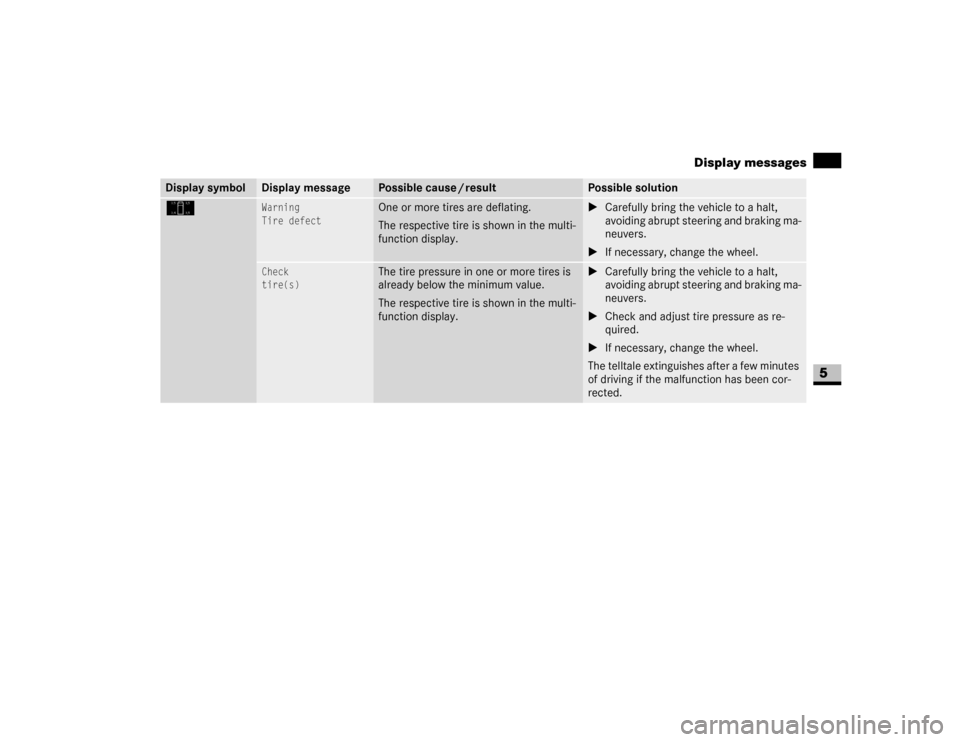
C
Warning
Tire defect
One or more tires are deflating.
The respective tire is shown in the multi-
function display.
\1Carefully bring the vehicle to a halt,
avoiding abrupt steering and braking ma-
neuvers.
\1If necessary, change the wheel.
Check
tire(s)
The tire pressure in one or more tires is
already below the minimum value.
The respective tire is shown in the multi-
function display.
\1Carefully bring the vehicle to a halt,
avoiding abrupt steering and braking ma-
neuvers.
\1Check and adjust tire pressure as re-
quired.
\1If necessary, change the wheel.
The telltale extinguishes after a few minutes
of driving if the malfunction has been cor-
rected.
Display symbol
Display message
Possible cause / result
Possible solution
Page 301 of 393
300 Practical hintsWhere will I find...?
5
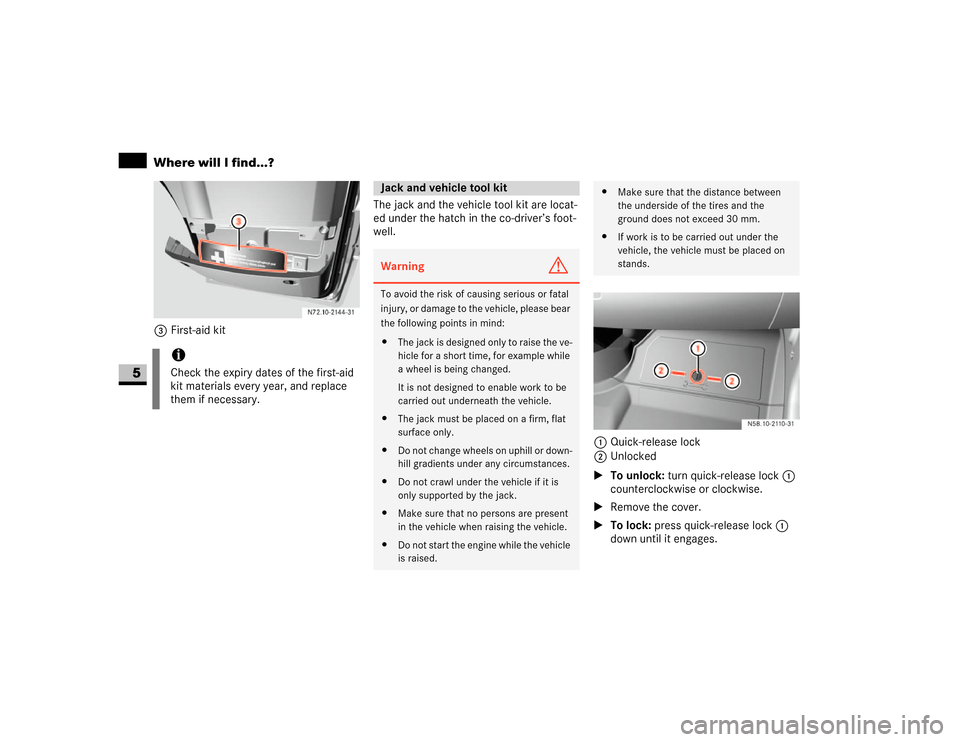
3First-aid kitThe jack and the vehicle tool kit are locat-
ed under the hatch in the co-driver’s foot-
well.
1Quick-release lock
2Unlocked
\1To unlock: turn quick-release lock 1
counterclockwise or clockwise.
\1Remove the cover.
\1To lock: press quick-release lock 1
down until it engages.
iCheck the expiry dates of the first-aid
kit materials every year, and replace
them if necessary.
Jack and vehicle tool kitWarning
G
To avoid the risk of causing serious or fatal
injury, or damage to the vehicle, please bear
the following points in mind:
\4The jack is designed only to raise the ve-
hicle for a short time, for example while
a wheel is being changed.
It is not designed to enable work to be
carried out underneath the vehicle.
\4The jack must be placed on a firm, flat
surface only.
\4Do not change wheels on uphill or down-
hill gradients under any circumstances.
\4Do not crawl under the vehicle if it is
only supported by the jack.
\4Make sure that no persons are present
in the vehicle when raising the vehicle.
\4Do not start the engine while the vehicle
is raised.
\4Make sure that the distance between
the underside of the tires and the
ground does not exceed 30 mm.
\4If work is to be carried out under the
vehicle, the vehicle must be placed on
stands.
Page 302 of 393
301 Practical hints
Where will I find...?
5
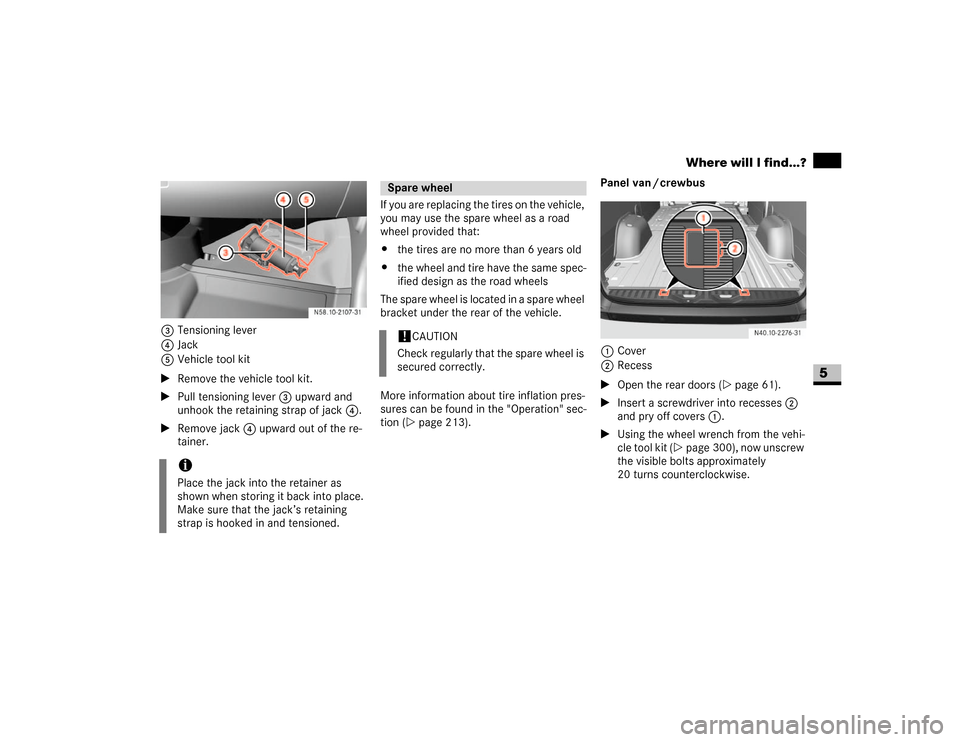
3Tensioning lever
4Jack
5Vehicle tool kit
\1Remove the vehicle tool kit.
\1Pull tensioning lever3 upward and
unhook the retaining strap of jack4.
\1Remove jack4 upward out of the re-
tainer.If you are replacing the tires on the vehicle,
you may use the spare wheel as a road
wheel provided that:
\4the tires are no more than 6 years old
\4the wheel and tire have the same spec-
ified design as the road wheels
The spare wheel is located in a spare wheel
bracket under the rear of the vehicle.
More information about tire inflation pres-
sures can be found in the "Operation" sec-
tion (\2page 213).Panel van / crewbus
1Cover
2Recess
\1Open the rear doors (\2page 61).
\1Insert a screwdriver into recesses2
and pry off covers1.
\1Using the wheel wrench from the vehi-
cle tool kit (\2page 300), now unscrew
the visible bolts approximately
20 turns counterclockwise.
iPlace the jack into the retainer as
shown when storing it back into place.
Make sure that the jack’s retaining
strap is hooked in and tensioned.
Spare wheel!
CAUTION
Check regularly that the spare wheel is
secured correctly.