fuel DODGE SPRINTER 2007 2.G Workshop Manual
[x] Cancel search | Manufacturer: DODGE, Model Year: 2007, Model line: SPRINTER, Model: DODGE SPRINTER 2007 2.GPages: 393, PDF Size: 7.61 MB
Page 359 of 393
358 *Technical dataService products and capacities
6
Adding engine oil Fuels for gasoline engines
Premium unleaded gasoline
!
CAUTION
Diesel engine:
Never use any amount of engine oil for
the diesel engine that does not con-
form to MB 229.51 or MB 229.31 spec-
ifications. Otherwise the diesel particle
filter (DPF) could be damaged.
If the above specified engine oils are
not available, you may also use engine
oils conforming to MB 228.5, 229.3
and 229.5 specifications. You should
add no more than 1 qt (1 l) of these en-
gine oils, however.
FuelsWarning
G
Gasoline is highly flammable and poisonous.
It burns violently and can cause serious inju-
ry. Whenever you are around gasoline, avoid
inhaling fumes and skin contact, extinguish
all smoking materials. Never allow sparks,
flame or smoking materials near gasoline!
Direct skin contact with fuels and the inha-
lation of fuel vapors are damaging to health.
Switch off the engine before refueling.!
CAUTION
If you are refueling the vehicle from
drums or canisters, you should filter
the fuel before adding it to the tank.
This will prevent malfunctions in the
fuel system caused by contaminated
fuel.
!
CAUTION
To maintain the engine’s durability and
performance, premium unleaded gaso-
line must be used. If premium unleaded
is not available and low octane fuel is
used, follow these precautions:
\4Have the fuel tank only partially
filled with unleaded regular and fill
up with premium unleaded as soon
as possible.
\4Avoid full throttle driving and abrupt
acceleration.
\4Do not exceed an engine speed
of 3000 rpm if the vehicle is loaded
with a light load, such as two per-
sons and no cargo.
\4Do not exceed
2/3 of maximum ac-
celerator pedal position if the vehi-
cle is fully loaded or operating in
mountainous terrain.
Page 360 of 393
359 *Technical data
Service products and capacities
6
Fuel requirements
Only use premium unleaded fuel:
\4The octane number (posted at the
pump) must be 91 min. It is an average
of both the Research (R) octane num-
ber and the Motor (M) octane number:
(R+M) / 2). This is also known as the
ANTI-KNOCK INDEX.
Unleaded gasoline containing oxygenates
such as ethanol, IPA, IBA and TBA can be
used provided the ratio of any one of these
oxygenates to gasoline does not
exceed 10%; MTBE not to exceed 15%.
The ratio of methanol to gasoline must not
exceed 3% plus additional cosolvents.
Using mixtures of ethanol and methanol is
not allowed. Gasohol, which contains 10%
ethanol and 90% unleaded gasoline, can be
used.
These blends must also meet all other fuel
requirements, such as resistance to spark
knock, boiling range, vapor pressure, etc.Fuels for diesel engines Fuel requirements
Only use commercially available vehicular
ULTRA-LOW SULFUR HIGHWAY DIESEL
FUEL (15 ppm SULFUR MAXIMUM).
DaimlerChrysler USA now approves the
use of B5 bio diesel (standard diesel with a
maximum of up to 5% Bio diesel content)
in the Sprinter CRD diesel engine.
Information on diesel quality can normally
be found on the fuel pump.
!
CAUTION
The following may lead to increased
wear or engine damage:
\4Using gasoline that does not meet
the specifications mentioned above
\4The use of non-approved special
additives
!
CAUTION
Marine diesel fuel, bio diesel fuel, heat-
ing oil or the like must not be used.
Do not blend diesel fuel with marine
diesel fuel, bio diesel fuel or heating oil.
The use of such non-approved fuels or
blending diesel fuel may result in mal-
function or cause engine damage.
Damage or malfunctions resulting from
poor fuel quality or from blending spe-
cific fuel additives are not covered by
the Sprinter warranty.
!
CAUTION
As bio diesel can be refined from a vari-
ety of raw materials resulting in widely
varying properties, the only approved
bio diesel content is one that meets
ASTM D6751 specification. It must also
have the necessary oxidation stability
(min. 6h, proved with EN 14112 meth-
od) to prevent damages to the system
from deposits and/or corrosion.
If the B5 Bio diesel blend is not suffi-
ciently labeled to clearly indicate that it
meets the above standards, do not use
it.
Page 361 of 393
360 *Technical dataService products and capacities
6
Diesel fuels containing a higher percenta-
ge of Bio diesel content will cause damage
to your engine and are not approved.
Damage or malfunctions resulting from
poor fuel quality are not covered by the
Sprinter Warranty.
For more information on diesel fuels con-
tact your authorized Sprinter Dealer. DaimlerChrysler USA now approves the
use of B5 bio diesel (standard diesel with a
maximum of up to 5% bio diesel content)
in all Common Rail Injection Diesel
“CDI-engines.” Diesel fuels containing a
higher percentage of bio diesel content will
cause damage to your engine and are not
approved.
As bio diesel can be refined from a variety of
raw materials resulting in widely varying
properties, the only approved bio diesel
content is one that meets ASTM D6751
specification. It must also have the neces-
sary oxidation stability (min. 6h, proved with
EN 14112 method) to prevent damages to
the system from deposits and/or corrosion.
Please ask your service station for further
information. If the B5 bio diesel blend is
not sufficiently labeled to clearly indicate that it meets the above standards, please
do not use it. The DaimlerChrysler limited
warranty does not cover
damage caused
by the use of fuels not meeting
DaimlerChrysler approved fuel standards.
For more information on diesel fuels con-
tact your authorized Sprinter Dealer.
Diesel fuels for use at very low tempera-
tures
Only use commercially available vehicular
ULTRA-LOW SULFUR DIESEL FUEL
(15 ppm SULFUR MAXIMUM).
To prevent malfunctions, diesel fuel with
improved cold flow characteristics is offe-
red in the winter months. Check with your
fuel retailer.
At very low temperatures the fluidity of
No. 2 diesel fuel may become insufficient
due to paraffin separation. For this reason
the vehicle comes equipped with a fuel
preheater. It permits trouble-free engine
operation to a temperature of approxi-
mately 14 °F (–10 °C).
!
CAUTION
The exhaust aftertreatment device
(DPF) will be seriously damaged if you
use
\4LOW SULFUR HIGHWAY DIESEL
FUEL (500 ppm SULFUR MAXI-
MUM)
\4any other diesel fuel with a sulfur
content of above 15 ppm
\4any other diesel fuel with a Bio die-
sel content of above 5%
\4any other diesel fuel with a Bio die-
sel content up to 5%, which does
not meet the above mentioned
standards
iCommercially available vehicular
ULTRA-LOW SULFUR HIGHWAY DIE-
SEL FUEL may contain up to 5% bio die-
sel. This proportion will not have an
effect on performance and wear.
Page 362 of 393
361 *Technical data
Service products and capacities
6
At temperatures below 14 °F (–10 °C) a
certain quantity of fuel flow improver may
be added. These substances may only be
mixed within the vehicle’s fuel tank.
Engine power may drop according to the
proportion of fuel flow improver. For this
reason, keep the percentage of fuel flow
improver to the minimum necessitated by
the ambient temperature.
Adding kerosene to diesel fuel is not rec-
ommended even at low temperatures.
Do not blend other specific fuel additives
with diesel fuel except for fuel flow improv-
er. They only result in unnecessary cost,
and may be harmful to the engine opera-
tion.Flow improvers
The effectiveness of flow improvers cannot
be guaranteed with all fuels. Observe the
mixing ratio and comply with the handling
instructions given from the manufacturer.
!
CAUTION
Do not fill the tank with gasoline.
Do not mix diesel fuel with gasoline or
kerosene. The fuel system and engine
will otherwise be damaged, which is
not covered by the Sprinter warranty.
Warning
G
Under no circumstances should gasoline be
mixed with diesel fuel.
Due to the high pressure and high tempera-
ture in the injection system, there is a risk of
fire and explosion.
In addition, there is a risk of engine damage.
Always follow basic safety rules when work-
ing with any combustible material.
Page 366 of 393
365 *Technical data
Service products and capacities
6
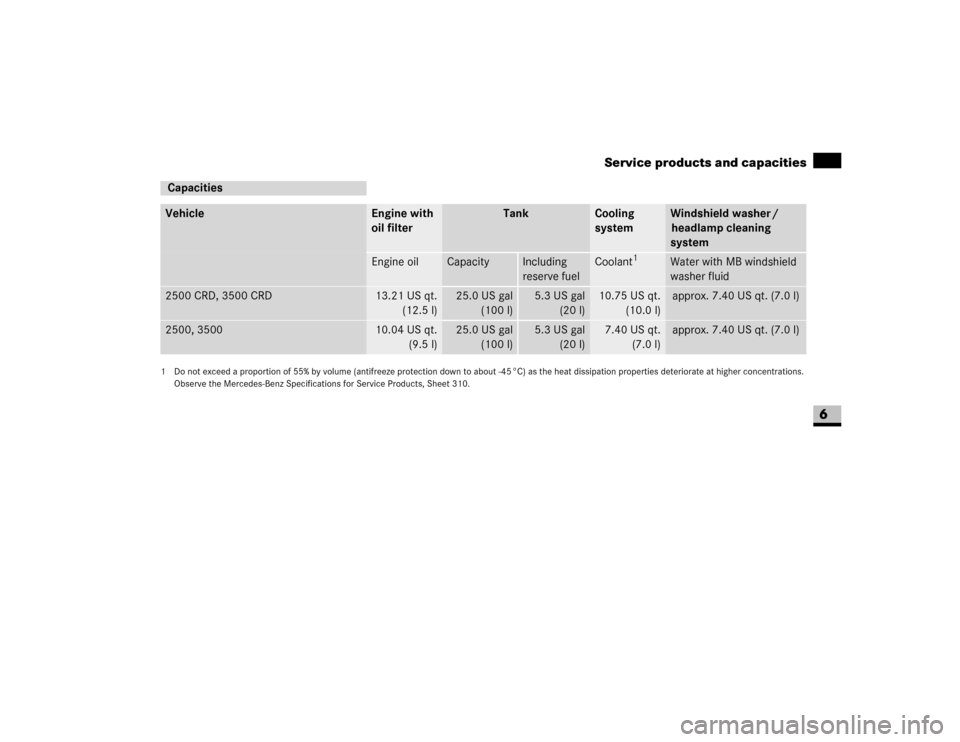
CapacitiesVehicle
Engine with
oil filter
Tank
Cooling
system
Windshield washer /
headlamp cleaning
system
Engine oil
Capacity
Including
reserve fuel
Coolant
1
1 Do not exceed a proportion of 55% by volume (antifreeze protection down to about -45 °C) as the heat dissipation properties deteriorate at higher concentrations.
Observe the Mercedes-Benz Specifications for Service Products, Sheet 310.
Water with MB windshield
washer fluid
2500 CRD, 3500 CRD
13.21 US qt.
(12.5 l)
25.0 US gal
(100 l)
5.3 US gal
(20 l)
10.75 US qt.
(10.0 l)
approx. 7.40 US qt. (7.0 l)
2500, 3500
10.04 US qt.
(9.5 l)
25.0 US gal
(100 l)
5.3 US gal
(20 l)
7.40 US qt.
(7.0 l)
approx. 7.40 US qt. (7.0 l)
Page 367 of 393
366 *Technical dataService products and capacities
6
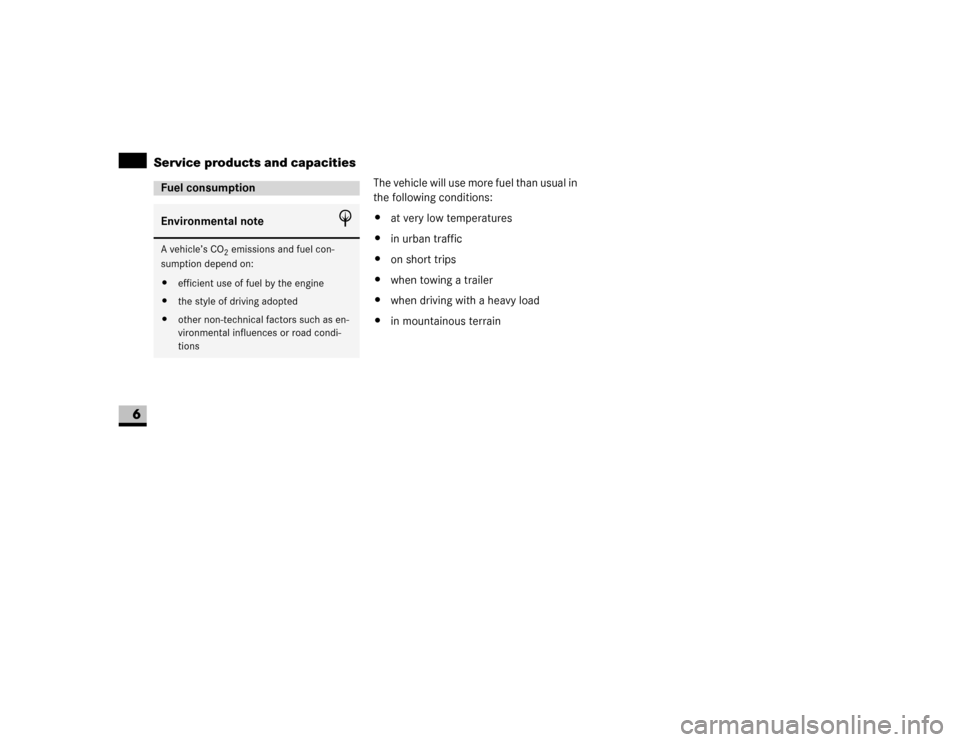
The vehicle will use more fuel than usual in
the following conditions:
\4at very low temperatures
\4in urban traffic
\4on short trips
\4when towing a trailer
\4when driving with a heavy load
\4in mountainous terrain
Fuel consumptionEnvironmental note
H
A vehicle’s CO
2 emissions and fuel con-
sumption depend on:
\4efficient use of fuel by the engine
\4the style of driving adopted
\4other non-technical factors such as en-
vironmental influences or road condi-
tions
Page 368 of 393
367 *Technical data
Rims and tires
6
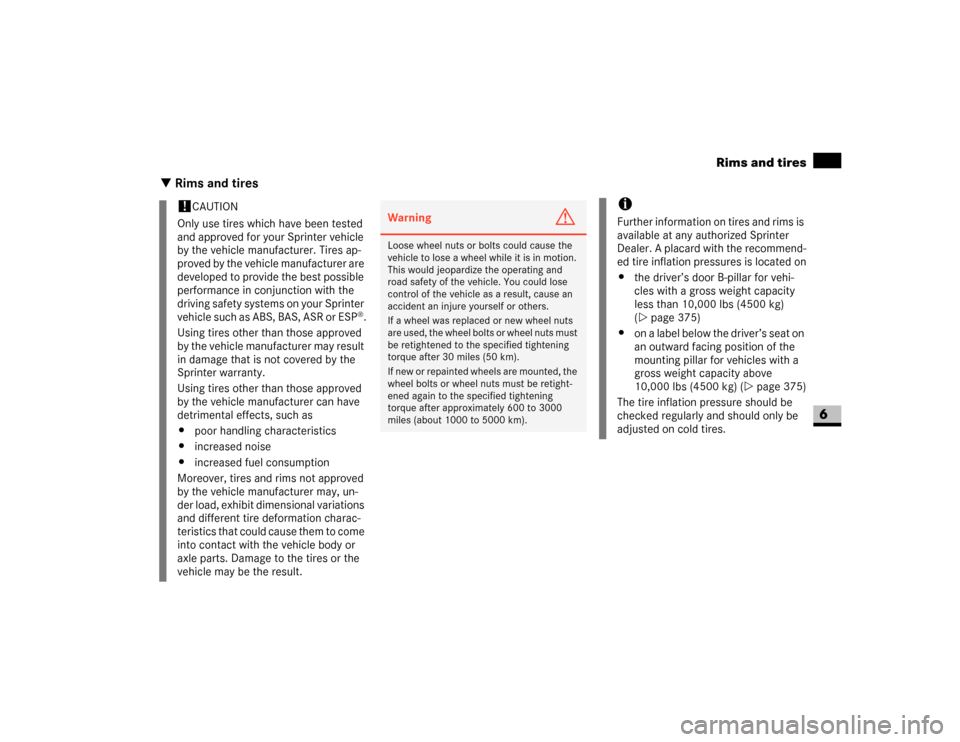
\3 Rims and tires
!
CAUTION
Only use tires which have been tested
and approved for your Sprinter vehicle
by the vehicle manufacturer. Tires ap-
proved by the vehicle manufacturer are
developed to provide the best possible
performance in conjunction with the
driving safety systems on your Sprinter
vehicle such as ABS, BAS, ASR or ESP
®.
Using tires other than those approved
by the vehicle manufacturer may result
in damage that is not covered by the
Sprinter warranty.
Using tires other than those approved
by the vehicle manufacturer can have
detrimental effects, such as
\4poor handling characteristics
\4increased noise
\4increased fuel consumption
Moreover, tires and rims not approved
by the vehicle manufacturer may, un-
der load, exhibit dimensional variations
and different tire deformation charac-
teristics that could cause them to come
into contact with the vehicle body or
axle parts. Damage to the tires or the
vehicle may be the result.
Warning
G
Loose wheel nuts or bolts could cause the
vehicle to lose a wheel while it is in motion.
This would jeopardize the operating and
road safety of the vehicle. You could lose
control of the vehicle as a result, cause an
accident an injure yourself or others.
If a wheel was replaced or new wheel nuts
are used, the wheel bolts or wheel nuts must
be retightened to the specified tightening
torque after 30 miles (50 km).
If new or repainted wheels are mounted, the
wheel bolts or wheel nuts must be retight-
ened again to the specified tightening
torque after approximately 600 to 3000
miles (about 1000 to 5000 km).
iFurther information on tires and rims is
available at any authorized Sprinter
Dealer. A placard with the recommend-
ed tire inflation pressures is located on
\4the driver’s door B-pillar for vehi-
cles with a gross weight capacity
less than 10,000 lbs (4500 kg)
(\2page 375)
\4on a label below the driver’s seat on
an outward facing position of the
mounting pillar for vehicles with a
gross weight capacity above
10,000 lbs (4500 kg) (\2page 375)
The tire inflation pressure should be
checked regularly and should only be
adjusted on cold tires.
Page 370 of 393
369 *Technical data
Tire inflation pressure
6
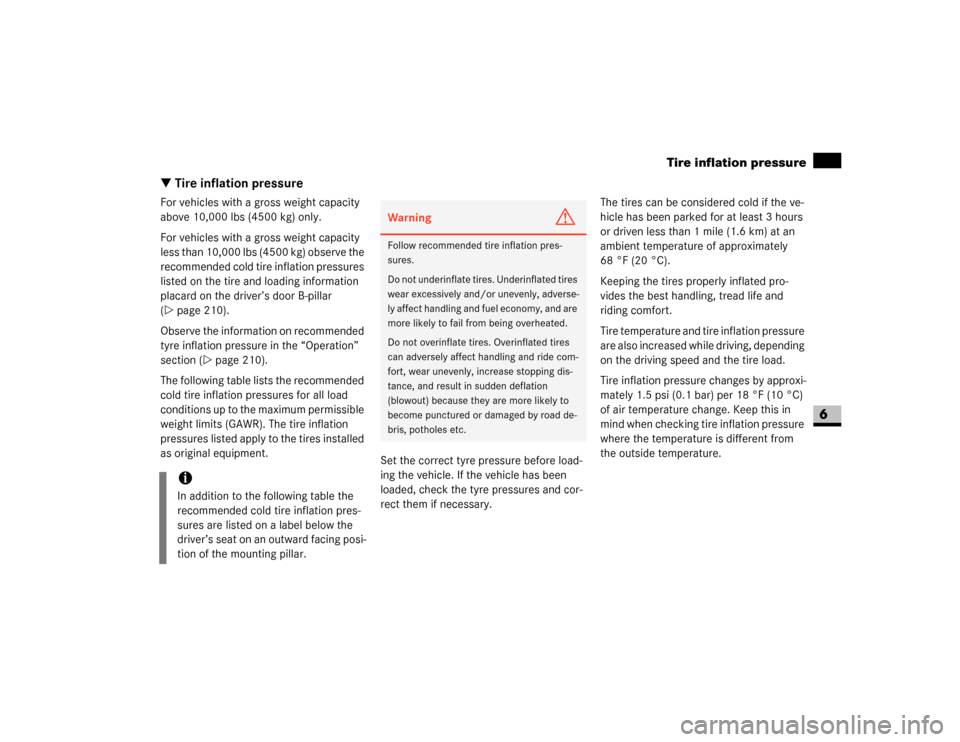
\3 Tire inflation pressureFor vehicles with a gross weight capacity
above 10,000 lbs (4500 kg) only.
For vehicles with a gross weight capacity
less than 10,000 lbs (4500 kg) observe the
recommended cold tire inflation pressures
listed on the tire and loading information
placard on the driver’s door B-pillar
(\2page 210).
Observe the information on recommended
tyre inflation pressure in the “Operation”
section (\2page 210).
The following table lists the recommended
cold tire inflation pressures for all load
conditions up to the maximum permissible
weight limits (GAWR). The tire inflation
pressures listed apply to the tires installed
as original equipment.
Set the correct tyre pressure before load-
ing the vehicle. If the vehicle has been
loaded, check the tyre pressures and cor-
rect them if necessary.The tires can be considered cold if the ve-
hicle has been parked for at least 3 hours
or driven less than 1 mile (1.6 km) at an
ambient temperature of approximately
68 °F (20 °C).
Keeping the tires properly inflated pro-
vides the best handling, tread life and
riding comfort.
Tire temperature and tire inflation pressure
are also increased while driving, depending
on the driving speed and the tire load.
Tire inflation pressure changes by approxi-
mately 1.5 psi (0.1 bar) per 18 °F (10 °C)
of air temperature change. Keep this in
mind when checking tire inflation pressure
where the temperature is different from
the outside temperature.
iIn addition to the following table the
recommended cold tire inflation pres-
sures are listed on a label below the
driver’s seat on an outward facing posi-
tion of the mounting pillar.
Warning
G
Follow recommended tire inflation pres-
sures.
Do not underinflate tires. Underinflated tires
wear excessively and/or unevenly, adverse-
ly affect handling and fuel economy, and are
more likely to fail from being overheated.
Do not overinflate tires. Overinflated tires
can adversely affect handling and ride com-
fort, wear unevenly, increase stopping dis-
tance, and result in sudden deflation
(blowout) because they are more likely to
become punctured or damaged by road de-
bris, potholes etc.
Page 381 of 393
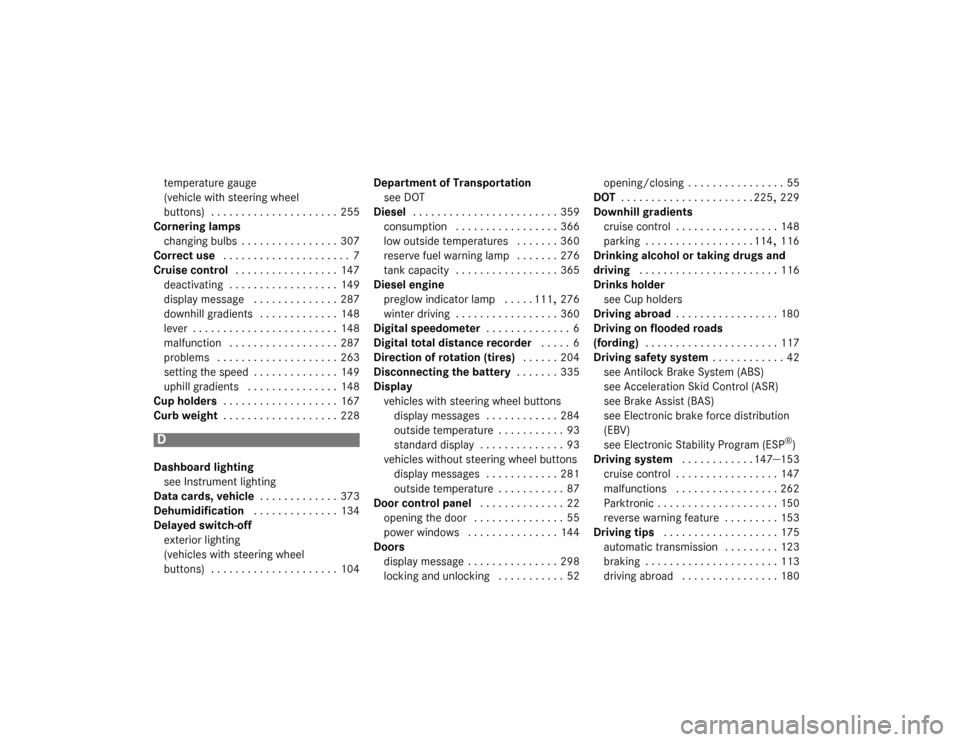
380 Indextemperature gauge
(vehicle with steering wheel
buttons)
. . . . . . . . . . . . . . . . . . . . . 255
Cornering lamps
changing bulbs
. . . . . . . . . . . . . . . . 307
Correct use
. . . . . . . . . . . . . . . . . . . . . 7
Cruise control . . . . . . . . . . . . . . . . . 147
deactivating . . . . . . . . . . . . . . . . . . 149
display message
. . . . . . . . . . . . . . 287
downhill gradients . . . . . . . . . . . . . 148
lever
. . . . . . . . . . . . . . . . . . . . . . . . 148
malfunction
. . . . . . . . . . . . . . . . . . 287
problems
. . . . . . . . . . . . . . . . . . . . 263
setting the speed
. . . . . . . . . . . . . . 149
uphill gradients
. . . . . . . . . . . . . . . 148
Cup holders
. . . . . . . . . . . . . . . . . . . 167
Curb weight . . . . . . . . . . . . . . . . . . . 228
D
Dashboard lighting
see Instrument lighting
Data cards, vehicle
. . . . . . . . . . . . . 373
Dehumidification
. . . . . . . . . . . . . . 134
Delayed switch-off
exterior lighting
(vehicles with steering wheel
buttons)
. . . . . . . . . . . . . . . . . . . . . 104Department of Transportation
see DOT
Diesel
. . . . . . . . . . . . . . . . . . . . . . . . 359
consumption
. . . . . . . . . . . . . . . . . 366
low outside temperatures
. . . . . . . 360
reserve fuel warning lamp . . . . . . . 276
tank capacity
. . . . . . . . . . . . . . . . . 365
Diesel engine
preglow indicator lamp
. . . . . 111
, 276
winter driving
. . . . . . . . . . . . . . . . . 360
Digital speedometer
. . . . . . . . . . . . . . 6
Digital total distance recorder
. . . . . 6
Direction of rotation (tires)
. . . . . . 204
Disconnecting the battery . . . . . . . 335
Display
vehicles with steering wheel buttons
display messages
. . . . . . . . . . . . 284
outside temperature . . . . . . . . . . . 93
standard display
. . . . . . . . . . . . . . 93
vehicles without steering wheel buttons
display messages . . . . . . . . . . . . 281
outside temperature . . . . . . . . . . . 87
Door control panel
. . . . . . . . . . . . . . 22
opening the door . . . . . . . . . . . . . . . 55
power windows . . . . . . . . . . . . . . . 144
Doors
display message . . . . . . . . . . . . . . . 298
locking and unlocking
. . . . . . . . . . . 52opening/closing
. . . . . . . . . . . . . . . . 55
DOT
. . . . . . . . . . . . . . . . . . . . . . 225
, 229
Downhill gradients
cruise control
. . . . . . . . . . . . . . . . . 148
parking
. . . . . . . . . . . . . . . . . . 114
, 116
Drinking alcohol or taking drugs and
driving
. . . . . . . . . . . . . . . . . . . . . . . 116
Drinks holder
see Cup holders
Driving abroad
. . . . . . . . . . . . . . . . . 180
Driving on flooded roads
(fording)
. . . . . . . . . . . . . . . . . . . . . . 117
Driving safety system
. . . . . . . . . . . . 42
see Antilock Brake System (ABS)
see Acceleration Skid Control (ASR)
see Brake Assist (BAS)
see Electronic brake force distribution
(EBV)
see Electronic Stability Program (ESP
®)
Driving system
. . . . . . . . . . . . 147
–153
cruise control
. . . . . . . . . . . . . . . . . 147
malfunctions . . . . . . . . . . . . . . . . . 262
Parktronic
. . . . . . . . . . . . . . . . . . . . 150
reverse warning feature
. . . . . . . . . 153
Driving tips
. . . . . . . . . . . . . . . . . . . 175
automatic transmission
. . . . . . . . . 123
braking
. . . . . . . . . . . . . . . . . . . . . . 113
driving abroad
. . . . . . . . . . . . . . . . 180
D
Page 383 of 393
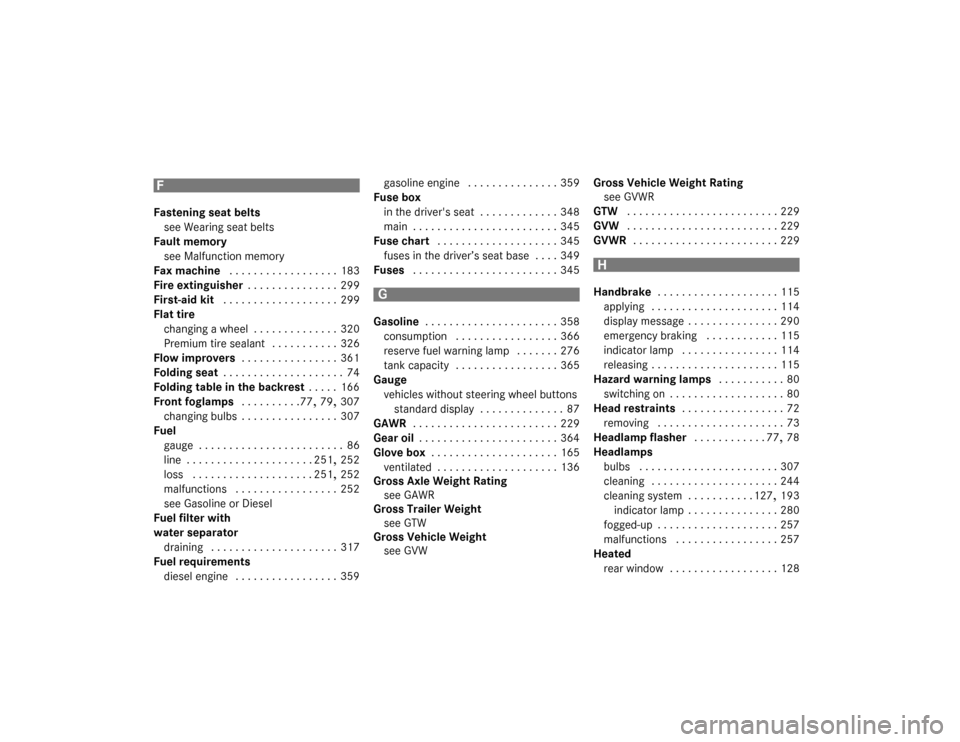
382 IndexF
Fastening seat belts
see Wearing seat belts
Fault memory
see Malfunction memory
Fax machine
. . . . . . . . . . . . . . . . . . 183
Fire extinguisher
. . . . . . . . . . . . . . . 299
First-aid kit
. . . . . . . . . . . . . . . . . . . 299
Flat tire
changing a wheel
. . . . . . . . . . . . . . 320
Premium tire sealant . . . . . . . . . . . 326
Flow improvers
. . . . . . . . . . . . . . . . 361
Folding seat
. . . . . . . . . . . . . . . . . . . . 74
Folding table in the backrest
. . . . . 166
Front foglamps
. . . . . . . . . .77
, 79
, 307
changing bulbs
. . . . . . . . . . . . . . . . 307
Fuel
gauge
. . . . . . . . . . . . . . . . . . . . . . . . 86
line
. . . . . . . . . . . . . . . . . . . . . 251
, 252
loss
. . . . . . . . . . . . . . . . . . . . 251
, 252
malfunctions
. . . . . . . . . . . . . . . . . 252
see Gasoline or Diesel
Fuel filter with
water separator
draining
. . . . . . . . . . . . . . . . . . . . . 317
Fuel requirements
diesel engine
. . . . . . . . . . . . . . . . . 359gasoline engine
. . . . . . . . . . . . . . . 359
Fuse box
in the driver's seat . . . . . . . . . . . . . 348
main
. . . . . . . . . . . . . . . . . . . . . . . . 345
Fuse chart
. . . . . . . . . . . . . . . . . . . . 345
fuses in the driver’s seat base
. . . . 349
Fuses
. . . . . . . . . . . . . . . . . . . . . . . . 345
G
Gasoline
. . . . . . . . . . . . . . . . . . . . . . 358
consumption
. . . . . . . . . . . . . . . . . 366
reserve fuel warning lamp
. . . . . . . 276
tank capacity
. . . . . . . . . . . . . . . . . 365
Gauge
vehicles without steering wheel buttons
standard display
. . . . . . . . . . . . . . 87
GAWR
. . . . . . . . . . . . . . . . . . . . . . . . 229
Gear oil . . . . . . . . . . . . . . . . . . . . . . . 364
Glove box . . . . . . . . . . . . . . . . . . . . . 165
ventilated . . . . . . . . . . . . . . . . . . . . 136
Gross Axle Weight Rating
see GAWR
Gross Trailer Weight
see GTW
Gross Vehicle Weight
see GVWGross Vehicle Weight Rating
see GVWR
GTW
. . . . . . . . . . . . . . . . . . . . . . . . . 229
GVW . . . . . . . . . . . . . . . . . . . . . . . . . 229
GVWR . . . . . . . . . . . . . . . . . . . . . . . . 229
H
Handbrake
. . . . . . . . . . . . . . . . . . . . 115
applying
. . . . . . . . . . . . . . . . . . . . . 114
display message
. . . . . . . . . . . . . . . 290
emergency braking . . . . . . . . . . . . 115
indicator lamp
. . . . . . . . . . . . . . . . 114
releasing
. . . . . . . . . . . . . . . . . . . . . 115
Hazard warning lamps
. . . . . . . . . . . 80
switching on
. . . . . . . . . . . . . . . . . . . 80
Head restraints . . . . . . . . . . . . . . . . . 72
removing
. . . . . . . . . . . . . . . . . . . . . 73
Headlamp flasher
. . . . . . . . . . . . 77
, 78
Headlamps
bulbs
. . . . . . . . . . . . . . . . . . . . . . . 307
cleaning . . . . . . . . . . . . . . . . . . . . . 244
cleaning system
. . . . . . . . . . . 127
, 193
indicator lamp
. . . . . . . . . . . . . . . 280
fogged-up
. . . . . . . . . . . . . . . . . . . . 257
malfunctions . . . . . . . . . . . . . . . . . 257
Heated
rear window . . . . . . . . . . . . . . . . . . 128
GH F