wheel DODGE SPRINTER 2007 2.G Repair Manual
[x] Cancel search | Manufacturer: DODGE, Model Year: 2007, Model line: SPRINTER, Model: DODGE SPRINTER 2007 2.GPages: 393, PDF Size: 7.61 MB
Page 121 of 393
120 Controls in detailDriving and parking
3
Alignment and balance
Poor suspension alignment may result in:
\4Fast tire wear
\4Uneven tire wear, such as feathering
and one-sided wear
\4Vehicle pulling to the left or right
Tires may also cause the vehicle to pull to
the left or right. Alignment will not correct
this condition. See an authorized Sprinter
Dealer for proper diagnosis.
Improper alignment will not cause vehicle
vibration. Vibration may be the result of a
tire and wheel imbalance. Proper balanc-
ing will reduce vibration and avoid tire cup-
ping and spotty wear.Coolant temperature
During severe operating conditions and
stop-and-go city traffic, the coolant tem-
perature may rise close to approximately
250 °F (120 °C).
The engine should not be operated with
the coolant temperature over 250 °F
(120 °C). Doing so may cause serious en-
gine damage which is not covered by the
Sprinter warranty.
Warning
G
\4Driving when your engine is overheated
can cause some fluids, which may have
leaked into the engine compartment, to
catch fire. You could be seriously
burned.
\4Steam from an overheated engine can
cause serious burns which can occur
just by opening the hood. Stay away
from the engine if you see or hear steam
coming from it.
Turn off the engine, get out of the vehicle
and do not stand near the vehicle until the
engine has cooled down.
Page 122 of 393
121 Controls in detail
Automatic transmission
3
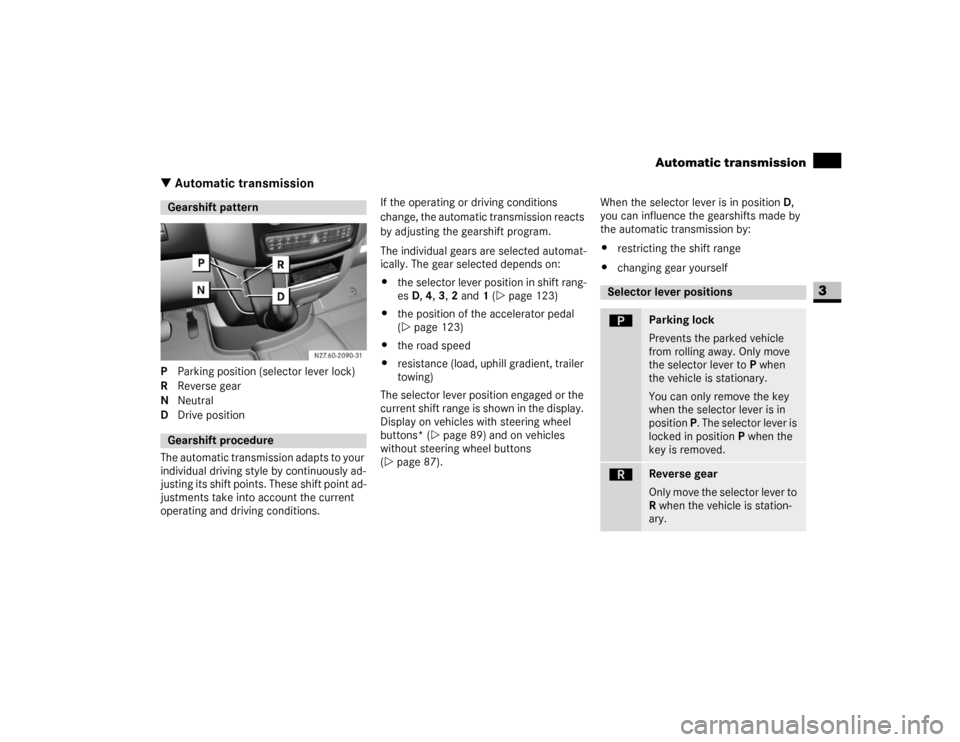
\3 Automatic transmissionP Parking position (selector lever lock)
R Reverse gear
N Neutral
D Drive position
The automatic transmission adapts to your
individual driving style by continuously ad-
justing its shift points. These shift point ad-
justments take into account the current
operating and driving conditions.If the operating or driving conditions
change, the automatic transmission reacts
by adjusting the gearshift program.
The individual gears are selected automat-
ically. The gear selected depends on:
\4the selector lever position in shift rang-
es D, 4, 3, 2 and 1 (\2page 123)
\4the position of the accelerator pedal
(\2page 123)
\4the road speed
\4resistance (load, uphill gradient, trailer
towing)
The selector lever position engaged or the
current shift range is shown in the display.
Display on vehicles with steering wheel
buttons* (\2page 89) and on vehicles
without steering wheel buttons
(\2page 87).When the selector lever is in position D,
you can influence the gearshifts made by
the automatic transmission by:
\4restricting the shift range
\4changing gear yourselfGearshift patternGearshift procedure
Selector lever positionsì
Parking lock
Prevents the parked vehicle
from rolling away. Only move
the selector lever to P when
the vehicle is stationary.
You can only remove the key
when the selector lever is in
position P. The selector lever is
locked in position P when the
key is removed.
í
Reverse gear
Only move the selector lever to
R when the vehicle is station-
ary.
Page 123 of 393
122 Controls in detailAutomatic transmission
3
When the selector lever is in position D,
you can perform gearshifts yourself, even
on vehicles with automatic transmission.
Downshifting
\1Press the selector lever to the left to-
wards D–.
The automatic transmission restricts
the shift range (\2page 123) by one
gear. The automatic transmission shifts
to the next gear down, depending on
the gear currently engaged.Upshifting
\1Press the selector lever to the right to-
wards D+.
The automatic transmission extends
the shift range by one gear. The auto-
matic transmission shifts to the next
gear up, depending on the current
gearshift program.
Derestricting the shift range
\1Press and hold the selector lever to-
wards D+ until
D is shown once more in
the display.
The automatic transmission shifts from
the current shift range directly to D.
ë
Neutral
No power is transmitted from
the engine to the drive wheels.
Releasing the brakes will allow
you to move the vehicle freely,
e.g. by pushing or towing.
Do not move the selector lever
to N while the vehicle is in mo-
tion. The automatic transmis-
sion could otherwise be
damaged.
If ASR is deactivated or ESP
®
has malfunctioned: only move
the selector lever to N if the ve-
hicle is in danger of skidding,
e.g. on icy roads.
ê
Drive
The automatic transmission
changes gear automatically. All
5 forward gears are available.
One-touch gearshifting Warning
G
Do not downshift for additional engine brak-
ing on a slippery surface. The drive wheels
may lose their grip and the vehicle could
skid.
iThe automatic transmission does not
shift down if you press the selector le-
ver towards D– and the speed of the
vehicle is too high. The engine could
otherwise overrev.
Page 127 of 393
126 Controls in detailGood visibility
3
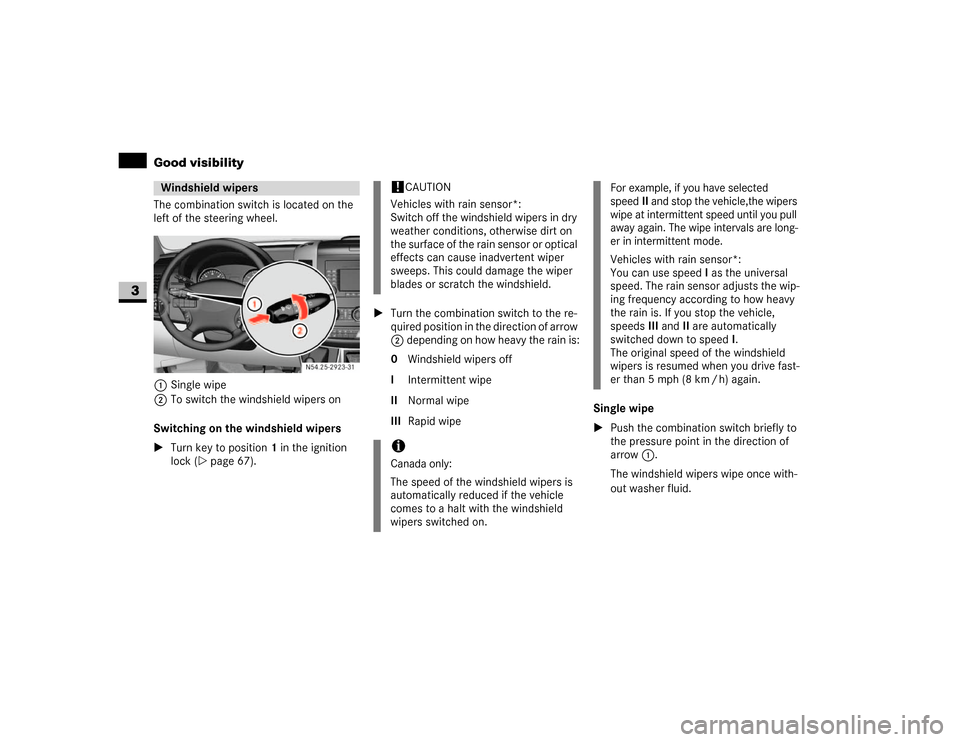
The combination switch is located on the
left of the steering wheel.
1Single wipe
2To switch the windshield wipers on
Switching on the windshield wipers
\1Turn key to position1 in the ignition
lock (\2page 67).\1Turn the combination switch to the re-
quired position in the direction of arrow
2 depending on how heavy the rain is:
0 Windshield wipers off
I Intermittent wipe
II Normal wipe
III Rapid wipeSingle wipe
\1Push the combination switch briefly to
the pressure point in the direction of
arrow1.
The windshield wipers wipe once with-
out washer fluid.Windshield wipers
N54.25-2923-31
!
CAUTION
Vehicles with rain sensor*:
Switch off the windshield wipers in dry
weather conditions, otherwise dirt on
the surface of the rain sensor or optical
effects can cause inadvertent wiper
sweeps. This could damage the wiper
blades or scratch the windshield.
iCanada only:
The speed of the windshield wipers is
automatically reduced if the vehicle
comes to a halt with the windshield
wipers switched on.
For example, if you have selected
speedII and stop the vehicle,the wipers
wipe at intermittent speed until you pull
away again. The wipe intervals are long-
er in intermittent mode.
Vehicles with rain sensor*:
You can use speedI as the universal
speed. The rain sensor adjusts the wip-
ing frequency according to how heavy
the rain is. If you stop the vehicle,
speedsIII andII are automatically
switched down to speedI.
The original speed of the windshield
wipers is resumed when you drive fast-
er than 5 mph (8 km / h) again.
Page 128 of 393
127 Controls in detail
Good visibility
3
Wiping with washer fluid
\1Press the combination switch beyond
the pressure point in the direction of
arrow1.
The windshield wiper will wipe with
windshield washer fluid.
Vehicles with headlamp cleaning sys-
tem*:
If the low-beam headlamps have been
switched on, a high-pressure water jet
also cleans the headlamps.
Intermittent wipe
Only switch on intermittent wipe in damp
weather conditions or when it is raining.
Vehicles with rain sensor*:
The a rain sensor is activated when you
switch on intermittent wipe. The appropri-
ate wiping frequency is set automatically
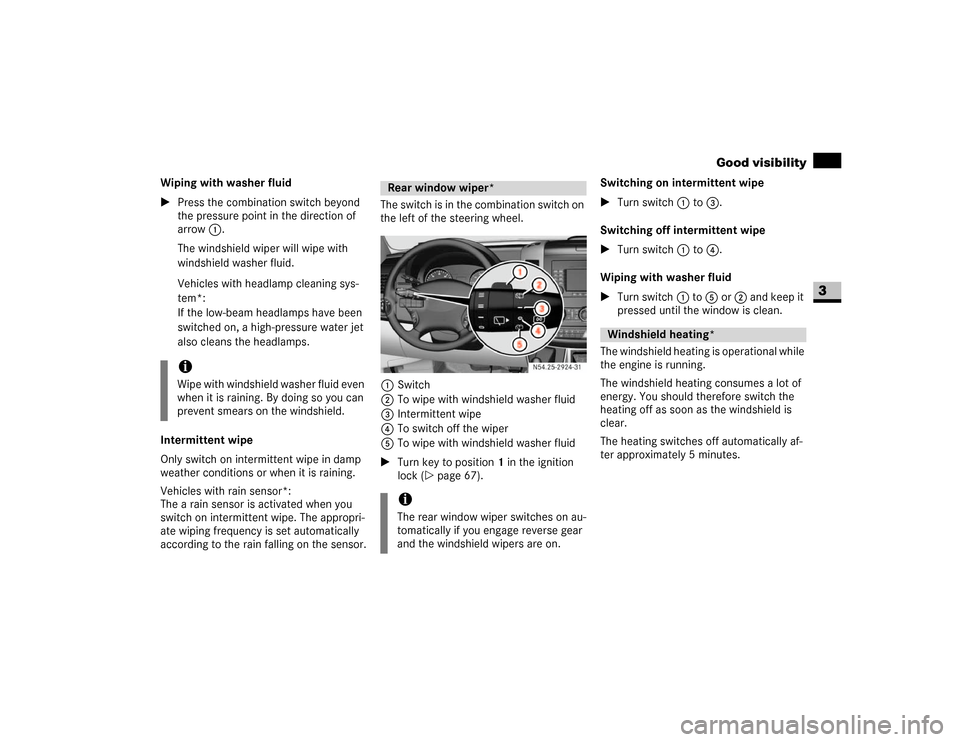
according to the rain falling on the sensor.The switch is in the combination switch on
the left of the steering wheel.
1Switch
2To wipe with windshield washer fluid
3Intermittent wipe
4To switch off the wiper
5To wipe with windshield washer fluid
\1Turn key to position1 in the ignition
lock (\2page 67).Switching on intermittent wipe
\1Turn switch1 to 3.
Switching off intermittent wipe
\1Turn switch1 to 4.
Wiping with washer fluid
\1Turn switch1 to 5or 2 and keep it
pressed until the window is clean.
The windshield heating is operational while
the engine is running.
The windshield heating consumes a lot of
energy. You should therefore switch the
heating off as soon as the windshield is
clear.
The heating switches off automatically af-
ter approximately 5 minutes.
iWipe with windshield washer fluid even
when it is raining. By doing so you can
prevent smears on the windshield.
Rear window wiper*iThe rear window wiper switches on au-
tomatically if you engage reverse gear
and the windshield wipers are on.
N54.25-2924-31
Windshield heating*
Page 131 of 393
130 Controls in detailTempmatic
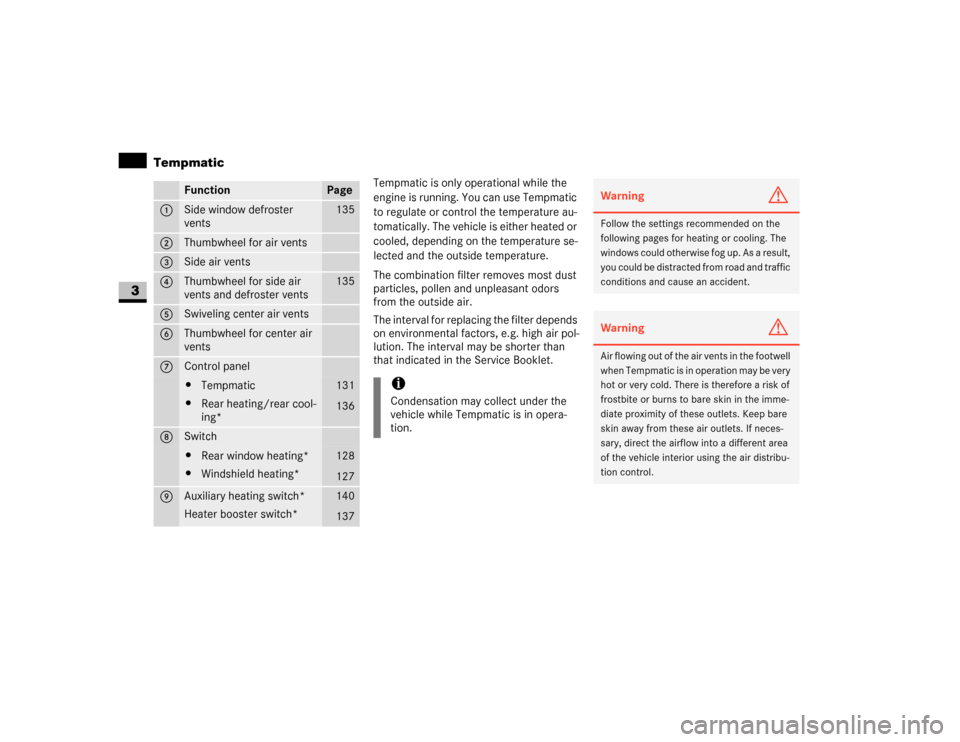
3
Tempmatic is only operational while the
engine is running. You can use Tempmatic
to regulate or control the temperature au-
tomatically. The vehicle is either heated or
cooled, depending on the temperature se-
lected and the outside temperature.
The combination filter removes most dust
particles, pollen and unpleasant odors
from the outside air.
The interval for replacing the filter depends
on environmental factors, e.g. high air pol-
lution. The interval may be shorter than
that indicated in the Service Booklet.
Function
Page
1
Side window defroster
vents
135
2
Thumbwheel for air vents
3
Side air vents
4
Thumbwheel for side air
vents and defroster vents
135
5
Swiveling center air vents
6
Thumbwheel for center air
vents
7
Control panel\4Tempmatic
\4Rear heating/rear cool-
ing*
131
136
8
Switch\4Rear window heating*
\4Windshield heating*
128
127
9
Auxiliary heating switch*
Heater booster switch*
140
137
iCondensation may collect under the
vehicle while Tempmatic is in opera-
tion.
Warning
G
Follow the settings recommended on the
following pages for heating or cooling. The
windows could otherwise fog up. As a result,
you could be distracted from road and traffic
conditions and cause an accident.Warning
G
Air flowing out of the air vents in the footwell
when Tempmatic is in operation may be very
hot or very cold. There is therefore a risk of
frostbite or burns to bare skin in the imme-
diate proximity of these outlets. Keep bare
skin away from these air outlets. If neces-
sary, direct the airflow into a different area
of the vehicle interior using the air distribu-
tion control.
Page 136 of 393
135 Controls in detail
Tempmatic
3
The indicator lamp in the switch comes
on.
\1Turn airflow control2 (\2page 131)
to a higher blower speed, but do not
turn the control below second speed.
\1Turn temperature selector control1
(\2page 131) to a higher temperature.
\1Turn air distribution control5
to‚P.
\1Close the center air vents and the air
outlets for the head area and the rear
compartment.
\1Open the side air vents and direct them
at the side windows.
\1If the windshield is fogged up on the
outside, switch on the windshield wip-
ers (\2page 126).Defrosting
The following settings can be used to clear
the windshield and the side windows, e.g.
if covered with frost.
\1Set temperature selector control 1 to
P.
\1Turn airflow control2 to fourth speed.
\1Turn air distribution control5
to‚P.
\1Close the center air vents and the air
vents for the head area and the rear
compartment.
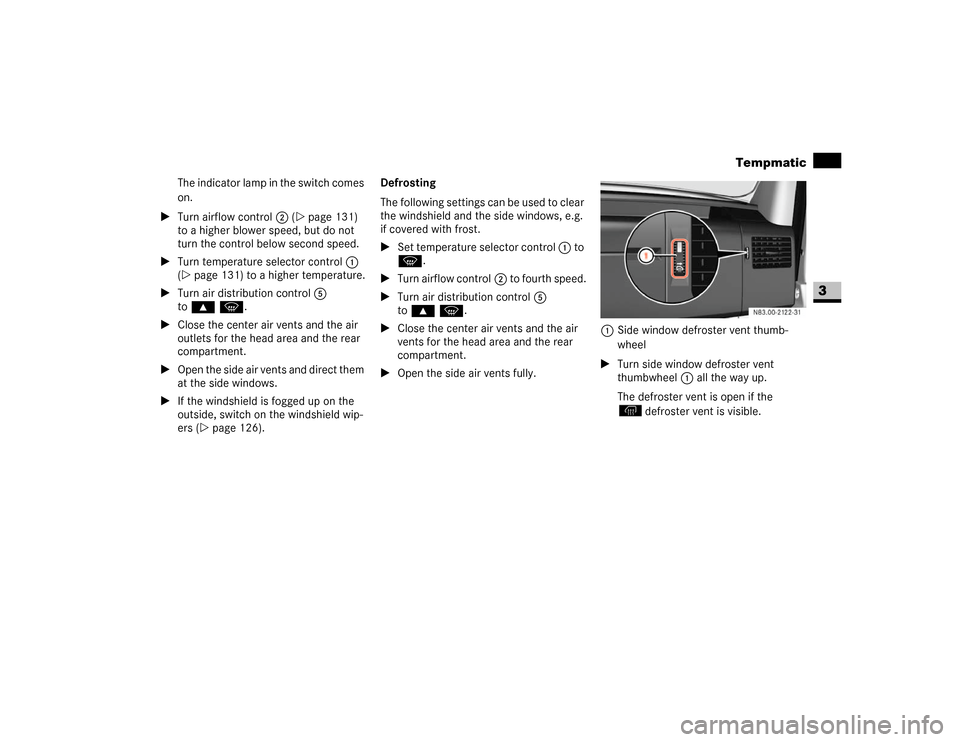
\1Open the side air vents fully.1Side window defroster vent thumb-
wheel
\1Turn side window defroster vent
thumbwheel1 all the way up.
The defroster vent is open if the
defroster vent is visible.
Page 138 of 393
137 Controls in detail
Tempmatic
3
\1To reduce: turn the temperature selec-
tor control counterclockwise.
Air vents in the roof air duct
Adjustable air vents are integrated in the
roof air duct.
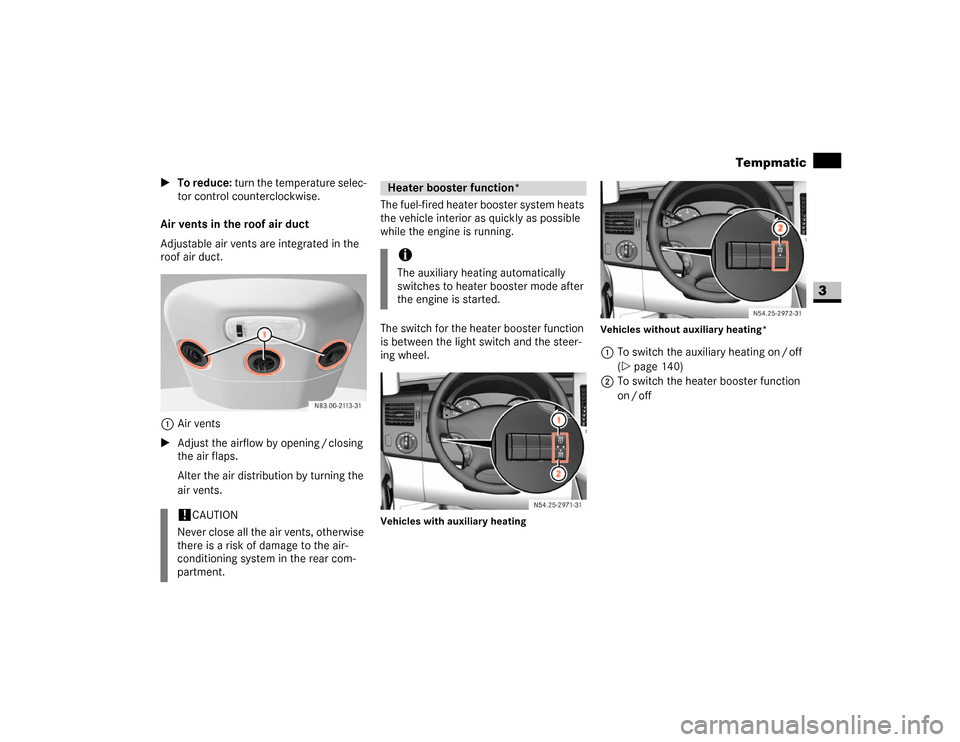
1Air vents
\1Adjust the airflow by opening / closing
the air flaps.
Alter the air distribution by turning the
air vents.The fuel-fired heater booster system heats
the vehicle interior as quickly as possible
while the engine is running.
The switch for the heater booster function
is between the light switch and the steer-
ing wheel.
Vehicles with auxiliary heatingVehicles without auxiliary heating*
1To switch the auxiliary heating on / off
(\2page 140)
2To switch the heater booster function
on / off
!
CAUTION
Never close all the air vents, otherwise
there is a risk of damage to the air-
conditioning system in the rear com-
partment.
Heater booster function*iThe auxiliary heating automatically
switches to heater booster mode after
the engine is started.
N54.25-2926-31
N54.25-2927-31
Page 141 of 393
140 Controls in detailAuxiliary heating/ventilation*
3
You can switch the auxiliary heating / ven-
tilation on and off immediately using:
\4the auxiliary heating / heater booster
switch (\2page 140)
\4the auxiliary heating remote control*
(\2page 141)
Before switching on
\1Adjust the heat output to the desired
temperature using the temperature
control (\2page 131).
\1Set the air distribution as required.Operation using the switch
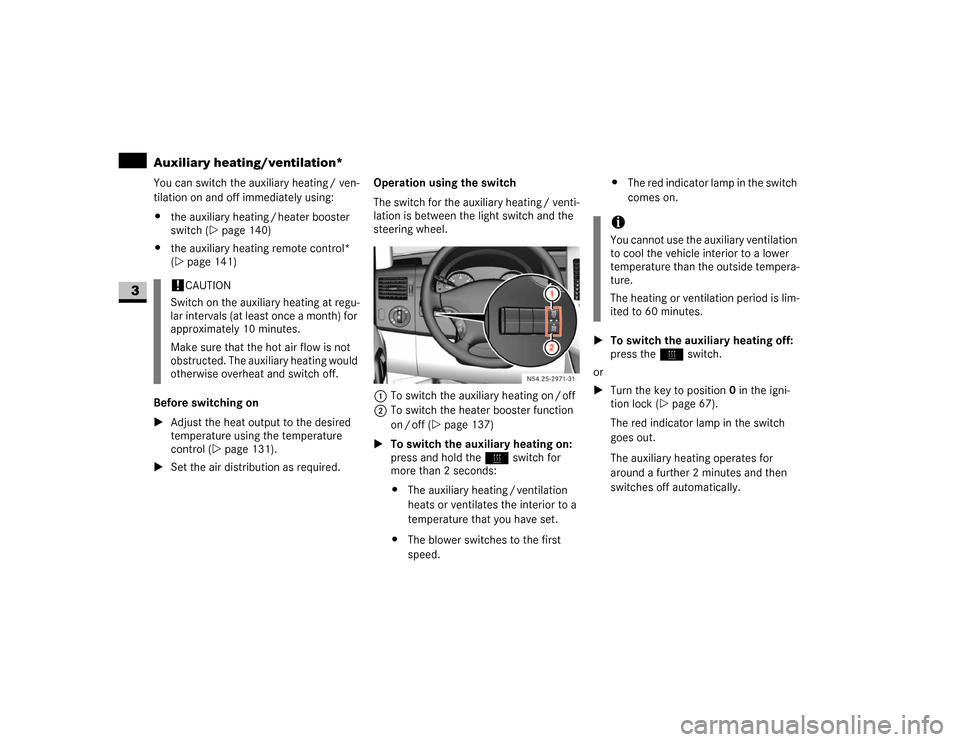
The switch for the auxiliary heating / venti-
lation is between the light switch and the
steering wheel.
1To switch the auxiliary heating on / off
2To switch the heater booster function
on / off (\2page 137)
\1To switch the auxiliary heating on:
press and hold theö switch for
more than 2 seconds:
\4The auxiliary heating / ventilation
heats or ventilates the interior to a
temperature that you have set.
\4The blower switches to the first
speed.\4The red indicator lamp in the switch
comes on.
\1To switch the auxiliary heating off:
press theö switch.
or
\1Turn the key to position0 in the igni-
tion lock (\2page 67).
The red indicator lamp in the switch
goes out.
The auxiliary heating operates for
around a further 2 minutes and then
switches off automatically.
!
CAUTION
Switch on the auxiliary heating at regu-
lar intervals (at least once a month) for
approximately 10 minutes.
Make sure that the hot air flow is not
obstructed. The auxiliary heating would
otherwise overheat and switch off.
N54.25-2928-31
iYou cannot use the auxiliary ventilation
to cool the vehicle interior to a lower
temperature than the outside tempera-
ture.
The heating or ventilation period is lim-
ited to 60 minutes.
Page 143 of 393
142 Controls in detailAuxiliary heating/ventilation*
3
Selecting a switch-on time
You can use the operating system to define
up to 3 switch-on times, one of which can
be selected to switch on the auxiliary
heating / ventilation.
Operating system without steering
wheel buttons
\1Switch on the ignition (\2page 67).
\1Press theö switch.
Theö symbol in the display flashes.
or
\1Press the menu button on the in-
strument cluster repeatedly until the
ö symbol in the display flashes.
\1Use the or button on the instru-
ment cluster to select desired switch-
on time
1 to
3.
The switch-on time selected is dis-
played.\1Wait 10 seconds for the standard dis-
play to appear.
The switch-on time is selected.
The yellow indicator lamp in theö
switch comes on.
If you have not selected a switch-on time
and
--:--
appears in the display, the auto-
matic switch-on is deactivated. The yellow
indicator lamp in theö switch goes
out.Operating system with steering wheel
buttons*
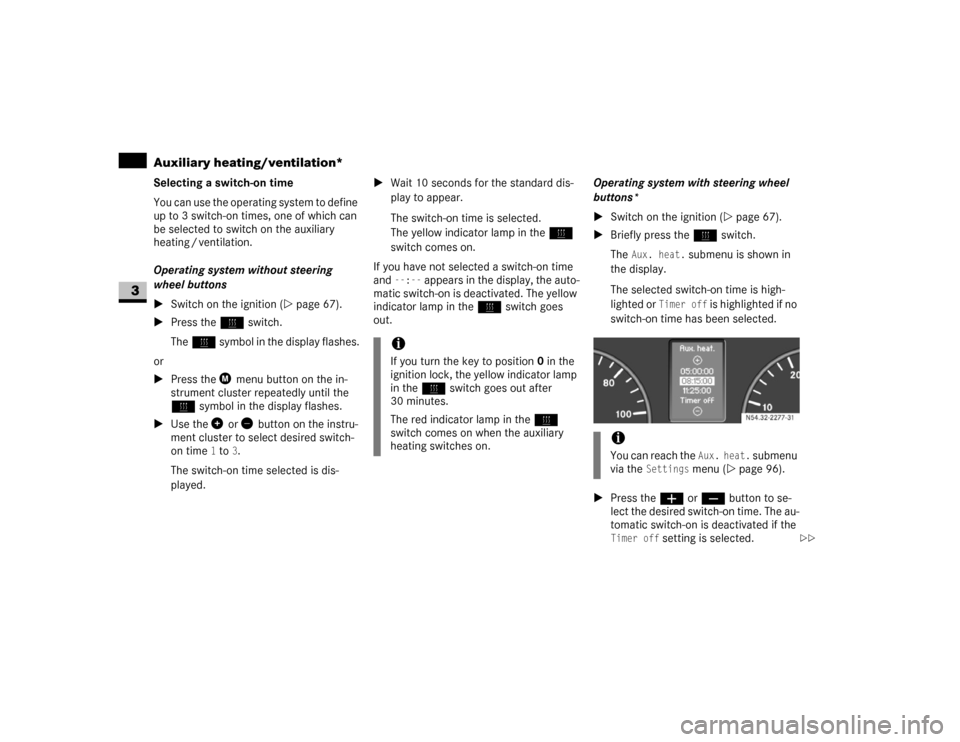
\1Switch on the ignition (\2page 67).
\1Briefly press theö switch.
The
Aux. heat.
submenu is shown in
the display.
The selected switch-on time is high-
lighted or
Timer off
is highlighted if no
switch-on time has been selected.
\1Press theæ orç button to se-
lect the desired switch-on time. The au-
tomatic switch-on is deactivated if the
Timer off
setting is selected.
iIf you turn the key to position0 in the
ignition lock, the yellow indicator lamp
in theö switch goes out after
30 minutes.
The red indicator lamp in theö
switch comes on when the auxiliary
heating switches on.
iYou can reach the
Aux. heat.
submenu
via the
Settings
menu (\2page 96).
N54.32-2277-31
\2\2