lock DODGE SPRINTER 2007 2.G Owners Manual
[x] Cancel search | Manufacturer: DODGE, Model Year: 2007, Model line: SPRINTER, Model: DODGE SPRINTER 2007 2.GPages: 393, PDF Size: 7.61 MB
Page 14 of 393
13 At a glance
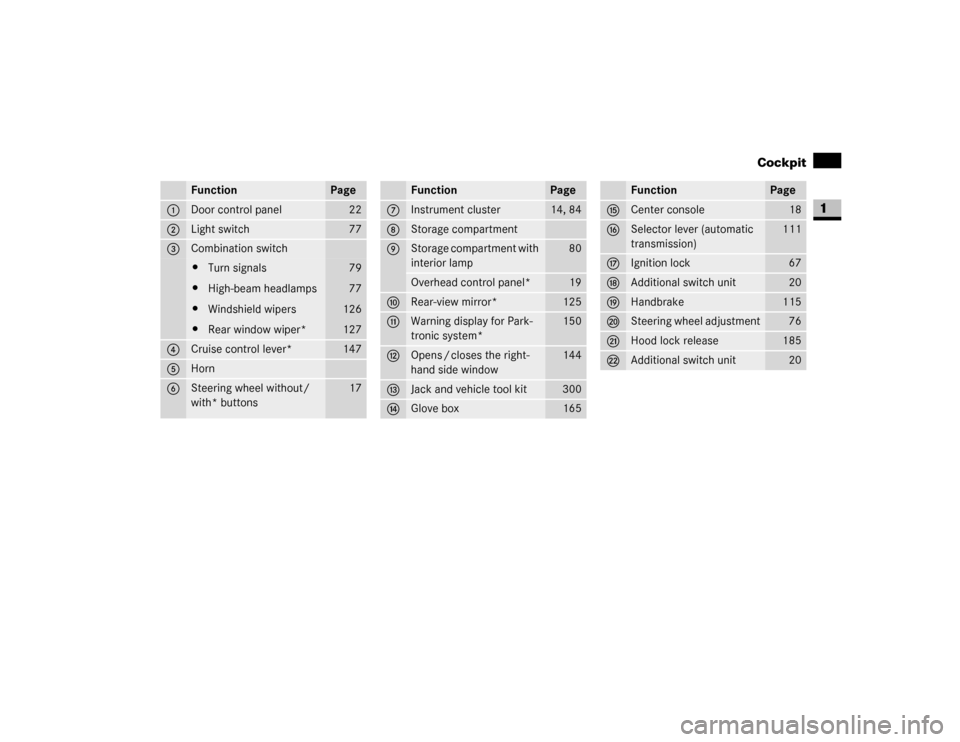
Cockpit
1
Function
Page
1
Door control panel
22
2
Light switch
77
3
Combination switch\4Turn signals
\4High-beam headlamps
\4Windshield wipers
\4Rear window wiper*
79
77
126
127
4
Cruise control lever*
147
5
Horn
6
Steering wheel without/
with* buttons
17
Function
Page
7
Instrument cluster
14, 84
8
Storage compartment
9
Storage compartment with
interior lamp
80
Overhead control panel*
19
a
Rear-view mirror*
125
b
Warning display for Park-
tronic system*
150
c
Opens / closes the right-
hand side window
144
d
Jack and vehicle tool kit
300
e
Glove box
165
Function
Page
f
Center console
18
g
Selector lever (automatic
transmission)
111
h
Ignition lock
67
j
Additional switch unit
20
k
Handbrake
115
l
Steering wheel adjustment
76
m
Hood lock release
185
n
Additional switch unit
20
Page 21 of 393
20 At a glanceSwitch units
1
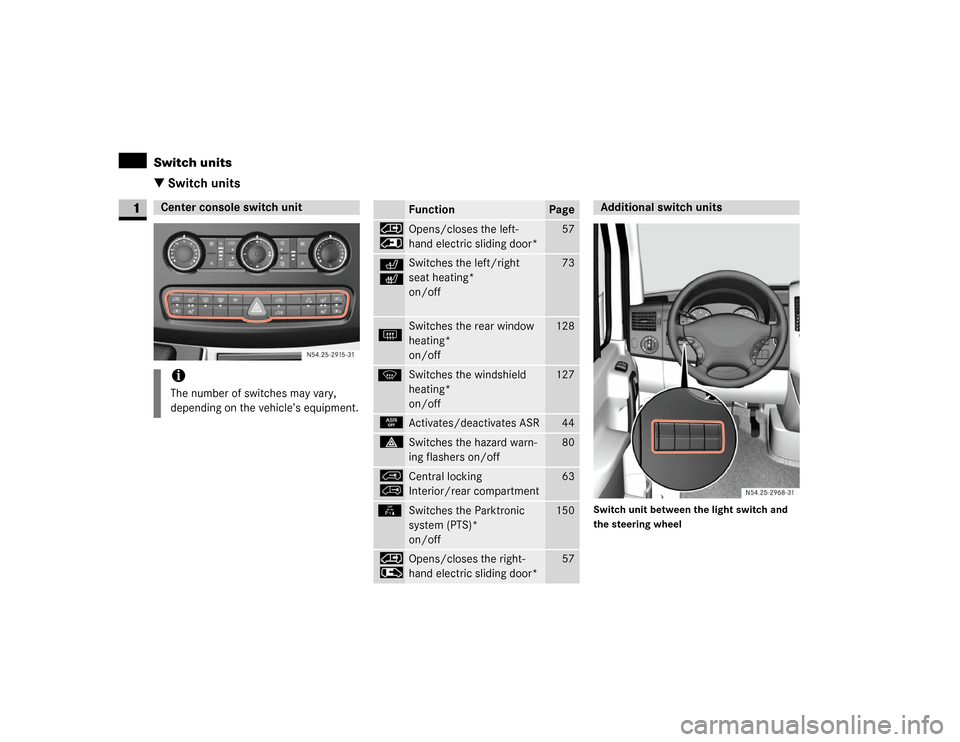
\3 Switch units
Switch unit between the light switch and
the steering wheel
Center console switch unitiThe number of switches may vary,
depending on the vehicle’s equipment.
N54.25-2915-31
Function
Page
Opens/closes the left-
hand electric sliding door*
57
&
Switches the left/right
seat heating*
on/off
73
Switches the rear window
heating*
on/off
128
P
Switches the windshield
heating*
on/off
127
Activates/deactivates ASR
44
Switches the hazard warn-
ing flashers on/off
80
Central locking
Interior/rear compartment
63
!
Switches the Parktronic
system (PTS)*
on/off
150
Opens/closes the right-
hand electric sliding door*
57
Additional switch units
N54.25-2913-31
Page 22 of 393
21 At a glance
Switch units
1
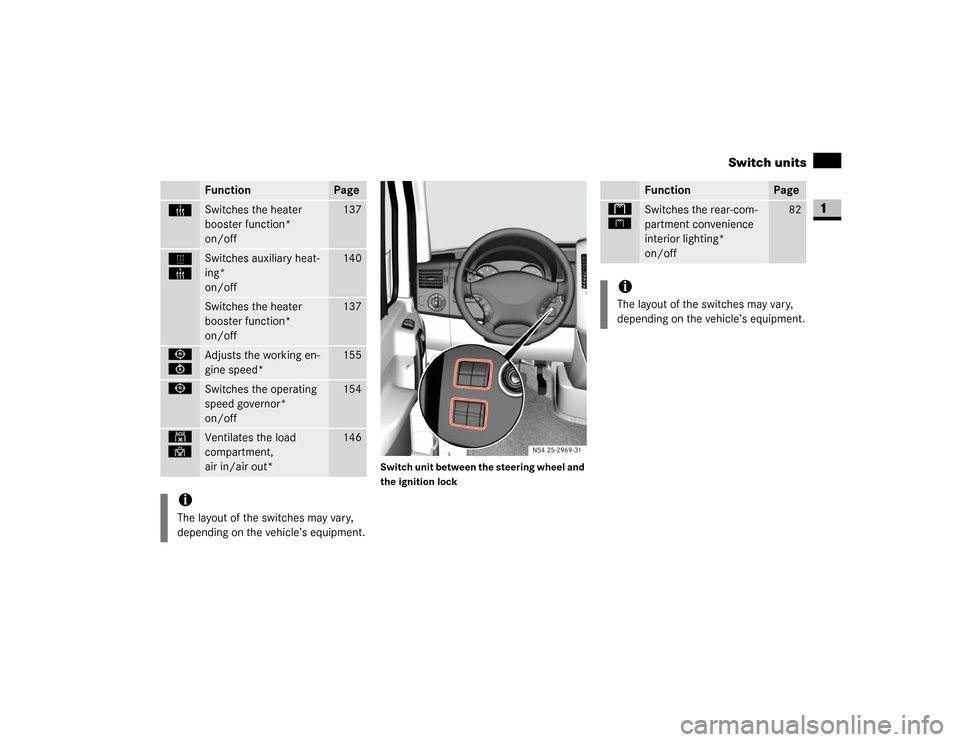
Switch unit between the steering wheel and
the ignition lock
Function
Page
³
Switches the heater
booster function*
on/off
137
ö
³
Switches auxiliary heat-
ing*
on/off
140
Switches the heater
booster function*
on/off
137
Adjusts the working en-
gine speed*
155
Switches the operating
speed governor*
on/off
154
Ventilates the load
compartment,
air in/air out*
146
iThe layout of the switches may vary,
depending on the vehicle’s equipment.
N54.25-2912-31
Function
Page
Switches the rear-com-
partment convenience
interior lighting*
on/off
82
iThe layout of the switches may vary,
depending on the vehicle’s equipment.
Page 38 of 393
37 Safety
Occupant safety
2
Child restraint systems
We recommend all infants and children be
properly restrained at all times while the
vehicle is in motion.
All lap-shoulder belts except the driver’s
seat belt have special seat belt retractors
for secure fastening of child restraints.
To fasten a child restraint, follow child re-
straint instructions for mounting. Then pull
the shoulder belt out completely and let it
retract. During seat belt retraction, a ratch-eting sound can be heard to indicate taht
the special seat belt retractor is activated.
The belt is now locked. push down on child
restraint to take up any slack.
To deactivate, release seat belt buckle and
let seat belt retract completely. The seat
belt can again be used in the usual
manner.Do not carry heavy or hard objects inside
the vehicle or load compartment unless they
are secured. You will find further information
under “Transporting156” (\2page 156) and
“Features164” (\2page 164) in the “Con-
trols in detail” section.
An unsecured or incorrectly positioned load
increases the risk of injury to occupants,
particularly children, in the event of:
\4sharp braking
\4a sudden change of direction
\4an accident
Warning
G
Never release the seat belt buckle while the
vehicle is in motion, since the special seat
belt retractor will be deactivated.Warning
G
To reduce the risk of serious or fatal injury to
a child in the event of an accident, sharp
braking or a sudden change in direction:
\4Always secure children less than 5 ft
(1.50 m) tall or under 12 years of age in
a special child restraint system installed
on a suitable vehicle seat, since the seat
belts are not designed for this body size.
\4Do not secure children under 12 years
of age on the co-driver’s seat unless
they are secured in a suitable forward-
facing child restraint system.
\4It is not permitted to secure a child in a
rearward-facing child restraint system
on the co-driver’s seat if the vehicle is
equipped with a co-driver’s airbag.
Only secure a rearward-facing child re-
straint system on a suitable rear seat.
\4Always move the co-driver’s seat to its
rearmost position if you have secured a
child on this seat in a forward-facing
child restraint system.
\4A child must never be carried sitting on
the lap of a vehicle occupant. It would
not be possible to restrain the child as a
result of the forces acting in the event of
an accident, braking or abrupt changes
in direction. The child would be thrown
against parts of the vehicle interior and
be seriously or fatally injured.
\4Vehicle occupants must wear their seat
belt correctly at all times.
Page 43 of 393
42 SafetyDriving safety systems
2
\3 Driving safety systemsIn this section, you will find information
about the following driving safety systems:
\4ABS (A
ntilock B
rake S
ystem)
\4BAS (B
rake As
sist)
\4ESP
® (E
lectronic S
tability P
rogram)
\4ASR (acceleration skid control)
\4EBV (electronic brake force distribu-
tion)ABS regulates the brake pressure in such a
way that the wheels do not lock when you
brake. This allows you to continue steering
when braking.
ABS works from a speed of about 3 mph
(5 km/h) upwards, regardless of road sur-
face conditions.
ABS works on slippery surfaces, even
when you only brake gently.
There is a malfunction if the - indicator
lamp is permanently lit while the engine is
running (\2page 271).
Despite this, the normal driving and brak-
ing functions remain available.
iThe maximum effect of ABS, BAS,
ESP
®, ASR and EBV can only be
achieved if you:
\4always drive with the correct tire
pressures adjusted according to
the load (\2page 210)
\4use winter tires (M+S tires) in win-
try conditions, with snow chains if
necessary
Warning
G
There is an increased risk of an accident if
you:
\4drive too fast, in particular when corner-
ing and on a wet or slippery road surface
\4drive too close to the vehicle in front
The driving safety systems described in this
section cannot reduce this risk and are un-
able to override the laws of physics.
Always adapt your driving style to the pre-
vailing road and weather conditions, and
maintain an adequately safe distance from
other road users as well as any obstacles on
the road.iOnly use wheels with the recommend-
ed tire sizes (\2page 367), otherwise
the driving safety systems will not work
correctly.
Antilock Brake System (ABS)Warning
G
Do not depress the brake pedal several
times in quick succession (pumping). De-
press the brake firmly and evenly. Pumping
the brake pedal may reduce the braking ef-
fect.
Page 44 of 393
43 Safety
Driving safety systems
2
Braking
If ABS intervenes during braking, you will
feel the steering wheel vibrate gently and
the brake pedal pulsate.
If ABS intervenes:
\1Continue to depress the brake pedal
firmly until the braking situation is over.
For full brake application:
\1Depress the brake pedal with maxi-
mum force.Brake Assist operates in emergency brak-
ing situations. If you depress the brake
pedal quickly, BAS automatically increases
the brake pressure, thereby reducing the
stopping distance.
\1Keep the brake pedal firmly depressed
until the emergency braking situation is
over.
ABS prevents the wheels from locking.
When you release the brake pedal, the
brakes will work as normal again. BAS is
deactivated.
Vehicles without steering wheel buttons:
There is a malfunction if thek indicator
lamp is permanently lit while the engine is
running (\2page 270).ESP
® monitors driving stability and detects
a tendency of the vehicle to understeer or
oversteer (skidding). ESP
® stabilizes the
vehicle by braking individual wheels, limit-
ing the engine power output, and greatly
assists you when driving on wet or slippery
road surfaces. ESP
® also stabilizes the ve-
hicle when braking.
When ESP
® intervenes, thev warning
lamp in the speedometer flashes.
Warning
G
Always adapt your driving style to the pre-
vailing road and weather conditions, and
maintain an adequately safe distance from
other road users as well as any obstacles on
the road.
If ABS malfunctions, the wheels could lock
when you brake. This means that the steer-
ability of the vehicle is restricted during
braking and the stopping distance may in-
crease. If ABS is deactivated due to a mal-
function, BAS is also deactivated.Brake Assist (BAS)
Warning
G
If BAS malfunctions, the brake system is still
available with the full brake boosting effect.
In an emergency braking situation, however,
the braking force will not be additionally
boosted automatically and the stopping dis-
tance may increase.Electronic Stability Program (ESP
®)
Page 45 of 393
44 SafetyDriving safety systems
2
There is a malfunction if the # indicator
lamp is permanently lit while the engine is
running (\2page 272).
If ESP
® malfunctions, engine power output
may be reduced.ASR improves traction for a sustained peri-
od, i.e. the transfer of power from the tires
to the road surface, and thus also improves
the driving stability of the vehicle. ASR as-
sists you when pulling away and accelerat-
ing, especially on smooth and slippery
surfaces.
ASR brakes individual drive wheels and
limits the engine torque to prevent the
drive wheels from spinning. When ASR in-
tervenes, thev indicator lamp in the
speedometer flashes.
If the road surface is not capable of provid-
ing sufficient traction, bearing in mind the
tires, load and gradient, it is not be possi-
ble to pull away smoothly even with ASR.
Vehicles without steering wheel buttons:
There is a malfunction if thek indicator
lamp is permanently lit while the engine is
running (\2page 270).
If ASR malfunctions, engine power output
may be reduced.
Warning
G
Proceed as follows if the v warning lamp
in the speedometer flashes:
\4Do not deactivate ASR under any cir-
cumstances.
\4Only depress the accelerator pedal as
far as necessary when pulling away.
\4Adapt your driving style to suit the pre-
vailing road and weather conditions.
Otherwise, the vehicle could begin to skid.
ESP
® cannot reduce the risk of an accident
if you drive too fast. ESP
® is unable to over-
ride the laws of physics.
!
CAUTION
Only operate the vehicle briefly (maxi-
mum of 10 seconds) on a brake dyna-
mometer. The key must be turned to
position1 in the ignition lock during
this time. You could damage the drive
train or the brake system.
!
CAUTION
Do not operate the vehicle on a roller
dynamometer (for example for perfor-
mance testing). If you wish to operate
the vehicle on a roller dynamometer,
please consult an authorized Sprinter
Dealer beforehand. You could other-
wise damage the drive train or the
brake system.
Acceleration skid control (ASR)
Page 47 of 393
46 SafetyDriving safety systems
2
EBV monitors and regulates the brake
pressure at the rear wheels to improve
driving stability during braking.There is a malfunction if the #, k,
- and indicator lamps are perma-
nently lit while the engine is running
(\2page 268). Electronic brake force distribution
(EBV)Warning
G
If EBV malfunctions, the brake system is still
available with the full brake boosting effect.
However, the rear wheels may lock, for ex-
ample if the brakes are applied with maxi-
mum force. You could then lose control of
the vehicle and cause an accident. Always
adapt your driving style to the change in
handling characteristics.
Have the system checked at an authorized
Sprinter Dealer as soon as possible.
Page 48 of 393
47 Safety
Anti-theft systems
2
\3 Anti-theft systemsThe immobilizer prevents the vehicle from
being started without the correct key.
When leaving the vehicle, always take the
key or remote keyless entry transmitter
with you and lock the vehicle. The engine
could be started by anyone with a valid key
or remote keyless entry transmitter that is
left inside the vehicle
\1To switch on: remove the key from the
ignition lock (\2page 67).
\1To switch off: switch on the ignition
(\2page 67).A visual and audible alarm is triggered if
the alarm system is enabled and:
\4a door is opened
\4the hood is opened
Enabling the alarm system
\1Close all the doors.
\1Lock the vehicle using the‹ button
on the key (\2page 52).
The indicator lamp in the central lock-
ing switch (\2page 63) flashes.
Deactivating the anti-theft alarm sys-
tem
\1Unlock the vehicle using theΠbut-
ton on the key (\2page 52).
The indicator lamp in the central lock-
ing switch (\2page 63) goes out.Switching off the alarm
\1Insert the key into the ignition lock.
or
\1Press theΠbutton (\2page 52).
The alarm is switched off.Immobilizer
Anti-theft alarm system (ATA)*
iThe vehicle locks again automatically if
you do not open a door within 40 sec-
onds after unlocking the vehicle.iThe alarm system will be triggered if
the vehicle has been locked with the
key and is then unlocked from the in-
side.
Page 49 of 393
48 SafetyAnti-theft systems
2
A visual and audible alarm is triggered if
the inclination of the vehicle changes while
tow-away protection is enabled.
Enabling tow-away protection
Tow-away protection is automatically en-
abled approximately 20 seconds after you
lock the vehicle.
Tow-away protection is automatically de-
activated when you unlock the vehicle.Deactivating the tow-away protection
for transportation
Deactivate tow-away protection if the vehi-
cle is transported or loaded onto another
vehicle. This will prevent false alarms.
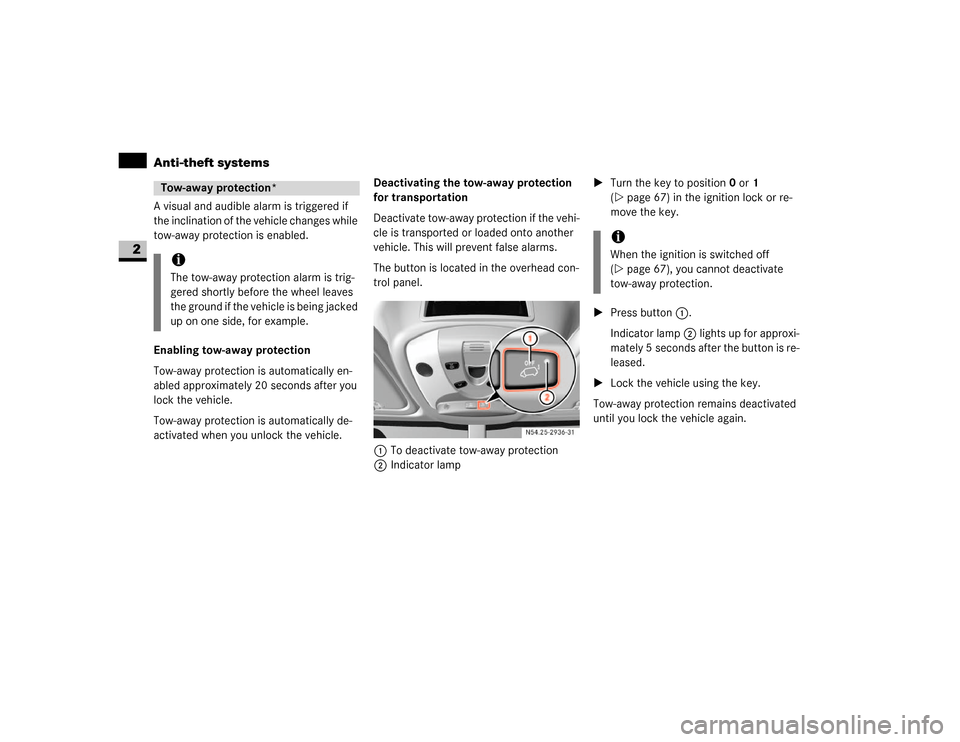
The button is located in the overhead con-
trol panel.
1To deactivate tow-away protection
2Indicator lamp\1Turn the key to position0 or1
(\2page 67) in the ignition lock or re-
move the key.
\1Press button1.
Indicator lamp2 lights up for approxi-
mately 5 seconds after the button is re-
leased.
\1Lock the vehicle using the key.
Tow-away protection remains deactivated
until you lock the vehicle again.Tow-away protection*iThe tow-away protection alarm is trig-
gered shortly before the wheel leaves
the ground if the vehicle is being jacked
up on one side, for example.
iWhen the ignition is switched off
(\2page 67), you cannot deactivate
tow-away protection.