wheel size DODGE SPRINTER 2008 2.G User Guide
[x] Cancel search | Manufacturer: DODGE, Model Year: 2008, Model line: SPRINTER, Model: DODGE SPRINTER 2008 2.GPages: 666, PDF Size: 14.11 MB
Page 379 of 666
377 Operation
Tires and wheels
4
Warning
G
Each tire, including the spare (if provided),
should be checked monthly when cold
and inflated to the inflation pressure rec-
ommended by the vehicle manufacturer
on the vehicle placard or the tire inflation
pressure label. (If your vehicle has tires of
a different size than the size indicated on
the vehicle placard or the tire inflation
pressure label, you should determine the
proper tire inflation pressure for those
tires).
Continued
Warning (Continued)
G
As an added safety feature, your vehicle
has been equipped with a Tire Pressure
Monitoring System (TPMS) that illumi-
nates a low tire pressure telltale when one
or more of your tires is significantly under-
inflated. Accordingly, when the low tire
pressure telltale illuminates, you should
stop and check your tires as soon as pos-
sible, and inflate them to the proper pres-
sure. Driving on a significantly
underinflated tire causes the tire to over-
heat and can lead to tire failure.
Continued
Warning (Continued)
G
Underinflation also reduces fuel efficiency
and tire tread life, and may affect the ve-
hicle’s handling and stopping ability.
Please note that the TPMS is not a substi-
tute for proper tire maintenance, and it is
the driver’s responsibility to maintain cor-
rect tire pressure, even if underinflation
has not reached the level to trigger illumi-
nation of the TPMS low tire pressure tell-
tale.
Continued
nf_BA.book Page 377 Friday, January 25, 2008 3:53 PM
Page 384 of 666
382 OperationTires and wheels
4
3. Ride comfort and vehicle stabilityProper tire inflation contributes to a
comfortable ride. Overinflation produces
a jarring and uncomfortable ride.
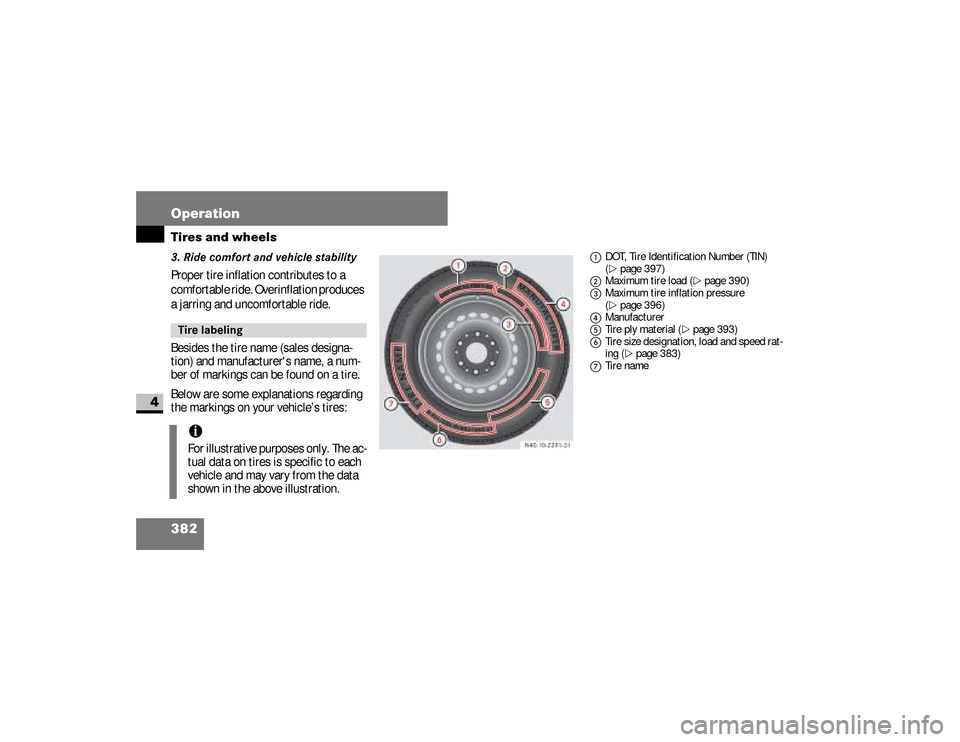
Besides the tire name (sales designa-
tion) and manufacturer's name, a num-
ber of markings can be found on a tire.
Below are some explanations regarding
the markings on your vehicle’s tires:
1DOT, Tire Identification Number (TIN)
(\2page 397)
2Maximum tire load (\2page 390)
3Maximum tire inflation pressure
(\2page 396)
4Manufacturer
5Tire ply material (\2page 393)
6Tire size designation, load and speed rat-
ing (\2page 383)
7Tire name
Tire labelingiFor illustrative purposes only. The ac-
tual data on tires is specific to each
vehicle and may vary from the data
shown in the above illustration.
nf_BA.book Page 382 Friday, January 25, 2008 3:53 PM
Page 385 of 666
383 Operation
Tires and wheels
4
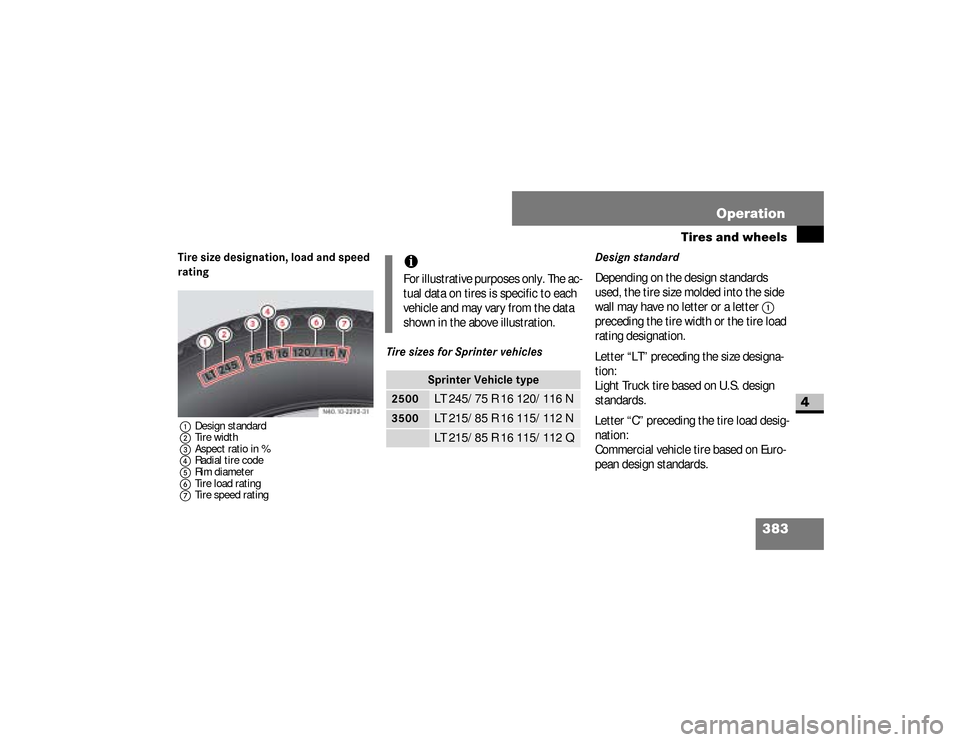
Tire size designation, load and speed
rating1Design standard
2Tire width
3Aspect ratio in %
4Radial tire code
5Rim diameter
6Tire load rating
7Tire speed rating
Tire sizes for Sprinter vehiclesDesign standard
Depending on the design standards
used, the tire size molded into the side
wall may have no letter or a letter
1
preceding the tire width or the tire load
rating designation.
Letter “LT” preceding the size designa-
tion:
Light Truck tire based on U.S. design
standards.
Letter “C” preceding the tire load desig-
nation:
Commercial vehicle tire based on Euro-
pean design standards.
iFor illustrative purposes only. The ac-
tual data on tires is specific to each
vehicle and may vary from the data
shown in the above illustration.
Sprinter Vehicle type
2500
LT 245/75 R 16 120/116 N
3500
LT 215/85 R 16 115/112 NLT 215/85 R 16 115/112 Q
nf_BA.book Page 383 Friday, January 25, 2008 3:53 PM
Page 387 of 666
385 Operation
Tires and wheels
4
The commercial vehicle tires based on
European standards may have an addi-
tional value in the parentheses (as illus-
trated). In such cases, the value
preceding the parentheses is valid for
European countries and the parenthe-
sized for the USA and Canada.
Refer also to "Maximum tire load"
(\2
page 390) where the maximum load
associated with the load index is indicat-
ed in kg and lbs.
Warning
G
The tire load rating must always be at
least half of the GAWR of your vehicle.
Otherwise, tire failure may be the result
which may cause an accident and/or se-
rious personal injury to you or others.
Always replace rims and tires with the
same designation, manufacturer and type
as shown on the original part.
Warning
G
Do not overload the tires by exceeding the
specified load limit as indicated on the
placard located on the driver’s door B-pil-
lar. Overloading the tires can overheat
them, possibly causing a blowout. Over-
loading the tires can also result in han-
dling or steering problems, or brake
failure.iTire load rating
6
and tire speed
rating
7
are also referred to as “ser-
vice description”.
nf_BA.book Page 385 Friday, January 25, 2008 3:53 PM
Page 388 of 666
386 OperationTires and wheels
4
Tire speed ratingThe tire speed rating
6
indicates the
approved maximum speed for the tire.
The commercial vehicle tires based on
European standards may have an addi-
tional index in the parentheses. In such
cases, the index preceding the paren-
theses is valid for European countries
and the parenthesized for the USA and
Canada.
Warning
G
Even when permitted by law, never oper-
ate a vehicle at speeds greater than the
maximum speed rating of the tires.
Exceeding the maximum speed for which
tires are rated can lead to sudden tire fail-
ure, causing loss of vehicle control and
possibly resulting in an accident and/or
personal injury and possible death, for
you and for others.
iAlways observe the speed rating of
the winter tires installed on your
Sprinter vehicle. If the maximum
speed for which your tires are rated
is below the speed rating of your
Sprinter vehicle, you must place a
notice to this effect where it will be
seen by the driver.
Such notices are available at your
tire dealer or any authorized Sprinter
Dealer.
nf_BA.book Page 386 Friday, January 25, 2008 3:53 PM
Page 389 of 666
387 Operation
Tires and wheels
4
U.S. tire regulations require each new
tire manufacturer or tire retreader to
mold a TIN into or onto a side wall of
each tire produced.The TIN is a unique identifier which facil-
itates efforts by tire manufactures to no-
tify purchasers in recall situations or
other safety matters concerning tires
and gives purchasers the means to easi-
ly identify such tires.
The TIN is comprised of the “manufac-
turer’s identification mark”, “tire size”,
“tire type code” and “date of manufac-
ture”.
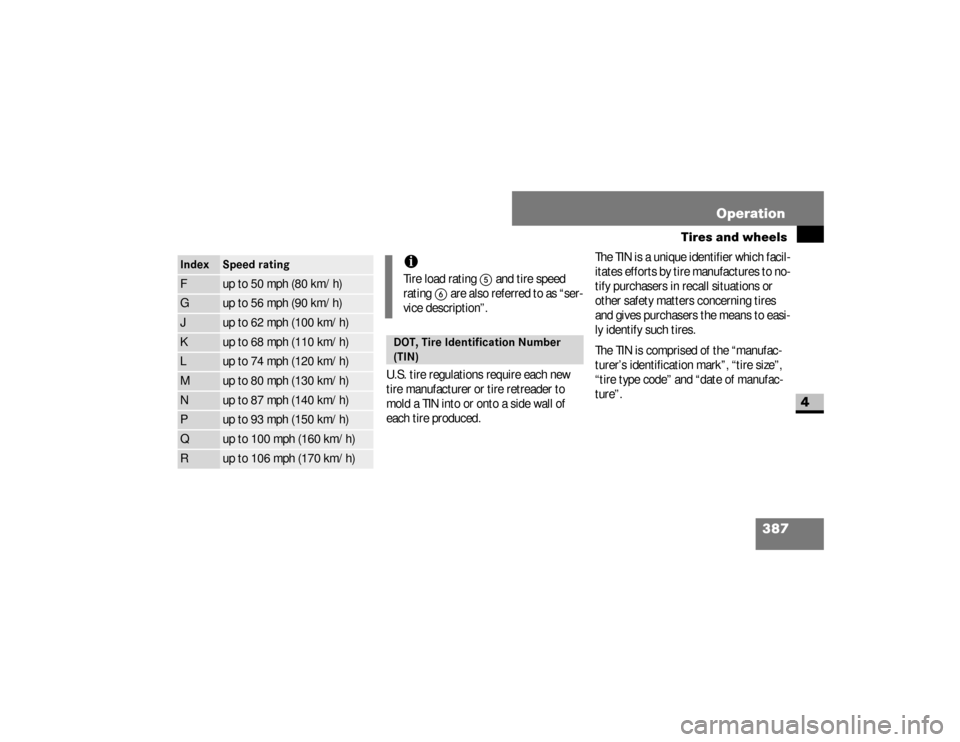
Index
Speed rating
F
up to 50 mph (80 km/h)
G
up to 56 mph (90 km/h)
J
up to 62 mph (100 km/h)
K
up to 68 mph (110 km/h)
L
up to 74 mph (120 km/h)
M
up to 80 mph (130 km/h)
N
up to 87 mph (140 km/h)
P
up to 93 mph (150 km/h)
Q
up to 100 mph (160 km/h)
R
up to 106 mph (170 km/h)
iTire load rating
5
and tire speed
rating
6
are also referred to as “ser-
vice description”.
DOT, Tire Identification Number
(TIN)
nf_BA.book Page 387 Friday, January 25, 2008 3:53 PM
Page 390 of 666
388 OperationTires and wheels
4
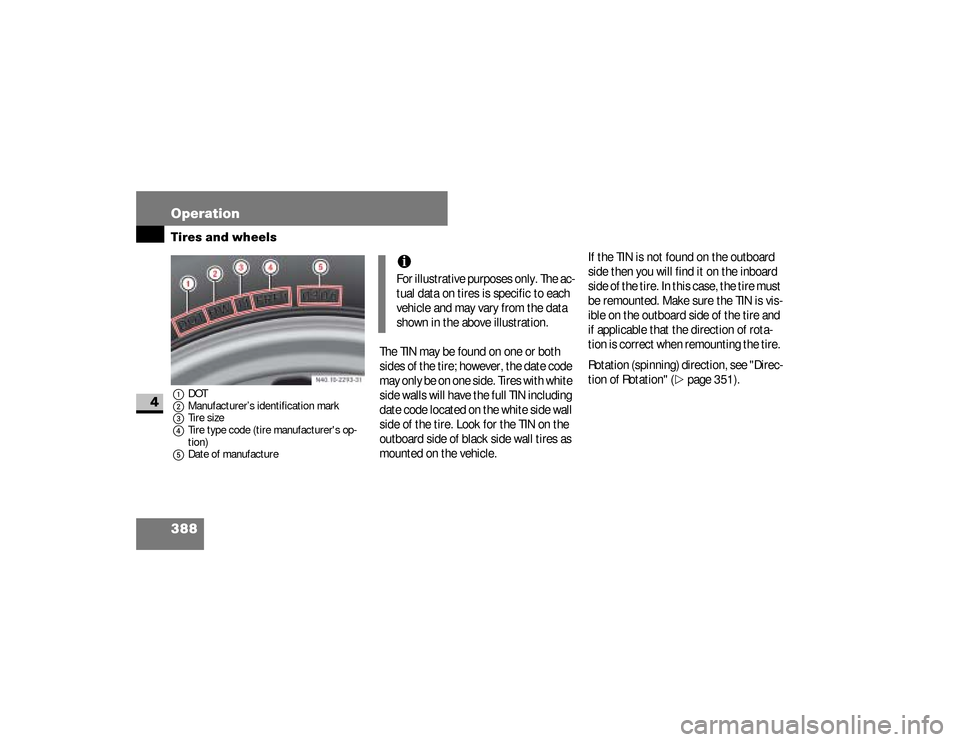
1DOT
2Manufacturer’s identification mark
3Tire size
4Tire type code (tire manufacturer's op-
tion)
5Date of manufacture
The TIN may be found on one or both
sides of the tire; however, the date code
may only be on one side. Tires with white
side walls will have the full TIN including
date code located on the white side wall
side of the tire. Look for the TIN on the
outboard side of black side wall tires as
mounted on the vehicle.If the TIN is not found on the outboard
side then you will find it on the inboard
side of the tire. In this case, the tire must
be remounted. Make sure the TIN is vis-
ible on the outboard side of the tire and
if applicable that the direction of rota-
tion is correct when remounting the tire.
Rotation (spinning) direction, see "Direc-
tion of Rotation" (
\2
page 351).
iFor illustrative purposes only. The ac-
tual data on tires is specific to each
vehicle and may vary from the data
shown in the above illustration.
nf_BA.book Page 388 Friday, January 25, 2008 3:53 PM
Page 391 of 666
389 Operation
Tires and wheels
4
DOT (D
epartment O
f T
ransportation)
A tire branding symbol
1
which de-
notes the tire meets requirements of the
U.S. Department of Transportation.
Manufacturer’s identification markThe manufacturer’s identification
mark
2
denotes the tire manufacturer.
New tires have a mark with two symbols.
Retreaded tires have a mark with four
symbols. For more information on re-
treaded tires, see (
\2
page 341).
Tire sizeThe code
3
indicates the tire size.
Tire type codeThe code
4
may, as the manufacturer's
option, be used as a descriptive code for
identifying significant characteristics of
the tire.
Date of manufactureThe date of manufacture
5
identifies
the week and year of manufacture.
The first two figures identify the week,
starting with “01” to represent the first
full week of the calendar year. The sec-
ond two figures represent the year.
For example, "031" could represent the
3rd week of 1981 or 1991.If the date of manufacture code indicat-
ed on the tire is less than 4 figures, do
not use it.
iPrior to July 2000, tire manufactur-
ers were only required to have 1
number to represent the year in
which the tire was manufactured.
For example, "031" could represent
the 3rd week of 1981 or 1991.
nf_BA.book Page 389 Friday, January 25, 2008 3:53 PM
Page 393 of 666
391 Operation
Tires and wheels
4
For more information on tire load rating,
refer to "Tire size designation, load and
speed rating" (
\2
page 383).
For information on calculating total and
cargo load capacities, refer to "Tire and
loading information" (
\2
page 352).
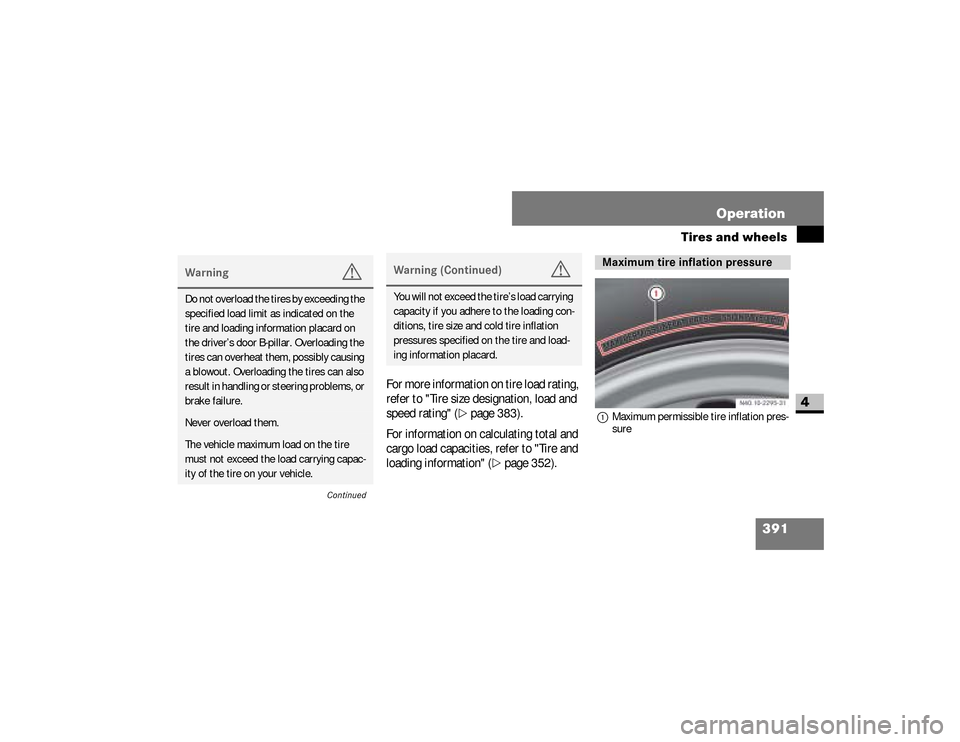
1Maximum permissible tire inflation pres-
sure
Warning
G
Do not overload the tires by exceeding the
specified load limit as indicated on the
tire and loading information placard on
the driver’s door B-pillar. Overloading the
tires can overheat them, possibly causing
a blowout. Overloading the tires can also
result in handling or steering problems, or
brake failure.Never overload them.The vehicle maximum load on the tire
must not exceed the load carrying capac-
ity of the tire on your vehicle.
Continued
Warning (Continued)
G
You will not exceed the tire’s load carrying
capacity if you adhere to the loading con-
ditions, tire size and cold tire inflation
pressures specified on the tire and load-
ing information placard.
Maximum tire inflation pressure
nf_BA.book Page 391 Friday, January 25, 2008 3:53 PM
Page 399 of 666
397 Operation
Tires and wheels
4
Production options weightThe combined weight of those installed
regular production options weighing
over 5 lbs (2.3 kg) in excess of those
standard items which they replace, not
previously considered in curb weight or
accessory weight, including heavy duty
brakes, ride levelers, roof rack, heavy
duty battery, and special trim.PSI (P
ounds per S
quare I
nch)
A standard unit of measure for air pres-
sure. Another metric unit for air pres-
sure is bar or kilopascal (kPa).
Recommended tire inflation pressureRecommended tire inflation pressure for
normal driving conditions listed on the
tire and loading information placard
1 or
on the tire inflation pressure placard lo-
cated on the driver’s door B-pillar.
Provides best handling, tread life and
riding comfort.
RimA metal support for a tire or a tire and
tube assembly upon which the tire
beads are seated.
Side wallThe portion of a tire between the tread
and the bead.TIN (T
ire I
dentification N
umber)
Unique identifier which facilitates efforts
by tire manufacturers to notify purchas-
ers in recall situations or other safety
matters concerning tires and gives pur-
chases the means to easily identify such
tires. The TIN is comprised of the “man-
ufacturer’s identification mark”, “tire
size”, “tire type code” and “date of man-
ufacture”.
1. For vehicles with a gross weight capacity less
than 10 000 lbs (4 536 kg) (USA only).
nf_BA.book Page 397 Friday, January 25, 2008 3:53 PM