ECU DODGE SPRINTER 2008 2.G Owner's Manual
[x] Cancel search | Manufacturer: DODGE, Model Year: 2008, Model line: SPRINTER, Model: DODGE SPRINTER 2008 2.GPages: 666, PDF Size: 14.11 MB
Page 208 of 666
206 Controls in detailAutomatic transmission
3
Kickdown
Use kickdown for maximum acceleration.\1
Depress the accelerator pedal be-
yond the pressure point.
The automatic transmission shifts to
the next gear down, depending on
the engine speed.
\1
Release the accelerator pedal as
soon as the desired speed has been
reached.
The automatic transmission shifts up
again.
StoppingIf you are only stopping briefly:\1
leave the selector lever in the drive
position
\1
secure the vehicle against rolling
away using the brake pedal
ManeuveringManeuvering in a tight space:\1
Control the speed by braking carefully.
\1
Accelerate only slightly and avoid
jolting.iFor rapid maneuvering (e.g. to rock
the vehicle out of snow or slush), you
can shift back and forth between
drive position
D and reverse gear
R
at low speeds without applying the
brakes.
nf_BA.book Page 206 Friday, January 25, 2008 3:53 PM
Page 278 of 666
276 Controls in detailTransporting
3
\3 TransportingLoading guidelinesWarning
G
Secure and position a load as described in
the loading guidelines. Otherwise, the
load could slide or be thrown around in
the event of strong braking maneuvers,
sudden changes of direction or poor road
conditions, thereby injuring you or others.
The same applies to dismantled seats if
left inside the vehicle.Please note that loads increase the risk of
injury during an accident even if you com-
ply with all loading guidelines.Observe the notes in the "Securing a load"
section (\2page 280).
Warning
G
Do not exceed the vehicle's permissible
gross weight or the permissible axle loads
when loading the vehicle or carrying addi-
tional passengers. If you exceed the vehicle's permissible
axle loads or the maximum permissible
gross weight when transporting items or
carrying passengers, tire stability and
driving safety are reduced. The vehicle's
driving and steering characteristics would
be greatly altered. Braking and stopping
distances would be significantly longer.
Continued
Warning (Continued)
G
Your vehicle's driving, steering and brak-
ing characteristics change as the vehi-
cle's gross weight increases or its center
of gravity is raised.Always ensure that loads are distributed
correctly and adapt your driving style in
accordance with the load.
nf_BA.book Page 276 Friday, January 25, 2008 3:53 PM
Page 279 of 666
277 Controls in detail
Transporting
3
For more information about the maxi-
mum roof load and roof carrier systems,
please refer to the "Technical data" sec-
tion (
\2
page 599).
Before loading
\1
Check the tire pressures and correct
them if necessary (
\2
page 365).
\1
Clean the load compartment floor.
The load compartment floor must be
dry, cleanly swept and free of oil and
dust to reduce the risk of the load
slipping.
\1
If necessary, place anti-slip mats on
the load compartment floor.
Warning
G
After an accident, have a damaged load
compartment floor or damaged load sur-
face, the lashing eyes and lashing materi-
als inspected by a specialist workshop
having the necessary technical expertise
and tools to carry out the required work. The manufacturer recommends that you
use an authorized Sprinter Dealer for this
purpose. In particular, work relevant to
safety or on safety-related systems must
be carried out at a qualified specialist
workshop.
!
CAUTION
If you are using a roof carrier system,
observe the maximum roof load and
maximum load-bearing capacity of
the roof carrier system.
!
CAUTION
As soon as the anti-slip mats start to
show signs of permanent deforma-
tion, squashed areas or tears/holes,
they are unsuitable for securing loads
and must be replaced.
nf_BA.book Page 277 Friday, January 25, 2008 3:53 PM
Page 280 of 666
278 Controls in detailTransporting
3
During loading
\1
Observe the maximum permissible
axle loads and permissible gross
weight for the vehicle.
\1
Observe the notes on load distribu-
tion (
\2
page 279).
\1
Secure the load (
\2
page 280). All
country-specific legal requirements
must be observed.
Checks after loading
\1Securing a load:
before each jour-
ney and at regular intervals during
longer journeys, check whether the
load is properly secured and take ad-
ditional securing measures, if neces-
sary.
\1Doors:
close the sliding doors and
rear doors.
\1Tire pressure:
adjust the tire pres-
sure in accordance with the vehicle's
load (
\2
page 365).
\1Driving characteristics:
adapt your
driving style to the load.
!
CAUTION
In passenger vans with the maximum
number of seats, the maximum pay-
load would cause the permissible
rear axle load to be exceeded.
iBear in mind that your vehicle's un-
laden weight is increased by the in-
stallation of optional equipment and
accessories.
Warning
G
Make sure that the sliding doors and rear
doors are always closed when the engine
is running.
Otherwise, exhaust fumes could enter the
vehicle interior and poison you.
nf_BA.book Page 278 Friday, January 25, 2008 3:53 PM
Page 281 of 666
279 Controls in detail
Transporting
3
The load's overall center of gravity
should be as low and central as possible,
between the axles near the rear axle. For crewbus models:
\1
Always transport loads in the load
compartment.
\1
Always place loads flush against the
seat backrests of the rear bench
seat.
\1
Slide larger and heavier loads as far
forward as possible when looking in
the direction of travel. Stack items
against each other behind the rear
bench seat.
\1
Always secure loads with suitable
transport aids or lashing materials.
Load distribution!
CAUTION
Excessive loads on individual points
of the load compartment floor or load
surface have a negative effect on
handling characteristics and could
damage the floor covering.
iObserve the following notes:\4
Do not stack loads higher than
the upper edge of the backrests.
\4
Transport loads behind seats that
are not occupied.
\4
If the rear bench seat is not occu-
pied, insert the seat belts in a
crosswise pattern into the oppo-
site belt buckles.
nf_BA.book Page 279 Friday, January 25, 2008 3:53 PM
Page 282 of 666
280 Controls in detailTransporting
3
As the driver of the vehicle, you are re-
sponsible for ensuring that the load is
secured against slipping, tipping over,
rolling or falling down, whether driving in
normal traffic situations or on poor road
surfaces or as a result of having to
swerve to avoid an obstacle or applying
the brakes fully.
Failing to secure the load in accordance
with relevant requirements and sound
practice may be a punishable offense,
depending on national legislation and
the consequences that arise.
For this reason, observe the legal re-
quirements in all countries concerned.Before each journey and at regular inter-
vals during longer journeys, check
whether the load is secure and take ad-
ditional action to improve any incorrect
or inadequate safety measures.
\1
Fill up any empty spaces between
the load and the load compartment
walls or wheel arches in a form-fit-ting manner. For this purpose, use
solid transport aids, such as chocks,
wooden blocks or storage cushions.
\1
Secure tilt and tip-resistant loads in
all directions by using the lashing
points or lashing eyes and load rails
in the load compartment or on the
load surface, according to your vehi-
cle's equipment.
Only use lashing materials that have
been tested according to valid stan-
dards, such as lashing nets and
straps.
Securing a load
iInformation about how to secure a
load correctly can be obtained from
the manufacturers of transport aids
or lashing materials for securing
loads.
nf_BA.book Page 280 Friday, January 25, 2008 3:53 PM
Page 283 of 666
281 Controls in detail
Transporting
3
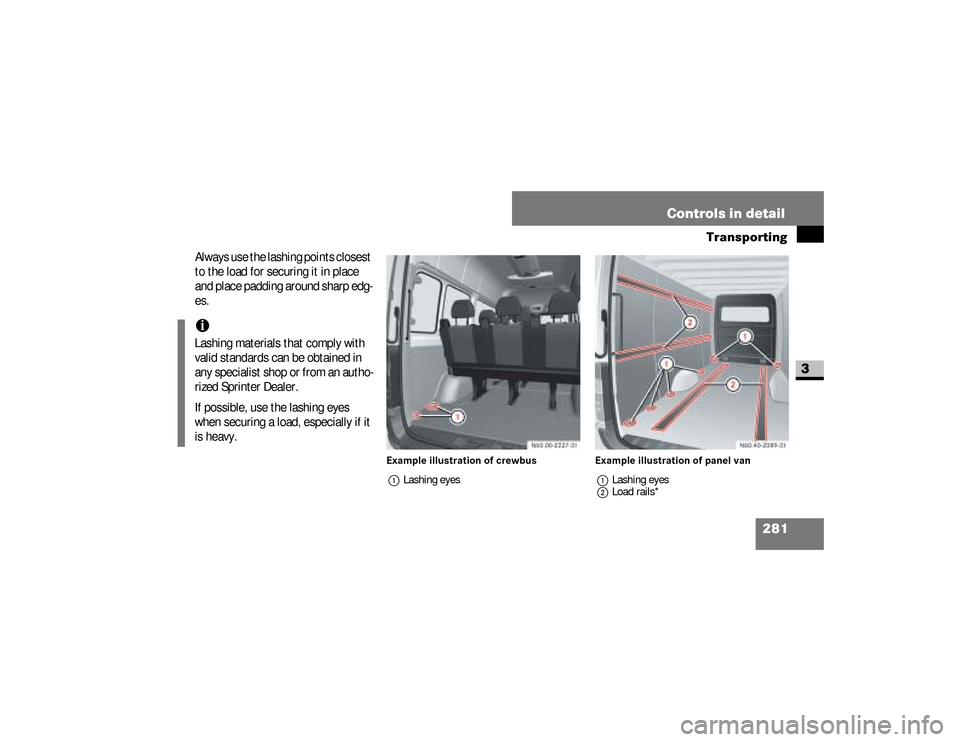
Always use the lashing points closest
to the load for securing it in place
and place padding around sharp edg-
es.
Example illustration of crewbus
1Lashing eyesExample illustration of panel van
1Lashing eyes
2Load rails*
iLashing materials that comply with
valid standards can be obtained in
any specialist shop or from an autho-
rized Sprinter Dealer.
If possible, use the lashing eyes
when securing a load, especially if it
is heavy.
nf_BA.book Page 281 Friday, January 25, 2008 3:53 PM
Page 284 of 666
282 Controls in detailTransporting
3
\1
Always attach the lashing net or
tarps to all available lashing points.
While doing so, make sure that the
mounting hooks cannot open unin-
tentionally.
Warning
G
Do not carry out any modifications or repairs
to the lashing points, the lashing eyes or the
lashing materials. The load or the lashing
points could accidentally come loose and
cause serious injury to you or others as well
as damage to property.Distribute loads evenly between the lash-
ing points or lashing eyes.
Observe the loading guidelines.iLoose loads should be secured with
an approved lashing net or tarp.
!
CAUTION
Observe the data on the maximum
load-bearing capacity of the individu-
al lashing points
(\2
page 629).
During full-braking applications, for
example, forces can be involved that
are much greater than the weight
force of the load.
Always use several lashing points in
order to distribute force absorption,
and make sure that the lashing
points have an equal load.
iIf your vehicle has load rails in the
floor, you should position locking
rods immediately in front of and be-
hind the load. The locking rods ab-
sorb possible shifting forces directly.
nf_BA.book Page 282 Friday, January 25, 2008 3:53 PM
Page 285 of 666
283 Controls in detail
Transporting
3
Warning
G
If you tension the lashing straps between
the side walls or between a side wall and
the load compartment floor, the permissi-
ble load for the lashing rails, lashing
points or lashing eyes could be exceeded
in the event of strong braking, sudden
changes of direction or an accident.The load would no longer be secured,
which could result in serious injuries
caused by the load slipping.
Continued
Warning (Continued)
G
For this reason, do not tension a lashing
strap between the side walls or between a
side wall and the load compartment floor.
Only locking bars or rods may be installed
between the load rails near the side walls. Observe the operating instructions issued
by the locking bar or locking rod manufac-
turer.
iSecuring loads to the load compart-
ment floor is only recommended for
lightweight loads and should be rein-
forced by using anti-slip mats.Warning
G
Before releasing lashing straps, make
sure that the load is stable and would not
tip over even without being lashed down.
Otherwise, you or others could be injured
by a moving load.
nf_BA.book Page 283 Friday, January 25, 2008 3:53 PM
Page 286 of 666
284 Controls in detailTransporting
3
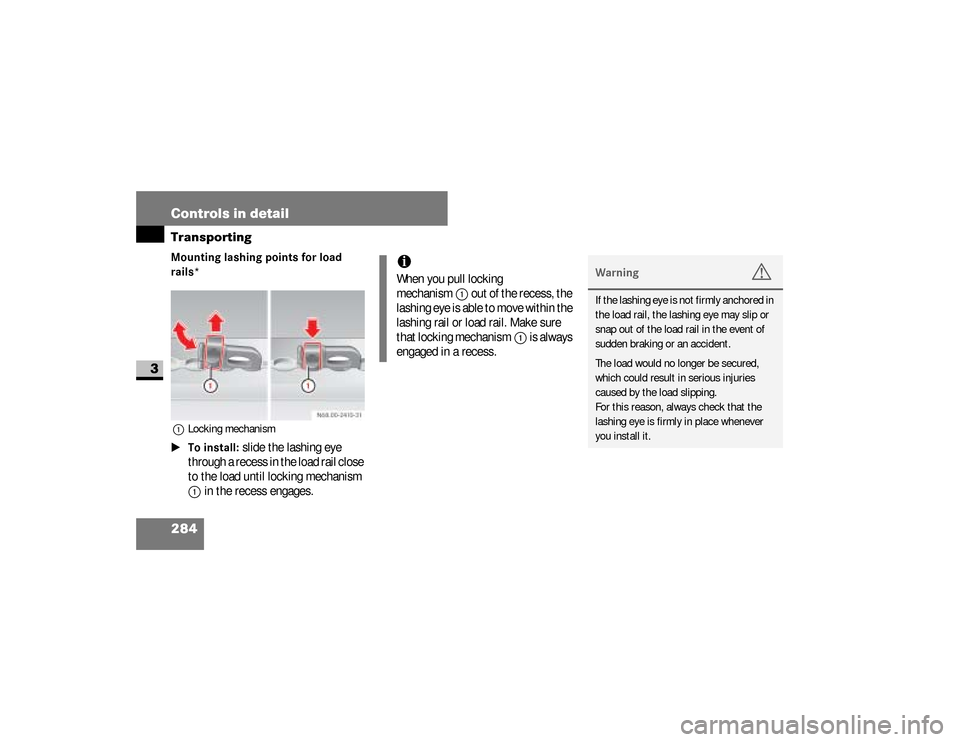
Mounting lashing points for load
rails*1Locking mechanism\1To install:
slide the lashing eye
through a recess in the load rail close
to the load until locking mechanism
1
in the recess engages.
iWhen you pull locking
mechanism
1
out of the recess, the
lashing eye is able to move within the
lashing rail or load rail. Make sure
that locking mechanism
1
is always
engaged in a recess.
Warning
G
If the lashing eye is not firmly anchored in
the load rail, the lashing eye may slip or
snap out of the load rail in the event of
sudden braking or an accident.
The load would no longer be secured,
which could result in serious injuries
caused by the load slipping.
For this reason, always check that the
lashing eye is firmly in place whenever
you install it.
nf_BA.book Page 284 Friday, January 25, 2008 3:53 PM