brake DODGE SPRINTER 2008 2.G Workshop Manual
[x] Cancel search | Manufacturer: DODGE, Model Year: 2008, Model line: SPRINTER, Model: DODGE SPRINTER 2008 2.GPages: 666, PDF Size: 14.11 MB
Page 314 of 666
312 OperationDriving tips
4
You will find information about the
speed limit for your tires under “Tires
and wheels” in this section
(\2
page 383).
Check regularly, e.g. weekly or when re-
fueling:
\4
the vehicle lighting
\4
the condition of the tires
(\2
page 346) and the tire pressures
(
\2
page 361)
\4
the engine oil level (
\2
page 322)
\4
the brake fluid level (
\2
page 331)
\4
the fluid level in the windshield wash-
er system / headlamp cleaning sys-
tem reservoir (
\2
page 333)
\4
the contamination level of the rear
air-conditioning air cleaner
(\2
page 414)
Your vehicle is equipped with monolith-
ic-type catalytic converters, an impor-
tant element in conjunction with the
oxygen sensors to achieve substantial
control of the pollutants in the exhaust
emissions. Keep your vehicle in proper
operating condition by following our rec-
ommended maintenance instructions as
outlined in your Service Booklet.
Warning
G
Exceeding the permissible maximum
speed can cause tire damage, which
could lead to loss of control of the vehi-
cle.
As the driver, you must find out about the
maximum speed of the vehicle and the re-
sulting permissible maximum speed of
the tires (tire and tire pressure).
Never exceed the speed limit for your
tires under any circumstances
(\2page 383).
Regular checks
Catalytic converter (gasoline engine)
nf_BA.book Page 312 Friday, January 25, 2008 3:53 PM
Page 324 of 666
322 OperationEngine compartment
4
Mechanical elements and the lubricants
used for them must be carefully
matched.
For this reason, only brands tested and
approved by the manufacturer should be
used. Please contact your Sprinter Deal-
er to obtain the necessary information.
No lubricant additives should be used.
The use of such additives could affect
your warranty rights. Information is
available from any authorized Sprinter
Dealer.For specifications of engine oils, coolant
and brake fluid, see "Service products
and capacities" (
\2
page 604) and con-
tact your authorized Sprinter Dealer.The vehicle consumes a maximum of
1 US qt (1.0 l) oil per 620 miles
(1000 km), depending on your driving
style.
Engine oil consumption may even be
higher if:
\4
the vehicle is new
\4
you mainly operate the vehicle under
arduous operating conditions
\4
you often drive at high engine
speeds
The engine oil consumption can only be
judged after a lengthy distance has been
covered.
Service products
Warning
G
If handled incorrectly, service products
can constitute a health risk for people and
an environmental hazard.
Always observe relevant guidelines for
handling, storing and disposing of service
products.
Engine oil
nf_BA.book Page 322 Friday, January 25, 2008 3:53 PM
Page 331 of 666
329 Operation
Engine compartment
4
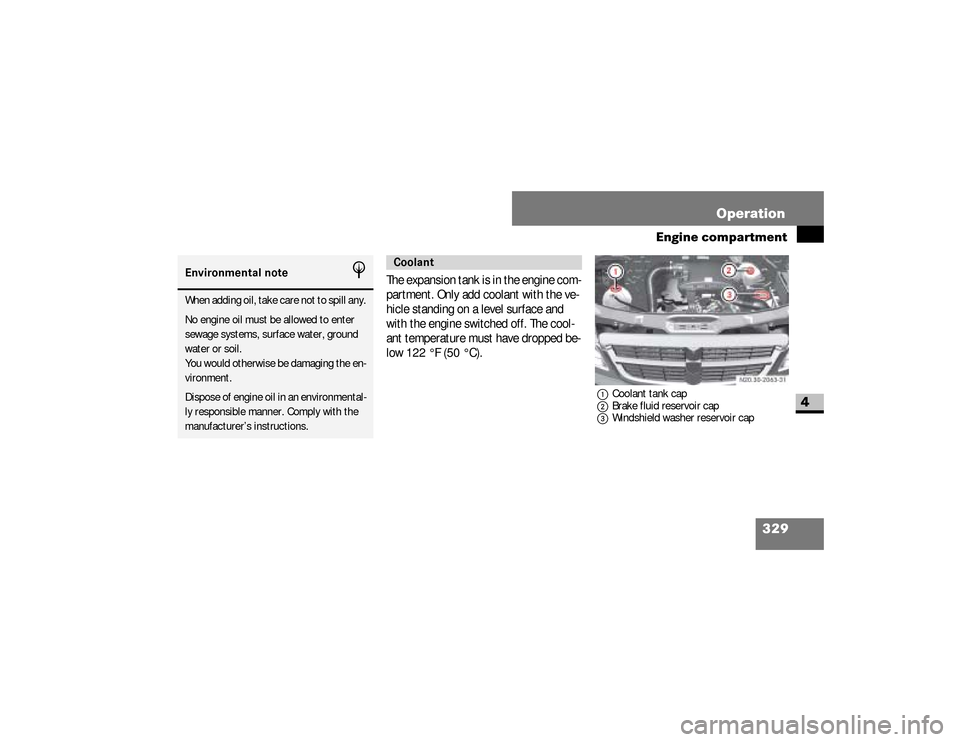
The expansion tank is in the engine com-
partment. Only add coolant with the ve-
hicle standing on a level surface and
with the engine switched off. The cool-
ant temperature must have dropped be-
low 122 °F (50 °C).
1Coolant tank cap
2Brake fluid reservoir cap
3Windshield washer reservoir cap
Environmental note
H
Wh en addi n g o i l, ta ke c ar e n ot t o s pi ll a n y.
No engine oil must be allowed to enter
sewage systems, surface water, ground
water or soil.
You would otherwise be damaging the en-
vironment.
Dispose of engine oil in an environmental-
ly responsible manner. Comply with the
manufacturer’s instructions.
Coolant
N20.30-2063-31
nf_BA.book Page 329 Friday, January 25, 2008 3:53 PM
Page 333 of 666
331 Operation
Engine compartment
4
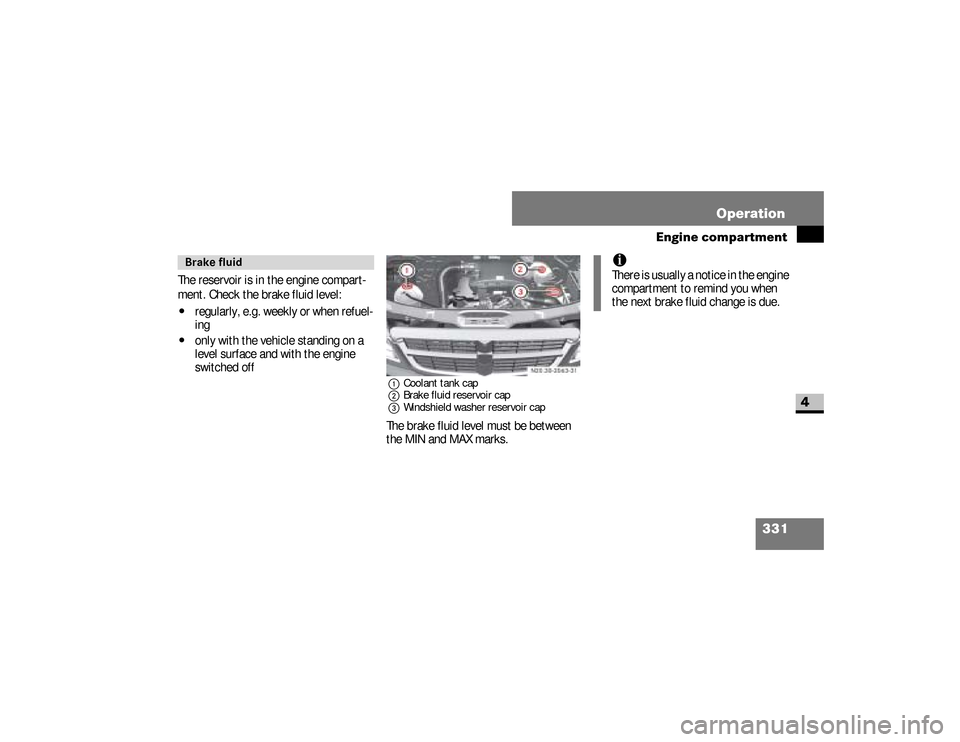
The reservoir is in the engine compart-
ment. Check the brake fluid level:\4
regularly, e.g. weekly or when refuel-
ing
\4
only with the vehicle standing on a
level surface and with the engine
switched off
1Coolant tank cap
2Brake fluid reservoir cap
3Windshield washer reservoir capThe brake fluid level must be between
the MIN and MAX marks.
Brake fluid
N20.30-2063-31
iThere is usually a notice in the engine
compartment to remind you when
the next brake fluid change is due.
nf_BA.book Page 331 Friday, January 25, 2008 3:53 PM
Page 334 of 666
332 OperationEngine compartment
4
!
CAUTION
Brake fluid corrodes paintwork. If
brake fluid comes into contact with
the paintwork, immediately rinse
with water.
If the brake fluid does not reach the
MIN mark, the vehicle’s hydraulic
system could be malfunctioning. Do
not add brake fluid under any cir-
cumstances. This will not solve the
problem.
Do not drive any further.
Have the system checked immediate-
ly at an authorized Sprinter Dealer.
Warning
G
Brake fluid is hazardous to health. Do not
swallow brake fluid. Consult a doctor im-
mediately if any brake fluid is swallowed.Brake fluid must not come into contact
with the skin, eyes or clothing. Wash af-
fected areas with plenty of clean water
and consult a doctor immediately if nec-
essary.You should always wear eye pro-
tection and gloves when you are adding
brake fluid.
Continued
Warning (Continued)
G
Only store brake fluid in its closed original
container and keep out of the reach of
children. Comply with safety regulations
when handling brake fluid.
nf_BA.book Page 332 Friday, January 25, 2008 3:53 PM
Page 335 of 666
333 Operation
Engine compartment
4
For specifications of brake fluid, see
"Service products and capacities"
(\2
page 616).The windshield washer reservoir is in the
engine compartment. It holds approx.
7.4 US qt (7.0 l).
On vehicles with a headlamp cleaning
system, this is also supplied from the
windshield washer reservoir.
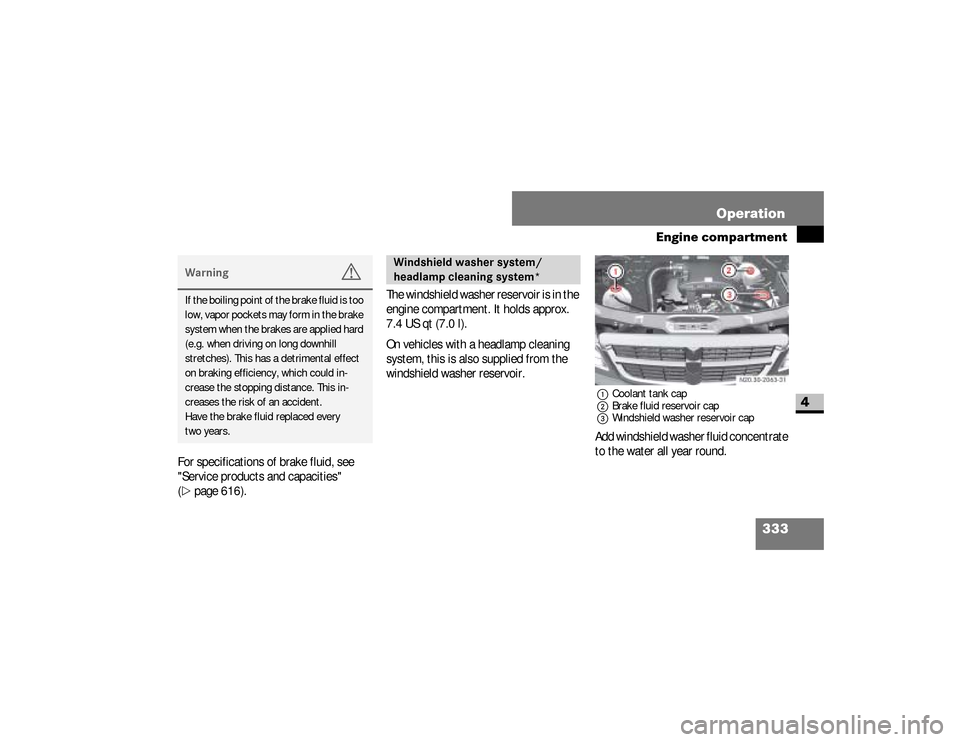
1Coolant tank cap
2Brake fluid reservoir cap
3Windshield washer reservoir capAdd windshield washer fluid concentrate
to the water all year round.
Warning
G
If the boiling point of the brake fluid is too
low, vapor pockets may form in the brake
system when the brakes are applied hard
(e.g. when driving on long downhill
stretches). This has a detrimental effect
on braking efficiency, which could in-
crease the stopping distance. This in-
creases the risk of an accident.
Have the brake fluid replaced every
two years.
Windshield washer system/
headlamp cleaning system*
N20.30-2063-31
nf_BA.book Page 333 Friday, January 25, 2008 3:53 PM
Page 355 of 666
353 Operation
Tires and wheels
4
The GVWR includes the weight of the ve-
hicle, all occupants, fuel and cargo.
The GAWR is the total allowable weight
that can be carried by a single axle (front
or rear).
The GCWR is the total allowable weight
of vehicle and trailer when weighed in
combination.
Never exceed the GVWR, the GAWR for
either the front axle or rear axle or the
GCWR.
Warning
G
Do not overload the tires by exceeding the
specified load limit as indicated on the
tire and loading information placard on
the driver’s door B-pillar or on the certifi-
cation label below the driver’s seat on the
mounting pillar. Overloading the tires can
overheat them, possibly causing a blow-
out. Overloading the tires can also result
in handling or steering problems, or brake
failure.
Continued
Warning (Continued)
G
Overloading of tires is dangerous. Over-
loading can cause tire failure, affect vehi-
cle handling, and increase the stopping
distance. Use tires of the recommended
load capacity for the vehicle. Never over-
load them.
nf_BA.book Page 353 Friday, January 25, 2008 3:53 PM
Page 371 of 666
369 Operation
Tires and wheels
4
Warning (Continued)
G
Always ensure that you re-calibrate the
TPMS after you inflated the tires to the
recommended cold inflation pressure.Always adjust tire inflation pressure ac-
cording to the tire and loading information
placard on the driver’s door B-pillar.Underinflated tires wear excessively and/
or unevenly, adversely affect handling and
fuel economy, and are more likely to fail
from being overheated.
Continued
Warning (Continued)
G
Overinflated tires can adversely affect
handling and ride comfort, wear unevenly,
increase stopping distance, and result in
sudden deflation (blowout) because they
are more likely to become punctured or
damaged by road debris, potholes etc.The TPMS is not able to issue a warning
due to a sudden dramatic loss of pressure
(e.g. tire blowout caused by a foreign ob-
ject). In this case bring the vehicle to a
halt by carefully applying the brakes and
avoiding abrupt steering maneuvers.
Warning
G
Each tire, including the spare (if provided),
should be checked monthly when cold
and inflated to the inflation pressure rec-
ommended by the vehicle manufacturer
on the tire and loading information plac-
ard. (If your vehicle has tires of a different
size than the size indicated on the vehicle
placard or the tire inflation pressure label,
you should determine the proper tire infla-
tion pressure for those tires).
Continued
nf_BA.book Page 369 Friday, January 25, 2008 3:53 PM
Page 374 of 666
372 OperationTires and wheels
4
\1
Make sure the tire inflation pressure
of all four tires is correct, using the
tire and loading information placard
1 or the tire inflation pressure placard
located on the driver’s door B-pillar
(
\2
page 362).
In addition to the placard also con-
sult the tire inflation pressure table
(
\2
page 628).
Warning
G
It is the driver’s responsibility to calibrate
the TPMS on the recommended cold infla-
tion pressure. Underinflated tires affect
the ability to steer or brake the vehicle.
You might lose control over the vehicle.1. For vehicles with a gross weight capacity less
than 10 000 lbs (4 536 kg) (USA only).
iReactivate the TPMS after adjusting
the tire inflation pressure to the infla-
tion pressure recommended for the
vehicle operating condition. Tire
pressure should only be adjusted on
cold tires. Observe the recommend-
ed tire inflation pressure on the tire
and loading information placard on
the driver’s door B-pillar
(\2
page 354).
nf_BA.book Page 372 Friday, January 25, 2008 3:53 PM
Page 377 of 666
375 Operation
Tires and wheels
4 i
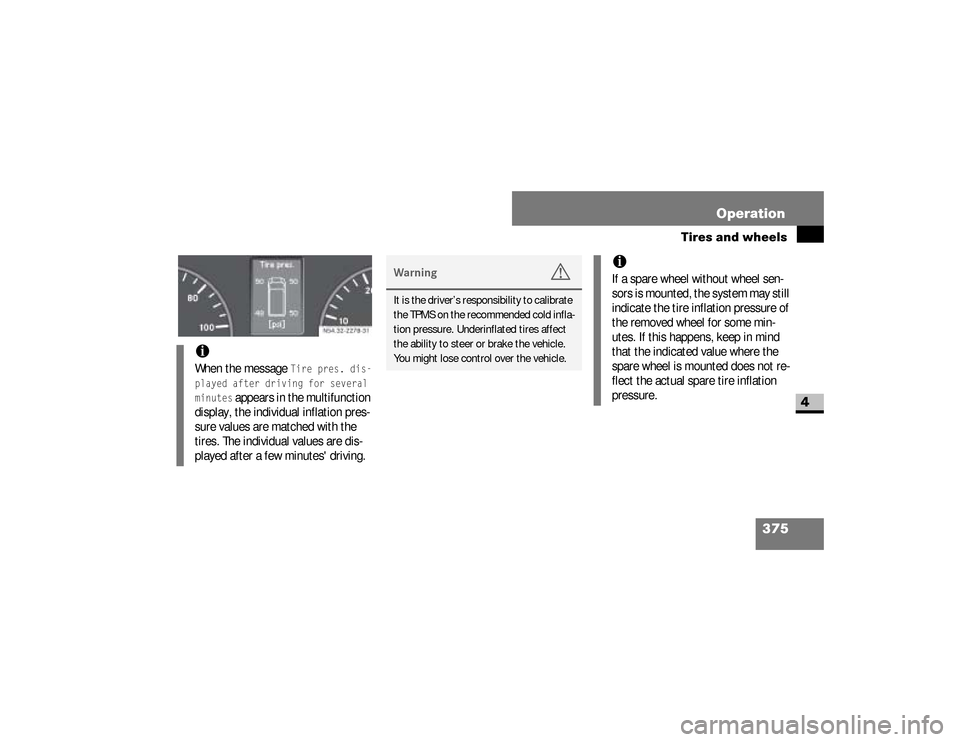
When the message
Tire pres. dis-
played after driving for several
minutes
appears in the multifunction
display, the individual inflation pres-
sure values are matched with the
tires. The individual values are dis-
played after a few minutes' driving.54.32-2278-31
Warning
G
It is the driver’s responsibility to calibrate
the TPMS on the recommended cold infla-
tion pressure. Underinflated tires affect
the ability to steer or brake the vehicle.
You might lose control over the vehicle.
iIf a spare wheel without wheel sen-
sors is mounted, the system may still
indicate the tire inflation pressure of
the removed wheel for some min-
utes. If this happens, keep in mind
that the indicated value where the
spare wheel is mounted does not re-
flect the actual spare tire inflation
pressure.
nf_BA.book Page 375 Friday, January 25, 2008 3:53 PM