brake DODGE SPRINTER 2008 2.G Repair Manual
[x] Cancel search | Manufacturer: DODGE, Model Year: 2008, Model line: SPRINTER, Model: DODGE SPRINTER 2008 2.GPages: 666, PDF Size: 14.11 MB
Page 378 of 666
376 OperationTires and wheels
4
Warning
G
The TPMS does not warn you against in-
correctly selected tire inflation pressure
and does not warn you when the tire pres-
sure is not properly selected for the re-
spective vehicle load. It warns you only
when the pressure of one or more tires
decreases significantly below the refer-
ence inflation pressure which was stored
at the time of calibration of the TPMS af-
ter you inflated the tires.Always ensure that you recalibrate the
TPMS after you have inflated the tires to
the recommended cold inflation pressure.
Continued
Warning (Continued)
G
Always adjust the tire inflation pressure
according to the tire and loading informa-
tion placard on the driver’s door B-pillar.Underinflated tires wear excessively and/
or unevenly, adversely affect handling and
fuel economy, and are more likely to fail
from being overheated.Overinflated tires can adversely affect
handling and ride comfort, wear unevenly,
increase stopping distance, and result in
sudden deflation (blowout) because they
are more likely to become punctured or
damaged by road debris, potholes etc.
Continued
Warning (Continued)
G
The TPMS is not able to issue a warning
due to a sudden dramatic loss of pressure
(e.g. tire blowout caused by a foreign ob-
ject). In this case bring the vehicle to a
halt by carefully applying the brakes and
avoiding abrupt steering maneuvers.
nf_BA.book Page 376 Friday, January 25, 2008 3:53 PM
Page 381 of 666
379 Operation
Tires and wheels
4
Reactivating the Advanced TPMSThe TPMS must be reactivated when you
have adjusted the tire inflation pressure
to a new level (e.g. because of different
load or driving conditions). The TPMS is
then recalibrated to the current tire in-
flation pressures.
\1
Make sure the tire inflation pressure
of all four tires is correct, using the
tire and loading information placard
1
or the tire inflation pressure placard
located on the driver’s door B-pillar
(
\2
page 362).
Warning!
G
It is the driver’s responsibility to calibrate
the TPMS on the recommended cold infla-
tion pressure. Underinflated tires affect
the ability to steer or brake the vehicle.
You might lose control over the vehicle.
1. For vehicles with a gross weight capacity less
than 10 000 lbs (4 536 kg) (USA only).
iReactivate the TPMS after adjusting
the tire inflation pressure to the infla-
tion pressure recommended for the
vehicle operating condition. Tire in-
flation pressure should only be adju-
sted on cold tires. Observe the
recommended tire inflation pressure
on the tire and loading information
placard
1 or on the tire inflation pres-
sure placard on the driver’s door B-
pillar (\2
page 362).
nf_BA.book Page 379 Friday, January 25, 2008 3:53 PM
Page 387 of 666
385 Operation
Tires and wheels
4
The commercial vehicle tires based on
European standards may have an addi-
tional value in the parentheses (as illus-
trated). In such cases, the value
preceding the parentheses is valid for
European countries and the parenthe-
sized for the USA and Canada.
Refer also to "Maximum tire load"
(\2
page 390) where the maximum load
associated with the load index is indicat-
ed in kg and lbs.
Warning
G
The tire load rating must always be at
least half of the GAWR of your vehicle.
Otherwise, tire failure may be the result
which may cause an accident and/or se-
rious personal injury to you or others.
Always replace rims and tires with the
same designation, manufacturer and type
as shown on the original part.
Warning
G
Do not overload the tires by exceeding the
specified load limit as indicated on the
placard located on the driver’s door B-pil-
lar. Overloading the tires can overheat
them, possibly causing a blowout. Over-
loading the tires can also result in han-
dling or steering problems, or brake
failure.iTire load rating
6
and tire speed
rating
7
are also referred to as “ser-
vice description”.
nf_BA.book Page 385 Friday, January 25, 2008 3:53 PM
Page 393 of 666
391 Operation
Tires and wheels
4
For more information on tire load rating,
refer to "Tire size designation, load and
speed rating" (
\2
page 383).
For information on calculating total and
cargo load capacities, refer to "Tire and
loading information" (
\2
page 352).
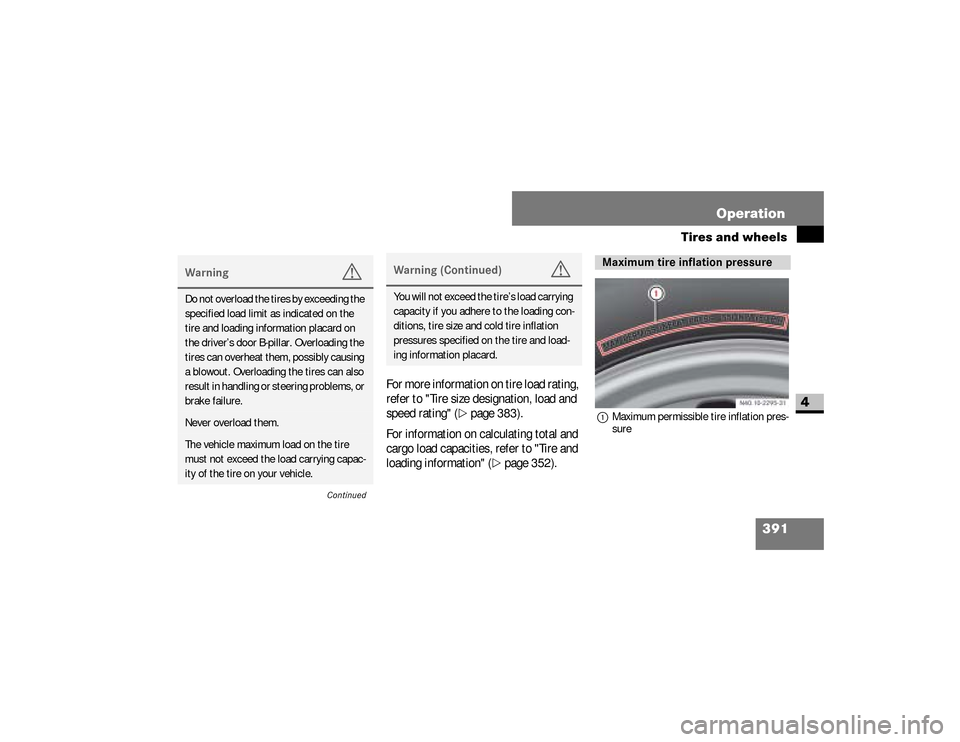
1Maximum permissible tire inflation pres-
sure
Warning
G
Do not overload the tires by exceeding the
specified load limit as indicated on the
tire and loading information placard on
the driver’s door B-pillar. Overloading the
tires can overheat them, possibly causing
a blowout. Overloading the tires can also
result in handling or steering problems, or
brake failure.Never overload them.The vehicle maximum load on the tire
must not exceed the load carrying capac-
ity of the tire on your vehicle.
Continued
Warning (Continued)
G
You will not exceed the tire’s load carrying
capacity if you adhere to the loading con-
ditions, tire size and cold tire inflation
pressures specified on the tire and load-
ing information placard.
Maximum tire inflation pressure
nf_BA.book Page 391 Friday, January 25, 2008 3:53 PM
Page 395 of 666
393 Operation
Tires and wheels
4
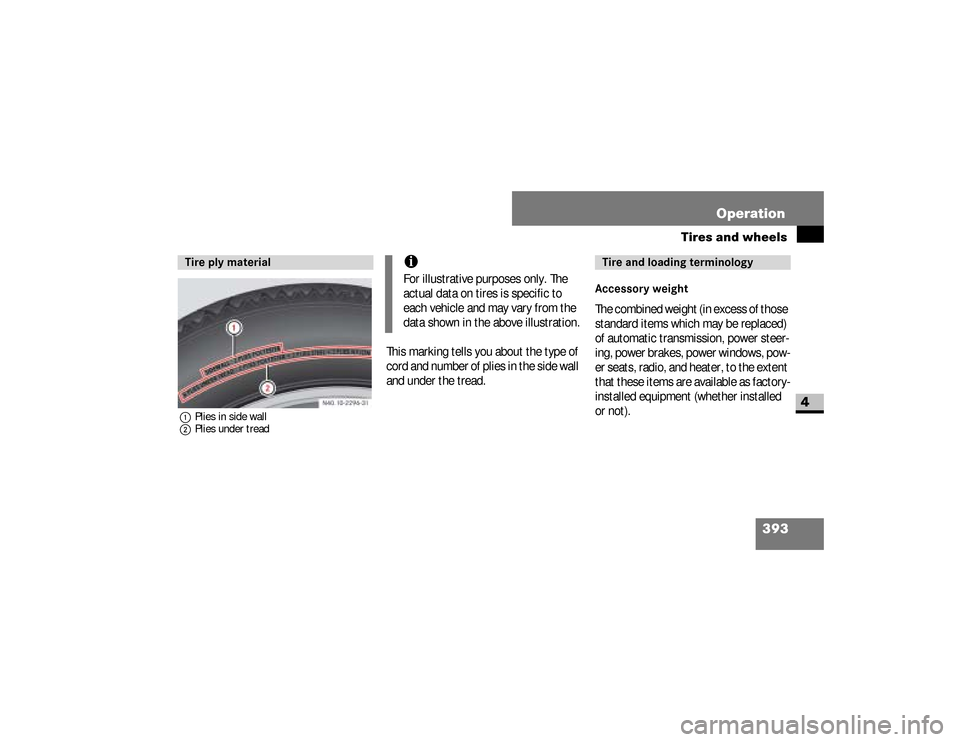
1Plies in side wall
2Plies under tread
This marking tells you about the type of
cord and number of plies in the side wall
and under the tread.
Accessory weightThe combined weight (in excess of those
standard items which may be replaced)
of automatic transmission, power steer-
ing, power brakes, power windows, pow-
er seats, radio, and heater, to the extent
that these items are available as factory-
installed equipment (whether installed
or not).
Tire ply material
iFor illustrative purposes only. The
actual data on tires is specific to
each vehicle and may vary from the
data shown in the above illustration.
Tire and loading terminology
nf_BA.book Page 393 Friday, January 25, 2008 3:53 PM
Page 399 of 666
397 Operation
Tires and wheels
4
Production options weightThe combined weight of those installed
regular production options weighing
over 5 lbs (2.3 kg) in excess of those
standard items which they replace, not
previously considered in curb weight or
accessory weight, including heavy duty
brakes, ride levelers, roof rack, heavy
duty battery, and special trim.PSI (P
ounds per S
quare I
nch)
A standard unit of measure for air pres-
sure. Another metric unit for air pres-
sure is bar or kilopascal (kPa).
Recommended tire inflation pressureRecommended tire inflation pressure for
normal driving conditions listed on the
tire and loading information placard
1 or
on the tire inflation pressure placard lo-
cated on the driver’s door B-pillar.
Provides best handling, tread life and
riding comfort.
RimA metal support for a tire or a tire and
tube assembly upon which the tire
beads are seated.
Side wallThe portion of a tire between the tread
and the bead.TIN (T
ire I
dentification N
umber)
Unique identifier which facilitates efforts
by tire manufacturers to notify purchas-
ers in recall situations or other safety
matters concerning tires and gives pur-
chases the means to easily identify such
tires. The TIN is comprised of the “man-
ufacturer’s identification mark”, “tire
size”, “tire type code” and “date of man-
ufacture”.
1. For vehicles with a gross weight capacity less
than 10 000 lbs (4 536 kg) (USA only).
nf_BA.book Page 397 Friday, January 25, 2008 3:53 PM
Page 403 of 666
401 Operation
Tires and wheels
4
Rotate tires before the characteristic
tire wear pattern becomes visible (shoul-
der wear on front tires and tread center
wear on rear tires).
The reasons for any rapid or unusual
wear should be corrected prior to rota-
tion being performed.
Thoroughly clean the mounting face of
wheels and brake disks, i.e. the inner
side of the wheels/tires, during each ro-
tation. Check for and ensure proper tire infla-
tion pressure, refer to "Recommended
tire inflation pressure" (
\2
page 361).
!
CAUTION
If your vehicle is equipped with the
tire pressure monitor*, each wheel
has an electronic component.
Tire mounting tools should not be ap-
plied in the area of the valve, as this
could damage the electronic compo-
nents.
Have the tires changed only at an
authorized Sprinter Dealer.
Warning
G
In order to avoid loosing a wheel and in or-
der to reduce the risk of fatal or serious
injuries or vehicle damage, please follow
these safety instructions:Always replace wheel bolts that are dam-
aged or rusted.Never apply oil or grease to wheel bolts.
Continued
nf_BA.book Page 401 Friday, January 25, 2008 3:53 PM
Page 408 of 666
406 OperationWinter driving
4
Drive with particular care on icy roads.
Avoid sudden acceleration, steering
movements and braking.
If it seems likely that the vehicle is about
to enter a skid or cannot be stopped at a
low speed:\4
Move the selector lever to position N.
\4
Try to maintain control of the vehicle
using light corrective steering.
Road salt may adversely affect braking
efficiency. It may therefore be necessary
to apply the brakes more forcefully in or-
der to achieve the same braking force as
normal.
iW h e n t h e y h a v e b e e n r e m o v e d , s t o r e
wheels and tires in a cool, dry, and if
possible dark place. Protect the tires
from oil, grease, and gasoline /
diesel.
Driving in winterWarning
G
Downshifting to brake could cause the
drive wheels to lose grip on a slippery sur-
face due to the increased difference in
speed between the engine and the drive
wheels at this time.
Do not downshift for additional engine
braking on a slippery surface. Use the ser-
vice brake in accordance with road condi-
tions. Only downshift to a lower gear
when traveling at a low engine speed.
nf_BA.book Page 406 Friday, January 25, 2008 3:53 PM
Page 409 of 666
407 Operation
Winter driving
4
Apply the brakes regularly when making
longer journeys on gritted or salted
roads. This will have the effect of restor-
ing the brakes to their normal level of
performance.
When stopping the vehicle after travel-
ing on roads that have been salted,
check that the brakes are fully functional
before proceeding further.
Use "Class U" chains, or other traction
aids that meet SAE Type "U" specifica-
tions.Snow chai ns m us t be the p rope r si ze f or
the vehicle, as recommended by the
chain manufacturer. They should only be
driven on snow-covered roads at speeds
not to exceed 30 mph (50 km / h). Re-
move chains as soon as possible when
driving on roads without snow.Snow chains
!
CAUTION
Use snow chains on rear wheels only.
Some tire sizes do not leave ade-
quate clearance for snow chains. To
help avoid serious damage to your
vehicle or tires, use of snow chains is
not permissible with the spare wheel.
iWhen driving with snow chains, you
may wish to deactivate the ASR
(\2
page 73) before setting the vehi-
cle in motion. This will improve the
vehicle’s traction.
nf_BA.book Page 407 Friday, January 25, 2008 3:53 PM
Page 412 of 666
410 OperationMaintenance and servicing
4
Mechanical elements and the lubricants
used for them must be carefully
matched.
For this reason, only brands tested and
approved by the manufacturer should be
used. Please contact your Sprinter Deal-
er to obtain the necessary information.
No lubricant additives should be used.
The use of such additives could affect
your warranty rights. Information is
available from any authorized Sprinter
Dealer.For specifications of engine oils, coolant
and brake fluid, see "Service products
and capacities" (
\2
page 604) and con-
tact your authorized Sprinter Dealer.
Observe the information on spare parts
in the “Technical data” section
(
\2
page 600).
Warning (Continued)
G
The manufacturer recommends that you
use an authorized Sprinter Dealer for this
purpose. In particular, work relevant to
safety or on safety-related systems must
be carried out at an authorized Sprinter
Dealer.
Service products
Warning
G
If handled incorrectly, service products
can constitute a health risk for people and
an environmental hazard.
Always observe relevant guidelines for
handling, storing and disposing of service
products.
nf_BA.book Page 410 Friday, January 25, 2008 3:53 PM