wheel DODGE SPRINTER 2008 2.G Manual PDF
[x] Cancel search | Manufacturer: DODGE, Model Year: 2008, Model line: SPRINTER, Model: DODGE SPRINTER 2008 2.GPages: 666, PDF Size: 14.11 MB
Page 181 of 666
179 Controls in detail
Operating system with steering wheel buttons*
3
\1
Switch on the cell phone and audio
system.
See the separate operating instruc-
tions.
\1
Press the
è
or
ÿ
button re-
peatedly until you see the
TEL
menu
in the display.
You will see different messages in
the display, depending on the status
of your cell phone:
\4
If the cell phone is switched off,
you will see the
TEL off
message
(Sound 20) .
\4
If you have not yet entered a PIN,
you will see the
TEL PIN
message
(Sound 20) .
\1
Enter the PIN code using the cell
phone, audio system.
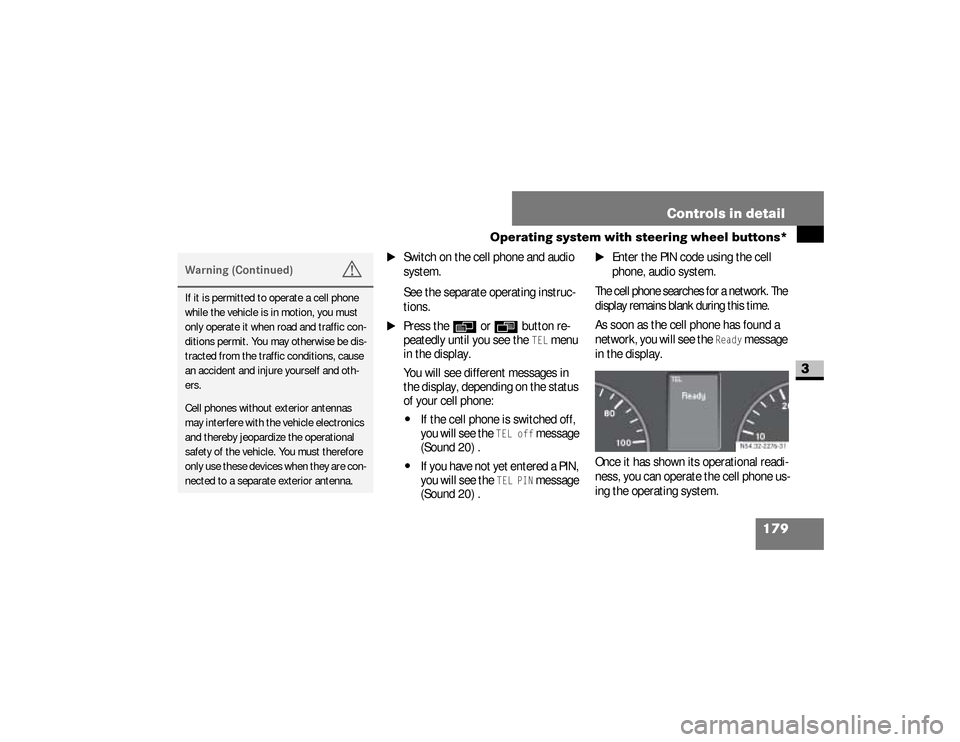
The cell phone searches for a network. The
display remains blank during this time.As soon as the cell phone has found a
network, you will see the
Ready
message
in the display.
Once it has shown its operational readi-
ness, you can operate the cell phone us-
ing the operating system.
Warning (Continued)
G
If it is permitted to operate a cell phone
while the vehicle is in motion, you must
only operate it when road and traffic con-
ditions permit. You may otherwise be dis-
tracted from the traffic conditions, cause
an accident and injure yourself and oth-
ers.Cell phones without exterior antennas
may interfere with the vehicle electronics
and thereby jeopardize the operational
safety of the vehicle. You must therefore
only use these devices when they are con-
nected to a separate exterior antenna.
N54.32-2276-31
nf_BA.book Page 179 Friday, January 25, 2008 3:53 PM
Page 182 of 666
180 Controls in detailOperating system with steering wheel buttons*
3
Rejecting a callIf you do not wish to speak to the person
who is calling, you can reject the call.\1
Press the
t
button.
The caller then hears the busy signal.
Accepting a callYou can accept a call at any time, provid-
ed the cell phone is ready to receive
calls. \1
Press the
s
button.
The call duration is shown in the dis-
play.
Ending a call
\1
Press the
t
button.
The display now shows the opera-
tional readiness symbol again.
Dialing a number from the phone
bookYou may select and dial a number from
the phone book at any time, provided
the cell phone is ready to receive calls.
\1
Press the
è
or
ÿ
button re-
peatedly until you see the
TEL
menu
with the operational readiness sym-
bol in the display.
\1
Press the
j
or
k
button.
The operating system reads the
phone book stored on the SIM card
or in the phone. This may take more
than 1 minute.
You will see the
Processing
message
(Sound 20) in the display.
\1
Press the
j
or
k
button re-
peatedly until you see the name you
are looking for.
iIt is only possible to create new
phone number entries in the phone
book using the cell phone itself. See
the separate operating instructions.
nf_BA.book Page 180 Friday, January 25, 2008 3:53 PM
Page 183 of 666
181 Controls in detail
Operating system with steering wheel buttons*
3
The stored names are displayed al-
phabetically from A to Z, or Z to A.
\1
Press the
s
button.
The operating system dials the se-
lected phone number. You will see
the
dialing
message (Sound 20) in
the display.
The operating system stores the
phone numbers in the redial memo-
ry.
If a connection is made, you will see
the name of the person you are call-
ing and the call duration.
RedialingThe operating system stores the most
recently dialed phone numbers. This
means that you do not have to search
through the entire phone book.\1
Press the
ÿ
or
è
button re-
peatedly until you see the
TEL
menu
with the operational readiness sym-
bol in the display.
\1
Press the
s
button.
The redial memory shows the most
recently dialed numbers or names.
iThe operating system scrolls through
the names rapidly if you press and
hold the
j
or
k
button for
more than one second. Releasing the
button stops the rapid scroll.
If you no longer wish to make a call,
press the
t
button.
nf_BA.book Page 181 Friday, January 25, 2008 3:53 PM
Page 184 of 666
182 Controls in detailOperating system with steering wheel buttons*
3
\1
Press the
j
or
k
button re-
peatedly until the number or the
name you are looking for is dis-
played.
\1
Press the
s
button.
The operating system dials the se-
lected phone number.
If a connection is made, you will see
the call duration and name of the
person you are calling if stored in the
phone book. Otherwise, the number
you are dialing continues to be dis-
played.
iIf you no longer wish to make a call,
press the
t
button.
nf_BA.book Page 182 Friday, January 25, 2008 3:53 PM
Page 188 of 666
186 Controls in detailDriving and parking
3
Starting the engine
Gasoline engine
\1
Turn the key to position
3 in the igni-
tion lock (
\2
page 111) and release it
immediately ("touch-start" function).
The engine starts automatically.
Diesel engine
\1
Switch on the ignition (
\2
page 111).
The
q
preglow indicator lamp in
the instrument cluster comes on.
\1
As soon as the
q
preglow indica-
tor lamp goes out, turn the key to po-
sition
3 in the ignition lock and
release it as soon as the engine is
running.
\1
Warm the engine up quickly.
\1
Do not run the engine at full speed
until it has reached operating tem-
perature.iYou can start the engine without pre-
glow when the engine is warm.After a cold start
Pulling awayWarning
G
Do not downshift for additional engine
braking on a slippery surface. The drive
wheels may lose their grip and the vehicle
could skid.!
CAUTION
Only drive at high speeds once the
engine has warmed up. This protects
the engine.
When driving on slippery surfaces,
avoid spinning the drive wheels
where possible as this could damage
the drive train.
nf_BA.book Page 186 Friday, January 25, 2008 3:53 PM
Page 195 of 666
193 Controls in detail
Driving and parking
3
Stopping the engine\1
Apply handbrake (
\2
page 191).
\1
Move selector lever to
P.
\1
Turn key to position
0 (\2
page 111)
in the ignition lock and remove it.
The immobilizer is activated.
\1
Secure the vehicle at the front axle if
unloaded and at the rear axle if load-
ed, e.g. using a chock (
\2
page 521).
Warning
G
The wheels on the rear axle could lock if
the handbrake lever is applied too abrupt-
ly. The vehicle could then start to skid.
Make sure that you apply the handbrake
lever carefully to ensure that braking ap-
plication is moderated.
!
CAUTION
If the coolant temperature is raised,
e.g. following driving in mountainous
terrain, run the engine at idling speed
for a further 1 or 2 minutes before
you switch off the engine. This allows
the coolant temperature to return to
normal again.
iWhen parking on steep uphill or
downhill gradients, turn the front
wheels towards the curb.
iYou can only remove the key from
the ignition lock when the selector le-
ver is in position
P.
nf_BA.book Page 193 Friday, January 25, 2008 3:53 PM
Page 196 of 666
194 Controls in detailDriving and parking
3
Drinking and drivingSteering
Overrun cut-off
The gasoline/diesel supply is cut off if
the driver's foot is completely removed
from the accelerator pedal when the en-
gine is overrunning at engine speeds
outside of the idling control range.
General driving tipsWarning
G
Drinking and driving and/or taking drugs
and driving are very dangerous combina-
tions. Even a small amount of alcohol or
drugs can affect your reflexes, percep-
tions and judgment. The possibility of a
serious or even fatal accident is sharply
increased when you drink or take drugs
and drive.
Never drink or take drugs and drive or al-
low anyone to drive after drinking or tak-
ing drugs.
Warning
G
There is no power-steering assistance
when the engine is not running.
You will need to use significantly more
force to steer and could therefore lose
control of the vehicle and cause an acci-
dent.
Never switch off the engine while driving.
!
CAUTION
Do not hold the steering wheel in its
end positions for longer than neces-
sary (e.g. when turning or maneuver-
ing).
The hydraulic pump can be damaged
by the increased temperature of the
hydraulic fluid.
nf_BA.book Page 194 Friday, January 25, 2008 3:53 PM
Page 198 of 666
196 Controls in detailDriving and parking
3
\4
causes and consequences of tire
wear
\4
measures to be taken in the event of
tire damage
\4
tire types for certain regions, areas
of operation or conditions of vehicle
use
\4
interchangeability of tires, etc.
Modifications to the brake system or
wheels are not permissible, nor is the
use of spacer plates or brake dust
shields. Any such modifications will in-
validate the vehicle’s general operating
permit.Treadwear indicators (TWI) are required
by law. These indicators are located in
six places on the tread circumference
and become visible at a tread depth of
approximately 1/16 in (1.6 mm), at
which point the tire is considered worn
and should be replaced.
The Treadwear Indicator appears as a
solid band across the tread.
Warning
G
If you feel a sudden significant vibration
or ride disturbance, or you suspect that
possible damage to your vehicle has oc-
curred, you should turn on the hazard
warning flashers, carefully slow down,
and drive with caution to an area which is
a safe distance from the road.
Inspect the tires and the vehicle undercar-
riage for possible damage. If the vehicle
or tires appear unsafe, have the vehicle
towed to the nearest authorized Sprinter
Dealer or tire dealer for repairs.
nf_BA.book Page 196 Friday, January 25, 2008 3:53 PM
Page 199 of 666
197 Controls in detail
Driving and parking
3
Specified tire inflation pressures must
be maintained. This applies particularly
if the tires are subject to extreme oper-
ating conditions (e.g. high speeds, heavy
loads, high ambient temperatures).For detailed information on tires, see
"Tires and wheels" (
\2
page 341).
HydroplaningDepending on the depth of the water lay-
er on the road, hydroplaning may occur,
even at low speeds and with new tires.
Reduce vehicle speed, avoid track
grooves in the road and apply brakes
cautiously in the rain.
Warning
G
Although the applicable federal motor ve-
hicle safety laws consider a tire to be
worn when the Treadwear Indicators
(TWI) become visible at approximately 1/
16 in (1.6 mm), do not allow your tires to
wear down to that level. As tread depth
approaches 1/8 in (3 mm) for summer
tires or 1/6 in (4 mm) for winter tires, the
adhesion properties on a wet road are
sharply reduced.
Depending upon the weather and/or road
surface (conditions), the tire traction var-
ies widely.
Warning
G
Do not drive with a flat tire. A flat tire af-
fects the ability to steer or brake the vehi-
cle. You may lose control of the vehicle.
Continued driving with a flat tire or driving
at high speed with a flat tire will cause ex-
cessive heat buildup and possibly a fire.
nf_BA.book Page 197 Friday, January 25, 2008 3:53 PM
Page 200 of 666
198 Controls in detailDriving and parking
3
Tire tractionTire grip is greatly reduced on a wet,
snow covered or icy road. Speed and
driving style must therefore be adapted
to suit road conditions. The safe speed
on a wet, snow covered or icy road is al-
ways lower than on a dry road.
Below a tread depth of 1/8 in (3 mm),
tire grip begins to decrease rapidly on
wet roads.
Pay particular attention to the condition
of the road whenever the outside tem-
peratures is close to the freezing point.In winter, install M+S radial tires with a
minimum tread depth of approximately
1/6 in (4 mm) on all wheels to ensure
normal balanced handling characteris-
tics. On packed snow, they can reduce
y ou r st opp ing di st ance com pa re d to s um -
mer tires.Stopping distance, however, is still con-
siderably greater than when the road is
not covered with snow or ice. Exercise
appropriate caution.
For information on winter tires, see
"Winter tires" (
\2
page 404).
Warning
G
If ice has formed on the road, tire traction
will be substantially reduced. Under such
weather conditions, drive, steer and
brake with extreme caution.
!
CAUTION
Avoid spinning a drive wheel. This
may cause serious damage to the
drive train which is not covered by
the Sprinter warranty.
nf_BA.book Page 198 Friday, January 25, 2008 3:53 PM