fuel pump DODGE TRUCK 1993 Service Repair Manual
[x] Cancel search | Manufacturer: DODGE, Model Year: 1993, Model line: TRUCK, Model: DODGE TRUCK 1993Pages: 1502, PDF Size: 80.97 MB
Page 942 of 1502
•
FUEL
SYSTEM
14 - 123
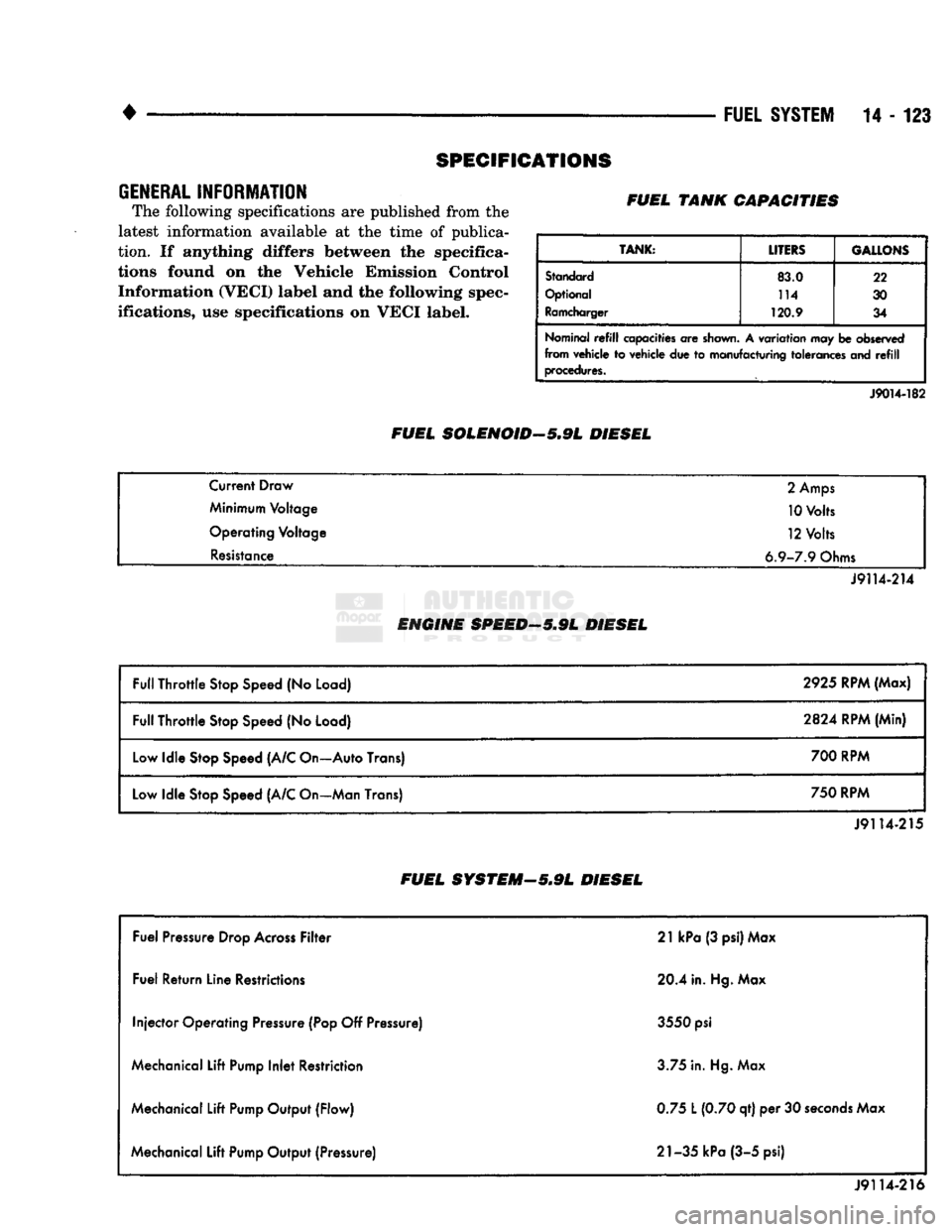
SPECIFICATIONS
GENERAL
INFORMATION
The following specifications
are
published from
the
latest information available
at the
time
of
publica
tion.
If
anything differs between
the
specifica
tions found
on the
Vehicle Emission Control Information (VECI) label
and the
following spec
ifications,
use
specifications
on
VECI label. FUEL TANK CAPACITIES
TANK:
LITERS GALLONS
Standard
83.0 22
Optional 114
30
Ramcharger
120.9
34
Nominal
refill
capacities
are
shown.
A
variation
may be
observed
from vehicle
to
vehicle
due to
manufacturing tolerances
and refill
procedures.
FUEL SOLENOID-5.9L DIESEL
J9014-182
Current Draw
2
Amps
Minimum Voltage 10 Volts
Operating Voltage 12 Volts
Resistance 6.9-7.9 Ohms
J9114-214
ENGINE SPEED—5.9L DIESEL
Full Throttle Stop Speed
(No
Load) 2925 RPM (Max)
Full Throttle Stop Speed
(No
Load)
2824
RPM (Min)
Low Idle Stop Speed (A/C On—Auto Trans) 700 RPM
Low Idle Stop Speed (A/C On—Man Trans) 750 RPM
J9114-215
FUEL SYSTEM—5*9L DIESEL
Fuel Pressure Drop Across Filter 21
kPa
(3 psi) Max
Fuel Return Line Restrictions 20.4 in. Hg. Max
Injector Operating Pressure (Pop
Off
Pressure) 3550
psi
Mechanical Lift Pump Inlet Restriction 3.75 in. Hg. Max
Mechanical Lift Pump Output (Flow) 0.75
L
(0.70 qt)
per 30
seconds Max
Mechanical Lift Pump Output (Pressure) 21-35 kPa (3-5 psi)
J9114-216
Page 944 of 1502
• —_ —_
FUEL
SYSTEM
14 - 125
Component
N-m ft.
lbs.
/In. lbs.
Air Fuel Control Tube 12 N-m 9 ft. lbs.
Fuel Line Clamp to Intake Manifold Mounting Screws 24 N-m 18 ft. lbs.
Fuel Line Fittings at Injector—High Pressure 24 N-m 18ft. lbs.
Fuel Line Fittings at Injection Pump—High Pressure 24 N-m 18ft. lbs.
Fuel Solenoid 43 Nm 32 ft. lbs.
Injection Pump Mounting Nuts 24 N-m 18ft. lbs.
Injection Pump Lockscrew (Locked Position) 30 Nm 22 ft. lbs.
Injection Pump Lockscrew (Unlocked Position) 13 Nm 10ft. lbs.
Injection Pump Gear Retaining Nut 65 Nm 48 ft. lbs.
*
Injection Pump Support Bracket 24 Nm 18 ft. lbs.
Injection Pump Timing Plug 10Nm
7.5 ft. lbs.
Injector Drain Screw 8 N-m 6 ft. lbs.
Injector Retainer Nut 60 Nm 44 ft. lbs.
Low Pressure Bleed Screw on Filter Head 8 Nm 6 ft. lbs.
Mechanical Lift Pump Mounting Screws 24 Nm 18ft. lbs.
Throttle Linkage Rod Lock Nuts 9 N-m 7 ft. lbs.
Throttle Control Bracket Mounting Screws 24 Nm 18 ft. lbs.
Throttle Rod to Throttle Rod Ball Stud Nut 10 Nm 7.5 ft. lbs.
*
Mounting bolts must be tightened in specified sequence. J9114-205
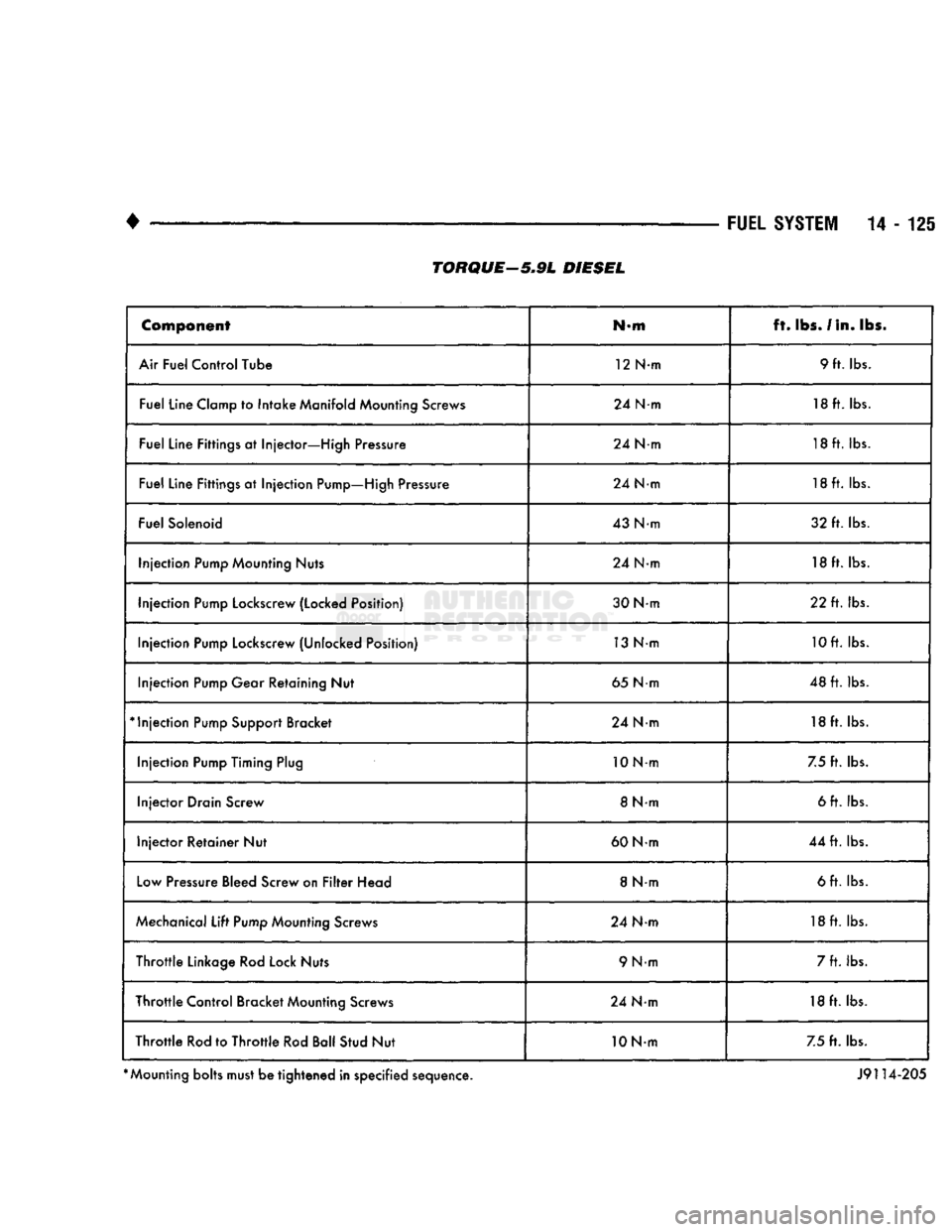
TORQUE—5.9L
DIESEL
Page 1082 of 1502
•
AUTOMATIC
TRANSMISSION—32RH/36RH/37RH/42RH/46RH
21 - 81
TORQUE
CONVERTER
A three element torque converter
is
used
for all ap
plications.
The
converter consists
of the
impeller,
sta-
tor
and
turbine.
The
converter also contains
an
overrunning clutch
and a
modulated converter clutch
mechanism.
The converter used with
1993,
42RH transmissions
is
new. The
converter
hub was
changed
to
accept
the
new style drive flats
on the oil
pump inner gear.
The
new style converter
is not
interchangeable with pre
vious designs.
The converter modulated clutch consists
of a
slid
ing clutch piston, clutch springs
and the
clutch disc
friction material.
The
clutch provides optimum
torque transfer
and
economy when engaged.
The clutch disc
is
attached
to the
converter front
cover.
The
clutch piston
and
clutch springs
are at
tached
to the
turbine
hub. The
springs dampen
en
gine firing impulses
and
loads during
the
initial
phase
of
converter clutch engagement.
Clutch engagement
is
controlled
by the
converter
clutch valve
and
solenoid. Both
are
located
on the
transmission valve body. Clutch engagement occurs in drive range
at
speeds above approximately 30-35
mph.
The clutch provides reduced engine speed
and
greater fuel economy when engaged. Clutch engage
ment also provides reduced transmission fluid tem
peratures.
COMPONENTS
UNIQUE
TO
DIESEL VERSION
OF
46RH
Planetary
Gears
The transmission
and
overdrive planetary gear car
riers
in the
diesel version
of the
46RH
are
heavy duty components.
The
transmission planetary carriers have four pinion gears.
The
carrier
in the
over
drive compounder
has
five pinion gears.
The
heavy
duty planetary units
are
unique
to the
diesel 46RH.
Clutch
Packs
Clutch packs used
in the
diesel version
of the
46RH contain
the
following number
of
discs
and
plates:
• transmission front/rear clutch
has 4
discs
and 5
steel plates
• overdrive clutch
has 5
discs
and 6
steel plates
• overdrive direct clutch
has 8
discs
and 9
steel
plates
Governor
Weight
Assembly
The governor weight assembly
in the
diesel 46RH
is made
of
alloyed brass.
The
diesel weight assembly
is easily identified
by the
distinctive gold color
of the
alloyed material.
The
heavier weight assembly pro
vides
the
shift points needed
to
offset lower operating speeds
of a
diesel engine. The alloyed weight assembly
is
unique
to the
diesel
46RH.
It is not
interchangeable with
the
weight
as
semblies used
in gas
engine versions.
Diesel
Thermo
Switch
Fourth gear operation
in the
diesel 46RH
is
also
controlled
by two
temperature sensitive thermo- switches.
The first thermo-switch
is the
engine coolant tem
perature switch. This switch prevents overdrive fourth gear operation when engine coolant tempera
ture
is
below approximately
65° F.
The second thermo-switch directly monitors trans
mission fluid temperature.
The
switch will either
downshift
the
transmission
to
third gear,
or
prevent a
3-4
upshift when fluid temperature exceeds
270-275°
F.
The fluid temperature switch
is
located
in a
boss
built into
the
cooler outlet line.
The
boss
and
switch are located approximately
2-3
inches from
the
outlet
line fitting
in the
transmission case.
The engine coolant
and
fluid temperature switches
are
in
circuit with
the
overdrive control switch
in the
instrument panel.
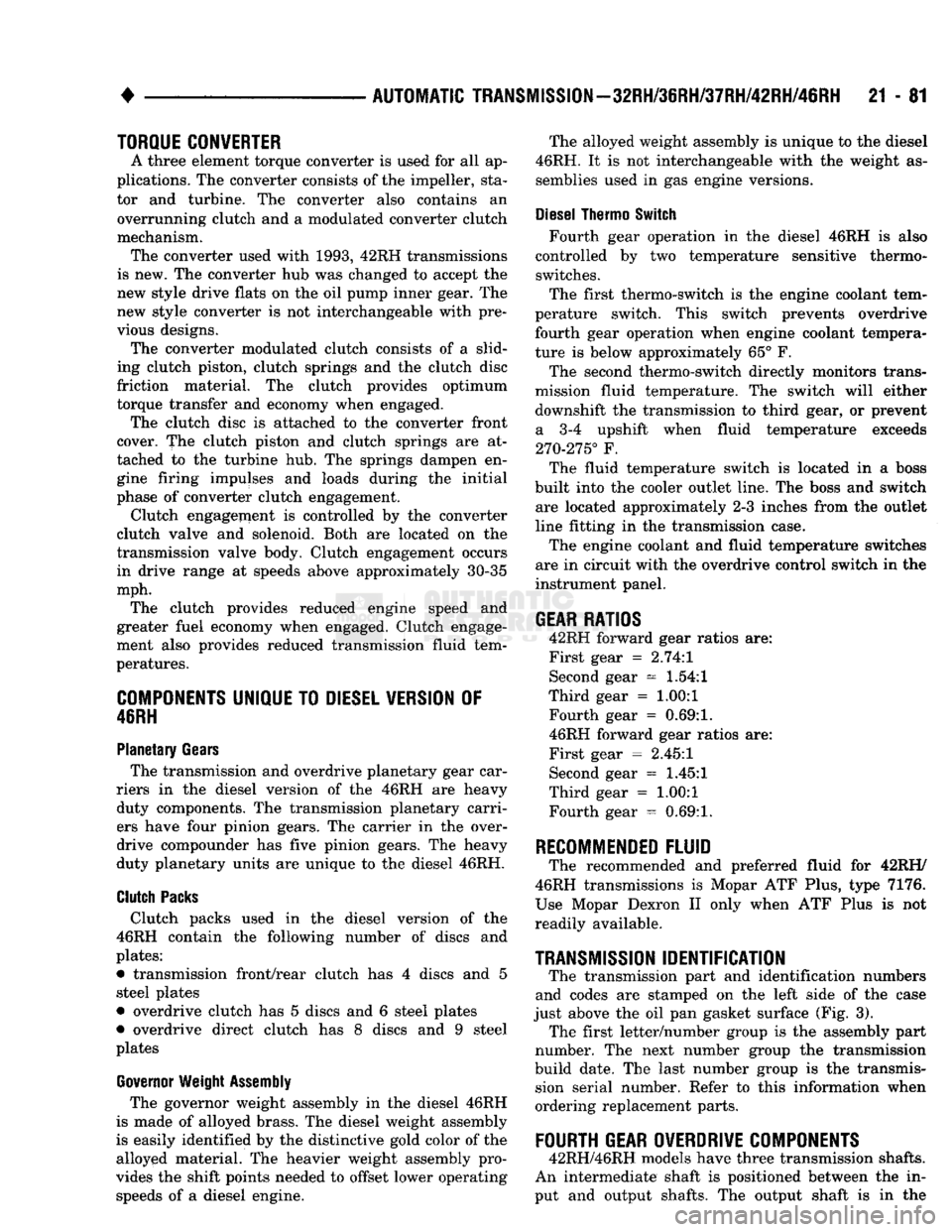
GEAR RATIOS
42RH forward gear ratios
are:
First gear
=
2.74:1
Second gear
= 1.54:1
Third gear
= 1.00:1
Fourth gear
=
0.69:1.
46RH forward gear ratios
are:
First gear
=
2.45:1 Second gear
= 1.45:1
Third gear
= 1.00:1
Fourth gear
=
0.69:1.
RECOMMENDED
FLUID
The recommended
and
preferred fluid
for
42RH/
46RH transmissions
is
Mopar
ATF
Plus, type
7176.
Use Mopar Dexron
II
only when
ATF
Plus
is not
readily available.
TRANSMISSION
IDENTIFICATION
The transmission part
and
identification numbers
and codes
are
stamped
on the
left side
of the
case
just above
the oil pan
gasket surface
(Fig. 3).
The first letter/number group
is the
assembly part
number.
The
next number group
the
transmission
build date.
The
last number group
is the
transmis sion serial number. Refer
to
this information when
ordering replacement parts.
FOURTH
GEAR OVERDRIVE COMPONENTS
42RH/46RH models have three transmission shafts.
An intermediate shaft
is
positioned between
the in
put
and
output shafts.
The
output shaft
is in the
Page 1478 of 1502
•
EMISSION
CONTROL
SYSTEMS
25
- 1
CONTENTS
page page
AIR INJECTION
SYSTEM-o
9L
HDC-GAS EVAPORATIVE EMISSION CONTROLS
6
ENGINE
15
EXHAUST EMISSION CONTROLS
10
COMPONENT
REMOVAL/INSTALLATION
17
GENERAL INFORMATION
1
GENERAL
INFORMATION
Throughout this group, references are made
to
par
ticular vehicle models
by
alphabetical designation
or
by the particular vehicle nameplate.
A
chart showing a breakdown
of
alphabetical designations
is
included
in
the
Introduction section
at
the
beginning
of
this
manual.
The 5.9L (V-8) gas powered engine will
be
referred
to
in
this group
as
either the: LDC (Light Duty Cy cle)
or
HDC (Heavy Duty Cycle) engine.
The
HDC
engine can
be
easily identified
by
the
use
of
an en
gine mounted
air
injection pump. The 3.9L/5.2L/5.9L
LDC engine will not use
an
air
injection pump.
Maintenance requirements for LDC and HDC emis
sion systems differ because
of
different load
and
op
erating conditions. This section will cover emission control systems
for
the 3.9L (V-6), 5.2L (V-8), 5.9L LDC (V-8), 5.9L HDC (V-8) and 5.9L (in-line six cylinder) diesel engines.
SERVICE
REMINDER INDICATOR
(SRI)
LIGHT
The instrument panel mounted SRI light was for
merly referred
to as the
emission maintenance
re
minder (EMR) light.
It is
used with 5.9L HDC-gas
powered engines only.
It is
not
used with diesel
en
gines.
The SRI system
is
incorporated into the powertrain
control module (PCM)
(the
PCM
was
formerly
re
ferred
to as the
engine controller
or
SBEC).
The
PCM records
the
vehicles mileage and stores
it
into
memory every
8
miles. At that time, the PCM checks
for the 60,000 and 82,500 mileage trip points. When
the current mileage matches one
of
the above men
tioned trip points,
the
SRI light
is
activated.
The following parts are
to
be replaced
at
either the
indicated mileage
or
when the SRI light remains
on
when the key
is in
the ON position. After performing
the required maintenance,
the
SRI light must
be
re set
to
turn the light
off.
96,000
km
(60,000 miles):
• Replace EGR Valve
• Clean EGR passage • Replace PCV Valve
132,000
km
(82,500 miles):
• Replace Oxygen Sensor
Refer
to
Group
0,
Lubrication and Maintenance
for
all required maintenance schedules.
Failure
to
perform
the
required maintenance
and
only reset the SRI light may be
a
violation of federal
law. Only after performing
the
required mainte
nance, should the SRI light
be
reset.
RESETTING
SRI
LIGHT
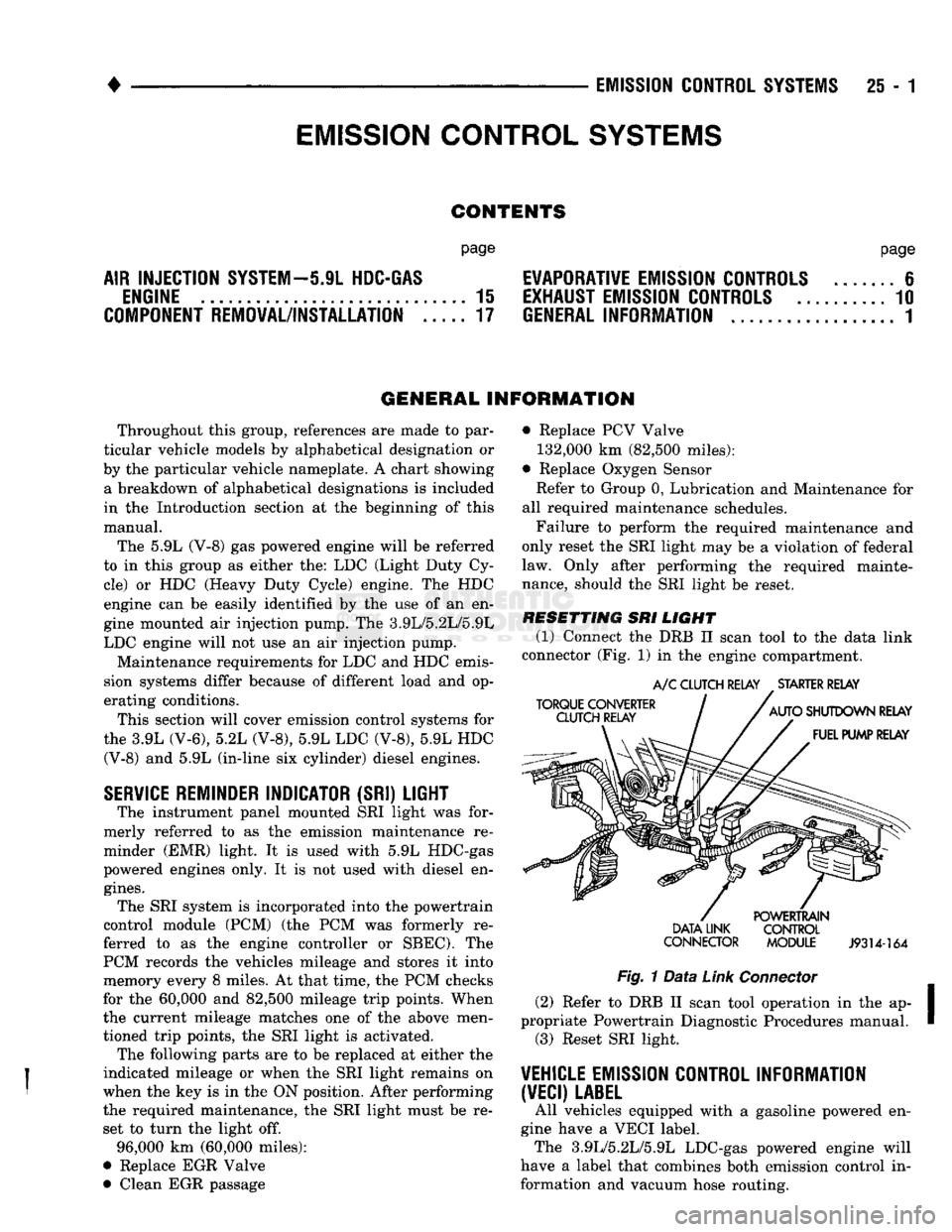
(1) Connect
the
DRB
II
scan tool
to
the
data link
connector (Fig.
1)
in
the engine compartment.
TORQUE CONVERTER
CLUTCH RELAY
A/C
CLUTCH RELAY
.
STARTER RELAY
AUTO
SHUTDOWN RELAY FUEL PUMP RELAY DATA LINK
CONNECTOR POWERTRAIN
CONTROL
MODULE
J9314-164
Fig.
1
Data
Link
Connector
(2) Refer
to
DRB
II
scan tool operation
in
the ap
propriate Powertrain Diagnostic Procedures manual. (3) Reset SRI light.
VEHICLE
EMISSION CONTROL INFORMATION
(VECI)
LABEL
All vehicles equipped with
a
gasoline powered
en
gine have
a
VECI label. The 3.9L/5.2L/5.9L LDC-gas powered engine will
have
a
label that combines both emission control
in
formation and vacuum hose routing.
EMISSION CONTROL
SYSTEMS
Page 1488 of 1502
•
EMISSION
CONTROL
SYSTEMS
25 - 11 • The electrical solenoid portion of the EET is not
energized.
• The engine back pressure entering the EGR valve
inlet is strong enough to close the transducer bleed
valve.
If back pressure is not strong enough to close the
transducer bleed valve, the transducer will bleed off the vacuum preventing EGR operation.
When the electrical solenoid portion of the EET is
de-energized by the powertrain control module (PCM), vacuum flows to the transducer. The trans
ducer is connected to the engine exhaust system by a small hose that connects to the base of the EGR
valve.
The vacuum section of the transducer is controlled
by exhaust system back pressure. When back pres sure is high enough it will close a bleed valve in the
transducer allowing vacuum to actuate the EGR
valve. If back pressure does not close the bleed valve,
vacuum will be bled off.
For more information, refer to Group 14, Fuel Sys
tems.
Refer to the Component Removal/Installation sec
tion of this group for EGR valve replacement proce
dures.
EGR SYSTEM ON-BOARD DIAGNOSTICS
(CALIFORNIA VEHICLES
ONLY)
The powertrain control module (PCM) performs an
On-Board Diagnostic (OBD) check of the EGR system
on all California vehicles. The diagnostic system uses
the electric EGR transducer (EET) for the system
tests.
The OBD check activates only during selected en
gine/driving conditions. When the conditions are met,
the PCM energizes the EET solenoid to disable the EGR. The PCM checks for a change in the oxygen sensor signal. If the air-fuel mixture goes lean, the
PCM will attempt to enrichen the mixture. The PCM
registers a diagnostic trouble code (DTC) if the EGR system has failed or degraded. After registering a
DTC,
the PCM turns the malfunction indicator
lamp (MIL) on. (The malfunction indicator lamp was formerly referred to as the check engine lamp). The
malfunction indicator lamp indicates the need for im
mediate service.
If a malfunction is indicated by the malfunction in
dicator lamp and a DTC for the EGR system was set,
check for proper operation of EGR system. Use the
following: System Test, EGR Gas Flow Test and EGR
Diagnosis Chart.
If the EGR system tests properly, check the system
using the DRB II scan tool. For use of the DRB II,
refer to the appropriate Powertrain Diagnostics Pro cedure service manual. EGR SYSTEM SERVICE
A malfunctioning EGR system can cause engine
spark knock, sags or hesitation, rough idle, engine
stalling and poor driveability. To be sure of proper
operation of the EGR system, inspect all passages for
blockage. Check moving parts for binding. Inspect
the complete system for leaks. Replace system com ponents or hoses that are leaking.
Inspect all hose connections between throttle body,
intake manifold, EGR valve and EGR purge solenoid.
Replace any vacuum harness components that are
leaking or damaged. Refer to EGR Control System Test and EGR Gas
Flow Test to check EGR System operation.
EGR GAS FLOW TEST (1) Disconnect hose from EGR valve and connect a
hand vacuum pump to EGR valve nipple. Apply a
minimum of 12 inches vacuum the valve.
(2) The engine should now idle roughly or stall. If
this occurs, the valve is performing correctly. Proceed
to Electric EGR Transducer Test.
(3) If the engine idle speed did not change, remove
the EGR valve and inspect the valve and the exhaust passage in the manifold for blockage. Repair as nec
essary. If blockage is not present, replace the EGR
valve.
ELECTRIC EGR TRANSDUCER (EET)
TESTING ELECTRIC SOLENOID PORTION OF TRANSDUCER
(1) Bring the engine to normal operating tempera
ture.
Operate at idle speed. Test the EET as follows: (2) Check vacuum at EET vacuum source. Discon
nect the hose and attach a vacuum gauge to it.
(3) Vacuum should be a minimum of 15 inches:
• If vacuum is low, check the line for kinks, twists
or a loose connection at vacuum connector or intake
manifold.
• If vacuum is correct, remove gauge. Connect the
vacuum line and proceed to next step. (4) Check EET operation using the appropriate
Powertrain Diagnostic Procedures service manual.
Refer to this manual for use of the DRB II scan tool and repair EET as necessary.
TESTING VACUUM PORTION
OF
TRANSDUCER
(1) Disconnect the EET vacuum lines, back pres
sure line and electrical connector. Remove trans
ducer.
(2) Plug the EET EGR valve port.
(3) Apply 1-2 pounds air pressure to exhaust back
pressure port. Air pressure can be supplied with a
hand operated air pump or compressed air (regulated
to correct psi).
(4) Apply a minimum of 12 inches of vacuum to
vacuum supply port.
Replace the EET if it will not hold vacuum.
Page 1494 of 1502

•
EMISSION
CONTROL SYSTEMS
25 - 17
COMPONENT REMOVAL/INSTALLATION
INDEI
page
Air
Filter/Filter
Housing—Diesel Engines
17
Air
Filter/Filter
Housing—Gas Engines
17
Air
Injection
Pump
17
Air
Injection
Pump Relief Valve
18
Check
Valve—Air
Injection
Tube
18
Coolant Temperature
Sensor
. 18
EGR
Tube—Gas Powered Engines
19
EGR
Valve
19
AIR FILTER/FILTER HOUSING-GAS ENGINES
REMOVAL/INSTALLATION Remove crankcase breather/filter hose at side of air
filter housing. Remove wingnut (Fig. 1) and remove
housing from engine. Check condition of gasket at
throttle body and replace as necessary. To replace air filter element only: Remove wingnut
and air filter housing cover (Fig. 1). Clean inside of
housing before replacing filter. Housing removal is not necessary for filter replacement.
^
WING NUT
COVER
:
GASKET
| I
MOUNTING
STUD
Fig.
1 Air
Filter
Housing—Gas
Powered
Engines—Typical
page
Electric
EGR Transducer (EET)
20
EVAP
Canister
20
EVAP
Canister Purge Solenoid
20
Fuel Tank
Filler
Tube
Cap . 21
Oxygen
(02)
Sensor
21
Powertrain Control Module (PCM)
21
Pressure
Relief/Rollover Valve
21
If housing-to-throttle body mounting stud is being
installed, tighten to 10 N»m (90 in. lbs.) torque. In stall housing to engine and tighten wingnut to 1.5
N»m (15 in. lbs.) torque.
AIR FILTER/FILTER HOUSING-DIESEL ENGINES
REMO
VAL/INSTALLA
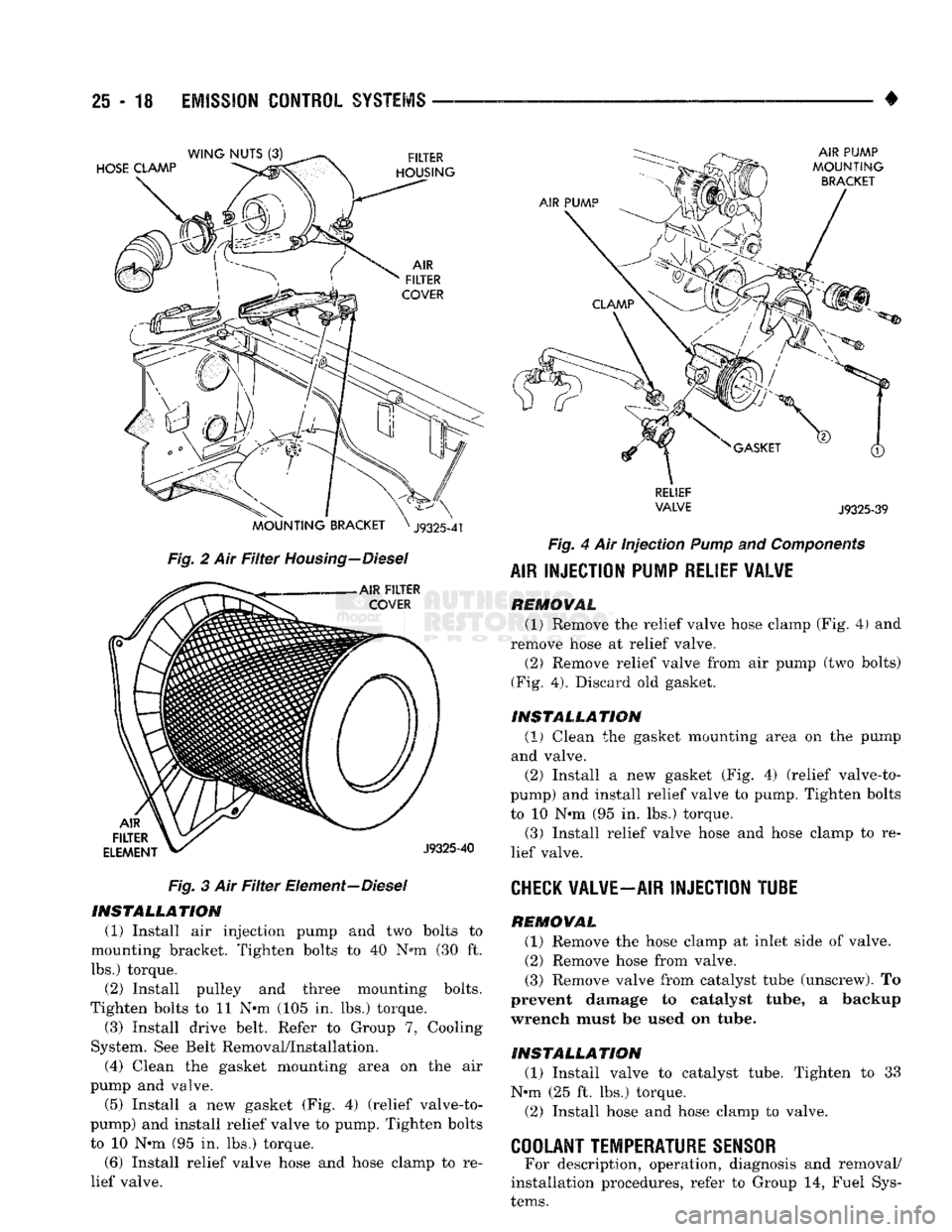
TION Remove the hose clamp at air filter housing (Fig.
2).
Remove mounting nuts and remove air filter
housing from vehicle.
To replace air filter element only: Remove hose clamp
and hose at air filter housing inlet tube. Remove three
wingnuts and air filter housing cover (Figs. 2 and 3). Clean inside of housing before replacing filter. Housing
removal is not necessary for filter replacement.
When installing a new air filter element, push el
ement into cover. Be sure it is pushed into tabs in
back of filter housing. Install wing nuts.
If housing had been removed, install mounting
nuts and tighten to 10 N»m (95 in. lbs.) torque.
AIR INJECTION PUMP
REMOVAL (1) Remove the relief valve hose clamp (Fig. 4) and
remove hose at relief valve.
(2) Remove relief valve from air pump (two bolts)
(Fig. 4). (3) Loosen (but do not remove at this time) the
three air pump pulley mounting bolts (number 2—figure 4).
(4) Relax the automatic belt tensioner and remove
the engine accessory drive belt. Refer to Group 7, Cooling System. See Belt Removal/Installation.
(5) Remove the three air pump pulley bolts and re
move pulley from pump.
(6) Remove the two air pump mounting bolts
(number
1—figure
4) and remove pump from mount
ing bracket.
Page 1495 of 1502
25
- 18
EMISSION
CONTROL
SYSTEMS
Fig. 2 Air Filter Housing—Diesel Fig. 3 Air Filter Element—Diesel INSTALLATION
(1) Install air injection pump and two bolts to
mounting bracket. Tighten bolts to 40 N*m (30 ft.
lbs.) torque. (2) Install pulley and three mounting bolts.
Tighten bolts to 11 N*m (105 in. lbs.) torque.
(3) Install drive belt. Refer to Group 7, Cooling
System. See Belt Removal/Installation.
(4) Clean the gasket mounting area on the air
pump and valve. (5) Install a new gasket (Fig. 4) (relief valve-to-
pump) and install relief valve to pump. Tighten bolts to 10 N*m (95 in. lbs.) torque.
(6) Install relief valve hose and hose clamp to re
lief valve. •
RELIEF
VALVE
J9325-39
Fig. 4 Air Injection
Pump
and
Components
AIR
INJECTION PUMP RELIEF VALVE REMOVAL
(1) Remove the relief valve hose clamp (Fig. 4) and
remove hose at relief valve.
(2) Remove relief valve from air pump (two bolts)
(Fig. 4). Discard old gasket.
INSTALLATION (1)
Clean the gasket mounting area on the pump
and valve. (2) Install a new gasket (Fig. 4) (relief valve-to-
pump) and install relief valve to pump. Tighten bolts
to 10 N*m (95 in. lbs.) torque. (3) Install relief valve hose and hose clamp to re
lief valve.
CHECK
VALVE—AIR INJECTION TUBE REMOVAL
(1) Remove the hose clamp at inlet side of valve.
(2) Remove hose from valve.
(3) Remove valve from catalyst tube (unscrew). To
prevent damage to catalyst tube, a backup
wrench must be used on tube.
INSTALLATION
(1) Install valve to catalyst tube. Tighten to 33
N«m (25 ft. lbs.) torque.
(2) Install hose and hose clamp to valve.
COOLANT TEMPERATURE SENSOR
For description, operation, diagnosis and removal/
installation procedures, refer to Group 14, Fuel Sys
tems.
Page 1500 of 1502
COMPONENT AND SYSTEM INDEX
Name
Group-page
AUDIO
SYSTEMS
8F-1
SERVICE
PROCEDURES 8F-7
TEST PROCEDURES 8F-2
BATTERY/STARTER/GENERATOR SERVICE 8B-1 BATTERY SERVICE PROCEDURES 8B-1
GENERATOR SERVICE 8B-6
SPECIFICATIONS 8B-9
STARTER SERVICE PROCEDURES 8B-4
BODY COMPONENTS 23-1 CAB/BODY INTERIOR COMPONENTS
23-35
DOORS
23-21
EXTERIOR COMPONENTS 23-1
FIXED GLASS
23-29
PAINT
CODE CHART
23-54
REFINISHING PROCEDURES
23-54
BRAKES
5-1 BENDIX DISC BRAKE 5-37 BRAKE ADJUSTMENTS-BRAKE BLEEDING 5-7
BRAKE DIAGNOSIS 5-3
CHRYSLER
DISC BRAKE 5-27 DRUM BRAKES—ELEVEN INCH 5-46
DRUM BRAKES-TWELVE INCH 5-50
GENERAL INFORMATION 5-1 MASTER CYLINDER—COMBINATION VALVE-BRAKE
LINES 5-10
PARKING BRAKES 5-56
POWER BRAKE BOOSTER-BRAKE PEDAL 5-20 POWER BRAKE VACUUM PUMP-DIESEL ENGINE. . 5-22
REAR
WHEEL ANTILOCK
(RWAL)
BRAKES 5-59
SPECIFICATIONS 5-65
CHIME/BUZZER WARNING
SYSTEMS
8U-1
CLUTCH 6-1 CLUTCH DIAGNOSIS 6-2 CLUTCH SERVICE 6-11
COOLING SYSTEM 7-1
DIAGNOSIS 7-4
ENGINE ACCESSORY DRIVE BELTS 7-40
ENGINE BLOCK HEATERS 7-48
SERVICE
PROCEDURES 7-15 SPECIFICATIONS 7-49
ELECTRICAL 8A-1 BATTERY TEST PROCEDURES 8A-2
ENGINE STARTER MOTOR TEST PROCEDURES.... 8A-9
GENERAL INFORMATION 8A-1
GENERATOR TEST PROCEDURES ON VEHICLE . . . 8A-13
GROUP INDEX 8A-1
SPECIFICATIONS 8A-18
BATTERY/STARTING/CHARGING
SYSTEMS
DIAGNOSTICS 8A-1
EMISSION
CONTROL
SYSTEMS.
25-1 AIR INJECTION SYSTEM—5.9L HDC-GAS ENGINE . 25-15 COMPONENT REMOVAL/INSTALLATION 25-17 EVAPORATIVE EMISSION CONTROLS 25-6
EXHAUST EMISSION CONTROLS 25-10
GENERAL INFORMATION 25-1
ENGINES 9-1 3.9L ENGINE SERVICE PROCEDURES 9-17 5.2L ENGINE SERVICE PROCEDURES 9-47
5.9L (DIESEL) ENGINE SERVICE PROCEDURES . . . 9-107
Name
Group-page
5.9L ENGINE SERVICE PROCEDURES 9-77 ENGINE DIAGNOSIS 9-5
STANDARD SERVICE PROCEDURES 9-1
EXHAUST SYSTEM AND INTAKE MANIFOLD 11-1
EXHAUST SYSTEM DIAGNOSIS 11-3
GENERAL INFORMATION 11-1
SERVICE
PROCEDURES (DIESEL ENGINES) 11-17
SERVICE
PROCEDURES (GASOLINE ENGINES) 11-4
SPECIFICATIONS 11-27
FRAME AND BUMPERS 13-1 ATTACHED COMPONENTS 13-30
BUMPERS
13-1
FRAME 13-20
SNOW PLOW 13-3
FRONT SUSPENSION AND AXLE 2-1 FRONT SUSPENSION—2WD VEHICLES 2-7
FRONT SUSPENSION—4WD VEHICLES 2-14 FRONT WHEEL ALIGNMENT 2-3
GENERAL INFORMATION 2-1 MODEL 44 FRONT AXLE 2-17
MODEL 60 FRONT AXLE 2-49
TORQUE SPECIFICATIONS 2-75
FUEL SYSTEM 14-1 ACCELERATOR PEDAL AND THROTTLE CABLE . . . 14-25
DIESEL
FUEL INJECTION—COMPONENT DESCRIPTION/SYSTEM OPERATION 14-76
DIESEL
FUEL INJECTION-GENERAL DIAGNOSIS. . 14-88
DIESEL
FUEL INJECTION-SERVICE
PROCEDURES
14-106
FUEL DELIVERY SYSTEM-EXCEPT DIESEL 14-3
FUEL DELIVERY-DIESEL ENGINE 14-15 FUEL TANKS 14-20
GENERAL INFORMATION 14-1 MULTI-PORT FUEL INJECTION (MPI)-COMPONENT DESCRIPTION/SYSTEM OPERATION-EXCEPT
DIESEL
14-29
MULTI-PORT FUEL INJECTION
(MPlj-COMPONENT
REMOVAL/INSTALLATION-EXCEPT DIESEL .... 14-64
MULTI-PORT FUEL INJECTION (MPI)—GENERAL DIAGNOSIS-EXCEPT DIESEL 14-43
SERVICE
ADJUSTMENTS-DIESEL
14-122
SPECIFICATIONS
14-123
HEATING AND AIR CONDITIONING 24-1 CLIMATE CONTROL SYSTEM
24-29
COMPRESSOR
SERVICE
(SD-709)
24-21 DIAGNOSTIC PROCEDURES 24-3
GENERAL INFORMATION 24-1 REFRIGERANT SYSTEM SERVICE PROCEDURES . . 24-17
TORQUE SPECIFICATIONS
24-39
HORNS 8G-1
SERVICE
PROCEDURES 8G-3
TEST PROCEDURES 8G-1
IGNITION
SYSTEMS
8D-1 COMPONENT IDENTIFICATION/SYSTEM OPERATION. 8D-1
COMPONENT REMOVAL/INSTALLATION 8D-18 DIAGNOSTICS/SERVICE PROCEDURES 8D-7
IGNITION
SWITCH
8D-25
SPECIFICATIONS
8D-28
INSTRUMENT PANEL AND GAUGES 8E-1