ad blue DODGE TRUCK 1993 Service User Guide
[x] Cancel search | Manufacturer: DODGE, Model Year: 1993, Model line: TRUCK, Model: DODGE TRUCK 1993Pages: 1502, PDF Size: 80.97 MB
Page 590 of 1502
![DODGE TRUCK 1993 Service User Guide
•
WIRING DIAGRAMS 8W - 115 RIGHT DOOR SWITCH CONNECTOR
P33
160R/BK (LOCK)
P35
160R/VT
] —E
FORWARD
TERMINAL END
-BLUE
P36 16PK/VT
• F35 16RD
P34 1BPK/BK (UNLOCK)
t
UP
y-](/img/12/56922/w960_56922-589.png "DODGE TRUCK 1993 Service User Guide
•
WIRING DIAGRAMS 8W - 115 RIGHT DOOR SWITCH CONNECTOR
P33
160R/BK (LOCK)
P35
160R/VT
] —E
FORWARD
TERMINAL END
-BLUE
P36 16PK/VT
• F35 16RD
P34 1BPK/BK (UNLOCK)
t
UP
y-")
•
WIRING DIAGRAMS 8W - 115 RIGHT DOOR SWITCH CONNECTOR
P33
160R/BK (LOCK)
P35
160R/VT
] —E
FORWARD
TERMINAL END
-BLUE
P36 16PK/VT
• F35 16RD
P34 1BPK/BK (UNLOCK)
t
UP
y-—•
• •—'
RIGHT FRONT DOOR SWITCH /
(VIEW FROM /
TERMINAL END) / BLACK—^
fTOPl
/
VLK
P36 P34
16PK 16PK VT BK F35 16RD-
P36 16PK/VT -J
P35
160R/VT-
P33
160R/BK- P34 16PK/BK
J938W-11 P34
16PK
BK
F35
16RD P35
160R VT
P33
160R/BK-P34 16PK/BK
POWER
DOOR LOCKS RIGHT FRONT
DOOR
MOTOR
^ LK X—\UNLK
to AD 74
Page 594 of 1502
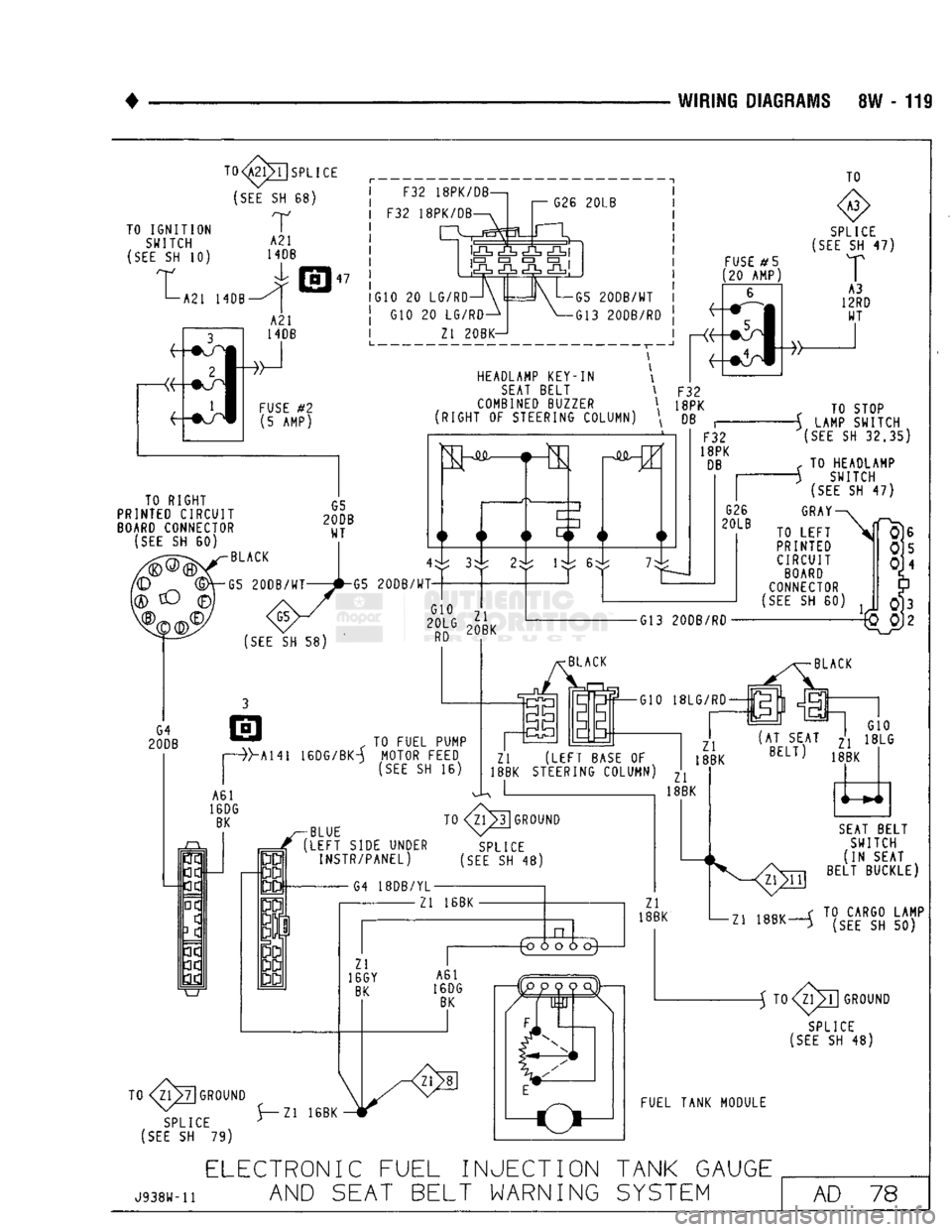
WIRING
DIAGRAMS SW - 119
TO IGNITION SWITCH
(SEE
SH 10)
t 1—A21 HOB TO
1| SPLICE
(SEE
SH 68)
r
A21
HOB
47 F32 18PK/DB—,
F32 18PK/DB G26
20LB
lc£L
iCZD
• • • G10 20 LG/RD-
G10 20 LG/RD- Zl 20BK- ~1
G5
20DB/WT
G13 20DB/RD TO
FUSE
#5
[20 AMP)
SPLICE
(SEE
SH 47)
HEADLAMP KEY-IN
SEAT
BELT
COMBINED
BUZZER \ F32
\ 18PK
RIGHT OF STEERING COLUMN \ DB TO RIGHT
PRINTED CIRCUIT
BOARD
CONNECTOR
(SEE
SH 60)
(SEE
SH 58)
BLACK
G5
20DB/WT
G5
20DB/WT-
G10
20LG
Zl
20BK F32
18PK
DB
G26
20LB
TO STOP
-\ LAMP SWITCH
(SEE
SH
32,35)
< TO HEADLAMP
S SWITCH
(SEE
SH 47)
GRAY
TO LEFT
PRINTED CIRCUIT
BOARD
CONNECTOR
(SEE
SH 60)
•G13 20DB/RD
, TO FUEL PUMP
Hi41 16DG/BK-A MOTOR FEED
(SEE
SH 16) G10
Zl
(LEFT
BASE
OF
18BK STEERING COLUMN) ^ I , 18BK Zl
8BK (AT SEAT ^ 18LG
BELT>
18BK
^BLUE
r
(LEFT
SIDE UNDER INSTR/PANEL)
G4 18DB/YL- TO
GROUND
SPLICE
[SEE
SH 48)
Zl 16BK XL Zl
16GY
BK
TO
SPLICE
(SEE
SH 79) \ z^20
5~Zl 16BK -HT A61
16DG
BK
4o
o o d
) c
F. it
JJ Zl
18BK Z1>11
SEAT
BELT
SWITCH
(IN SEAT
BELT BUCKLE) 71 1ftR. f TO CARGO LAMP
-Zl 18BK—^ (SEE SH 50) -5 TO
SPLICE
(SEE
SH 48)
FUEL TANK MODULE
J938W-11
ELECTRONIC
FUEL INJECTION TANK GAUGE
AND
SEAT BELT WARNING
SYSTEM
AD
78
Page 595 of 1502
![DODGE TRUCK 1993 Service User Guide
8W - 120 WIRING
DIAGRAMS
TO TRANSMISSION
WIRING r
(SEE
SH 7 DIESEL)J
(SEE
SH 9 GAS)
TO<L7^T]
SPLICE
(SEE
SH 47) S
TO TURN
SIGNAL SWITCH
(SEE
SH 56)
T0<Z1>3
[SPLICE
(SEE
SH](/img/12/56922/w960_56922-594.png "DODGE TRUCK 1993 Service User Guide
8W - 120 WIRING
DIAGRAMS
TO TRANSMISSION
WIRING r
(SEE
SH 7 DIESEL)J
(SEE
SH 9 GAS)
TO<L7^T]
SPLICE
(SEE
SH 47) S
TO TURN
SIGNAL SWITCH
(SEE
SH 56)
T0<Z1>3
[SPLICE
(SEE
SH")
8W - 120 WIRING
DIAGRAMS
TO TRANSMISSION
WIRING r
(SEE
SH 7 DIESEL)J
(SEE
SH 9 GAS)
TO
(SEE
SH 47) S
TO TURN
SIGNAL SWITCH
(SEE
SH 56)
T0
[SPLICE
(SEE
SH 48)
SPORT
UTILITY
LEFT
TAIL.
STOP
i TURN X2
SIGNAL 18GY
LAMP
LEFT
BACK-UP LAMP CAB I
CHASSIS
SWEPT
LINE
BOX
LEFT
TAIL.
STOP
I
TURN
SIGNAL LAMP -
LEFT
BACK-UP LAMP
LEFT
TAIL,
STOP
I
TURN Y9
SIGNAL ,ppv LAMP 18fY
LEFT
BACK-UP LAMP BLUE
(LEFT
SIDE UNDER I/P)
TO
SPLICE
(SEE
SH
77.78)
B2
18VT/BK
AD
79
REAR
LIGHTING
J938W-11
Page 598 of 1502
•
WIRING DIAGRAMS 8W - 123 F33
F33 El 18TN
18PK/RD
18PK/RD BLUE DOT TURN SIGNAL
FLASHER
(SEE
SH 56) L6 18RD/BK
L5 18RD
_ L5 18RD
V34
20WT/RD
A21 14DB
F20 18WT
F20 18WT
G5 20DB/WT
A3 12RD/WT
F35 16RD
F32 A31 18PK/DB
14BK/WT
GREEN
DOT
F21
E2
200R
F30 16RD/TN A4 12BK/RD
A4 12BK/RD
Ml 20PK
X12 20RD/WT
L5 18RD L5 14RD
V34 20WT/RD
12TN L19 18PK
HAZARD
L9 18BK/WT
X3
20BK/RD
F33 18PK/RD X2 18DG/RD_
A15 16PK
A22 12BK/0R V6 18DB
V6 18DB HAZARD
FLASHER
(SEE
SH 56)
HORN
RELAY
(SEE
SH 30)
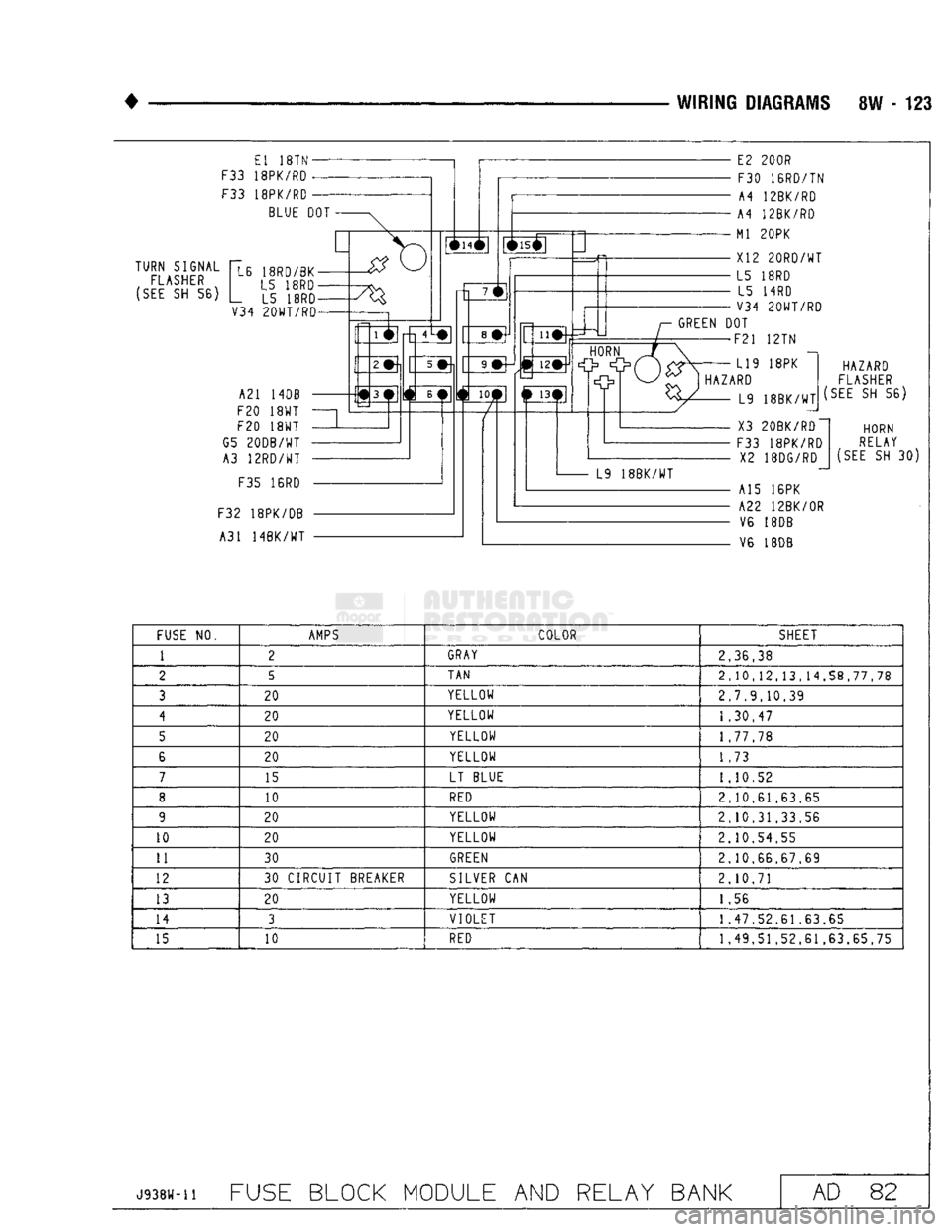
FUSE
NO.
AMPS
COLOR
SHEET
1 2
GRAY
2,36,38
2
5
TAN
2, 10,
12.13,14,58,77,78
3 20 YELLOW
2.7,9,10,39
4 20 YELLOW
1.30.47
5
20 YELLOW
1
.77.78
6 20 YELLOW
1 ,73
7 15 LT BLUE
1,10.52
8 10
RED
2,10,61.63.65
9 20 YELLOW
2.10,31.33.56
10 20 YELLOW
2.10.54.55
11 30
GREEN
2.10.66,67.69
12 30 CIRCUIT BREAKER
SILVER
CAN
2,10,71
13 20 YELLOW
1 ,56
14 3 VIOLET
1.47,52.61.63,65
15 10
RED
1,49,51.52,61,63,65,75
J938W-H
FUSE BLOCK MODULE AND RELAY BANK
AD 82
Page 617 of 1502
9
- 12
ENGINES
•
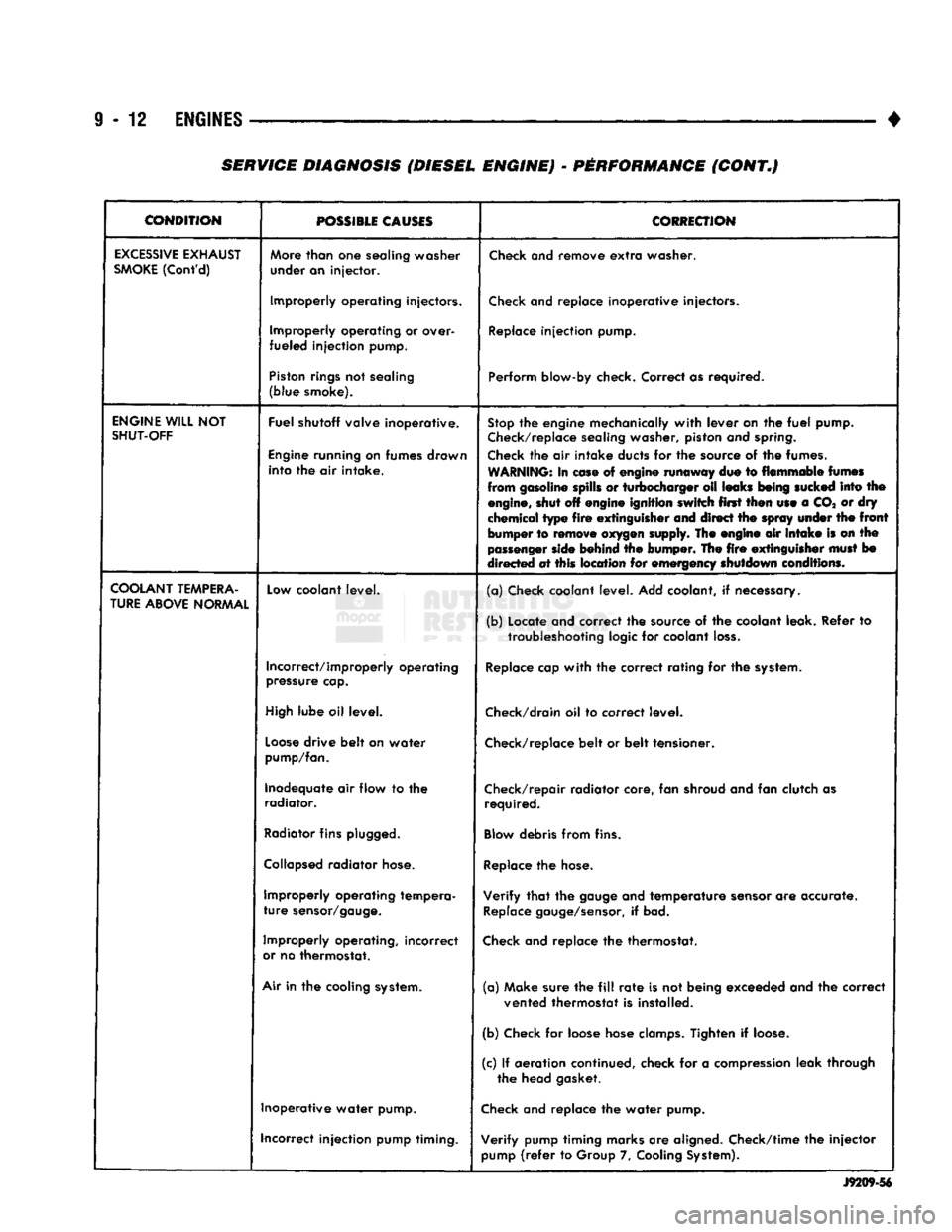
CONDITION
POSSIBLE
CAUSES
CORRECTION
EXCESSIVE
EXHAUST
SMOKE
(Cont'd)
More
than
one
sealing washer
under an injector.
Check
and remove
extra
washer.
Improperly operating injectors.
Check
and replace inoperative injectors.
Improperly operating or over-
fueled injection pump.
Replace
injection pump.
Piston
rings
not sealing
(blue smoke). Perform blow-by check. Correct as required.
ENGINE
WILL
NOT
SHUT-OFF
Fuel shutoff valve inoperative.
Engine
running on fumes drawn into the air intake.
Stop
the engine mechanically
with
lever on the
fuel
pump.
Check/replace
sealing washer, piston and
spring.
Check
the air intake ducts for the source of the fumes.
WARNING:
In
ease
of engine runaway due to flammable
fumes
from gasoline spills or turbocharger oil leaks
being
sucked
into the
engine,
shut off engine ignition switch first then use a CO* or dry
chemical type
fire
extinguisher
and direct the
spray
under
the
front
bumper to
remove
oxygen
supply. The engine air
intake
is on the
passenger
side
behind the bumper. The
fire
extinguisher
must
bo
directed at this location for emergency shutdown conditions.
COOLANT
TEMPERA
TURE
ABOVE
NORMAL
Low
coolant level.
(a) Check coolant level. Add coolant, if necessary.
(b) Locate and correct the source of the coolant leak. Refer to
troubleshooting
logic for coolant
loss.
Incorrect/improperly operating
pressure
cap.
Replace
cap
with
the correct rating for the
system.
High
lube oil level.
Check/drain
oil to correct level.
Loose
drive belt on water
pump/fan.
Check/replace
belt or belt tensioner.
Inadequate air flow to the radiator. Check/repair radiator core, fan shroud and fan clutch as
required.
Radiator
fins
plugged.
Blow
debris from fins.
Collapsed
radiator
hose.
Replace
the
hose.
Improperly operating tempera
ture
sensor/gauge.
Verify
that
the
gauge
and temperature
sensor
are accurate.
Replace
gauge/sensor,
if bad.
Improperly operating, incorrect
or
no thermostat.
Check
and replace the thermostat.
Air
in the cooling
system.
(a) Make sure the
fill
rate
is not being exceeded and the correct
vented thermostat is installed.
(b) Check for loose hose
clamps.
Tighten if
loose.
(c) If aeration continued, check for a
compression
leak through the head gasket.
Inoperative water pump.
Check
and replace the water pump.
incorrect injection pump timing. Verify pump timing marks are aligned. Check/time the injector
pump
(refer
to Group 7,
Cooling
System).
J9209-56
SERVICE DIAGNOSIS (DIESEL ENGINE) - PERFORMANCE (CONT.)
Page 631 of 1502
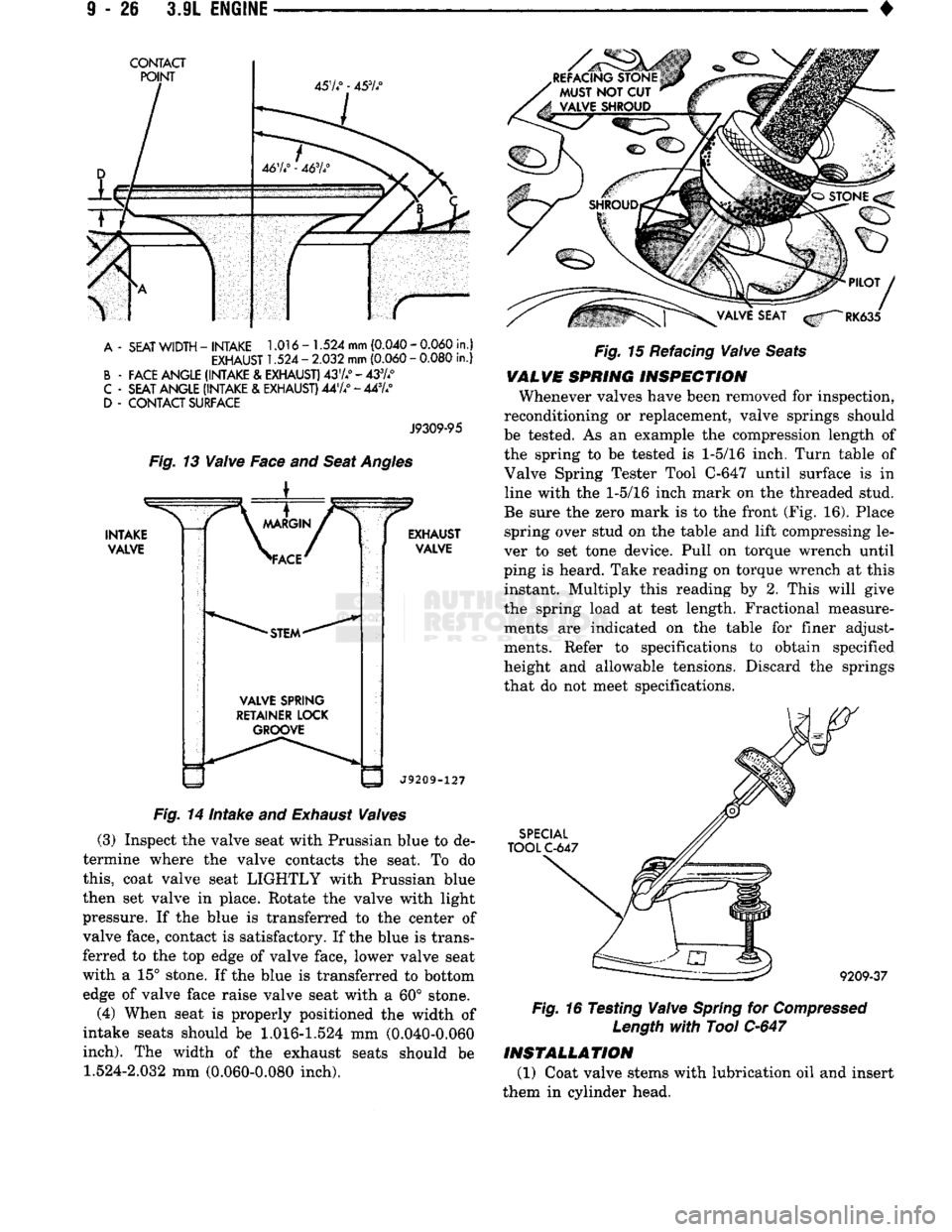
A
-
SEAT
WIDTH
-
INTAKE
1.016
-
1.524
mm
(0.040
-
0.060
in.)
EXHAUST
1.524
-
2.032
mm
(0.060
-
0.080
in.)
B
-
FACE
ANGLE
(INTAKE
& EXHAUST)
4374°
-
433A°
C
-
SEAT
ANGLE
(INTAKE
& EXHAUST)
4474°
-
44%°
D
-
CONTACT SURFACE
J9309-95
Fig.
13
Valve
Face and
Seat
Angles
i
INTAKE
VALVE
\
MARGIN
/ "
>FACE'
•STEM"
VALVE SPRING
RETAINER LOCK GROOVE EXHAUST
VALVE
J9209-127
Fig.
14 Intake and
Exhaust
Valves
(3) Inspect
the
valve seat with Prussian blue
to de
termine where
the
valve contacts
the
seat.
To do
this,
coat valve seat LIGHTLY with Prussian blue
then
set
valve
in
place. Rotate
the
valve with light
pressure.
If the
blue
is
transferred
to the
center
of
valve face, contact
is
satisfactory.
If
the blue
is
trans
ferred
to the top
edge
of
valve face, lower valve seat
with
a 15°
stone.
If
the blue
is
transferred
to
bottom edge
of
valve face raise valve seat with
a 60°
stone.
(4)
When seat
is
properly positioned
the
width
of
intake seats should
be 1.016-1.524 mm (0.040-0.060
inch).
The
width
of the
exhaust seats should
be 1.524-2.032 mm (0.060-0.080
inch).
Fig.
15 Refacing
Valve
Seats
VALVE
SPRING
INSPECTION
Whenever valves have been removed
for
inspection,
reconditioning
or
replacement, valve springs should
be tested.
As an
example
the
compression length
of
the spring
to be
tested
is 1-5/16
inch. Turn table
of
Valve Spring Tester Tool
C-647
until surface
is in
line with
the 1-5/16
inch mark
on the
threaded stud.
Be sure
the
zero mark
is to the
front (Fig.
16).
Place spring over stud
on the
table
and
lift compressing
le
ver
to set
tone device. Pull
on
torque wrench until
ping
is
heard. Take reading
on
torque wrench
at
this instant. Multiply this reading
by 2.
This will give
the spring load
at
test length. Fractional measure ments
are
indicated
on the
table
for
finer adjustments. Refer
to
specifications
to
obtain specified
height
and
allowable tensions. Discard
the
springs
that
do not
meet specifications.
SPECIAL
TOOL
C-647
9209-37
Fig.
16 Testing
Valve
Spring
for
Compressed
Length
with
Tool
C-647
INSTALLATION
(1)
Coat valve stems with lubrication
oil and
insert
them
in
cylinder head.
Page 660 of 1502
•
5.2L
ENGINE
I - 55
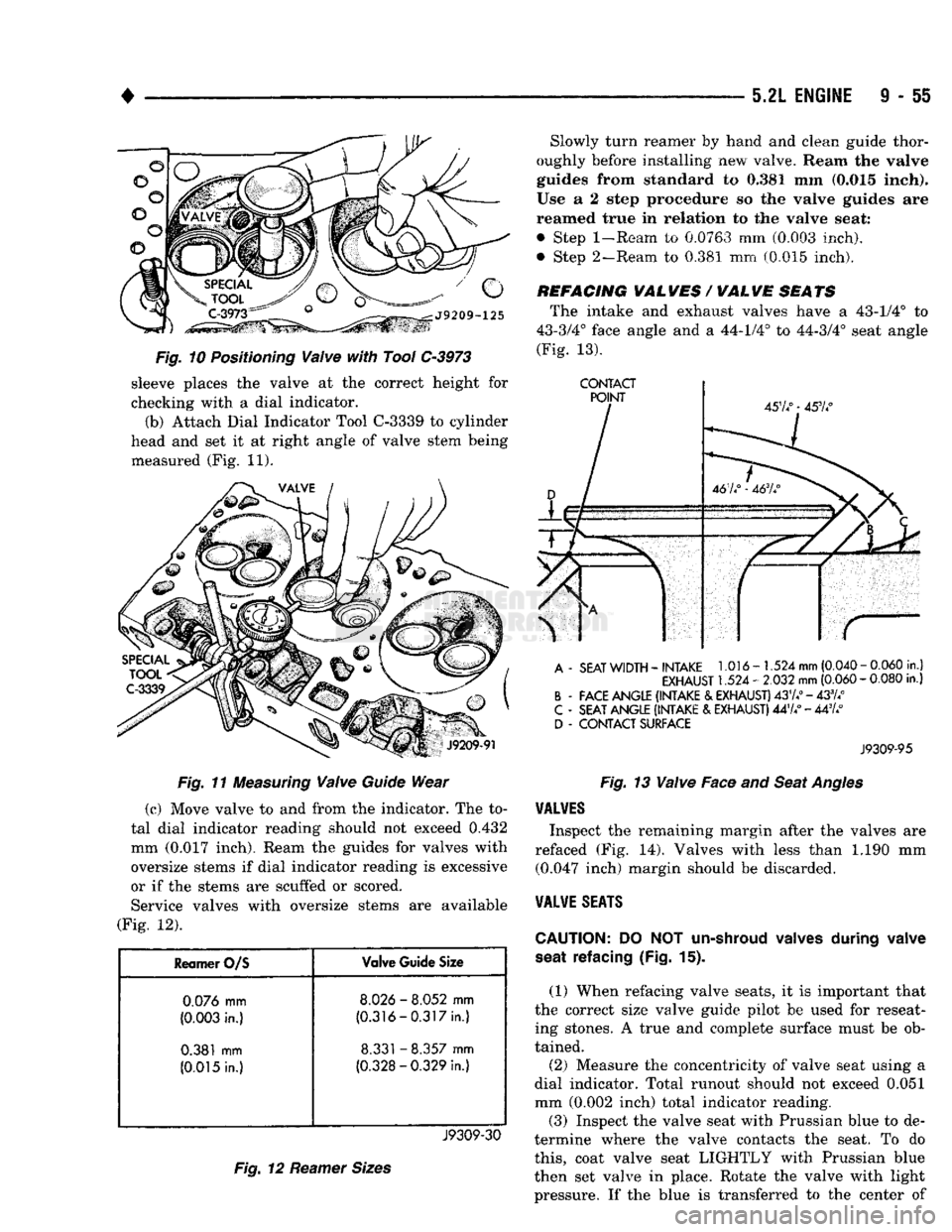
Fig. 10 Positioning Valve with Tool C-3973 sleeve places the valve at the correct height for
checking with a dial indicator.
(b) Attach Dial Indicator Tool C-3339 to cylinder
head and set it at right angle of valve stem being measured (Fig. 11).
Fig. 11 Measuring Valve Guide Wear
(c) Move valve to and from the indicator. The to
tal dial indicator reading should not exceed
0.432
mm
(0.017
inch). Ream the guides for valves with
oversize stems if dial indicator reading is excessive
or if the stems are scuffed or scored. Service valves with oversize stems are available
(Fig. 12).
Reamer
O/S
Valve
Guide
Size
0.076
mm
8.026
-
8.052
mm
(0.003
in.)
(0.316-0.317in.)
0.381
mm
8.331
-
8.357
mm
(0.015
In.)
(0.328-0.329
In.)
J9309-30
Fig. 12 Reamer Sizes
Slowly turn reamer
by
hand
and
clean guide thor
oughly before installing
new
valve. Ream
the valve
guides from standard
to 0,381 mm
(0.015 Inch).
Use
a 2
step procedure
so the
valve guides
are
reamed true
in
relation
to the
valve seat:
• Step
1-Ream
to 0.0763 mm (0.003 inch),
• Step 2—Ream, to 0.381 mm (0.015 inch).
REFACING
VAL
WES
/
WAL
WE
SEATS
The intake and exhaust valves have a 43-1/4° to
43-3/4° face angle and a 44-1/4° to 44-3/4° seat angle
(Fig.
13).
CONTACT
A
-
SEAT
WIDTH
-
INTAKE
1.016-1.524
mm
(0.040
-
0.060
in.)
EXHAUST
1.524 -
2.032
mm
(0.060
-
0.080
in.)
B
-
FACE ANGLE (INTAKE
&
EXHAUST)
437.°
-433//
C
-
SEAT ANGLE (INTAKE
&
EXHAUST)
447/ - 447/
D
-
CONTACT SURFACE
J9309-95
Fig. 13 Valve Face and Seat Angles
VALVES
Inspect the remaining margin after the valves are
refaced (Fig. 14). Valves with less than 1.190 mm (0.047 inch) margin should be discarded.
VALVE
SEATS
CAUTION:
DO NOT
un-shroud valves
during
valve
seat
refacing (Fig.
15).
(1) When refacing valve seats, it is important that
the correct size valve guide pilot be used for reseat ing stones. A true and complete surface must be ob
tained.
(2) Measure the concentricity of valve seat using a
dial indicator. Total runout should not exceed 0.051
mm (0.002 inch) total indicator reading. (3) Inspect the valve seat with Prussian blue to de
termine where the valve contacts the seat. To do
this,
coat valve seat LIGHTLY with Prussian blue
then set valve in place. Rotate the valve with light
pressure. If the blue is transferred to the center of
Page 661 of 1502
9
- 56 5.2L
ENGINE
•
VALVE
SPRING
RETAINER LOCK GROOVE
EXHAUST
VALVE
J9209-127 the spring load at test length. Fractional measure
ments are indicated on the table for finer adjust
ments. Refer to specifications to obtain specified
height and allowable tensions. Discard the springs
that do not meet specifications.
SPECIAL
TOOL
C-647
Fig.
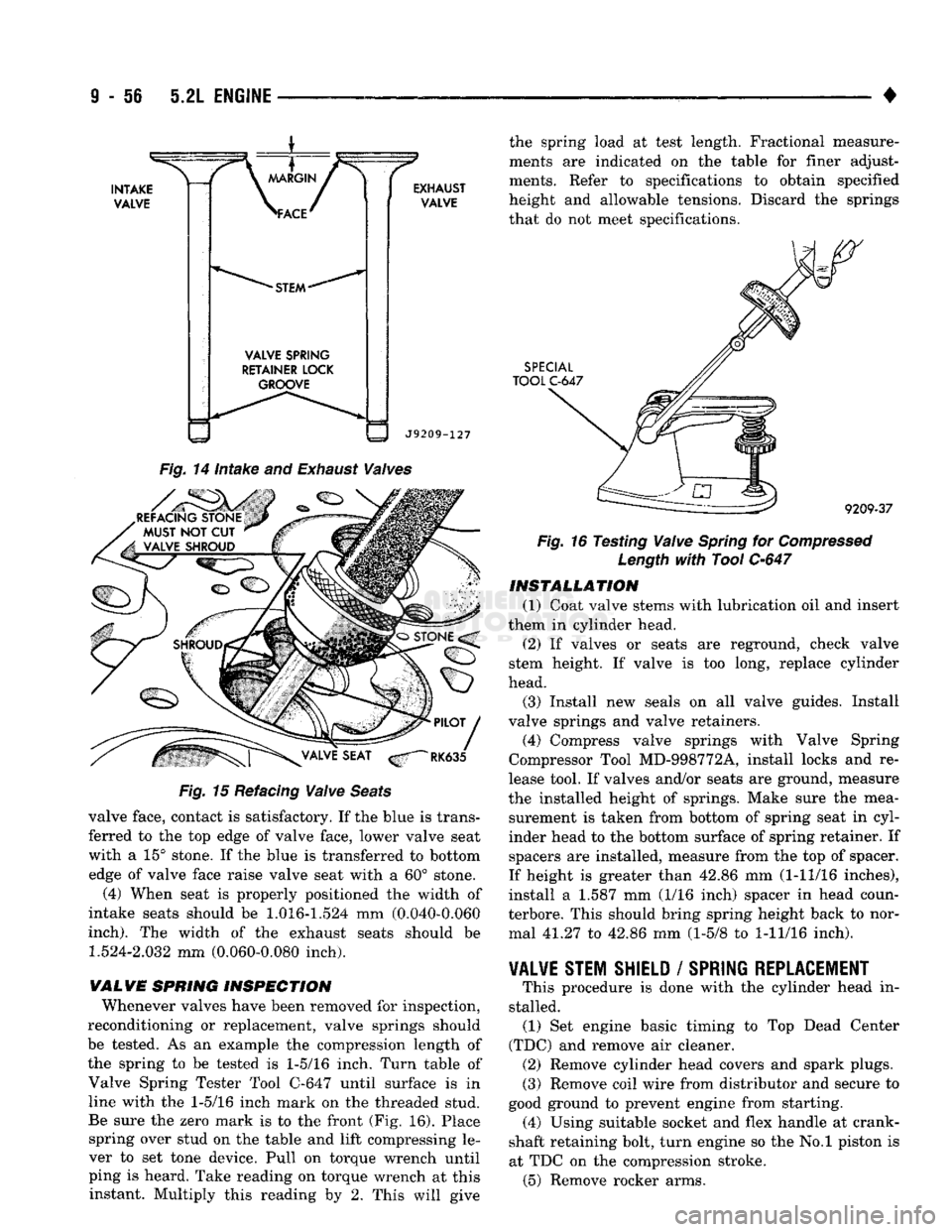
14 Intake and
Exhaust
Valves
Fig.
15 Refacing
Valve
Seats
valve face, contact is satisfactory. If the blue is trans
ferred to the top edge of valve face, lower valve seat
with a 15° stone. If the blue is transferred to bottom edge of valve face raise valve seat with a 60° stone.
(4) When seat is properly positioned the width of
intake seats should be
1.016-1.524
mm (0.040-0.060
inch).
The width of the exhaust seats should be
1.524-2.032
mm (0.060-0.080 inch).
WALVE SPRING INSPECTION Whenever valves have been removed for inspection,
reconditioning or replacement, valve springs should
be tested. As an example the compression length of
the spring to be tested is
1-5/16
inch. Turn table of Valve Spring Tester Tool C-647 until surface is in line with the
1-5/16
inch mark on the threaded stud.
Be sure the zero mark is to the front (Fig. 16). Place spring over stud on the table and lift compressing le
ver to set tone device. Pull on torque wrench until ping is heard. Take reading on torque wrench at this instant. Multiply this reading by 2. This will give ^
9209-37
Fig.
16 Testing
Valve
Spring
for
Compressed
Length
with
Tool
C-647
INSTALLATION
(1) Coat valve stems with lubrication oil and insert
them in cylinder head.
(2) If valves or seats are reground, check valve
stem height. If valve is too long, replace cylinder
head.
(3) Install new seals on all valve guides. Install
valve springs and valve retainers.
(4) Compress valve springs with Valve Spring
Compressor Tool MD-998772A, install locks and re
lease tool. If valves and/or seats are ground, measure
the installed height of springs. Make sure the mea surement is taken from bottom of spring seat in cyl
inder head to the bottom surface of spring retainer. If spacers are installed, measure from the top of spacer.
If height is greater than 42.86 mm (1-11/16 inches),
install a 1.587 mm (1/16 inch) spacer in head coun-
terbore. This should bring spring height back to nor mal 41.27 to 42.86 mm (1-5/8 to
1-11/16
inch).
VALVE STEM SHIELD
/
SPRING REPLACEMENT
# This procedure is done with the cylinder head in
stalled. (1) Set engine basic timing to Top Dead Center
(TDC) and remove air cleaner. (2) Remove cylinder head covers and spark plugs.
(3) Remove coil wire from distributor and secure to
good ground to prevent engine from starting. (4) Using suitable socket and flex handle at crank
shaft retaining bolt, turn engine so the No.l piston is
at TDC on the compression stroke. (5) Remove rocker arms.
Page 690 of 1502
•
5.9L
ENGINE
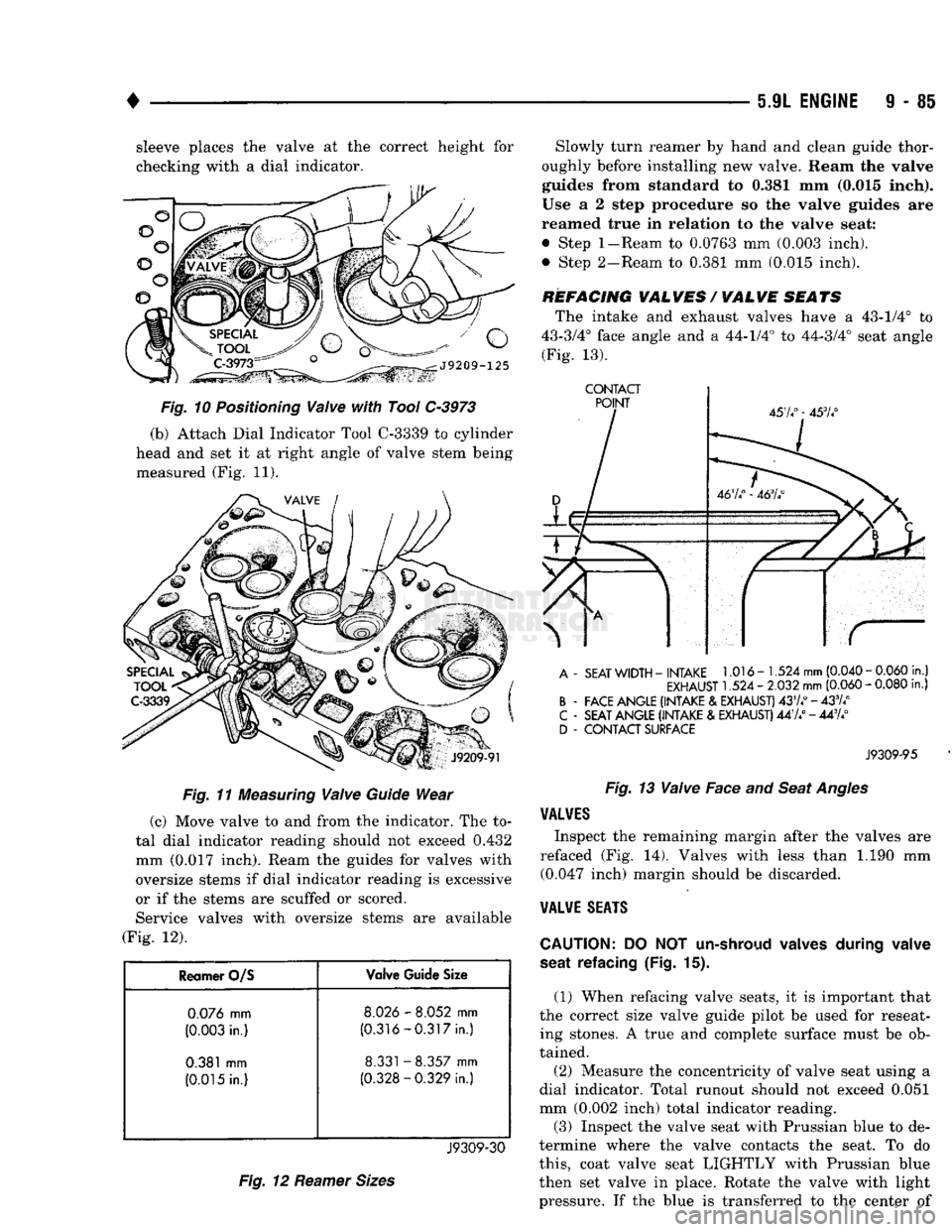
9 - 85 sleeve places the valve at the correct height for
checking with a dial indicator.
Fig.
11
Measuring
Valve
Guide
Wear
(c) Move valve to and from the indicator. The to
tal dial indicator reading should not exceed 0.432
mm (0.017 inch). Ream the guides for valves with
oversize stems if dial indicator reading is excessive
or if the stems are scuffed or scored. Service valves with oversize stems are available
(Fig. 12).
Reamer O/S Valve Guide Size
0.076
mm
8.026
-
8.052
mm
(0.003
in.)
(0.316-0.317
in.)
0.381
mm
8.331
-
8.357
mm
(0.015
in.)
(0.328-0.329
in.)
J9309-30
Fig.
12
Reamer
Sizes
Slowly turn reamer by hand and clean guide thor
oughly before installing new valve. Ream the valve
guides from standard to 0.381 mm (0.015 inch).
Use a 2 step procedure so the valve guides are
reamed true in relation to the valve seat:
• Step
1-Ream
to 0.0763 mm (0.003 inch).
• Step 2-Ream to 0.381 mm (0.015 inch).
REFACING VALVES / VALVE SEATS The intake and exhaust valves have a 43-1/4° to
43-3/4° face angle and a 44-1/4° to 44-3/4° seat angle (Fig. 13).
CONTACT
A
-
SEAT
WIDTH
-
INTAKE
1.016-1.524
mm
(0.040
-
0.060
in.)
EXHAUST
1.524 -
2.032
mm
(0.060
-
0.080
in.)
B
-
FACE ANGLE (INTAKE
&
EXHAUST)
4374°-433/4°
C
-
SEAT ANGLE (INTAKE
&
EXHAUST)
447/ - 443A°
D
-
CONTACT SURFACE
J9309-95
Fig.
13
Valve
Face and
Seat
Angles
VALVES
Inspect the remaining margin after the valves are
refaced (Fig. 14). Valves with less than 1.190 mm (0.047 inch) margin should be discarded.
VALVE
SEATS
CAUTION:
DO NOT
un-shroud valves during valve
seat refacing
(Fig. 15).
(1) When refacing valve seats, it is important that
the correct size valve guide pilot be used for reseat ing stones. A true and complete surface must be ob
tained.
(2) Measure the concentricity of valve seat using a
dial indicator. Total runout should not exceed 0.051
mm (0.002 inch) total indicator reading.
(3)
Inspect the valve seat with Prussian blue to de
termine where the valve contacts the seat. To do
this,
coat valve seat LIGHTLY with Prussian blue
then set valve in place. Rotate the valve with light pressure. If the blue is transferred to the center of
Page 691 of 1502

9
• 86 5.9L
ENGINE
•
INTAKE
VALVE
\
MARGIN
/ >
\ACE^
*
STEM
*
VALVE
SPRING
RETAINER
LOCK
GROOVE EXHAUST
VALVE
J9209-127
Fig.
14
intake
and
Exhaust
Waives
REFACING STONE MUST
NOT CUT
VALVE SHROUD Fig.
15 Refacing
Waive
Seats
valve face, contact is satisfactory. If the blue is trans ferred to the top edge of valve face, lower valve seat
with a 15° stone. If the blue is transferred to bottom edge of valve face raise valve seat with a 60° stone.
(4) When seat is properly positioned the width of
intake seats should be
1.016-1.524
mm (0.040-0.060
inch).
The width of the exhaust seats should be
1.524-2.032
mm (0.060-0.080 inch).
VALVE
SPRING
INSPECTION
Whenever valves have been removed for inspection,
reconditioning or replacement, valve springs should be tested. As an example the compression length of
the spring to be tested is
1-5/16
inch. Turn table of
Valve Spring Tester Tool C-647 until surface is in
line with the
1-5/16
inch mark on the threaded stud. Be sure the zero mark is to the front (Fig. 16). Place spring over stud on the table and lift compressing le
ver to set tone device. Pull on torque wrench until
ping is heard. Take reading on torque wrench at this instant. Multiply this reading by 2. This will give the spring load at test length. Fractional measure
ments are indicated on the table for finer adjust
ments. Refer to specifications to obtain specified
height and allowable tensions. Discard the springs that do not meet specifications.
SPECIAL
TOOL
C-647
9209-37
Fig.
16 Testing
Waive
Spring
for
Compressed
Length
with
Tool
C-647
INSTALLATION
(1) Coat valve stems with lubrication oil and insert
them in cylinder head.
(2) If valves or seats are reground, check valve
stem height. If valve is too long, replace cylinder
head.
(3) Install new seals on all valve guides. Install
valve springs and valve retainers.
(4) Compress valve springs with Valve Spring
Compressor Tool MD-998772A, install locks and re
lease tool. If valves and/or seats are ground, measure
the installed height of springs. Make sure the mea surement is taken from bottom of spring seat in cyl
inder head to the bottom surface of spring retainer. If
spacers are installed, measure from the top of spacer.
If height is greater than 42.86 mm (1-11/16 inches),
install a 1.587 mm (1/16 inch) spacer in head coun-
terbore. This should bring spring height back to nor mal 41.27 to 42.86 mm (1-5/8 to
1-11/16
inch).
¥AL¥E
STEM SHIELD
/
SPRING REPLACEMENT
This procedure is done with the cylinder head in
stalled. (1) Set engine basic timing to Top Dead Center
(TDC) and remove air cleaner. (2) Remove cylinder head covers and spark plugs. (3) Remove coil wire from distributor and secure to
good ground to prevent engine from starting. (4) Using suitable socket and flex handle at crank
shaft retaining bolt, turn engine so the No.l piston is
at TDC on the compression stroke. (5) Remove rocker arms.