key DODGE TRUCK 1993 Service Repair Manual
[x] Cancel search | Manufacturer: DODGE, Model Year: 1993, Model line: TRUCK, Model: DODGE TRUCK 1993Pages: 1502, PDF Size: 80.97 MB
Page 25 of 1502
0 - 6
LUBRICATION
AND
MAINTENANCE
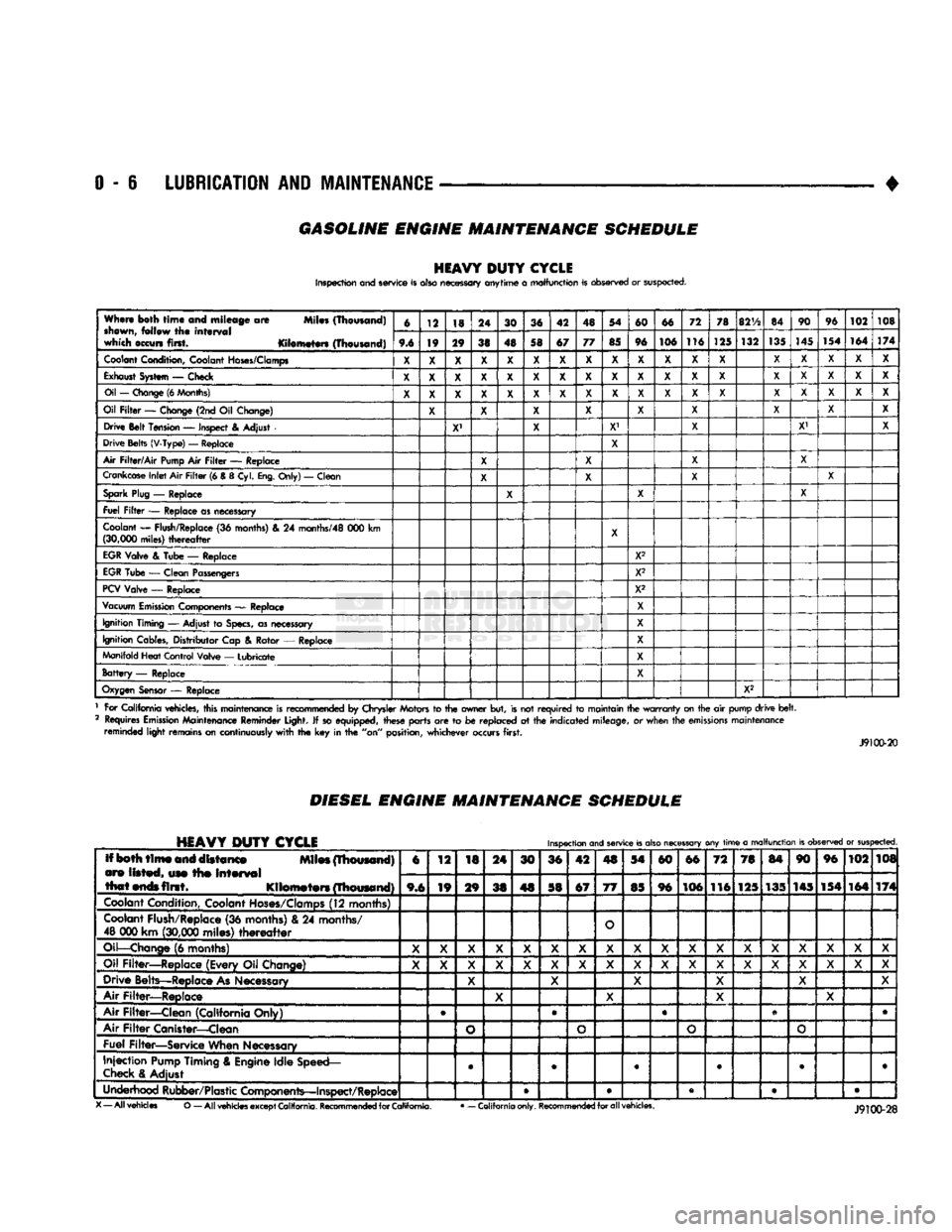
GASOLINE ENGINE MAINTENANCE SCHEDULE
HEAVY
DUTY
CYCLE
Inspection and service is also necessary anytime
a
malfunction is observed or suspected.
When both
time
and mileage
are
Miles (Thousand)
shewn,
follow
the
interval
which occurs first. Kilometers (Thousand) 6
12 18 24
30 36 42 48 54
60 66 72
78
82V2
84 90
96
102 108
When both
time
and mileage
are
Miles (Thousand)
shewn,
follow
the
interval
which occurs first. Kilometers (Thousand) 9.6 19 29
38 48 58 67 77
85 96 106 116
125 132
135
145
154 164
174
Coolant
Condition, Coolant
Hoses/Clamps
X
X X X
X X X X
X X X X
X X X
X X X
Exhaust
System
—
Check
X X X X X X X X X X X
X X X X X
X X
Oil
—
Change
(6
Months)
X X X X X X X
X X
X
X
X
X X X
X X
X
Oil
Filter
—
Change (2nd
Oil
Change)
X X X X
X X
X X
X
Drive Belt Tension
—
Inspect
&
Adjust
X' X
X1
X X' X
Drive Belts (V-Type)
—
Replace
X
Air
Filter/Air
Pump
Air
Filter
—
Replace
X X X
X
Crankcase
Inlet
Air
Filter
(6 &
8
Cyl.
Eng.
Only)
—
Clean
X X
X X
Spark
Plug
—
Replace
X X X
Fuel
Filter
—
Replace as necessary
Coolant
—
Flush/Replace
(36
months)
& 24
months/48
000 km
(30,000
miles)
thereafter
X
EGR
Valve
&
Tube
—
Replace X2
EGR
Tube
—
Clean Passengers
X2
PCV
Valve
—
Replace X2
Vacuum
Emission
Components
—
Replace
X
Ignition Timing
—
Adjust
to
Specs,
as necessary X
Ignition Cables, Distributor Cap
&
Rotor
—
Replace
X
Manifold Heat Control Valve
—
Lubricate
X
Battery
—
Replace X
Oxygen
Sensor
—
Replace
X2
1 For California vehicles, this maintenance is recommended
by
Chrysler Motors
to the
owner but, is not
required
to
maintain the
warranty
on the
air
pump drive
belt.
2 Requires
Emission
Maintenance Reminder Light.
If
so equipped, these parts
are to be
replaced
at the
indicated mileage,
or
when the
emissions
maintenance reminded light remains on continuously
with
the key in the
"on" position, whichever occurs first.
J9100-20
DIESEL
ENGINE
MAINTENANCE
SCHEDULE
HEAVY
DUTY
CYCLE
Inspection
and
service
is
also
necessary
any
time
a
malfunction
is
observed
or
suspected.
Iff both
time
and distance Miles (Thousand)
are listed, use the
interval
that
ends
first. Kilometers (Thousand) 6
12
18 24
30 36 42
4S
54
60 66
72 78
84 90 96
102 108
Iff both
time
and distance Miles (Thousand)
are listed, use the
interval
that
ends
first. Kilometers (Thousand) 9,6 19
29
38 48 58 67
77
85 96 106
116 125 135 145 154
164 174
Coolant
Condition, Coolant
Hoses/Clamps
(12 months)
Coolant
Flush/Replace (36 months) & 24 months/
48 000 km
(30,000
miles)
thereafter
O
Oil—Change
(6 months)
X X X
X X X
X X X X X
X X X X X X
X
Oil Filter—Replace (Every Oil Change)
X X X
X X X
X X
X X X
X
X X X X
X X
Drive Belts—Replace
As
Necessary
X X
X X X X
Air Filter—Replace
X X
X X
Air Filter—Clean (California Only) e
®
• •
Air
Filter
Canister—Clean
o o o
o
Fuel Filter—Service When Necessary
Injection
Pump
Timing & Engine Idle Speed—
Check
& Adjust
©
• 9 • • •
Underhood Rubber/Plastic Components—Inspect/Replace • • • • •
X
— All vehicles
O
— All
vehicles
except
California.
Recommended
for
California.
•
— California only.
Recommended
for all vehicles.
Page 51 of 1502
0
- 32
LUBRICATION
AND
MAINTENANCE
•
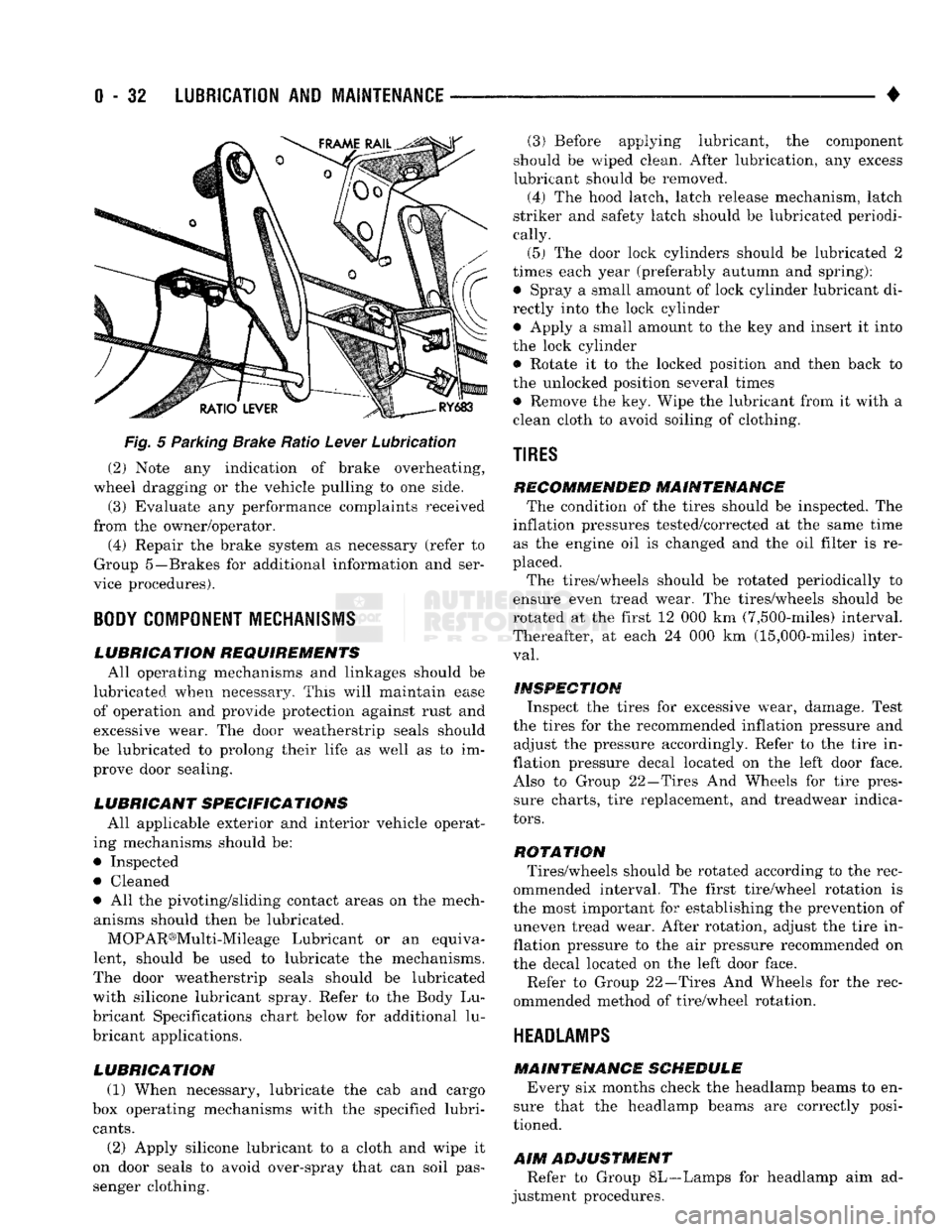
Fig.
5 Parking Brake Ratio Lever Lubrication (2) Note any indication of brake overheating,
wheel dragging or the vehicle pulling to one side.
(3) Evaluate any performance complaints received
from the owner/operator. (4) Repair the brake system as necessary (refer to
Group 5—Brakes for additional information and ser
vice procedures).
BODY
COMPONENT
MECHANISMS
LUBRICATION REQUIREMENTS
All operating mechanisms and linkages should be
lubricated when necessary. This will maintain ease of operation and provide protection against rust and
excessive wear. The door weatherstrip seals should
be lubricated to prolong their life as well as to im prove door sealing.
LUBRICANT SPECIFICATIONS
All applicable exterior and interior vehicle operat
ing mechanisms should be:
• Inspected • Cleaned
• All the pivoting/sliding contact areas on the mech anisms should then be lubricated.
MOPAR®Multi-Mileage Lubricant or an equiva
lent, should be used to lubricate the mechanisms.
The door weatherstrip seals should be lubricated
with silicone lubricant spray. Refer to the Body Lu
bricant Specifications chart below for additional lu
bricant applications.
LUBRICATION
(1) When necessary, lubricate the cab and cargo
box operating mechanisms with the specified lubri
cants.
(2) Apply silicone lubricant to a cloth and wipe it
on door seals to avoid over-spray that can soil pas
senger clothing. (3) Before applying lubricant, the component
should be wiped clean. After lubrication, any excess
lubricant should be removed.
(4) The hood latch, latch release mechanism, latch
striker and safety latch should be lubricated periodi
cally.
(5) The door lock cylinders should be lubricated 2
times each year (preferably autumn and spring): • Spray a small amount of lock cylinder lubricant di
rectly into the lock cylinder
• Apply a small amount to the key and insert it into
the lock cylinder • Rotate it to the locked position and then back to
the unlocked position several times
• Remove the key. Wipe the lubricant from it with a
clean cloth to avoid soiling of clothing.
TIRES
RECOMMENDED MAINTENANCE
The condition of the tires should be inspected. The
inflation pressures tested/corrected at the same time as the engine oil is changed and the oil filter is re
placed.
The tires/wheels should be rotated periodically to
ensure even tread wear. The tires/wheels should be
rotated at the first 12 000 km (7,500-miles) interval.
Thereafter, at each 24 000 km (15,000-miles) inter
val.
INSPECTION
Inspect the tires for excessive wear, damage. Test
the tires for the recommended inflation pressure and adjust the pressure accordingly. Refer to the tire in
flation pressure decal located on the left door face. Also to Group 22—Tires And Wheels for tire pressure charts, tire replacement, and treadwear indica
tors.
ROTATION
Tires/wheels should be rotated according to the rec
ommended interval. The first tire/wheel rotation is
the most important for establishing the prevention of uneven tread wear. After rotation, adjust the tire in
flation pressure to the air pressure recommended on
the decal located on the left door face.
Refer to Group 22—Tires And Wheels for the rec
ommended method of tire/wheel rotation.
HEADLAMPS
MAINTENANCE SCHEDULE
Every six months check the headlamp beams to en
sure that the headlamp beams are correctly posi
tioned.
AIM
ADJUSTMENT
Refer to Group 8L—Lamps for headlamp aim ad
justment procedures.
Page 160 of 1502
•
REAR
SUSPENSION
AND
AXLE
3 - 33
WHEEL BEARING SERVICE
REMOVAL (1) Remove the axle shaft, refer to the removal
procedure. (2) Remove the nut lock and adjustment nut.
(3) Remove the hub and drum assembly. The outer
wheel bearing will slide out as the hub is being re
moved. (4) Place hub on bench and remove inner grease
seal. Discard seal. (5) Remove inner wheel bearing. Inspect wheel
bearings for wear. Replace as necessary.
CLEANING AND INSPECTION (1) Thoroughly clean both wheel bearings and in
terior of the hub. Remove all of the residual lubri cant. (2) To clean the bearings:
• Soak them in an appropriate cleaning solvent
• Strike the flat of each bearing against a hardwood
block several times • Flush bearing between strikes
• Repeat the procedure above until each bearing is clean
• Dry the bearings with compressed air but do not
spin them (3) After cleaning, apply engine oil to each bear
ing. (4) Rotate each bearing slowly while applying
downward force. Examine the rollers for pitting and
roughness. Replace worn or otherwise defective bear
ings.
If a bearing has pitted and/or rough surfaced
rollers, replace both the bearing and bearing cup. (5) If reusable, remove the engine oil from each
bearing. Pack each bearing with multi-purpose
NLGI, grade 2, EP-type lubricant. Ensure that lubricant is forced into all the cav
ities between the bearing cage and rollers.
INSTALLATION (1) If a bearing and cup must be replaced, remove
the cup from the hub bore. Use a brass drift or an appropriate removal tool to tap out the cup. (2) Install the replacement bearing cup(s) with an
appropriate installation tool.
(3) Apply lubricant to surface area of the hub bore.
Install the inner wheel bearing in the hub. Install a
replacement bearing seal with an appropriate seal installation tool. (4) Inspect the bearing and seal contact surfaces on
the axle for burrs and/or roughness.
(5) Remove all the rough contact surfaces from the
axle.
Apply a coating of multi-purpose NLGI, grade
2,
EP-type lubricant to the axle.
CAUTION:
Use care to prevent the inner
wheel
bear
ing
and bearing
seal
from contacting the axle
threads
during installation. Otherwise, the
threads,
bearing,
and
seal
could
be
damaged.
(6) Carefully slide the hub onto the axle. Install
the outer wheel bearing, the locktab and outer wheel
bearing locknut.
(7) Tighten the adjustment nut to 163-190 Nnn
(120-140 ft. lbs.) torque while rotating the wheel. (8) Loosen the adjustment nut 1/3 of-a-turn (120
degrees) to provide 0.001-inch to 0.008-inch wheel
bearing end play.
(9) Tap the nut lock into the spindle keyway and
adjustment nut.
(10) Install the axle shaft, refer to the installation
procedure.
COMPLETE AXLE REMOVAL/INSTALLATION
REMOVAL It is not necessary to remove the complete axle
from the vehicle for routine or differential service. If
the differential housing or axle shaft tubes are dam aged, the complete axle can be removed and in
stalled.
(1) Raise the rear of the vehicle until the rear
wheels are not contacting the surface. Support the
vehicle body at the front of the rear springs.
(2) Use a wooden block to retain the brake pedal
in the up position.
(3) Remove the axle shafts, wheels, hubs and
brake drums. If necessary, refer to the applicable re moval procedures.
(4) Disconnect the brake line and cap the fittings
to prevent loss of brake fluid. (5) Disconnect the parking brake cables.
Scribe installation alignment reference marks
on drive shaft U-joint and on pinion yoke. (6) Disconnect the drive shaft U-joint from the pin
ion yoke. Secure it in an upright position to prevent
damage to the U-joint.
(7) Remove the rear shock absorbers and the rear
spring U-bolts from the axle. (8) Remove the rear axle from the vehicle.
INSTALLATION (1) If the differential housing cover was removed,
ensure differential housing and cover mating sur
faces are clean.
(2) If cover was removed, apply a bead of MOPAR
Silicone Rubber Sealant around the cover bolt circle.
Install the differential housing cover. Tighten the
cover bolts to 47 N»m (35 ft. lbs.) torque. Install the axle gear ratio identification tag under one of
the cover bolts.
(3) With the vehicle body supported at the front of
the rear springs, position the axle under the rear springs.
Page 224 of 1502
•
BRAKES
5 - 37
BENDIX
DISC
BRAKE
INDEX
page
Caliper Overhaul
41
Disc
Brake Inspection
39
Disc
Brakeshoe
Installation
40
Disc
Brakeshoe Removal
. 39
GENERAL
SERVICE
INFORMATION
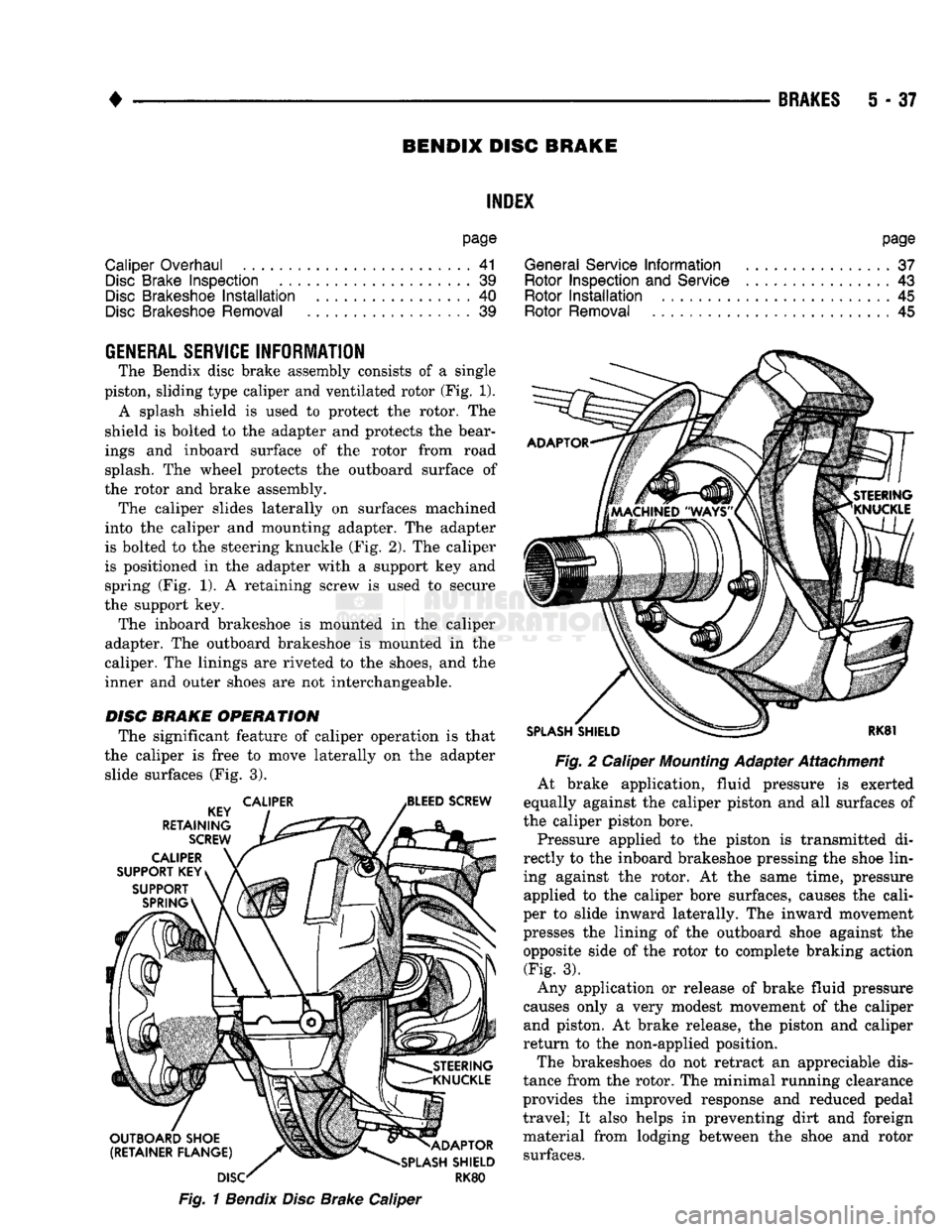
The Bendix disc brake assembly consists of a single
piston, sliding type caliper and ventilated rotor (Fig. 1). A splash shield is used to protect the rotor. The
shield is bolted to the adapter and protects the bear
ings and inboard surface of the rotor from road splash. The wheel protects the outboard surface of
the rotor and brake assembly. The caliper slides laterally on surfaces machined
into the caliper and mounting adapter. The adapter
is bolted to the steering knuckle (Fig. 2). The caliper
is positioned in the adapter with a support key and spring (Fig. 1). A retaining screw is used to secure
the support key. The inboard brakeshoe is mounted in the caliper
adapter. The outboard brakeshoe is mounted in the
caliper. The linings are riveted to the shoes, and the
inner and outer shoes are not interchangeable.
DISC
BRAKE OPERATION
The significant feature of caliper operation is that
the caliper is free to move laterally on the adapter slide surfaces (Fig. 3).
Fig.
1
Bendix
Disc
Brake Caliper
page
General Service
Information
37
Rotor Inspection
and
Service
................ 43
Rotor
Installation
45
Rotor Removal
45
Fig.
2 Caliper
Mounting
Adapter Attachment
At brake application, fluid pressure is exerted
equally against the caliper piston and all surfaces of
the caliper piston bore.
Pressure applied to the piston is transmitted di
rectly to the inboard brakeshoe pressing the shoe lin ing against the rotor. At the same time, pressure applied to the caliper bore surfaces, causes the cali
per to slide inward laterally. The inward movement
presses the lining of the outboard shoe against the
opposite side of the rotor to complete braking action (Fig. 3).
Any application or release of brake fluid pressure
causes only a very modest movement of the caliper and piston. At brake release, the piston and caliper
return to the non-applied position.
The brakeshoes do not retract an appreciable dis
tance from the rotor. The minimal running clearance
provides the improved response and reduced pedal
travel; It also helps in preventing dirt and foreign
material from lodging between the shoe and rotor surfaces.
Page 226 of 1502
BRAKES
5 - 39
DISC BRAKE LINING WEAR COMPENSATION
Normal lining wear is compensated for by exten
sion of the caliper piston and by lateral movement of
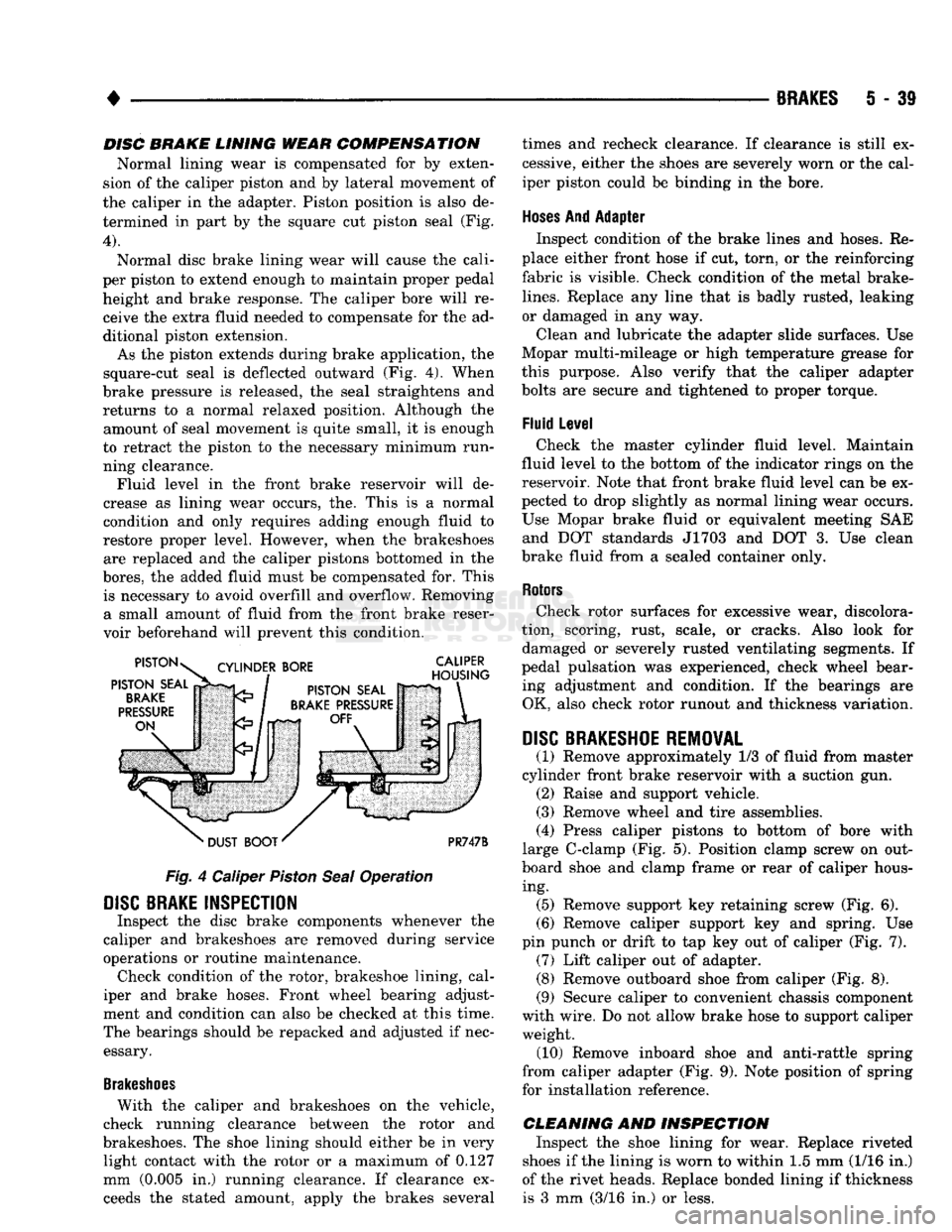
the caliper in the adapter. Piston position is also de termined in part by the square cut piston seal (Fig.
4).
Normal disc brake lining wear will cause the cali
per piston to extend enough to maintain proper pedal height and brake response. The caliper bore will receive the extra fluid needed to compensate for the ad
ditional piston extension.
As the piston extends during brake application, the
square-cut seal is deflected outward (Fig. 4). When
brake pressure is released, the seal straightens and returns to a normal relaxed position. Although the amount of seal movement is quite small, it is enough
to retract the piston to the necessary minimum run ning clearance. Fluid level in the front brake reservoir will de
crease as lining wear occurs, the. This is a normal
condition and only requires adding enough fluid to
restore proper level. However, when the brakeshoes are replaced and the caliper pistons bottomed in the
bores,
the added fluid must be compensated for. This is necessary to avoid overfill and overflow. Removing a small amount of fluid from the front brake reser
voir beforehand will prevent this condition.
Fig.
4 Caliper
Piston
Seal
Operation
DISC
BRAKE INSPECTION
Inspect the disc brake components whenever the
caliper and brakeshoes are removed during service
operations or routine maintenance. Check condition of the rotor, brakeshoe lining, cal
iper and brake hoses. Front wheel bearing adjust
ment and condition can also be checked at this time.
The bearings should be repacked and adjusted if nec essary.
Brakeshoes
With the caliper and brakeshoes on the vehicle,
check running clearance between the rotor and
brakeshoes. The shoe lining should either be in very light contact with the rotor or a maximum of 0.127
mm (0.005 in.) running clearance. If clearance exceeds the stated amount, apply the brakes several times and recheck clearance. If clearance is still ex
cessive, either the shoes are severely worn or the cal
iper piston could be binding in the bore.
Hoses
And Adapter Inspect condition of the brake lines and hoses. Re
place either front hose if cut, torn, or the reinforcing
fabric is visible. Check condition of the metal brake-
lines.
Replace any line that is badly rusted, leaking
or damaged in any way.
Clean and lubricate the adapter slide surfaces. Use
Mopar multi-mileage or high temperature grease for
this purpose. Also verify that the caliper adapter
bolts are secure and tightened to proper torque.
Fluid Level Check the master cylinder fluid level. Maintain
fluid level to the bottom of the indicator rings on the
reservoir. Note that front brake fluid level can be ex
pected to drop slightly as normal lining wear occurs.
Use Mopar brake fluid or equivalent meeting SAE and DOT standards J1703 and DOT 3. Use clean
brake fluid from a sealed container only.
Rotors
Check rotor surfaces for excessive wear, discolora
tion, scoring, rust, scale, or cracks. Also look for damaged or severely rusted ventilating segments. If
pedal pulsation was experienced, check wheel bear ing adjustment and condition. If the bearings are OK, also check rotor runout and thickness variation.
DISC
BRAKESHOE REMOVAL
(1) Remove approximately 1/3 of fluid from master
cylinder front brake reservoir with a suction gun. (2) Raise and support vehicle.
(3) Remove wheel and tire assemblies.
(4) Press caliper pistons to bottom of bore with
large C-clamp (Fig. 5). Position clamp screw on out
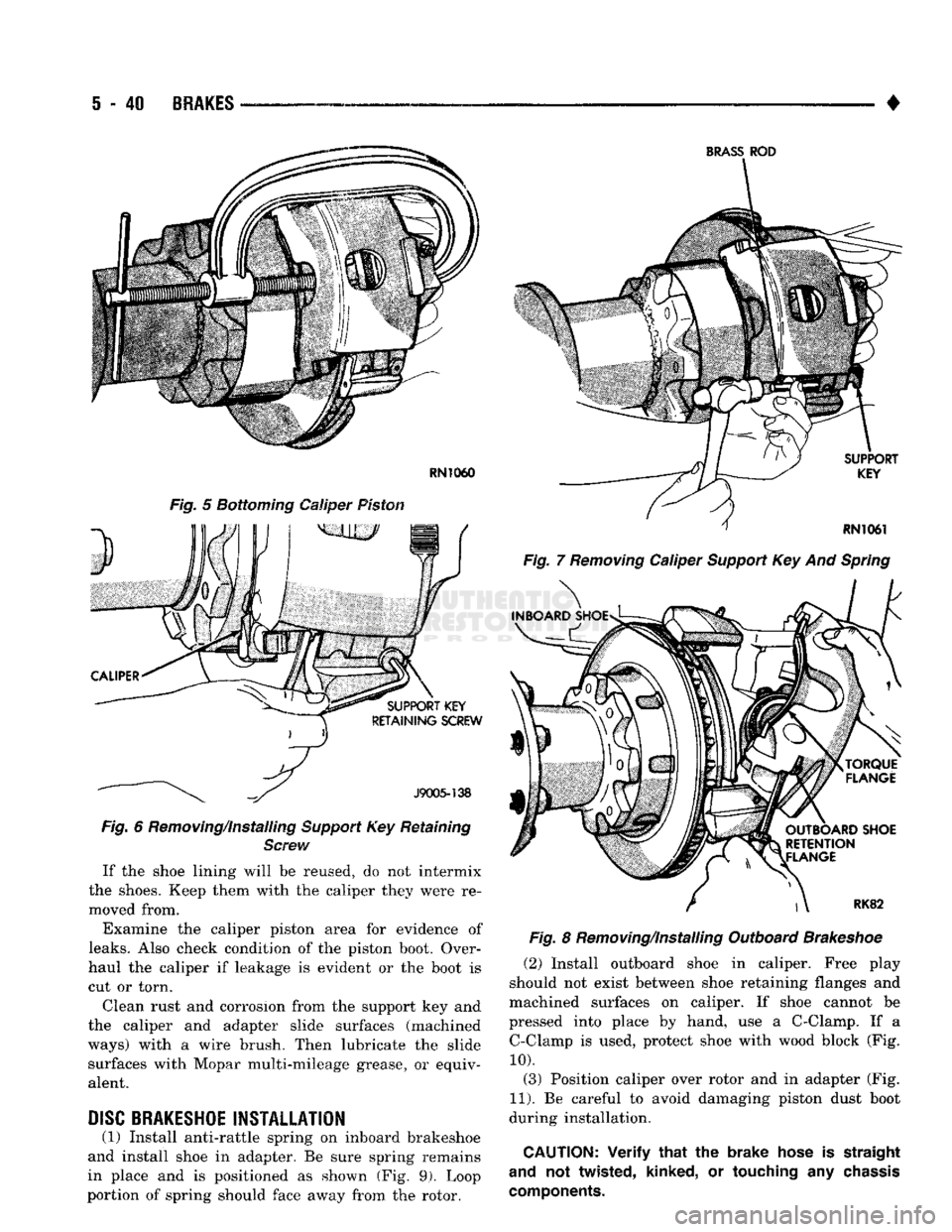
board shoe and clamp frame or rear of caliper hous ing. (5) Remove support key retaining screw (Fig. 6).
(6) Remove caliper support key and spring. Use
pin punch or drift to tap key out of caliper (Fig. 7). (7) Lift caliper out of adapter. (8) Remove outboard shoe from caliper (Fig. 8).
(9) Secure caliper to convenient chassis component
with wire. Do not allow brake hose to support caliper weight. (10) Remove inboard shoe and anti-rattle spring
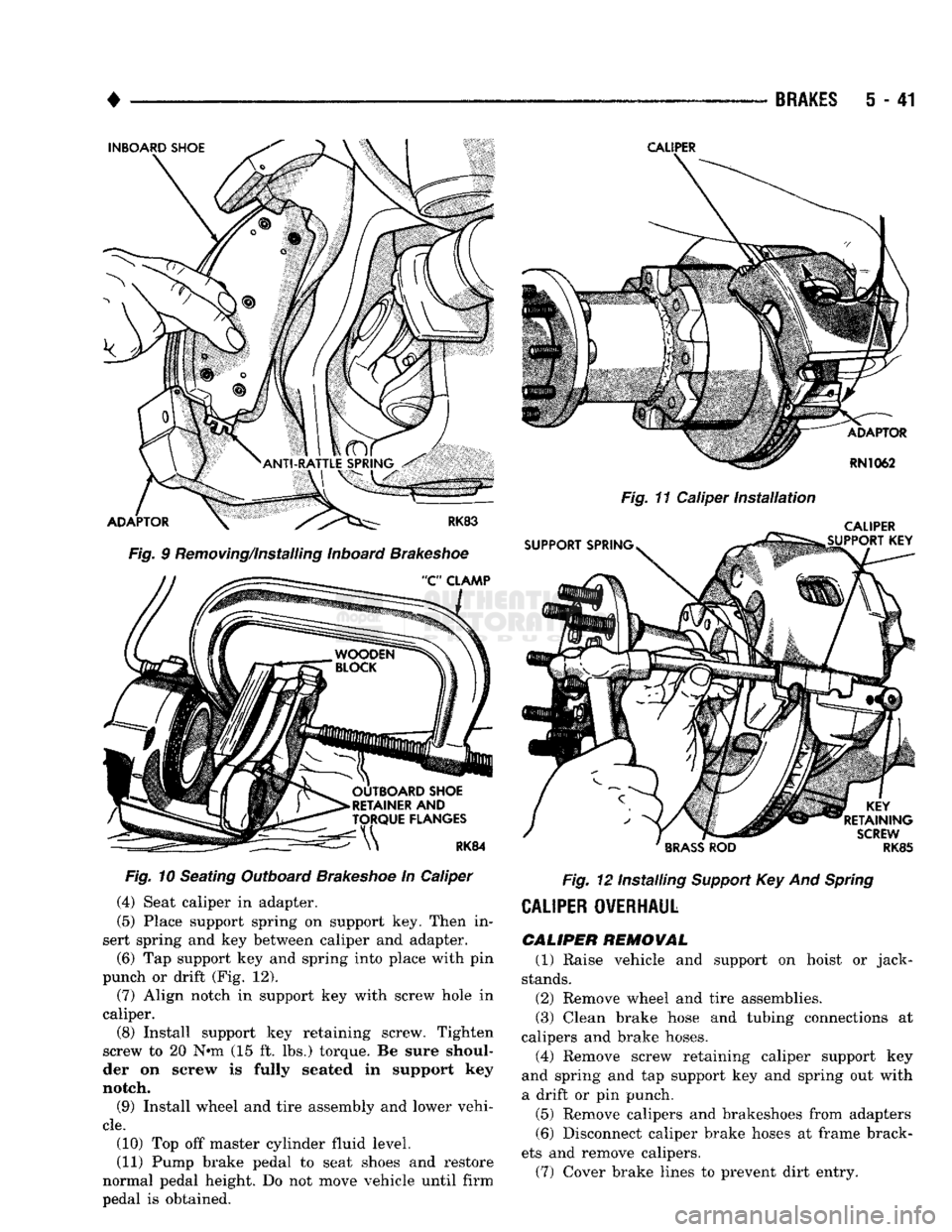
from caliper adapter (Fig. 9). Note position of spring
for installation reference.
CLEANING AND INSPECTION Inspect the shoe lining for wear. Replace riveted
shoes if the lining is worn to within 1.5 mm (1/16 in.)
of the rivet heads. Replace bonded lining if thickness is 3 mm (3/16 in.) or less.
Page 227 of 1502
5
- 40
BRAKES
•
Fig.
6 Removing/Installing
Support
Key Retaining
Screw
If the shoe lining will be reused, do not intermix
the shoes. Keep them with the caliper they were re moved from.
Examine the caliper piston area for evidence of
leaks.
Also check condition of the piston boot. Over
haul the caliper if leakage is evident or the boot is
cut or torn.
Clean rust and corrosion from the support key and
the caliper and adapter slide surfaces (machined
ways) with a wire brush. Then lubricate the slide surfaces with Mopar multi-mileage grease, or equiv
alent.
DISC
BRAKESHOE
INSTALLATION
(1) Install anti-rattle spring on inboard brakeshoe
and install shoe in adapter. Be sure spring remains
in place and is positioned as shown (Fig. 9). Loop
portion of spring should face away from the rotor.
BRASS
ROD
Fig.
7
Removing
Caliper
Support
Key And
Spring
Fig.
8 Removing/Installing Outboard
Brakeshoe
(2) Install outboard shoe in caliper. Free play
should not exist between shoe retaining flanges and
machined surfaces on caliper. If shoe cannot be
pressed into place by hand, use a C-Clamp. If a C-Clamp is used, protect shoe with wood block (Fig.
10).
(3) Position caliper over rotor and in adapter (Fig.
11).
Be careful to avoid damaging piston dust boot
during installation.
CAUTION:
Verify
that
the brake
hose
is straight
and
not twisted, kinked, or
touching
any
chassis
components.
Page 228 of 1502
•
BRAKES
5 - 41
Fig.
9 Removing/Installing Inboard
Brakeshoe
Fig.
10 Seating Outboard
Brakeshoe
In Caliper (4) Seat caliper in adapter.
(5) Place support spring on support key. Then in
sert spring and key between caliper and adapter.
(6) Tap support key and spring into place with pin
punch or drift (Fig. 12). (7) Align notch in support key with screw hole in
caliper.
(8) Install support key retaining screw. Tighten
screw to 20 N»m (15 ft. lbs.) torque. Be sure shoul
der on screw is fully seated in support key
notch.
(9) Install wheel and tire assembly and lower vehi
cle.
(10) Top off master cylinder fluid level.
(11) Pump brake pedal to seat shoes and restore
normal pedal height. Do not move vehicle until firm
pedal is obtained.
CALIPER
Fig.
11 Caliper
Installation
CALIPER
Fig.
12 Installing
Support
Key And
Spring
CALIPER
OVERHAUL
CALIPER REMOVAL
(1) Raise vehicle and support on hoist or jack-
stands.
(2) Remove wheel and tire assemblies.
(3) Clean brake hose and tubing connections at
calipers and brake hoses.
(4) Remove screw retaining caliper support key
and spring and tap support key and spring out with
a drift or pin punch.
(5) Remove calipers and brakeshoes from adapters (6) Disconnect caliper brake hoses at frame brack
ets and remove calipers. (7) Cover brake lines to prevent dirt entry.
Page 229 of 1502
5
- 42
BRAKES
•
CALIPER
DISASSEMBLY.
(1) Drain old fluid out of caliper.
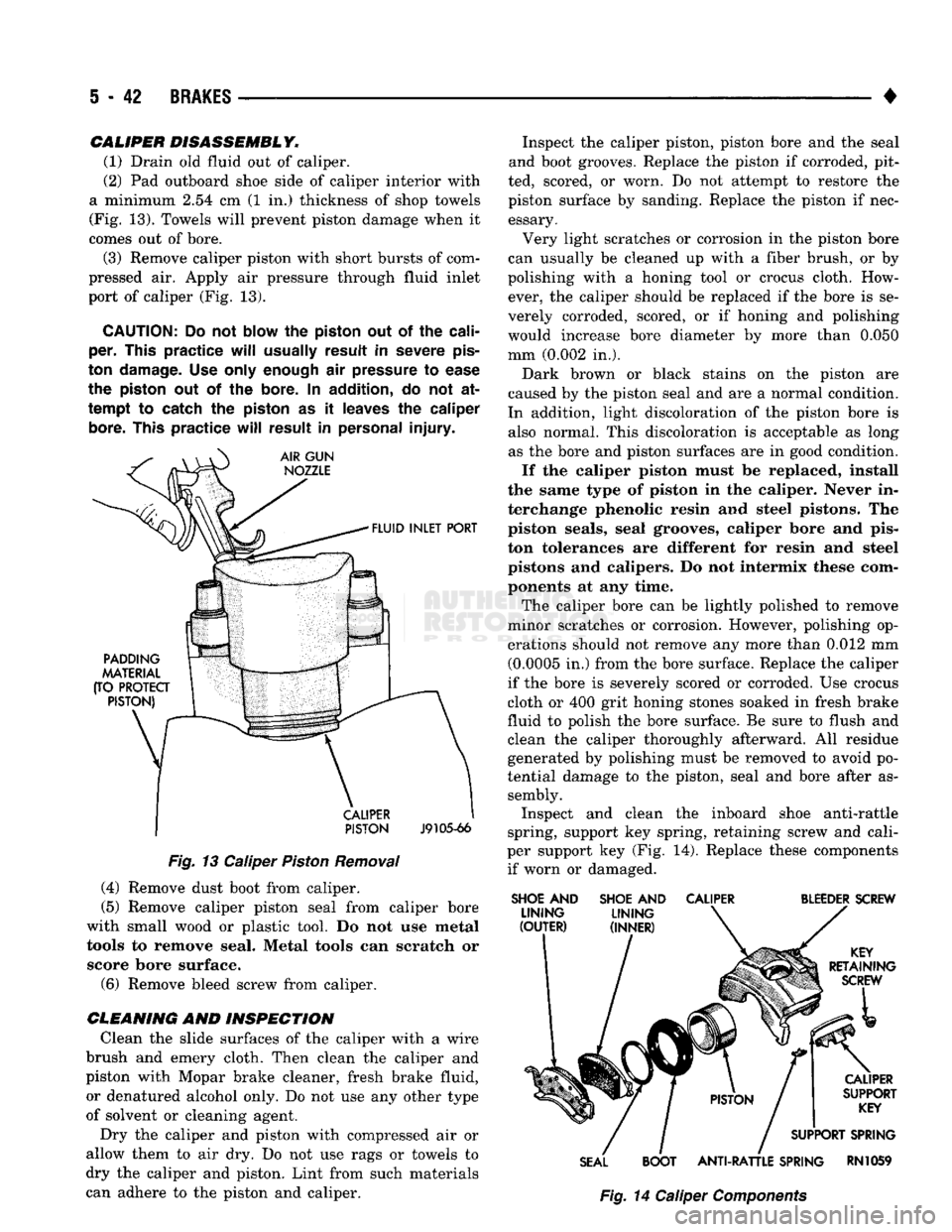
(2) Pad outboard shoe side of caliper interior with
a minimum 2.54 cm (1 in.) thickness of shop towels
(Fig. 13). Towels will prevent piston damage when it
comes out of bore.
(3) Remove caliper piston with short bursts of com
pressed air. Apply air pressure through fluid inlet
port of caliper (Fig. 13).
CAUTION:
Do not
blow
the
piston
out of the
cali
per.
This
practice
will
usually
result
in
severe
pis
ton
damage.
Use only
enough
air
pressure
to
ease
the
piston
out of the
bore.
In
addition,
do not at
tempt
to catch the
piston
as it
leaves
the
caliper
bore.
This
practice
will
result
in
personal
injury.
PISTON
J9105-66
Fig.
13 Caliper
Piston
Removal (4) Remove dust boot from caliper.
(5) Remove caliper piston seal from caliper bore
with small wood or plastic tool. Do not use metal tools to remove seal. Metal tools can scratch or score bore surface. (6) Remove bleed screw from caliper.
CLEANING
AND INSPECTION Clean the slide surfaces of the caliper with a wire
brush and emery cloth. Then clean the caliper and
piston with Mopar brake cleaner, fresh brake fluid, or denatured alcohol only. Do not use any other type
of solvent or cleaning agent.
Dry the caliper and piston with compressed air or
allow them to air dry. Do not use rags or towels to
dry the caliper and piston. Lint from such materials
can adhere to the piston and caliper. Inspect the caliper piston, piston bore and the seal
and boot grooves. Replace the piston if corroded, pit
ted, scored, or worn. Do not attempt to restore the
piston surface by sanding. Replace the piston if nec essary.
Very light scratches or corrosion in the piston bore
can usually be cleaned up with a fiber brush, or by
polishing with a honing tool or crocus cloth. How ever, the caliper should be replaced if the bore is se
verely corroded, scored, or if honing and polishing
would increase bore diameter by more than 0.050
mm (0.002 in.).
Dark brown or black stains on the piston are
caused by the piston seal and are a normal condition.
In addition, light discoloration of the piston bore is also normal. This discoloration is acceptable as long as the bore and piston surfaces are in good condition.
If the caliper piston must be replaced, install
the same type of piston in the caliper. Never in
terchange phenolic resin and steel pistons. The piston seals, seal grooves, caliper bore and pis
ton tolerances are different for resin and steel
pistons and calipers. Do not intermix these com ponents at any time.
The caliper bore can be lightly polished to remove
minor scratches or corrosion. However, polishing op
erations should not remove any more than 0.012 mm (0.0005 in.) from the bore surface. Replace the caliper
if the bore is severely scored or corroded. Use crocus
cloth or 400 grit honing stones soaked in fresh brake
fluid to polish the bore surface. Be sure to flush and
clean the caliper thoroughly afterward. All residue generated by polishing must be removed to avoid po
tential damage to the piston, seal and bore after as sembly. Inspect and clean the inboard shoe anti-rattle
spring, support key spring, retaining screw and cali
per support key (Fig. 14). Replace these components if worn or damaged.
SHOE
AND
SHOE
AND
CALIPER
BLEEDER
SCREW
SEAL
BOOT
ANTI-RATTLE
SPRING
RN1059
Fig.
14 Caliper
Components
Page 232 of 1502
•
BRAKES
5 - 45 multaneously with dual cutter heads. Equipment ca
pable of machining only one side at a time will
produce a tapered rotor. The lathe should also be equipped with a grinder
attachment or dual sanding discs for final cleanup or
light refinishing.
If the rotor surfaces only need minor cleanup of
rust, scale, or scoring, use abrasive discs to clean up
the rotor surfaces. However, when a rotor is scored or
worn, machining with cutting tools will be required.
CAUTION:
Do not refinish a rotor if
machining
would
cause
the rotor to
fall
below minimum allow
able
thickness.
ROTOR REMOVAL
(1) Raise and support front of vehicle.
(2) Remove wheel and tire assemblies.
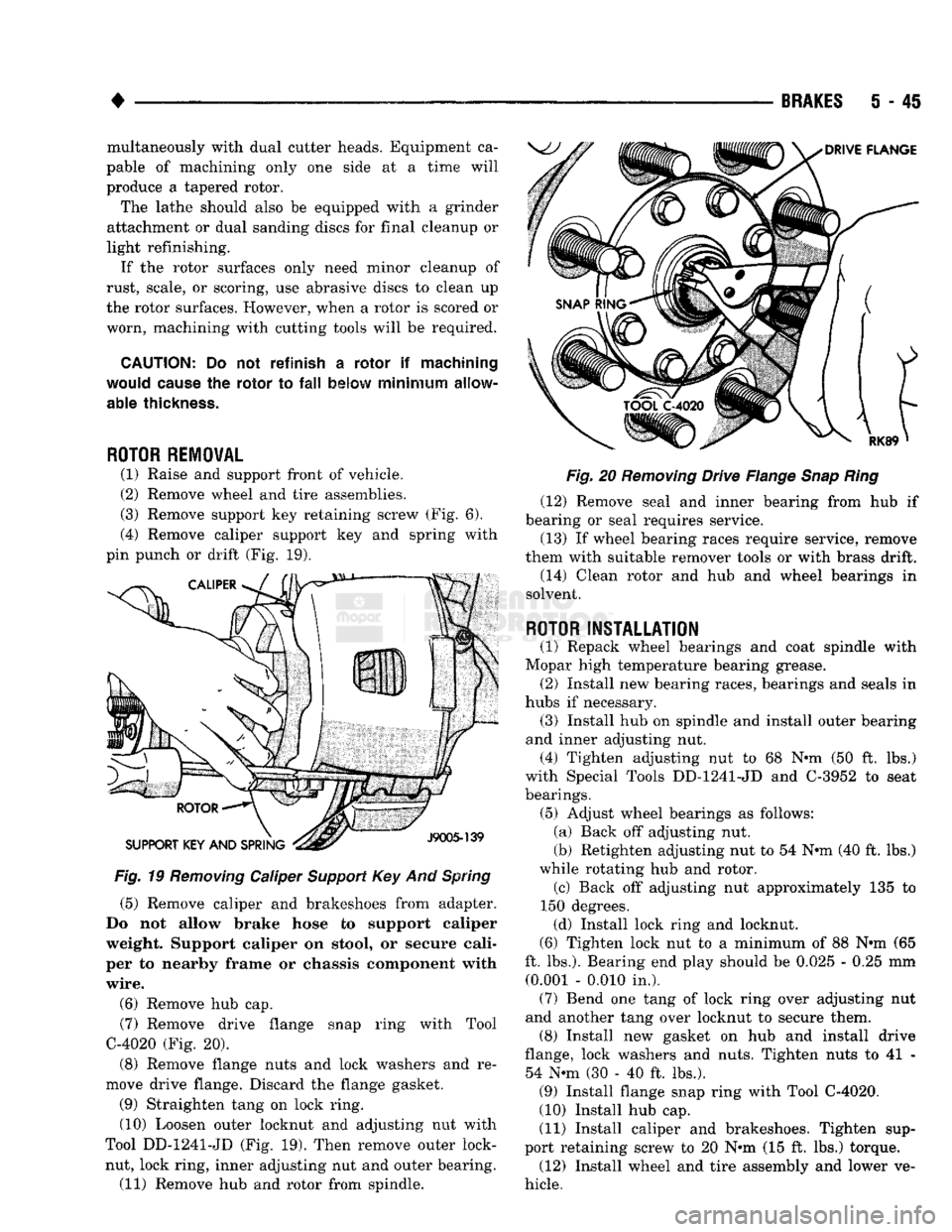
(3) Remove support key retaining screw (Fig. 6).
(4) Remove caliper support key and spring with
pin punch or drift (Fig. 19).
Fig.
19
Removing
Caliper
Support
Key And
Spring
(5) Remove caliper and brakeshoes from adapter.
Do not allow brake hose to support caliper
weight. Support caliper on stool, or secure cali
per to nearby frame or chassis component with
wire.
(6) Remove hub cap. (7) Remove drive flange snap ring with Tool
C-4020 (Fig. 20).
(8) Remove flange nuts and lock washers and re
move drive flange. Discard the flange gasket.
(9) Straighten tang on lock ring. (10) Loosen outer locknut and adjusting nut with
Tool DD-1241-JD (Fig. 19). Then remove outer lock- nut, lock ring, inner adjusting nut and outer bearing. (11) Remove hub and rotor from spindle.
Fig.
20
Removing
Drive Flange
Snap
Ring
(12) Remove seal and inner bearing from hub if
bearing or seal requires service.
(13) If wheel bearing races require service, remove
them with suitable remover tools or with brass drift. (14) Clean rotor and hub and wheel bearings in
solvent.
ROTOR
INSTALLATION
(1) Repack wheel bearings and coat spindle with
Mopar high temperature bearing grease. (2) Install new bearing races, bearings and seals in
hubs if necessary. (3) Install hub on spindle and install outer bearing
and inner adjusting nut. (4) Tighten adjusting nut to 68 Nrni (50 ft. lbs.)
with Special Tools DD-1241-JD and C-3952 to seat
bearings. (5) Adjust wheel bearings as follows: (a) Back off adjusting nut.
(b) Retighten adjusting nut to 54 N*m (40 ft. lbs.)
while rotating hub and rotor. (c) Back off adjusting nut approximately 135 to
150 degrees. (d) Install lock ring and locknut.
(6) Tighten lock nut to a minimum of 88 N»m (65
ft. lbs.). Bearing end play should be 0.025 - 0.25 mm (0.001 - 0.010 in.). (7) Bend one tang of lock ring over adjusting nut
and another tang over locknut to secure them. (8) Install new gasket on hub and install drive
flange, lock washers and nuts. Tighten nuts to 41 - 54 N«m (30 - 40 ft. lbs.). (9) Install flange snap ring with Tool C-4020.
(10) Install hub cap.
(11) Install caliper and brakeshoes. Tighten sup
port retaining screw to 20 Nnn (15 ft. lbs.) torque. (12) Install wheel and tire assembly and lower ve
hicle.
Page 252 of 1502
•
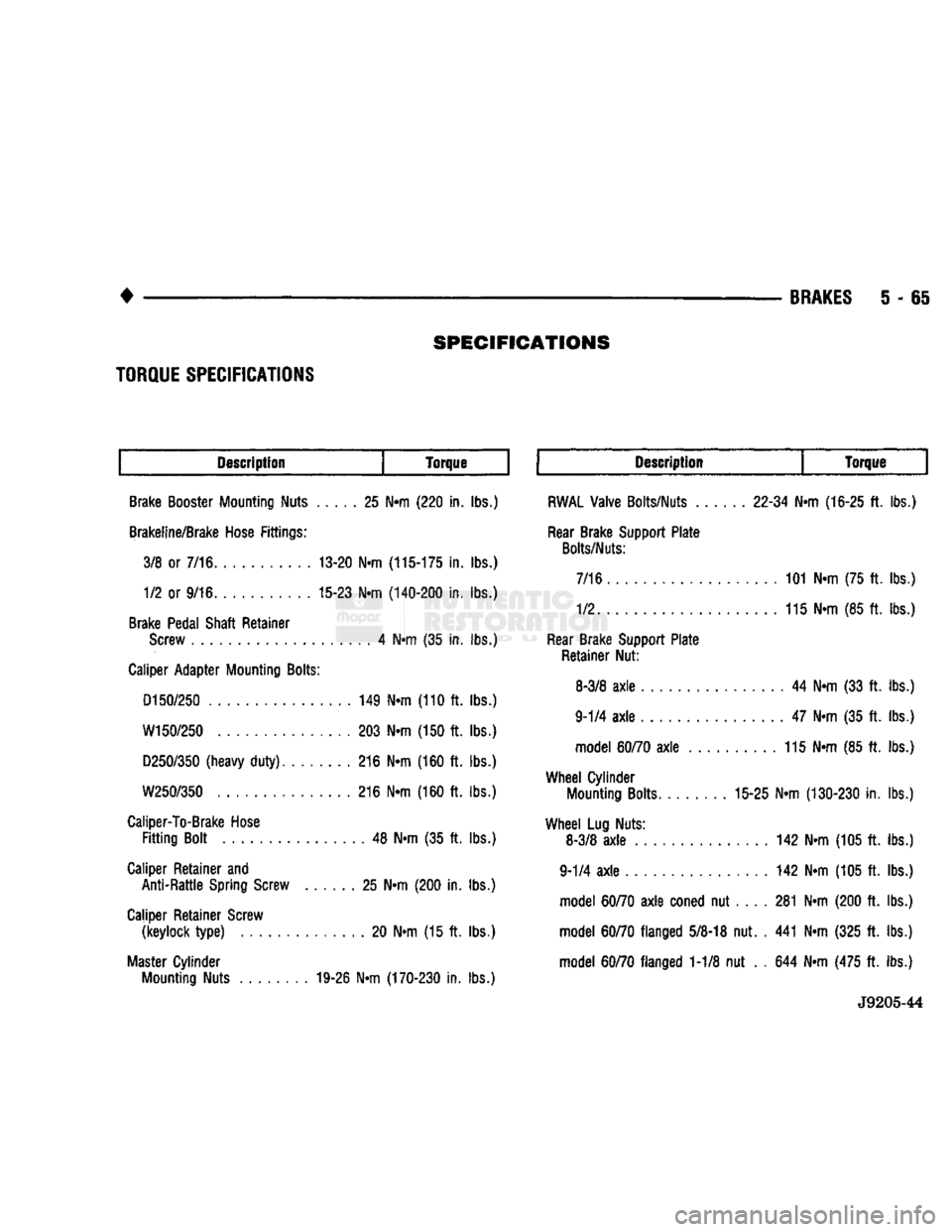
SPECIFICATIONS
BRAKES
5 - 65
Description
Torque Description
Torque
Brake Booster Mounting Nuts 25 N«m (220 in. lbs.)
Brakeline/Brake Hose Fittings: 3/8 or 7/16 13-20 Nrn
(115-175
in. lbs.) 1/2 or 9/16 15-23 N«m
(140-200
in. lbs.)
Brake Pedal Shaft Retainer Screw 4 Ntn (35 in. lbs.)
Caliper Adapter Mounting
Bolts:
D150/250
149 N«m (110 ft. lbs.)
W150/250
203 N«m (150 ft. lbs.)
D250/350
(heavy
duty)
216 Nrn (160 ft. lbs.)
W250/350
216 N»m (160 ft. lbs.)
Caliper-To-Brake Hose
Fitting
Bolt 48 N«m (35 ft. lbs.)
Caliper Retainer and Anti-Rattle Spring Screw 25 N«m (200 in. lbs.)
Caliper Retainer Screw (keylock
type)
20 N«m (15 ft. lbs.)
Master Cylinder Mounting Nuts 19-26 N«m
(170-230
in. lbs.)
RWAL
Valve Bolts/Nuts
22-34
Nrn
(16-25
ft. lbs.)
Rear Brake Support Plate
Bolts/Nuts:
7/16 101 N»m (75 ft. lbs.)
1/2 115 N«m (85 ft. lbs.)
Rear Brake Support Plate Retainer Nut:
8-3/8
axle
44 N«m (33 ft. lbs.)
9-1/4
axle
47 N-m (35 ft. lbs.) model
60/70
axle
115 N-m (85 ft. lbs.)
Wheel
Cylinder Mounting Bolts 15-25 N«m
(130-230
in. lbs.)
Wheel
Lug Nuts: 8-3/8
axle
142 N»m (105 ft. lbs.)
9-1/4
axle
142 Nrn (105 ft. lbs.) model
60/70
axle
coned nut 281 N«m (200 ft. lbs.)
model
60/70
flanged
5/8-18
nut. . 441 Nrn (325 ft. lbs.)
model
60/70
flanged 1-1/8 nut . . 644 Nrn (475 ft. lbs.)
J9205-44
TORQUE
SPECIFICATIONS