instrument panel FIAT 124 SPIDER 2016 2.G Owner's Manual
[x] Cancel search | Manufacturer: FIAT, Model Year: 2016, Model line: 124 SPIDER, Model: FIAT 124 SPIDER 2016 2.GPages: 216, PDF Size: 3.1 MB
Page 70 of 216
DSC operation is possible at speeds
greater than 20 km/h.
The warning light turns on when the
system has a malfunction. Refer to
“Warning lights and messages”
paragraph in “Knowing the instrument
panel” chapter.
NOTE The DSC may not operate
correctly unless the following are
observed:
use tires of the correct size specified
for your vehicle on all four wheels;
use tires of the same manufacturer,
brand and tread pattern on all four
wheels;
do not mix worn tires.
IMPORTANT The DSC may not operate
correctly when tire chains are used or a
temporary spare tire is installed
because the tire diameter changes.
TCS / DSC indicator light
The
indicator light stays on for a few
seconds when the ignition is switched
ON. If the TCS or DSC is operating, the
indicator light flashes.
If the light stays on, the TCS, DSC or
the brake assist system may have a
malfunction and they may not operate
correctly. Take your vehicle to a Fiat
Dealership.DSC OFF indicator light
The
indicator light stays on for a few
seconds when the ignition is switched
ON. It also illuminates when the DSC
OFF switch is pressed and TCS/DSC is
switched off.
If the light remains illuminated and the
TCS/DSC is not switched off, contact a
Fiat Dealership. The DSC may have a
malfunction.
DSC OFF switch
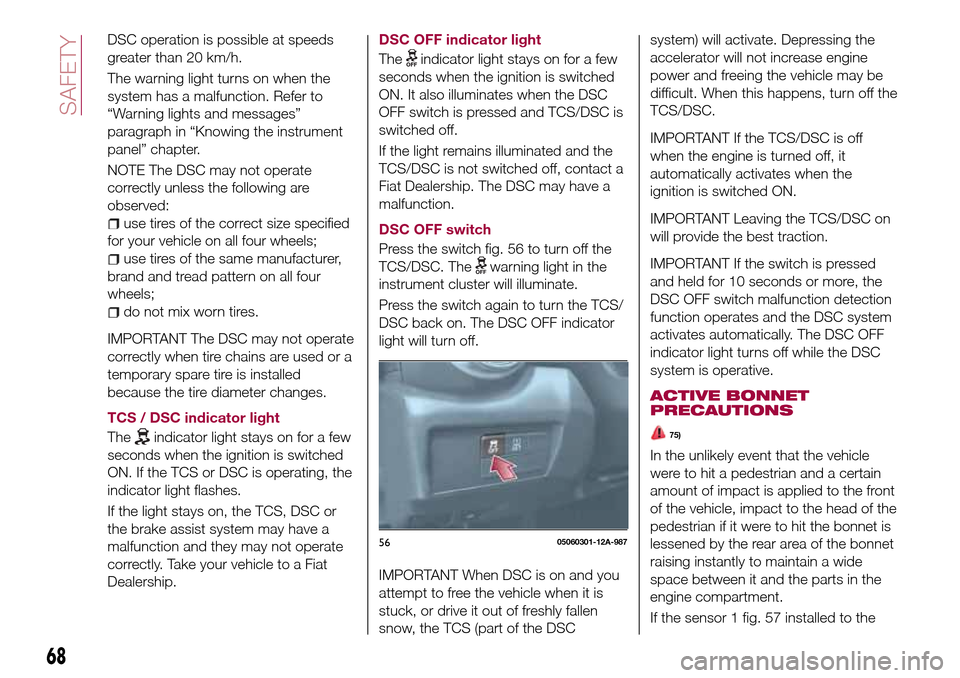
Press the switch fig. 56 to turn off the
TCS/DSC. The
warning light in the
instrument cluster will illuminate.
Press the switch again to turn the TCS/
DSC back on. The DSC OFF indicator
light will turn off.
IMPORTANT When DSC is on and you
attempt to free the vehicle when it is
stuck, or drive it out of freshly fallen
snow, the TCS (part of the DSCsystem) will activate. Depressing the
accelerator will not increase engine
power and freeing the vehicle may be
difficult. When this happens, turn off the
TCS/DSC.
IMPORTANT If the TCS/DSC is off
when the engine is turned off, it
automatically activates when the
ignition is switched ON.
IMPORTANT Leaving the TCS/DSC on
will provide the best traction.
IMPORTANT If the switch is pressed
and held for 10 seconds or more, the
DSC OFF switch malfunction detection
function operates and the DSC system
activates automatically. The DSC OFF
indicator light turns off while the DSC
system is operative.
ACTIVE BONNET
PRECAUTIONS
75)
In the unlikely event that the vehicle
were to hit a pedestrian and a certain
amount of impact is applied to the front
of the vehicle, impact to the head of the
pedestrian if it were to hit the bonnet is
lessened by the rear area of the bonnet
raising instantly to maintain a wide
space between it and the parts in the
engine compartment.
If the sensor 1 fig. 57 installed to the
5605060301-12A-987
68
SAFETY
Page 73 of 216
75)If the active bonnet has activated,
always contact a Fiat Dealership. If the
bonnet release handle is pulled after the
active bonnet has activated, the bonnet will
rise even further. If the vehicle is driven with
the bonnet raised it will obstruct visibility
and could result in an accident. In addition,
do not attempt to push the bonnet back
down. Otherwise, it could deform the
bonnet or cause injury because the
activated bonnet cannot be lowered
manually. Before driving the vehicle contact
a Fiat Dealership after the active bonnet
has activated, make sure that the raised
bonnet does not obstruct vision and drive
the vehicle at a low speed.AUXILIARY DRIVING
SYSTEMS
TPMS (Tire Pressure
Monitoring System)
76) 77) 78)
The Tire Pressure Monitoring System
(TPMS) monitors the air pressure of all
four tires. If the air pressure of one or
more tires is too low, the system warns
the driver by indicating the tire pressure
monitoring system warning light in the
instrument cluster and operating a beep
sound. The system monitors the tire
pressures indirectly using the data sent
from the ABS wheel speed sensors.
To allow the system to operate
correctly, the system needs to be
initialized with the specifi ed tyre
pressure (value on the tire pressure
label). Follow the procedure and
perform the initialization. Refer to “Tire
Pressure Monitoring System
Initialization” in this paragraph.
The warning light flashes when the
system has a malfunction. Refer to
“Warning lights and messages”
paragraph in “Knowing the instrument
panel” chapter.
IMPORTANT Each tire, including the
spare (where provided), should be
checked monthly when cold and
inflated to the inflation pressurerecommended by the vehicle
manufacturer on the vehicle placard or
tire inflation pressure label (if your
vehicle has tires of a different size than
the size indicated on the vehicle placard
or tire inflation pressure label, you
should determine the proper tire
inflation pressure for those tires).
IMPORTANT As an added safety
feature, your vehicle has been equipped
with a TMPS system that illuminates a
low tire pressure telltale when one or
more of your tires is significantly
under-inflated. Accordingly, when the
low tire pressure telltale illuminates, you
should stop and check your tires as
soon as possible, and inflate them to
the proper pressure. Driving on a
significantly under-inflated tire causes
the tire to overheat and can lead to tire
failure. Under-inflation also reduces fuel
efficiency and tire tread life, and may
affect the vehicle's handling and
stopping ability.
IMPORTANT Please note that the
TPMS is not a substitute for proper tire
maintenance, and it is the driver's
responsibility to maintain correct tire
pressure, even if under-inflation has not
reached the level to trigger illumination
of the TPMS low tire pressure telltale.
Your vehicle has also been equipped
with a TPMS malfunction indicator to
71
Page 77 of 216
applied, the vehicle has not stopped
completely, or the clutch pedal is
released.
IMPORTANT While Hill Launch Assist is
operating, the brake pedal may feel stiff
and vibrate, however, this does not
indicate a malfunction.
IMPORTANT Hill Launch Assist does
not operate while the TCS/DSC
indicator light is illuminated. Refer to
“Warning lights and messages”
paragraph in “Knowing the instrument
panel” chapter.
IMPORTANT Hill Launch Assist (HLA)
does not turn off even if the DSC OFF
switch is pressed to turn off the
TCS/DSC.
IMPORTANT For vehicles with an
automatic transmission although the Hill
Launch Assist does not operate during
idling stop, the vehicle roll prevention
function operates to prevent vehicle roll.
IMPORTANT Do not rely completely on
Hill Launch Assist. Hill Launch Assist is
an auxiliary device for accelerating from
a stop on a slope. The system only
operates for about two seconds and
therefore, relying only on the system,
when accelerating from a stop is
dangerous because the vehicle may
move (roll) unexpectedly and cause anaccident. The vehicle could roll
depending on the vehicle's load or if it
is towing something. In addition, for
vehicles with a manual transmission,
the vehicle could still roll depending on
how the clutch pedal or the accelerator
pedal is operated. Always confirm the
safety around the vehicle before starting
to drive the vehicle.
WARNING
76)The presence of the TPMS does not
permit the driver to neglect regular checks
of the tire pressure, including for the spare
wheel, and correct maintenance: the
system is not used to signal a possible fault
to a tire. Tire pressure must be checked
with tires rested and cold. Should it
become necessary for whatever reason to
check pressure with warm tires, do not
reduce pressure even though it is higher
than the prescribed value. Repeat the
check when the tires are cold.
77)Replacing the normal tires with winter
tires and vice versa requires an inspection
of the TPMS, which should be carried out
only by a Fiat Dealership.
78)Changes in outside temperature may
cause tire pressures to vary. The system
may temporarily indicate insufficient
pressure. In this case check the tire
inflation pressure with the tires cold and, if
necessary top up the inflation pressure.
OCCUPANT
PROTECTION
SYSTEMS
The most important safety equipment
of the vehicle comprise the following
protection systems:
seat belts;
SBA (Seat Belt Alert) system;
head restraints;
child restraint systems;
front air bags and side air bags.
Read the information given the following
pages with the utmost care.
It is of fundamental importance that the
protection systems are used in the
correct way to guarantee the maximum
possible safety level for the driver and
the passengers.
75
Page 79 of 216
USING THE SEAT BELTS
81) 82) 83) 84) 85)
Fastening the seat belt
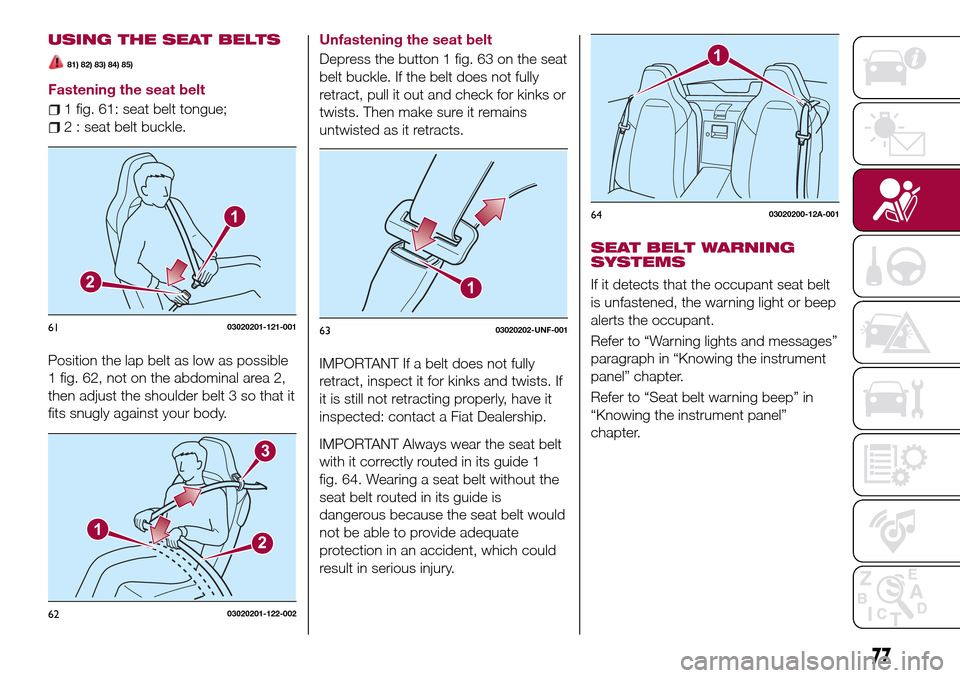
1 fig. 61: seat belt tongue;
2 : seat belt buckle.
Position the lap belt as low as possible
1 fig. 62, not on the abdominal area 2,
then adjust the shoulder belt 3 so that it
fits snugly against your body.Unfastening the seat belt
Depress the button 1 fig. 63 on the seat
belt buckle. If the belt does not fully
retract, pull it out and check for kinks or
twists. Then make sure it remains
untwisted as it retracts.
IMPORTANT If a belt does not fully
retract, inspect it for kinks and twists. If
it is still not retracting properly, have it
inspected: contact a Fiat Dealership.
IMPORTANT Always wear the seat belt
with it correctly routed in its guide 1
fig. 64. Wearing a seat belt without the
seat belt routed in its guide is
dangerous because the seat belt would
not be able to provide adequate
protection in an accident, which could
result in serious injury.SEAT BELT WARNING
SYSTEMS
If it detects that the occupant seat belt
is unfastened, the warning light or beep
alerts the occupant.
Refer to “Warning lights and messages”
paragraph in “Knowing the instrument
panel” chapter.
Refer to “Seat belt warning beep” in
“Knowing the instrument panel”
chapter.
1
2
6103020201-121-001
1
3
2
6203020201-122-002
1
6303020202-UNF-001
1
6403020200-12A-001
77
Page 81 of 216
SBA SYSTEM
(Seat Belt Alert)
SEAT BELT WARNING
LIGHT
The LED on dashboard trim turns on if
the driver or passenger's seat is
occupied and the seat belt is not
fastened with the ignition switched ON.
If the driver or passenger's seat belt is
unfastened (only when the passenger
seat is occupied) and the vehicle is
driven at a speed faster than about
20 km/h, the
LED flashes. After a
short time, the LED stops flashing, but
remains illuminated.
If a seat belt remains unfastened, the
LED flashes again for a given period of
time. In this case, fasten the seat belt.
If the driver or passenger's seat belt is
unfastened after the LED turns on, and
the vehicle speed exceeds 20 km/h, the
LED flashes again.
SEAT BELT
PRETENSIONER AND
LOAD LIMITING
SYSTEMS
PRETENSIONERS
88) 89) 90) 91)
For optimum protection, the driver and
passenger seat belts are equipped with
pretensioner and load limiting systems.
For both these systems to work
properly you must wear the seat belt
properly.
When a collision is detected, the
pretensioners deploy simultaneously
with the air bags. For deployment
details, refer to the “SRS air bag
deployment criteria” paragraph in this
chapter.
The seat belt retractors remove slack
quickly as the air bags are expanding.
Any time the air bags and seat belt
pretensioners have fired they must be
replaced.
A system malfunction or operation
conditions are indicated by a warning.
Refer to “Warning lights and messages”
and “Warning sound is activated”
paragraph in “Knowing the instrument
panel” chapter.
In addition, the pretensioner system for
the passenger, like the front and side
passenger air bag, is designed to onlydeploy when the passenger occupant
classification sensor detects a
passenger sitting on the passenger's
seat. For details, refer to the passenger
occupant classification sensor.
IMPORTANT The pretensioner system
may not operate depending on the type
of the collision. For details, refer to the
“SRS Air Bag deployment criteria”
paragraph.
IMPORTANT Some smoke (non-toxic
gas) will be released when the air bags
and pretensioners deploy. This does
not indicate a fire. This gas normally
has no effect on occupants, however,
those with sensitive skin may
experience slight skin irritation. If
residue from the deployment of the air
bags or the pretensioner system gets
on the skin or in the eyes, wash it off as
soon as possible.
LOAD LIMITER
The load limiting system releases belt
webbing in a controlled manner to
reduce belt force on the occupant's
chest.
While the most severe load on a seat
belt occurs in frontal collisions, the load
limiter has an automatic mechanical
function and can activate in any
accident mode with sufficient occupant
movement.
79
Page 98 of 216
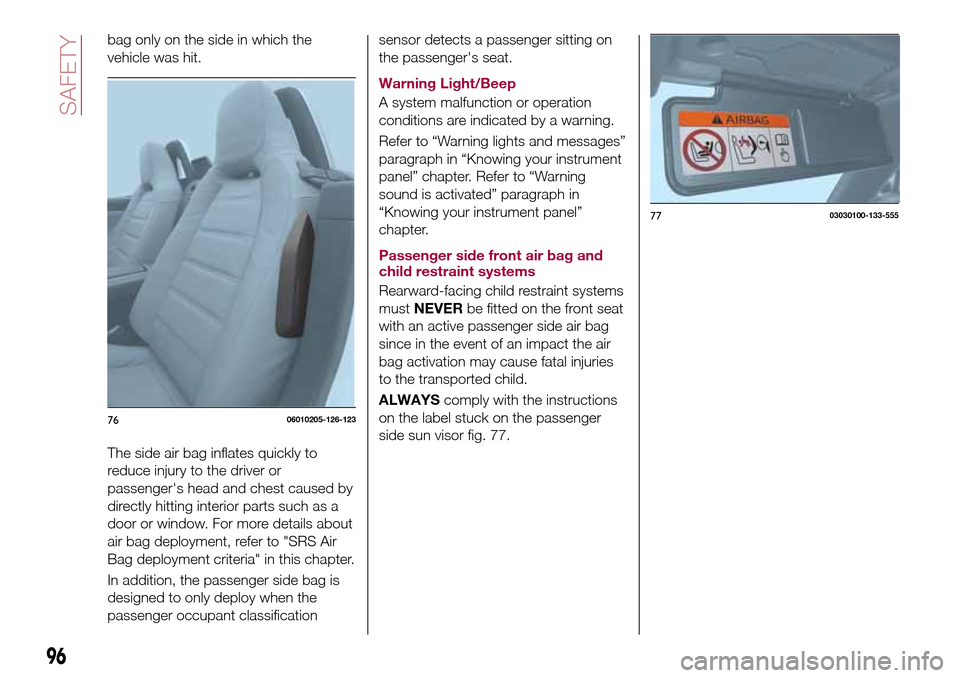
bag only on the side in which the
vehicle was hit.
The side air bag inflates quickly to
reduce injury to the driver or
passenger's head and chest caused by
directly hitting interior parts such as a
door or window. For more details about
air bag deployment, refer to "SRS Air
Bag deployment criteria" in this chapter.
In addition, the passenger side bag is
designed to only deploy when the
passenger occupant classificationsensor detects a passenger sitting on
the passenger's seat.
Warning Light/Beep
A system malfunction or operation
conditions are indicated by a warning.
Refer to “Warning lights and messages”
paragraph in “Knowing your instrument
panel” chapter. Refer to “Warning
sound is activated” paragraph in
“Knowing your instrument panel”
chapter.
Passenger side front air bag and
child restraint systems
Rearward-facing child restraint systems
mustNEVERbe fitted on the front seat
with an active passenger side air bag
since in the event of an impact the air
bag activation may cause fatal injuries
to the transported child.
ALWAYScomply with the instructions
on the label stuck on the passenger
side sun visor fig. 77.
7606010205-126-123
7703030100-133-555
96
SAFETY
Page 107 of 216
126)Do not operate a vehicle with
damaged air bag/seat belt pretensioner
system components. Expended or
damaged air bag/seat belt pretensioner
system components must be replaced
after any collision which caused them to
deploy or damage them. Only a trained
expert repairer, we recommend a Fiat
Dealership that can fully evaluate these
systems to see that they will work in any
subsequent accident. Driving with an
expended or damaged air bag or
pretensioner unit will not afford you the
necessary protection in the event of any
subsequent accident which could result in
serious injury or death.
127)Do not remove interior air bag parts.
Removing any components such as the
seats, front instrument panel, the steering
wheel, containing air bag parts or sensors
is dangerous. These parts contain essential
air bag components. The air bag could
accidentally activate and cause serious
injuries. Always have a Fiat Dealership
remove these parts.128)Do not allow an occupant in the
passenger's seat to sit with a posture
which makes it difficult for the passenger
occupant classification sensor to detect
the occupant correctly. Sitting in the
passenger's seat with a posture which
makes it difficult for the passenger
occupant classification sensor to detect
the occupant correctly is dangerous. If the
passenger occupant classification sensor
cannot detect the occupant sitting on the
passenger's seat correctly, the passenger
front and side air bags and pretensioner
system may not operate (deploy) or they
may operate (deploy) accidentally. The
passenger will not have the supplementary
protection of the air bags or the accidental
operation (deployment) of the air bags
could result in serious injury or death.129)Under the following conditions, the
passenger occupant classification sensor
cannot detect a passenger sitting on the
passenger's seat correctly and the
deployment/non-deployment of the air
bags cannot be controlled as indicated in
the passenger air bag deactivation
indicator light on/off condition chart. For
example: luggage or other items placed
under the passenger seat or between the
passenger seat and driver seat that push
up the passenger seat bottom / An object,
such as a seat cushion, is put on the
passenger's seat or between the
passenger's back and the seat back / A
seat cover is put on the passenger's seat /
Luggage or other items are placed on the
seat with the child in the child restraint
system / The seat is washed / Liquids are
spilled on the seat / The passenger seat is
moved backward, pushing into luggage or
other items placed behind it / Luggage or
other items are placed between the
passenger seat and driver seat / An electric
device is put on the passenger's seat. The
passenger front and side air bags and seat
belt pretensioner systems will deactivate if
the passenger air bag deactivation OFF
indicator light turns on.
IMPORTANT
22)To assure proper deployment of the
front air bag and to prevent damage to the
sensor in the seat cushion: do not place
sharp objects on the seat cushion or leave
heavy luggage on them. Do not spill any
liquids on the seats or under the seats.
105
Page 158 of 216
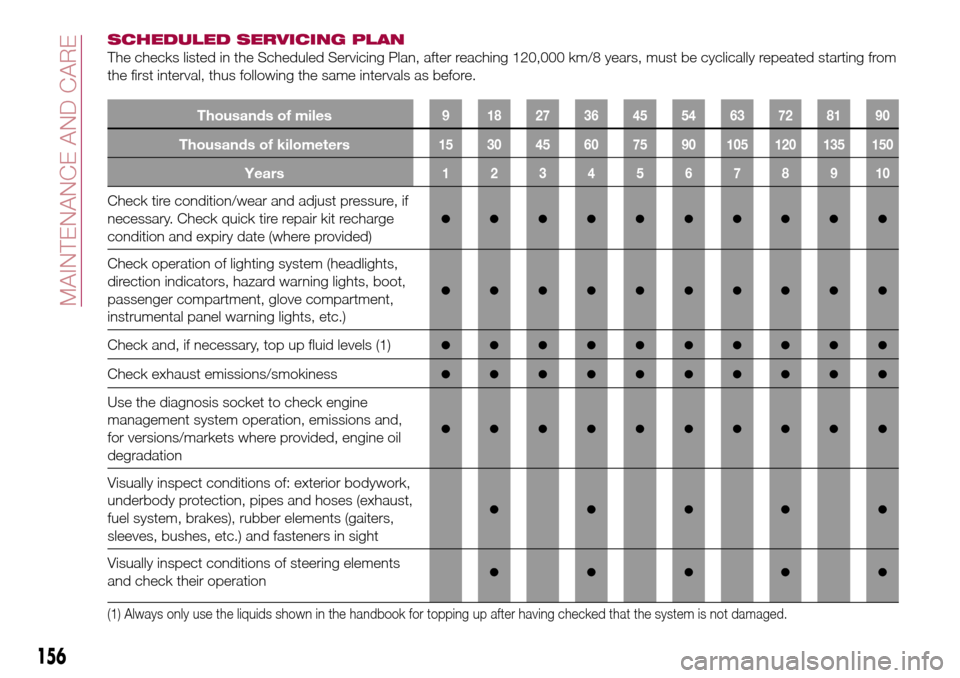
SCHEDULED SERVICING PLAN
The checks listed in the Scheduled Servicing Plan, after reaching 120,000 km/8 years, must be cyclically repeated starting from
the first interval, thus following the same intervals as before.
Thousands of miles9 182736455463728190
Thousands of kilometers15 30 45 60 75 90 105 120 135 150
Years12345678910
Check tire condition/wear and adjust pressure, if
necessary. Check quick tire repair kit recharge
condition and expiry date (where provided)
●●●●●●●●●●
Check operation of lighting system (headlights,
direction indicators, hazard warning lights, boot,
passenger compartment, glove compartment,
instrumental panel warning lights, etc.)
●●●●●●●●●●
Check and, if necessary, top up fluid levels (1)●●●●●●●●●●
Check exhaust emissions/smokiness●●●●●●●●●●
Use the diagnosis socket to check engine
management system operation, emissions and,
for versions/markets where provided, engine oil
degradation
●●●●●●●●●●
Visually inspect conditions of: exterior bodywork,
underbody protection, pipes and hoses (exhaust,
fuel system, brakes), rubber elements (gaiters,
sleeves, bushes, etc.) and fasteners in sight
●●●●●
Visually inspect conditions of steering elements
and check their operation●●●●●
(1) Always only use the liquids shown in the handbook for topping up after having checked that the system is not damaged.
156
MAINTENANCE AND CARE
Page 171 of 216
INTERIORS
SEATS AND FABRIC
PARTS
Seat belt maintenance
213) 214)
Clean the soiled area by lightly dabbing
it with a soft cloth soaked in a mild
detergent (approx. 5%) diluted with
water.
Wipe off the remaining detergent using
a cloth soaked in clean water and
wrung out well.
Before retracting seat belts which have
been pulled out for cleaning, dry them
off thoroughly and make sure there is
no remaining moisture on them.
NOTE Clean seat belts diligently if they
get dirty. Leaving them uncleaned will
make it dif cult to clean them later, and
it may affect the smooth retracting of
the seat belt.
PLASTIC PART
MAINTENANCE
54)
Instrument panel top maintenance
212)
Wipe the soiled area with a soft cloth
soaked in a mild detergent (approx. 5%)
diluted with water.Wipe off the remaining detergent using
a cloth soaked in clean water and
wrung out well.
WARNING
212)Do not spray water into the vehicle
cabin. Spraying water into the vehicle cabin
is dangerous as electrical devices such as
the audio and switches could get wet
resulting in a malfunction or vehicle fire.
213)If a seat belt appears frayed or has
abrasions, have it replaced by a Fiat
Dealership. If a seat belts is used under
such a condition, it cannot function at its
full capacity which could result in serious
injury or death.
214)Use a mild detergent to remove
soiling from a seat belt. If organic solvents
are used for cleaning the seat belts or they
become stained or bleached, there is the
possibility of them becoming weakened
and as a result, they may not function at
their full capacity which could cause
serious injury or death.
215)Never use flammable products, such
as petrol ether or rectified petrol to clean
the inside of the car. The electrostatic
charges which are generated by rubbing
during the cleaning operation may cause a
fire.
216)Do not keep aerosol cans in the car:
they might explode. Aerosol cans must not
be exposed to a temperature exceeding
50°C. When the vehicle is exposed to
sunlight, the internal temperature can
greatly exceed this value.217)There must be no obstacles on the
floor underneath the pedals; make sure
that mats are always flat and do not
interfere with the pedals.
IMPORTANT
54)Never use alcohol, petrols and
derivatives to clean the dashboard and
instrument panel lens.
169
Page 212 of 216
INDEX
ABS system................67
Active bonnet precautions........68
Active safety systems...........67
Advanced Keyless Entry System....14
AFS (Adaptive Front Lighting
System)..................27
Attaching the tow hooks........150
Auto-wiper control............29
Automatic climate control system.......................34
Automatic lighting.............25
Automatic transmission.........111
Auxiliary driving systems.........71
Battery (maintenance).........162
Battery recharging............164
Bodywork (care and
maintenance).............167
Bonnet....................40
Boot lid...................38
Boot lid (opening).............38
Brake Assist................110
Brake/clutch fluid (level check). . . .162
Checking levels.............160
Child restraint system suitability
for various seat position.......85
Child seat installation position.....84
Child-restraint precautions.......80
Child-restraint system types......83
Climate control system..........31CO2 emissions..............184
Coming Home light system.......25
Constant monitoring..........107
Control panel and instruments.....46
Convertible Top (lowering)........41
Convertible Top (Soft Top)........41
Cruise Control..............114
Dashboard..................8
Dimensions................177
Doors.....................16
Double locking system..........16
Driver Air Bag................95
DRL (Daytime Running Lights).....24
DSC system................67
Emergency flap opening.......120
Emergency stop signal system. . . .127
Emergency towing............152
Engine...................172
Engine compartment..........160
Engine coolant (level check)......161
Engine oil (level check).........161
Essential information............3
Exterior lights................24
Flash to pass...............25
Fluid capacities..............178
Fluids and lubricants..........179
Front fog lights...............25
Fuel consumption............183
Fuel filler cap...............120Fuse block (engine compartment)......................138
Fuse block (left side of the vehicle)......................141
Fuses (under the bonnet)........137
Fuses (vehicle's left side)........136
Gear lever positions..........112
Gear Shift Indicator............50
Hazard warning lights.........127
Hazard warning lights (control). . . .127
Head restraints...............21
Headlight washer.............30
Headlights..................24
Heated seats................19
Heavy-dute use of the vehicle
(scheduled servicing)........155
High beams.................25
HLA function................74
How the SRS Air bags work......95
How to use this manual..........3
Identification data............171
Ignition switch...............11
Immobilizer system............15
INFO switch.................49
Installing child restraint systems....89
Interiors..................169
Jump starting..............148
Jump starting (procedure).......148
Key battery replacement........10
Keyless Entry System...........9
Keys......................9
INDEX