tow FIAT 500 2018 Owner handbook (in English)
[x] Cancel search | Manufacturer: FIAT, Model Year: 2018, Model line: 500, Model: FIAT 500 2018Pages: 224, PDF Size: 3.89 MB
Page 100 of 224
KNOWING YOUR CAR
98
❒ Last calls
❒ Outgoing calls
❒ Missed calls
❒ Incoming calls
❒ Phonebook
❒ Search
❒ Show text
❒ Send a text message
❒ Show messages
Radio
The following voice commands can be
given after pressing the button on the
steering wheel
}:
❒ Tune to FM “frequency”
❒ Tune to AM “frequency”
❒ Tune to “radio name” FM
Media
The following voice commands can be
given after pressing the button on the
steering wheel
}:
❒ Play song...
❒ Play album…
❒ Play artist…
❒ Play genre…
❒ Play playlist…
❒ Play podcast…
❒ Play audiobook…❒ Select source...
❒ View...
Navigation (Uconnect™ 7”
HD Nav LIVE only)
The following voice commands can be
given after pressing the button on the
steering wheel
}:
❒ Find “POI”
❒ Go to "address"
❒ Go to town centre "town name"
❒ Go to an address
❒ Go to a town centre
❒ Go home
❒ Go via home
❒ Delete route
❒ Add current location to “My places”
❒ View “My places”
❒ Go via a saved location
❒ Recent destinations
❒ Go via a recent destination
❒ Zoom in
❒ Zoom out
❒ 2D view
❒ 3D view
❒ Report speed camera
❒ Report risk area
OFFICIAL TYPE
APPROVALS
All radio equipment supplied with the
vehicle complies with the
2014/53/EU directive.
For further information visit the
www.mopar.eu/owner or
http://aftersales.fiat.com/elum/
websites.
Page 122 of 224
STARTING AND DRIVING
120
PARKING THE
VEHICLE
When parking and leaving the car,
proceed as follows:
❒ engage a gear (1st gear if facing
uphill or reverse if facing downhill)
and leave the wheels turned;
❒ stop the engine and engage the
handbrake;
❒ always remove the key from the
starter switch.
Block the wheels with a wedge or a
stone if the car is parked on a steep
slope.
On versions equipped with automatic
transmission, wait for the letter P to be
displayed before releasing the brake
pedal.
IMPORTANT NEVER leave the car with
the gearbox in neutral (or, on versions
equipped with automatic transmission,
before putting the shift lever at P).
HANDBRAKE 27)
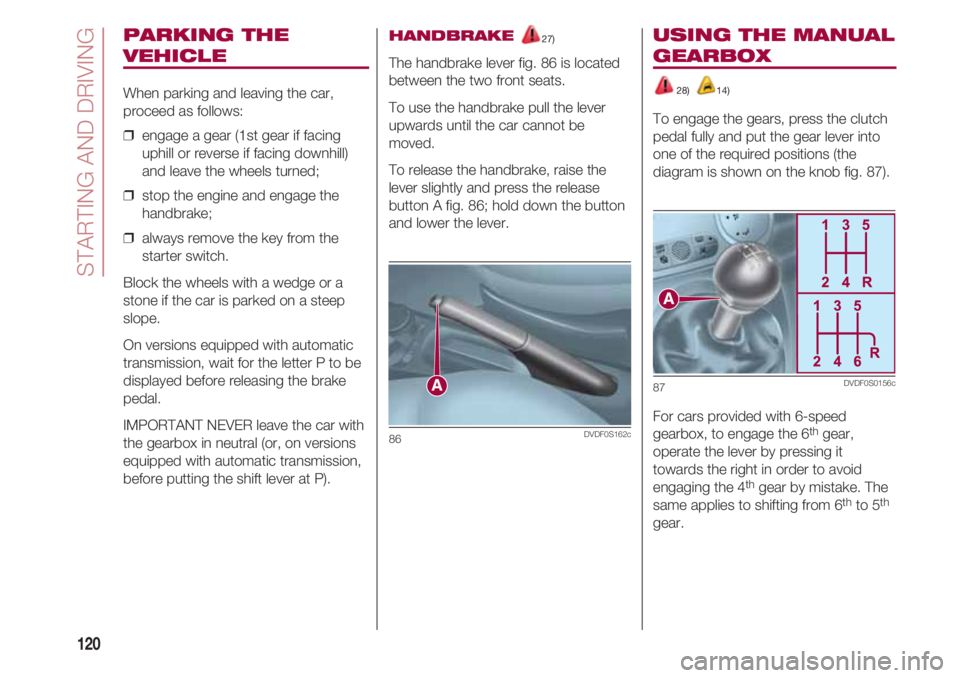
The handbrake lever fig. 86 is located
between the two front seats.
To use the handbrake pull the lever
upwards until the car cannot be
moved.
To release the handbrake, raise the
lever slightly and press the release
button A fig. 86; hold down the button
and lower the lever.
86DVDF0S162c
USING THE MANUAL
GEARBOX
28) 14)
To engage the gears, press the clutch
pedal fully and put the gear lever into
one of the required positions (the
diagram is shown on the knob fig. 87).
For cars provided with 6-speed
gearbox, to engage the 6
thgear,
operate the lever by pressing it
towards the right in order to avoid
engaging the 4
thgear by mistake. The
same applies to shifting from 6thto 5th
gear.
87DVDF0S0156c
Page 123 of 224
121
IMPORTANT Reverse can only be
engaged when the vehicle is
completely stationary. With the engine
running, wait for at least 2 seconds
with the clutch pedal fully pressed
before engaging reverse to prevent
damage to the gears and grating.
To engage reverse R from neutral, lift
the sliding ring A-fig. 87 under the
knob and shift the lever to the right and
back.
IMPORTANT The clutch pedal should
be used only to change gear. Do not
drive with your foot resting on the
clutch pedal, however lightly. For
versions/markets, where provided, the
electronic clutch control could cut in,
interpreting the incorrect driving style
as a fault.USING THE
DUALOGIC
GEARBOX 14)
(for versions/markets, where provided)
OPERATING MODE
The gearbox/transmission can function
in two operating modes:
❒ MANUAL the driver decides when
to shift gear;
❒ AUTO the system decides when to
shift gear.
MANUAL MODE
❒ Press the brake pedal and start the
engine.
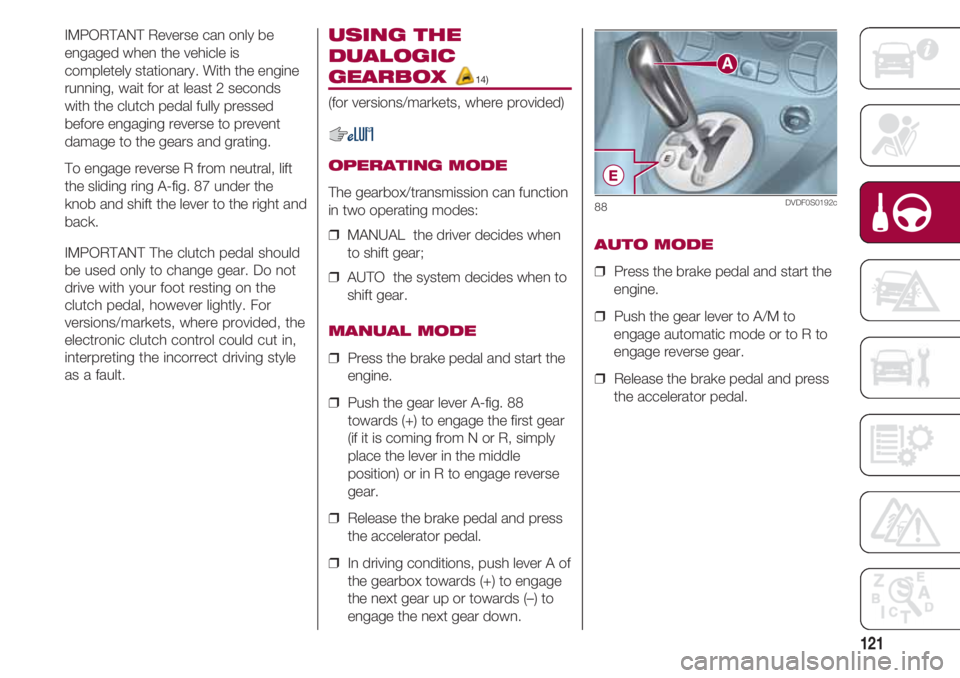
❒ Push the gear lever A-fig. 88
towards (+) to engage the first gear
(if it is coming from N or R, simply
place the lever in the middle
position) or in R to engage reverse
gear.
❒ Release the brake pedal and press
the accelerator pedal.
❒ In driving conditions, push lever A of
the gearbox towards (+) to engage
the next gear up or towards (–) to
engage the next gear down.
AUTO MODE
❒ Press the brake pedal and start the
engine.
❒ Push the gear lever to A/M to
engage automatic mode or to R to
engage reverse gear.
❒ Release the brake pedal and press
the accelerator pedal.
88DVDF0S0192c
Page 124 of 224
STARTING AND DRIVING
122
SPORT function
(1.4 16V versions – for versions /
markets, where provided)
On these versions, the driver can also
use the SPORT function which enables
a sporty driving setting by intervening
on gear changes, the engine control
unit and the steering. To activate this
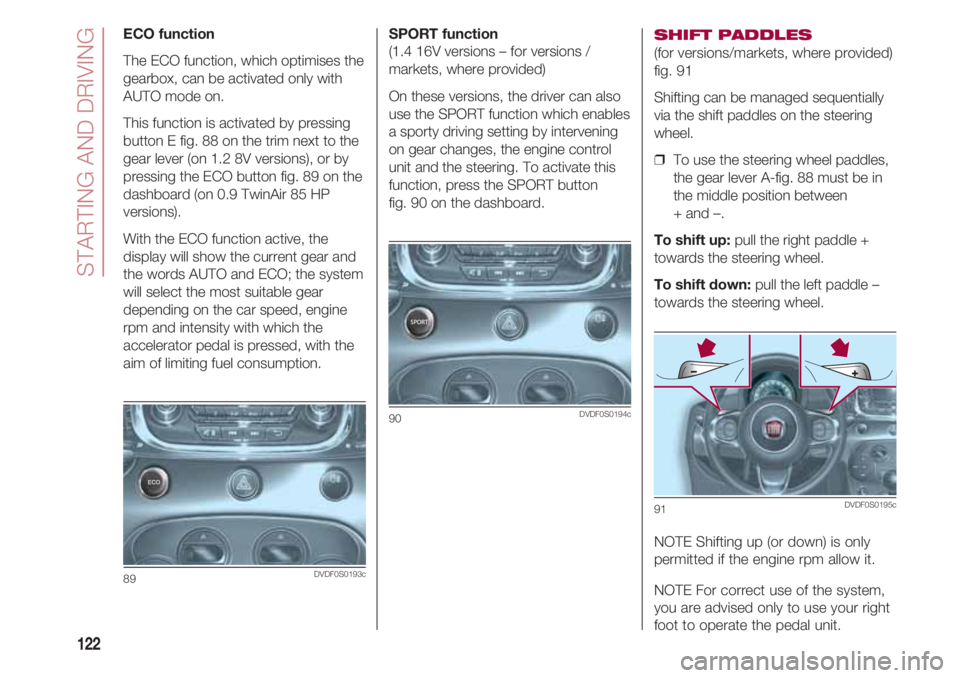
function, press the SPORT button
fig. 90 on the dashboard.
90DVDF0S0194c
ECO function
The ECO function, which optimises the
gearbox, can be activated only with
AUTO mode on.
This function is activated by pressing
button E fig. 88 on the trim next to the
gear lever (on 1.2 8V versions), or by
pressing the ECO button fig. 89 on the
dashboard (on 0.9 TwinAir 85 HP
versions).
With the ECO function active, the
display will show the current gear and
the words AUTO and ECO; the system
will select the most suitable gear
depending on the car speed, engine
rpm and intensity with which the
accelerator pedal is pressed, with the
aim of limiting fuel consumption.
89DVDF0S0193c
SHIFT PADDLES
(for versions/markets, where provided)
fig. 91
Shifting can be managed sequentially
via the shift paddles on the steering
wheel.
❒ To use the steering wheel paddles,
the gear lever A-fig. 88 must be in
the middle position between
+ and –.
To shift up: pull the right paddle +
towards the steering wheel.
To shift down:pull the left paddle –
towards the steering wheel.
NOTE Shifting up (or down) is only
permitted if the engine rpm allow it.
NOTE For correct use of the system,
you are advised only to use your right
foot to operate the pedal unit.
91DVDF0S0195c
Page 127 of 224
125
ELECTRONIC
CRUISE CONTROL
(for versions/markets, where provided)
This is an electronically controlled
driving assistance device that allows
the desired vehicle speed to be
maintained, without having to press the
accelerator pedal.
This device can be used at a speed
above 30 km/h on long stretches of
dry, straight roads with few variations
(e.g. motorways).
It is therefore not recommended to use
this device on extra-urban roads with
traffic. Do not use it in town.
ENABLING THE DEVICE
38)
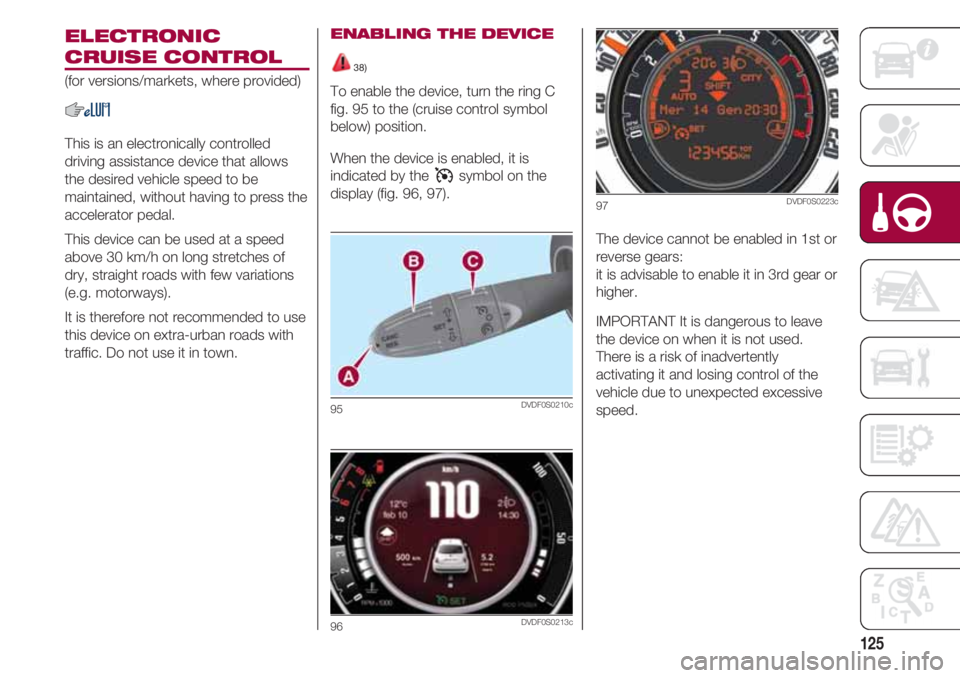
To enable the device, turn the ring C
fig. 95 to the (cruise control symbol
below) position.
When the device is enabled, it is
indicated by the symbol on the
display (fig. 96, 97).
95DVDF0S0210c
96DVDF0S0213c
The device cannot be enabled in 1st or
reverse gears:
it is advisable to enable it in 3rd gear or
higher.
IMPORTANT It is dangerous to leave
the device on when it is not used.
There is a risk of inadvertently
activating it and losing control of the
vehicle due to unexpected excessive
speed.
97DVDF0S0223c
Page 130 of 224
IN AN EMERGENCY
128
BUMP STARTING13)
Never bump start the engine by
pushing, towing or driving downhill.
This could cause fuel to flow into the
catalytic converter and damage it
beyond repair.
IMPORTANT Remember that the
brake servo and electrical power
steering system (where provided) are
not operational until the engine is
started, a greater effort will therefore
be required to press the brake pedal
or turn the steering wheel.
CHANGING A
WHEEL 32) 30)
JACK
Please note that:
❒ the jack weighs 1.76 kg;
❒ the jack requires no adjustment;
❒ the jack cannot be repaired; if it
breaks, it must be replaced with a
new one of the same type;
❒ no tool other than its cranking
device may be fitted on the jack.
SERVICING
❒ prevent any dirt from depositing on
the “worm screw”
❒ keep the “worm screw” lubricated
❒ never modify the jack.
CONDITIONS OF NON-
USE
❒ at temperatures lower than -40°C
on a sandy or muddy ground
❒ on uneven ground
❒ on a road with steep gradient
❒ in extreme weather conditions:
thunderstorms, typhoons,
hurricanes, blizzards, storms, etc.
❒ in direct contact with the engine or
to carry out repairs under the
vehicle
❒ on boats.
RAISING WITH A JACK
AND REPLACING A
WHEEL
To change a wheel, proceed as
follows:
❒ Stop the car in a position that is
not dangerous for oncoming traffic
where you can change the wheel
safely. The ground must be flat and
sufficiently compact.
❒ Turn the engine off and pull up the
handbrake.
❒ Engage first gear or reverse.
❒ Lift up the luggage compartment
mat and loosen the central locking
device A - fig. 99.
❒ Take out the tool container
B and take it near to the wheel to
be changed.
❒ Take the space-saver wheel C.
Page 136 of 224
IN AN EMERGENCY
134
REPLACING A BULB
34) 19)
GENERAL
INSTRUCTIONS
❒ Before changing a bulb check the
contacts for oxidation;
❒ burnt bulbs must be replaced by
others of the same type and power;
❒ always check the headlight beam
aiming after changing a bulb;
❒ whenever a lamp does not work,
please check that the
corresponding fuse is in tact before
replacing it: please refer to the
paragraph “Replacing fuses” in this
chapter for the location of fuses.
IMPORTANT Whenever the weather is
hot or cold, of after heavy rain, the
surface of the headlights or rear lights
may steam up and/or form droplets of
condensation on the inside. This is a
natural phenomenon due to the
difference in temperature and humidity
between the inside and the outside of
the glass which does not indicate a
fault and does not compromise the
normal operation of lighting devices.
The mist disappears quickly when the
lights are turned on, starting from the
centre of the diffuser, extending
progressively towards the edges.
Page 141 of 224
139
Side
IMPORTANT The intervention must be
carried out taking all precautions
necessary to avoid damaging the
bodywork (use a sufficiently rigid and
appropriately thick plastic card).
To replace the bulb, proceed as
follows:
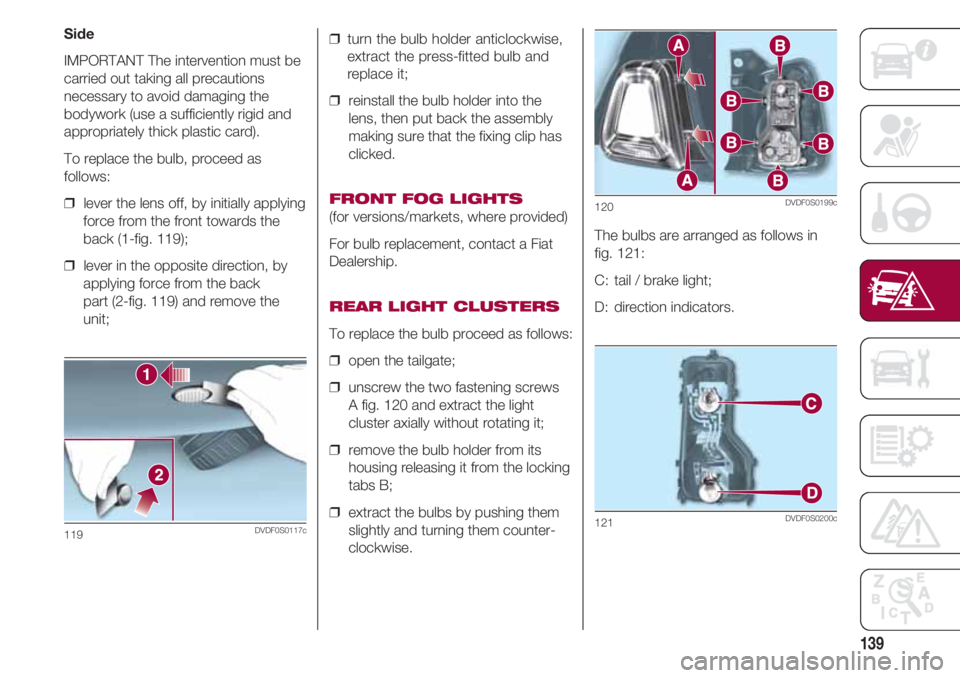
❒ lever the lens off, by initially applying
force from the front towards the
back (1-fig. 119);
❒ lever in the opposite direction, by
applying force from the back
part (2-fig. 119) and remove the
unit;
119DVDF0S0117c
❒ turn the bulb holder anticlockwise,
extract the press-fitted bulb and
replace it;
❒ reinstall the bulb holder into the
lens, then put back the assembly
making sure that the fixing clip has
clicked.
FRONT FOG LIGHTS
(for versions/markets, where provided)
For bulb replacement, contact a Fiat
Dealership.
REAR LIGHT CLUSTERS
To replace the bulb proceed as follows:
❒ open the tailgate;
❒ unscrew the two fastening screws
A fig. 120 and extract the light
cluster axially without rotating it;
❒ remove the bulb holder from its
housing releasing it from the locking
tabs B;
❒ extract the bulbs by pushing them
slightly and turning them counter-
clockwise.The bulbs are arranged as follows in
fig. 121:
C: tail / brake light;
D: direction indicators.
120DVDF0S0199c
121DVDF0S0200c
Page 147 of 224
145
TOWING THE CAR 37)
Version with Dualogic gearbox
Make sure that the gearbox is in neutral
(N) (checking that the vehicle moves
when pushed) and proceed in the
same way as for towing a normal
vehicle with a manual gearbox.
If the gearbox cannot be put in neutral,
do not tow the vehicle and contact a
Fiat Dealership.
ATTACHING THE
TOW RING
The tow ring provided with the car is
housed in the tool box under the boot
mat.
Proceed as follows:
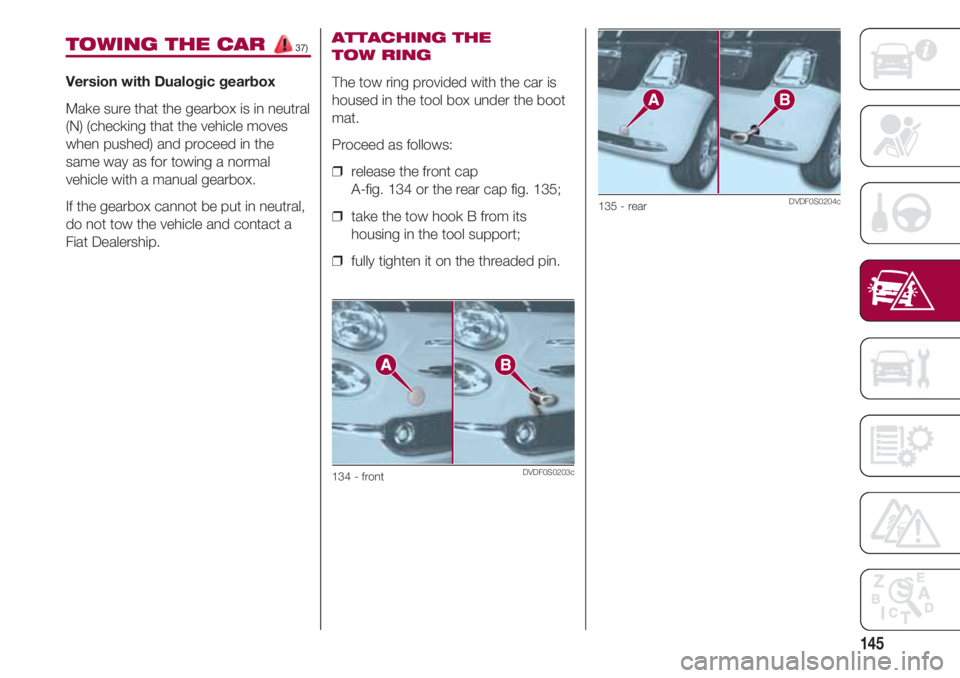
❒ release the front cap
A-fig. 134 or the rear cap fig. 135;
❒ take the tow hook B from its
housing in the tool support;
❒ fully tighten it on the threaded pin.
134 - frontDVDF0S0203c
135 - rearDVDF0S0204c
Page 149 of 224
147
SERVICING AND CARE
SCHEDULED SERVICING
Correct servicing is crucial for
guaranteeing a long life for the vehicle
under the best conditions.
For this reason, Fiat has planned a
series of checks and services at fixed
distance intervals and, for
versions/markets, where provided, at
fixed time intervals, as described in the
Scheduled Servicing Plan.
Regardless of the above, it is always
necessary to carefully follow the
instructions in the Scheduled Servicing
Plan (e.g. periodically check level of
liquids, tyre pressure, etc.).
Scheduled Servicing is offered by all
Fiat Dealerships according to fixed
time or kilometres/miles intervals.
If, during each operation, in addition to
the ones scheduled, the need arises
for further replacements or repairs,
these may be carried out with the
owner’s explicit agreement only. If your
vehicle is used frequently for towing,
the interval between one service
operation and the next should be
reduced. IMPORTANT NOTES
Scheduled Servicing interventions are
set out by the Manufacturer. Failure to
have them carried out may invalidate
the warranty.
We advise you to inform a Fiat
Dealership of any small operating
irregularities without waiting for the
next service.