wheel FIAT 500 2018 Owner handbook (in English)
[x] Cancel search | Manufacturer: FIAT, Model Year: 2018, Model line: 500, Model: FIAT 500 2018Pages: 224, PDF Size: 3.89 MB
Page 197 of 224
195
•Remember that the servo-brake and power steering are not
operational until the engine has been started, therefore much
effort than usual is required on the brake pedal and steering
wheel.
•For vehicles featuring a Dualogic gearbox, if the engine is not
started with a gear engaged, a warning is sounded to notify
the driver of the potential danger due to the gear being
automatically put into neutral.
•This starting procedure must be performed by expert
personnel because incorrect actions could cause electrical
discharge of considerable intensity. Furthermore, battery fluid
is poisonous and corrosive: avoid contact with skin and eyes.
Keep naked flames and lighted cigarettes away from the
battery and do not cause sparks.
•Remove any metal objects (e.g. rings, watches, bracelets),
that might cause an accidental electrical contact and cause
serious injury.
•Do not attempt to charge a frozen battery: it must be thawed
first, otherwise it may explode.
If freezing has occurred, the battery should be checked by
skilled personnel to make sure that the internal elements are
not damaged and that the body is not cracked, with the risk of
leaking poisonous and corrosive acid.
27) HANDBRAKE
• The car should be braked after a few clicks of the lever, if it is
not, contact a Fiat Dealership to have it adjusted.
• Never leave children in the unattended car. Always remove
the ignition key when leaving the car and take it out with you. • In the case of parking manoeuvres on roads on a gradient, the
front wheels must be steered towards the pavement
(when parking downhill), or in the opposite direction if the vehicle
is parked uphill. Block the wheels with a wedge or a stone if the
car is parked on a steep slope.
28) USING THE MANUAL GEARBOX
Press the clutch pedal fully to change gears correctly. It is
therefore essential that there is nothing under the pedals: make
sure the mats are lying flat and do not get in the way of the pedals.
29) TOWING TRAILERS
•The ABS with which the car is equipped will not control the
braking system of the trailer. Particular caution is required on
slippery roads.
•Do not, under any circumstances, modify the vehicle braking
system to control the trailer breaking system.
The towing braking system must be completely independent of the
vehicle’s hydraulic system.
30) SNOW TYRES
The maximum speed for snow tyres marked
“Q” is 160 km/h, while it is 190 km/h for “T” tyres and 210 km/h for
“H” tyres.
The highway code speed limits must however always be complied
with.
31) WARNING LIGHTS AND MESSAGES
•If the warning light
xturns on when travelling (on certain
versions together with the message on the display) stop the car
immediately and contact a Fiat Dealership.
(CONTINUES)
PERSONAL SAFETY
(CONTINUED)
Page 199 of 224
197(CONTINUES)
32) CHANGING A WHEEL
•The space-saver wheel (for versions/markets, where
provided) is specific to your car, do not use it on other models,
or use the space-saver wheel of other models on your car.
The space-saver wheel must only be used in an emergency.
Never use it for more than strictly necessary and never exceed
80 km/h.
•On the space-saver wheel there is an orange label,
summarising the main warnings regarding space-saver wheel
usage restrictions. Never remove or cover the label. The label
contains the following indications in four languages: “Warning!
For temporary use only! 80 km/h max! Replace with standard
wheel as soon as possible. Never cover this indication.” Never
apply a wheel cap on a space-saver wheel.
•If you change the type of wheel (alloy rims instead of
steel rims and vice versa) you will have to change the entire set
of fastening bolts with another set of suitably sized bolts.
•Alert other drivers that the car is stationary in compliance
with local regulations: hazard warning lights, warning triangle,
etc. Any passengers on board should leave the car, especially
if it is heavily laden. Passengers should stay away from on-
coming traffic while the wheel is being changed. On hills or
uneven roads, use chocks or appropriate objects to block the
wheels of the vehicle.
•The driving features of the car may change when a space-
saver wheel is fitted. Avoid violent acceleration and braking,
abrupt steering and fast cornering.
The total life of a space-saver wheel is approximately 3,000
km, after which it must be replaced by another wheel of the
same type. Never install a traditional tyre on a rim designed to
be used as a space-saver wheel.
PERSONAL SAFETY
(CONTINUED)
Have the wheel repaired and refitted as soon as possible. Using
two or more space-saver wheels at the same time is forbidden.
Do not apply grease to the bolt threads before fitting: they could
come unscrewed.
•Snow chains cannot be fitted to the space-saver wheel.
So, if a front (drive) wheel is punctured and chains are needed,
a rear wheel should be fitted to the front of the car and the
space-saver wheel should be fitted to the rear. In this way,
equipped with two normal drive wheels at the front, they can be
fitted with snow chains, thus resolving the emergency situation.
•If the hub cap is not fitted correctly, it may come off when the
car is travelling.
Never tamper with the inflation valve.
Never introduce tools of any kind between rim and tyre. Check
tyre and space-saver wheel pressures regularly, complying with
the values given in the “Technical specifications” chapter.
•The jack is a tool developed and designed only for changing a
wheel, if a tyre gets punctured or damaged, on the vehicle with
which it is supplied or on other vehicles of the same model.
Any other use, e.g. to jack up other vehicle models or different
things, is strictly prohibited. Never use it to carry out
maintenance or repairs under the vehicle or to change
summer/winter wheels and vice versa.
Never go under the raised vehicle. If any work under the vehicle
is necessary, contact the Fiat Service Network. Incorrect
placing of the jack can cause the vehicle to drop: use it only in
the positions indicated.
Page 201 of 224
199(CONTINUES)
PERSONAL SAFETY
(CONTINUED)
• The electronic Cruise Control can be dangerous if the system is
unable to maintain a constant speed. In specific conditions speed
may be excessive, resulting in the risk of losing control of the
vehicle and causing accidents. Do not use the device in heavy
traffic or on winding, icy, snowy or slippery roads.
39) SERVICING - CHECKING FLUID LEVELS
•Never smoke while working in the engine compartment: gas
and inflammable vapours may be present, with the risk of fire.
•Be very careful when working in the engine compartment when
the engine is hot: you may get burned. Remember that when the
engine is hot, the fan may operate: danger of injury. Scarves, ties
and other loose clothing might be pulled by moving parts.
•The cooling system is pressurised. If necessary, only replace
the plug with another original or the operation of the system may
be adversely affected. Do not remove the reservoir plug when the
engine is hot: you risk scalding yourself.
•Do not travel with the windscreen washer fluid reservoir empty:
the windscreen washer is essential for improving visibility.
•Some commercial windscreen washer additives are flammable.
The engine compartment contains hot components which may
set it on fire.
•Brake fluid is poisonous and highly corrosive. In the event of
accidental contact, immediately wash the affected parts with
water and mild soap. Then rinse thoroughly. Call a doctor
immediately if swallowed.
•Symbol
πon the contain indicates a synthetic brake fluid,
which is different from a mineral fluid.
Use of a mineral type fluid will damage the special rubber seals of
the braking system beyond repair.
•Battery fluid is poisonous and corrosive. Avoid contact with skin
and eyes. Keep naked flames and sources of sparks away from
the battery: risk of explosion and fire. •Before towing, turn the ignition key to MAR and then to STOP
without removing it. The steering column will automatically lock
when the key is removed and the wheels cannot be steered.
•When towing, remember that without the help of the brake
servo and electric power steering, a greater effort is required on
the pedal and steering wheel.
•Do not use flexible cables when towing and avoid jerky
movements.
•During towing, make sure that the trailer hitch does not
damage any components it is touching.
•When towing the vehicle, you must comply with all specific
traffic regulations, both in terms of the towing device and
behaviour on the road.
•Do not start the engine while towing the car.
•The (front/rear) tow hook must be used exclusively for
roadside assistance operations.
You are allowed to tow the vehicle for short distances using an
appropriate device in accordance with the highway code (a rigid
bar), to move the vehicle on the road in readiness for towing or
transport via a breakdown vehicle.
The tow hook MUST NOT be used to tow vehicles off the road
or where there are obstacles and/or for towing operations using
cables or other non-rigid devices. In compliance with the above
conditions, towing must take place with the two vehicles (one
towing, the other towed) aligned as much as possible along the
same centre line.
38) ELECTRONIC CRUISE CONTROL
•Never move the shift lever to neutral when driving with the
device active.
• In the event of device malfunction or failure, contact a Fiat
Dealership.
Page 202 of 224
200
PERSONAL SAFETY
(CONTINUED)
42) INTERIORS
•Never use flammable products, such as petrol ether or rectified
petrol to clean the inside of the car. The electrostatic charges which
are generated by rubbing during the cleaning operation may cause
a fire.
•Do not keep aerosol cans in the vehicle: they might explode.
Aerosol cans must not be exposed to a temperature exceeding
50°C. When the vehicle is exposed to sunlight, the internal
temperature can greatly exceed this value.
43) TECHNICAL SPECIFICATIONS – FUEL SUPPLY
Modifications or repairs to the supply system that are not carried
out correctly or do not take the system technical specifications
into account can cause malfunctions leading to the risk of fire.
44) TECHNICAL SPECIFICATIONS – RIM PROTECTOR
TYRES
DO NOT fit wheel hub caps when using integral hub caps fixed
(with springs) to the steel rim and after sale tyres provided with
Rim Protector. Use of unsuitable tyres and wheel caps may cause
sudden decrease of tyre pressure.
45) LPG
•Note that in some countries (including Italy) there are legal
restrictions in force for parking/garaging motor vehicles fuelled by
gas that is denser than air; LPG comes under this category.
•Do not switch between the two operating modes (petrol/LPG)
whilst starting the engine.
•The LPG supply system is equipped with a “consumption”
function linked to the LED display of LPG level on the switch; this
function activates only after a consistent variation in fuel level has
been detected. •Running the battery with an excessively low liquid level will
damage the battery beyond repair and could even cause its
explosion.
•If the vehicle must remain unused for a long time at a very low
temperature, remove the battery and take it to a warm place, to
avoid freezing.
•When performing any operation on the battery or near it,
always protect your eyes with special goggles.
40) TYRES AND WHEELS
•Remember that the road holding qualities of your car also
depend on correct tyre pressures.
•If tyre pressure is too low, the tyre may overheat and be
severely damaged as a result.
•Do not switch tyres from the right hand side of the vehicle to the
left hand side, and vice versa.
•Never submit alloy rims to repainting treatments requiring the
use of temperatures exceeding 150°C.
The mechanical properties of the wheels could be impaired.
41) WINDSCREEN AND –REAR WINDOW WIPER
•Driving with worn windscreen/rear window wiper blades is a
serious hazard, because visibility is reduced in bad weather.
•If the window needs to be cleaned, make sure the device is
deactivated or the key is on STOP.
IMPORTANT INFORMATION AND RECOMMENDATIONS
(CONTINUES)
Page 206 of 224
IMPORTANT INFORMATION AND RECOMMENDATIONS
204(CONTINUES)
• Warning light mwill blink for 60 seconds after starting or
during prolonged cranking to indicate a fault to the glow plug
heating system.
Use the car normally if the engine starts and go to a Fiat
Dealership as soon as possible.
• Never bump start the engine by pushing, towing or coasting
downhill. This could cause fuel to flow into the catalytic
converter and damage it beyond repair.
• Never use a fast battery-charger to start the engine as this could
damage the electronic systems of your vehicle, particularly the
ignition and engine fuel supply control units.
• Do not connect the cable to the negative terminal (–) of the flat
battery. The following spark could lead to battery explosion and
cause serious harm.
Only use the specific earth point; do not use
any other exposed metallic part.
• A quick burst on the accelerator before turning off the engine
serves absolutely no practical purpose; it wastes fuel and is
especially damaging to turbocharged engines.
14) USING THE GEARBOX: MANUAL AND DUALOGIC
• Do not drive with your hand resting on the gear lever as the
force exerted, even if slight, could lead over time to premature
wear of the gearbox internal components.
• If the gearbox is faulty, contact a Fiat Dealership as soon as
possible to have the system checked.
• Avoid keeping your hand placed on this lever in between
gear changes or Auto/Manual mode.
• Using the paddles incorrectly (paddles pushed towards the
dashboard) could break them.• In order to safeguard the efficiency of the clutch, do not use the
accelerator to keep the car still (for example:
stopped on a hill); the clutch could overheat and be damaged;
use the brake pedal and only operate the accelerator pedal when
you decide to set off.
• If the messages continue to be shown in the display, contact a
Fiat Dealership.
15) SNOW CHAINS
• Keep the vehicle’s speed down when snow chains are fitted;
never exceed 50 km/h.
• With snow chains, use the accelerator with extreme care to
prevent, or to limit as much as possible, slipping of the drive
wheels that could cause chain breakage, resulting in damage to
the car body or mechanical components.
• Avoid potholes, steps and pavements and avoid driving long
distances on roads not covered with snow to avoid damaging the
car and the roadbed.
16) POWER SOCKET
Only accessories with a maximum power of 180 W (maximum
absorption 15 A)
can be connected to the socket.
17) DIESEL FILTER
The presence of water in the supply circuit may cause severe
damage to the injection system and irregular engine operation.
If the warning light or the symbol
Eon the colour display turns
on, contact a Fiat Dealership as soon as possible to have the
system bled.
VEHICLE SAFETY
(CONTINUED)
Page 209 of 224
207
• Although the LPG system has numerous safety features, it is
advisable to proceed as follows every time the vehicle is not in
use for a long period or moved in an emergency as a result of a
breakdown or accident:
unscrew the fastening devices, then remove the cover B. Close
the LPG valve rotating the ring nut C clockwise; refit the cover and
tighten the fixing devices.
• It is strictly forbidden to use any additive in the LPG.
• Periodically (at least once every six months) it is advisable to
let the LPG in the tank run out and, at the first refuelling, check
that it does not exceed the maximum capacity of 30.5 litres
(including reserve). If the level is above 30.5 litres (reserve
included) contact a Fiat Dealership immediately.
In special usage conditions:
• starting up and operation at low ambient temperature
• LPG supply with low propane content: the system may
switch temporarily to petrol operation, without any indication.
In the case of:
• low LPG levels in the tank
• request for high performance (e.g. overtaking, car fully laden,
steep hills): the system can automatically switch to petrol
operation to guarantee the required engine performance; in this
event, the performed switching is shown by the orange (petrol)
LED lit and the green (LPG) LED off on the switch. When the
above conditions stop, the system automatically restores the
LPG operation; the orange (petrol) LED turns off and the green
(LPG) LED is lit on the switch.
(CONTINUED)
VEHICLE SAFETY
• To achieve the automatic switching described above, make sure
that there is always enough fuel in the petrol tank.
• There must therefore always be enough petrol in the tank to
protect the petrol pump and to guarantee temporary switching
from LPG to petrol operation.
30) CHANGING A WHEEL
When turning the jack handle make sure that it can turn freely
without scraping your hand against the ground. The moving
components of the jack (“worm screw” and joints) can also cause
injuries: avoid touching them. If you come into contact with
lubricating grease, clean yourself thoroughly.
31) FIX&GO QUICK TYRE REPAIR KIT
• The sealant fluid is effective with external temperatures between
-40°C and +55°C. The sealant has an expiry date. It is possible to
repair tyres which have been damaged on tread up to a diameter
of 6 mm. Show the cartridge and the label to the personnel
charged with handling the tyre treated with the tyre repair kit.
Page 217 of 224
215
KNOWING YOUR CAR
Dashboard ......................................................................7
Instrument panel ..............................................................9
– Versions with multifunction display.................................9
– Versions with colour display.........................................10
– Warning lights and messages.................................11-23
Display panel..................................................................24
– Multifunctional display panel.........................................24
– Colour display panel....................................................24
– Setup menu.................................................................24
– Trip computer............................................................ 25
– Set time.......................................................................25
– Deactivating front passenger airbag and side
bag..............................................................................26
– Service (Scheduled Maintenance) ................................26
– Headlight adjustment...................................................27
– Reset tyres..................................................................27
Keys.............................................................................. 27
– Code card................................................................. 27
– Mechanical key ...........................................................27
– Key with remote control ..............................................27
The Fiat Code System....................................................28
Start-up device ..............................................................28
– Steering lock ..............................................................29
Seats ............................................................................29
– Front seats .................................................................29Head restraints ..............................................................30
– Rear head restraints (removal)..................................... 31
Steering wheel ...............................................................31
Rear-view mirrors ..........................................................31
– Interior mirror ..............................................................31
– Interior electrochromic mirror.......................................32
– Interior mirrors.............................................................32
Manual climate control system........................................33
– Air recirculation ..........................................................33
Automatic climate control system ..................................34
– Automatic operation....................................................34
– Air recirculation ..........................................................34
External lights ................................................................35
– Daylight lights..............................................................35
– Dipped headlights/side lights.......................................35
– Main beam headlights .................................................35
– Parking lights.............................................................. 35
– Direction indicators......................................................35
– Lane change function..................................................35
– Follow Me Home function............................................35
– Auto function (Dusk sensor)........................................ 36
Window cleaning ...........................................................37
– Windscreen wipers......................................................37
– Rear window wiper .....................................................38
– Rain sensor................................................................ 38
Automatic wiping........................................................... 39
CONTENTS
Page 219 of 224
217
– Suitability of passenger seats for use with i-Size......... 110
Supplementary restraint system (SRS) - airbag..............114
– Front airbags .............................................................114
– Passenger airbag deactivation....................................117
– Side bags ..................................................................117
STARTING AND DRIVING
Engine starting..............................................................119
Handbrake ...................................................................120
Using the manual gearbox ............................................120
Using the Dualogic gearbox ..........................................121
– Operating mode .........................................................121
– MANUAL logic.......................................................... 121
– AUTO logic............................................................... 121
– Shift paddles..............................................................122
Speed limiter............................................................... 123
– Enabling the device................................................... 123
– Speed limit programming........................................... 124
– Device activation/ deactivation................................... 124
– Exceeding the programmed speed............................ 124
– Flashing of programmed speed................................. 124
– Disabling the device................................................... 124
Electronic cruise control ............................................. 125
– Enabling the device................................................... 125
– Setting the desired speed.......................................... 126
– Increasing the speed................................................. 126
– Decreasing speed...................................................... 126
– Recalling the speed................................................... 126
– Deactivating the device.............................................. 126
– Disabling the device................................................... 126
IN AN EMERGENCY
Jump starting................................................................127
Bump starting...............................................................128
Changing a wheel .........................................................128
– Jack......................................................................... 128
– Raising with a jack and replacing a wheel ...................128
– Refitting the wheel......................................................130
Fix&Go Automatic fast tyre repair kit.......................131-133
Changing a bulb ...........................................................134
– General information ..................................................134
– Bulb types .................................................................135
– Front light clusters .....................................................136
– Dipped beam headlights ............................................137
– Main beam headlights ................................................137
– Side lights/brake lights................................................138
– Direction indicators.....................................................138
– Front fog lights ..........................................................139
– Rear light clusters ......................................................139
– Reverse/rear fog light..................................................140
– Third brake light .........................................................140
– Number plate lights ...................................................141
Fuse replacement .........................................................141
– Dashboard fuses .......................................................141
– Engine compartment fuses.........................................142
Recharging the battery .................................................144
Towing the car .............................................................145
– Attaching the tow ring.................................................145
SERVICING AND CARE
Scheduled servicing plan .......................................147-153
Regular checks ............................................................154
Page 220 of 224
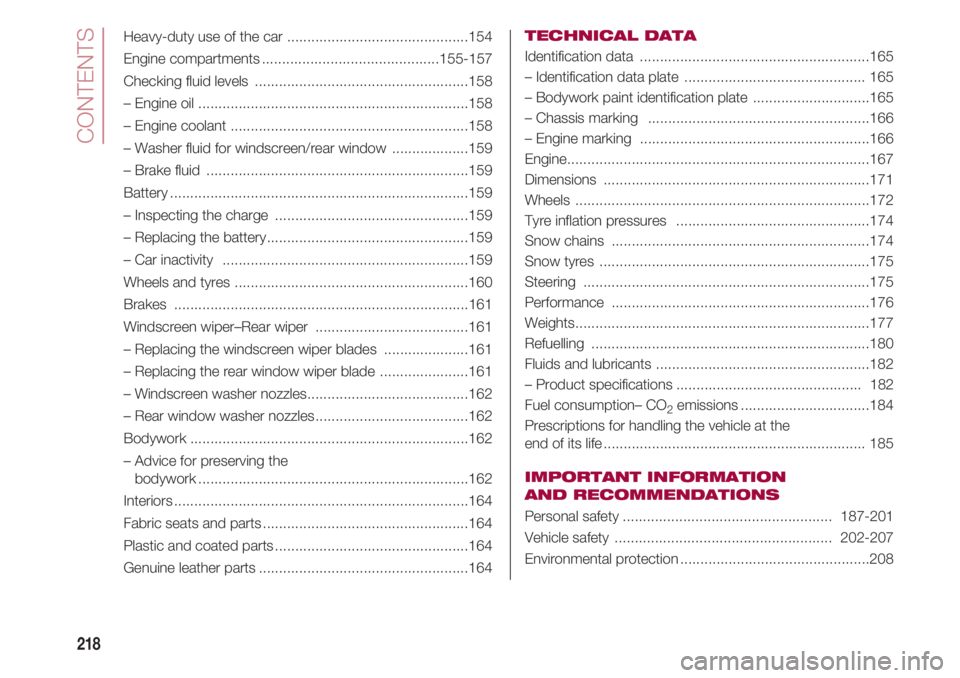
CONTENTS
218
Heavy-duty use of the car .............................................154
Engine compartments............................................155-157
Checking fluid levels .....................................................158
– Engine oil ...................................................................158
– Engine coolant ...........................................................158
– Washer fluid for windscreen/rear window ...................159
– Brake fluid .................................................................159
Battery..........................................................................159
– Inspecting the charge ................................................159
– Replacing the battery..................................................159
– Car inactivity .............................................................159
Wheels and tyres ..........................................................160
Brakes .........................................................................161
Windscreen wiper–Rear wiper ......................................161
– Replacing the windscreen wiper blades .....................161
– Replacing the rear window wiper blade ......................161
– Windscreen washer nozzles........................................162
– Rear window washer nozzles......................................162
Bodywork.....................................................................162
– Advice for preserving the
bodywork...................................................................162
Interiors.........................................................................164
Fabric seats and parts...................................................164
Plastic and coated parts................................................164
Genuine leather parts....................................................164TECHNICAL DATA
Identification data .........................................................165
– Identification data plate ............................................. 165
– Bodywork paint identification plate .............................165
– Chassis marking .......................................................166
– Engine marking .........................................................166
Engine...........................................................................167
Dimensions ..................................................................171
Wheels .........................................................................172
Tyre inflation pressures ................................................174
Snow chains ................................................................174
Snow tyres ...................................................................175
Steering .......................................................................175
Performance ................................................................176
Weights.........................................................................177
Refuelling .....................................................................180
Fluids and lubricants .....................................................182
– Product specifications.............................................. 182
Fuel consumption– CO
2emissions................................184
Prescriptions for handling the vehicle at the
end of its life................................................................. 185
IMPORTANT INFORMATION
AND RECOMMENDATIONS
Personal safety....................................................187-201
Vehicle safety ......................................................202-207
Environmental protection...............................................208
Page 223 of 224
We really know your car because we invented, designed and built it: we really know every single detail.
At Fiat Service authorised workshopsyou can find technicians directly trained by us,
offering quality and professionalism for all service operations.
Fiat workshops are always close to you for the regular servicing operations, season checks
and practical recommendations by our experts.
With Original Parts distributed by MOPAR
®, you maintain the reliability, comfort
and performance features that you bought your new car for over time.
Always ask for Genuine Parts for the components used on our cars; we recommend them because
they come from our steady commitment in research and development of highly innovative technologies.
For all these reasons: rely on Genuine Parts, because they are the only ones designed
by FCA for your car.
SAFETY:
BRAKING SYSTEMENVIRONMENT: PARTICULATE FILTERS,
CLIMATE CONTROL MAINTENANCECOMFORT: SUSPENSION
AND WINDSCREEN WIPERS PERFORMANCE: SPARK PLUGS,
INJECTORS AND BATTERIESLINEACCESSORI
ROOF RACK BARS, WHEEL RIMS
WHY CHOOSING
GENUINE PARTS