tire pressure FIAT 500 ABARTH 2013 2.G Owner's Manual
[x] Cancel search | Manufacturer: FIAT, Model Year: 2013, Model line: 500 ABARTH, Model: FIAT 500 ABARTH 2013 2.GPages: 84, PDF Size: 4.63 MB
Page 56 of 84
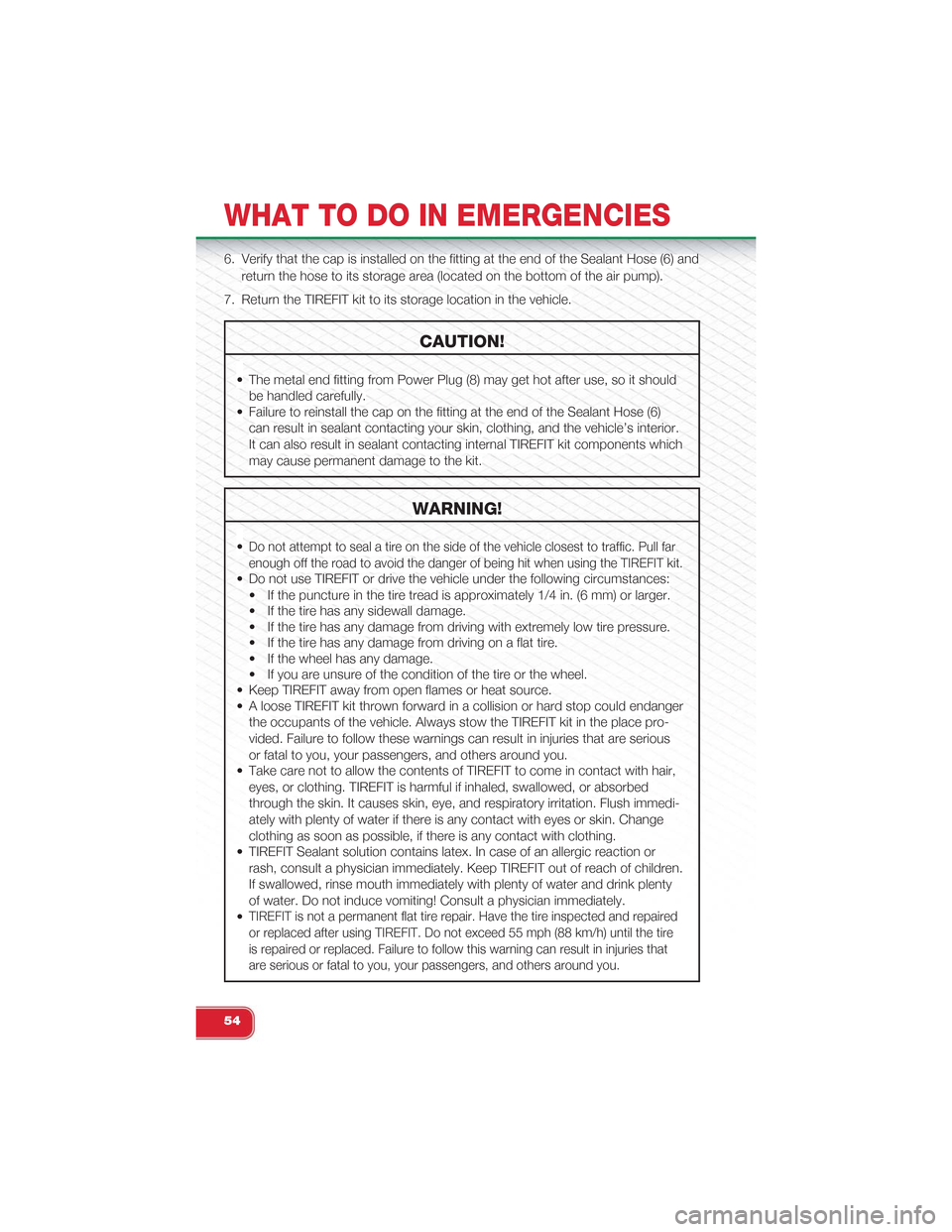
6. Verify that the cap is installed on the fitting at the end of the Sealant Hose (6) and
return the hose to its storage area (located on the bottom of the air pump).
7. Return the TIREFIT kit to its storage location in the vehicle.
CAUTION!
• The metal end fitting from Power Plug (8) may get hot after use, so it should
be handled carefully.
• Failure to reinstall the cap on the fitting at the end of the Sealant Hose (6)
can result in sealant contacting your skin, clothing, and the vehicle’s interior.
It can also result in sealant contacting internal TIREFIT kit components which
may cause permanent damage to the kit.
WARNING!
•Do not attempt to seal a tire on the side of the vehicle closest to traffic. Pull far
enough off the road to avoid the danger of being hit when using the TIREFIT kit.
• Do not use TIREFIT or drive the vehicle under the following circumstances:
• If the puncture in the tire tread is approximately 1/4 in. (6 mm) or larger.
• If the tire has any sidewall damage.
• If the tire has any damage from driving with extremely low tire pressure.
• If the tire has any damage from driving on a flat tire.
• If the wheel has any damage.
• If you are unsure of the condition of the tire or the wheel.
• Keep TIREFIT away from open flames or heat source.
• A loose TIREFIT kit thrown forward in a collision or hard stop could endanger
the occupants of the vehicle. Always stow the TIREFIT kit in the place pro-
vided. Failure to follow these warnings can result in injuries that are serious
or fatal to you, your passengers, and others around you.
• Take care not to allow the contents of TIREFIT to come in contact with hair,
eyes, or clothing. TIREFIT is harmful if inhaled, swallowed, or absorbed
through the skin. It causes skin, eye, and respiratory irritation. Flush immedi-
ately with plenty of water if there is any contact with eyes or skin. Change
clothing as soon as possible, if there is any contact with clothing.
• TIREFIT Sealant solution contains latex. In case of an allergic reaction or
rash, consult a physician immediately. Keep TIREFIT out of reach of children.
If swallowed, rinse mouth immediately with plenty of water and drink plenty
of water. Do not induce vomiting! Consult a physician immediately.
•TIREFIT is not a permanent flat tire repair. Have the tire inspected and repaired
or replaced after using TIREFIT. Do not exceed 55 mph (88 km/h) until the tire
is repaired or replaced. Failure to follow this warning can result in injuries that
are serious or fatal to you, your passengers, and others around you.
WHAT TO DO IN EMERGENCIES
54
Page 61 of 84
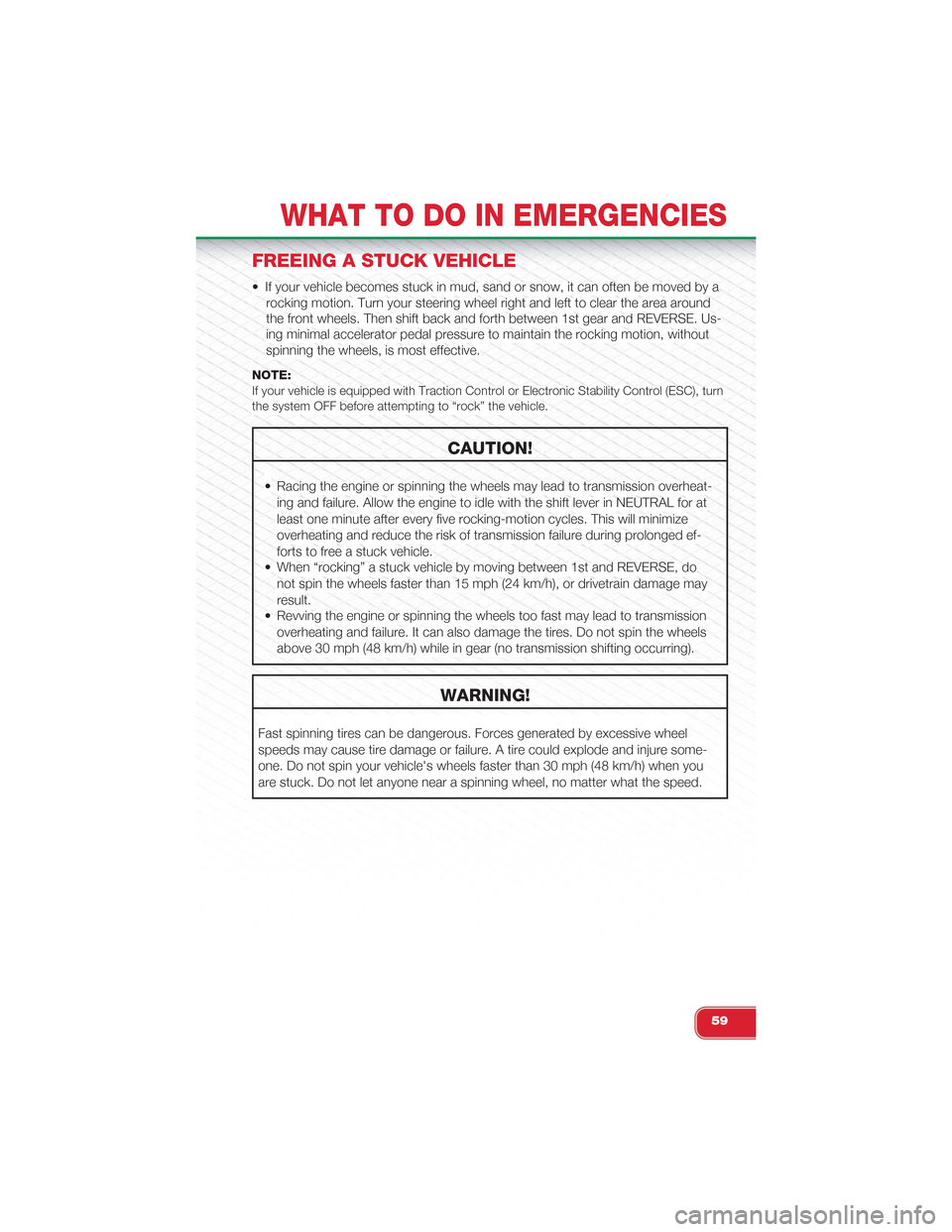
FREEING A STUCK VEHICLE
• If your vehicle becomes stuck in mud, sand or snow, it can often be moved by a
rocking motion. Turn your steering wheel right and left to clear the area around
the front wheels. Then shift back and forth between 1st gear and REVERSE. Us-
ing minimal accelerator pedal pressure to maintain the rocking motion, without
spinning the wheels, is most effective.
NOTE:If your vehicle is equipped with Traction Control or Electronic Stability Control (ESC), turnthe system OFF before attempting to “rock” the vehicle.
CAUTION!
• Racing the engine or spinning the wheels may lead to transmission overheat-
ing and failure. Allow the engine to idle with the shift lever in NEUTRAL for at
least one minute after every five rocking-motion cycles. This will minimize
overheating and reduce the risk of transmission failure during prolonged ef-
forts to free a stuck vehicle.
• When “rocking” a stuck vehicle by moving between 1st and REVERSE, do
not spin the wheels faster than 15 mph (24 km/h), or drivetrain damage may
result.
• Revving the engine or spinning the wheels too fast may lead to transmission
overheating and failure. It can also damage the tires. Do not spin the wheels
above 30 mph (48 km/h) while in gear (no transmission shifting occurring).
WARNING!
Fast spinning tires can be dangerous. Forces generated by excessive wheel
speeds may cause tire damage or failure. A tire could explode and injure some-
one. Do not spin your vehicle's wheels faster than 30 mph (48 km/h) when you
are stuck. Do not let anyone near a spinning wheel, no matter what the speed.
WHAT TO DO IN EMERGENCIES
59
Page 66 of 84
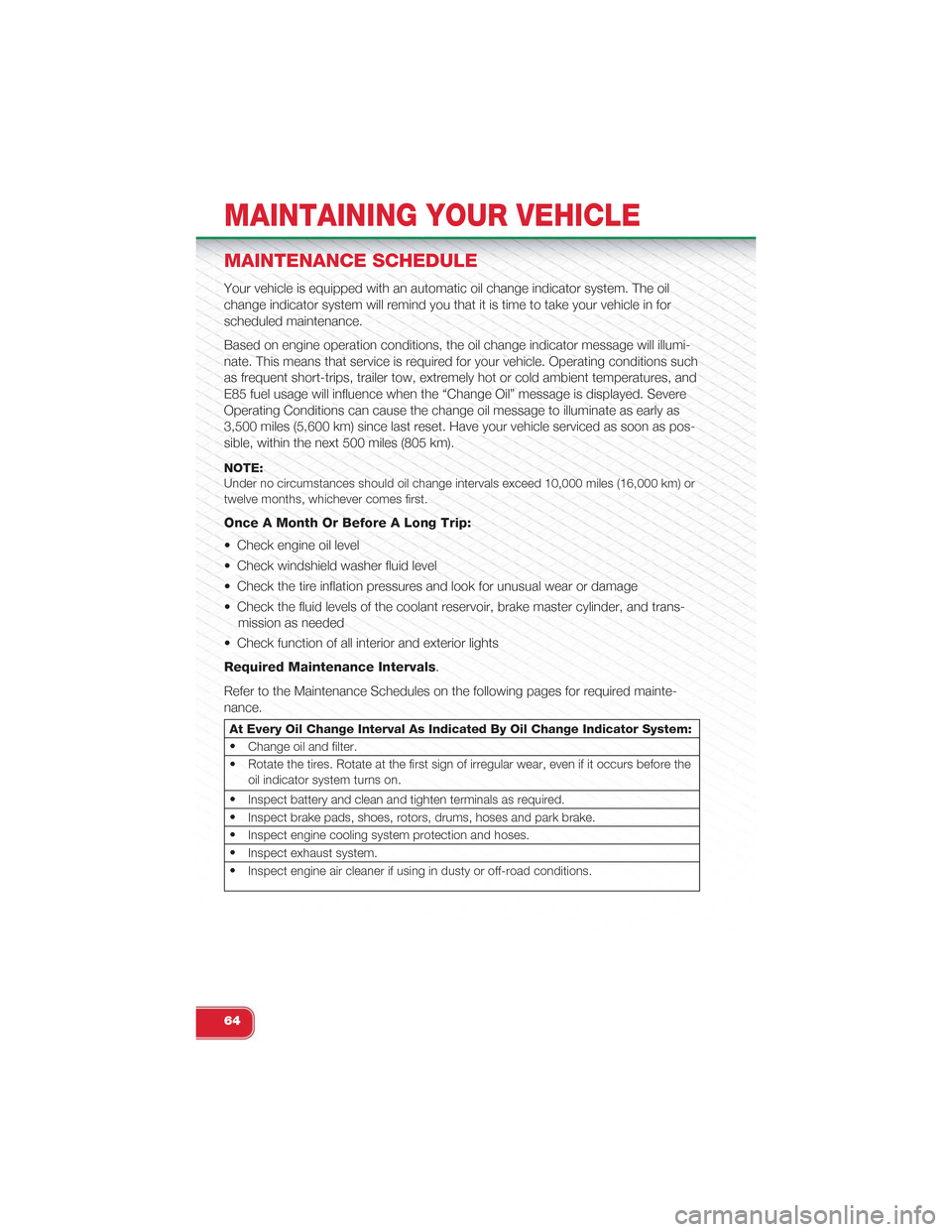
MAINTENANCE SCHEDULE
Your vehicle is equipped with an automatic oil change indicator system. The oil
change indicator system will remind you that it is time to take your vehicle in for
scheduled maintenance.
Based on engine operation conditions, the oil change indicator message will illumi-
nate. This means that service is required for your vehicle. Operating conditions such
as frequent short-trips, trailer tow, extremely hot or cold ambient temperatures, and
E85 fuel usage will influence when the “Change Oil” message is displayed. Severe
Operating Conditions can cause the change oil message to illuminate as early as
3,500 miles (5,600 km) since last reset. Have your vehicle serviced as soon as pos-
sible, within the next 500 miles (805 km).
NOTE:Under no circumstances should oil change intervals exceed 10,000 miles (16,000 km) ortwelve months, whichever comes first.
Once A Month Or Before A Long Trip:
• Check engine oil level
• Check windshield washer fluid level
• Check the tire inflation pressures and look for unusual wear or damage
• Check the fluid levels of the coolant reservoir, brake master cylinder, and trans-
mission as needed
• Check function of all interior and exterior lights
Required Maintenance Intervals.
Refer to the Maintenance Schedules on the following pages for required mainte-
nance.
At Every Oil Change Interval As Indicated By Oil Change Indicator System:
•Change oil and filter.
• Rotate the tires. Rotate at the first sign of irregular wear, even if it occurs before theoil indicator system turns on.
•Inspect battery and clean and tighten terminals as required.
•Inspect brake pads, shoes, rotors, drums, hoses and park brake.
•Inspect engine cooling system protection and hoses.
•Inspect exhaust system.
•Inspect engine air cleaner if using in dusty or off-road conditions.
MAINTAINING YOUR VEHICLE
64
Page 70 of 84
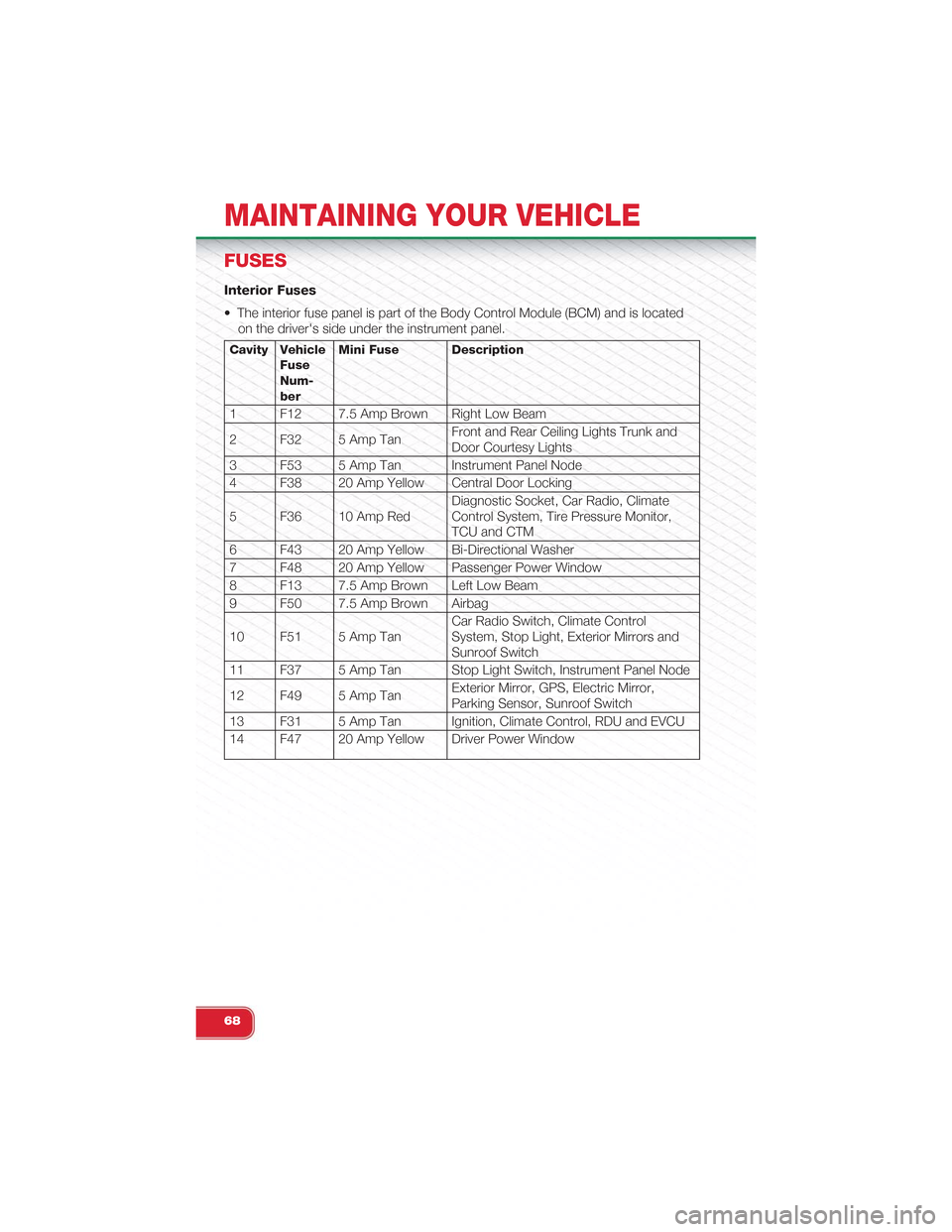
FUSES
Interior Fuses
• The interior fuse panel is part of the Body Control Module (BCM) and is located
on the driver's side under the instrument panel.
Cavity VehicleFuseNum-ber
Mini Fuse Description
1 F12 7.5 Amp Brown Right Low Beam
2 F32 5 Amp TanFront and Rear Ceiling Lights Trunk andDoor Courtesy Lights
3 F53 5 Amp Tan Instrument Panel Node
4 F38 20 Amp Yellow Central Door Locking
5 F36 10 Amp RedDiagnostic Socket, Car Radio, ClimateControl System, Tire Pressure Monitor,TCU and CTM
6 F43 20 Amp Yellow Bi-Directional Washer
7 F48 20 Amp Yellow Passenger Power Window
8 F13 7.5 Amp Brown Left Low Beam
9 F50 7.5 Amp Brown Airbag
10 F51 5 Amp TanCar Radio Switch, Climate ControlSystem, Stop Light, Exterior Mirrors andSunroof Switch
11 F37 5 Amp Tan Stop Light Switch, Instrument Panel Node
12 F49 5 Amp TanExterior Mirror, GPS, Electric Mirror,Parking Sensor, Sunroof Switch
13 F31 5 Amp Tan Ignition, Climate Control, RDU and EVCU
14 F47 20 Amp Yellow Driver Power Window
MAINTAINING YOUR VEHICLE
68
Page 72 of 84
TIRE PRESSURES
• Check the inflation pressure of each tire, at least monthly and inflate to the rec-
ommended pressure for your vehicle.
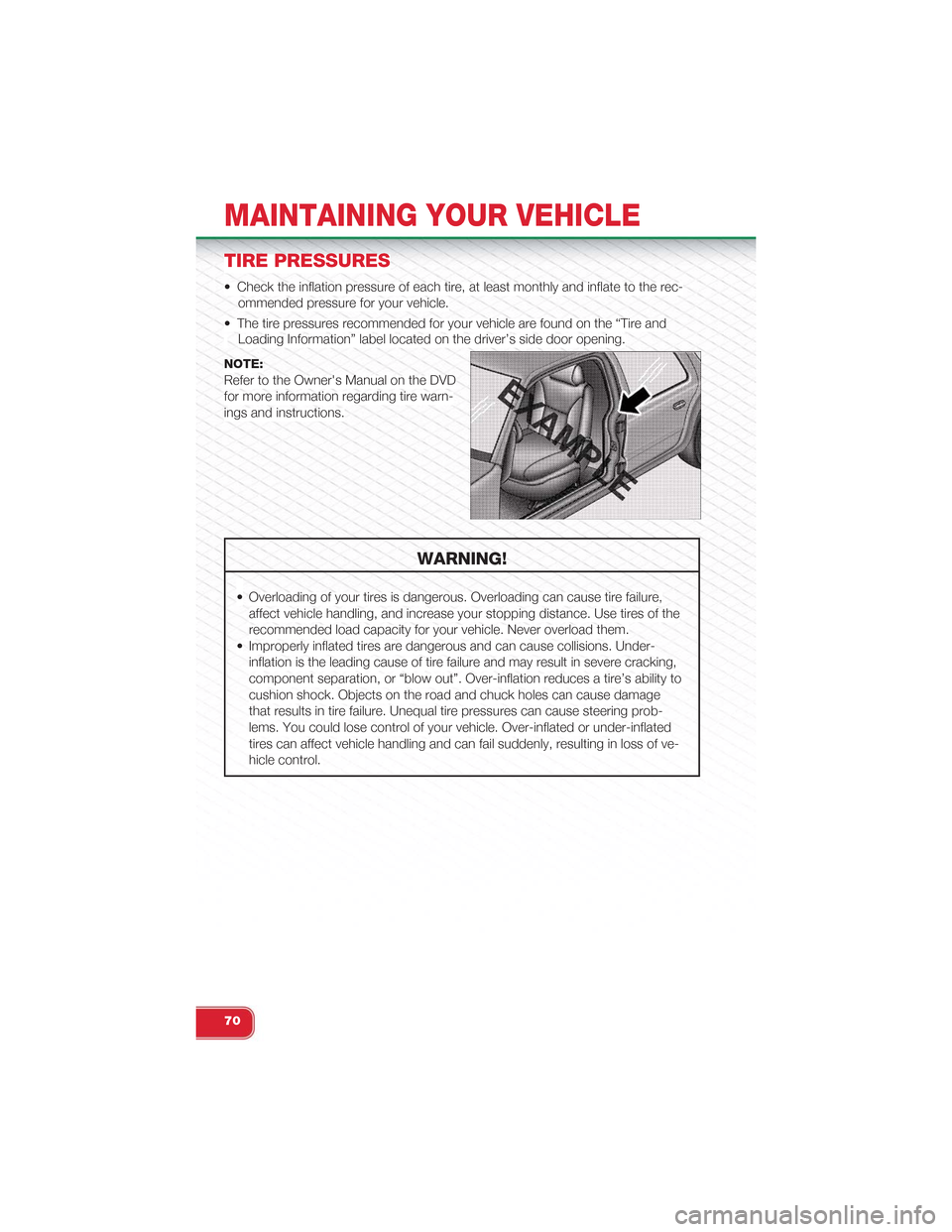
• The tire pressures recommended for your vehicle are found on the “Tire and
Loading Information” label located on the driver’s side door opening.
NOTE:
Refer to the Owner's Manual on the DVD
for more information regarding tire warn-
ings and instructions.
WARNING!
• Overloading of your tires is dangerous. Overloading can cause tire failure,
affect vehicle handling, and increase your stopping distance. Use tires of the
recommended load capacity for your vehicle. Never overload them.
• Improperly inflated tires are dangerous and can cause collisions. Under-
inflation is the leading cause of tire failure and may result in severe cracking,
component separation, or “blow out”. Over-inflation reduces a tire’s ability to
cushion shock. Objects on the road and chuck holes can cause damage
that results in tire failure. Unequal tire pressures can cause steering prob-
lems. You could lose control of your vehicle. Over-inflated or under-inflated
tires can affect vehicle handling and can fail suddenly, resulting in loss of ve-
hicle control.
MAINTAINING YOUR VEHICLE
70
Page 78 of 84
FREQUENTLY ASKED QUESTIONS
GETTING STARTED
• How do I install my LATCH Equipped Child Seat? pg. 12
• How do I fold down my rear seat? pg. 15
ELECTRONICS
• What Sound System do I have? pg. 30
• How do I set the clock on my radio? pg. 33
• How do I set the presets on my radio? pg. 33
• How do I connect my portable media player/iPod/MP3? pg. 39
• How do I pair my cell phone via Bluetooth® with the BLUE&ME™ Hands-Free
Communication System? pg. 36
WHAT TO DO IN EMERGENCIES
• What do I do if my TPMS warning light is blinking? pg. 46
• How do I Jump-Start my vehicle? pg. 55
MAINTAINING YOUR VEHICLE
• Where is my underhood fuse block located? pg. 69
• Where is my interior fuse block located? pg. 68
• What type of oil do I use? pg. 63
• How often should I change my engines oil? pg. 64
• What should my tire pressure be set at? pg. 70
FAQ (How To?)
76
Page 80 of 84
Rear Seat, Folding. . . . . . . . . . . . .15Reclining Front Seats. . . . . . . . . . .14Recreational Towing. . . . . . . . . . . .43Remote Keyless Entry (RKE)Power Convertible Top Function . . .8Replacement Bulbs. . . . . . . . . . . .72Reporting Safety Defects. . . . . . . . .74Restraints, Child. . . . . . . . . . . . . .12
Schedule, Maintenance. . . . . . . . . .64Seat Belts. . . . . . . . . . . . . . . . .10SeatsAdjustment. . . . . . . . . . . . . .14Rear Folding. . . . . . . . . . . . . .15Security Against Theft. . . . . . . . . . .9Setting the Clock. . . . . . . . . . . . .33Signals, Turn. . . . . . . . . . . . . . . .18Spark Plugs. . . . . . . . . . . . . . . .63Speed ControlAccel/Decel. . . . . . . . . . . . . .21Cancel. . . . . . . . . . . . . . . . .21Distance Setting (ACC Only) .. . . .21Speed Control (Cruise Control). . . . . .21StartingCold Weather. . . . . . . . . . . . .29SteeringTilt Column. . . . . . . . . . . . . .16
Steering Wheel Audio Controls. . . . . .34Store Radio Presets. . . . . . . . . . . .33Stuck, Freeing. . . . . . . . . . . . . . .59
Theft System Arming. . . . . . . . . . . .9Theft System Disarming . .. . . . . . . .9Tilt Steering Column . .. . . . . . . . . .16TIREFIT. . . . . . . . . . . . . . . . . . .49TiresAir Pressure. . . . . . . . . . . . . .70Pressure Warning Light. . . . . . .46Towing24-Hour Towing Assistance. . . . .44Disabled Vehicle. . . . . . . . . . .57Recreational. . . . . . . . . . . . . .43Towing Vehicle Behind a Motorhome . .43TransmissionFluid. . . . . . . . . . . . . . . . . .63Turn Signals. . . . . . . . . . . . . . . .18
USB Port . . . . .. . . . . . . . . . . . .39
WasherRear. . . . . . . . . . . . . . . . . .20Wheel and Wheel Trim Care. . . . . . .71Wind Buffeting. . . . . . . . . . . . . . .29Wiper, Rear .. . . . . . . . . . . . . . .20
INDEX
78