engine FIAT 500 ABARTH CABRIO 2017 2.G User Guide
[x] Cancel search | Manufacturer: FIAT, Model Year: 2017, Model line: 500 ABARTH CABRIO, Model: FIAT 500 ABARTH CABRIO 2017 2.GPages: 338, PDF Size: 2.78 MB
Page 66 of 338
Periodic Safety Checks You Should Make
Outside The Vehicle
Tires
Examine tires for excessive tread wear and uneven wear
patterns. Check for stones, nails, glass, or other objects
lodged in the tread or sidewall. Inspect the tread for
cuts and cracks. Inspect sidewalls for cuts, cracks and
bulges. Check the wheel bolts for tightness. Check the
tires (including spare) for proper cold inflation pres-
sure.
Lights
Have someone observe the operation of brake lights
and exterior lights while you work the controls. Check
turn signal and high beam indicator lights on the
instrument panel.
Door Latches
Check for proper closing, latching, and locking.
Fluid Leaks
Check area under vehicle after overnight parking for
fuel, engine coolant, oil, or other fluid leaks. Also, if
gasoline fumes are detected or if fuel, power steering
fluid (if equipped), or brake fluid leaks are suspected.
The cause should be located and corrected immediately.
64 THINGS TO KNOW BEFORE STARTING YOUR VEHICLE
Page 82 of 338
TO OPEN AND CLOSE THE HOOD
To open the hood, two latches must be released.
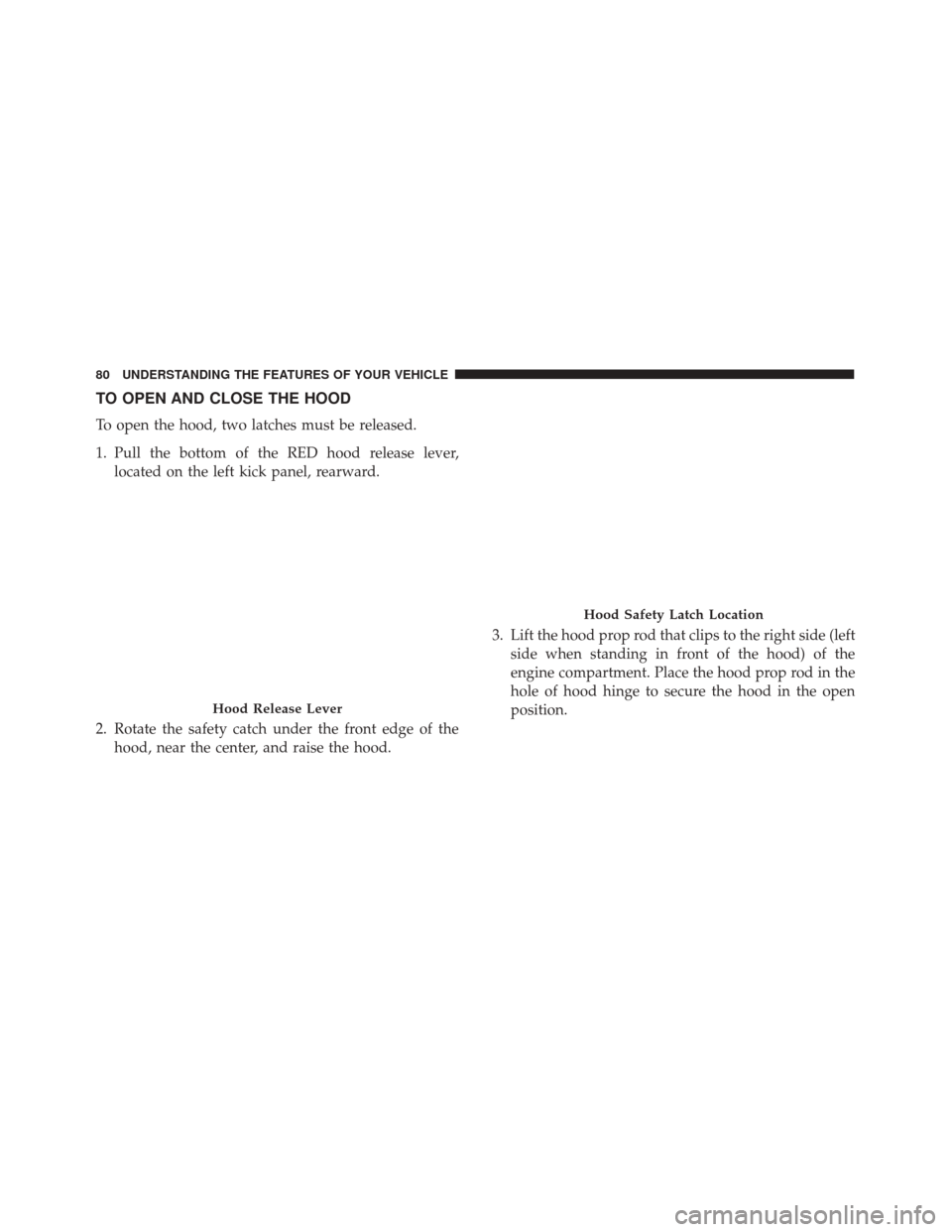
1. Pull the bottom of the RED hood release lever,located on the left kick panel, rearward.
2. Rotate the safety catch under the front edge of the hood, near the center, and raise the hood. 3. Lift the hood prop rod that clips to the right side (left
side when standing in front of the hood) of the
engine compartment. Place the hood prop rod in the
hole of hood hinge to secure the hood in the open
position.
Hood Release Lever
Hood Safety Latch Location
80 UNDERSTANDING THE FEATURES OF YOUR VEHICLE
Page 89 of 338
NOTE:The Intermittent function only has one detent
but wiper delay will vary with changes in vehicle
speed. As vehicle speed increases the delay time will
decrease.
Low Speed
Push the lever downward to the second detent. The
wipers will operate at low speed.
High Speed
Push the lever downward to the third detent. The
wipers will operate at high speed.
Manual High Speed/Mist
Push the lever upward from the off position. The wipers
will operate at high speed to clear off road mist or spray
from a passing vehicle. This operation will continue
until the lever is released. When the lever is released,
the wipers will return to the off position and automati-
cally shut off.
Front Windshield Washer Operation
Pull the windshield wiper/washer lever toward the
steering wheel to activate the washers. The wipers will
activate automatically for three cycles after the lever is
released.
CAUTION!
• Turn the windshield wipers off when driving
through an automatic car wash. Damage to the
windshield wipers may result if the wiper control
is left in any position other than off.
• In cold weather, always turn off the wiper switch
and allow the wipers to return to the “Park”
position before turning off the engine. If the
wiper switch is left on and the wipers freeze to
the windshield, damage to the wiper motor may
occur when the vehicle is restarted.
•
Always remove any buildup of snow that prevents
the windshield wiper blades from returning to the
off position. If the windshield wiper control is
turned off and the blades cannot return to the off
position, damage to the wiper motor may occur.
3
UNDERSTANDING THE FEATURES OF YOUR VEHICLE 87
Page 102 of 338
CAUTION!(Continued)
•Power outlets are designed for accessory plugs
only. Do not insert any other object in the power
outlets as this will damage the outlet and blow
the fuse. Improper use of the power outlet can
cause damage not covered by your New Vehicle
Limited Warranty.
WARNING!
To avoid serious injury or death:
• Only devices designed for use in this type of
outlet should be inserted into any 12 Volt outlet.
• Do not touch with wet hands.
• Close the lid when not in use and while driving
the vehicle.
• If this outlet is mishandled, it may cause an
electric shock and failure.
CAUTION!
• Many accessories that can be plugged in draw
power from the vehicle’s battery, even when not
in use (i.e., cellular phones, etc.). Eventually, if
plugged in long enough, the vehicle’s battery will
discharge sufficiently to degrade battery life
and/or prevent the engine from starting.
• Accessories that draw higher power (i.e., coolers,
vacuum cleaners, lights, etc.) will degrade the
battery even more quickly. Only use these inter-
mittently and with great caution.
(Continued)
Power Outlet Fuse Location – Underhood
F15 Fuse 15 A Blue Cigar Lighter Front Console/Aux Power
Outlet 100 UNDERSTANDING THE FEATURES OF YOUR VEHICLE
Page 105 of 338
REAR WINDOW FEATURES
Rear Window Defroster
The rear window defroster button is located in
the center of the instrument panel, below the
radio. Push this button to turn on the rear window
defroster. An indicator in the Instrument Cluster Dis-
play will illuminate when the rear window defroster is
on. The rear window defroster automatically turns off
after approximately 20 minutes. To manually shut the
defroster off, push the button a second time.
NOTE: To prevent excessive battery drain, use the rear
window defroster only when the engine is operating.
Rear Seat Release Buttons
Folded Rear Seats
3
UNDERSTANDING THE FEATURES OF YOUR VEHICLE 103
Page 110 of 338
TURBO BOOST GAUGE
Your vehicle is equipped with a boost gauge and
integrated shift light indicator located to the left of the
instrument cluster. The boost gauge indicates the intake
manifold pressure relative to barometric pressure. The
engine management system in your vehicle intelligently
regulates intake manifold pressure based on environ-
mental (ambient) and engine operating conditions.
Turbo Boost Gauge
1 — Turbo Boost Gauge
2 — SPORT Indicator
108 UNDERSTANDING YOUR INSTRUMENT PANEL
Page 112 of 338
1.Tachometer
• This gauge measures engine revolutions per min-
ute (RPM x 1000). Before the pointer reaches the red
area, ease up on the accelerator to prevent engine
damage. 2.
Temperature Gauge
• The temperature gauge shows engine coolant tem-
perature. Any reading within the normal range
indicates that the engine cooling system is operat-
ing satisfactorily.
Sport Instrument Cluster Sport Mode
110 UNDERSTANDING YOUR INSTRUMENT PANEL
Page 113 of 338
•The digital gauge will likely indicate a higher
temperature when driving in hot weather, or up
mountain grades. It should not be allowed to
exceed the upper limits of the normal operating
range.
WARNING!
Driving with a hot engine cooling system could
damage your vehicle. If the temperature gauge reads
“H” pull over and stop the vehicle. Idle the vehicle
with the air conditioner turned off until the pointer
drops back into the normal range. If the pointer
remains on the “H,” turn the engine off immediately
and call an authorized dealer for service.
WARNING!
A hot engine cooling system is dangerous. You or
others could be badly burned by steam or boiling
coolant. You may want to call an authorized dealer
for service if your vehicle overheats. If you decide
to look under the hood yourself, see “Maintaining
Your Vehicle.” Follow the warnings under the Cool-
ing System Pressure Cap paragraph.
3. Speedometer
• Indicates vehicle speed.
4. Fuel Gauge
• The digital display shows the amount of fuel in the
tank.
• The switching on of the digital warning light
indicates that 1 – 1.3 gallons of fuel are left in the
tank; in this situation, refuel as soon as possible.
• Do not travel with the fuel tank almost empty; any
gaps in fuel delivery could damage the catalytic
converter.
4
UNDERSTANDING YOUR INSTRUMENT PANEL 111
Page 114 of 338
5.Sport Base and Sport Mode Gauge Displays
Depending on what options and trim level, your vehicle
may be equipped with two gauge displays available
with the push of the Sport Mode button. •“Sport Base” — Instant Consumption Bargraph:
This bargraph shows the instant fuel consumption,
the style changes according to vehicle version while
minimum and maximum values change depending
on selected unit. The possible labels are:
• mpg
• Km/l
• l/100 km
• “Sport Mode” — Gas Pedal Percentage Gauge: This
gauge shows what percent the gas pedal is cur-
rently depressed at.
• “Sport Mode” — The active Instrument Cluster
Display will change to the G-Force screen. NOTE:
Different trips may have different values even if
the same driving style is maintained. Some factors that
may impact the calculated index value are:
•Traffic conditions
• Trip duration
• Temperature (engine and ambient)
6. Instrument Cluster Display
• The Instrument Cluster Display features a driver-
interactive display. Refer to “Instrument Cluster
Display” in “Understanding Your Instrument
Panel” for further information.
112 UNDERSTANDING YOUR INSTRUMENT PANEL
Page 117 of 338
1.Tachometer
•
This gauge measures engine revolutions per minute
(RPM x 1000). Before the pointer reaches the red area,
ease up on the accelerator to prevent engine damage.
2. Temperature Gauge
• The temperature gauge shows engine coolant tem-
perature. Any reading within the normal range
indicates that the engine cooling system is operat-
ing satisfactorily.
•
The digital gauge will likely indicate a higher tem-
perature when driving in hot weather, or up moun-
tain grades. It should not be allowed to exceed the
upper limits of the normal operating range.
WARNING!
Driving with a hot engine cooling system could
damage your vehicle. If the temperature gauge reads
“H” pull over and stop the vehicle. Idle the vehicle
with the air conditioner turned off until the pointer
drops back into the normal range. If the pointer
remains on the “H,” turn the engine off immediately
and call an authorized dealer for service.
WARNING!
A hot engine cooling system is dangerous. You or
others could be badly burned by steam or boiling
coolant. You may want to call an authorized dealer
for service if your vehicle overheats. If you decide
to look under the hood yourself, see “Maintaining
Your Vehicle.” Follow the warnings under the Cool-
ing System Pressure Cap paragraph.
3. Speedometer
• Indicates vehicle speed.
4. Fuel Gauge
• The digital display shows the amount of fuel in the
tank.
• The switching on of the digital warning light
indicates that 1 – 1.3 gallons of fuel are left in the
tank; in this situation, refuel as soon as possible.
• Do not travel with the fuel tank almost empty; any
gaps in fuel delivery could damage the catalytic
converter.
4
UNDERSTANDING YOUR INSTRUMENT PANEL 115