engine FIAT 500 ABARTH CABRIO 2017 2.G Workshop Manual
[x] Cancel search | Manufacturer: FIAT, Model Year: 2017, Model line: 500 ABARTH CABRIO, Model: FIAT 500 ABARTH CABRIO 2017 2.GPages: 338, PDF Size: 2.78 MB
Page 200 of 338
Shallow Standing Water
Although your vehicle is capable of driving through
shallow standing water, consider the following Cau-
tions and Warnings before doing so.
WARNING!
•Driving through standing water limits your vehi-
cle’s traction capabilities. Do not exceed 5 mph
(8 km/h) when driving through standing water.
• Driving through standing water limits your vehi-
cle’s braking capabilities, which increases stop-
ping distances. Therefore, after driving through
standing water, drive slowly and lightly press on
the brake pedal several times to dry the brakes.
•
Failure to follow these warnings may result in inju-
ries that are serious or fatal to you, your passengers,
and others around you.
CAUTION!
• Always check the depth of the standing water
before driving through it. Never drive through
standing water that is deeper than the bottom of
the tire rims mounted on the vehicle.
•
Determine the condition of the road or the path that
is under water and if there are any obstacles in the
way before driving through the standing water.
•Do not exceed 5 mph (8 km/h) when driving through
standing water. This will minimize wave effects.
• Driving through standing water may cause dam-
age to your vehicle’s drivetrain components. Al-
ways inspect your vehicle’s fluids (i.e., engine oil,
transmission, axle, etc.) for signs of contamination
(i.e., fluid that is milky or foamy in appearance)
after driving through standing water. Do not
continue to operate the vehicle if any fluid ap-
pears contaminated, as this may result in further
damage. Such damage is not covered by the New
Vehicle Limited Warranty.
•
Getting water inside your vehicle’s engine can
cause it to lock up and stall out, and cause serious
internal damage to the engine. Such damage is not
covered by the New Vehicle Limited Warranty.
198 STARTING AND OPERATING
Page 203 of 338
WARNING!(Continued)
•Be sure the parking brake is fully disengaged
before driving; failure to do so can lead to brake
failure and a collision.
• Always fully apply the parking brake when leav-
ing your vehicle, or it may roll and cause damage
or injury. Also be certain to leave a manual
transmission in FIRST gear or REVERSE gear.
Failure to do so may allow the vehicle to roll and
cause damage or injury.
CAUTION!
If the Brake Warning Light remains on with the
parking brake released, a brake system malfunction
is indicated. Have the brake system serviced by an
authorized dealer immediately.
SPORT MODE
Manual Transmission — If Equipped
In Sport mode, the engine is more responsive to the
throttle pedal, and provides more maximum torque by
increasing turbo boost pressure. Steering feedback is improved, and steering effort is slightly higher. This
driving mode is useful for spirited driving.
1. To activate the Sport mode, push the SPORT button.
Once activated, a SPORT message will be displayed in
the instrument cluster.
2. Momentarily release the accelerator pedal.
3. Press the accelerator pedal again to activate.
SPORT Button
5
STARTING AND OPERATING 201
Page 204 of 338
Automatic Transmission — If Equipped
The Sport mode increases steering feedback to the driver
with slight increase in effort and changes the transmission
shift schedules for more aggressive shifting. This driving
mode is useful while driving on twisty roads where more
steering precision is desired in spirited cornering.
1. To activate the Sport mode, push the SPORT button.Once activated, a SPORT message will be displayed in
the instrument cluster.
2. Push the SPORT button again to return to the stan-
dard driving mode.
BRAKE SYSTEM
Your vehicle is equipped with dual hydraulic brake
systems. If either of the two hydraulic systems loses
normal capability, the remaining system will still func-
tion. However, there will be some loss of overall brak-
ing effectiveness. You may notice increased pedal travel
during application, greater pedal force required to slow
or stop, and potential activation of the “Brake System
Warning Light”.
In the event power assist is lost for any reason (i.e.,
repeated brake applications with the engine off), the
brakes will still function. However, the effort required
to brake the vehicle will be much greater than that
required with the power system operating.
SPORT Button
202 STARTING AND OPERATING
Page 206 of 338
When you are in a severe braking condition involving
the use of the ABS, you will experience some pedal drop
as the vehicle comes to a stop. This is the result of the
system reverting to the base brake system.
Engagement of the ABS may be accompanied by a
pulsing sensation. You may also hear a clicking noise.
These occurrences are normal and indicate that the
system is functioning properly.
Brake Assist System (BAS)
The BAS is designed to optimize the vehicle’s braking
capability during emergency braking maneuvers. The
system detects an emergency braking situation by sens-
ing the rate and amount of brake application and then
applies optimum pressure to the brakes. This can help
reduce braking distances. The BAS complements the
Anti-Lock Brake System (ABS). Applying the brakes
very quickly results in the best BAS assistance. To
receive the benefit of the system, you must apply
continuousbraking pressure during the stopping se-
quence (do not “pump” the brakes). Do not reduce
brake pedal pressure unless braking is no longer de-
sired. Once the brake pedal is released, the BAS is
deactivated.
WARNING!
• The Brake Assist System (BAS) cannot prevent
the natural laws of physics from acting on the
vehicle, nor can it increase the traction afforded
by prevailing road conditions.
•
The BAS cannot prevent collisions, including those
resulting from excessive speed in turns, driving on
very slippery surfaces, or hydroplaning.
• The capabilities of a BAS-equipped vehicle must
never be exploited in a reckless or dangerous
manner which could jeopardize the user ’s safety
or the safety of others.
Traction Control System (TCS)
The Traction Control System (TCS) monitors the
amount of wheel spin of each of the driven wheels. If
wheel spin is detected, brake pressure is applied to the
slipping wheel(s) and engine power is reduced to
provide enhanced acceleration and stability. A feature of
the TCS system, Brake Limited Differential (BLD), func-
tions similar to a limited slip differential and controls
the wheel spin across a driven axle. If one wheel on a
driven axle is spinning faster than the other, the system
will apply the brake of the spinning wheel. This will
204 STARTING AND OPERATING
Page 207 of 338
allow more engine torque to be applied to the wheel
that is not spinning. This feature remains active even if
TCS and ESC are in the Partial Off mode or Full Off
mode. Refer to “Electronic Stability Control (ESC)” in
this section for further information.
Hill Start Assist (HSA)
The HSA system is designed to assist the driver when
starting a vehicle from a stop on a hill. HSA will
maintain the level of brake pressure the driver applied
for a short period of time after the driver takes his foot
off the brake pedal. If the driver does not apply the
throttle during this short period of time, the system will
release brake pressure and the vehicle will roll down
the hill. The system will release brake pressure in
proportion to the amount of throttle applied as the
vehicle starts to move in the intended direction of
travel.
HSA Activation Criteria
The following criteria must be met in order for HSA to
activate:
•Vehicle must be stopped. •
Vehicle must be on a 2.5% (manual transmission) or
7% grade or greater (automatic transmission) grade
hill.
• Gear selection matches vehicle uphill direction (i.e.,
vehicle in NEUTRAL [manual transmission], vehicle
facing uphill is in forward gear; vehicle backing
uphill is in REVERSE gear).
WARNING!
There may be situations on minor hills with a
loaded vehicle, or while pulling a trailer, when the
system will not activate and slight rolling may
occur. This could cause a collision with another
vehicle or object. Always remember the driver is
responsible for braking the vehicle.
Disabling/Enabling HSA
If you wish to turn the HSA system on or off, it can be
done using the Customer Programmable Features in the
Uconnect Settings. Refer to “Uconnect Settings” in for
further information.
5
STARTING AND OPERATING 205
Page 208 of 338
Electronic Stability Control (ESC)
The Electronic Stability Control (ESC) system enhances
directional control and stability of the vehicle under
various driving conditions. ESC corrects for oversteer-
ing or understeering of the vehicle by applying the
brake of the appropriate wheel to assist in counteracting
the oversteering or understeering condition. Engine
power may also be reduced to help the vehicle maintain
the desired path. ESC uses sensors in the vehicle to
determine the vehicle path intended by the driver and
compares it to the actual path of the vehicle. When the
actual path does not match the intended path, ESC
applies the brake of the appropriate wheel to assist in
counteracting the oversteer or understeer condition.
•Oversteer - when the vehicle is turning more than
appropriate for the steering wheel position.
• Understeer - when the vehicle is turning less than
appropriate for the steering wheel position.
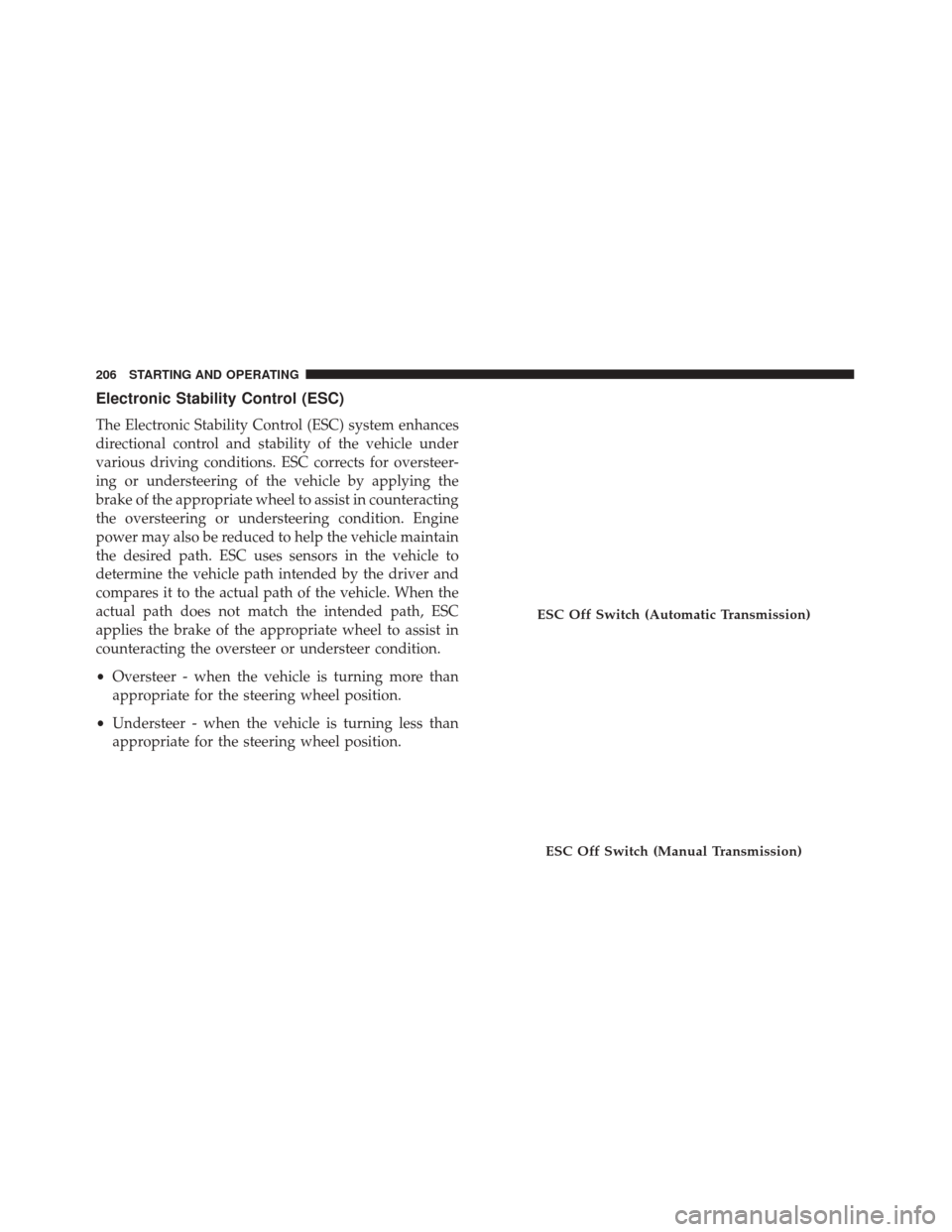
ESC Off Switch (Automatic Transmission)
ESC Off Switch (Manual Transmission)
206 STARTING AND OPERATING
Page 210 of 338
Partial Off
This mode is entered by momentarily pressing the ESC
Off switch. This mode is intended for times when a
more spirited driving experience is desired. It is also
intended for driving in deep snow, sand or gravel
conditions, when more wheel spin than ESC would
normally allow is required to gain traction.
To turn ESC on again, momentarily press the switch
again. This will restore the normal ESC On mode of
operation.
WARNING!
When in “Partial Off” mode, the TCS functionality
of ESC (except for the limited slip feature described
in the TCS section) has been disabled and the “ESC
Off Indicator Light” will be illuminated. When in
“Partial Off” mode, the engine power reduction of
TCS is disabled, and the enhanced vehicle stability
offered by the ESC system is reduced.Full Off
This mode is intended for off-highway or off-road use
only and should not be used on public roadways. In this
mode, all TCS and ESC stability features are turned
OFF, except for the limited slip feature described in the
TCS section. To enter the “Full Off” mode, depress and
hold the ESC OFF switch for five seconds. After five
seconds, the ESC OFF Indicator Light will illuminate,
and the “ESC OFF” message will display in the instru-
ment cluster. To turn ESC ON again, momentarily press
the ESC OFF switch.
WARNING!
In the ESC “Full Off” mode, the engine torque
reduction and stability features are cancelled.
Therefore, the enhanced vehicle stability offered by
ESC is unavailable. The “Full Off” ESC mode is
intended for off-highway or offroad use only.
208 STARTING AND OPERATING
Page 211 of 338
ESC Activation/Malfunction Indicator Light And
ESC OFF Indicator Light
The ESC Activation/Malfunction Indicator
Light in the instrument cluster will come on
when the ignition switch is turned to the
MAR (ACC/ON/RUN) position for four sec-
onds. If the ESC Activation/Malfunction Indicator
Light comes on continuously with the engine running, a
malfunction has been detected in the ESC system. If this
light remains on after several ignition cycles, and the
vehicle has been driven several miles (kilometers) at
speeds greater than 30 mph (48 km/h), see your autho-
rized dealer as soon as possible to have the problem
diagnosed and corrected.
The ESC Activation/Malfunction Indicator Light (lo-
cated in the instrument cluster) starts to flash as soon as
the tires lose traction and the ESC system becomes active. The ESC Activation/Malfunction Indicator Light
also flashes when TCS is active. If the ESC Activation/
Malfunction Indicator Light begins to flash during
acceleration, ease up on the accelerator and apply as
little throttle as possible. Be sure to adapt your speed
and driving to the prevailing road conditions.
NOTE:
•
The ESC Activation/Malfunction Indicator Light and
the ESC OFF Indicator Light come on momentarily
each time the ignition switch is turned ON.
• Each time the ignition is turned ON, the ESC system
will be ON even if it was turned off previously.
The ESC OFF Indicator Light indicates the
Electronic Stability Control (ESC) is partially
off or full off.
5
STARTING AND OPERATING 209
Page 241 of 338
FUEL REQUIREMENTS
This engine is designed to meet all
emission regulations and provide sat-
isfactory fuel economy and perfor-
mance when using high-quality un-
leaded “regular” gasoline with a
minimum octane rating of 87. For op-
timum performance and fuel economy
the use of 91 octane or higher is recommended.
Light spark knock at low engine speeds is not harmful
to your engine. However, continued heavy spark knock
at high speeds can cause damage and immediate ser-
vice is required.
Poor quality gasoline can cause problems such as hard
starting, stalling and hesitations. If you experience these
symptoms, try another brand of gasoline (with the
appropriate octane rating for your engine) before con-
sidering service for the vehicle.
Reformulated Gasoline
Many areas of the country require the use of cleaner
burning gasoline referred to as “Reformulated Gaso-
line”. Reformulated gasoline contains oxygenates and
are specifically blended to reduce vehicle emissions and
improve air quality.
The use of reformulated gasoline is recommended.
Properly blended reformulated gasoline will provide
improved performance and durability of engine and
fuel system components.
Gasoline/Oxygenate Blends
Some fuel suppliers blend unleaded gasoline with
oxygenates such as ethanol.
CAUTION!
DO NOT use gasoline containing methanol or gaso-
line containing more than 15% ethanol (E-15). Use
of these blends may result in starting and drivabil-
ity problems, damage critical fuel system compo-
nents, cause emissions to exceed the applicable
standard, and/or cause the “Malfunction Indicator
(Continued)
5
STARTING AND OPERATING 239
Page 242 of 338
CAUTION!(Continued)
Light” to illuminate. Please observe pump labels as
they should clearly communicate if a fuel contains
greater than 15% ethanol (E-15).
Problems that result from using gasoline containing
more than 15% ethanol (E-15) or gasoline containing
methanol are not the responsibility of the manufacturer
and may void or not be covered under New Vehicle
Limited Warranty.
E-85 Usage In Non-Flex Fuel Vehicles
Non-Flex Fuel Vehicles (FFV) are compatible with gaso-
line containing up to 15% ethanol (E-15). Gasoline with
higher ethanol content may void the New Vehicle
Limited Warranty.
If a Non-FFV vehicle is inadvertently fueled with E-85
fuel, the engine will have some or all of these symp-
toms:
• Operate in a lean mode.
• OBD II “Malfunction Indicator Light” on.
• Poor engine performance. •
Poor cold start and cold drivability.
• Increased risk for fuel system component corrosion.
CNG And LP Fuel System Modifications
Modifications that allow the engine to run on com-
pressed natural gas (CNG) or liquid propane (LP) may
result in damage to the engine, emissions, and fuel
system components. Problems that result from running
CNG or LP are not the responsibility of the manufac-
turer and may void or not be covered under the New
Vehicle Limited Warranty.
MMT In Gasoline
Methylcyclopentadienyl Manganese Tricarbonyl (MMT)
is a manganese-containing metallic additive that is
blended into some gasoline to increase octane. Gasoline
blended with MMT provides no performance advantage
beyond gasoline of the same octane number without
MMT. Gasoline blended with MMT reduces spark plug
life and reduces emissions system performance in some
vehicles. The manufacturer recommends that gasoline
without MMT be used in your vehicle. The MMT content
of gasoline may not be indicated on the gasoline pump,
therefore, you should ask your gasoline retailer whether
the gasoline contains MMT. MMT is prohibited in Federal
240 STARTING AND OPERATING