battery FIAT 500E 2015 2.G Owner's Manual
[x] Cancel search | Manufacturer: FIAT, Model Year: 2015, Model line: 500E, Model: FIAT 500E 2015 2.GPages: 367, PDF Size: 9.42 MB
Page 128 of 367
CAUTION!
Before getting out of the vehicle be sure that the
switch is in the center position or that the lights are
off to avoid draining the battery.
Interior Light Timing (Center Position)
There are four different modes of operation that can be
activated in this position:
•When one door is opened a three minute timer is
activated.
•When the key is removed from the ignition (within
two minutes of the ignition being turned off), a
10 second timer is activated.
•When the doors are unlocked with the Key Fob a
10 second timer is activated.
•When the doors are locked with the Key Fob the lights
will turn off.
Interior Light Timing (On/Right Position)
•When all doors are closed a 15 minute timer is
activated.
NOTE:The timer is deactivated when the key is moved
into the ON/RUN position.
126 UNDERSTANDING THE FEATURES OF YOUR VEHICLE
Page 149 of 367
CAUTION!
•Many accessories that can be plugged in draw
power from the vehicle’s battery, even when not in
use (i.e., cellular phones, etc.). Eventually, if
plugged in long enough, the vehicle’s battery will
discharge sufficiently to degrade battery life and/or
prevent the engine from starting.
•Accessories that draw higher power (i.e., coolers,
vacuum cleaners, lights, etc.) will degrade the bat-
tery even more quickly. Only use these intermit-
tently and with great caution.
•After the use of high power draw accessories, or
long periods of the vehicle not being started (with
accessories still plugged in), the vehicle must be
driven a sufficient length of time to allow the
generator to recharge the vehicle’s battery.
CIGAR LIGHTER — IF EQUIPPED
This is located on the center console, in front of the cup
holders. To activate the cigar lighter, push and release the
knob. After a few seconds the knob automatically returns
to its initial position, and the cigar lighter is ready for use.
WARNING!
When the cigar lighter is in use it becomes very hot.
To avoid serious injury, handle the cigar lighter with
care. Always check that the cigar lighter has turned
off.
3
UNDERSTANDING THE FEATURES OF YOUR VEHICLE 147
Page 171 of 367
Electronic Vehicle Information Center (EVIC)
Setup Menu
The menu comprises a series of functions arranged in a
cycle. Push and release the + and – buttons to access the
different options and settings (setup).
The setup menu can be activated by pushing the MENU
ESC button. Single pushes on the + or – buttons will
scroll through the setup menu options. The menu in-
cludes the following functions:
•Charging Schedule
•Set Date
•Set Time
•Units
•Language
•Battery % Display
•Auto Door Locks
•Remote Unlock
•Daytime Running Lights
•Button Volume
•Hill Start Assist
•Stored Warnings
•Tutorial
•Connectivity ID
•Restore Factory Settings
•Exit Menu
4
UNDERSTANDING YOUR INSTRUMENT PANEL 169
Page 174 of 367
Trip Functions
Both trip functions are resettable (reset — start of new
trip).
“Trip A” can be used to display the figures relating to:
•distance
•avg. energy
•avg. speed
•elapsed time (driving time)
“Trip B” can be used to display the figures relating to:
•distance
•avg. energy
•avg. speed
•elapsed time (driving time)
Values Displayed
Range
This indicates the distance which may be travelled with
the remaining battery charge, assuming that driving
conditions will not change. The message “----” will
appear when the system is initializing.
NOTE:The range depends on several factors: driving
style, type of route (freeway, residential, mountain roads,
etc.), conditions of use of the car (load, tire pressure, etc.).
Trip planning must take into account the above notes.
Distance Traveled
This value shows the distance covered since the last reset.
Average Speed
This value shows the vehicle’s average speed as a func-
tion of the overall time elapsed since the last reset.
172 UNDERSTANDING YOUR INSTRUMENT PANEL
Page 189 of 367
On Volume Limit
This function makes it possible to activate/deactivate the
maximum volume limit when turning the radio on.
The display shows the function status:
•“On volume limit: on” – when the radio is turned on
the volume level will be:
– If the volume level is equal to or higher than the
maximum value, the radio will come on at the
maximum volume.
– If the volume level is between the minimum and
maximum values, the radio will come on at the
same volume as before it was switched off.
– If the volume level is equal to or lower than the
minimum value, the radio will come on at the
minimum volume.
•“On volume limit: off” – The radio will come on at the
same volume as before it was switched off. The
volume level can be between 0 and 40.
Use the buttonsorto change the setting.
NOTE:
•Using the Menu it is only possible to adjust the
activation/deactivation of the function and not the
minimum or maximum volume value.
•If the battery charge is too low, the volume cannot be
adjusted between the minimum and the maximum
level.
Radio Off Function
This function makes it possible to set the radio switching
off mode by choosing between two methods.
4
UNDERSTANDING YOUR INSTRUMENT PANEL 187
Page 236 of 367
The ESC Activation/Malfunction Indicator Light also
flashes when TCS is active. If the ESC Activation/
Malfunction Indicator Light begins to flash during accel-
eration, ease up on the accelerator and apply as little
throttle as possible. Be sure to adapt your speed and
driving to the prevailing road conditions.
NOTE:
•The ESC Activation/Malfunction Indicator Light and
the ESC OFF Indicator Light come on momentarily
each time the ignition switch is turned ON.
•Each time the ignition is turned ON, the ESC system
will be ON even if it was turned off previously.
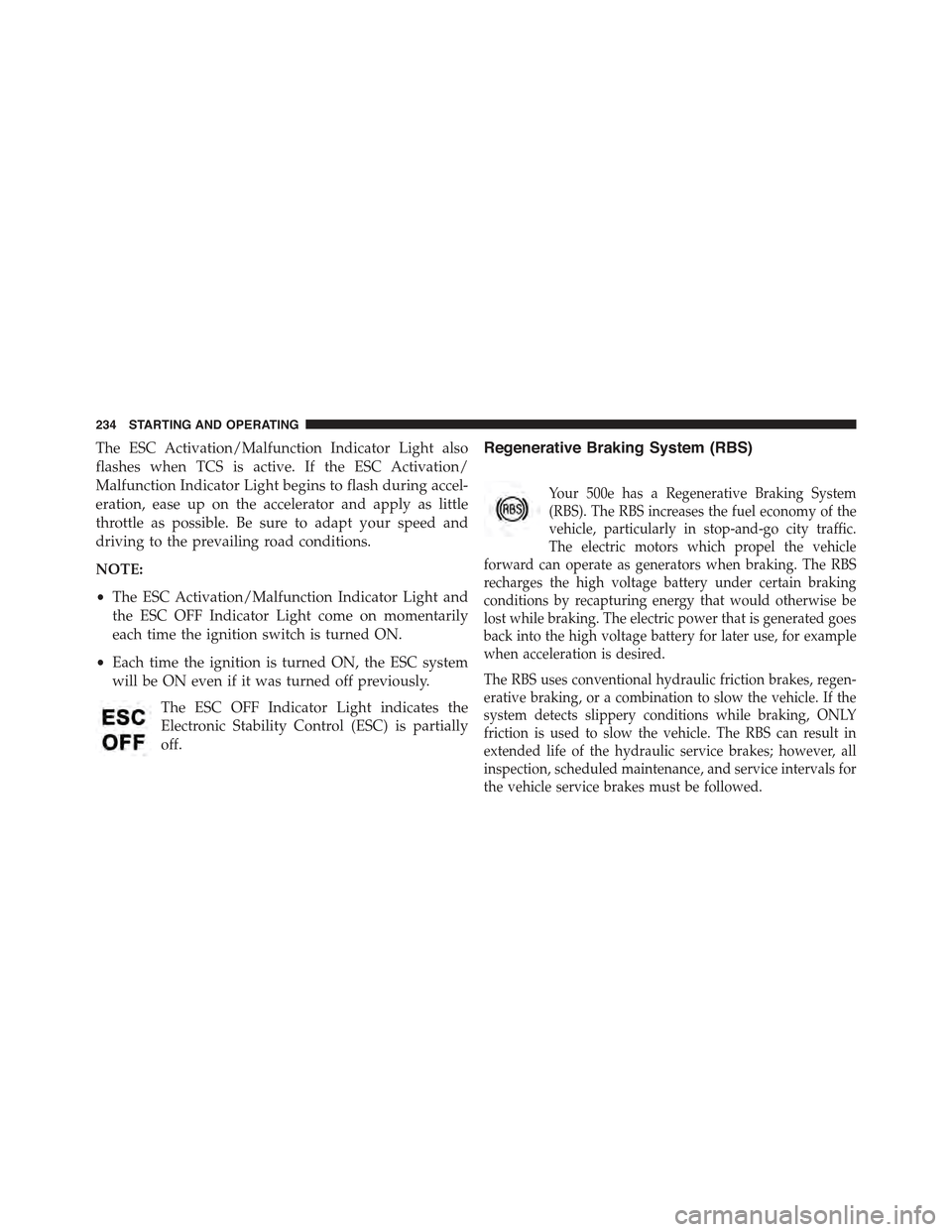
The ESC OFF Indicator Light indicates the
Electronic Stability Control (ESC) is partially
off.
Regenerative Braking System (RBS)
Your 500e has a Regenerative Braking System
(RBS). The RBS increases the fuel economy of the
vehicle, particularly in stop-and-go city traffic.
The electric motors which propel the vehicle
forward can operate as generators when braking. The RBS
recharges the high voltage battery under certain braking
conditions by recapturing energy that would otherwise be
lost while braking. The electric power that is generated goes
back into the high voltage battery for later use, for example
when acceleration is desired.
The RBS uses conventional hydraulic friction brakes, regen-
erative braking, or a combination to slow the vehicle. If the
system detects slippery conditions while braking, ONLY
friction is used to slow the vehicle. The RBS can result in
extended life of the hydraulic service brakes; however, all
inspection, scheduled maintenance, and service intervals for
the vehicle service brakes must be followed.
234 STARTING AND OPERATING
Page 272 of 367
RECREATIONAL TOWING (BEHIND MOTORHOME, ETC.)
Towing This Vehicle Behind Another Vehicle
Towing ConditionWheels OFF the GroundSingle-Speed Transmission
Flat TowNONENOT ALLOWED
Dolly TowFrontOK
RearNOT ALLOWED
On TrailerALLOK
NOTE:This vehicle must be towed on a dolly or vehicle
trailer with the front wheelsOFFthe ground.
CAUTION!
Towing this vehicle in violation of the above require-
ments can cause severe transmission damage. Dam-
age from improper towing is not covered under the
New Vehicle Limited Warranty.
EXTENDING YOUR DRIVING RANGE PER
CHARGE
The drive system and cabin temperature management
features use the most energy from the high voltage
battery. Reducing energy draw from these features are
the easiest and most effective way to extend driving
range.
270 STARTING AND OPERATING
Page 273 of 367
The 500e uses high voltage components to heat and cool
the cabin, so when using automatic climate control,
consider setting temperatures a few degrees higher or
lower during hot and cold days. If your 500e has been
soaking in hot or cold temperatures for an extended
period, it is recommended that the car be preconditioned
using the FIAT Access smartphone app while still
plugged into a charging source. This will allow 500e to
use external power to establish a comfortable cabin
temperature before the drive and allow the battery to
maintain the temperature at significantly lower energy
levels.
Additional tips:
•Keep tires properly inflated
•When practical, choose surface streets over the high-
way, and work to maintain a steady speed
•Avoid carrying nonessential cargo
•Be mindful of adding external accessories that may
increase aerodynamic drag
•Perform all scheduled maintenance at recommended
intervals
Driver Behavior Gauge
To help the driver extend the driving range of the high
voltage battery your vehicle is equipped with a Driver
Behavior Gauge. The Driver Behavior Gauge is located
on the right side of the instrument cluster and contains
three driving ranges:
•Power
The needle will move into the Power range when under
acceleration.
•ECO
The needle will move into the ECO range when you are
maximizing the driving range of the high voltage battery.
5
STARTING AND OPERATING 271
Page 274 of 367
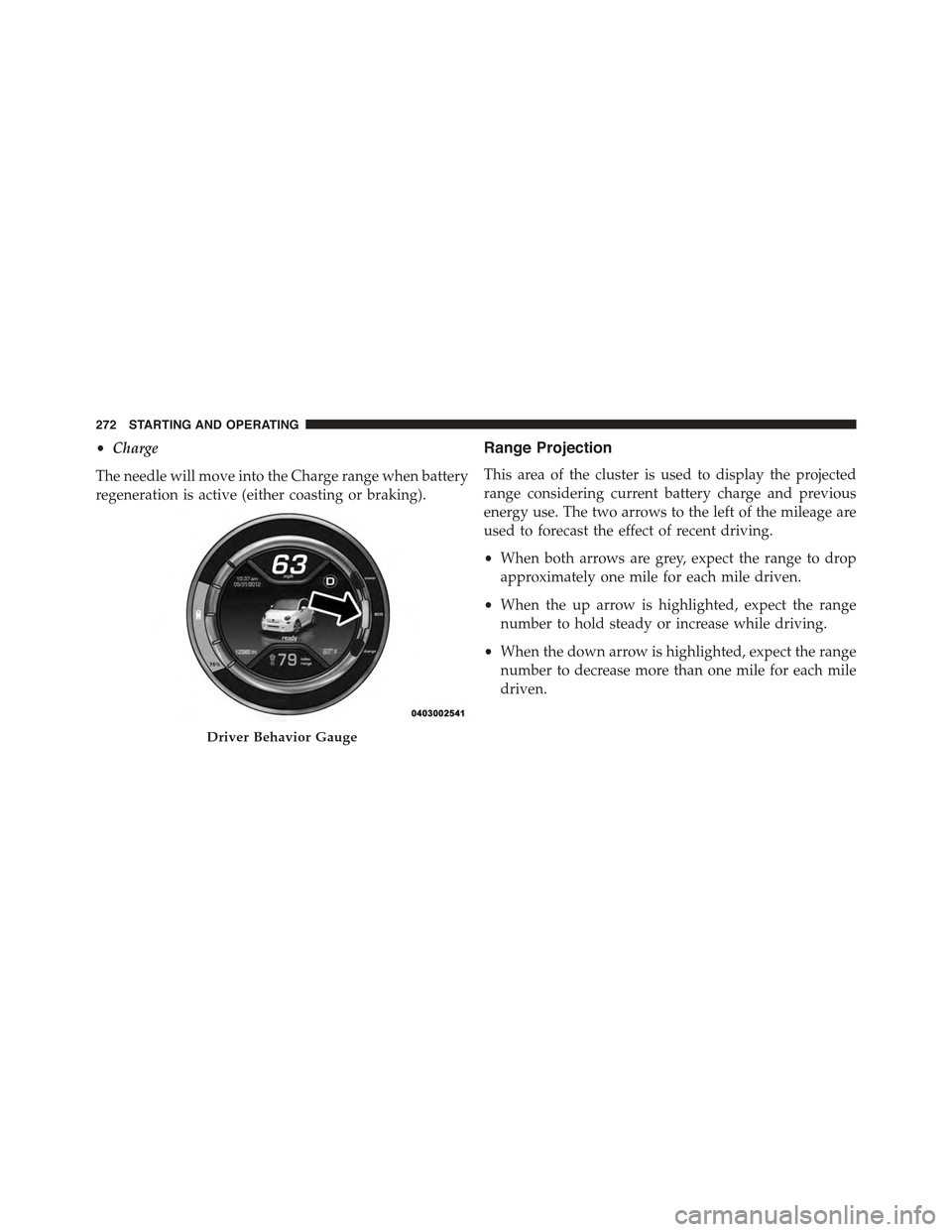
•Charge
The needle will move into the Charge range when battery
regeneration is active (either coasting or braking).
Range Projection
This area of the cluster is used to display the projected
range considering current battery charge and previous
energy use. The two arrows to the left of the mileage are
used to forecast the effect of recent driving.
•When both arrows are grey, expect the range to drop
approximately one mile for each mile driven.
•When the up arrow is highlighted, expect the range
number to hold steady or increase while driving.
•When the down arrow is highlighted, expect the range
number to decrease more than one mile for each mile
driven.
Driver Behavior Gauge
272 STARTING AND OPERATING
Page 275 of 367
WHAT TO DO IN EMERGENCIES
CONTENTS
!HAZARD WARNING FLASHERS...........274
!WHEEL AND TIRE TORQUE
SPECIFICATIONS......................275
▫Torque Specifications...................275
!TIRE SERVICE KIT — IF EQUIPPED.........276
▫Tire Service Kit Storage.................277
▫Tire Service Kit Components And Operation . .277
▫Tire Service Kit Usage Precautions..........278
▫Sealing A Tire With Tire Service Kit.........281
!JUMP-STARTING PROCEDURE (12 VOLT
BATTERY ONLY).......................287
▫Preparations For Jump-Start..............287
▫Jump-Starting Procedure................289
!FREEING A STUCK VEHICLE.............291
!MANUAL PARK RELEASE................292
!TOWING A DISABLED VEHICLE...........293
6